You've built a channel around a topic you understand, uploaded consistently, and watched the subscriber counter stall just below the threshold. At the same time, one Short may be attracting attention while your longer videos accumulate watch time. The question, “How do I become a YouTube partner?”, now has a more complicated answer than a single subscriber target.
YouTube's Partner Program is tiered, the qualification windows differ by format, and approval depends on more than reaching a number. A channel can qualify for earlier access to fan-funding and Shopping features while still being below the requirements for broader ad and Premium revenue sharing. Originality also matters more than many beginner guides explain, especially for channels built around compilations, templates, or AI-assisted production.
Understanding the YouTube Partner Program Tiers
A creator sitting at 480 subscribers often assumes there's only one finish line ahead: reach 1,000 subscribers, then turn on ads. That approach can waste months if the channel has a highly engaged niche audience that would support memberships, live-stream payments, or direct viewer appreciation before it reaches the full advertising tier.
As of 2026, YouTube offers an earlier YPP entry path. The early-access tier requires 500 subscribers, 3 public uploads in the last 90 days, and either 3,000 public watch hours in the past 365 days or 3 million public Shorts views in the past 90 days, subject to YouTube's eligibility and policy requirements (YouTube Partner Program requirements).
What the early-access tier unlocks
This tier can provide access to fan-funding and Shopping features, depending on the feature's availability in your country or region. In practical terms, that can include tools such as channel memberships, Super Chat, Super Stickers, and Super Thanks. These tools work particularly well when viewers feel connected to the creator and have a clear reason to participate.
A gaming streamer with a smaller but committed audience may earn more from live viewer support than from low-volume advertising. A tutorial creator might use memberships for bonus lessons, downloadable resources, or private community access. The exact income depends on audience behavior, pricing, eligibility, and feature availability, so the lower tier shouldn't be treated as an automatic monthly payment.
The key strategic point is that early access isn't merely a waiting room. It can become a legitimate business model for a specialist channel whose viewers are engaged enough to pay directly, even before the channel reaches full ad-revenue eligibility.
What full monetization adds
The broader tier requires 1,000 subscribers and either 4,000 valid public watch hours in the past 12 months or 10 million valid public Shorts views in the past 90 days. YouTube's help materials identify this higher level as the route to features such as watch-page ads, Shorts Feed ads, and YouTube Premium revenue (YouTube monetization options).
That distinction changes how you should plan. Long-form channels generally build toward public watch hours, while Shorts-first channels may pursue the Shorts-view route. You don't need to force every format onto the same channel strategy. A channel can use Shorts for discovery while using longer videos to develop watch time, trust, and opportunities outside advertising.
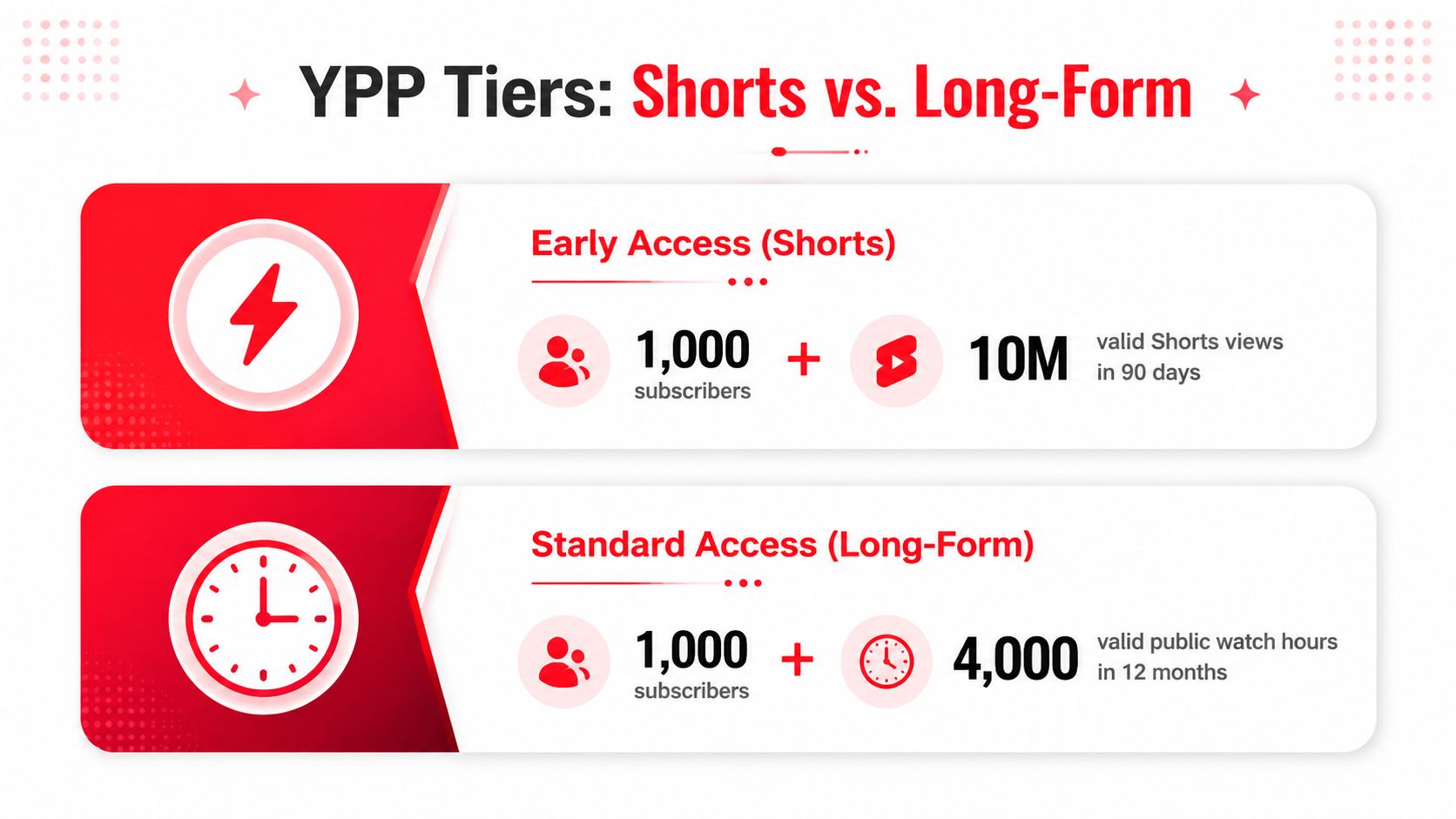
Both tiers still require baseline compliance. You must be in an eligible country or region, follow monetization policies, avoid active Community Guidelines strikes, enable 2-step verification, have access to advanced features, and connect an AdSense for YouTube account. Reaching the numeric threshold doesn't guarantee acceptance.
Practical rule: Choose the first tier that matches how your audience already behaves, then build toward full monetization without compromising originality to chase a shortcut.
YPP Eligibility Requirements and the 2027 Changes
The eligibility calculation is easier to understand when you separate subscribers, public watch hours, and Shorts views. YouTube doesn't let one metric substitute for another. You reach the relevant tier by satisfying the subscriber requirement and one of the available performance paths.
| Requirement | Early-Access Tier | Full Monetization Tier | Notes |
|---|---|---|---|
| Subscribers | 500 | 1,000 | Both tiers also require policy compliance and other account conditions |
| Public uploads | 3 in the last 90 days | Not listed as a separate full-tier requirement | The early-access route includes this activity condition |
| Public watch hours | 3,000 in the past 365 days | 4,000 in the past 12 months | The hours must be valid public watch hours |
| Public Shorts views | 3 million in the past 90 days | 10 million in the past 90 days | Shorts and long-form use separate qualification paths |
| Main access | Fan funding and Shopping features | Watch-page ads, Shorts Feed ads, and YouTube Premium revenue | Feature availability can depend on region and policy status |
For a more detailed explanation of what counts toward public watch hours, review this guide to public watch hours on YouTube. The practical lesson is simple: don't assume every minute visible in Analytics contributes to the eligibility counter. Public status, format, and YouTube's validity rules matter.
Comparing the two routes
A long-form vlog channel with an average viewing session of eight minutes may have a realistic path through public watch hours if its videos hold attention consistently. The creator should inspect audience retention, identify where viewers leave, and improve the opening, pacing, and subject selection rather than publishing longer videos purely to inflate duration.
A Shorts-first comedy channel that attracts 50,000 views per clip still needs sustained performance across the rolling qualification window. A few successful clips may create momentum, but the relevant question is whether the channel can repeatedly produce eligible public Shorts views while retaining subscribers and building a recognizable format.
If your long-form videos average under three minutes of watch time per view, the Shorts route may be faster in some cases, but that isn't a universal rule. Compare your recent performance against the actual threshold, the time window, and your production capacity. A Short that reaches many viewers but produces little subscriber intent may be less useful than a focused long-form video that attracts fewer people but keeps them watching and returning.
What changes in 2027
YouTube has announced that, beginning February 1, 2027, new applicants seeking ads and Premium revenue sharing will face a higher threshold of 8,000 qualified watch hours in the last 365 days or 20 million qualified Shorts views in the last 90 days. The announced update keeps the entry requirements for Fan Funding and Shopping unchanged, so the two-tier structure becomes even more important for creators planning ahead (YouTube's 2027 YPP update).
Treat this as a planning constraint, not a reason to panic. If you're close to the current full tier, prioritize sustainable publishing and policy readiness. If you're starting later, build a channel that can qualify for early fan-funding access while developing the audience loyalty and original library needed for the higher ads threshold.
Shorts views are measured inside a rolling 90-day window, not as a permanent cumulative total. Private, deleted, or otherwise ineligible videos can stop contributing to the relevant public totals, so don't remove successful public content casually while you're relying on it for qualification. Before making a major library change, check the Earn tab and understand which videos support your current progress.
Preparing Your Channel for Monetization Approval
Approval preparation should begin before the application button appears. YouTube reviews the channel as a body of work, so a strong recent upload won't necessarily compensate for a library filled with copied clips, unclear ownership, or policy problems.
Audit compliance before you apply
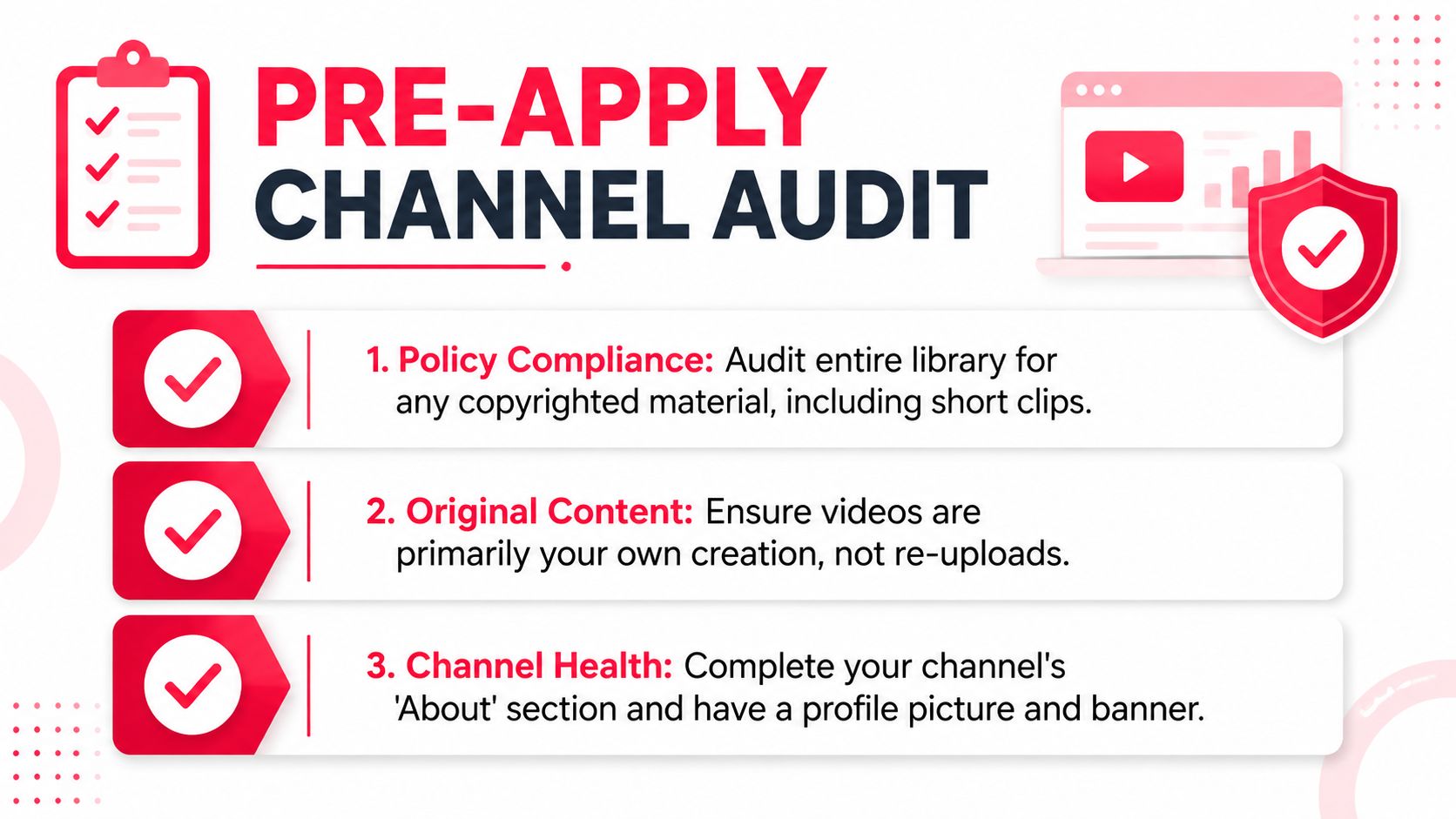
Start with the channel's oldest and most-viewed videos. Look for copyrighted music, television or film clips, sports footage, reposted social videos, misleading titles, and material that adds little original explanation. A Content ID claim isn't identical to a Community Guidelines strike, but both can affect your ability to earn from specific videos or signal that your production process needs attention.
Use YouTube Studio to review video restrictions and the Earn tab. Confirm that your channel has no active Community Guidelines strikes, and make a record of videos with copyright concerns. If a video depends on material you don't have the right to use, replacing the audio or removing the video may be safer than hoping it escapes review.
A monetization application is a library audit, not a popularity contest.
Misleading metadata creates a separate risk. Titles and descriptions should accurately represent what the viewer receives. Don't use a famous person's name, a trending event, or a dramatic promise merely to attract clicks if the video doesn't deliver on it.
Make originality visible
Originality isn't limited to appearing on camera. A faceless channel can still offer genuine editorial value through original research, narration, screen demonstrations, analysis, visual design, and a clear point of view. The reviewer should be able to understand what you created and why your version adds value.
Voice production deserves attention here. If your channel uses narration, compare the practical differences between human voiceover and synthetic narration with these YouTube voiceover vs TTS tips. The goal isn't to avoid every production aid. It's to ensure that the final video feels authored rather than assembled from interchangeable parts.
A repeatable format is useful, but a repeatable template becomes dangerous when every video uses the same script structure, visuals, pacing, and conclusion with only the subject changed. Keep a consistent promise to viewers while varying the substance, examples, commentary, and presentation.
Improve retention without padding
Watch time grows when viewers choose to continue, not when creators stretch a short idea into a long video. Open with the specific problem or outcome promised by the title, remove greetings that delay the subject, and use visual or structural changes when the explanation starts to flatten.
Useful techniques include:
- Front-load the payoff: Show the result, question, or mistake the video will resolve before moving into background information.
- Use purposeful pattern changes: Change the visual, example, camera angle, or on-screen element when the viewer needs renewed context, rather than inserting random effects.
- Build connected viewing: Use end screens and playlists to direct viewers to a relevant next video, not an unrelated upload.
- Review retention manually: Find repeated drop-off points and revise that section in future scripts.
End screens work best when the recommendation follows the viewer's current intent. A camera review should point to a related comparison or setup guide. A cooking video should lead to another recipe using a similar technique. Playlist architecture can also help viewers move through a coherent subject sequence, provided each video earns its place.
For channel settings, branding, and the operational steps required before enabling monetization, use this guide on how to enable YouTube monetization. It should support your final checklist, not replace a policy review.
Submitting Your YPP Application and Navigating Review
Once the Earn tab shows that your channel is eligible, open YouTube Studio and follow the YPP application flow. You'll typically review the program terms, connect or create an AdSense for YouTube account, and submit the channel for review.
Use accurate legal, tax, and payment details in AdSense. A mismatch between account information and payment records can create administrative delays after approval, even if YouTube accepts the channel itself. Don't create duplicate AdSense accounts to solve a setup problem. Resolve the account issue through the available Google support process.
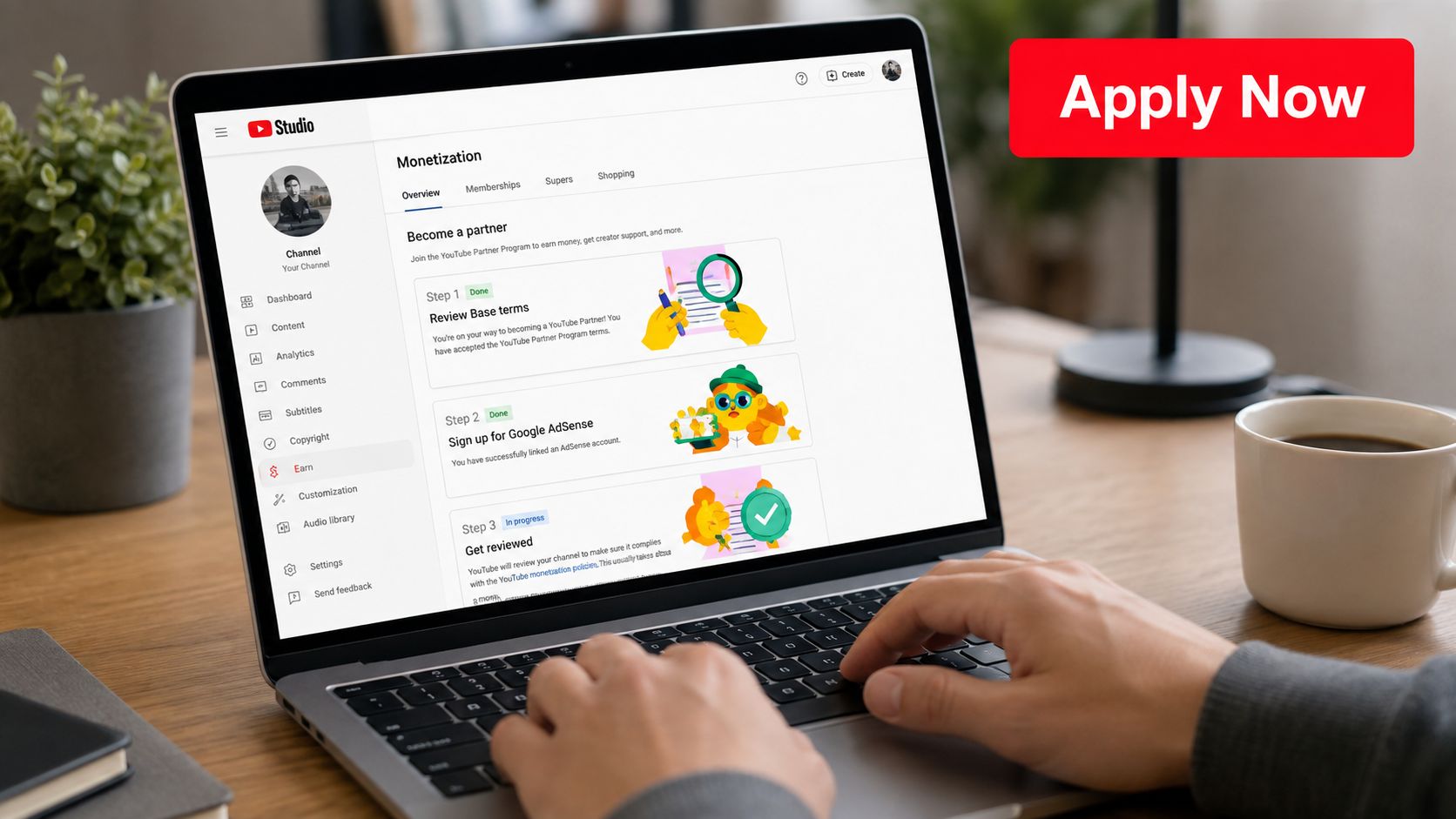
YouTube's review focuses on whether the channel follows monetization and Community Guidelines policies, whether the content is original and authentic, and whether the overall library is suitable for the relevant features. Reviewers can assess the channel's main theme, most-viewed videos, newest uploads, metadata, and other parts of the public library.
Keep publishing while the application is pending, but don't make sudden changes just to create the appearance of a different channel. Continue the same original production process, monitor new uploads for claims or restrictions, and avoid behavior that could result in a strike.
Check progress and respond calmly
The Earn tab is the place to monitor application status and available monetization steps. An approval notification means the channel has been accepted for the relevant YPP features, but you may still need to enable individual modules or monetization settings before eligible videos can earn.
Because YPP is tiered, a channel may gain access to fan-funding or Shopping features without yet qualifying for the broader ads and Premium tier. That isn't an error or a failed application. It reflects the separate requirements explained earlier.
If YouTube rejects the application, read the stated reason before changing anything. The correct response depends on whether the problem involves reused content, insufficient originality, policy compliance, or another channel-level issue. Applying again with the same library and the same production method usually leaves the underlying problem untouched.
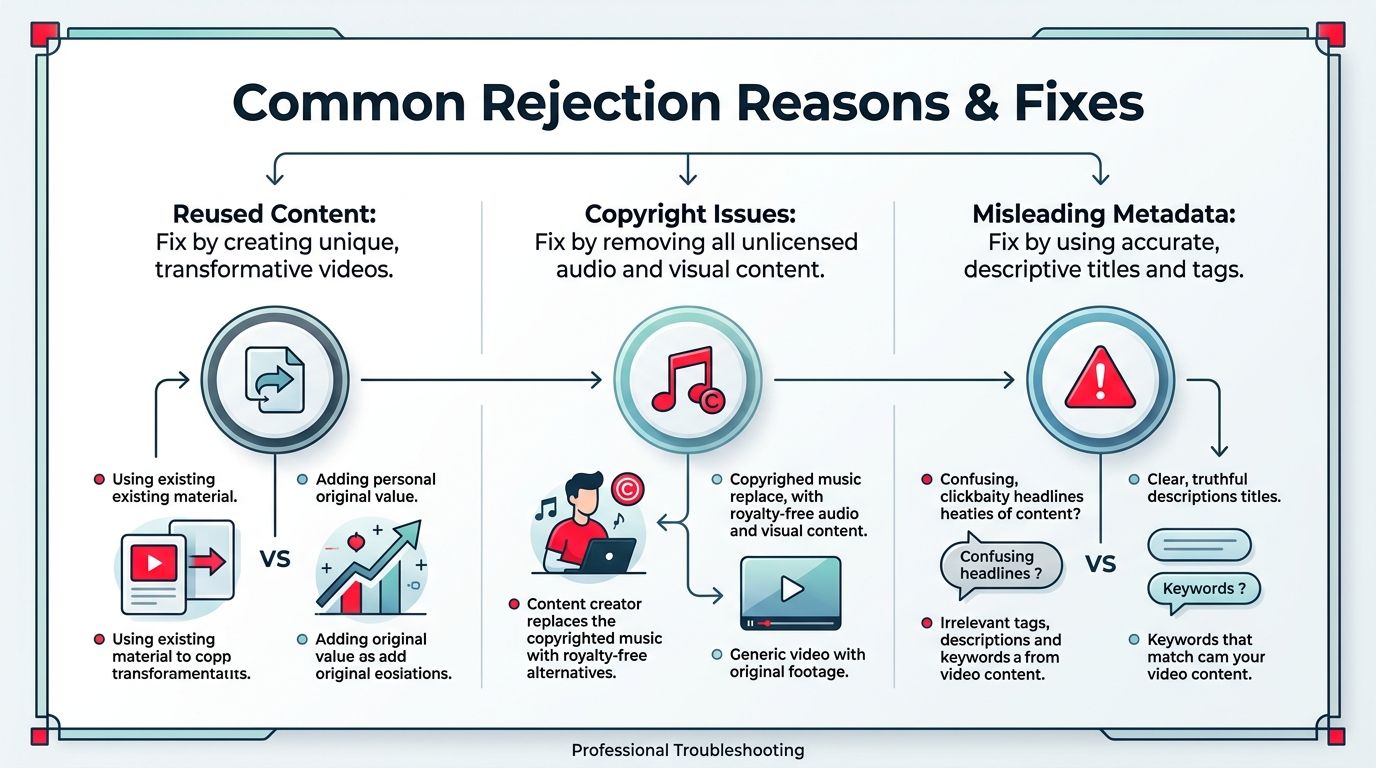
Common Rejection Reasons and How to Fix Them
Many creators treat subscriber and watch-hour thresholds as the whole application. That assumption fails because the numbers only establish eligibility to apply. YouTube can still reject a channel whose content appears repetitive, reused, misleading, or insufficiently original.
Reused content needs real transformation
Reused content can include compilations, reposted clips, reaction videos with minimal commentary, AI-generated slideshows, and videos that add little beyond material gathered from elsewhere. YouTube's monetization guidance emphasizes original and authentic content, and its review process looks for meaningful creative contribution (YouTube's monetization policy guidance).
Independent commentary has estimated reused content at 60% to 70% of rejections, but that estimate isn't an official YouTube statistic and shouldn't be treated as a confirmed platform-wide figure. The actionable conclusion is still clear: reaching the threshold won't protect a channel whose videos rely on other people's footage without substantial narration, analysis, editing, or editorial purpose (commentary on common YPP rejection reasons).
A transformation checklist is more useful than a vague promise to “add value”:
- Rewrite the format: Replace clip sequences with a clear argument, explanation, critique, or lesson.
- Add authorship: Use original narration, demonstrations, interviews, screen recordings, or on-camera context.
- Change the viewer's purpose: Make the video teach, compare, investigate, or interpret rather than just display borrowed footage.
- Review the whole library: One highly viewed reused video can draw attention to a broader pattern.
Reaction content can qualify when the commentary is central and continuous. A silent face-cam beside a compilation usually doesn't establish enough original contribution.
Repetitive production creates a second problem
A channel can record every video itself and still look mass-produced if the episodes contain nearly identical scripts, stock visuals, pacing, and conclusions. AI tools can speed up research or editing, but they don't replace the need for distinct insight and human editorial decisions.
Misleading metadata also deserves a direct audit. Remove titles that promise content the video doesn't contain, rewrite descriptions that imply unsupported results, and make thumbnails match the actual subject. Copyright issues and Community Guidelines violations require more than changing a title. Remove or replace unlicensed material, address strikes through the proper process, and stop publishing the workflow that caused the problem.
Reapply only after meaningful change
YouTube gives rejected creators a reapplication process and a waiting period. Use that period to identify the videos that create the greatest policy risk, document what changed, and publish several clearly original examples that demonstrate the new standard.
Don't rely on a single unconnected “safe” upload. A reviewer needs to see a consistent channel direction. If the rejection cited reused content, deleting one video while leaving a library of near-identical reposts won't solve it. If the issue was repetitive content, changing only the thumbnail won't demonstrate a new production method.
There isn't a verified case study in the available data that supports claiming a specific creator was rejected and later approved after an overhaul. The safer practitioner advice is to treat approval as the result of visible, channel-wide remediation, not a lucky second submission.
Maximizing Revenue After Approval and Beyond YPP
Approval gives you access to tools. It doesn't automatically create a sustainable business. The right revenue mix depends on how your viewers behave, what your niche supports, and whether your content can move people toward a useful next action.
At the earlier tier, fan-funding features can include Super Chat, Super Stickers, Super Thanks, and memberships, subject to availability and eligibility. Make those tools easy to understand. Explain what membership includes, acknowledge live contributions without turning every stream into a sales pitch, and use Super Thanks as an optional way for viewers to support a particularly useful video.
At the broader tier, ads and Premium revenue become available through the applicable YouTube modules. Choose ad placements with the viewer's experience in mind. A forced interruption at the point where a tutorial reveals its answer may reduce satisfaction, while a natural transition can make the same placement less disruptive. YouTube's available ad settings and eligibility rules should guide the final configuration.
Build income around the audience, not the dashboard
Ad revenue is only one part of a creator business. Sponsorships, affiliate offers, merchandise, services, courses, and owned products can give a channel more ways to convert attention into revenue. A channel that teaches software, for example, might earn from an affiliate recommendation or consulting offer even when a particular video produces modest advertising income.
For creators developing promotional content with AI assistance, a practical guide to how to make an AI advertorial can help with the production process. Keep the result honest, disclose commercial relationships where required, and preserve the same originality standards that apply to ordinary uploads.
Don't build a financial plan around subscriber count alone. Two channels with the same subscriber total can have very different results because one has stronger viewer intent, better conversion paths, or a more valuable offer.
| Revenue Stream | AdSense-Only ($) | Diversified Strategy ($) |
|---|---|---|
| Watch-page and Shorts advertising | Variable | Variable |
| Fan funding and memberships | Not included | Variable |
| Sponsorships and affiliates | Not included | Variable |
| Products, services, or courses | Not included | Variable |
| Total | Depends primarily on eligible views and ad demand | Depends on several audience and sales factors |
The table intentionally avoids invented earnings for a 50K-subscriber channel. YouTube revenue varies by niche, geography, format, viewer behavior, advertiser demand, and the offer behind the channel. Use analytics to identify which videos attract qualified viewers and which ones lead to clicks, enquiries, or purchases. The YouTube video monetization guide can help organize that broader planning process.
ViewsMax can support this type of attribution by creating trackable links and connecting clicks, leads, and sales to the content that generated them. That changes the question from “Which video got the most views?” to “Which video created the most valuable action?”
The mindset shift matters. YPP approval is a milestone, but a durable channel is built by combining original programming, audience trust, sensible monetization, and a clear path from viewing to value.
ViewsMax helps creators plan content, publish across channels, and trace clicks, leads, and sales back to specific videos or posts. Visit ViewsMax to see which content is driving revenue, then use those insights to build a more focused YouTube monetization strategy.