Most advice on how to earn money from a YouTube channel starts and ends with AdSense. That's a weak business plan. Platform advertising can provide a useful base, but a durable channel turns attention into several measurable outcomes, including sponsorship revenue, affiliate commissions, product sales, memberships, and qualified leads. The central question isn't “How many views did this video get?” It's “What did those views produce?”
A profitable channel therefore needs two systems working together. You need YouTube's native monetization features, and you need an attribution process that connects specific videos to clicks, customers, and revenue. Views create opportunity, but tracking tells you where the opportunity exists.
The First Gate: Qualifying for YouTube's Native Monetization
YouTube Partner Program approval is a distribution advantage, not a business result. Before your channel can use YouTube's advertising and fan-funding features, it must qualify for the YouTube Partner Program, commonly called YPP. The standard route to direct ad and YouTube Premium revenue sharing requires 1,000 subscribers plus either 4,000 qualified public watch hours during the last 12 months or 10 million qualified Shorts views during the last 90 days, according to YouTube's current monetization guidance and the reported 2026 threshold update. Shorts views do not count toward the 4,000-hour long-form requirement. They are separate qualification paths.
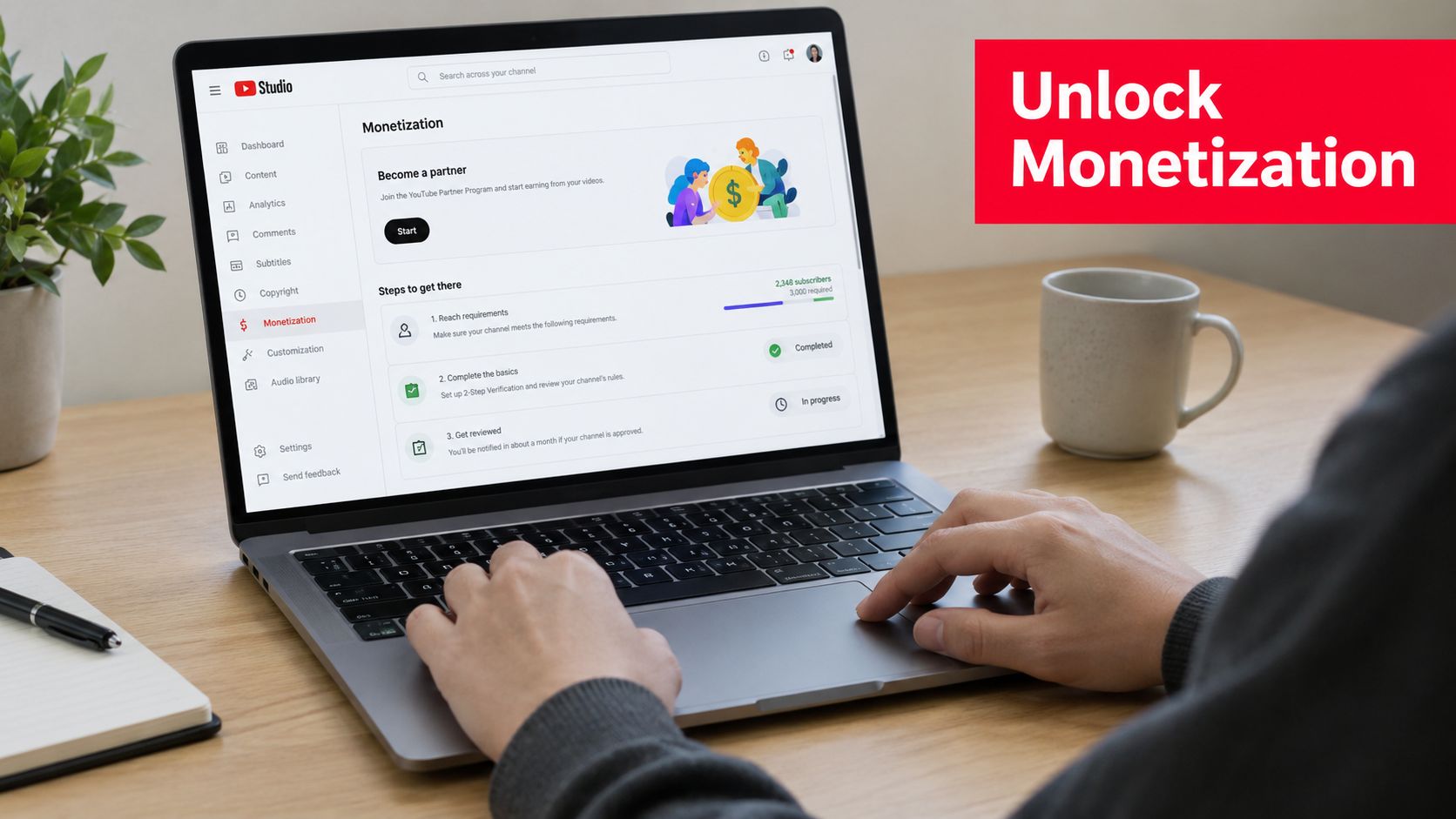
YouTube also announced an updated path for new applicants in August 2026, requiring 1,000 subscribers plus 8,000 public watch hours or 20 million Shorts views for the latest partner-program expansion. Requirements can change, so check the Earn tab in YouTube Studio before using a specific threshold in your forecast. Treat the displayed eligibility criteria as the current operating requirement.
Prepare the account before applying
Eligibility is an operating checklist, not the point where revenue begins. Review the channel for reused material, copyright problems, misleading metadata, and content that may fail YouTube's monetization policies. A channel can reach the required audience milestones and still encounter review problems if its library lacks original, advertiser-suitable content.
Set up an approved Google AdSense account when YouTube Studio requests it. Use accurate payment and tax information, then complete every verification step. Account delays can prevent a technically eligible channel from receiving payouts, so handle this work before meaningful revenue accumulates.
For a practical setup walkthrough, follow this guide on how to enable YouTube monetization. Use it alongside the instructions shown in your own YouTube Studio account, since the platform's eligibility and setup screens determine what applies to your channel.
Activate the features that fit your format
After approval, open the monetization settings and review each feature separately.
- Watch-page ads: Enable advertising on eligible long-form videos, then assess individual videos instead of applying every placement without considering viewer experience.
- Shorts revenue sharing: Treat Shorts as a separate revenue model. Its pooled advertising system operates differently from watch-page advertising.
- Channel Memberships: Offer recurring benefits that are simple to deliver, such as member-only posts, private discussions, or early access.
- Super Chat and Super Stickers: Use these during live streams, where viewers can pay for participation, recognition, or direct attention.
- Super Thanks: Give viewers a direct way to support published videos without waiting for a live broadcast.
Standard long-form ad revenue is generally split 55% to the creator and 45% to YouTube, while Shorts creators receive 45% of the allocated advertising portion under the pooled Shorts model, as explained in YouTube's official revenue-sharing documentation. That difference should shape your publishing plan. Long-form videos can combine watch-page revenue with deeper audience trust, while Shorts can introduce new viewers who later convert through other offers.
Practical rule: Apply for native monetization, then measure the revenue it produces. YPP gives you access to tools. Your broader business model determines their value.
Building Your Income Portfolio Beyond AdSense
AdSense is useful, but it shouldn't carry the entire business. A channel becomes more resilient when every major content theme has a logical next step, such as a relevant product recommendation, a sponsor integration, a paid resource, or a membership benefit.
The right portfolio depends on your audience's intent. A product-review channel can often begin with affiliate links. A consultant or educator may earn more from a workshop, course, or service. A broad entertainment channel may have stronger options in sponsorships, memberships, merchandise, and live participation.
| Revenue Stream | Typical Audience Size | Income Potential | Setup Effort |
|---|---|---|---|
| Brand sponsorships | An engaged niche audience | High, especially through recurring partnerships | Medium |
| Affiliate marketing | Viewers with purchase intent | Performance-based and scalable | Low to medium |
| Merchandise | A loyal community | Moderate to high, depending on demand and margins | Medium to high |
| Digital products | Viewers seeking a defined result | High margin and closely tied to expertise | High |
| Memberships and live support | A committed returning audience | Recurring and community-driven | Medium |
Sponsorships create larger individual transactions
A one-off integration pays for a deliverable. A long-term partnership can give the brand a dependable place in your content calendar and give you more predictable income. Start by identifying companies that already serve the problem your audience is trying to solve. Relevance matters more than prestige because a mismatched sponsor can reduce trust and weaken future conversions.
Your proposal should describe the audience, the content environment, the deliverable, the distribution plan, and the reporting you'll provide. Don't sell raw exposure alone. Sell a credible path to awareness, consideration, trial, or purchase.
Affiliates turn recommendations into performance revenue
Affiliate marketing works when the product fits the video so naturally that the recommendation improves the viewer's next step. Demonstrate the product, explain who should use it, disclose the relationship clearly, and send viewers to a trackable destination.
Independent benchmarks suggest description-link click-through rates of about 0.5% to 3% of video views, while affiliate revenue can represent 10% to 30% of total brand-deal income for established mid-tier creators, according to benchmarks for YouTube influencer and affiliate activity. These figures are benchmarks, not guarantees. Your topic, audience intent, offer, placement, and landing page determine the result.
Shorts can support this system by introducing a product or problem, but the conversion path must remain clear. For format-specific ideas, review how to make money on YouTube Shorts. If your channel has a strong recurring format, you can also repurpose episodes into audio. This guide to turning a YouTube channel into a podcast offers useful context for extending your content into another distribution channel.
Products and merchandise deepen ownership
Merchandise works best when it expresses an inside reference, identity, or practical need that already exists in the community. Don't begin with a warehouse of inventory. Test demand with a small, focused range, and calculate production, fulfillment, refunds, platform fees, and customer support before setting a price.
Digital products offer a different trade-off. A course, template, ebook, or paid workshop can convert expertise into an owned asset, but it requires a clear promise and customer support. Build it from repeated questions in comments, livestreams, and emails. A product that solves one specific problem usually sells more clearly than a broad library of information.
The Art of the Pitch Securing High-Value Brand Deals
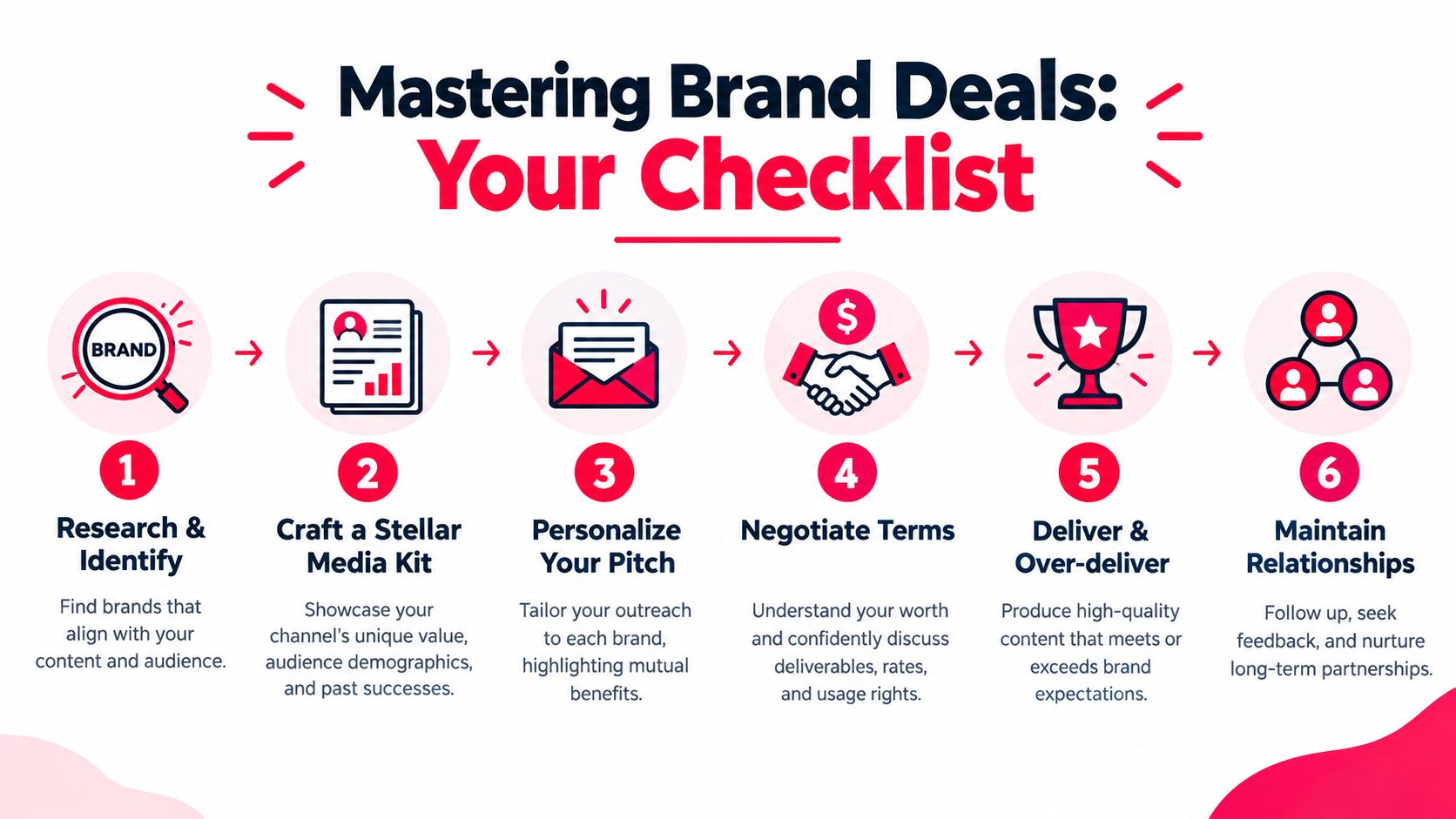
Brands rarely choose a creator because of subscriber count alone. They want a credible audience, a safe content environment, a clear audience fit, and evidence that the creator can deliver professionally. Your job is to make those factors easy to evaluate.
Choose partners before writing the email
Create a prospect list from products you already use, companies your viewers mention, and businesses serving the same problem as your channel. Study the brand's existing creator campaigns, landing pages, customer language, and content restrictions. Then identify the person responsible for influencer partnerships, content marketing, or creator relations instead of sending an unpersonalized message to a general inbox.
Your media kit should answer practical questions quickly:
- Audience profile: Explain who watches, what they care about, and what buying context surrounds your videos.
- Content examples: Link to relevant videos that demonstrate your presentation style and audience response.
- Available deliverables: List integrations, dedicated videos, live mentions, community posts, or cross-platform packages.
- Measurement plan: Describe how you'll report publication, clicks, engagement, or other agreed outcomes.
- Commercial terms: State that usage rights, exclusivity, revisions, and payment terms require separate agreement.
A 2025 creator-economy report found that 62% of creators said they earned more from brand partnerships than from ad revenue, compared with 41% in 2023, as reported by InfluenceFlow's creator monetization analysis. That shift makes proactive outreach worthwhile, particularly for channels with a well-defined niche and a professional sales process.
Use a pitch that makes the next step easy
Your email should be brief, specific, and built around mutual fit. Adapt this template rather than copying it without research:
Subject: Partnership idea for [Brand] and [Channel]
Hi [Name],
I run [Channel], where I help [specific audience] with [specific topic or outcome]. I'm reaching out because [Brand] fits the way my viewers already think about [relevant problem or use case].
A recent video about [topic] shows how I explain this subject and how viewers respond to practical recommendations. I'd like to propose [specific deliverable], with [brief description of integration and viewer benefit]. I can also provide [trackable link, campaign recap, or additional placement] so we can evaluate the response.
Would you be open to a short conversation about the campaign objective, deliverables, timing, and usage terms? I've attached my media kit with audience information and relevant examples.
Best,
[Name]
[Channel]
[Contact details]
Don't promise sales you can't control. Promise a well-matched audience, strong execution, transparent reporting, and a clear process. After the campaign, send the agreed report promptly, ask for feedback, and record what the brand valued. That record becomes evidence for the next pitch and a foundation for a renewal.
Optimizing Your Channel for Maximum Revenue
Revenue optimization starts with audience value, not video length by itself. CPM describes advertiser cost around ad impressions, while RPM is closer to what the creator earns per 1,000 views after the relevant revenue factors. Both vary with niche, geography, format, audience behavior, and the commercial intent surrounding the content.
Industry benchmarks place long-form creator RPM at roughly $1.65 to $25 per 1,000 views, while Shorts are estimated at about $0.02 to $0.12 RPM, according to creator-economy RPM benchmarks. On that benchmark range, one million long-form views could generate $1,650 to $24,750, while one million Shorts views could generate $20 to $120. These aren't promises. They illustrate why a view count without format and revenue context can mislead you.
Improve the economics of long-form content
Choose topics where viewers have a meaningful reason to act. A tutorial for a professional tool, a detailed comparison, or a solution-led review can support advertising, affiliates, sponsorships, and products at the same time. The topic should serve the viewer first, but its commercial context should be clear before you spend time producing it.
Watch time matters because a viewer who stays longer has more opportunity to understand the idea, trust the presenter, and encounter an appropriate monetization point. Build the video around a clear promise, show progress early, remove repeated explanations, and place the most useful proof before the conclusion. Longer videos only help when the additional minutes earn attention.
Use YouTube Analytics to compare audience retention, returning viewers, traffic sources, RPM, clicks, and downstream actions. Publishing at a time your audience is available can help the initial distribution, and this guide to maximizing YouTube views for creators provides planning context. Timing won't rescue an unclear title or weak opening, so treat it as a supporting variable.
Give Shorts a defined job
Shorts can be valuable even when their direct payout is modest. Use them to test hooks, introduce a recurring problem, answer one narrow question, and point interested viewers toward a related long-form video or offer. The handoff must be explicit. A viewer who watches a Short should know what to do next.
A useful content chain might begin with a Short showing a common mistake, continue with a long-form tutorial explaining the fix, and finish with a trackable resource or product recommendation. This approach treats Shorts as discovery and long-form as deeper engagement and revenue capture.
For broader search and packaging improvements, use these YouTube SEO optimization tips. Focus on the promise in the title and thumbnail, the answer delivered in the video, and the next action connected to the viewer's intent. Don't optimize keywords in isolation from the buying or learning journey.
Audience-depth test: If a video attracts attention but gives viewers no relevant next step, it may be growing the channel without building the business.
From Views to Sales: Measuring What Works
Views measure exposure. Sales measure business results. The gap between them is an observable sequence: a viewer notices a recommendation, clicks a link, reaches the offer, and completes an action. Tracking that sequence shows whether a video merits another production cycle or delivered reach without commercial value.
Give each important content asset its own trackable destination. Use separate links for a tutorial, review, livestream, and Short, even when they promote the same offer. Record the video title, publication date, topic, placement, offer, clicks, leads, sales, commissions, refunds, and net revenue. This record lets you compare content by attributable return rather than audience size alone.
Description-link performance varies by channel, so treat any outside benchmark as a diagnostic prompt rather than a target. Your own conversion data matters more. Separate formats in revenue analysis because long-form watch-page advertising and Shorts revenue use different sharing structures, as noted earlier.
Build a repeatable attribution workflow
Put the call to action where viewers have enough context to care. An offer at the end may suit a warm audience, while a tutorial may perform better when its relevant resource appears immediately after the problem is demonstrated. Keep one primary action per video where possible, and state exactly what the viewer receives after clicking.
ViewsMax can create trackable links, connect clicks, leads, and sales to the content that generated them, and organize publishing and performance data in one dashboard. Use it with your affiliate platform, store, course checkout, or customer relationship system. It should support those systems, not replace their transaction records.
The video below offers another practical way to connect published content with measurable performance.
Review revenue per video, revenue per click, lead quality, conversion rate, and production effort. A video with fewer views may deserve more investment if it generates qualified customers. A viral upload may need a clearer path to the offer before it produces meaningful revenue.
Attribution also improves editorial decisions. Compare related videos by the action they generate, then preserve the topics, formats, and offers that produce profitable customers. If clicks are strong but sales are weak, inspect the landing page or offer. If views are high but clicks are scarce, revise the placement, promise, or call to action. Each result points to a different fix.
Common Monetization Pitfalls and How to Avoid Them
A creator can publish consistently, reach the YPP threshold, and still build a fragile business. The problems usually appear in the gap between audience growth and commercial design.
Depending on one platform payout
A channel owner watches monthly ad revenue fluctuate and responds by publishing more of the same content. That may increase workload without improving business stability. Advertising remains one income stream, but sponsorships, affiliates, products, memberships, and services can give the audience more ways to support the channel.
Build the second stream before the first one becomes essential. Choose the option that matches existing viewer intent, then use relevant videos to test it. A finance educator might begin with a paid template, while a gear reviewer might begin with carefully selected affiliate recommendations.
Mentioning an offer without giving viewers a reason to click
“Check the link below” is not a persuasive call to action. It doesn't tell viewers what they'll receive, who it's for, or why they should act now.
Replace it with a concrete instruction: explain the resource, connect it to the problem in the video, and make the destination easy to identify. Keep the link near the top of the description when it's the primary next step, and use a distinct tracking link so you can evaluate the result.
Chasing unrelated viral topics
A creator sees a trend outside the channel's subject, publishes a rushed response, and attracts viewers who never return for the core content. The view count looks positive, but the audience fit weakens and the commercial path becomes harder to define.
Use trends only when they reveal something useful to your existing audience. Adapt the topic to your established promise, or treat it as an experiment with a clear success criterion beyond reach.
Underpricing sponsorships
A creator accepts the first offer without discussing usage rights, exclusivity, revisions, placement, or reporting. The sponsor gains broader access than expected, while the creator absorbs extra work without matching compensation.
Separate the creative deliverable from the rights attached to it. Ask what the brand can reuse, where it can run the content, how long the agreement lasts, and whether competitors are restricted. Put every agreed term in writing before production begins.
Commercial discipline: Never evaluate a sponsorship only by the fee. Evaluate the work required, the rights granted, the audience fit, and the opportunity cost of occupying that publishing slot.
Publishing without learning from the result
Some creators review views and likes, then immediately plan the next upload. That routine misses the information that makes growth more efficient. Compare the topic, format, audience retention, calls to action, clicks, leads, sales, and net revenue across videos.
The goal isn't to turn every upload into a sales pitch. It's to understand which videos attract the right viewers, which ones build trust, and which ones produce measurable business outcomes. Once you know that pattern, you can create more deliberately and stop rewarding empty reach.
ViewsMax helps creators plan content, publish across channels, and track clicks, leads, and sales back to the specific content that generated them. Visit ViewsMax to connect your YouTube publishing decisions with attributable revenue and identify which videos are selling.