The median YouTube channel with 1 to 99 subscribers grows by only about 0.5 subscriber per month, according to vidIQ's analysis of more than 61 million channels (vidIQ subscriber growth benchmarks). That changes the question. “How to get subscribers on YouTube fast” isn't mainly about uploading more often. It's about converting the right viewers efficiently, then identifying exactly which videos and surfaces caused those subscriptions.
YouTube gives creators an enormous discovery environment, but reach alone doesn't create a durable audience. A Short can attract attention, a long-form video can build trust, and a playlist can turn one viewing session into a repeat habit. The channel grows when those pieces work as a connected system.
Why Fast Subscriber Growth Is Hard and Where Opportunity Lives
YouTube reached about 2.72 billion monthly logged-in users and 1.06 billion daily active users by 2026, while India alone was reported at 518 million users in April 2026 (YouTube audience statistics). Its largest global age group is 25 to 34-year-olds at 21.3%, followed by 35 to 44-year-olds at 18.7%. That combination of scale and concentrated adult attention creates real opportunity for tutorials, entertainment, niche commentary, product education, and practical how-to content.
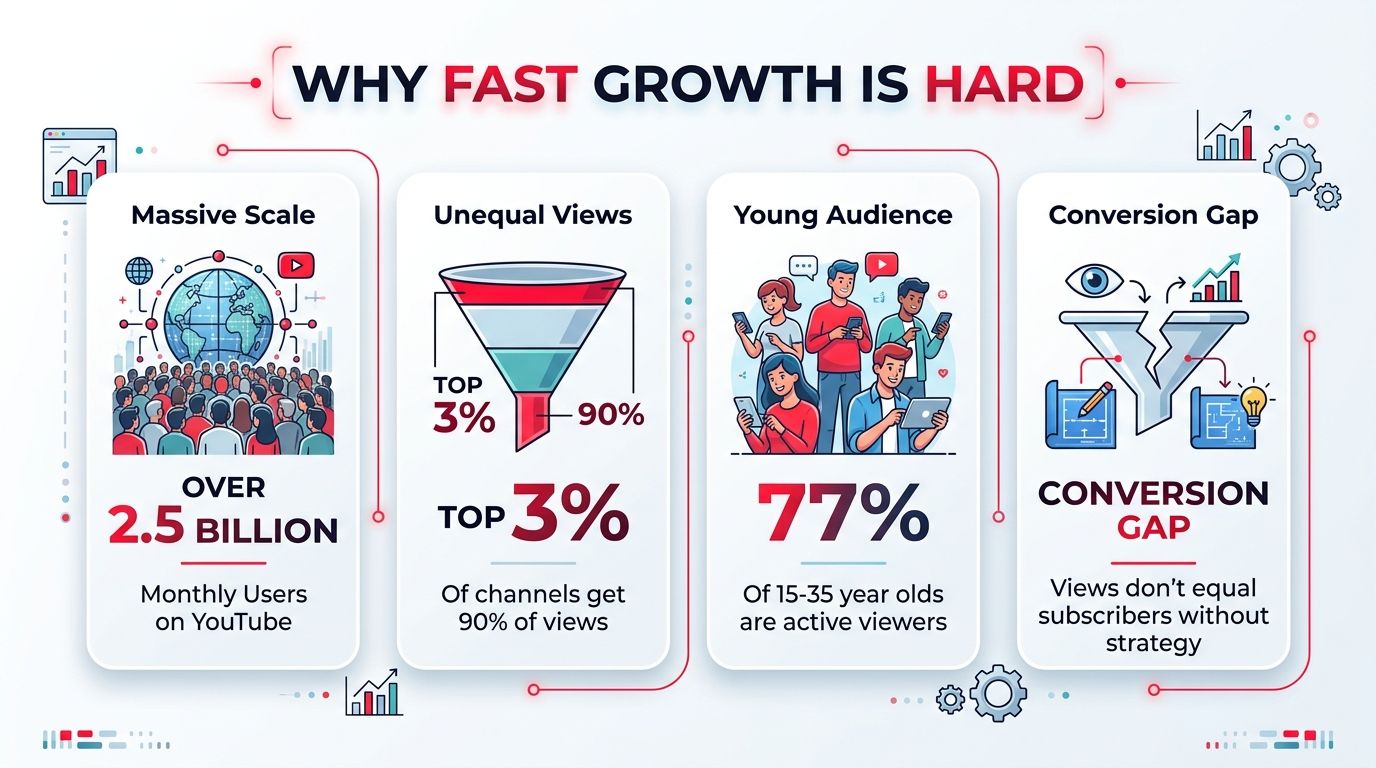
But a large audience doesn't make growth evenly available. vidIQ's dataset shows that 40.6% of channels reached 1,000 subscribers, 7.9% reached 10,000, 1.3% reached 100,000, and only 0.13% reached 1 million (the full channel-scale analysis). Each milestone becomes substantially harder because a channel must earn attention against creators with clearer positioning, stronger libraries, and more established viewer habits.
Why small channels stall
Very small channels usually don't have a distribution problem alone. They have a conversion problem hidden inside a distribution problem. A viewer may click because a topic looks useful, watch part of the video, and leave without understanding what the channel consistently offers. Another viewer may enjoy a Short but have no reason to expect the next upload will be relevant.
That's why upload frequency by itself rarely fixes a stalled channel. Consistency gives YouTube and viewers more opportunities to evaluate your content, but niche clarity, packaging, and retention determine whether those opportunities become repeat viewing and subscriptions.
A practical audit should ask:
- Who is this for? Can a new viewer identify the audience without studying the channel page?
- What promise repeats? Do the videos solve a recognizable class of problems or deliver a consistent type of entertainment?
- What happens next? Does each video lead to a related video, a playlist, or a clear reason to subscribe?
- Which content converts? Are you measuring subscribers gained by individual video, rather than judging success by views alone?
Creators who want to understand the wider operating environment can also explore about the growth platform for additional context on audience and channel growth workflows. For platform changes that may affect discovery and channel behavior, keep a reference such as this guide to changes in YouTube close to your planning process.
The opportunity is conversion efficiency
The baseline for tiny channels is sobering. Channels with 1 to 99 subscribers had a median monthly growth rate of 1.26%, or about 0.5 subscriber per month, in the same vidIQ analysis (channel growth distribution). You don't beat that baseline by treating every view as equally valuable. You beat it by finding topics and formats that attract viewers with a strong reason to return.
Think of every upload as a funnel:
- Discovery: A title, thumbnail, search result, recommendation, or Short earns attention.
- Trust: The opening confirms the promise and the video delivers useful or entertaining value.
- Continuation: The viewer has an obvious next video or series to watch.
- Subscription: The channel promise makes following feel worthwhile.
- Attribution: You record which video, playlist, or link contributed to the result.
That final step prevents vanity metrics from controlling your strategy. A video with broad reach but weak subscriber intent may be less useful than a smaller video that attracts viewers who watch again, click an offer, or join the channel. Fast growth comes from increasing the number of qualified viewers who move through the entire path.
Packaging That Converts Viewers Into Subscribers in Seconds
A viewer decides whether to continue before your best insight appears. The title, thumbnail, and opening must communicate one clear promise, then prove quickly that the video deserves attention.
Build one promise across title and thumbnail
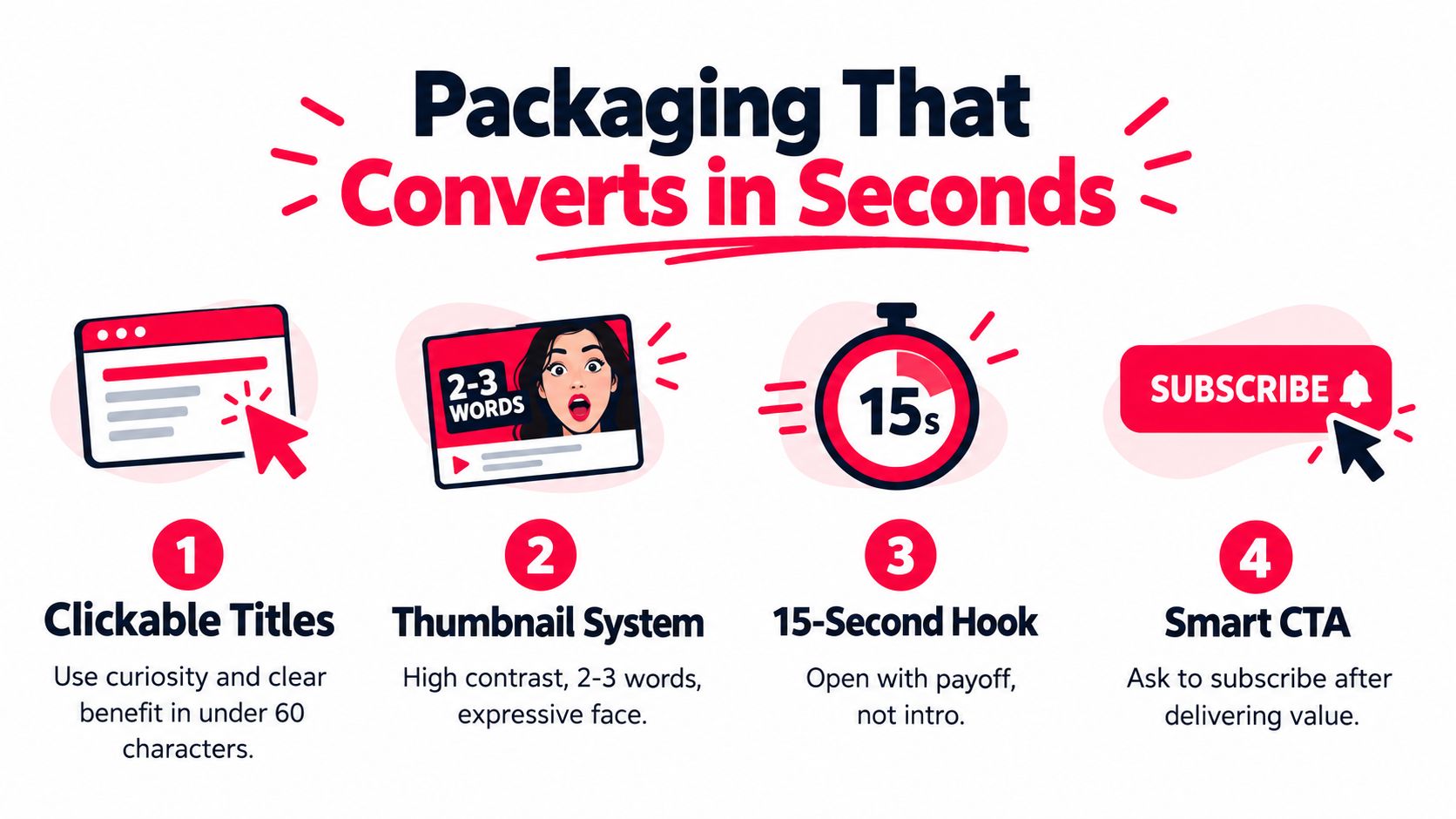
Start with the viewer's desired outcome, not your production process. “My Weekly YouTube Workflow” describes your activity. “Turn One Video Into a Week of Content” describes a benefit.
Weak packaging often contains several ideas at once:
- Weak title: “YouTube Tips for Beginners”
- Weak thumbnail: A crowded collage of software windows and tiny text
- Stronger title: “Your First YouTube Video, Without the Guesswork”
- Stronger thumbnail: “START HERE”
The stronger version gives the viewer a recognizable problem and a reason to believe the video will provide direction. The thumbnail shouldn't repeat every word in the title. It should reinforce the central idea visually, with readable text, contrast, and a single focal point. Use the practical principles in YouTube thumbnail best practices when reviewing the design at mobile size.
Avoid packaging that promises an outcome the video delays or never delivers. A high click-through rate followed by an immediate retention collapse is not a subscriber strategy. It attracts people under the wrong expectation and teaches YouTube that the viewing experience disappoints.
Win the first one to three seconds
Shorts need an especially direct opening. The independent benchmark in the Shorts playbook recommends optimizing the first 1 to 3 seconds, keeping the promise narrow, and making the channel identity obvious immediately (Shorts growth methodology).
For long-form videos, the same principle applies with more room to develop. Remove logo animations, greetings, and general background unless they're essential to the story. Open with one of these structures:
- Show the result: Display the finished edit, transformation, experiment, or answer.
- Name the tension: State the mistake or risk the viewer wants to avoid.
- Set the test: Explain what you'll compare and what decision the viewer will be able to make.
- Preview the path: Give the viewer the specific steps, not a vague promise to “cover everything.”
A strong hook doesn't need manufactured drama. It needs specificity. “I tested three ways to turn Shorts viewers into long-form viewers, and one created a much clearer subscriber path” gives the audience a reason to stay without pretending the result is more dramatic than it is.
Place CTAs after evidence
A subscribe request before the viewer receives value can feel like a transaction without proof. Deliver a useful insight first, then connect the CTA to the channel promise.
Promise clarity: Ask viewers to subscribe because they'll want the next relevant outcome, not because the creator wants a larger number.
Use a soft CTA after the first meaningful payoff. For example, a tutorial creator might say, “If you're building a channel around practical creator workflows, subscribe. The next video covers the publishing system that connects this setup to a repeatable schedule.” This works better than a generic request because it tells the viewer what future subscription value looks like.
Reserve the harder CTA for a natural transition or the conclusion. Mention the next video, show its thumbnail, and explain why it follows the current one. The viewer should never have to guess what subscribing changes.
A final pre-publish check:
- Does the title promise one outcome?
- Does the thumbnail communicate the same idea without becoming a duplicate?
- Does the opening prove relevance immediately?
- Does the first section deliver a useful result before asking for the subscription?
- Does the ending point to one clearly related next action?
Choosing Formats That Actually Drive Subscribers
Views and subscribers come from different forms of intent. Shorts can introduce a creator to people who have never encountered the channel. Long-form videos give viewers more time to assess expertise, personality, and consistency. Live content can deepen the relationship, while community posts can keep existing viewers engaged between uploads.
The right question isn't “Which format gets the most views?” It's “Which format moves this audience from discovery to a durable reason to return?”
| Format | Reach Potential | Subscriber Conversion | Best Use |
|---|---|---|---|
| Shorts | Broad discovery and fast topic testing | Often lower efficiency unless the channel promise is obvious | Reach new viewers and test hooks |
| Long-form | More deliberate viewing and deeper trust | Independent coverage cites roughly 3% to 8% conversion compared with 0.5% to 2% for Shorts, though results vary by audience and channel (format conversion analysis) | Teach, explain, entertain, and build repeat viewing |
| Live | Direct interaction and community depth | Strongest when viewers already have a reason to participate | Answer questions, review work, and strengthen loyalty |
| Community posts | Re-engagement with people who already know the channel | Better for nurturing than cold discovery | Poll viewers, preview topics, and restart conversations |
Use Shorts as an entry point, not the whole strategy
Independent benchmark data places typical Shorts-to-subscriber conversion around 0.5% to 3%. It also estimates that a million-view Short may produce roughly 5,000 to 30,000 subscribers on strong channels, while weaker channel-brand pull may yield only 500 to 3,000 (Shorts conversion benchmarks). Those ranges are wide because a view doesn't prove that the viewer understands or wants the channel.
Build the bridge deliberately:
- Series framing: Label the Short as part of a sequence, so the viewer expects another installment.
- Visible identity: Show the channel name, recurring visual treatment, or recognizable host early.
- Related destination: Route the viewer to one long-form video or playlist that expands the same promise.
- Consistent topic: Don't use a viral Short about an unrelated subject to promote a channel built around something else.
- Specific CTA: Ask the viewer to watch the full breakdown, follow the series, or subscribe for the next part.
A Short about fixing a microphone should lead to a longer guide about recording clean audio, not a general channel homepage filled with unrelated uploads. Relevance does the conversion work.
Choose format by intent
Long-form should carry the core promise when the subject needs demonstration, context, or a complete process. A software tutorial, buying guide, or detailed analysis usually gives the viewer enough evidence to decide whether your channel deserves a place in their routine.
Live content is different. It can create stronger loyalty, but it usually performs poorly as a first introduction unless the topic or creator already has pull. Use it to answer recurring questions, review subscriber submissions, or develop ideas that later become edited videos.
Community posts help you keep attention warm. Ask a focused question tied to the next upload, share a decision between two topics, or publish a short follow-up that rewards people who watched the main video. For more tactical ideas on discovery content, use this Shorts views guide as a planning reference.
The most efficient mix is usually a discovery layer plus a depth layer. Shorts find potential viewers. Long-form earns confidence. Playlists and follow-up posts make returning easy.
Building a Content System That Compounds Growth
A channel compounds when each upload creates demand for another upload. That requires more than a list of unrelated ideas. It requires a clear audience, repeatable pillars, and a path that makes the next viewing decision simple.
Start with a narrow promise
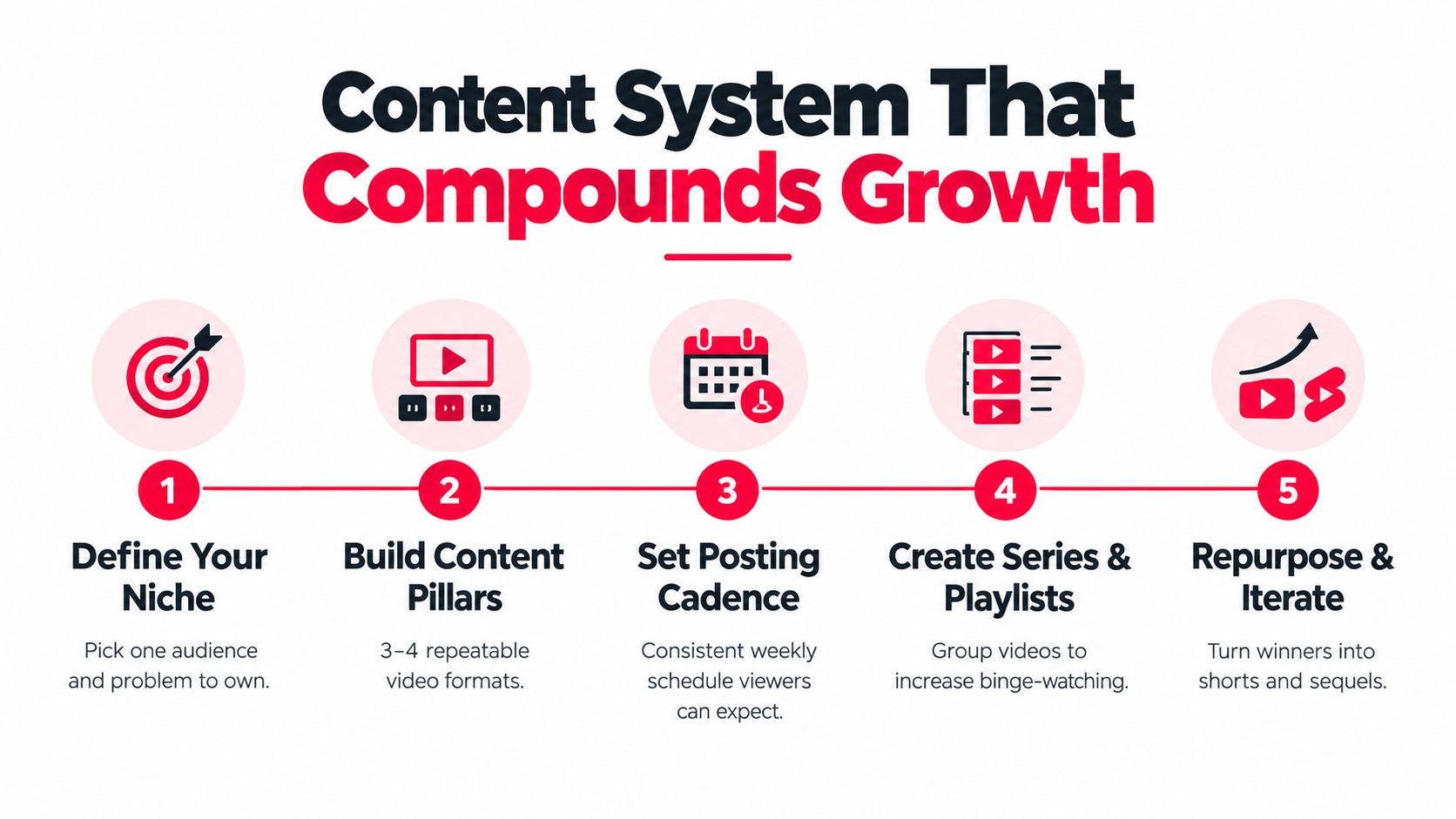
Choose one audience and one recurring problem or interest you can serve repeatedly. “People interested in business” is too broad to guide programming. “Freelancers who need simple client acquisition systems” gives you a clearer set of topics, examples, and future products.
Write the promise in one sentence:
For [specific audience], I publish [repeatable format] that helps them [specific outcome].
Then build three or four content pillars around that promise. A creator-focused channel might use channel strategy, video production, audience research, and monetization. The pillars should generate multiple episodes, not merely describe categories.
Plan a calendar that you can maintain
The available benchmark data links 12 or more posts per month with roughly 66% more subscribers than lower-frequency publishing, while coverage on combined Shorts and long-form reports channels growing about 41% faster (subscriber strategy analysis). These are correlations, not guarantees, so don't treat the cadence as a promise that any channel will reproduce the same outcome.
Use the finding as a planning constraint, not a demand to publish low-quality work. Batch research, outlines, filming, and editing separately. One substantial video can supply several Shorts, a community prompt, and a follow-up topic without forcing you to invent a new concept every day.
A practical monthly system might include:
- Core videos: Publish the deeper pieces that establish expertise and give viewers a reason to subscribe.
- Discovery clips: Extract focused moments that stand alone and point back to a related core video.
- Conversation posts: Ask questions, preview decisions, and collect objections that can shape future scripts.
- Continuation videos: Turn a successful topic into a sequel, comparison, or advanced version.
Make the library navigable
Create playlists around outcomes rather than upload dates. “Improve Your YouTube Hooks” is more useful than “Videos from March” because it tells a new viewer what they'll achieve by continuing.
Each core upload should have a deliberate neighbor. Add the related video to the description, pinned comment, and end screen. Keep the destination narrow. A viewer who finishes a video about thumbnails should see another packaging lesson, not a random vlog.
Cross-promotion can extend the system outside YouTube. Adapt the idea for newsletters, Instagram Reels, TikTok, LinkedIn, or relevant communities, but change the framing for the platform. A clip should create interest in the full video without pretending the short version contains the entire answer.
If your workflow includes written tutorials, product documentation, or scripts, it may help to evaluate technical writing tools before choosing a production process. The principle is the same across formats. Reduce repetitive work so more attention goes toward research, clarity, and audience fit.
Retention and Optimization That Turns Views Into Loyalty
Subscriber growth often improves faster when you repair existing videos than when you add more work to the calendar. A video that earns clicks but loses viewers during its opening has a packaging or expectation problem. A video that holds attention but produces few subscriptions has a promise, routing, or CTA problem.

Read the retention curve as a diagnosis
Start with the first major drop. If viewers leave before the first useful point, inspect the opening for delays, vague framing, or a mismatch between title and delivery. If the curve falls after a section transition, the structure may be unclear or the next point may not feel connected to the original promise.
Don't optimize retention as an abstract score. Ask what the viewer expected at each moment and whether the video gave them a reason to continue. A tutorial can retain attention by showing progress. A commentary video can maintain momentum by introducing evidence, tension, or a clear sequence of questions.
Use a simple decision process:
- Early drop: Rewrite the first lines, remove setup, and show the payoff sooner.
- Mid-video drift: Shorten repeated explanations and add stronger transitions.
- Late abandonment: Move the most important conclusion earlier and make the next step visible.
- Healthy viewing but weak subscriptions: Clarify the channel promise and place a relevant CTA after the strongest value moment.
Improve the paths around the video
End screens should lead to one logical continuation. Choose the next video based on the viewer's current problem, not the upload you happen to want to promote. A pinned comment can repeat that path in plain language, while a playlist can give viewers a structured sequence instead of a single isolated recommendation.
Cards can support a reference point when a related explanation would interrupt the current video. Use them sparingly. Too many choices create friction and distract from the main narrative.
Titles and thumbnails also deserve ongoing testing. Change one variable at a time when possible, record what changed, and judge the result alongside retention and subscribers gained. A more clickable thumbnail that attracts the wrong audience isn't an improvement.
Track conversion and attribution
For each video, record views, subscribers gained, and the resulting subscriber conversion rate. The basic calculation is:
Subscribers gained ÷ views × 100
Compare videos within the same format and audience intent. A Short should not be judged by the same conversion expectation as a long-form tutorial. Also record which playlist, end screen, pinned comment, or external link helped the viewer continue.
ViewsMax can sit alongside YouTube Analytics when the channel has an offer behind the content. It lets creators create trackable links and connect clicks, leads, and sales back to specific content, which adds a revenue attribution layer to subscriber analysis. That distinction matters because a video can be valuable even when it doesn't produce the highest public view count.
Your 30 and 90 Day Plan to Accelerate Subscribers
Fast growth needs a short feedback cycle and a longer operating horizon. Use the first month to identify conversion patterns, then use the following two months to build around the formats and topics that attract the right viewers.
The first 30 days
Days 1 through 7 should establish a baseline. Export or record each recent video's views, subscribers gained, average view duration, click-through rate, and traffic source. Mark the videos that produce subscriptions efficiently, then inspect their topic, opening, structure, and next-video path.
Days 8 through 14 should repair the channel journey. Rewrite unclear titles, refresh thumbnails where the promise is weak, add relevant end-screen destinations, and organize the strongest related videos into outcome-based playlists. Give every active upload one obvious continuation.
Days 15 through 21 should test a format bridge. Create Shorts from ideas that already connect to your strongest long-form topics. Add on-screen identity, keep each promise narrow, and route viewers to the matching full video or playlist. Track subscriber gains by Short rather than assuming views represent success.
Days 22 through 30 should repeat the strongest pattern. Publish another core video based on the topic or structure that produced qualified subscribers, then support it with discovery content and a conversation post. Compare the new results with your baseline, not with a creator in a different niche.
The 90-day operating plan
During the next two months, turn your findings into a programming system. Keep a record of:
- Subscriber conversion per video: Which topics and formats turn viewers into subscribers?
- Average view duration: Where do people continue, skip, or leave?
- Click-through rate: Which title and thumbnail combinations earn qualified clicks?
- End-screen movement: Which destinations cause viewers to continue watching?
- Attributed clicks and sales: Which content drives business outcomes, not just attention?
Use weekly reviews to choose the next topic. Use monthly reviews to decide which pillar deserves more production capacity. If a format earns views but attracts no repeat behavior, reduce its role or redesign the bridge. If a smaller topic consistently produces subscriptions and qualified clicks, make it a recurring series.
ViewsMax can support this workflow by placing trackable links, content planning, publishing, and click, lead, and sales reporting in one workspace. The practical outcome is a clearer connection between each video and the action that follows it.
The operating checklist is short:
- Define one audience and one repeatable promise.
- Package every video around one outcome.
- Hook viewers immediately.
- Use Shorts for discovery and long-form for depth.
- Route every viewer toward one relevant next step.
- Measure subscribers gained per video.
- Attribute clicks, leads, and sales to the content that generated them.
- Repeat the formats that create both audience growth and meaningful action.
Use ViewsMax to plan content, publish across channels, create trackable links, and connect clicks, leads, and sales to the exact videos that generated them. Start by reviewing your last uploads, identify the pieces with the strongest subscriber and business intent, and build your next 30-day calendar around those patterns.