ViewsMax
Sign In Sign Up Free

Tag: shorts revenue

  • How Much Does YouTube Pay for Shorts in 2026

    How Much Does YouTube Pay for Shorts in 2026

    Shorts commonly earn roughly $0.03 to $0.10 per 1,000 views, and YouTube allocates 45% of Shorts revenue to creators while retaining 55%. That headline range isn't a fixed rate, though, because Shorts earnings depend on the shared ad pool, music licensing, audience geography, eligible view share, and what those viewers do after watching.

    You post a Short every day, one of them takes off, and the view counter climbs past two million. Then you open YouTube Studio expecting a dramatic payout and see only a modest balance. The result feels wrong until you understand that Shorts weren't designed like traditional videos, where an ad can be associated more directly with a particular upload.

    The better question isn't only how much does YouTube pay for Shorts. It's also what those views are worth when they introduce people to your channel, newsletter, product, service, affiliate offer, or long-form library. Shorts can produce weak direct ad revenue and still become an efficient discovery channel.

    What Shorts Actually Pay Per 1,000 Views

    A Short can pass a million views and still produce a payout that feels surprisingly small. Independent creator benchmarks commonly place Shorts RPM around $0.03 to $0.10 per 1,000 views, with some reports reaching as low as $0.01. The Hootsuite overview of YouTube Shorts monetization provides context for that benchmark range.

    Results vary by audience and content. U.S.-heavy audiences, finance or technology topics, and limited music licensing often support stronger RPMs. Broad entertainment and music-heavy Shorts commonly fall nearer the lower end because licensing and advertiser demand affect the amount available for distribution.

    At those benchmark levels, a million-view Short could generate roughly $30 to $100, before taxes, currency conversion, or other deductions. The basic estimate is:

    Estimated Shorts revenue = views ÷ 1,000 × Shorts RPM

    That formula helps with planning, but it does not describe a fixed price for each thousand views. Shorts ads run across the feed rather than attaching to one video in the same direct way as many long-form ads. YouTube combines the advertising revenue, accounts for music licensing, and allocates the remaining pool according to each creator's share of eligible Shorts views. The creator receives a portion of that allocation, while YouTube retains the rest, as described in YouTube's Shorts monetization documentation.

    Practical rule: Treat a Shorts RPM estimate as a planning range, not a promise attached to every thousand views.

    Shorts RPM at a glance

    Video format Typical RPM range Notes
    YouTube Shorts $0.03 to $0.10 per 1,000 views Pool-based allocation, affected by music, geography, eligible views, and advertiser demand
    Long-form YouTube video Qualitatively higher in many channels More direct ad placement and different monetization mechanics
    Music-heavy Short Often lower within the Shorts range Licensing can reduce the pool before creator allocation
    Finance or technology Short Can perform toward the higher end Audience intent and advertiser demand may support stronger payouts

    The more useful question is what those views do after the Short ends. Shorts are often a top-of-funnel format, helping new viewers discover a channel, newsletter, product, service, affiliate offer, or long-form library. A creator may earn little from the feed itself while gaining subscribers, email signups, product interest, affiliate clicks, or service inquiries.

    That is why Shorts can make business sense even with a low RPM. Long-form videos often work better for direct ad revenue and deeper viewing, while Shorts can supply reach and introduce people to offers that pay more than the initial view. Evaluate both outcomes before deciding whether a Short performed well.

    How Shorts Monetization Got Here

    A creator publishing Shorts in the early days could attract millions of views without seeing a consistent advertising payout. In August 2021, YouTube introduced the $100 million Shorts Fund, a bonus-style pool designed to reward creators whose Shorts gained attention. It encouraged participation, yet it did not connect every eligible channel's views to a clear advertising calculation.

    That difference shaped the next stage. A bonus could recognize selected creators, while a revenue-sharing system could follow advertising activity across the Shorts feed. As viewing grew, YouTube moved toward a model that treated Shorts more like a shared advertising marketplace than a promotional experiment.
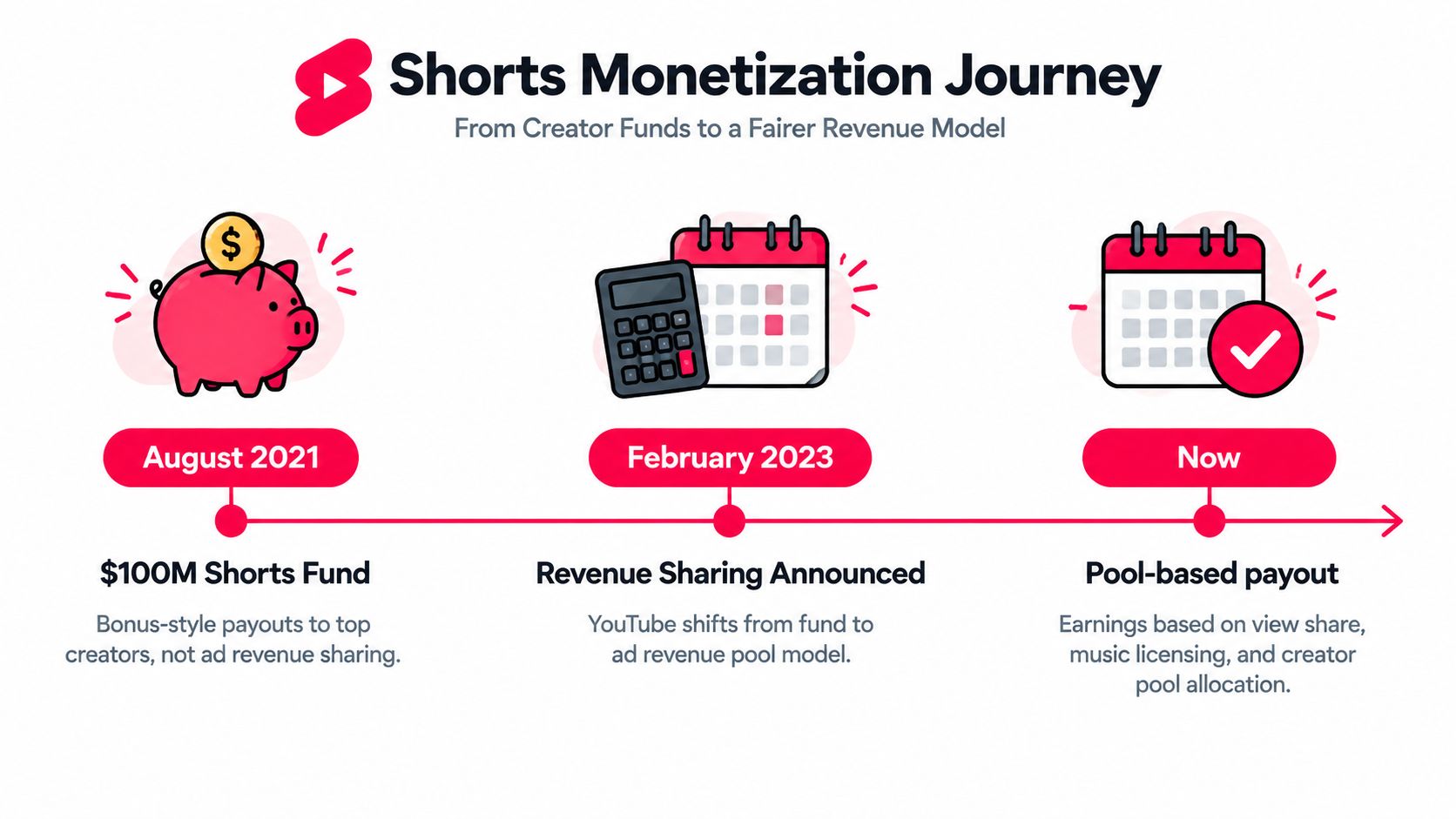
    A timeline graphic showing the evolution of YouTube Shorts monetization from a creator fund to pool-based payouts.

    The move to revenue sharing

    In February 2023, YouTube introduced formal Shorts ad-revenue sharing. Advertising revenue from the Shorts feed entered a shared pool, music licensing was accounted for, and creator earnings were allocated according to eligible view share. Creators received 45% of their allocated revenue, replacing the discretionary structure of the earlier fund. The official YouTube help documentation describes this pool-based arrangement.

    The change made payouts repeatable, though not fixed. Earnings could vary with the size of the overall pool, a channel's eligible views, its audience mix, and whether its Shorts used music. Two channels with similar public view counts could therefore receive different results.

    That variability also explains why a single Shorts RPM is only a planning estimate. The system rewards participation in a large feed, but each creator's share depends on more than the view counter.

    From launch feature to meaningful channel revenue

    By March 28, 2024, YouTube said that more than 25% of channels in the YouTube Partner Program were earning through Shorts revenue sharing. YouTube also said Shorts averaged over 70 billion daily views at that time. The Business Insider reporting on early Shorts monetization documents these milestones and the early payout experience.

    The historical shift clarifies Shorts' role today. Monetization became more formal than the old bonus model, while the format remained built for broad distribution. A Short's value may come from its feed payout, but also from new subscribers, visits to long-form videos, leads, or sales that happen later.

    Shorts became easier to monetize, but not necessarily more valuable per view. Their strategic advantage remains distribution and audience entry.

    How YouTube Calculates Your Shorts Earnings

    A Short can attract a large audience while producing a modest direct payout. The reason is simple: YouTube does not attach a fixed payment to each upload. It collects advertising revenue from the Shorts feed, adjusts the available amount under its music-rights arrangements, and distributes the creator portion according to eligible view share.

    The calculation works in four stages:

    1. YouTube gathers Shorts advertising revenue. Ads appear between videos in the Shorts feed, and the related revenue enters a shared pool.
    2. Music licensing is accounted for. Shorts that use licensed music may send part of the available revenue toward the applicable rights arrangements.
    3. YouTube assigns the creator portion. Creators receive 45% of their allocated amount, while YouTube retains 55%, as explained in YouTube's explanation of Shorts revenue sharing.
    4. The creator portion follows eligible view share. Your allocation depends on your eligible Shorts views compared with the eligible activity represented in the wider pool.
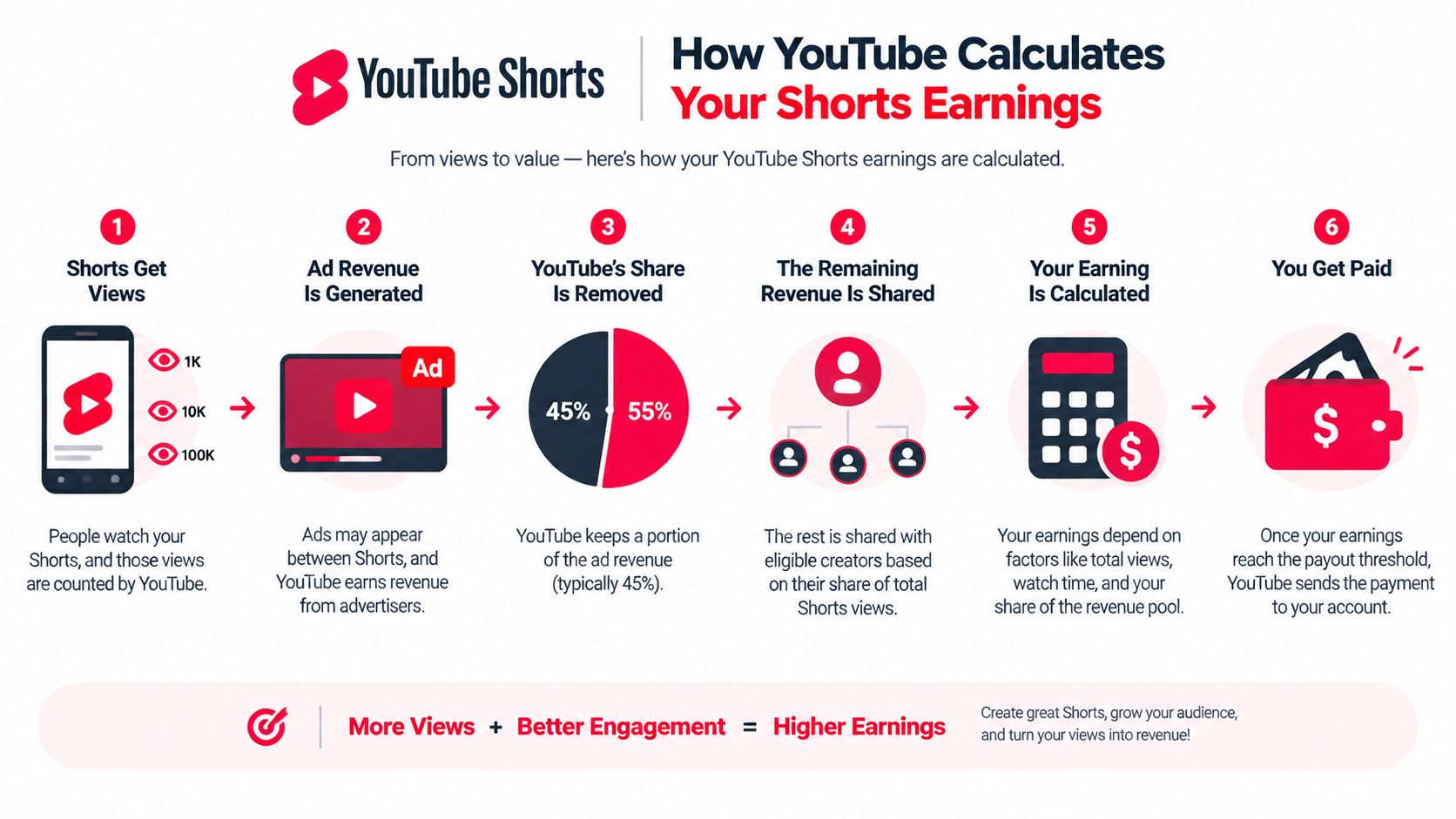
    An infographic detailing the six-step process of how YouTube calculates and pays earnings for Short video content.

    A simplified pool example

    Suppose a hypothetical creator pool contains $10 million after advertising revenue has been gathered and music-related costs have been handled. YouTube does not divide that amount evenly across every raw view. It calculates each creator's share of eligible Shorts views, then applies the creator portion to that allocation.

    A channel contributing a larger share of eligible views receives a larger allocation. If the overall eligible-view volume is enormous, the same pool is divided across more activity. That is why Shorts RPM can remain only a few cents even when view counts look impressive.

    Music can change the result as well. Two Shorts with the same number of views may produce different earnings if one uses licensed music and the other uses original audio or a rights arrangement with different economics. A million views is therefore a reach milestone, not a universal payout unit.

    Creators should also separate RPM from CPM. RPM describes what the creator receives per thousand views after the relevant platform calculations, while CPM refers to an advertiser-facing cost metric. The guide explaining what CPM means on YouTube can help clarify that distinction. To compare the possible business value of traffic beyond the feed payout, try the Auspia traffic value calculator.

    The practical formula is:

    Estimated earnings = Shorts RPM × (eligible views ÷ 1,000)

    This formula estimates an outcome after the allocation mechanics have already shaped the RPM. It does not turn Shorts into a fixed-rate product. Studio data gives you a better planning base because it reflects your audience, category, music usage, and eligible-view mix. More importantly, Shorts can pay off through reach, subscribers, leads, or later sales when direct feed revenue is small.

    Who Qualifies for Shorts Revenue Sharing

    Shorts ad-revenue sharing isn't automatic for every creator who uploads vertical video. You generally need to be accepted into the YouTube Partner Program, be located where the relevant features are available, and meet YouTube's current eligibility and policy requirements.

    YouTube can adjust requirements and availability by region, so creators should verify the latest rules inside YouTube Studio and the YouTube Partner Program application guidance. Don't build a revenue forecast from an old screenshot or a threshold copied from another country.

    The qualification path

    The process usually includes several separate checks:

    • Reach the applicable audience threshold: YouTube evaluates the subscriber requirement and the relevant watch-hour or Shorts-view route for the features you're applying for.
    • Secure the account: Two-step verification helps satisfy account requirements and protects access to monetization tools.
    • Accept the revenue terms: Shorts creators must accept the terms that govern Shorts ad-revenue sharing.
    • Connect AdSense: An approved AdSense account is needed for payments through YouTube's monetization system.
    • Pass channel review: YouTube reviews content for originality, policy compliance, and suitability for monetization.

    Approval doesn't make every view payable. A channel can be inside the Partner Program while an individual Short receives limited or no eligible revenue because of policy issues, reused content, artificial engagement, or other restrictions.

    Common problems that delay or limit earnings

    Reused material is a frequent risk. Uploading another person's clip with minimal changes may not demonstrate enough original contribution, even if the edit includes a caption or a visual effect. Commentary, meaningful transformation, original presentation, and clear editorial value create a stronger foundation than simple reposting.

    Misleading metadata, unsafe demonstrations, and artificial engagement can also affect monetization. A sudden view count isn't useful if the traffic violates platform rules or fails to qualify as legitimate engagement.

    Views earned before monetization approval generally don't become retroactively payable. Check the monetization status for your channel and individual uploads in YouTube Studio before assuming that a high-performing Short has accumulated an unpaid balance.

    Shorts RPM Compared With Long-Form Video

    A Short can attract a million views and still earn less than a long-form video with a fraction of that reach. RPM helps explain why. It puts different view totals on the same basis, but it is an average outcome, not a guaranteed price. It also differs from CPM, which measures the advertiser-side cost rather than the creator's realized revenue.

    Shorts usually have a much lower RPM than long-form video. Shorts earnings come from a shared feed pool, while long-form videos can support more direct ad placement and different inventory conditions. Geography, topic, advertiser demand, seasonality, and viewer intent all affect the gap.

    A 2026 analysis of 274 mixed-format channels found that Shorts RPM was only 3% to 14% of long-form RPM in almost every niche. In those results, creators needed roughly 11,000 to 34,000 Shorts views to match the revenue from 1,000 long-form views. The findings appear in AIR Media-Tech's 2026 Shorts and long-form RPM analysis.

    A direct comparison

    Metric YouTube Shorts Long-form video
    Revenue structure Shared Shorts ad pool More direct video ad monetization
    Typical view economics Often around $0.03 to $0.10 RPM Commonly higher, depending on channel and audience
    Strongest strategic role Discovery, reach, subscriber entry, funnel activity Deeper viewing, stronger ad value, conversion support
    Main variables Eligible view share, music, geography, topic, pool size Ad inventory, watch time, topic, geography, viewer intent
    Best planning question What downstream action did the Short create? What revenue did this viewing session generate?

    The difference becomes clear in a simple comparison. One million Shorts views at $0.05 RPM produces about $50, while 100,000 long-form views at a hypothetical $5 RPM produces about $500. These are examples, not forecasts. Equal view totals can represent very different commercial value.

    Shorts can still win on reach. A brief clip may find viewers who would not click a long video from an unfamiliar creator. If those viewers continue to a detailed tutorial, email sequence, product page, or consultation, the Short's direct RPM becomes only one part of its return. For many creators, Shorts work as the discovery and lead-capture layer, while long-form carries more of the advertising and conversion load.

    Realistic Earnings With Example Calculations

    A Short can reach a million views and still produce less direct ad revenue than a smaller long-form video. Use the RPM range as a planning scenario, not a promise. The calculation is simple, while the inputs vary with audience location, music use, eligible views, advertiser demand, and the size of the shared pool.

    Scenario one, one million views

    At $0.03 RPM, one million views works out as:

    1,000,000 ÷ 1,000 × $0.03 = $30

    At $0.10 RPM, the same view count works out as:

    1,000,000 ÷ 1,000 × $0.10 = $100

    The $0.03 to $0.10 range is a benchmark, not guaranteed take-home income. YouTube's calculation depends on eligible activity within the Shorts system, so two channels with the same public view count can receive different estimates.

    Scenario two, a ten-million-view month

    Suppose a channel receives 10 million views across its Shorts in one month. At $0.05 RPM, the estimate is $500. At $0.08 RPM, it is $800.

    Scenario Shorts RPM Views Estimated revenue
    Lower-range month $0.03 1,000,000 $30
    Upper-range benchmark $0.10 1,000,000 $100
    Mixed-audience month $0.05 10,000,000 $500
    Stronger mixed-audience month $0.08 10,000,000 $800

    The spread reflects different audience and content conditions inside a pool-based system. A U.S.-heavy audience, a commercially valuable topic, limited music exposure, and stronger eligible-view performance can produce a different result from broad entertainment traffic.

    Scenario three, the long-form comparison

    At 100,000 qualified views, a Short earning $0.06 RPM would produce $6. A long-form video earning a hypothetical $5 RPM would produce $500.

    Scenario Shorts RPM Views Estimated revenue
    Shorts comparison $0.06 100,000 $6
    Long-form comparison $5 100,000 $500

    These examples exclude taxes, withholding, currency conversion, and applicable deductions. They also leave out the value of a Short that creates a subscriber, lead, or sale. That is why Shorts often make more sense as a reach and lead-capture layer than as an advertising paycheck by themselves.

    For your own baseline, export the last 30 days of qualified views and estimated revenue from YouTube Studio. Divide estimated revenue by qualified views, then multiply by 1,000. Your channel's RPM is more useful for forecasting than a generic range because it reflects your audience and format mix. Use it to judge whether Shorts are paying through ads, or whether their stronger return comes from sending viewers to a tutorial, email sequence, product page, or consultation.

    Factors That Move Your Shorts Pay Up or Down

    A Short can receive strong distribution and still produce a small AdSense payout. The result depends on who watches, what the video is about, how much licensed music is involved, and whether viewers keep watching. These variables affect either the value of eligible views or the number of eligible views your Short earns.

    Audience geography

    Advertiser demand differs by market, so viewer location can shift Shorts earnings substantially. U.S.-heavy audiences generally produce stronger advertising value than audiences concentrated in lower-demand markets. You cannot fully choose where viewers live, but you can make the content understandable and relevant to the audience you want.

    Language, examples, cultural references, titles, and posting context all influence who discovers the Short. Treat those choices as audience filters, not just packaging.

    Topic and advertiser intent

    Finance, technology, and business topics often attract more commercial interest than broad entertainment. The same view count can therefore produce different advertising value. That does not make comedy or gaming a poor choice. A sustainable format with a clear audience usually beats a higher-value topic you cannot produce consistently.

    Topic value also affects revenue beyond AdSense. A creator teaching software workflows may send viewers to an affiliate offer, software trial, or consulting service. That downstream result can matter more than a small change in Shorts RPM. For many creators, Shorts work best as the top of a path, not the entire business.

    Music and original audio

    Music usage affects the pool before the creator allocation. Music-heavy content can therefore fall toward the lower end of available benchmarks. The Miraflow breakdown of Shorts RPM and licensing estimates that a million-view music Short may generate only $15 to $30 net after licensing effects.

    Original narration, original sound design, or music used under a suitable arrangement gives you more control. It still does not guarantee a higher payout, because audience and eligible-view performance remain part of the calculation.

    Hook and retention

    The first seconds determine whether a viewer stays long enough to understand the promise. Continued viewing helps the Short remain competitive in the feed. Immediate swipes can limit distribution before RPM becomes meaningful.

    Open with the specific result, remove slow introductions, and make the payoff clear. Review early retention rather than guessing which line failed.

    Posting consistency and audience fit

    Consistency creates more chances to test topics, openings, and formats. Frequency alone does not raise payment, and publishing weak Shorts can consume production time without improving business results.

    Relevant subscribers may help a new upload find an initial audience. Subscribers do not receive a direct payment or guarantee reach, but a well-matched subscriber base can help move viewers from a Short to a longer video, email list, product, or service.

    For a focused 30-day test, track:

    • Geography: Compare audience locations with your channel RPM.
    • Audio: Separate original-audio Shorts from music-heavy uploads.
    • Topics: Group results by niche and viewer intent.
    • Openings: Review early retention and rewrite the first line.
    • Downstream actions: Measure clicks, signups, and long-form sessions, not only views.

    Creators who want more ideas can review how to make money on YouTube Shorts. The practical test is simple: improve the variables you control, then judge Shorts by the business outcome they create, including reach, leads, and sales rather than ad revenue alone.

    Turning Shorts Into Real Revenue With ViewsMax

    A Short can earn only a few dollars directly and still be responsible for valuable activity elsewhere. That's why a serious Shorts dashboard should place direct Shorts RPM beside downstream results, including long-form viewing, channel subscriptions, link clicks, leads, and sales.

    ViewsMax is designed for that attribution problem. It lets creators create trackable links for offers, place those links in descriptions, bios, and posts, and connect clicks, leads, and sales to the content that generated them. For a Shorts strategy, the useful question becomes less “How much did this Short earn in AdSense?” and more “What did this Short cause a viewer to do next?”

    A practical attribution setup

    Start by giving each campaign, offer, or content series a trackable destination. Use distinct links for different Shorts or content groups so the resulting traffic doesn't disappear into one undifferentiated total.

    Then pair the link data with YouTube Studio metrics:

    • Shorts views and RPM: Record the direct platform payout.
    • Long-form movement: Identify viewers who continue into deeper videos.
    • Subscriber activity: Watch whether the Short attracts the audience your channel serves.
    • Clicks and leads: Connect viewers with the offer, newsletter, booking page, or product.
    • Attributed revenue: Compare the money generated downstream with the Short's production cost.

    A dashboard organized this way can change your publishing decisions. A Short with a low RPM but strong click-through and lead quality may deserve more production attention than a high-view Short that creates no meaningful next step.

    Consider a hypothetical month in which a creator receives $4 in direct Shorts payout and attributes $220 in channel revenue to viewers who arrived through Shorts. The direct AdSense number looks disappointing in isolation. The combined view shows a discovery asset that helped create a much more valuable revenue path.

    That's the key use case for attribution. Shorts don't have to carry the entire business through feed advertising. They can introduce the right viewer, while long-form content, products, services, sponsorships, or email capture complete the commercial journey.


    ViewsMax helps creators connect content with measurable clicks, leads, and sales instead of judging Shorts only by RPM or view count. Visit ViewsMax to track which Shorts and other content contribute to revenue, then use that evidence to plan your next publishing cycle.
  • How to Make Money on YouTube Shorts A Creator’s Guide

    How to Make Money on YouTube Shorts A Creator’s Guide

    Making money on YouTube Shorts isn't some far-off dream—it's a very real possibility for creators who know how to play the game. The main gate you need to walk through is the YouTube Partner Program (YPP), and for Shorts creators, the entrance requirements are crystal clear: 1,000 subscribers and 10 million valid Shorts views within the last 90 days.

    Once you're in, you start getting a cut of the ad revenue that runs between Shorts in the feed.

    Your Blueprint for Monetizing YouTube Shorts

    A laptop displaying the YouTube logo with 'MONETIZE SHORTS' text, a smartphone, and a notebook on a wooden desk.

    Turning your creativity into cash is more straightforward than you might think. We've moved past the era where only long-form video giants could earn a living. YouTube has built out an entire ecosystem for Shorts creators, and for good reason—Shorts are pulling in over 70 billion daily views. They know where the attention is.

    Your first major step is getting into the YouTube Partner Program (YPP). Think of it less as a hurdle and more as the key that unlocks a whole suite of income streams that come directly from the platform itself.

    Understanding the YPP Thresholds

    For Shorts creators, the path into the YPP is refreshingly direct. Forget about watch hours; your focus is on two core metrics.

    • Building a Community: You’ll need at least 1,000 subscribers. This tells YouTube that you're not just getting random views; you’re building a loyal audience that wants to see more from you.
    • Hitting Viral Velocity: The big one—you must generate 10 million valid public Shorts views in a rolling 90-day period. This benchmark proves your content has what it takes to capture widespread attention and keep people scrolling.

    Meeting these milestones gets your foot in the door. Once accepted, you can flip the switch on Shorts monetization and start earning from the "Creator Pool," which is funded by the ads that appear in the Shorts feed.

    How Shorts Revenue Sharing Actually Works

    The way you get paid for Shorts is unique. It's not like the pre-roll ads you see on long-form videos. Instead, YouTube pools all the revenue from ads shown in the Shorts feed. From that pot, they first pay for music licensing (a huge deal for Shorts). What's left is the Creator Pool.

    Your slice of that pie is based on your share of total monetized Shorts views in your country. The more views you drive, the bigger your piece. Simple as that.

    The big question is always, "How much can I actually make?" The reality is that your earning potential is tied directly to your audience's location and engagement. Most creators see an RPM (revenue per 1,000 views) somewhere between $0.01 and $0.05.

    So, what does that look like in practice? Hitting that 10 million view YPP requirement could mean an initial payout of $100 to $500. Creators with audiences in high-value ad markets like the US, UK, or Australia will naturally trend toward the higher end of that range.

    Officially, you get to keep 45% of the allocated ad revenue. It's a system built to reward consistency and the ability to capture and hold attention. You can dive deeper into Shorts statistics and earnings to set some realistic goals.

    To help you visualize the different ways you can earn, here’s a quick breakdown of the primary monetization pathways available to you.

    YouTube Shorts Monetization Pathways at a Glance

    This table summarizes the main methods for making money with your Shorts, giving you a clear picture of what's required and what you can expect.

    Monetization Method Requirements Typical Earnings (RPM/CPM) Best For
    Shorts Ad Revenue YPP: 1k subs & 10M Shorts views (90 days) $0.01 – $0.05 RPM All monetized creators looking for consistent, passive income.
    Channel Memberships YPP qualification + 18 years old Varies by creator (you set the price) Creators with a loyal, engaged community willing to pay for perks.
    Super Thanks YPP qualification + available in your region Varies (viewer-funded tips) Creators who create highly valuable or entertaining "share-worthy" content.
    Brand Deals Established niche & engaged audience $10 – $50+ CPM (highly variable) Creators with a strong personal brand and influence in a specific niche.
    Affiliate Marketing No official requirements, just an audience Commission-based (5%-30% of sales) Creators who can naturally recommend products or services to their audience.

    Each of these methods taps into a different aspect of your channel's strength—from raw view counts to the trust you've built with your community.

    This guide will show you how to move beyond just chasing views and start building a real, sustainable business around your content.

    Tapping Into YouTube's Official Monetization Tools

    Getting into the YouTube Partner Program (YPP) is your official ticket to earning money directly from your content. It’s the moment your channel goes from a passion project to a real business, giving you access to all of YouTube’s built-in revenue features. While there are a few ways to get in, YouTube created a specific, fast-paced track just for Shorts creators.

    If you're focused on short-form video, you have a clear path to the YPP. You need to hit two main goals:

    • Build a community of at least 1,000 subscribers. This tells YouTube that you've got a core audience that cares about what you're making.
    • Rack up 10 million valid public Shorts views in the last 90 days. This is the big one—it proves your content has viral potential and can hold people's attention in the fast-scrolling Shorts feed.

    Once you cross those thresholds and get accepted into the program, you unlock the primary way to make money on Shorts: ad revenue sharing.

    How Shorts Ad Revenue Sharing Actually Works

    The way you earn from Shorts ads is totally different from long-form videos. Instead of an ad running right before your video, ads pop up between Shorts as people scroll. YouTube takes all the money made from these ads and puts it into a big pot called the "Creator Pool."

    Before that money gets to you, YouTube first takes out a cut to pay for music licensing. What’s left is then split up among monetizing creators based on their slice of the total Shorts views in their country. So, if your Shorts made up 1% of all eligible Shorts views in your region last month, you'd get 1% of the Creator Pool for that area.

    From there, you get a 45% cut of that allocation. It’s a system that directly rewards you for consistently cranking out Shorts that people watch.

    This visual from YouTube's own resources helps show how money from different sources, including Shorts ads, flows through their system.

    The main thing to remember is that your earnings aren't a simple calculation. They're a piece of a much larger pie that changes based on overall viewership and how well ads are doing across the entire platform.

    Going Beyond Ads with Fan Funding

    Ad revenue is a great starting point, but it should never be your only source of income. Once you're in the YPP, you get access to powerful features that let your most dedicated fans support you directly. Honestly, this is where you can often make much more per fan than you ever could from ads alone.

    These "fan funding" features are a game-changer. They create a direct financial link between you and your audience, which helps protect you from the constant ups and downs of ad rates and algorithm tweaks. For a closer look at how these rules change over time, our article covering recent changes in YouTube policies is a must-read.

    Super Thanks

    Think of Super Thanks as a digital tip jar for your Shorts. A viewer can buy a cool, animated graphic that pops up over your video to show their appreciation. It's a quick, easy way for someone to say "thanks!" for a Short that made them laugh, taught them something cool, or just really resonated with them.

    Here’s how to encourage more Super Thanks:

    • Give shout-outs to supporters in your next Short or in a Community tab post.
    • Focus on creating Shorts that deliver huge value or hit a strong emotional note.
    • Pin a comment on your best videos reminding people that Super Thanks is an option if they want to show some love.

    Channel Memberships

    Channel Memberships are the ultimate way to build a loyal, paying community. Your fans can pay a monthly fee to get exclusive perks you create just for them. It’s how you turn casual viewers into your biggest supporters. You can even set up different price tiers with better benefits for each level.

    Here's the key difference: Ad revenue monetizes your views, but memberships monetize your relationships. A single fan paying $4.99 a month can easily be worth more than tens of thousands of ad views.

    Some popular perks creators offer their members include:

    • Custom Badges & Emojis: Little icons that members can show off next to their name in comments.
    • Members-Only Content: Behind-the-scenes Shorts, unfiltered Q&As, or early access to your regular videos.
    • Exclusive Access: A private Discord server or a promise that you'll reply to their comments first.

    To make memberships work, you have to be crystal clear about the value you're providing. Use your Shorts to tease the exclusive content members get, and don't be shy about reminding your audience how their support helps you keep the channel going. By putting these official tools to work, you can build a much more stable and diverse income stream right inside the YouTube ecosystem.

    Creating Shorts That Actually Get Views and Make Money

    A man records a video outdoors using a smartphone on a tripod, with documents and a pen on a table, and 'HOOK VIEWERS' text.

    Let's be real: just throwing short videos at the wall and hoping something sticks isn't a strategy for making money. That's playing the lottery. To build a real income from YouTube Shorts, you have to be intentional. You need a content plan that consistently grabs attention and plays nice with the YouTube algorithm.

    Going viral isn't just a fluke. It’s about knowing what makes people stop their endless scroll and what signals tell YouTube, "Hey, people love this, show it to more of them!" It all comes down to creating content that keeps people watching.

    The First Three Seconds are Everything

    You have a tiny window—maybe three seconds, tops—to convince someone your Short is worth their time. If you blow the intro, the rest of your video is dead in the water. Your opening has to be punchy, clear, and spark instant curiosity.

    Forget the slow burns and lengthy "hey guys" intros. Jump straight into the action. Start with the most dramatic clip, a controversial take, or a question that your target viewer can't help but want the answer to. This "hook" is the single most critical part of your video.

    A few hook formulas I've seen work incredibly well:

    • Problem/Solution: "You're editing your videos all wrong. Stop doing this…"
    • The Big Reveal: "I tried the viral [trend], and you won't believe what happened."
    • The Direct Question: "Are you tired of getting zero views on your Shorts?"

    A strong hook grabs them by the collar and promises that sticking around for the next 30 seconds will be worth it.

    Finding the Sweet Spot for Length

    Just because you can make a 60-second Short doesn't mean you should. I've found the magic window for keeping people glued to the screen is somewhere between 20 and 40 seconds.

    That's enough time to tell a quick story, share a solid tip, or get a point across without overstaying your welcome. Sure, a super-short video under 15 seconds can work for a quick meme or trend, but that 20-40 second range is where you can actually deliver substance and keep retention high.

    Watch time is king, but percentage watched is what really moves the needle. A 30-second Short where people watch 90% (27 seconds) looks way better to the algorithm than a 60-second video where they only watch 50% (30 seconds). High retention percentage is a massive green flag for YouTube.

    Keeping it tight also makes you a better creator. It forces you to trim the fat and deliver pure value.

    How to Use Trends and Audio Without Selling Out

    Hopping on a trend is one of the fastest shortcuts to getting your Shorts in front of a new audience. The algorithm is already pushing trending audio and formats, so you're basically catching a ride on a wave that's already building.

    But here's the key: don't just blindly copy a trend. Adapt it to your niche. If you run a channel about gardening and a new dance challenge is everywhere, find a creative way to tie it to planting a new flower bed. This lets you tap into the trend's momentum while still being authentic to your brand.

    Where to spot trends early:

    • Your Shorts Feed: Just scroll. When you hear the same sound over and over, that's your cue. Tap the sound to see how many people have used it.
    • The "Trending" Tab: YouTube literally has a page for this. It often highlights popular Shorts and the audio driving them.
    • TikTok and Instagram Reels: Trends are rarely contained to one platform. See what's blowing up elsewhere, because it's probably on its way to YouTube.

    A popular sound can be the difference between getting a few hundred views and a few hundred thousand.

    Optimizing for the Algorithm and Your Audience

    Making a great video is only half the job. You have to package it so the algorithm knows exactly who to show it to. This is where a little bit of SEO for Shorts makes a huge difference.

    Your title is your first shot. Keep it short, compelling, and load it with your most important keyword. Think like a viewer: what would they type in the search bar to find your content?

    Next up are your description and tags. While they're less important for discovery in the Shorts feed, they are crucial for showing up in YouTube search. A tool like ViewsMax can be a lifesaver here, helping you generate titles, descriptions, and tags that are already proven to work in your niche. For a deeper look at this, check out our guide on how to get more views on YouTube Shorts.

    Finally, don't forget the technical stuff. Make sure your video file is formatted correctly to avoid any weird compression or quality issues on upload. Brushing up on YouTube's video size limits and optimal formats is a simple step that ensures your content looks as good as you intended.

    Taking Your Income Beyond YouTube Ads

    Relying just on the Shorts ad revenue pool is a classic mistake. Think of it like building a house on land you don't own. It's a great starting point, but algorithm changes and fluctuating ad rates can pull the rug out from under you without warning.

    Real financial independence as a creator comes from building your own thing. You need to diversify. The great news is your Shorts audience is the perfect launching pad.

    Every Short you post isn't just a piece of content; it's a free ad for your bigger ventures. When a video takes off, it's your chance to guide those thousands—or millions—of viewers toward partnerships and your own products, where the earning potential is in a completely different league. This is the mental shift you need to make: from earning fractions of a cent per view to building a real, sustainable business.

    Landing Your First Brand Deal

    A lot of creators think they need a massive subscriber count to get noticed by brands. That's a myth. Brands are smarter now; they're hunting for micro-influencers with smaller, super-engaged niche audiences.

    Honestly, a passionate community of 5,000 mountain bikers is way more valuable to a bike gear company than an audience of 100,000 who just passively watch random videos.

    First things first, you have to look professional. Put together a simple media kit—a clean, one-page PDF is all you need.

    • Your Channel Stats: Show off your view counts, audience demographics (age, gender, location), and most importantly, your engagement rate.
    • Your Niche & Vibe: Spell out what your channel is about and who you're talking to.
    • Contact Info: Don't make them hunt for it. A clear, professional email address is a must.

    Start small. Reach out to brands in your niche that you already use and genuinely like. A personal email explaining why you're a great fit for their product will always beat a generic template. Offer them a simple starting package, like one dedicated Short or a mention in three videos, just to get your foot in the door.

    Mastering Affiliate Marketing the Right Way

    Affiliate marketing is probably the easiest income stream to get started with. You get a commission when someone buys a product through your unique link. The trick is to make it feel authentic and helpful, not like you're just trying to make a buck.

    Please, don't just spam links everywhere.

    Instead, create Shorts that actually solve a problem or show a product in action. If you're a tech creator, maybe it's a Short titled "The one accessory every gamer needs." If you're in the beauty space, "My 30-second trick for perfect eyeliner" is perfect.

    Your audience trusts your recommendations. The moment you promote something you don't believe in, you erode that trust. Always prioritize authenticity over a quick commission; your long-term success depends on it.

    So, how do you get the links in there without being obnoxious?

    1. Pin a Comment: This is the best way. Post your affiliate link in a comment and pin it. Then, just say in your video, "Link for this is in the pinned comment!" Easy.
    2. Use a Link-in-Bio Tool: Direct viewers to a single, clean link in your channel bio that holds all your recommended products.
    3. Add it to the Description: It's less visible on Shorts, but it's good practice. Some viewers will look for it.

    Selling Your Own Products

    This is the end game. Turning your viewers into your customers is the ultimate goal for any creator. When you sell your own stuff, whether it's merch or digital products, you have complete control over your income and it cements your brand identity.

    Your Shorts become the top of your sales funnel, driving free, targeted traffic straight to your online store.

    For physical merchandise, platforms like Printful or Spring (formerly Teespring) let you create custom shirts, mugs, or hats with zero upfront cost. You can design products around inside jokes or catchphrases from your channel, which makes your audience feel like they're part of an exclusive club.

    Digital products, though, are where the real magic happens. They often have much higher profit margins. This could be anything—e-books, workout plans, video editing presets, or in-depth guides. To really scale up, you need a solid strategy when you create and sell digital products, giving your audience something genuinely valuable. A Short that gives a "sneak peek" of a killer tip from your new e-book? That’s a simple, powerful sales pitch.

    Decoding Your Earnings with Real World Examples

    Alright, let's get down to what you really want to know: the numbers. It's one thing to talk about abstract ideas like RPM and revenue sharing, but seeing what actual creators are making is what truly helps set realistic goals for your own channel.

    The truth is, your earnings can feel a bit all over the place when you're starting out. You might have one Short blow up with 10 million views but earn less than another that only got 7 million. It’s a common scenario, and it almost always comes down to a few key things—mainly where your audience is from and the niche you’re in.

    A Look at Real Creator Payouts

    To really wrap your head around the potential, there's no substitute for looking at real-world data. One creator in the popular storytelling niche, for example, shared their analytics from a few viral Shorts, and it paints a very clear picture.

    Here's how their numbers broke down:

    • 5.9 million views earned $733.63 and pulled in 22,400 new subscribers.
    • 7.7 million views brought in an impressive $1,263.33 and 25,900 subscribers.
    • Interestingly, a Short with even more views—9.5 million—earned a bit less at $1,252.31, while still adding 21,800 subscribers.

    These results show a pretty consistent trend. In niches like storytelling or finance tips, creators are often seeing earnings in the ballpark of $160 to $200 per million views. You can dive deeper into these examples and see how other creators are doing by checking out breakdowns of their earnings on YouTube.

    The big takeaway here is that more views don't automatically mean more money. The quality of those views is what counts. A view from a country with high ad spend, like the US or UK, is simply worth more than a view from a country with a smaller ad market.

    To make this even clearer, I've put together some real-world examples in a table.

    Sample Earnings from Real YouTube Shorts

    This table shows a few different Shorts and how their views translated into subscribers and cold, hard cash. Notice how the "Revenue per 1M Views" fluctuates—this is a perfect illustration of how much your niche and audience demographics matter.

    Views Subscribers Gained Total Revenue (USD) Approx. Revenue per 1M Views (USD)
    5.9M 22,400 $733.63 $124
    7.7M 25,900 $1,263.33 $164
    9.5M 21,800 $1,252.31 $132

    As you can see, the relationship isn't always linear. The goal isn't just to get views, but to get the right views from an audience that advertisers are willing to pay more to reach.

    Getting a Grip on RPM and CPM

    Your RPM, or Revenue Per Mille, is the metric that tells you how much you're earning for every 1,000 views. For Shorts, this number is almost always lower than what you'd see on long-form videos. Based on what many creators report, a typical RPM for Shorts lands somewhere between $0.17 and $0.25 (that's 17 to 25 cents per 1,000 views).

    Just remember not to confuse RPM with CPM. Your RPM is your actual take-home pay, whereas the CPM (Cost Per Mille) is what advertisers are paying YouTube for 1,000 ad impressions. If you want to get into the nitty-gritty, our guide explaining the CPM meaning on YouTube is a great resource.

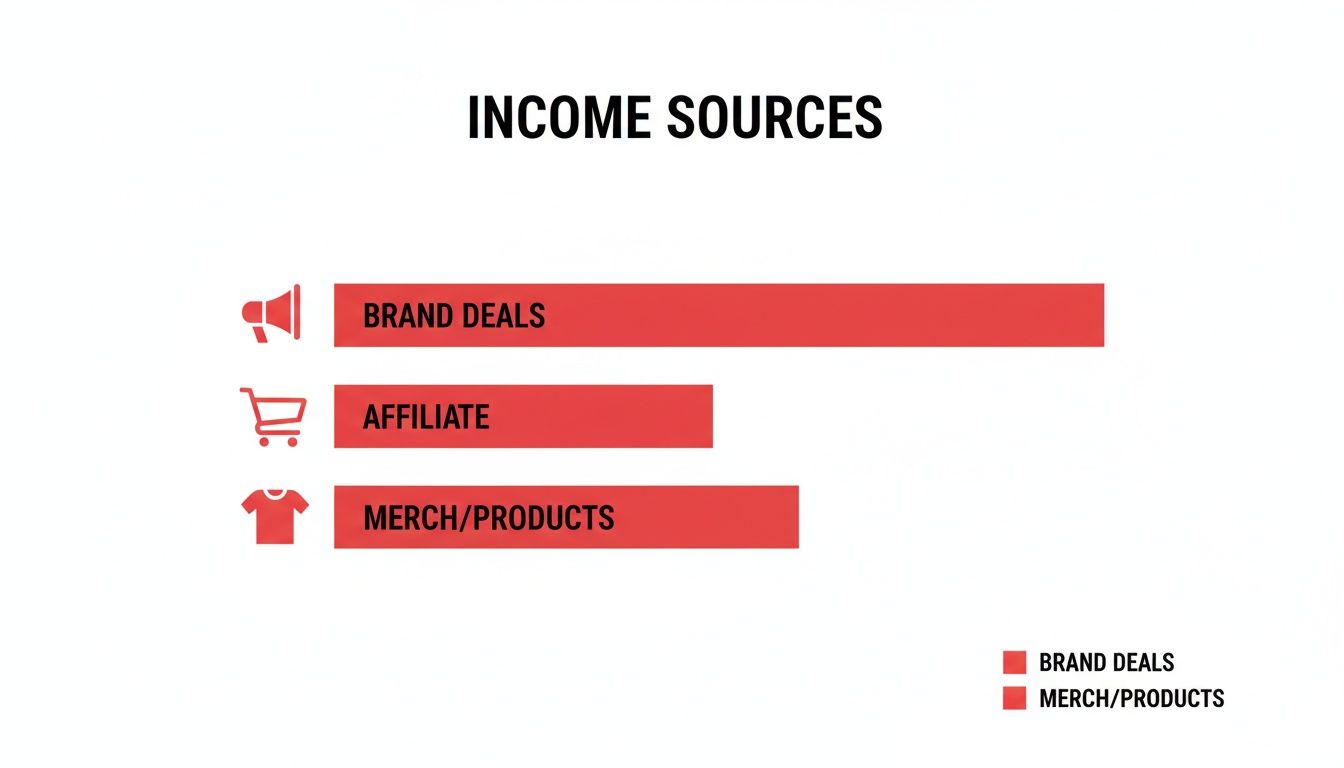
    The chart below really drives home the point that Shorts ad revenue is just one part of a much bigger strategy for top creators.

    A bar chart illustrating income sources: Brand Deals, Affiliate, and Merch/Products, with Brand Deals being the largest.

    It's clear that while ads provide a nice, steady income stream, the serious money often comes from diversifying into brand deals, affiliate marketing, and selling your own products or merchandise.

    What Really Moves the Needle on Your Earnings?

    So, why does one Short make bank while another with similar views falls flat? It boils down to a few critical factors that create a unique financial fingerprint for every single video you post.

    • Audience Geography: This is the heavyweight champion of earning factors. A million views from the United States will almost always outperform a million views from a region where companies spend less on advertising. It's that simple.
    • Content Niche: Advertisers are willing to pay a premium to get in front of certain audiences. If your Shorts are about finance, tech, or business, your RPM will likely be higher than if you're in the comedy or prank space. The potential customer value is just higher.
    • Engagement Signals: While likes and comments don't directly deposit money into your account, they are powerful signals to the YouTube algorithm. High engagement tells the algorithm your content is worth pushing, leading to more views and, by extension, more potential earnings.
    • Seasonality: Advertising budgets aren't static; they change throughout the year. Budgets typically spike during the Q4 holiday season, which can give your RPM a nice temporary boost.

    Once you start understanding these variables, you can shift from just chasing viral trends to building a real strategy. The goal is to create content that not only gets a ton of views but attracts the right kind of views—the ones that advertisers are lining up to reach.

    Your Top Questions About Monetizing Shorts, Answered

    Jumping into YouTube Shorts monetization often feels like navigating a new world. The rules are a bit different from what long-form creators are used to, and it's natural to have questions. Let's clear up some of the most common things creators ask when they're figuring out how to make money with their Shorts.

    How Quickly Can I Actually Get Paid After I Qualify?

    So you've hit the magic numbers: 1,000 subscribers and 10 million Shorts views in 90 days. Great! The first step is to apply for the YouTube Partner Program (YPP), and you can expect the review process to take about a month.

    Once you get the green light, don't forget to accept the "Shorts Monetization Module" in the Earn tab of your YouTube Studio. This is a crucial step. From that moment, your eligible Shorts start earning revenue. But keep in mind, you won't see that cash instantly. YouTube works on a monthly payment cycle. For example, everything you earn in March gets finalized and sent to your AdSense account in mid-April, and the actual payment usually lands in your bank account later that month, as long as you've met the payment threshold.

    Do All My Shorts Views Make Me Money?

    This is a big one that catches a lot of people off guard. The short answer is no—not every single view translates into revenue. For a view to count towards your ad revenue share, it needs to be what YouTube considers a "monetizable view."

    Here’s a quick rundown of what makes a view ineligible:

    • Non-original Shorts: If you just upload unedited clips from movies, TV shows, or other creators' content, those views won't count.
    • Artificial or invalid views: Any traffic from bots or other inorganic methods gets filtered out.
    • Ad-unfriendly Shorts: Content that goes against the advertiser-friendly guidelines won't have ads run on it.

    Your best bet is to focus on creating original, engaging content that people genuinely want to watch. That way, you know the vast majority of your views are actually contributing to your bottom line.

    A key mindset shift for any Shorts creator is to stop chasing just any view and start chasing quality views. A smaller, highly engaged audience in a country with strong ad markets can easily be more profitable than a massive, passive audience elsewhere.

    Is it Okay to Re-Upload My Old Videos as Shorts?

    Absolutely! In fact, this can be a powerhouse strategy. If you've got a backlog of longer videos, you already have a goldmine of potential Shorts. Go back through your content and pull out the best moments—the punchlines, the "aha!" moments, the most valuable tips, or the most dramatic scenes.

    Repurposing these clips as vertical Shorts is a brilliant way to give your old work a second life and introduce it to a completely new audience on the Shorts shelf. Just make sure the clips you choose can stand on their own and are edited to look great in a vertical format. This tactic not only helps you rack up views toward that 10 million requirement but can also act as a trailer, driving curious viewers back to your full-length videos.

    What Type of Content Makes the Most Money on Shorts?

    While you can build a profitable channel in almost any niche, some topics naturally attract higher-paying ads. This is measured by RPM (Revenue Per Mille, or revenue per 1,000 views).

    Historically, niches with higher RPMs include:

    • Finance & Business: Think investing tips, side hustle ideas, and digital marketing.
    • Tech & Gadgets: Unboxings, reviews, and tutorials on the latest tech.
    • Education & How-Tos: Any content that solves a specific problem for the viewer.

    But here’s the most important piece of advice: authenticity will always outperform a trend. Don't jump into a high-RPM niche if you couldn't care less about it. Viewers can spot a fake from a mile away. The creators who build a sustainable income are the ones who are genuinely passionate and consistent, building a real community around a topic they love.


    Ready to stop guessing and start growing? ViewsMax gives you the AI-powered tools and data-driven insights to create Shorts that get noticed. From generating viral titles to optimizing your descriptions, we help you build a content strategy that turns views into revenue. Explore our creator toolkit and see the difference.