A reported up to 80% reduction in long-form recommendation slots on YouTube's home page reframes the platform's latest change. The central question for creators in 2026 isn't only whether a video earns strong retention or satisfaction signals. It's whether the video gets enough discovery surface to generate impressions in the first place, as described in recent reporting on YouTube's home-feed changes.
That distinction has direct revenue consequences. A video can attract the right audience, hold attention, and support a valuable offer, yet produce less business impact if fewer viewers encounter it through Home or Browse. The modern YouTube strategy therefore has two connected layers: earning ranking strength and protecting access to distribution real estate.
Why the YouTube Algorithm Change Is About Discovery Surface
A reported reduction in long-form recommendation slots makes the latest YouTube change a distribution issue before it becomes a content-quality issue. Fewer Home placements mean creators compete for a smaller set of visible opportunities. A video can retain viewers effectively once displayed, yet receive fewer chances to enter those viewers' consideration.
This distinction changes how performance data should be read. Falling impressions do not by themselves prove that a title weakened, a thumbnail lost persuasive power, or viewer satisfaction declined. The interface can limit how often a long-form video is presented. Ranking signals influence outcomes only after exposure is available.
Distribution has become an economic variable
Recommendation performance functions as more than a content score. It is also an allocation decision. YouTube determines which formats receive valuable Home-feed positions, and that allocation affects how many opportunities long-form videos have to generate views, watch time, leads, and sales.
Three measures should remain separate:
- Content efficiency asks how well a video performs after an impression.
- Content volume asks how many relevant viewers receive that impression.
- Revenue efficiency asks whether those viewers take a commercially valuable action.
A video can improve the first measure while losing ground on the second. That creates an attribution problem for creators. If fewer qualified viewers reach the video, downstream revenue may decline even when the video's conversion rate among exposed viewers remains stable.
The practical distinction is simple: separate “viewers did not choose this video” from “viewers had fewer chances to see this video.” Repeated thumbnail changes may raise the conversion of available impressions, but they cannot restore distribution that the interface no longer supplies.
Why long-form creators feel the change first
Long-form content generally requires more deliberate commitment than a short vertical clip. It can support education, product demonstrations, consultations, or lead-generation journeys, but each outcome depends on enough qualified viewers entering the video.
A smaller recommendation footprint can also distort format comparisons. Shorts may occupy more visible feed space, while long-form videos provide stronger commercial context for some businesses. The relevant issue is format-specific access to attention, not an automatic victory by one format over the other.
Measure impressions by surface, rather than relying on total views alone. Track Home, Suggested, Search, playlists, external referrals, and direct links, then compare each source with the business actions that follow. If Home impressions fall while Search and external traffic bring high-intent viewers, the evidence points toward a distribution redesign. A complete content overhaul may solve the wrong problem.
The Timeline Behind the YouTube Algorithm Change
YouTube changed recommendation priorities through three major phases: 2012, 2015 and 2016, and 2019. Each phase expanded the system's prediction target, from sustained viewing to broader behavior and then to the viewer's immediate intent. That progression improved relevance, while also making distribution more dependent on context and audience fit.
The 2012 watch-time pivot
In August 2012, YouTube publicly shifted its recommendation focus from raw view count to watch time. The platform began favoring videos that kept viewers watching longer instead of attracting clicks, as documented in this research paper on YouTube's recommendation history.
View-count optimization rewarded an initial visit even when the viewing experience failed to satisfy the viewer. Watch time connected distribution more closely to sustained attention and total minutes viewed. A longer video with consistent viewing could therefore compete with, or outperform, a shorter video that generated the same number of views.
For creators, the change affected more than video length. Titles and thumbnails still needed to earn the click, while the opening and subsequent viewing experience had to justify the expectation created by that packaging. Metadata became part of a promise system. Packaging set the expected value, and retention showed whether the video delivered it.
Neural networks and broader engagement signals
By 2015 and 2016, YouTube had moved beyond watch time as a standalone measure. Google's research described two neural networks, one for candidate generation and one for ranking. Together, they showed how machine learning could identify and order recommendations at scale. The technical model appears in the Google research paper on deep neural networks for YouTube recommendations.
The system also incorporated broader engagement and satisfaction-related inputs, including shares, likes, and dislikes. Video length therefore became only one component of performance. Recommendations could favor content that connected with a specific audience, even when another video accumulated more passive minutes.
This introduced an attribution problem for creators and marketers. A view became less informative without its source, session context, and downstream action. If a recommendation produced attention but failed to create a return viewer, subscriber, lead, or purchase, its revenue value could differ from the headline view total.
The 2019 move toward intent
A further redesign arrived in 2019, when YouTube's recommendation system began using intent-aware ranking. In the Stanford-reported Google experiment, the system first predicted whether a viewer sought familiarity or novelty before ranking videos. The approach increased daily active users by 0.05%, according to Stanford's report on intent-aware YouTube recommendations.
The same viewer may want continuity in one session and exploration in another. A familiar series can suit the first state, while a new topic can suit the second. Creators can respond by aligning topics, openings, and follow-up videos with the viewer's immediate purpose.
For marketers tracking discovery measurement, latest site improvements offer additional context on how optimization tools change alongside recommendation systems. The commercial implication is direct: stronger intent alignment may improve the value of exposed impressions, while a smaller long-form discovery surface can reduce the number of impressions available for attribution. Algorithm literacy therefore requires tracking both relevance and the revenue produced after a viewer arrives.
What Signals Drive Reach Now
Durable reach depends on more than accumulated watch time. Recommendation ranking is better understood as a combination of attention, satisfaction, relevance, and audience affinity, with each signal addressing a different part of the viewer decision.
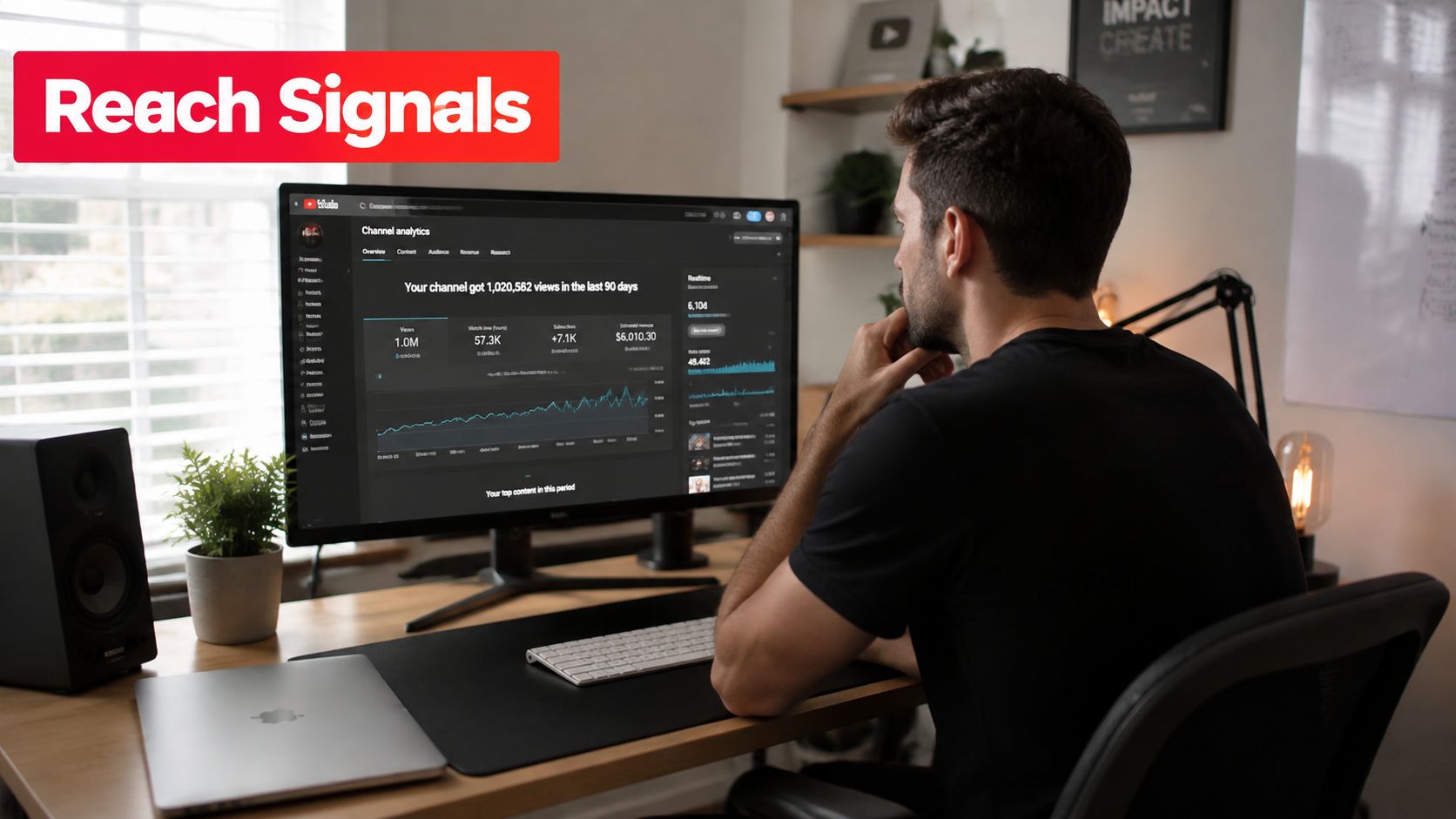
| Signal family | Question it helps answer | Creator implication |
|---|---|---|
| Watch behavior | Did the viewer continue watching? | Build a clear opening and remove unnecessary delay. |
| Satisfaction | Did the experience feel valuable and accurate? | Deliver the promised outcome instead of stretching the video. |
| Engagement | Did the viewer take an active step? | Invite relevant responses, shares, or repeat viewing. |
| Relevance | Does the video match the viewer's context? | Frame the topic for a specific audience need. |
| Affinity | Does this viewer already show interest in related content? | Build connected topic clusters rather than isolated uploads. |
Watch time and satisfaction measure different outcomes
Watch time measures quantity. Satisfaction reflects the quality of the experience inferred from behavior and feedback. A viewer who stays through a long video but leaves disappointed generates a different signal pattern from someone who watches a shorter, focused answer and returns for related content.
Recent analysis describes satisfaction through surveys, repeat viewership, share actions, and session value, while noting that YouTube does not expose one transparent satisfaction score to creators. Direct optimization is therefore limited. Creators must rely on observable proxies, including whether viewers continue to another relevant video, return to the channel, or share the material.
A minute watched is useful evidence. It isn't proof that the viewer valued the experience.
This distinction matters for attribution. A recommendation can produce strong attention while generating little downstream value if the viewer has no reason to continue, subscribe, or take a commercial action. Conversely, a smaller pool of highly relevant viewers can create more useful revenue signals than broad exposure with weak intent.
Affinity limits algorithmic “hacks”
A 2024 causal study found that, since YouTube's recommender changes in 2019, individual consumption patterns mostly reflected user preferences. Recommendations played at most a moderating role rather than acting as the dominant driver. The study is available through this causal analysis of YouTube recommendation effects.
Creators should identify viewers most likely to value a topic and build continuity around their interests. A channel about advanced camera workflows, for example, can connect setup, shooting, editing, and distribution topics for people already working through that problem space. This approach improves intent alignment, while the available long-form discovery surface still determines how many qualified impressions the channel can receive.
Timing can influence the first audience available to a new upload, so creators may find maximize YouTube views with timing useful as one input. Timing affects when a video enters the market. Relevance and satisfaction influence whether viewers continue choosing it.
Creators should compare surface-level attention with business intent through YouTube view statistics. A large audience with weak relevance may create impressive dashboard activity but limited commercial value. A smaller, focused audience may produce stronger downstream actions, making reach quality as important as reach volume.
The Hidden Truth About Shorts and Long-Form Competition
Shorts and long-form videos compete for different placements across YouTube's interface. The practical question is how those placements change the number of opportunities a long-form video has to reach a qualified viewer. Format performance therefore depends on both viewer intent and the amount of available recommendation space.
Recent reporting on which long-form discovery placements changed describes fewer long-form recommendations and more Shorts placement on YouTube's home feed in 2025 and 2026, including a reported reduction of up to 80% in long-form recommendation slots. That figure is an observation from the reporting, not a universal description of every viewer's home page.
The format may not be the actual bottleneck
A long-form video can retain strong viewer satisfaction yet receive fewer impressions when the interface gives its format less space. This points to a distribution constraint rather than a retention failure. The video may still satisfy its existing audience, while the channel has fewer chances to place it in front of new viewers.
That distinction matters for attribution economics. If fewer qualified impressions enter the funnel, downstream views, clicks, subscriptions, and product actions can decline even when the content's quality remains stable. Revenue then reflects both audience response and the number of opportunities the platform creates for that response to occur.
Shorts can introduce a topic and direct viewers toward a deeper video, but the connection must be specific. A broad clip may generate attention without producing continuity. Viewers can enjoy the Short and still show no interest in the longer tutorial, offer, or series.
Rebuild the route to the viewer
Home should be treated as one acquisition surface among several. Search, Suggested, playlists, email, communities, embedded videos, and relevant social posts provide alternative entry points, each with a different level of intent and attribution clarity.
Useful adaptations include:
- Search-led topics: Answer a defined problem using language that matches the viewer's need.
- Connected series: Give each video a logical next step, allowing one successful entry to lead to another.
- Shorts bridges: Present a specific long-form outcome instead of collecting unrelated views.
- External distribution: Send qualified audiences directly to a video when homepage supply is constrained.
Creators comparing vertical-video ecosystems can use analysis of which short-form platform wins to examine format differences. The commercial decision should still follow audience behavior, offer fit, and measurable downstream action. For practical guidance on Shorts discovery, this guide to getting more views on YouTube Shorts provides additional context.
Long-form creators do not need to treat Shorts as an enemy. They need more routes to qualified viewers, clearer bridges between formats, and attribution that distinguishes inexpensive attention from revenue-relevant intent.
Tactical Adaptations for Titles, Thumbnails, and Retention
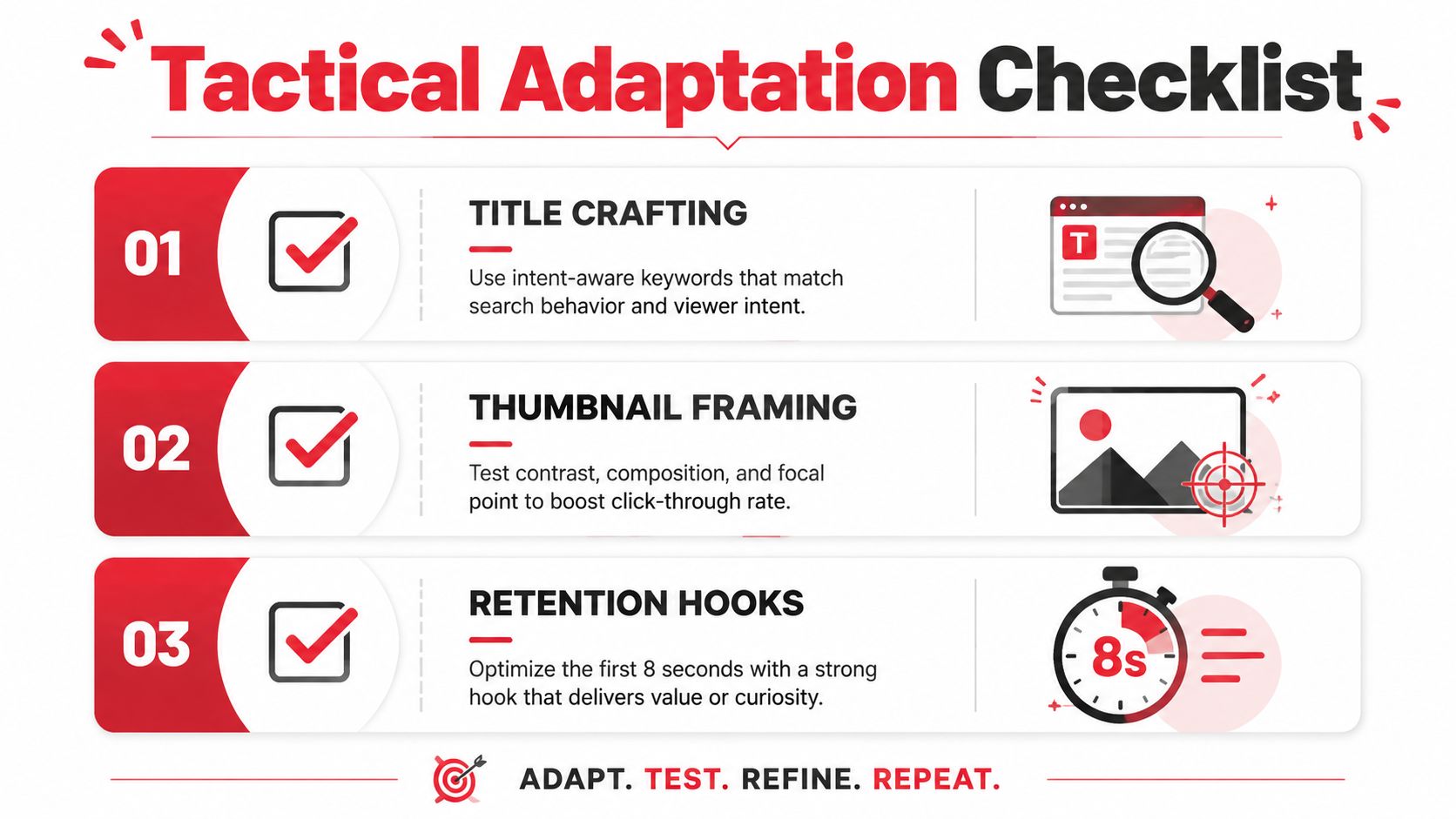
Intent-aware ranking makes packaging a matching problem. A title and thumbnail shouldn't appeal to everyone. They should help the right viewer recognize that the video fits the question, mood, or objective they have at the moment of exposure.
Start with the viewer's immediate intent
Before writing a title, define the state that produces the click. Is the viewer trying to solve a problem, compare options, learn a process, or explore a new perspective? The same subject can require different framing depending on that purpose.
A practical title workflow looks like this:
- Name the specific problem. Replace broad subjects with a recognizable situation.
- Promise a concrete outcome. Tell the viewer what they'll understand, create, compare, or avoid.
- Match the thumbnail's job to the title. Let the thumbnail communicate the visual tension or result instead of repeating the headline.
- Remove ambiguity. If the video serves advanced users, beginners, or a defined use case, make that audience visible.
Metadata should reinforce the same interpretation. Use the description, chapters, captions, and spoken introduction to establish the topic clearly, but don't fill those fields with disconnected keywords. Relevance works best when the language describes the video accurately.
Treat the opening as a contract
The first seconds determine whether the viewer sees the video as a credible answer to the promise they just accepted. A long greeting, unrelated montage, or delayed explanation can create a mismatch before the content has had a chance to demonstrate value.
Open with three elements:
- The outcome: State what the viewer will gain.
- The evidence or destination: Show the result, argument, or transformation the video will deliver.
- The first useful step: Begin the substance before attention fades.
Retention architecture also needs progression. Use sections, examples, visual changes, demonstrations, or questions when they clarify the argument. Pattern changes should support comprehension, not create noise.
Opening test: If the first moments were shown without the title or thumbnail, would a viewer still understand why the video matters?
Optimize for the next decision
A satisfying video doesn't merely keep a viewer inside the current upload. It helps the viewer decide what to do next. That may mean watching a related tutorial, saving a process, sharing a useful explanation, or visiting an offer.
Review the difference between packaging and delivery in this guide to improving click-through rate. Click-through performance is only one part of the chain. If a stronger thumbnail attracts viewers who don't fit the topic, the video may gain exposure while weakening retention and satisfaction.
After publishing, compare impressions, clicks, early retention, traffic sources, and downstream actions. Don't change every variable at once. A title revision may affect the audience entering the video, while an opening revision affects whether that audience stays. Treat each adjustment as a test of one hypothesis.
Closing the Loop Between Views and Revenue With ViewsMax
Algorithmic performance is an incomplete business metric. A video can accumulate attention without producing leads, sales, booked calls, or meaningful movement toward an offer. Another video may attract fewer viewers but reach people with a clearer commercial problem.
That difference matters more when long-form discovery surface shrinks. If impressions become harder to obtain, creators can't evaluate content only by asking which upload received the largest audience. They need to know which audience produced the most valuable result.
Attribution changes the optimization question
Without attribution, a creator might keep investing in a high-watch-time video because it looks healthy in YouTube Analytics. With trackable links attached to videos, descriptions, posts, or profiles, the creator can connect content exposure to clicks, leads, and sales. The analysis then moves from “Which video got attention?” to “Which video attracted viewers who acted?”
ViewsMax provides that attribution layer by letting creators create trackable links and connect resulting activity to specific content. It also supports content planning, cross-platform publishing, and performance monitoring in a single workflow, according to the publisher's product description.
A useful evaluation table might look like this:
| Video outcome | Likely interpretation | Business response |
|---|---|---|
| High watch time, weak commercial action | Strong attention, unclear offer fit or weak transition | Review audience intent and the next step. |
| Modest views, strong conversions | Narrow but valuable audience | Create related videos and protect that topic cluster. |
| Strong clicks, weak leads | Curiosity without sufficient qualification | Clarify the promise and landing-page alignment. |
| Low impressions, strong conversion rate | Distribution constraint may be limiting demand | Expand search, partnerships, and external promotion. |
The point isn't to turn every upload into a sales pitch. Educational and entertainment content can build trust before a viewer is ready to buy. Attribution helps identify which topics contribute to that journey, so creators don't confuse immediate conversion with total strategic value.
The video below adds a practical visual layer for creators reviewing content performance and planning decisions.
Revenue attribution also changes how you respond to the YouTube algorithm change. If a video loses Home impressions but continues generating sales from Search or direct links, it may still deserve investment. If another video wins recommendation traffic but produces no meaningful business outcome, its role may be awareness rather than conversion.
That distinction prevents a common mistake: optimizing every upload for the same metric. The right target depends on the video's place in the audience journey.
Building Sustainable Growth Beyond the Latest Update
Sustainable growth depends on how well a channel connects viewer intent, content roles, and revenue evidence. A creator can change one variable at a time, preserve a clear audience problem, and identify which adjustment affected performance. That discipline becomes more valuable as long-form discovery occupies less surface area while intent matching grows more precise.
Build a mapped viewer journey
Connected videos give recommendations stronger context and give viewers a relevant reason to continue. One video can introduce a problem, another can explain the method, and a third can help the viewer evaluate an offer or apply the solution. The sequence also creates clearer attribution, because later actions can be related to the topics and videos that preceded them.
Consider a coaching channel focused on business systems. A broad productivity video may attract casual interest, while a focused guide to preparing a first client workflow may reach fewer viewers and produce clearer intent. If it leads naturally to implementation guidance and an offer, its commercial value can exceed its view count.
Each upload can serve a different role:
- Discovery videos introduce a defined problem to new viewers.
- Trust videos demonstrate experience, reasoning, or a process.
- Conversion videos answer objections and clarify the offer.
- Continuity videos give existing viewers a relevant next step.
This structure links algorithm performance to attribution economics. A video with limited recommendation reach may still contribute revenue through Search, direct links, or a later conversion. A high-reach video may instead create awareness without producing an immediate sale. Both outcomes matter, but they support different decisions.
Use algorithm literacy as an operating discipline
The strongest response to the current environment is a repeatable review process:
- Identify the intended viewer and immediate need before production.
- Align the title, thumbnail, opening, and delivery around that need.
- Connect the video to a related next step.
- Track recommendation behavior alongside commercial outcomes.
- Revise one part of the system when evidence points to a specific weakness.
This process limits overreaction to interface changes. If Home provides less long-form discovery, creators can place more weight on Search, Suggested continuity, direct distribution, and audience-owned relationships. If intent matching becomes more precise, topic clusters and clear promises deserve more attention than broad publishing.
The long-term advantage belongs to creators who can explain which viewers a video reached, what they wanted, and what they did afterward. That knowledge turns algorithm changes into planning inputs, while shrinking discovery surface becomes a measurable attribution problem.
ViewsMax helps creators attach trackable links to YouTube videos, descriptions, and posts so clicks, leads, and sales can be connected to the content that generated them. Visit ViewsMax to measure revenue alongside recommendation performance and make the next content decision with evidence.