On YouTube, the term CPM gets thrown around a lot, but what does it actually mean for your wallet? CPM stands for Cost Per Mille, which is just a fancy way of saying cost per thousand impressions.
Think of it as the price an advertiser is willing to pay to have their ad show up on your videos 1,000 times. It’s the foundational metric that tells you how much your channel’s "digital real estate" is worth to businesses.
What Does CPM Mean for Your YouTube Channel

Let's use an analogy. Imagine your YouTube channel is a busy highway, and your viewers are the cars driving down it. Advertisers want to put up billboards (their ads) to catch the attention of all that traffic.
The CPM is the price they agree to pay for every 1,000 cars that pass by their billboard.
It's a purely advertiser-focused number. It tells you what they're bidding to get in front of your audience, not what you actually pocket. Still, it’s a critical number because a higher CPM often means advertisers see your audience as a premium, high-value group they're willing to pay more to reach.
Why CPM Matters for Monetization
Getting a handle on your CPM is one of the first real steps to building a sustainable income on YouTube. It gives you a direct look into the market value of the content you work so hard to create.
Here's why it's a metric you can't ignore:
- It's a Barometer for Your Content's Value: A high CPM is a clear signal that advertisers in your niche see your channel as prime advertising space. They believe your viewers are exactly who they want to reach.
- It Directly Influences Your Bottom Line: While CPM isn't your take-home pay (we'll get to that!), a higher CPM is the starting point for higher earnings. Think of it as the raw ingredient for your revenue.
- It Helps Steer Your Strategy: By watching your CPM, you can see which videos attract the big spenders. This insight is gold, helping you decide what kind of content to make next to maximize your income.
Essentially, CPM is the raw price tag for ad space on your channel. It’s what advertisers pay, not what you earn, but it’s one of the most powerful clues you have about your channel's monetization potential.
To boil it down, here is a quick look at what CPM really means for a creator.
CPM at a Glance
| Concept | Simple Explanation |
|---|---|
| CPM | The amount an advertiser pays for 1,000 ad views on your videos. |
| Advertiser-Centric | This metric reflects the advertiser's cost, not your final paycheck. |
| Value Indicator | A higher CPM shows that your audience is more valuable to advertisers. |
Ultimately, understanding this key metric helps you make smarter, more informed decisions about your content and growth strategy. It’s about working smarter, not just harder, to turn your passion into a profession.
How YouTube Calculates Your CPM
Knowing what CPM stands for is the first step, but the real power comes from understanding how that number gets calculated. It’s the key to seeing what advertisers are willing to pay to get in front of your audience.
The formula itself is actually pretty straightforward. It’s a simple calculation designed to figure out the average cost for every one thousand ad views on your content.
The CPM Formula:
(Total Advertiser Ad Spend / Total Ad Impressions) x 1,000 = CPM
This formula gives you the raw number—the gross amount an advertiser paid before YouTube takes its cut. Think of it as a pure measure of your content's value in the ad market. It's a fantastic indicator of how much advertisers are competing for your viewers' attention.
A Practical Calculation Example
Let's put this into a real-world context. Say you have a video that's doing pretty well, and you dive into your YouTube Studio analytics for a specific time frame.
Here's what you see:
- Advertiser Ad Spend: $150 (The total amount advertisers paid to show ads on your video).
- Total Ad Impressions: 25,000 (The number of times ads were actually displayed to viewers).
Now, let's run the numbers through the formula:
- Divide the total ad spend by the total impressions: $150 / 25,000 = $0.006
- Multiply that result by 1,000: $0.006 x 1,000 = $6.00
In this example, your CPM is $6.00. This means for every 1,000 times an ad was shown on that video, advertisers paid an average of $6.00.
Standard CPM vs. Playback-Based CPM
When you get into your YouTube Analytics, you'll spot two different kinds of CPM. This is a small detail that trips up a lot of creators, but it’s easy to understand once you see the difference.
- Standard CPM: This is a broad metric. It includes ad impressions from all over YouTube—the homepage, search results, your channel page, and of course, your videos.
- Playback-Based CPM: This is the one you really want to watch. It only counts the ad impressions that happened while someone was actively watching one of your videos. This gives you a much clearer, more accurate picture of what your specific content is earning.
Because it's so focused, your playback-based CPM is usually higher than the standard CPM. It’s the true measure of your video's monetization power.
Staying on top of this and other platform updates is crucial. To get a better sense of the landscape, you can learn more about recent changes in YouTube that could impact your channel. For now, just remember to keep your eyes on the playback-based CPM—it’s the number that will help you make the smartest decisions for your content strategy.
Understanding CPM vs RPM for Creators
Diving into your YouTube analytics can feel a bit like trying to read a foreign language. You're hit with a wall of acronyms, and two of the most confusing are CPM and RPM. They sound almost the same, but they tell completely different stories about how your channel makes money. For any creator who's serious about turning their passion into a paycheck, getting these two straight is non-negotiable.
Let's break it down with a simple analogy. Think of CPM (Cost Per Mille) as the sticker price an advertiser is willing to pay to show their ad 1,000 times on videos like yours. It’s an advertiser-focused number that reflects the raw market value of your audience, before anyone else gets a piece of the pie.
Now, RPM (Revenue Per Mille) is the number you really want to keep your eye on. This is your actual take-home pay for every 1,000 views your videos get, after YouTube has taken its 45% cut from ad revenue. RPM gives you a far more realistic picture of how much money is actually landing in your bank account.
Why RPM Is the Creator’s North Star
Having a high CPM is great, don't get me wrong. It means advertisers see value in your audience. But it's not the whole story, and it certainly doesn't guarantee a big payout. The real key to understanding your channel's financial health is tracking your RPM.
That's because RPM is a much broader metric. It doesn't just look at ad revenue; it bundles together all the ways you make money on the platform.
Your RPM calculation includes earnings from:
- Advertisements: The money from ads that play before, during, or after your videos.
- YouTube Premium: Your cut from the subscription fees of Premium members who watch your content.
- Channel Memberships: The monthly recurring revenue from fans who join your channel.
- Super Chat & Super Stickers: Donations and paid messages viewers send during live streams and premieres.
In simple terms, RPM answers the single most important question you have as a creator: "For every 1,000 views I get, how much am I actually making?" Focusing on this number is what allows you to make smart, strategic decisions to grow your income.
For instance, you might have a video with a so-so CPM from ads, but if it's a livestream that generated a ton of Super Chats, its RPM could be through the roof. Looking only at CPM would give you a misleading picture of that video's success. RPM gives you the full, unvarnished truth.
CPM vs RPM A Clear Comparison
To really nail down the difference, it helps to see them side-by-side. This quick comparison should clear up any lingering confusion and show you exactly when to look at each metric.
| Metric | What It Measures | Who It's For | Key Takeaway for Creators |
|---|---|---|---|
| CPM | The gross amount advertisers pay per 1,000 ad impressions before any cuts. | Advertisers and YouTube | A great indicator of how valuable your audience is to the market, but it’s not what you actually earn. |
| RPM | The net revenue you earn per 1,000 video views, after YouTube's cut and including all revenue sources. | You, the creator | This is the most accurate measure of your channel's financial performance and should be your guide for monetization strategy. |
Ultimately, CPM tells you what advertisers are willing to spend, while RPM tells you what you actually get to keep. Both are useful, but only one gives you a true sense of your business's bottom line.
The Key Factors That Influence Your CPM Rate
Have you ever looked at your YouTube analytics and wondered why your CPM seems to be all over the place? It’s a common question. One creator might be pulling in a $25 CPM, while another is stuck around $3. This isn't just luck of the draw—several key factors directly influence what advertisers are willing to pay to get in front of your audience.
Once you understand what these variables are, you can start to see where you have some control to boost your channel's earnings.
Audience Location
The single biggest factor dictating your CPM is where your viewers are watching from. Think about it from an advertiser's perspective: they'll always pay a premium to reach audiences in countries with strong economies and high purchasing power. A view from someone in the United States or Germany is simply more valuable to a global brand than one from a region with lower average consumer spending.
The difference isn't small, either. It can be massive. For example, data shows that Norway can have a CPM as high as $43.15. That means a creator could earn $43 for every thousand ad impressions from a Norwegian audience. Germany is not far behind at $38.85, and the United States often hovers between $32.75 and $36.03.
Your Content Niche
Right after geography comes the topic you cover. The niche of your channel plays a huge role in determining your CPM because advertisers in certain industries just have bigger budgets. They’re willing to spend top dollar to reach a highly relevant audience.
- High-CPM Niches: If you create content about personal finance, software tutorials, real estate, or luxury cars, you're in a great position. An advertiser in one of these spaces knows that a single lead from your video could be worth hundreds, if not thousands, of dollars to their business.
- Lower-CPM Niches: On the other hand, entertainment-focused niches like gaming vlogs or comedy skits tend to have lower CPMs. They can attract enormous audiences, but the products being advertised are often lower-cost consumer goods, which naturally leads to smaller ad bids.
For a deeper dive, it's worth learning about mastering content performance metrics to see the bigger picture. A big part of that is choosing the right topics and then zeroing in on high-value YouTube video keywords to attract the right kind of advertisers.
Seasonality and Video Length
Finally, two other practical elements can cause your CPM to swing: the time of year and how long your videos are.
First, ad spending isn't a flat line throughout the year. It predictably spikes in the fourth quarter (Q4) as brands ramp up their budgets for the holiday shopping season. Creators often refer to this as the "Q4 bump," where CPMs climb in October, November, and December because of the intense competition for ad placements.
Second, the length of your videos matters a lot. Any video over eight minutes long becomes eligible for mid-roll ads. These are the ad breaks you see in the middle of a longer video. Having more ad slots available on a single piece of content increases your potential earnings and can significantly lift the overall CPM for that video.
This image below does a great job of breaking down the difference between CPM (what advertisers pay) and RPM (what you, the creator, actually earn).
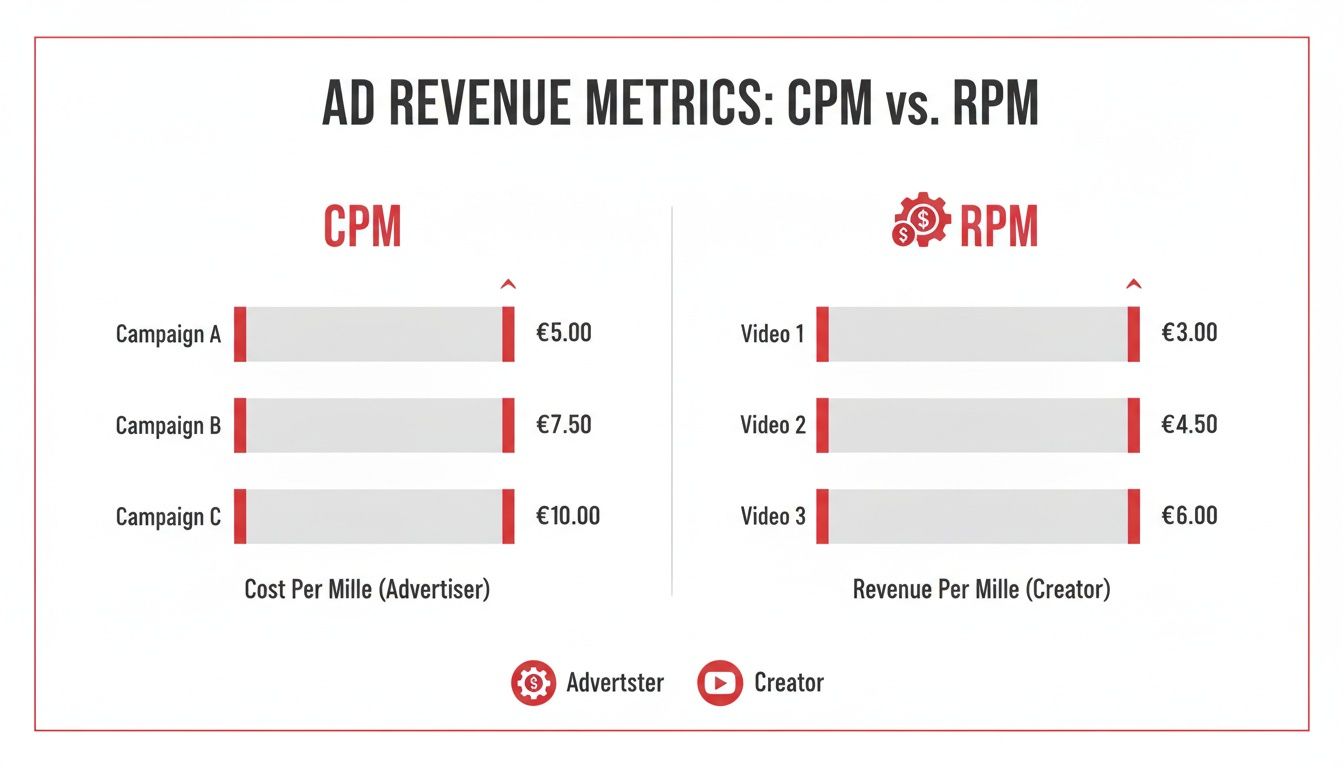
It’s a simple but crucial distinction: CPM is the advertiser's cost, while RPM is a more accurate measure of your actual revenue per thousand views after YouTube takes its cut.
Ready to Boost Your YouTube CPM? Here’s How.

Knowing what CPM means is half the battle. The other half? Actually getting that number to climb. Boosting your YouTube CPM isn't just wishful thinking; it comes down to making smart, strategic choices about your content, your audience, and how you structure your videos. A few focused tweaks can make your channel far more valuable to advertisers.
It all starts with the kind of content you produce. Some topics are just naturally more profitable because the audience they attract has more spending power. Think about it—advertisers will pay a lot more to reach people actively looking for information on finance, technology, or business.
At the same time, you have to create content that’s considered "advertiser-friendly." That means steering clear of controversial topics and sticking to YouTube's community guidelines. The more brand-safe your channel is, the bigger the pool of advertisers willing to bid for a spot on your videos.
Target High-Value Audiences and Niches
In the world of YouTube ads, not all views are created equal. A view from a viewer in a country with a strong economy is often worth more to an advertiser than a view from somewhere else.
This is where picking the right niche becomes so important. Topics like finance and digital marketing consistently pull in the highest rates, with CPMs often ranging from $14.55 to $36.36. In contrast, other niches might not even come close.
The same logic applies to geography. Focusing on viewers in high-CPM countries like Norway (where CPMs can hit $8.19–$43.15) or Germany ($9.79–$38.85) can dramatically increase your earnings. You can also translate your YouTube videos to reach a global audience, which opens you up to more viewers and potentially higher-paying international advertisers.
Key Takeaway: Your CPM is directly tied to who is watching and what they’re watching. If you want to raise your ad revenue, focus on high-value niches and target audiences in countries with strong economies.
Optimize Video Length and Ad Placements
Here’s one of the most powerful levers you can pull: video length. Once your videos are longer than eight minutes, YouTube gives you the option to place mid-roll ads. These are commercial breaks you can strategically insert during natural pauses in your video.
Think of it this way: a longer video creates more ad inventory. More ad slots mean more chances for advertisers to run their campaigns, which can drive up the total revenue (and thus, the CPM) for that single video.
But there’s a catch. You have to keep your audience engaged. If you cram too many ads into your content, you risk annoying your viewers and sending your watch time plummeting. The secret is finding that sweet spot where you maximize revenue without sacrificing the viewer experience.
Why a High CPM Doesn't Always Mean High Earnings
Here’s a lesson every creator learns, sometimes the hard way: a big, flashy CPM number in your YouTube Analytics doesn't automatically translate into a bigger paycheck. It’s a common misconception. Remember, CPM is what advertisers are willing to pay for 1,000 ad impressions, not what you actually earn from 1,000 video views.
Think about it. Your video could be racking up millions of views, but if ads aren't actually being shown and watched during those views, you're not making any money from them. The real money is made in the gap between a simple "view" and a "monetized view."
Views vs. Monetized Playbacks
This is the most important distinction to grasp. A view only counts as a monetized playback if a viewer is actually shown an ad. If no ad runs, no money is generated for that view.
So, what stops an ad from running? A few common culprits are at play:
- Ad Blockers: A surprising number of people use software that stops ads from ever loading.
- Skipped Ads: Viewers who hit "Skip Ad" instantly often don't register as a paid impression for the advertiser.
- No Ad Available: Sometimes, YouTube's system simply doesn't have a suitable ad to show to a particular viewer at that exact moment.
Think of it this way: a high CPM is like knowing the price of a single, premium fish at the market. That's great information, but your total income for the day depends on how many fish you actually catch and sell.
This is exactly why a channel with a modest CPM but a dedicated audience that watches ads can easily earn more than a channel with a sky-high CPM and an audience that skips everything. Chasing CPM alone gives you a distorted view of your business. That's why RPM is a much more reliable metric for understanding what you're actually banking.
Your Top YouTube CPM Questions, Answered
Even with a solid grasp of the basics, a few questions about YouTube CPM always seem to pop up. It's totally normal. Let's dig into some of the most common ones I hear from creators so you can get a clearer picture of what’s happening with your channel’s revenue.
What Is a Good CPM on YouTube?
This is the big one, isn't it? Everyone wants to know the magic number. But the truth is, there isn't one. What's considered a "good" CPM is completely relative and hinges on your niche and where your viewers are watching from.
- A gaming creator with a worldwide audience might be thrilled with a $3 to $5 CPM.
- But for a creator making videos about personal finance for a US-based audience, anything under $15 could feel disappointing.
The best way to think about it is to stop chasing some universal "good" number and start benchmarking against other channels in your specific field. A good CPM for you is one that's either growing over time or holding steady compared to your peers.
Here's the key takeaway: A good CPM isn't a single number. It's a competitive figure for your niche and your audience. Focus on improving your own metrics instead of getting hung up on what creators in totally different categories are earning.
Why Does My CPM Fluctuate So Much?
If you've ever seen your CPM numbers jump around and felt a little panicked, take a breath—it's perfectly normal. Your CPM isn't a static rate. It’s the live result of a dynamic ad auction, and it's always in motion.
The single biggest reason for this is seasonality. Advertisers pour money into ads during the fourth quarter (Q4) to reach holiday shoppers, which is why CPMs often shoot up in October, November, and December. Then, just as predictably, they tend to drop in January when new budgets are set. On top of that, advertiser demand for your specific niche can change with market trends, causing your CPM to go up or down unexpectedly.
How Do I Find My CPM in YouTube Studio?
Thankfully, YouTube makes it easy to find this data. Everything you need is right inside your channel's dashboard.
- First, log in to YouTube Studio.
- On the left-hand menu, click on the Analytics tab.
- From there, select the Revenue tab at the top of the page.
- You'll see a graph that prominently displays your Playback-based CPM.
From this screen, you can also change the date range to track how your CPM has performed over weeks, months, or even years. If you want to get really granular, click "See More" to break down the CPM for individual videos and figure out which content is attracting the highest-paying advertisers.
Ready to stop guessing and start growing? ViewsMax provides AI-powered tools to help you optimize your titles, find high-value keywords, and make data-driven decisions that can boost your CPM and RPM. Start turning your creative passion into measurable channel growth today. Learn more at https://blog.viewsmax.com.