The most common answer to how many subscribers on YouTube to make money is “1,000.” That answer is incomplete. YouTube doesn't turn on every revenue source the moment a channel reaches a subscriber milestone, and subscriber count alone doesn't guarantee income.
The more useful question is: which revenue path are you trying to pursue? Fan funding, advertising, affiliate sales, sponsorships, products, and services all work differently. A channel can start earning through some routes before it qualifies for YouTube ad revenue, while a channel with 1,000 subscribers can still be waiting for approval or missing the required watch-time activity.
Why Subscriber Count Alone Won't Pay Your Bills
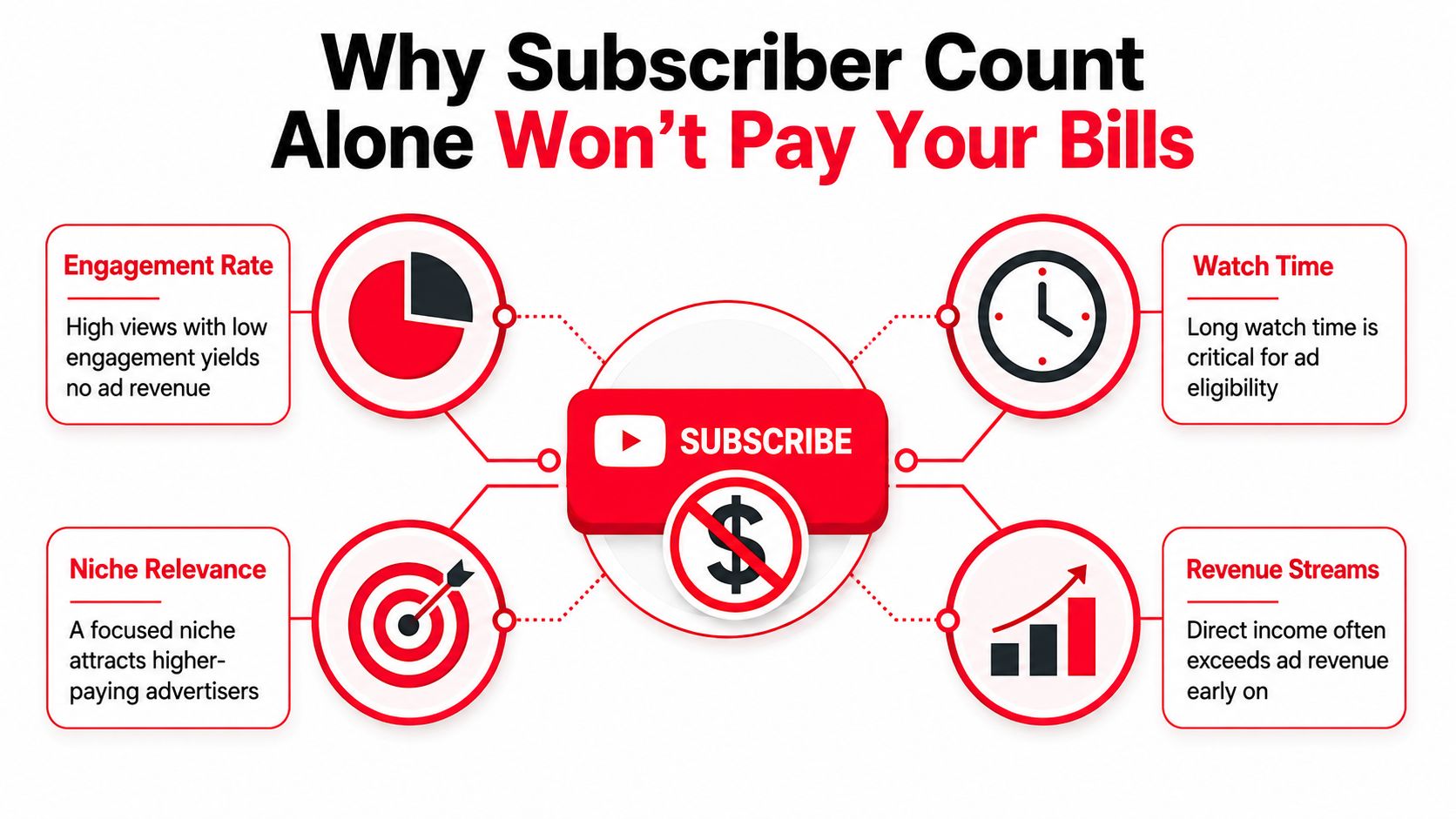
Subscribers represent people who chose to follow your channel. They don't represent how often those people watch, whether they watch long-form videos or Shorts, where they live, what advertisers value in your niche, or whether they ever click an offer. Those details shape revenue far more directly than the number displayed beneath your channel name.
YouTube's Partner Program has historically used 1,000 subscribers alongside either 4,000 valid public watch hours in the last 12 months or 10 million valid public Shorts views in the last 90 days for the full ad-revenue tier, as described in YouTube's official monetization documentation. Reaching the subscriber requirement is therefore only one part of eligibility.
Subscribers are an audience signal, not a paycheck
A subscriber may watch every upload, watch occasionally, or stop using YouTube altogether. The platform can't treat all subscribers as equally valuable because they don't create equal viewing activity. Advertisers and other buyers care about the viewers who watch, respond, click, and take action.
Your niche also changes the commercial value of attention. A focused channel that helps viewers make a purchase or solve a costly problem may have stronger opportunities than a broad channel with more subscribers but little buying intent. Geography, format, retention, and the mix between long-form videos and Shorts also affect which revenue options make sense.
Practical rule: Treat subscribers as an asset you're building, not as the revenue model itself.
You need a threshold and a vehicle
YouTube now separates access into two broad Partner Program stages. The earlier tier supports fan-funding and commerce features, while the higher tier adds ad and YouTube Premium revenue sharing. Off-platform options, including affiliate marketing, sponsorships, digital products, and services, don't depend on the same YouTube threshold.
That distinction changes your plan. Instead of waiting passively for 1,000 subscribers, decide whether your next goal is fan support, ad eligibility, product sales, client leads, or a combination. Each goal requires different content and a different call to action.
The Two Tiers of YouTube Monetization Explained
The useful question is not just how many subscribers you need to make money. It is which revenue path your channel is ready to access. YouTube's Partner Program has two main entry points: an earlier tier for fan support and selected commerce features, and a higher tier for advertising and YouTube Premium revenue sharing.
The earlier 500-subscriber tier
At 500 subscribers, creators may qualify for an earlier YPP tier that includes features such as Channel Memberships, Super Chat, and Super Thanks, subject to YouTube's eligibility rules and regional availability. The current requirements are outlined in YouTube's Partner Program eligibility guidance.
This tier also requires 3 public uploads in the last 90 days, plus either 3,000 public watch hours or 3 million valid public Shorts views. It suits channels with an active audience that is willing to provide direct support, even before the channel qualifies for ad revenue.
The distinction matters. A membership is recurring audience support, Super Chat is connected to live interaction, and Super Thanks lets viewers contribute on eligible published videos. Educators, commentators, and community-led channels may reach this stage with a smaller but more engaged audience.
The 1,000-subscriber ad-revenue tier
The familiar ad-revenue threshold requires 1,000 subscribers and either 4,000 valid public watch hours during the previous 12 months or 10 million valid public Shorts views during the previous 90 days, according to YouTube's official Help documentation. After YouTube reviews and accepts the channel, this tier can provide access to ad and YouTube Premium revenue sharing.
Subscriber count alone still does not qualify a channel. The relevant viewing threshold must also be met, and Shorts views do not convert into long-form watch hours. YouTube reviews content for compliance with its monetization policies, so reaching the displayed numbers does not guarantee approval.
The 2026 update for new applicants
As of August 2026, reporting indicates that YouTube announced a doubling of the activity requirement for new applicants seeking the full ad and Premium revenue tier. Under the reported change, applicants still need 1,000 subscribers, plus either 8,000 qualified public watch hours in the previous year or 20 million qualified public Shorts views in the previous 90 days. The change was reported as taking effect on February 1, 2027, in Forbes' coverage of the update.
The subscriber minimum stays the same. The activity requirement becomes the larger hurdle for new applicants, so creators planning around the older benchmarks should check the current figures in YouTube Studio before applying.
| Requirement | 500-Sub Tier | 1,000-Sub Tier |
|---|---|---|
| Subscriber threshold | 500 subscribers | 1,000 subscribers |
| Activity requirement | 3 public uploads in the last 90 days, plus either 3,000 watch hours or 3 million valid Shorts views | Historically, either 4,000 valid public watch hours in 12 months or 10 million valid public Shorts views in 90 days. For new applicants under the reported 2027 update, either 8,000 qualified public watch hours or 20 million qualified public Shorts views |
| Main features | Fan funding and selected commerce features | Ad and YouTube Premium revenue sharing, subject to approval |
| Best planning focus | Community participation and direct support | Sustained viewing activity and monetized reach |
A business-focused channel can also benefit from a practical YouTube monetization strategy for SMBs. Before applying, review channel status and available features with this guide to enabling YouTube monetization.
Every Revenue Stream Available to Creators
Advertising is only one part of a creator business. It can become useful at scale, but newer channels often have stronger control over revenue when they connect content to a product, service, or direct audience action.
Revenue streams on YouTube
Ad and Premium revenue depends on YPP eligibility, qualified viewing activity, content suitability, audience geography, and format. Long-form videos and Shorts operate differently, so creators shouldn't assume that a large view count produces the same result across both formats.
Channel Memberships let eligible viewers pay for recurring perks. This route suits channels with a strong community identity, such as teaching, commentary, gaming, and behind-the-scenes content. The offer must be specific enough that viewers understand what they receive.
Super Chat and Super Thanks support direct contributions from viewers. Live hosts can use Super Chat to acknowledge questions or comments, while Super Thanks gives viewers a way to support published videos. These features work best when the creator actively builds participation rather than just placing a donation button on screen.
YouTube Shopping and merchandise can connect product discovery with content. Reviews, tutorials, outfit videos, craft channels, and equipment-focused content can naturally support product recommendations or a merchandise shelf when the creator has access to the relevant features.
Revenue streams outside YouTube
Affiliate marketing pays when viewers purchase through tracked links. It's especially suitable for channels that review tools, software, cameras, books, fitness equipment, or other products that viewers already want to evaluate.
Brand sponsorships can work before or after YPP approval. Brands typically care about audience fit, content quality, trust, and the ability to deliver a relevant message. A smaller focused channel can be commercially useful when its viewers closely match a brand's customers.
Digital products include templates, presets, workbooks, ebooks, and courses. These products let an educator or specialist package knowledge instead of relying on every viewer becoming an advertiser impression.
Services such as coaching, consulting, editing, design, and freelance work can turn YouTube into a lead-generation channel. A tutorial can demonstrate your expertise while directing interested viewers to a booking page or inquiry form.
| Revenue Stream | Typical Earnings | Best For |
|---|---|---|
| Ads and YouTube Premium | Varies with qualified views, RPM, niche, geography, and format | Channels with sustained viewing activity |
| Memberships | Recurring viewer support tied to perks | Community-led channels |
| Super Chat and Super Thanks | Viewer contributions during lives or on videos | Interactive creators |
| Shopping and merchandise | Product or merchandise sales | Review, lifestyle, craft, and product-led channels |
| Sponsorships | Negotiated per campaign and deliverable | Focused audiences with strong brand fit |
| Affiliate marketing | Commission from tracked purchases | High-intent review and tutorial content |
| Digital products | Direct sales of owned resources | Educators and specialists |
| Services | Client revenue generated from content | Coaches, consultants, freelancers, and agencies |
Creators who want to compare different platforms and tools can browse creator revenue tools. The right mix depends on what your audience already asks for, not on which option sounds most familiar.
Realistic Revenue Per Subscriber Math With Examples
Subscriber math becomes useful only when it's connected to views and RPM. RPM is the revenue earned per 1,000 monetized views after the relevant platform share and adjustments. It isn't a fixed price for a subscriber, and it varies with niche, audience location, content format, seasonality, and advertiser demand.
The examples below are illustrative calculations, not earnings promises. They use the RPM and viewing assumptions stated in each example, so the arithmetic shows how the model works rather than predicting what any specific channel will earn.
Example one, a finance channel
Assume a finance creator averages 1,000 views per subscriber per year and has an RPM of $25. That produces:
- Views per subscriber: 1,000
- RPM: $25
- Estimated revenue: 1,000 ÷ 1,000 × $25, or $25 per subscriber per year
If the same creator averaged only 100 views per subscriber, the result would be lower even though the subscriber count stayed the same. The audience must keep watching for the subscriber base to translate into monetized views.
Example two, a gaming channel
Now assume a gaming channel has the same 1,000 annual views per subscriber, but an RPM of $4. The calculation is:
- Views per subscriber: 1,000
- RPM: $4
- Estimated revenue: 1,000 ÷ 1,000 × $4, or $4 per subscriber per year
This doesn't mean gaming channels can't earn well. It means ad revenue is only one variable. Sponsorships, memberships, live support, affiliate links, and products may matter more for a gaming creator than the ad figure alone.
Example three, a lifestyle channel
Suppose a lifestyle vlogger reaches 1,000 annual views per subscriber with an RPM of $8. The result is:
- Views per subscriber: 1,000
- RPM: $8
- Estimated revenue: 1,000 ÷ 1,000 × $8, or $8 per subscriber per year
A channel's geography can affect the result because advertisers value audiences differently across markets. A long-form audience that watches closely can also create a different outcome from a Shorts-heavy audience with rapid but brief viewing sessions.
| Niche | Avg RPM (USD) | Views per Subscriber/Year | Est. Earnings per Subscriber/Year |
|---|---|---|---|
| Finance | $25 | 1,000 | $25 |
| Gaming | $4 | 1,000 | $4 |
| Lifestyle | $8 | 1,000 | $8 |
Use this explanation of CPM meaning on YouTube to keep CPM and RPM separate when you review analytics. For planning, track total qualified views, average viewing behavior, audience geography, and conversions from non-ad offers. Subscriber count is the denominator in the conversation, not the complete calculation.
Common Misconceptions That Keep Creators Stuck
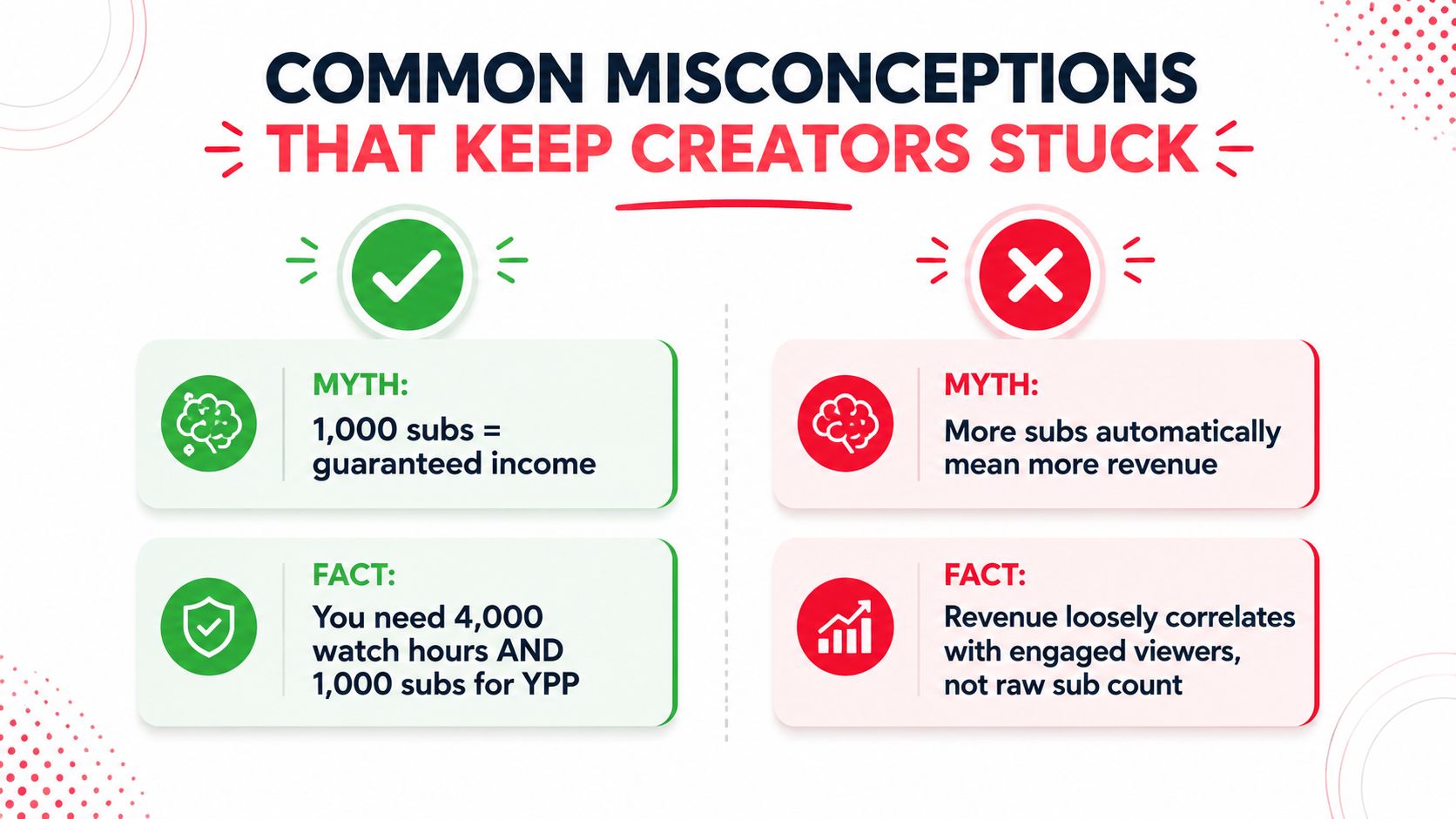
Subscriber count can open a monetization gate, but it does not make a channel profitable. YouTube Partner Program approval gives creators access to tools. Demand, strong videos, engaged viewers, and a relevant offer still determine whether those tools produce income.
Myth one, 1,000 subscribers guarantees income
Fact: The ad-revenue tier requires both the subscriber minimum and an activity threshold, followed by channel review. The earlier gate required 1,000 subscribers plus either 4,000 valid public watch hours or 10 million valid public Shorts views. As noted earlier, the updated requirement for new applicants raises the activity bar while keeping the subscriber minimum.
The lower tier changes the question. At 500 subscribers, eligible creators may access fan-funding features, but that is a different revenue path from ads. Reaching a subscriber milestone means you have crossed a gate, not that viewers will automatically pay.
Myth two, every subscriber has equal value
A subscriber who watches regularly contributes more to a channel's revenue system than an inactive subscriber. Returning viewers can build watch time, join live streams, respond to recommendations, and consider a product or affiliate offer.
Myth three, YPP approval equals profit
Approval provides access to monetization features, not a guaranteed business result. Limited viewing activity, weak commercial intent, or no clear offer can keep revenue modest even after approval.
Myth four, Shorts automatically provide the fastest path to ads
Shorts can help new viewers discover a channel, but their ad-revenue route has its own activity requirement. As reported earlier in this article, the updated requirement for new applicants is 20 million qualified Shorts views in the last 90 days. A Shorts strategy therefore needs more than reach. It should support retention, repeat viewing, and a revenue path that fits the audience.
A milestone tells you which gate you have crossed. It does not show whether the business behind the channel works.
How to Make Money Before You Reach YPP
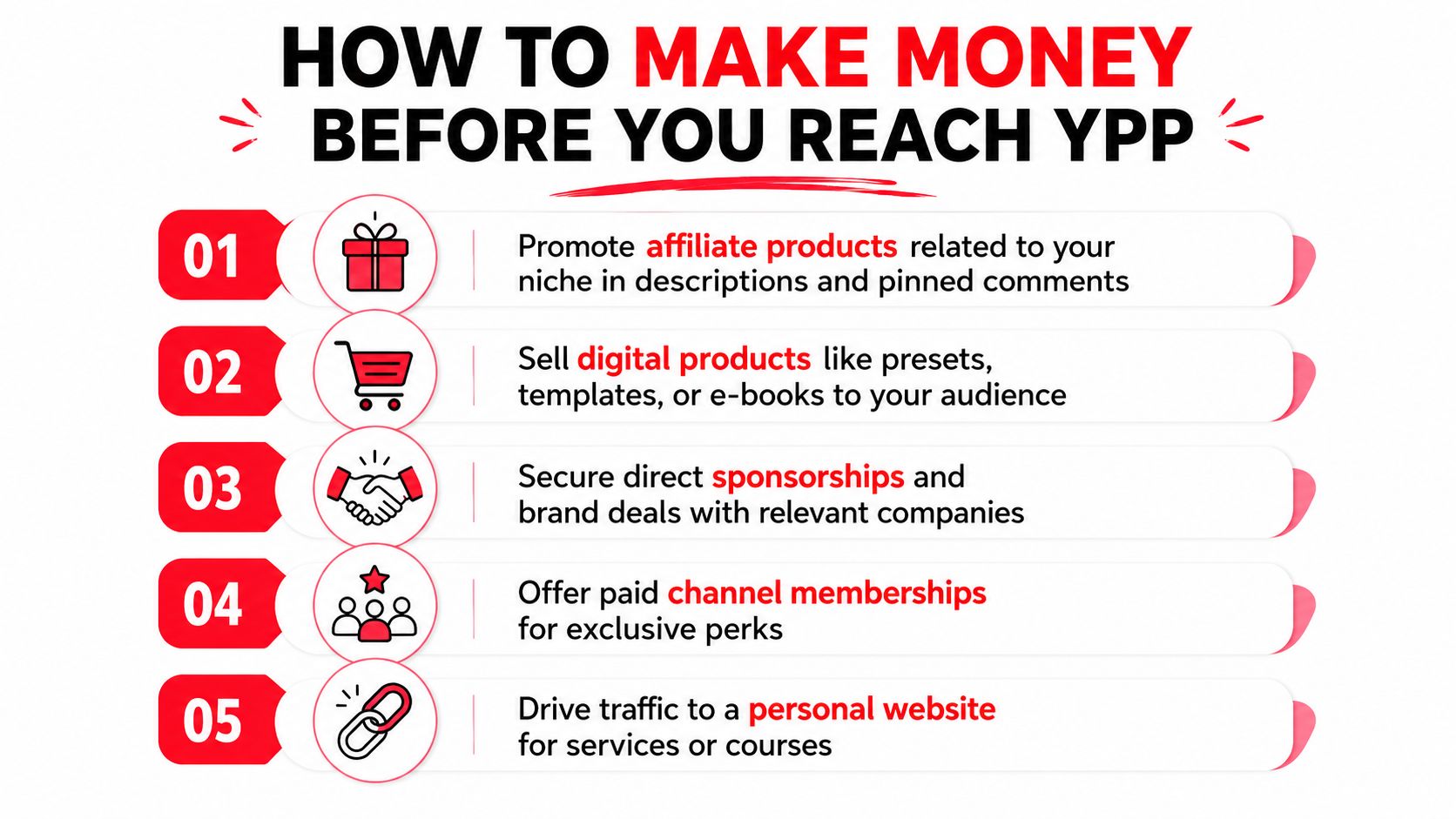
You don't need to wait for YPP approval to test whether your audience has commercial intent. The safest approach is to choose an offer that naturally follows from the problem your videos already solve.
Start with a relevant affiliate offer
A camera tutorial can point viewers toward equipment. A software walkthrough can use an affiliate link for the tool being demonstrated. Place the link in the description and, where appropriate, a pinned comment, then disclose the commercial relationship clearly.
Package knowledge into a digital product
Presets, templates, checklists, ebooks, and workbooks can give viewers a practical next step. A creator teaching job interviews might sell a preparation worksheet, while a design channel might offer editable templates. You don't need a huge audience if the product matches a specific need.
Turn expertise into a service
A YouTube channel can demonstrate how you think before a client ever contacts you. Coaches, editors, consultants, tutors, designers, and freelancers can use tutorials and breakdowns to attract people who need help beyond the free video.
Approach aligned sponsors directly
Small sponsorships can begin with a concise media kit, average-view context, audience description, and a clear proposal. Don't sell an arbitrary subscriber number. Sell a relevant audience, a credible format, and a deliverable the brand can understand.
Build an owned audience
An email list, website, or booking page gives viewers another way to stay connected. Your channel remains important, but you're less dependent on a single platform's eligibility rules or recommendation system.
| Route | First practical step | Strong fit |
|---|---|---|
| Affiliate links | Recommend products already demonstrated in videos | Review and tutorial channels |
| Digital products | Turn a repeated audience question into a useful resource | Educators and specialists |
| Services | Publish proof of expertise and add a clear inquiry path | Freelancers and consultants |
| Sponsorships | Contact brands with audience and content alignment | Niche channels |
| Email or website | Offer a useful reason to subscribe off-platform | Creators building a durable business |
Creators who are also growing professional audiences elsewhere may find ideas in this guide to lead generation for founders on X. For Shorts-specific publishing and revenue considerations, review this guide to making money on YouTube Shorts.
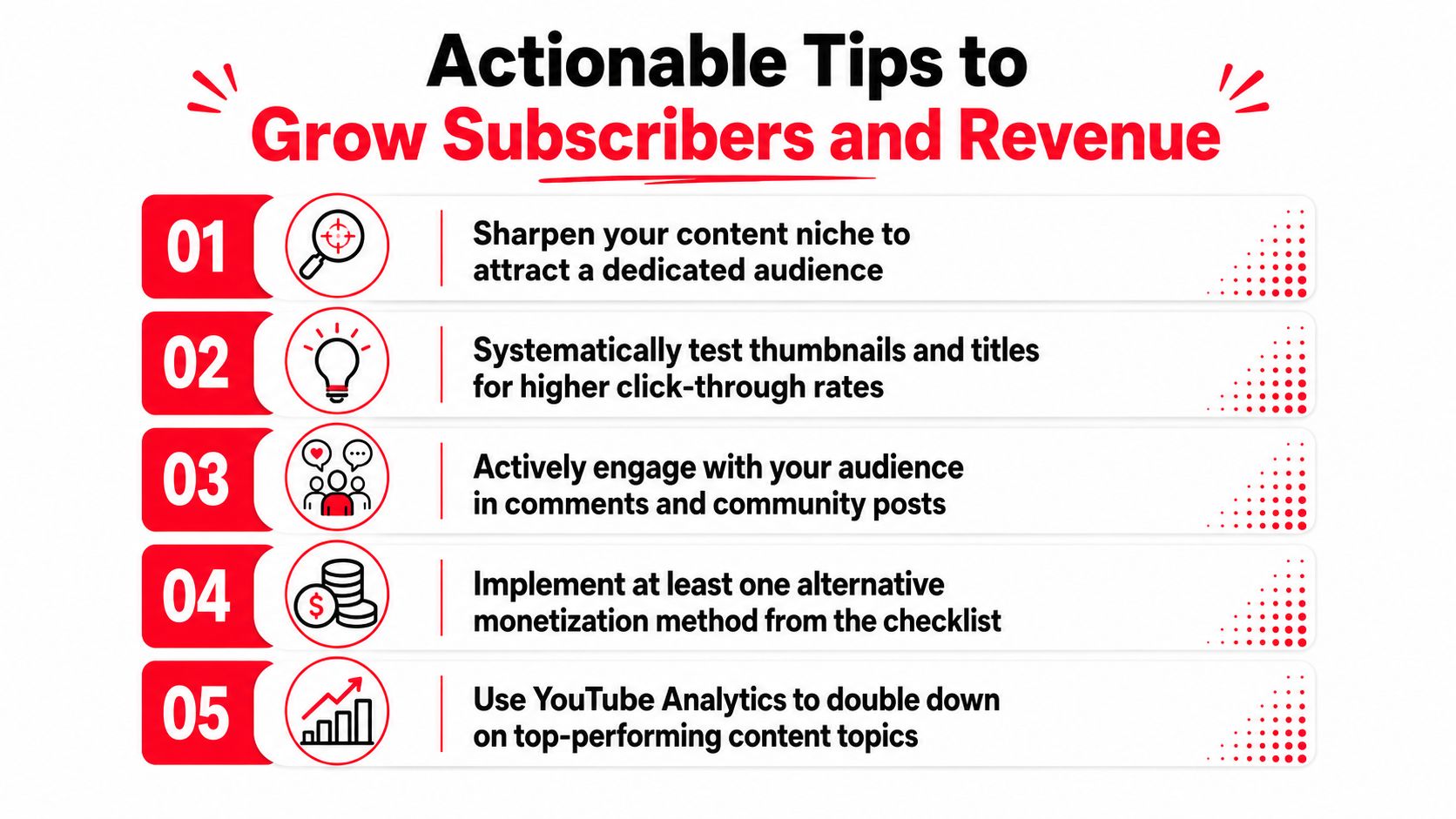
Actionable Tips to Grow Subscribers and Revenue
Growth works better when each content decision supports both audience development and a commercial goal. A video that attracts viewers but gives them no next step may grow the channel without strengthening the business.
1. Sharpen the niche
Choose a clear audience and recurring problem. “Fitness” is broad, while mobility routines for desk workers gives your titles, examples, products, and sponsorship choices a stronger direction. A focused promise helps viewers know why they should subscribe.
2. Test the packaging
Titles and thumbnails determine whether a strong video gets considered. Test a specific promise, remove unnecessary wording, and make the thumbnail communicate one idea. Use YouTube Studio to compare click-through rate with retention, because a high click rate paired with rapid abandonment signals a packaging mismatch.
3. Improve the first minutes
Open with the problem and the outcome. Remove long introductions, show the relevant result early, and use clear sections so viewers can follow the argument. Better retention supports watch-time growth and gives you more opportunities to introduce a related offer.
4. Balance Shorts with long-form
Shorts can help people discover your ideas, while long-form videos can provide room for tutorials, demonstrations, and stronger commercial context. Connect the formats deliberately. A Short about a common editing mistake can direct interested viewers to a full workflow video.
5. Use playlists and community posts
Organize related videos into a sequence that answers the next question. Community posts can prompt discussion, test future topics, and bring existing viewers back to the channel.
Track click-through rate, average view duration, returning viewers, subscriber conversion, and offer clicks in a consistent review routine. ViewsMax can create trackable links, connect clicks and sales to specific content, and show content performance alongside attributed revenue. Pair every growth experiment with a revenue experiment, even if the first result is only learning which audience problem creates the strongest response.
Choosing the Right Revenue Path for Your Channel
The right monetization path depends on what your viewers need and what your content can credibly deliver. A small education channel may earn earlier from a worksheet, course, or coaching service, while a larger gaming channel may have better alignment with memberships, live support, sponsorships, and affiliate links.
Use three questions to choose:
- What does my audience need next? Look at repeated comments, search questions, and requests for recommendations.
- What problem can I solve credibly? Your offer should extend the expertise shown in your videos.
- Which format supports the offer? Tutorials support products and services, live streams support direct fan funding, and reviews support affiliate sales and sponsorships.
A creator with a modest audience but strong purchase intent may be ready for affiliate marketing. A creator with an active live community may prioritize fan funding. A channel pursuing advertising must focus on the applicable YPP activity threshold as well as subscribers.
| Subscriber Tier | Best-Fit Revenue Stream | Secondary Option |
|---|---|---|
| Below 500 | Affiliate links, products, services, or sponsorship outreach | Email list and client leads |
| 500 subscribers, with required activity | Memberships, Super Chat, Super Thanks, and selected commerce features | Affiliate marketing or products |
| 1,000 subscribers, with required activity | Ads and YouTube Premium revenue sharing | Memberships, sponsorships, and affiliate sales |
| Above the ad-revenue threshold | A diversified revenue system | Products, services, sponsorships, and fan funding |
If you're asking how many subscribers on YouTube to make money, the honest answer is that no single number defines success. 500 subscribers can open an earlier YouTube fan-funding tier when the activity requirements are met. 1,000 subscribers remains the central subscriber requirement for the full ad-revenue tier, but new applicants must also meet the applicable watch-time or Shorts-view gate. Before either threshold, a relevant offer can turn engaged viewers into customers.
ViewsMax helps creators connect content with measurable commercial outcomes through trackable links, publishing workflows, and attribution for clicks, leads, and sales. Visit ViewsMax to see which videos are driving revenue, then use that evidence to plan your next growth and monetization decisions.