ViewsMax
Sign In Sign Up Free

Tag: youtube revenue

  • How to Earn Money from a YouTube Channel: Top 2026 Tips

    How to Earn Money from a YouTube Channel: Top 2026 Tips

    Most advice on how to earn money from a YouTube channel starts and ends with AdSense. That's a weak business plan. Platform advertising can provide a useful base, but a durable channel turns attention into several measurable outcomes, including sponsorship revenue, affiliate commissions, product sales, memberships, and qualified leads. The central question isn't “How many views did this video get?” It's “What did those views produce?”

    A profitable channel therefore needs two systems working together. You need YouTube's native monetization features, and you need an attribution process that connects specific videos to clicks, customers, and revenue. Views create opportunity, but tracking tells you where the opportunity exists.

    The First Gate: Qualifying for YouTube's Native Monetization

    YouTube Partner Program approval is a distribution advantage, not a business result. Before your channel can use YouTube's advertising and fan-funding features, it must qualify for the YouTube Partner Program, commonly called YPP. The standard route to direct ad and YouTube Premium revenue sharing requires 1,000 subscribers plus either 4,000 qualified public watch hours during the last 12 months or 10 million qualified Shorts views during the last 90 days, according to YouTube's current monetization guidance and the reported 2026 threshold update. Shorts views do not count toward the 4,000-hour long-form requirement. They are separate qualification paths.

    A person using a laptop to view the YouTube Studio monetization page with progress tracking subscriber requirements.

    YouTube also announced an updated path for new applicants in August 2026, requiring 1,000 subscribers plus 8,000 public watch hours or 20 million Shorts views for the latest partner-program expansion. Requirements can change, so check the Earn tab in YouTube Studio before using a specific threshold in your forecast. Treat the displayed eligibility criteria as the current operating requirement.

    Prepare the account before applying

    Eligibility is an operating checklist, not the point where revenue begins. Review the channel for reused material, copyright problems, misleading metadata, and content that may fail YouTube's monetization policies. A channel can reach the required audience milestones and still encounter review problems if its library lacks original, advertiser-suitable content.

    Set up an approved Google AdSense account when YouTube Studio requests it. Use accurate payment and tax information, then complete every verification step. Account delays can prevent a technically eligible channel from receiving payouts, so handle this work before meaningful revenue accumulates.

    For a practical setup walkthrough, follow this guide on how to enable YouTube monetization. Use it alongside the instructions shown in your own YouTube Studio account, since the platform's eligibility and setup screens determine what applies to your channel.

    Activate the features that fit your format

    After approval, open the monetization settings and review each feature separately.

    • Watch-page ads: Enable advertising on eligible long-form videos, then assess individual videos instead of applying every placement without considering viewer experience.
    • Shorts revenue sharing: Treat Shorts as a separate revenue model. Its pooled advertising system operates differently from watch-page advertising.
    • Channel Memberships: Offer recurring benefits that are simple to deliver, such as member-only posts, private discussions, or early access.
    • Super Chat and Super Stickers: Use these during live streams, where viewers can pay for participation, recognition, or direct attention.
    • Super Thanks: Give viewers a direct way to support published videos without waiting for a live broadcast.

    Standard long-form ad revenue is generally split 55% to the creator and 45% to YouTube, while Shorts creators receive 45% of the allocated advertising portion under the pooled Shorts model, as explained in YouTube's official revenue-sharing documentation. That difference should shape your publishing plan. Long-form videos can combine watch-page revenue with deeper audience trust, while Shorts can introduce new viewers who later convert through other offers.

    Practical rule: Apply for native monetization, then measure the revenue it produces. YPP gives you access to tools. Your broader business model determines their value.

    Building Your Income Portfolio Beyond AdSense

    AdSense is useful, but it shouldn't carry the entire business. A channel becomes more resilient when every major content theme has a logical next step, such as a relevant product recommendation, a sponsor integration, a paid resource, or a membership benefit.

    The right portfolio depends on your audience's intent. A product-review channel can often begin with affiliate links. A consultant or educator may earn more from a workshop, course, or service. A broad entertainment channel may have stronger options in sponsorships, memberships, merchandise, and live participation.

    Revenue Stream Typical Audience Size Income Potential Setup Effort
    Brand sponsorships An engaged niche audience High, especially through recurring partnerships Medium
    Affiliate marketing Viewers with purchase intent Performance-based and scalable Low to medium
    Merchandise A loyal community Moderate to high, depending on demand and margins Medium to high
    Digital products Viewers seeking a defined result High margin and closely tied to expertise High
    Memberships and live support A committed returning audience Recurring and community-driven Medium

    Sponsorships create larger individual transactions

    A one-off integration pays for a deliverable. A long-term partnership can give the brand a dependable place in your content calendar and give you more predictable income. Start by identifying companies that already serve the problem your audience is trying to solve. Relevance matters more than prestige because a mismatched sponsor can reduce trust and weaken future conversions.

    Your proposal should describe the audience, the content environment, the deliverable, the distribution plan, and the reporting you'll provide. Don't sell raw exposure alone. Sell a credible path to awareness, consideration, trial, or purchase.

    Affiliates turn recommendations into performance revenue

    Affiliate marketing works when the product fits the video so naturally that the recommendation improves the viewer's next step. Demonstrate the product, explain who should use it, disclose the relationship clearly, and send viewers to a trackable destination.

    Independent benchmarks suggest description-link click-through rates of about 0.5% to 3% of video views, while affiliate revenue can represent 10% to 30% of total brand-deal income for established mid-tier creators, according to benchmarks for YouTube influencer and affiliate activity. These figures are benchmarks, not guarantees. Your topic, audience intent, offer, placement, and landing page determine the result.

    Shorts can support this system by introducing a product or problem, but the conversion path must remain clear. For format-specific ideas, review how to make money on YouTube Shorts. If your channel has a strong recurring format, you can also repurpose episodes into audio. This guide to turning a YouTube channel into a podcast offers useful context for extending your content into another distribution channel.

    Products and merchandise deepen ownership

    Merchandise works best when it expresses an inside reference, identity, or practical need that already exists in the community. Don't begin with a warehouse of inventory. Test demand with a small, focused range, and calculate production, fulfillment, refunds, platform fees, and customer support before setting a price.

    Digital products offer a different trade-off. A course, template, ebook, or paid workshop can convert expertise into an owned asset, but it requires a clear promise and customer support. Build it from repeated questions in comments, livestreams, and emails. A product that solves one specific problem usually sells more clearly than a broad library of information.

    The Art of the Pitch Securing High-Value Brand Deals

    Brands rarely choose a creator because of subscriber count alone. They want a credible audience, a safe content environment, a clear audience fit, and evidence that the creator can deliver professionally. Your job is to make those factors easy to evaluate.

    Choose partners before writing the email

    Create a prospect list from products you already use, companies your viewers mention, and businesses serving the same problem as your channel. Study the brand's existing creator campaigns, landing pages, customer language, and content restrictions. Then identify the person responsible for influencer partnerships, content marketing, or creator relations instead of sending an unpersonalized message to a general inbox.

    Your media kit should answer practical questions quickly:

    • Audience profile: Explain who watches, what they care about, and what buying context surrounds your videos.
    • Content examples: Link to relevant videos that demonstrate your presentation style and audience response.
    • Available deliverables: List integrations, dedicated videos, live mentions, community posts, or cross-platform packages.
    • Measurement plan: Describe how you'll report publication, clicks, engagement, or other agreed outcomes.
    • Commercial terms: State that usage rights, exclusivity, revisions, and payment terms require separate agreement.

    A six-step checklist infographic illustrating the process of securing and managing successful brand deals as a creator.

    A 2025 creator-economy report found that 62% of creators said they earned more from brand partnerships than from ad revenue, compared with 41% in 2023, as reported by InfluenceFlow's creator monetization analysis. That shift makes proactive outreach worthwhile, particularly for channels with a well-defined niche and a professional sales process.

    Use a pitch that makes the next step easy

    Your email should be brief, specific, and built around mutual fit. Adapt this template rather than copying it without research:

    Subject: Partnership idea for [Brand] and [Channel]

    Hi [Name],

    I run [Channel], where I help [specific audience] with [specific topic or outcome]. I'm reaching out because [Brand] fits the way my viewers already think about [relevant problem or use case].

    A recent video about [topic] shows how I explain this subject and how viewers respond to practical recommendations. I'd like to propose [specific deliverable], with [brief description of integration and viewer benefit]. I can also provide [trackable link, campaign recap, or additional placement] so we can evaluate the response.

    Would you be open to a short conversation about the campaign objective, deliverables, timing, and usage terms? I've attached my media kit with audience information and relevant examples.

    Best,
    [Name]
    [Channel]
    [Contact details]

    Don't promise sales you can't control. Promise a well-matched audience, strong execution, transparent reporting, and a clear process. After the campaign, send the agreed report promptly, ask for feedback, and record what the brand valued. That record becomes evidence for the next pitch and a foundation for a renewal.

    Optimizing Your Channel for Maximum Revenue

    Revenue optimization starts with audience value, not video length by itself. CPM describes advertiser cost around ad impressions, while RPM is closer to what the creator earns per 1,000 views after the relevant revenue factors. Both vary with niche, geography, format, audience behavior, and the commercial intent surrounding the content.

    Industry benchmarks place long-form creator RPM at roughly $1.65 to $25 per 1,000 views, while Shorts are estimated at about $0.02 to $0.12 RPM, according to creator-economy RPM benchmarks. On that benchmark range, one million long-form views could generate $1,650 to $24,750, while one million Shorts views could generate $20 to $120. These aren't promises. They illustrate why a view count without format and revenue context can mislead you.

    Improve the economics of long-form content

    Choose topics where viewers have a meaningful reason to act. A tutorial for a professional tool, a detailed comparison, or a solution-led review can support advertising, affiliates, sponsorships, and products at the same time. The topic should serve the viewer first, but its commercial context should be clear before you spend time producing it.

    Watch time matters because a viewer who stays longer has more opportunity to understand the idea, trust the presenter, and encounter an appropriate monetization point. Build the video around a clear promise, show progress early, remove repeated explanations, and place the most useful proof before the conclusion. Longer videos only help when the additional minutes earn attention.

    Use YouTube Analytics to compare audience retention, returning viewers, traffic sources, RPM, clicks, and downstream actions. Publishing at a time your audience is available can help the initial distribution, and this guide to maximizing YouTube views for creators provides planning context. Timing won't rescue an unclear title or weak opening, so treat it as a supporting variable.

    Give Shorts a defined job

    Shorts can be valuable even when their direct payout is modest. Use them to test hooks, introduce a recurring problem, answer one narrow question, and point interested viewers toward a related long-form video or offer. The handoff must be explicit. A viewer who watches a Short should know what to do next.

    A useful content chain might begin with a Short showing a common mistake, continue with a long-form tutorial explaining the fix, and finish with a trackable resource or product recommendation. This approach treats Shorts as discovery and long-form as deeper engagement and revenue capture.

    For broader search and packaging improvements, use these YouTube SEO optimization tips. Focus on the promise in the title and thumbnail, the answer delivered in the video, and the next action connected to the viewer's intent. Don't optimize keywords in isolation from the buying or learning journey.

    Audience-depth test: If a video attracts attention but gives viewers no relevant next step, it may be growing the channel without building the business.

    From Views to Sales: Measuring What Works

    Views measure exposure. Sales measure business results. The gap between them is an observable sequence: a viewer notices a recommendation, clicks a link, reaches the offer, and completes an action. Tracking that sequence shows whether a video merits another production cycle or delivered reach without commercial value.

    Give each important content asset its own trackable destination. Use separate links for a tutorial, review, livestream, and Short, even when they promote the same offer. Record the video title, publication date, topic, placement, offer, clicks, leads, sales, commissions, refunds, and net revenue. This record lets you compare content by attributable return rather than audience size alone.

    Description-link performance varies by channel, so treat any outside benchmark as a diagnostic prompt rather than a target. Your own conversion data matters more. Separate formats in revenue analysis because long-form watch-page advertising and Shorts revenue use different sharing structures, as noted earlier.

    Build a repeatable attribution workflow

    Put the call to action where viewers have enough context to care. An offer at the end may suit a warm audience, while a tutorial may perform better when its relevant resource appears immediately after the problem is demonstrated. Keep one primary action per video where possible, and state exactly what the viewer receives after clicking.

    ViewsMax can create trackable links, connect clicks, leads, and sales to the content that generated them, and organize publishing and performance data in one dashboard. Use it with your affiliate platform, store, course checkout, or customer relationship system. It should support those systems, not replace their transaction records.

    The video below offers another practical way to connect published content with measurable performance.

    Review revenue per video, revenue per click, lead quality, conversion rate, and production effort. A video with fewer views may deserve more investment if it generates qualified customers. A viral upload may need a clearer path to the offer before it produces meaningful revenue.

    Attribution also improves editorial decisions. Compare related videos by the action they generate, then preserve the topics, formats, and offers that produce profitable customers. If clicks are strong but sales are weak, inspect the landing page or offer. If views are high but clicks are scarce, revise the placement, promise, or call to action. Each result points to a different fix.

    Common Monetization Pitfalls and How to Avoid Them

    A creator can publish consistently, reach the YPP threshold, and still build a fragile business. The problems usually appear in the gap between audience growth and commercial design.

    Depending on one platform payout

    A channel owner watches monthly ad revenue fluctuate and responds by publishing more of the same content. That may increase workload without improving business stability. Advertising remains one income stream, but sponsorships, affiliates, products, memberships, and services can give the audience more ways to support the channel.

    Build the second stream before the first one becomes essential. Choose the option that matches existing viewer intent, then use relevant videos to test it. A finance educator might begin with a paid template, while a gear reviewer might begin with carefully selected affiliate recommendations.

    Mentioning an offer without giving viewers a reason to click

    “Check the link below” is not a persuasive call to action. It doesn't tell viewers what they'll receive, who it's for, or why they should act now.

    Replace it with a concrete instruction: explain the resource, connect it to the problem in the video, and make the destination easy to identify. Keep the link near the top of the description when it's the primary next step, and use a distinct tracking link so you can evaluate the result.

    Chasing unrelated viral topics

    A creator sees a trend outside the channel's subject, publishes a rushed response, and attracts viewers who never return for the core content. The view count looks positive, but the audience fit weakens and the commercial path becomes harder to define.

    Use trends only when they reveal something useful to your existing audience. Adapt the topic to your established promise, or treat it as an experiment with a clear success criterion beyond reach.

    Underpricing sponsorships

    A creator accepts the first offer without discussing usage rights, exclusivity, revisions, placement, or reporting. The sponsor gains broader access than expected, while the creator absorbs extra work without matching compensation.

    Separate the creative deliverable from the rights attached to it. Ask what the brand can reuse, where it can run the content, how long the agreement lasts, and whether competitors are restricted. Put every agreed term in writing before production begins.

    Commercial discipline: Never evaluate a sponsorship only by the fee. Evaluate the work required, the rights granted, the audience fit, and the opportunity cost of occupying that publishing slot.

    Publishing without learning from the result

    Some creators review views and likes, then immediately plan the next upload. That routine misses the information that makes growth more efficient. Compare the topic, format, audience retention, calls to action, clicks, leads, sales, and net revenue across videos.

    The goal isn't to turn every upload into a sales pitch. It's to understand which videos attract the right viewers, which ones build trust, and which ones produce measurable business outcomes. Once you know that pattern, you can create more deliberately and stop rewarding empty reach.


    ViewsMax helps creators plan content, publish across channels, and track clicks, leads, and sales back to the specific content that generated them. Visit ViewsMax to connect your YouTube publishing decisions with attributable revenue and identify which videos are selling.

  • How Many Subscribers on YouTube to Make Money in 2026

    How Many Subscribers on YouTube to Make Money in 2026

    The most common answer to how many subscribers on YouTube to make money is “1,000.” That answer is incomplete. YouTube doesn't turn on every revenue source the moment a channel reaches a subscriber milestone, and subscriber count alone doesn't guarantee income.

    The more useful question is: which revenue path are you trying to pursue? Fan funding, advertising, affiliate sales, sponsorships, products, and services all work differently. A channel can start earning through some routes before it qualifies for YouTube ad revenue, while a channel with 1,000 subscribers can still be waiting for approval or missing the required watch-time activity.

    Why Subscriber Count Alone Won't Pay Your Bills

    Subscribers represent people who chose to follow your channel. They don't represent how often those people watch, whether they watch long-form videos or Shorts, where they live, what advertisers value in your niche, or whether they ever click an offer. Those details shape revenue far more directly than the number displayed beneath your channel name.

    YouTube's Partner Program has historically used 1,000 subscribers alongside either 4,000 valid public watch hours in the last 12 months or 10 million valid public Shorts views in the last 90 days for the full ad-revenue tier, as described in YouTube's official monetization documentation. Reaching the subscriber requirement is therefore only one part of eligibility.
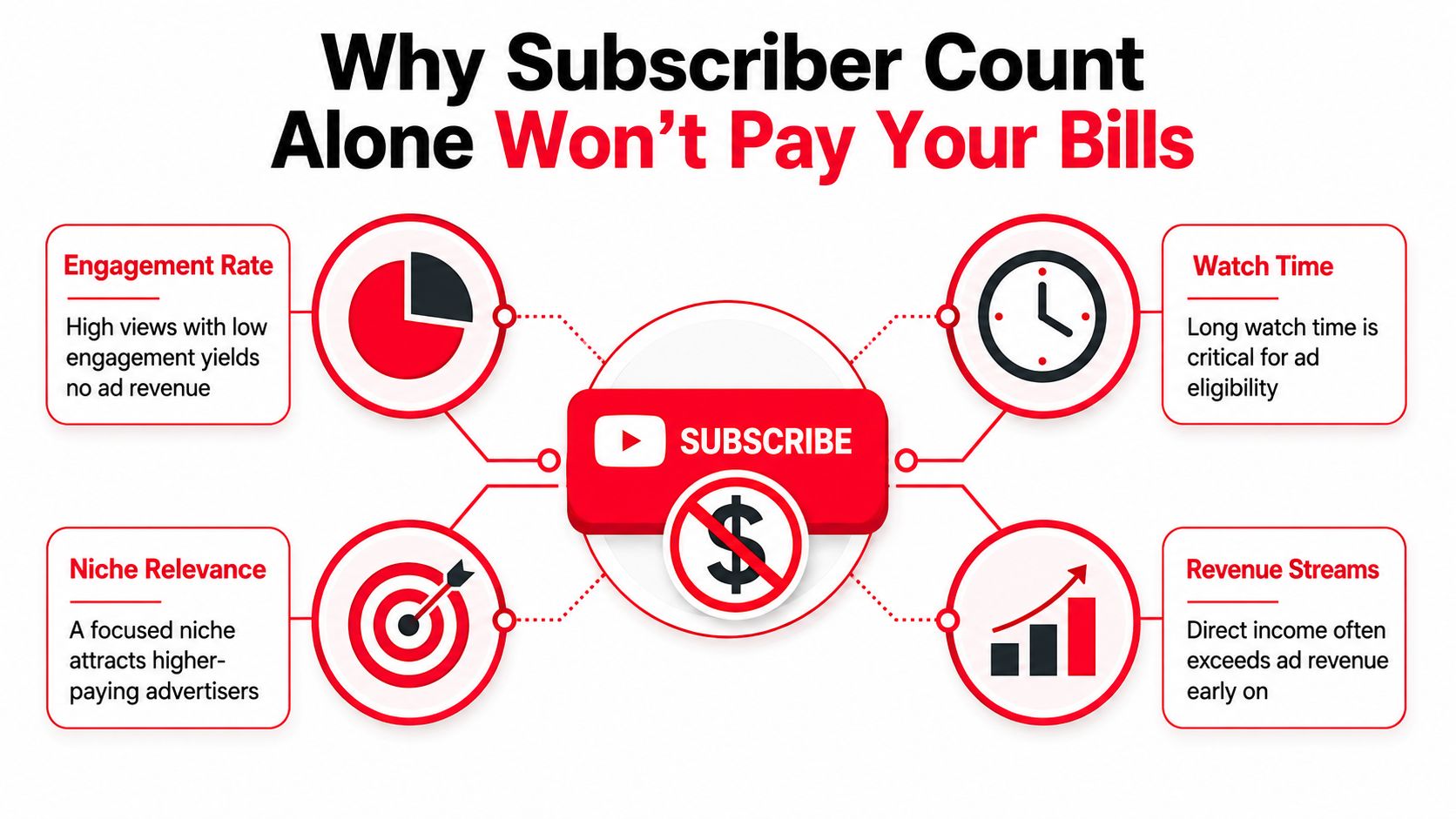
    An infographic titled Why Subscriber Count Alone Won't Pay Your Bills, illustrating key YouTube monetization factors.

    Subscribers are an audience signal, not a paycheck

    A subscriber may watch every upload, watch occasionally, or stop using YouTube altogether. The platform can't treat all subscribers as equally valuable because they don't create equal viewing activity. Advertisers and other buyers care about the viewers who watch, respond, click, and take action.

    Your niche also changes the commercial value of attention. A focused channel that helps viewers make a purchase or solve a costly problem may have stronger opportunities than a broad channel with more subscribers but little buying intent. Geography, format, retention, and the mix between long-form videos and Shorts also affect which revenue options make sense.

    Practical rule: Treat subscribers as an asset you're building, not as the revenue model itself.

    You need a threshold and a vehicle

    YouTube now separates access into two broad Partner Program stages. The earlier tier supports fan-funding and commerce features, while the higher tier adds ad and YouTube Premium revenue sharing. Off-platform options, including affiliate marketing, sponsorships, digital products, and services, don't depend on the same YouTube threshold.

    That distinction changes your plan. Instead of waiting passively for 1,000 subscribers, decide whether your next goal is fan support, ad eligibility, product sales, client leads, or a combination. Each goal requires different content and a different call to action.

    The Two Tiers of YouTube Monetization Explained

    The useful question is not just how many subscribers you need to make money. It is which revenue path your channel is ready to access. YouTube's Partner Program has two main entry points: an earlier tier for fan support and selected commerce features, and a higher tier for advertising and YouTube Premium revenue sharing.

    The earlier 500-subscriber tier

    At 500 subscribers, creators may qualify for an earlier YPP tier that includes features such as Channel Memberships, Super Chat, and Super Thanks, subject to YouTube's eligibility rules and regional availability. The current requirements are outlined in YouTube's Partner Program eligibility guidance.

    This tier also requires 3 public uploads in the last 90 days, plus either 3,000 public watch hours or 3 million valid public Shorts views. It suits channels with an active audience that is willing to provide direct support, even before the channel qualifies for ad revenue.

    The distinction matters. A membership is recurring audience support, Super Chat is connected to live interaction, and Super Thanks lets viewers contribute on eligible published videos. Educators, commentators, and community-led channels may reach this stage with a smaller but more engaged audience.

    The 1,000-subscriber ad-revenue tier

    The familiar ad-revenue threshold requires 1,000 subscribers and either 4,000 valid public watch hours during the previous 12 months or 10 million valid public Shorts views during the previous 90 days, according to YouTube's official Help documentation. After YouTube reviews and accepts the channel, this tier can provide access to ad and YouTube Premium revenue sharing.

    Subscriber count alone still does not qualify a channel. The relevant viewing threshold must also be met, and Shorts views do not convert into long-form watch hours. YouTube reviews content for compliance with its monetization policies, so reaching the displayed numbers does not guarantee approval.

    The 2026 update for new applicants

    As of August 2026, reporting indicates that YouTube announced a doubling of the activity requirement for new applicants seeking the full ad and Premium revenue tier. Under the reported change, applicants still need 1,000 subscribers, plus either 8,000 qualified public watch hours in the previous year or 20 million qualified public Shorts views in the previous 90 days. The change was reported as taking effect on February 1, 2027, in Forbes' coverage of the update.

    The subscriber minimum stays the same. The activity requirement becomes the larger hurdle for new applicants, so creators planning around the older benchmarks should check the current figures in YouTube Studio before applying.

    Requirement 500-Sub Tier 1,000-Sub Tier
    Subscriber threshold 500 subscribers 1,000 subscribers
    Activity requirement 3 public uploads in the last 90 days, plus either 3,000 watch hours or 3 million valid Shorts views Historically, either 4,000 valid public watch hours in 12 months or 10 million valid public Shorts views in 90 days. For new applicants under the reported 2027 update, either 8,000 qualified public watch hours or 20 million qualified public Shorts views
    Main features Fan funding and selected commerce features Ad and YouTube Premium revenue sharing, subject to approval
    Best planning focus Community participation and direct support Sustained viewing activity and monetized reach

    A business-focused channel can also benefit from a practical YouTube monetization strategy for SMBs. Before applying, review channel status and available features with this guide to enabling YouTube monetization.

    Every Revenue Stream Available to Creators

    Advertising is only one part of a creator business. It can become useful at scale, but newer channels often have stronger control over revenue when they connect content to a product, service, or direct audience action.

    Revenue streams on YouTube

    Ad and Premium revenue depends on YPP eligibility, qualified viewing activity, content suitability, audience geography, and format. Long-form videos and Shorts operate differently, so creators shouldn't assume that a large view count produces the same result across both formats.

    Channel Memberships let eligible viewers pay for recurring perks. This route suits channels with a strong community identity, such as teaching, commentary, gaming, and behind-the-scenes content. The offer must be specific enough that viewers understand what they receive.

    Super Chat and Super Thanks support direct contributions from viewers. Live hosts can use Super Chat to acknowledge questions or comments, while Super Thanks gives viewers a way to support published videos. These features work best when the creator actively builds participation rather than just placing a donation button on screen.

    YouTube Shopping and merchandise can connect product discovery with content. Reviews, tutorials, outfit videos, craft channels, and equipment-focused content can naturally support product recommendations or a merchandise shelf when the creator has access to the relevant features.

    Revenue streams outside YouTube

    Affiliate marketing pays when viewers purchase through tracked links. It's especially suitable for channels that review tools, software, cameras, books, fitness equipment, or other products that viewers already want to evaluate.

    Brand sponsorships can work before or after YPP approval. Brands typically care about audience fit, content quality, trust, and the ability to deliver a relevant message. A smaller focused channel can be commercially useful when its viewers closely match a brand's customers.

    Digital products include templates, presets, workbooks, ebooks, and courses. These products let an educator or specialist package knowledge instead of relying on every viewer becoming an advertiser impression.

    Services such as coaching, consulting, editing, design, and freelance work can turn YouTube into a lead-generation channel. A tutorial can demonstrate your expertise while directing interested viewers to a booking page or inquiry form.

    Revenue Stream Typical Earnings Best For
    Ads and YouTube Premium Varies with qualified views, RPM, niche, geography, and format Channels with sustained viewing activity
    Memberships Recurring viewer support tied to perks Community-led channels
    Super Chat and Super Thanks Viewer contributions during lives or on videos Interactive creators
    Shopping and merchandise Product or merchandise sales Review, lifestyle, craft, and product-led channels
    Sponsorships Negotiated per campaign and deliverable Focused audiences with strong brand fit
    Affiliate marketing Commission from tracked purchases High-intent review and tutorial content
    Digital products Direct sales of owned resources Educators and specialists
    Services Client revenue generated from content Coaches, consultants, freelancers, and agencies

    Creators who want to compare different platforms and tools can browse creator revenue tools. The right mix depends on what your audience already asks for, not on which option sounds most familiar.

    Realistic Revenue Per Subscriber Math With Examples

    Subscriber math becomes useful only when it's connected to views and RPM. RPM is the revenue earned per 1,000 monetized views after the relevant platform share and adjustments. It isn't a fixed price for a subscriber, and it varies with niche, audience location, content format, seasonality, and advertiser demand.

    The examples below are illustrative calculations, not earnings promises. They use the RPM and viewing assumptions stated in each example, so the arithmetic shows how the model works rather than predicting what any specific channel will earn.

    Example one, a finance channel

    Assume a finance creator averages 1,000 views per subscriber per year and has an RPM of $25. That produces:

    • Views per subscriber: 1,000
    • RPM: $25
    • Estimated revenue: 1,000 ÷ 1,000 × $25, or $25 per subscriber per year

    If the same creator averaged only 100 views per subscriber, the result would be lower even though the subscriber count stayed the same. The audience must keep watching for the subscriber base to translate into monetized views.

    Example two, a gaming channel

    Now assume a gaming channel has the same 1,000 annual views per subscriber, but an RPM of $4. The calculation is:

    • Views per subscriber: 1,000
    • RPM: $4
    • Estimated revenue: 1,000 ÷ 1,000 × $4, or $4 per subscriber per year

    This doesn't mean gaming channels can't earn well. It means ad revenue is only one variable. Sponsorships, memberships, live support, affiliate links, and products may matter more for a gaming creator than the ad figure alone.

    Example three, a lifestyle channel

    Suppose a lifestyle vlogger reaches 1,000 annual views per subscriber with an RPM of $8. The result is:

    • Views per subscriber: 1,000
    • RPM: $8
    • Estimated revenue: 1,000 ÷ 1,000 × $8, or $8 per subscriber per year

    A channel's geography can affect the result because advertisers value audiences differently across markets. A long-form audience that watches closely can also create a different outcome from a Shorts-heavy audience with rapid but brief viewing sessions.

    Niche Avg RPM (USD) Views per Subscriber/Year Est. Earnings per Subscriber/Year
    Finance $25 1,000 $25
    Gaming $4 1,000 $4
    Lifestyle $8 1,000 $8

    Use this explanation of CPM meaning on YouTube to keep CPM and RPM separate when you review analytics. For planning, track total qualified views, average viewing behavior, audience geography, and conversions from non-ad offers. Subscriber count is the denominator in the conversation, not the complete calculation.

    Common Misconceptions That Keep Creators Stuck

    Subscriber count can open a monetization gate, but it does not make a channel profitable. YouTube Partner Program approval gives creators access to tools. Demand, strong videos, engaged viewers, and a relevant offer still determine whether those tools produce income.
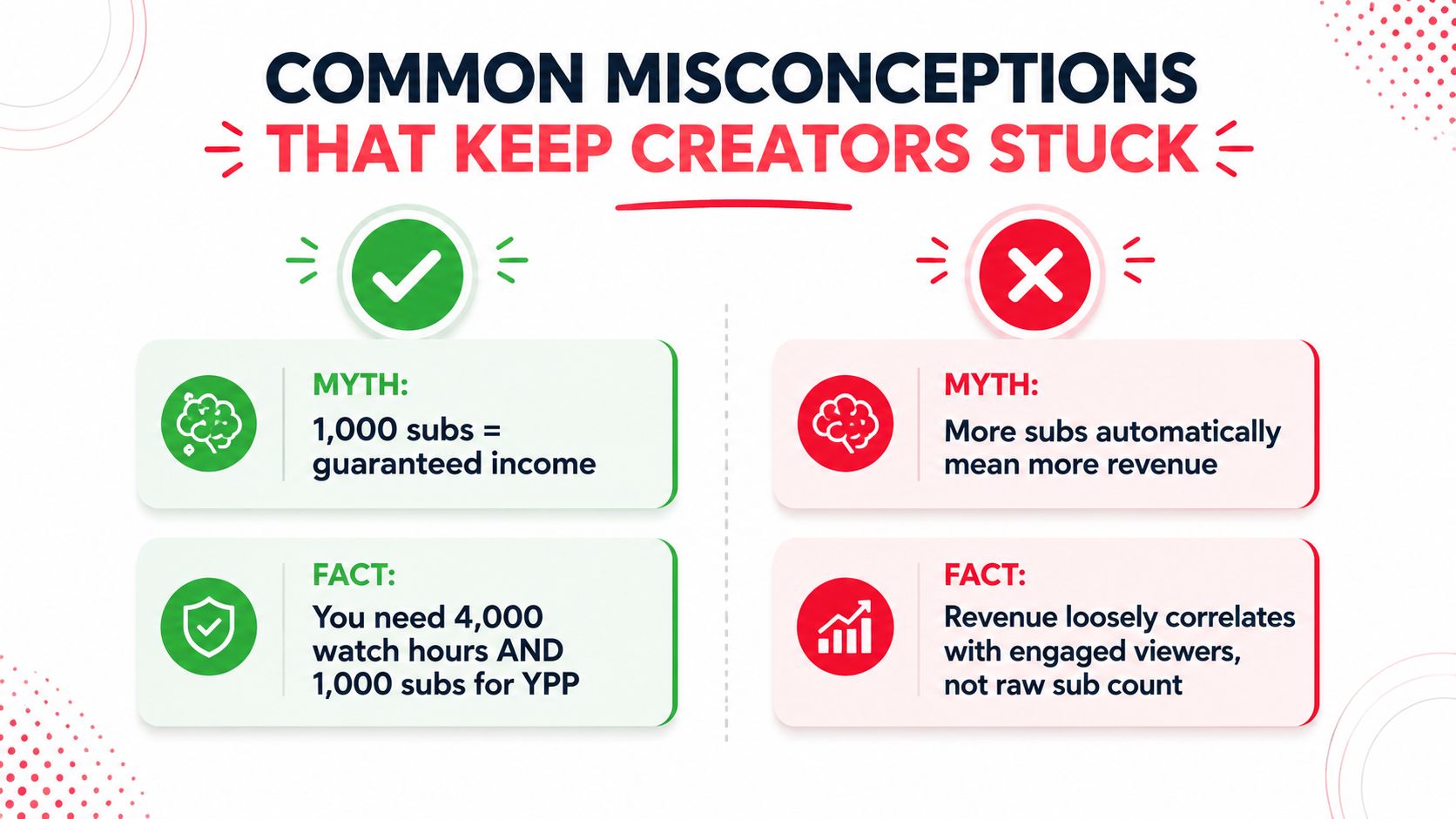
    An infographic showing common misconceptions for YouTube creators regarding subscriber counts and revenue generation requirements.

    Myth one, 1,000 subscribers guarantees income

    Fact: The ad-revenue tier requires both the subscriber minimum and an activity threshold, followed by channel review. The earlier gate required 1,000 subscribers plus either 4,000 valid public watch hours or 10 million valid public Shorts views. As noted earlier, the updated requirement for new applicants raises the activity bar while keeping the subscriber minimum.

    The lower tier changes the question. At 500 subscribers, eligible creators may access fan-funding features, but that is a different revenue path from ads. Reaching a subscriber milestone means you have crossed a gate, not that viewers will automatically pay.

    Myth two, every subscriber has equal value

    A subscriber who watches regularly contributes more to a channel's revenue system than an inactive subscriber. Returning viewers can build watch time, join live streams, respond to recommendations, and consider a product or affiliate offer.

    Myth three, YPP approval equals profit

    Approval provides access to monetization features, not a guaranteed business result. Limited viewing activity, weak commercial intent, or no clear offer can keep revenue modest even after approval.

    Myth four, Shorts automatically provide the fastest path to ads

    Shorts can help new viewers discover a channel, but their ad-revenue route has its own activity requirement. As reported earlier in this article, the updated requirement for new applicants is 20 million qualified Shorts views in the last 90 days. A Shorts strategy therefore needs more than reach. It should support retention, repeat viewing, and a revenue path that fits the audience.

    A milestone tells you which gate you have crossed. It does not show whether the business behind the channel works.

    How to Make Money Before You Reach YPP

    You don't need to wait for YPP approval to test whether your audience has commercial intent. The safest approach is to choose an offer that naturally follows from the problem your videos already solve.

    Start with a relevant affiliate offer

    A camera tutorial can point viewers toward equipment. A software walkthrough can use an affiliate link for the tool being demonstrated. Place the link in the description and, where appropriate, a pinned comment, then disclose the commercial relationship clearly.

    Package knowledge into a digital product

    Presets, templates, checklists, ebooks, and workbooks can give viewers a practical next step. A creator teaching job interviews might sell a preparation worksheet, while a design channel might offer editable templates. You don't need a huge audience if the product matches a specific need.

    Turn expertise into a service

    A YouTube channel can demonstrate how you think before a client ever contacts you. Coaches, editors, consultants, tutors, designers, and freelancers can use tutorials and breakdowns to attract people who need help beyond the free video.

    Approach aligned sponsors directly

    Small sponsorships can begin with a concise media kit, average-view context, audience description, and a clear proposal. Don't sell an arbitrary subscriber number. Sell a relevant audience, a credible format, and a deliverable the brand can understand.

    Build an owned audience

    An email list, website, or booking page gives viewers another way to stay connected. Your channel remains important, but you're less dependent on a single platform's eligibility rules or recommendation system.

    Route First practical step Strong fit
    Affiliate links Recommend products already demonstrated in videos Review and tutorial channels
    Digital products Turn a repeated audience question into a useful resource Educators and specialists
    Services Publish proof of expertise and add a clear inquiry path Freelancers and consultants
    Sponsorships Contact brands with audience and content alignment Niche channels
    Email or website Offer a useful reason to subscribe off-platform Creators building a durable business

    Creators who are also growing professional audiences elsewhere may find ideas in this guide to lead generation for founders on X. For Shorts-specific publishing and revenue considerations, review this guide to making money on YouTube Shorts.
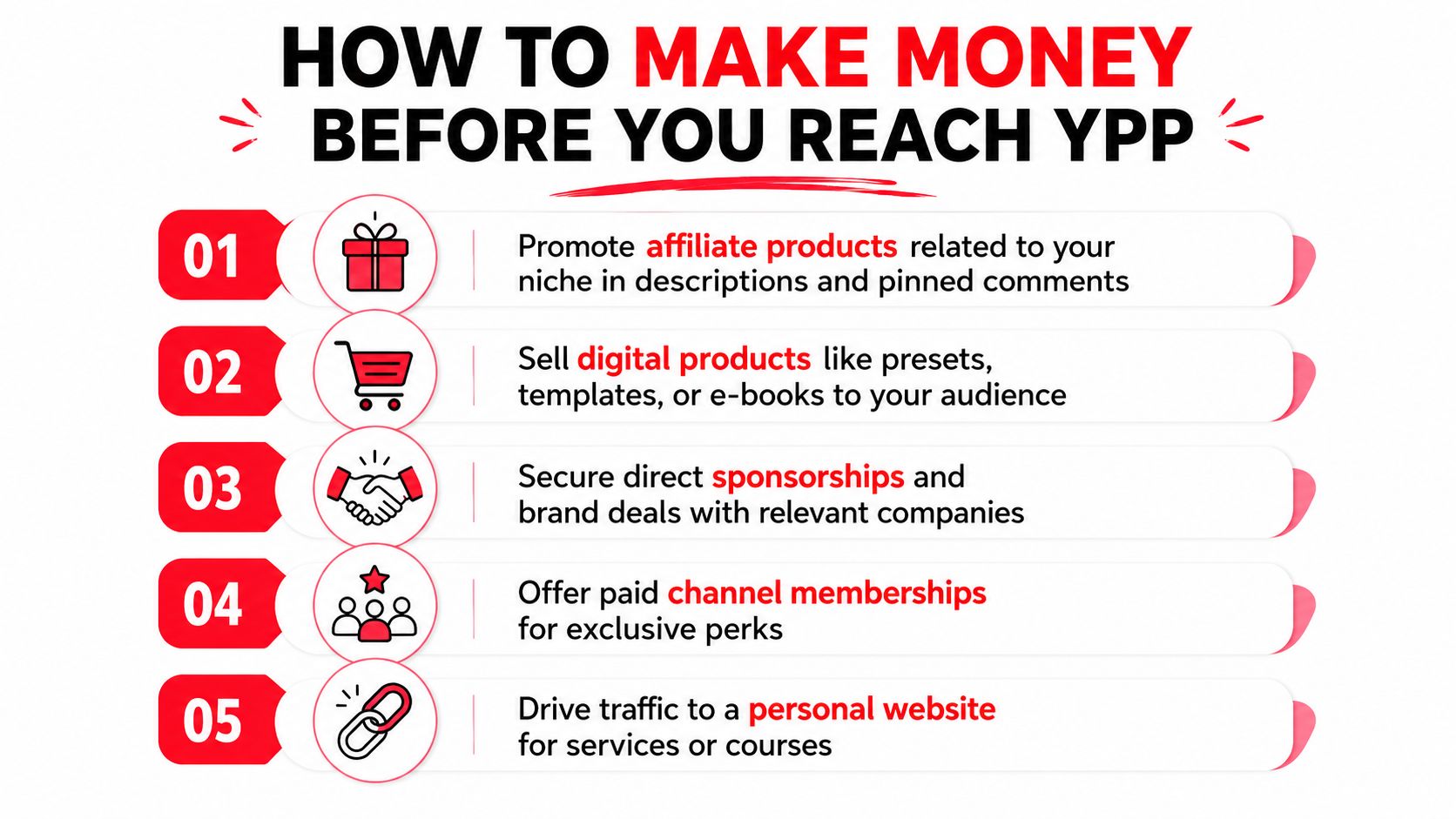
    An infographic detailing five effective strategies for YouTube creators to earn revenue before joining the YouTube Partner Program.

    Actionable Tips to Grow Subscribers and Revenue

    Growth works better when each content decision supports both audience development and a commercial goal. A video that attracts viewers but gives them no next step may grow the channel without strengthening the business.

    1. Sharpen the niche

    Choose a clear audience and recurring problem. “Fitness” is broad, while mobility routines for desk workers gives your titles, examples, products, and sponsorship choices a stronger direction. A focused promise helps viewers know why they should subscribe.

    2. Test the packaging

    Titles and thumbnails determine whether a strong video gets considered. Test a specific promise, remove unnecessary wording, and make the thumbnail communicate one idea. Use YouTube Studio to compare click-through rate with retention, because a high click rate paired with rapid abandonment signals a packaging mismatch.

    3. Improve the first minutes

    Open with the problem and the outcome. Remove long introductions, show the relevant result early, and use clear sections so viewers can follow the argument. Better retention supports watch-time growth and gives you more opportunities to introduce a related offer.

    4. Balance Shorts with long-form

    Shorts can help people discover your ideas, while long-form videos can provide room for tutorials, demonstrations, and stronger commercial context. Connect the formats deliberately. A Short about a common editing mistake can direct interested viewers to a full workflow video.

    5. Use playlists and community posts

    Organize related videos into a sequence that answers the next question. Community posts can prompt discussion, test future topics, and bring existing viewers back to the channel.
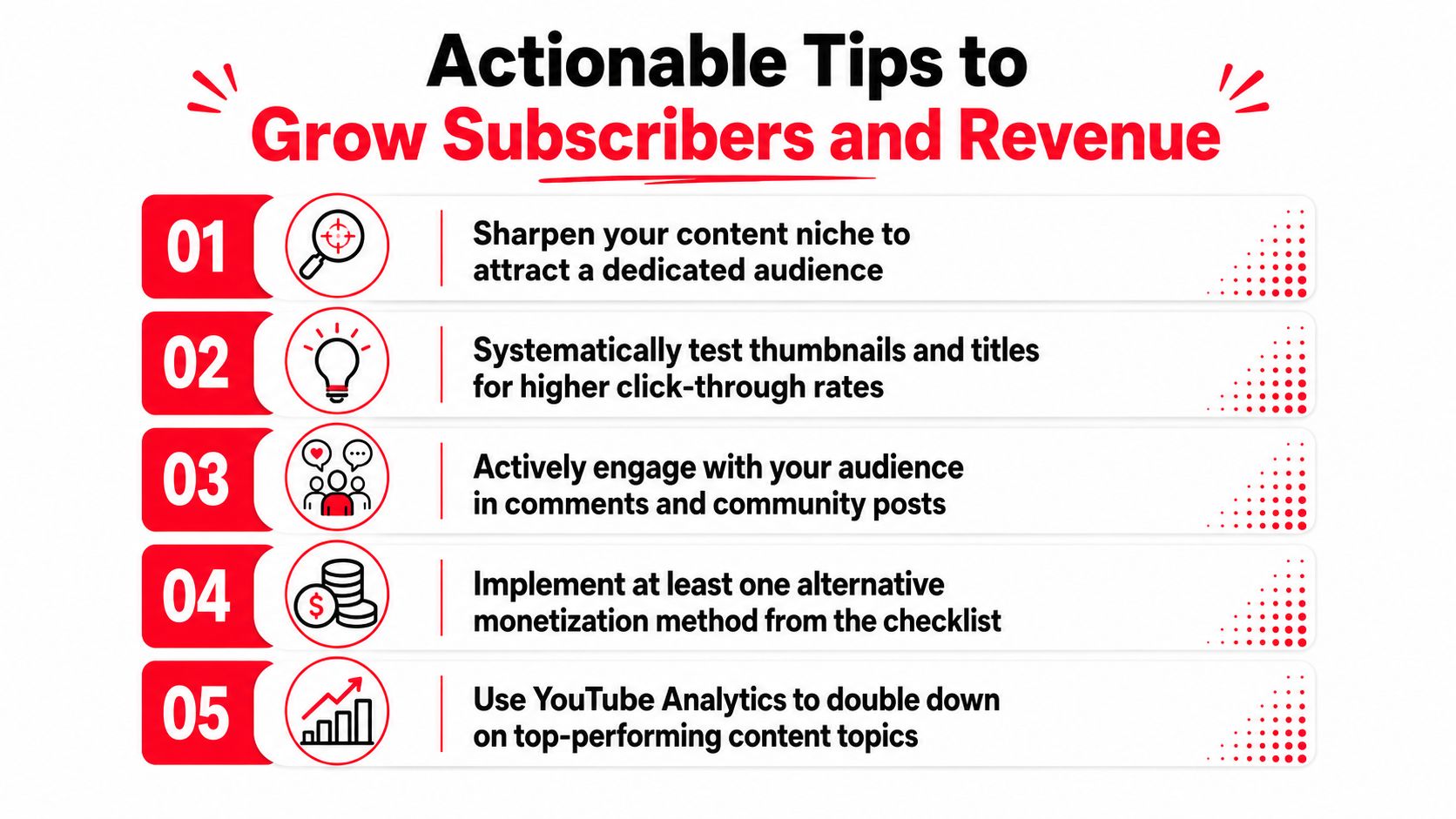
    An infographic listing five actionable tips for growing YouTube channel subscribers and increasing overall creator revenue.

    Track click-through rate, average view duration, returning viewers, subscriber conversion, and offer clicks in a consistent review routine. ViewsMax can create trackable links, connect clicks and sales to specific content, and show content performance alongside attributed revenue. Pair every growth experiment with a revenue experiment, even if the first result is only learning which audience problem creates the strongest response.

    Choosing the Right Revenue Path for Your Channel

    The right monetization path depends on what your viewers need and what your content can credibly deliver. A small education channel may earn earlier from a worksheet, course, or coaching service, while a larger gaming channel may have better alignment with memberships, live support, sponsorships, and affiliate links.

    Use three questions to choose:

    1. What does my audience need next? Look at repeated comments, search questions, and requests for recommendations.
    2. What problem can I solve credibly? Your offer should extend the expertise shown in your videos.
    3. Which format supports the offer? Tutorials support products and services, live streams support direct fan funding, and reviews support affiliate sales and sponsorships.

    A creator with a modest audience but strong purchase intent may be ready for affiliate marketing. A creator with an active live community may prioritize fan funding. A channel pursuing advertising must focus on the applicable YPP activity threshold as well as subscribers.

    Subscriber Tier Best-Fit Revenue Stream Secondary Option
    Below 500 Affiliate links, products, services, or sponsorship outreach Email list and client leads
    500 subscribers, with required activity Memberships, Super Chat, Super Thanks, and selected commerce features Affiliate marketing or products
    1,000 subscribers, with required activity Ads and YouTube Premium revenue sharing Memberships, sponsorships, and affiliate sales
    Above the ad-revenue threshold A diversified revenue system Products, services, sponsorships, and fan funding

    If you're asking how many subscribers on YouTube to make money, the honest answer is that no single number defines success. 500 subscribers can open an earlier YouTube fan-funding tier when the activity requirements are met. 1,000 subscribers remains the central subscriber requirement for the full ad-revenue tier, but new applicants must also meet the applicable watch-time or Shorts-view gate. Before either threshold, a relevant offer can turn engaged viewers into customers.


    ViewsMax helps creators connect content with measurable commercial outcomes through trackable links, publishing workflows, and attribution for clicks, leads, and sales. Visit ViewsMax to see which videos are driving revenue, then use that evidence to plan your next growth and monetization decisions.