ViewsMax
Sign In Sign Up Free

Tag: youtube shorts monetization

  • How to Monetize YouTube Shorts The Smart Way

    How to Monetize YouTube Shorts The Smart Way

    Yes, you can absolutely make money from YouTube Shorts—and it's a bigger opportunity than most people realize. The most direct route is through the YouTube Partner Program's ad revenue sharing, which gives you a 45% cut of the revenue your videos generate. But that's just scratching the surface. The smartest creators are stacking their income with sponsorships, affiliate marketing, and even selling their own products.

    Your Path to Monetizing YouTube Shorts

    A man in headphones works on a laptop, while a smartphone on a tripod records. Text reads 'Monetize Shorts'.

    Turning those quick, vertical clips into a steady paycheck is more doable today than ever before. The secret is knowing there isn't just one way to do it. You have multiple paths to choose from, each suited for different kinds of creators and audience sizes. While everyone talks about ad revenue, the truth is that it usually takes a massive number of views to see a significant payout from ads alone.

    Building Multiple Income Streams

    The creators who are really winning on Shorts don't just lean on one revenue source. They're building a whole monetization ecosystem around their content. You have to start thinking of your Shorts not just as little videos, but as powerful marketing assets that fuel your other money-making ventures. This shift in mindset is what separates hobbyists from creators building a real, sustainable business.

    Let’s say you post a Short reviewing a new gadget that goes viral. That video can do so much more than just earn a few cents from ads. It can also:

    • Bring in affiliate sales when you pin a comment with your link to the product.
    • Catch the eye of other tech brands who want to sponsor your next video.
    • Funnel viewers to your own digital products, like a "Beginner's Guide to Tech" ebook you sell.

    Understanding the Opportunity

    The sheer scale of YouTube Shorts is staggering. The platform was pulling in an average of around 200 billion daily views as of 2026, which is an incredible opportunity for any creator trying to grow an audience fast. When YouTube switched from the old Shorts Fund to a direct revenue-sharing model in 2023, it was a total game-changer. It finally gave creators a more reliable and predictable way to earn. You can find more great insights on the growth of Shorts on miraflow.ai.

    The real secret to monetizing Shorts effectively is diversification. Think of ad revenue as your foundation. Sponsorships, affiliate links, and your own products are the pillars that build a strong, scalable business on top of it.

    To help you visualize these pathways, here's a quick look at the primary ways you can start earning from your Shorts.

    YouTube Shorts Monetization Pathways at a Glance

    This table breaks down the main income streams available to Shorts creators. Each has its own pros and cons, and the best strategy for you will likely involve a mix of several of them.

    Monetization Method How It Works Earning Potential Best For
    Ad Revenue Sharing Earn 45% of the allocated ad revenue from the Creator Pool. Low to Moderate Creators with high view volume
    Sponsorships Partner with brands for dedicated or integrated promotions. Moderate to High Channels with a defined niche
    Affiliate Marketing Earn commissions by promoting products via unique links. Low to High Review and tutorial channels
    Selling Products Offer your own merch, digital goods, or courses. Moderate to High Creators with a loyal community

    We'll dive deeper into how to set up and succeed with each of these methods throughout this guide, but understanding the big picture first is key.

    Joining the YouTube Partner Program with Shorts

    Before you can make a single dime from ad revenue on your Shorts, you’ve got to get into the YouTube Partner Program (YPP). Think of it as the official gateway to monetization. For Shorts creators, YouTube carved out a specific path that's all about rewarding high-volume, viral content. It's not just about racking up views; it's about consistently getting the right kind of views.

    The magic numbers that Shorts creators are laser-focused on are 1,000 subscribers and a whopping 10 million valid public Shorts views within the last 90 days. This is YouTube's alternative to the traditional 4,000 public watch hours required from long-form videos, which is great news for channels built entirely on short-form content.

    What Are the Actual Requirements?

    The numbers seem simple enough, but the details are where people get stuck. Pay close attention to the phrase "valid public Shorts views." This means any views from Shorts you've set to private or unlisted are out. And it goes without saying, but views from bots or any other sketchy source will get disqualified and could put your entire channel at risk.

    Here’s a quick rundown of what you need to have in order:

    • 1,000 Subscribers: This is the baseline. It shows YouTube you’ve started to build a real community.
    • 10 Million Valid Public Shorts Views: This is a rolling 90-day window. That viral hit you had four months ago? Sorry, it no longer counts toward your eligibility today. You need to maintain momentum.
    • Follow YouTube's Rules: Your channel needs a clean record. No active Community Guideline strikes.
    • Create Original Content: This is a huge one. Re-uploading TikToks, movie clips, or other people's content without adding significant creative value is the fastest way to get your application rejected.

    When it comes to monetizing Shorts, consistency is your best friend. It’s far better to get 110,000 views every day for 90 days than to have one 10-million-view video and then radio silence. The algorithm—and the real people reviewing your channel—want to see sustained effort.

    How to Apply in YouTube Studio

    Once you’ve hit those milestones, it’s time to apply. You can do this right inside your YouTube Studio. Just head over to the "Earn" tab, and you'll see a dashboard tracking your progress.

    This is what it looks like—your command center for monetization, showing exactly how close you are to hitting the YPP goals.

    The application itself is pretty straightforward. You'll review and agree to the YPP terms, set up a Google AdSense account (or connect one you already have), and then comes the waiting game.

    A real person at YouTube will review your channel to make sure everything lines up with their policies. They'll look at your overall theme, your most popular videos, and your content strategy. This usually takes about a month. For a more detailed walkthrough, our guide on how to enable YouTube monetization breaks down every step. Just remember, the goal is to prove your channel offers real value, not just chasing trends with low-effort posts.

    How Shorts Ad Revenue Sharing Really Works

    When you first look at how YouTube pays out for Shorts, it can feel a bit convoluted. It's not like your traditional long-form videos where an ad runs right before or during your content. Instead, Shorts revenue is all about a shared pool.

    Let's pull back the curtain and walk through the four-step journey your earnings take, from the moment an ad is shown in the Shorts feed to the money finally landing in your AdSense account.

    This whole system is designed to give every eligible creator a fair slice of the pie, rewarding those whose Shorts are getting the most attention across the entire platform.
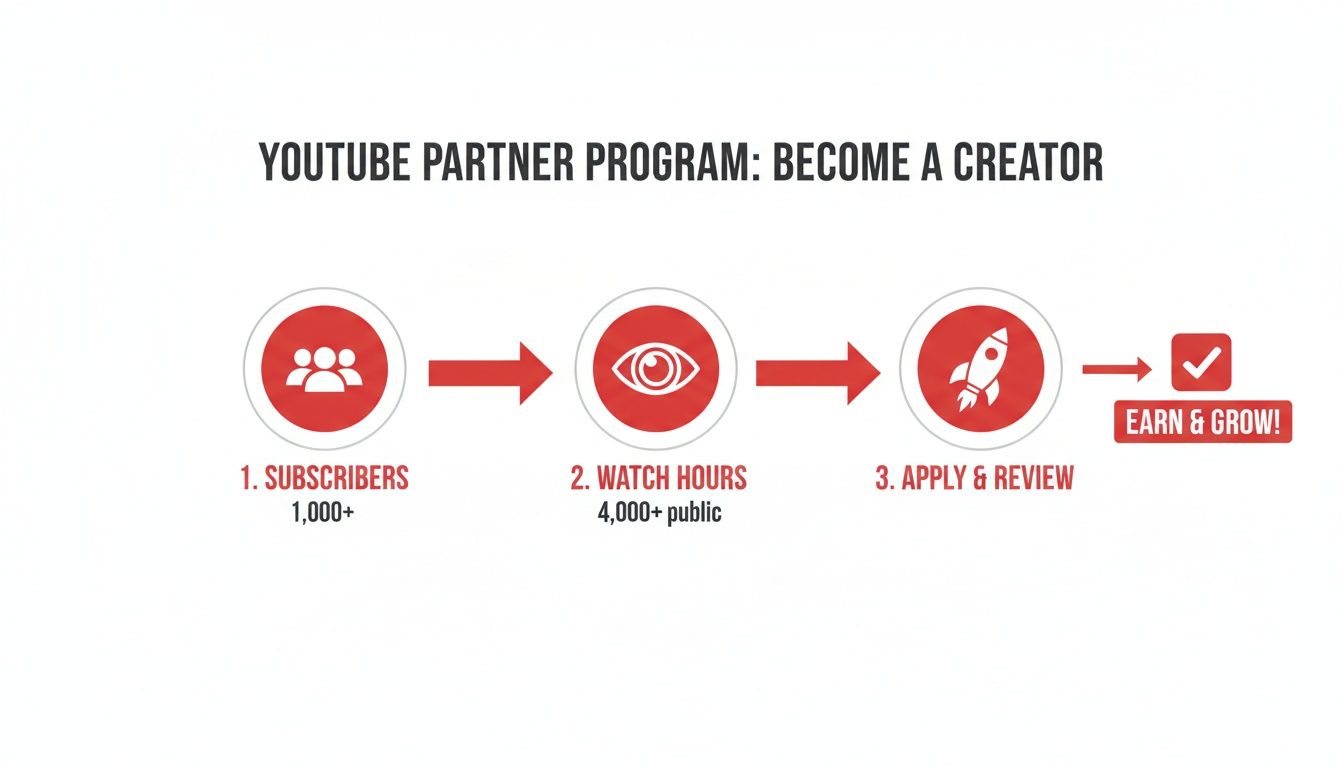
    YouTube Partner Program steps: achieve 1000 subscribers and 4000 watch hours, then apply.

    Hitting these milestones is your ticket to applying for the YouTube Partner Program, which is the essential first step to getting paid.

    The Four Steps of Shorts Revenue Allocation

    Knowing exactly how money moves from an advertiser to your pocket is crucial for setting realistic expectations. It’s not a simple "pay-per-view" game. It's about your share of the total monetized views across all of YouTube Shorts.

    Here’s how it all plays out:

    1. Revenue Gets Pooled: First, YouTube collects all the money made from ads that pop up between videos in the Shorts Feed. All of it goes into one big pot.
    2. The Creator Pool Is Calculated: Next, YouTube has to pay for any music licensing. If you used a chart-topping song in your Short, a piece of the revenue goes to the music publishers before you see a dime. What's left over is called the Creator Pool.
    3. Your Share Is Determined: Now, YouTube calculates your channel's total monetizing Shorts views as a percentage of all monetizing Shorts views on the platform during that month. If your content drove 1% of all eligible views, then you’re allocated 1% of the Creator Pool. Simple as that.
    4. You Get Your Cut: From your allocated slice, you take home 45%. YouTube keeps the other 55%. This 45% cut is the standard creator share for Shorts ad revenue.

    Let's make this real. Say the Creator Pool for June is $1,000,000. If your Shorts generated 1% of all eligible views that month, your allocation from the pool is $10,000. You then keep 45% of that, which means $4,500 goes into your AdSense account.

    This model means your earnings are directly tied not just to your own view count, but to how well all Shorts are performing on the platform.

    Why Your Shorts RPM Is So Different

    If you also make long-form videos, you've probably noticed that your RPM (Revenue Per Mille, or earnings per 1,000 views) for Shorts is way, way lower. That's not a glitch—it's just how the system works.

    Since ads in the Shorts feed are shared across countless videos instead of being attached to just one, the revenue for any single creator gets diluted. It's a volume game.

    However, a few key factors can seriously swing your Shorts earnings. Your audience's location is a huge one. Viewers from the US and UK can generate $2–$5 per 1,000 views, while an audience from developing countries might only bring in $0.10–$0.50. That’s a potential 10x difference right there.

    Your niche is just as important. A finance or tech Short can command a $10–$30 RPM, but general entertainment or lifestyle content often hovers around $1–$5. And be careful with music; using a copyrighted track can be a major pitfall, as labels can claim up to half of the earnings, effectively slashing your income.

    It’s also really helpful to know the difference between RPM and CPM. For a deeper dive into these metrics, check out our guide on the meaning of CPM on YouTube. By focusing on high-value niches and attracting a premium audience, you can absolutely make this system work in your favor and turn those massive view counts into a respectable income.

    Optimizing Shorts for Maximum Views and Revenue

    Laptop showing 'Maximize Views' on a red screen, with video editing interface and headphones.

    Getting views is one thing, but getting the right kind of views—the ones that actually put money in your pocket—is a whole different ballgame. This is where a smart content strategy really shines. To master how to monetize YouTube Shorts, you have to stop thinking like a regular user and start thinking like a content engineer.

    The entire battle is won or lost in the first two seconds. If you can't give someone a reason to slam the brakes on their endless scroll, you've already lost. Your opening shot has to be a hook that punches through the noise, whether it's by asking a question, presenting a problem, or just showing something visually jaw-dropping.

    Crafting a Scroll-Stopping Hook

    A truly great hook does more than just get attention; it makes a promise. It tells the viewer exactly why the next 30 seconds of their life are worth investing in your content. This could be a bold statement, a relatable struggle, or the start of an incredible transformation.

    Here are a few hook strategies that just plain work:

    • The Problem Hook: Hit them with a common pain point. Something like, "You're still editing your videos like this?" instantly grabs anyone who finds the process a chore.
    • The Curiosity Hook: Ask a question that people need to see answered. "What happens when you mix Diet Coke and Mentos… in zero gravity?"
    • The Visual Hook: Show the stunning final result first. Imagine a baker showing a perfectly decorated, multi-tiered cake before cutting to the messy, chaotic reality of making it.

    The trick is to create an immediate "information gap." The viewer feels a natural urge to stick around and see that gap filled.

    Building a Narrative That Holds Attention

    Okay, you've got their attention. Now you have to keep it. Even a 45-second clip needs a story with a beginning, middle, and end. This basic structure is what keeps people locked in and gives them a sense of satisfaction when the video concludes.

    A simple and powerful narrative for Shorts is the "Problem-Solution-Result" framework. First, present the problem (a disastrously messy closet). Next, show the solution (a clever organizational hack). Finally, reveal the satisfying result (the perfectly organized, color-coded closet). This formula is a workhorse that fits almost any niche, from DIY and cooking to tech tutorials.

    The Shorts that really earn are often the ones that create a "viral loop." This is when the end of the video flows seamlessly back to the beginning, tricking people into watching it two or three times. This is gold because it skyrockets your average view duration and screams to the YouTube algorithm that your content is sticky.

    The Double-Edged Sword of Trending Audio

    Jumping on trending audio can feel like a cheat code for discoverability, and sometimes it is. But remember, if you use copyrighted music, you're agreeing to split any ad revenue it generates. If maximizing your direct ad share is the primary goal, you're better off using your own original audio or royalty-free tracks.

    That said, if a trend is absolutely massive and fits your niche perfectly, the exposure might be worth the revenue split. It's a balancing act. For creators looking to pump out a lot of content consistently, an AI Shorts generator can be a huge help in producing optimized videos at scale.

    Why Quick Edits and Punchy Captions Matter

    The pacing of a Short is everything. You need quick cuts, dynamic text popping on screen, and a fast-paced edit to maintain high energy from start to finish. Any captions you add should be short, punchy, and super easy to read on a phone, reinforcing your main points without making the screen look cluttered.

    Here’s a practical workflow you can start using today:

    1. Script Your Hook: Literally write down the first one or two lines. Are they intriguing? Do they create an immediate question?
    2. Outline Your Story: Jot down a simple beginning, middle, and end. Make sure there’s a clear point A to point B.
    3. Choose Audio Strategically: Decide if the reach from a trending song is worth more than the potential ad revenue.
    4. Edit for Pace: Keep your cuts sharp and your visuals moving. A good rule of thumb is to introduce a new visual element or text every 2-3 seconds.
    5. Write a Great Caption: Use the video's caption and your pinned comment to add extra context or a clear call to action.

    By putting these simple, creative tweaks into practice, you can turn your Shorts from one-off viral hits into a consistent stream of high-performing assets that drive both views and revenue. For a deeper dive, check out our guide on how to get more views on YouTube Shorts.

    Expanding Your Income Beyond AdSense
    Overhead shot of a workspace with a smartphone, pens, plant, and a red notebook stating 'diversify income'.

    Shorts ad revenue is a great start, but let's be honest—relying on it alone is a risky game. The most successful creators I know treat AdSense as just one piece of a much bigger financial pie.

    True, sustainable income on YouTube comes from building multiple income streams. Your Shorts stop being just the product and become the marketing engine that drives your entire business. Each viral Short is a golden opportunity to push a massive, fired-up audience toward offers you control.

    Tapping into Affiliate Marketing

    Affiliate marketing is the most natural first step for most creators. You're simply earning a commission by recommending products or services you genuinely use and believe in. The trick is to make it feel like a helpful tip from a friend, not a hard sell.

    A great example is a home organization creator. They could post a 30-second Short showing how they transformed a messy drawer with a slick set of dividers. A pinned comment with a link to that exact product on Amazon is all it takes. It provides instant value and earns them a cut of every sale.

    The real power of Shorts is their ability to act as a top-of-funnel discovery tool. A single, well-placed affiliate link in a viral Short can generate passive income for months or even years as it continues to get views.

    Landing Your First Brand Deal

    Sponsorships are where your earnings can really take off. Brands are hungry for short-form creators because they deliver 2.5 times more engagement than longer videos. Your big view counts on Shorts are all the social proof you need when pitching.

    Don't just sit back and wait for them to come to you. Put together a simple one-page media kit with your channel's vitals:

    • Average Shorts Views: This shows your consistent reach.
    • Subscriber Count: Highlight your community size and growth.
    • Audience Demographics: Who are you reaching? (age, gender, location).

    When you reach out, don't just say you're available—pitch a concrete idea. A gaming creator could pitch a "60-Second Review" Short for a new headset, showing off its best features in a quick, punchy format. Being proactive like this makes it incredibly easy for a brand to say yes.

    Selling Your Own Products and Merch

    This is the ultimate goal. Selling your own stuff puts you in the driver's seat of your income and brand. Shorts are the perfect way to tease new designs or announce a product launch.

    Think of a fitness creator who wears a t-shirt with their catchphrase in a workout Short. They pin a comment with a link to their store, and the video becomes a natural, non-pushy ad. To really build a diverse business, look into the best platforms to sell digital products. You could offer workout guides, meal plans, or video courses that your Shorts audience would love.

    Embracing Direct Fan Support

    Never underestimate the power of your community wanting to support you directly. YouTube's Super Thanks feature lets your most dedicated fans send you a small monetary tip on a Short they particularly enjoyed.

    It might not pay all the bills, but it’s a meaningful revenue stream that adds up. More importantly, it shows you which content hits so hard that people are willing to open their wallets. That kind of feedback is priceless.

    Alternative Monetization vs. Ad Revenue

    When you're mapping out your strategy, it helps to see how these different income streams stack up against standard ad revenue. Notice how much more control you gain when you move beyond AdSense.

    Income Stream Creator Control Income Stability Setup Effort
    Shorts Ad Revenue Low (depends on YouTube's algorithm/RPMs) Volatile (can change month-to-month) Low
    Affiliate Marketing Medium (you choose products, not the price) Moderate (consistent with traffic) Low
    Brand Deals High (you negotiate rates and terms) High (contract-based) Medium
    Own Products/Merch Total (you set price, brand, and strategy) High (directly tied to your efforts) High
    Fan Funding Low (relies on viewer generosity) Low (unpredictable) Very Low

    As you can see, diversifying gives you stability and control that AdSense alone can't provide. Your Shorts feed the top of the funnel, and these other streams capture the value you've created with your community.

    Alright, let's dig into the numbers. You can't just throw content out there and hope for the best—that's a surefire way to burn out. To really grow your Shorts income, you have to get comfortable with YouTube Analytics. We're not chasing vanity metrics here; we're hunting for the data that directly impacts your bank account.

    First things first, jump into your YouTube Studio and find the Analytics tab on the left. It can feel like a data firehose at first, but the trick is knowing exactly which numbers matter and which ones are just noise.

    The Metrics That Actually Drive Your Shorts Revenue

    Once you're in the Analytics dashboard, you'll want to filter the view to focus specifically on your Shorts. This is where the real story of your channel's performance lives. A few key metrics will tell you almost everything you need to know.

    • Views: This is your top-of-funnel metric. Which Shorts are stopping the scroll? Pay attention to the hooks, topics, and editing styles of your most-viewed videos. There's a pattern there, I promise.
    • Watch Time: While not a direct part of the Shorts ad revenue formula, average view duration is a huge signal to the YouTube algorithm. It proves your content is sticky and keeps people watching, which YouTube loves to reward.
    • Estimated Revenue: This is where the rubber meets the road. Head over to the "Revenue" tab to see which individual Shorts are making you the most money. This is pure gold for planning your future content.

    Your analytics are basically your audience talking to you directly. If a certain video style gets massive views and high watch time, they're screaming, "Make more of this!" Your only job is to listen.

    How to Turn Raw Data Into a Content Strategy

    This is where you go from being a content creator to a content strategist. The real breakthrough happens when you start connecting the dots between these different metrics.

    For example, you might look at your analytics and see that your "day in the life" videos not only get tons of views but also attract a huge audience from a high-RPM country like the United States or Australia.

    That’s your lightbulb moment. It's a clear signal to double down on that specific format and topic. You're no longer just guessing; you're actively creating content that you know resonates with your most profitable audience demographic. That's how you engineer a bigger paycheck.

    Don't forget to check your Traffic Sources, either. Are people finding your Shorts primarily through the Shorts Feed, or are they coming from YouTube search? Knowing how viewers discover you helps you optimize your titles and hashtags to lean into what’s already working. This is the difference between hoping for a viral hit and strategically building a channel that pays the bills.

    Got Questions About Monetizing Shorts? Let's Clear Things Up

    Even with the best game plan, you're bound to have some lingering questions. That's perfectly normal. Let's dig into a few of the most common ones that pop up when creators start thinking about monetizing their Shorts.

    So, What's the Payout for 1 Million Views on a Short?

    This is the golden question, isn't it? The truth is, the payout for 1 million views on a YouTube Short can swing wildly, typically landing somewhere between $10 and $300.

    Why such a massive range? It really boils down to a few key factors. First, your audience's location is huge—viewers in the US, for example, tend to bring in much more ad revenue than viewers from many other countries. Your niche also matters a ton. A Short about personal finance or a new tech gadget will almost always have a higher RPM than a general entertainment or comedy clip.

    And don't forget about music. If you use a copyrighted track from YouTube's library, a slice of the revenue goes to pay for that license before you even see a penny.

    Do I Absolutely Have to Be in the YPP to Make Money?

    For direct ad revenue from YouTube, yes. To get paid from the Shorts ad-sharing pool, you must be an accepted member of the YouTube Partner Program (YPP). There are no shortcuts around that for earning AdSense money from your Shorts.

    But here's the good news: that's not the only way to earn. Plenty of creators who aren't in the YPP yet are still making great money. They just treat their Shorts as a top-of-funnel marketing engine to drive viewers toward other income sources. Think of it this way:

    • Affiliate marketing: Drop links in your pinned comments or description.
    • Brand deals: Secure sponsorships for dedicated Shorts.
    • Your own products: Sell merch, digital downloads, or courses.

    YPP is a major milestone, but it’s far from the only path to a paycheck.

    What's the Deal with Using Copyrighted Music in Monetized Shorts?

    You can definitely use music from YouTube’s built-in audio library, but be aware that it comes at a cost to your ad earnings. When you use a licensed song, the revenue your Short generates is split with the music partners first to cover the licensing fees.

    Here’s a simple way to think about it: if you use one popular song, the revenue is split between you (via the Creator Pool) and the music license holders. If you use two songs, a much larger portion of the revenue might go straight to licensing, leaving very little for you.

    If your primary goal is to maximize every last cent from the ad-share pool, your best bet is always to use your own original audio or stick to royalty-free music.


    Ready to stop guessing and start growing? ViewsMax gives you the AI-powered tools and data-driven insights you need to optimize your content, increase your watch time, and turn your YouTube channel into a real business. Explore our creator toolkit and see the difference.
  • How to Make Money on YouTube Shorts A Creator’s Guide

    How to Make Money on YouTube Shorts A Creator’s Guide

    Making money on YouTube Shorts isn't some far-off dream—it's a very real possibility for creators who know how to play the game. The main gate you need to walk through is the YouTube Partner Program (YPP), and for Shorts creators, the entrance requirements are crystal clear: 1,000 subscribers and 10 million valid Shorts views within the last 90 days.

    Once you're in, you start getting a cut of the ad revenue that runs between Shorts in the feed.

    Your Blueprint for Monetizing YouTube Shorts

    A laptop displaying the YouTube logo with 'MONETIZE SHORTS' text, a smartphone, and a notebook on a wooden desk.

    Turning your creativity into cash is more straightforward than you might think. We've moved past the era where only long-form video giants could earn a living. YouTube has built out an entire ecosystem for Shorts creators, and for good reason—Shorts are pulling in over 70 billion daily views. They know where the attention is.

    Your first major step is getting into the YouTube Partner Program (YPP). Think of it less as a hurdle and more as the key that unlocks a whole suite of income streams that come directly from the platform itself.

    Understanding the YPP Thresholds

    For Shorts creators, the path into the YPP is refreshingly direct. Forget about watch hours; your focus is on two core metrics.

    • Building a Community: You’ll need at least 1,000 subscribers. This tells YouTube that you're not just getting random views; you’re building a loyal audience that wants to see more from you.
    • Hitting Viral Velocity: The big one—you must generate 10 million valid public Shorts views in a rolling 90-day period. This benchmark proves your content has what it takes to capture widespread attention and keep people scrolling.

    Meeting these milestones gets your foot in the door. Once accepted, you can flip the switch on Shorts monetization and start earning from the "Creator Pool," which is funded by the ads that appear in the Shorts feed.

    How Shorts Revenue Sharing Actually Works

    The way you get paid for Shorts is unique. It's not like the pre-roll ads you see on long-form videos. Instead, YouTube pools all the revenue from ads shown in the Shorts feed. From that pot, they first pay for music licensing (a huge deal for Shorts). What's left is the Creator Pool.

    Your slice of that pie is based on your share of total monetized Shorts views in your country. The more views you drive, the bigger your piece. Simple as that.

    The big question is always, "How much can I actually make?" The reality is that your earning potential is tied directly to your audience's location and engagement. Most creators see an RPM (revenue per 1,000 views) somewhere between $0.01 and $0.05.

    So, what does that look like in practice? Hitting that 10 million view YPP requirement could mean an initial payout of $100 to $500. Creators with audiences in high-value ad markets like the US, UK, or Australia will naturally trend toward the higher end of that range.

    Officially, you get to keep 45% of the allocated ad revenue. It's a system built to reward consistency and the ability to capture and hold attention. You can dive deeper into Shorts statistics and earnings to set some realistic goals.

    To help you visualize the different ways you can earn, here’s a quick breakdown of the primary monetization pathways available to you.

    YouTube Shorts Monetization Pathways at a Glance

    This table summarizes the main methods for making money with your Shorts, giving you a clear picture of what's required and what you can expect.

    Monetization Method Requirements Typical Earnings (RPM/CPM) Best For
    Shorts Ad Revenue YPP: 1k subs & 10M Shorts views (90 days) $0.01 – $0.05 RPM All monetized creators looking for consistent, passive income.
    Channel Memberships YPP qualification + 18 years old Varies by creator (you set the price) Creators with a loyal, engaged community willing to pay for perks.
    Super Thanks YPP qualification + available in your region Varies (viewer-funded tips) Creators who create highly valuable or entertaining "share-worthy" content.
    Brand Deals Established niche & engaged audience $10 – $50+ CPM (highly variable) Creators with a strong personal brand and influence in a specific niche.
    Affiliate Marketing No official requirements, just an audience Commission-based (5%-30% of sales) Creators who can naturally recommend products or services to their audience.

    Each of these methods taps into a different aspect of your channel's strength—from raw view counts to the trust you've built with your community.

    This guide will show you how to move beyond just chasing views and start building a real, sustainable business around your content.

    Tapping Into YouTube's Official Monetization Tools

    Getting into the YouTube Partner Program (YPP) is your official ticket to earning money directly from your content. It’s the moment your channel goes from a passion project to a real business, giving you access to all of YouTube’s built-in revenue features. While there are a few ways to get in, YouTube created a specific, fast-paced track just for Shorts creators.

    If you're focused on short-form video, you have a clear path to the YPP. You need to hit two main goals:

    • Build a community of at least 1,000 subscribers. This tells YouTube that you've got a core audience that cares about what you're making.
    • Rack up 10 million valid public Shorts views in the last 90 days. This is the big one—it proves your content has viral potential and can hold people's attention in the fast-scrolling Shorts feed.

    Once you cross those thresholds and get accepted into the program, you unlock the primary way to make money on Shorts: ad revenue sharing.

    How Shorts Ad Revenue Sharing Actually Works

    The way you earn from Shorts ads is totally different from long-form videos. Instead of an ad running right before your video, ads pop up between Shorts as people scroll. YouTube takes all the money made from these ads and puts it into a big pot called the "Creator Pool."

    Before that money gets to you, YouTube first takes out a cut to pay for music licensing. What’s left is then split up among monetizing creators based on their slice of the total Shorts views in their country. So, if your Shorts made up 1% of all eligible Shorts views in your region last month, you'd get 1% of the Creator Pool for that area.

    From there, you get a 45% cut of that allocation. It’s a system that directly rewards you for consistently cranking out Shorts that people watch.

    This visual from YouTube's own resources helps show how money from different sources, including Shorts ads, flows through their system.

    The main thing to remember is that your earnings aren't a simple calculation. They're a piece of a much larger pie that changes based on overall viewership and how well ads are doing across the entire platform.

    Going Beyond Ads with Fan Funding

    Ad revenue is a great starting point, but it should never be your only source of income. Once you're in the YPP, you get access to powerful features that let your most dedicated fans support you directly. Honestly, this is where you can often make much more per fan than you ever could from ads alone.

    These "fan funding" features are a game-changer. They create a direct financial link between you and your audience, which helps protect you from the constant ups and downs of ad rates and algorithm tweaks. For a closer look at how these rules change over time, our article covering recent changes in YouTube policies is a must-read.

    Super Thanks

    Think of Super Thanks as a digital tip jar for your Shorts. A viewer can buy a cool, animated graphic that pops up over your video to show their appreciation. It's a quick, easy way for someone to say "thanks!" for a Short that made them laugh, taught them something cool, or just really resonated with them.

    Here’s how to encourage more Super Thanks:

    • Give shout-outs to supporters in your next Short or in a Community tab post.
    • Focus on creating Shorts that deliver huge value or hit a strong emotional note.
    • Pin a comment on your best videos reminding people that Super Thanks is an option if they want to show some love.

    Channel Memberships

    Channel Memberships are the ultimate way to build a loyal, paying community. Your fans can pay a monthly fee to get exclusive perks you create just for them. It’s how you turn casual viewers into your biggest supporters. You can even set up different price tiers with better benefits for each level.

    Here's the key difference: Ad revenue monetizes your views, but memberships monetize your relationships. A single fan paying $4.99 a month can easily be worth more than tens of thousands of ad views.

    Some popular perks creators offer their members include:

    • Custom Badges & Emojis: Little icons that members can show off next to their name in comments.
    • Members-Only Content: Behind-the-scenes Shorts, unfiltered Q&As, or early access to your regular videos.
    • Exclusive Access: A private Discord server or a promise that you'll reply to their comments first.

    To make memberships work, you have to be crystal clear about the value you're providing. Use your Shorts to tease the exclusive content members get, and don't be shy about reminding your audience how their support helps you keep the channel going. By putting these official tools to work, you can build a much more stable and diverse income stream right inside the YouTube ecosystem.

    Creating Shorts That Actually Get Views and Make Money

    A man records a video outdoors using a smartphone on a tripod, with documents and a pen on a table, and 'HOOK VIEWERS' text.

    Let's be real: just throwing short videos at the wall and hoping something sticks isn't a strategy for making money. That's playing the lottery. To build a real income from YouTube Shorts, you have to be intentional. You need a content plan that consistently grabs attention and plays nice with the YouTube algorithm.

    Going viral isn't just a fluke. It’s about knowing what makes people stop their endless scroll and what signals tell YouTube, "Hey, people love this, show it to more of them!" It all comes down to creating content that keeps people watching.

    The First Three Seconds are Everything

    You have a tiny window—maybe three seconds, tops—to convince someone your Short is worth their time. If you blow the intro, the rest of your video is dead in the water. Your opening has to be punchy, clear, and spark instant curiosity.

    Forget the slow burns and lengthy "hey guys" intros. Jump straight into the action. Start with the most dramatic clip, a controversial take, or a question that your target viewer can't help but want the answer to. This "hook" is the single most critical part of your video.

    A few hook formulas I've seen work incredibly well:

    • Problem/Solution: "You're editing your videos all wrong. Stop doing this…"
    • The Big Reveal: "I tried the viral [trend], and you won't believe what happened."
    • The Direct Question: "Are you tired of getting zero views on your Shorts?"

    A strong hook grabs them by the collar and promises that sticking around for the next 30 seconds will be worth it.

    Finding the Sweet Spot for Length

    Just because you can make a 60-second Short doesn't mean you should. I've found the magic window for keeping people glued to the screen is somewhere between 20 and 40 seconds.

    That's enough time to tell a quick story, share a solid tip, or get a point across without overstaying your welcome. Sure, a super-short video under 15 seconds can work for a quick meme or trend, but that 20-40 second range is where you can actually deliver substance and keep retention high.

    Watch time is king, but percentage watched is what really moves the needle. A 30-second Short where people watch 90% (27 seconds) looks way better to the algorithm than a 60-second video where they only watch 50% (30 seconds). High retention percentage is a massive green flag for YouTube.

    Keeping it tight also makes you a better creator. It forces you to trim the fat and deliver pure value.

    How to Use Trends and Audio Without Selling Out

    Hopping on a trend is one of the fastest shortcuts to getting your Shorts in front of a new audience. The algorithm is already pushing trending audio and formats, so you're basically catching a ride on a wave that's already building.

    But here's the key: don't just blindly copy a trend. Adapt it to your niche. If you run a channel about gardening and a new dance challenge is everywhere, find a creative way to tie it to planting a new flower bed. This lets you tap into the trend's momentum while still being authentic to your brand.

    Where to spot trends early:

    • Your Shorts Feed: Just scroll. When you hear the same sound over and over, that's your cue. Tap the sound to see how many people have used it.
    • The "Trending" Tab: YouTube literally has a page for this. It often highlights popular Shorts and the audio driving them.
    • TikTok and Instagram Reels: Trends are rarely contained to one platform. See what's blowing up elsewhere, because it's probably on its way to YouTube.

    A popular sound can be the difference between getting a few hundred views and a few hundred thousand.

    Optimizing for the Algorithm and Your Audience

    Making a great video is only half the job. You have to package it so the algorithm knows exactly who to show it to. This is where a little bit of SEO for Shorts makes a huge difference.

    Your title is your first shot. Keep it short, compelling, and load it with your most important keyword. Think like a viewer: what would they type in the search bar to find your content?

    Next up are your description and tags. While they're less important for discovery in the Shorts feed, they are crucial for showing up in YouTube search. A tool like ViewsMax can be a lifesaver here, helping you generate titles, descriptions, and tags that are already proven to work in your niche. For a deeper look at this, check out our guide on how to get more views on YouTube Shorts.

    Finally, don't forget the technical stuff. Make sure your video file is formatted correctly to avoid any weird compression or quality issues on upload. Brushing up on YouTube's video size limits and optimal formats is a simple step that ensures your content looks as good as you intended.

    Taking Your Income Beyond YouTube Ads

    Relying just on the Shorts ad revenue pool is a classic mistake. Think of it like building a house on land you don't own. It's a great starting point, but algorithm changes and fluctuating ad rates can pull the rug out from under you without warning.

    Real financial independence as a creator comes from building your own thing. You need to diversify. The great news is your Shorts audience is the perfect launching pad.

    Every Short you post isn't just a piece of content; it's a free ad for your bigger ventures. When a video takes off, it's your chance to guide those thousands—or millions—of viewers toward partnerships and your own products, where the earning potential is in a completely different league. This is the mental shift you need to make: from earning fractions of a cent per view to building a real, sustainable business.

    Landing Your First Brand Deal

    A lot of creators think they need a massive subscriber count to get noticed by brands. That's a myth. Brands are smarter now; they're hunting for micro-influencers with smaller, super-engaged niche audiences.

    Honestly, a passionate community of 5,000 mountain bikers is way more valuable to a bike gear company than an audience of 100,000 who just passively watch random videos.

    First things first, you have to look professional. Put together a simple media kit—a clean, one-page PDF is all you need.

    • Your Channel Stats: Show off your view counts, audience demographics (age, gender, location), and most importantly, your engagement rate.
    • Your Niche & Vibe: Spell out what your channel is about and who you're talking to.
    • Contact Info: Don't make them hunt for it. A clear, professional email address is a must.

    Start small. Reach out to brands in your niche that you already use and genuinely like. A personal email explaining why you're a great fit for their product will always beat a generic template. Offer them a simple starting package, like one dedicated Short or a mention in three videos, just to get your foot in the door.

    Mastering Affiliate Marketing the Right Way

    Affiliate marketing is probably the easiest income stream to get started with. You get a commission when someone buys a product through your unique link. The trick is to make it feel authentic and helpful, not like you're just trying to make a buck.

    Please, don't just spam links everywhere.

    Instead, create Shorts that actually solve a problem or show a product in action. If you're a tech creator, maybe it's a Short titled "The one accessory every gamer needs." If you're in the beauty space, "My 30-second trick for perfect eyeliner" is perfect.

    Your audience trusts your recommendations. The moment you promote something you don't believe in, you erode that trust. Always prioritize authenticity over a quick commission; your long-term success depends on it.

    So, how do you get the links in there without being obnoxious?

    1. Pin a Comment: This is the best way. Post your affiliate link in a comment and pin it. Then, just say in your video, "Link for this is in the pinned comment!" Easy.
    2. Use a Link-in-Bio Tool: Direct viewers to a single, clean link in your channel bio that holds all your recommended products.
    3. Add it to the Description: It's less visible on Shorts, but it's good practice. Some viewers will look for it.

    Selling Your Own Products

    This is the end game. Turning your viewers into your customers is the ultimate goal for any creator. When you sell your own stuff, whether it's merch or digital products, you have complete control over your income and it cements your brand identity.

    Your Shorts become the top of your sales funnel, driving free, targeted traffic straight to your online store.

    For physical merchandise, platforms like Printful or Spring (formerly Teespring) let you create custom shirts, mugs, or hats with zero upfront cost. You can design products around inside jokes or catchphrases from your channel, which makes your audience feel like they're part of an exclusive club.

    Digital products, though, are where the real magic happens. They often have much higher profit margins. This could be anything—e-books, workout plans, video editing presets, or in-depth guides. To really scale up, you need a solid strategy when you create and sell digital products, giving your audience something genuinely valuable. A Short that gives a "sneak peek" of a killer tip from your new e-book? That’s a simple, powerful sales pitch.

    Decoding Your Earnings with Real World Examples

    Alright, let's get down to what you really want to know: the numbers. It's one thing to talk about abstract ideas like RPM and revenue sharing, but seeing what actual creators are making is what truly helps set realistic goals for your own channel.

    The truth is, your earnings can feel a bit all over the place when you're starting out. You might have one Short blow up with 10 million views but earn less than another that only got 7 million. It’s a common scenario, and it almost always comes down to a few key things—mainly where your audience is from and the niche you’re in.

    A Look at Real Creator Payouts

    To really wrap your head around the potential, there's no substitute for looking at real-world data. One creator in the popular storytelling niche, for example, shared their analytics from a few viral Shorts, and it paints a very clear picture.

    Here's how their numbers broke down:

    • 5.9 million views earned $733.63 and pulled in 22,400 new subscribers.
    • 7.7 million views brought in an impressive $1,263.33 and 25,900 subscribers.
    • Interestingly, a Short with even more views—9.5 million—earned a bit less at $1,252.31, while still adding 21,800 subscribers.

    These results show a pretty consistent trend. In niches like storytelling or finance tips, creators are often seeing earnings in the ballpark of $160 to $200 per million views. You can dive deeper into these examples and see how other creators are doing by checking out breakdowns of their earnings on YouTube.

    The big takeaway here is that more views don't automatically mean more money. The quality of those views is what counts. A view from a country with high ad spend, like the US or UK, is simply worth more than a view from a country with a smaller ad market.

    To make this even clearer, I've put together some real-world examples in a table.

    Sample Earnings from Real YouTube Shorts

    This table shows a few different Shorts and how their views translated into subscribers and cold, hard cash. Notice how the "Revenue per 1M Views" fluctuates—this is a perfect illustration of how much your niche and audience demographics matter.

    Views Subscribers Gained Total Revenue (USD) Approx. Revenue per 1M Views (USD)
    5.9M 22,400 $733.63 $124
    7.7M 25,900 $1,263.33 $164
    9.5M 21,800 $1,252.31 $132

    As you can see, the relationship isn't always linear. The goal isn't just to get views, but to get the right views from an audience that advertisers are willing to pay more to reach.

    Getting a Grip on RPM and CPM

    Your RPM, or Revenue Per Mille, is the metric that tells you how much you're earning for every 1,000 views. For Shorts, this number is almost always lower than what you'd see on long-form videos. Based on what many creators report, a typical RPM for Shorts lands somewhere between $0.17 and $0.25 (that's 17 to 25 cents per 1,000 views).

    Just remember not to confuse RPM with CPM. Your RPM is your actual take-home pay, whereas the CPM (Cost Per Mille) is what advertisers are paying YouTube for 1,000 ad impressions. If you want to get into the nitty-gritty, our guide explaining the CPM meaning on YouTube is a great resource.

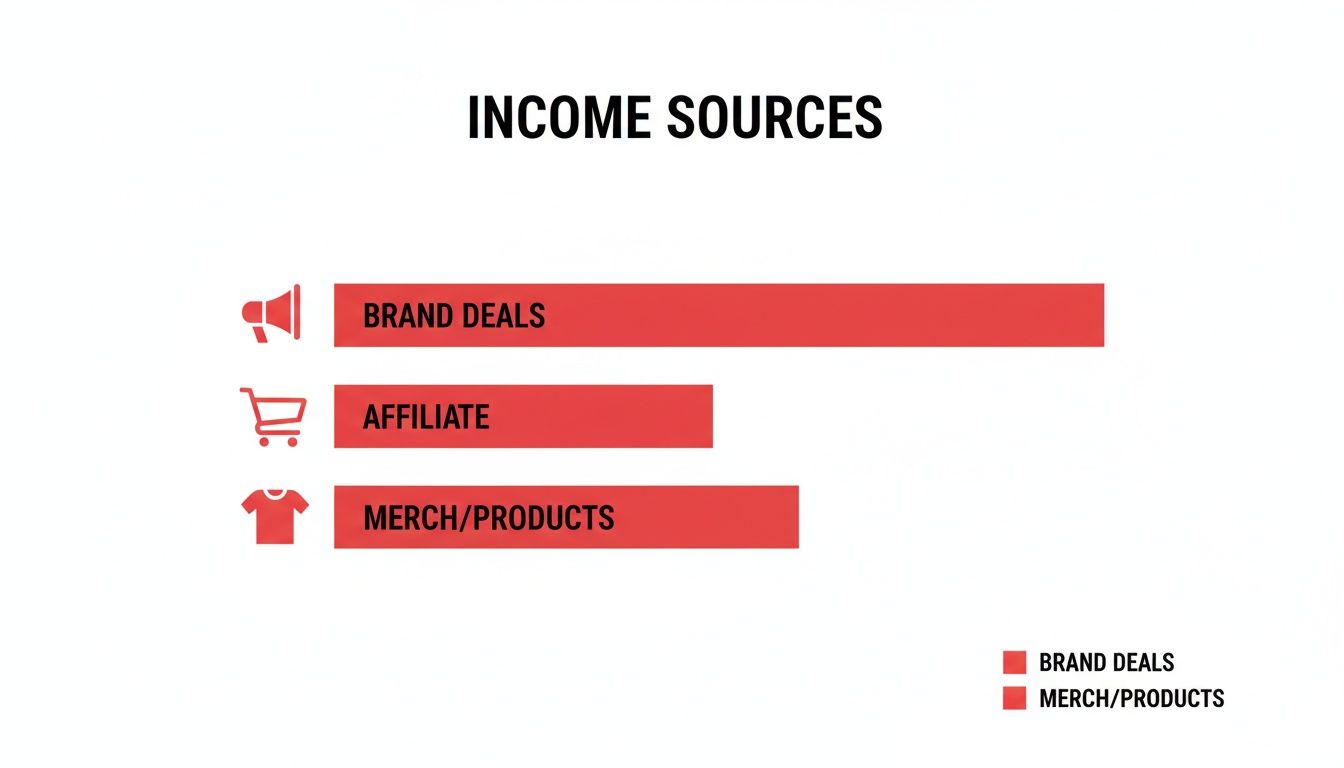
    The chart below really drives home the point that Shorts ad revenue is just one part of a much bigger strategy for top creators.

    A bar chart illustrating income sources: Brand Deals, Affiliate, and Merch/Products, with Brand Deals being the largest.

    It's clear that while ads provide a nice, steady income stream, the serious money often comes from diversifying into brand deals, affiliate marketing, and selling your own products or merchandise.

    What Really Moves the Needle on Your Earnings?

    So, why does one Short make bank while another with similar views falls flat? It boils down to a few critical factors that create a unique financial fingerprint for every single video you post.

    • Audience Geography: This is the heavyweight champion of earning factors. A million views from the United States will almost always outperform a million views from a region where companies spend less on advertising. It's that simple.
    • Content Niche: Advertisers are willing to pay a premium to get in front of certain audiences. If your Shorts are about finance, tech, or business, your RPM will likely be higher than if you're in the comedy or prank space. The potential customer value is just higher.
    • Engagement Signals: While likes and comments don't directly deposit money into your account, they are powerful signals to the YouTube algorithm. High engagement tells the algorithm your content is worth pushing, leading to more views and, by extension, more potential earnings.
    • Seasonality: Advertising budgets aren't static; they change throughout the year. Budgets typically spike during the Q4 holiday season, which can give your RPM a nice temporary boost.

    Once you start understanding these variables, you can shift from just chasing viral trends to building a real strategy. The goal is to create content that not only gets a ton of views but attracts the right kind of views—the ones that advertisers are lining up to reach.

    Your Top Questions About Monetizing Shorts, Answered

    Jumping into YouTube Shorts monetization often feels like navigating a new world. The rules are a bit different from what long-form creators are used to, and it's natural to have questions. Let's clear up some of the most common things creators ask when they're figuring out how to make money with their Shorts.

    How Quickly Can I Actually Get Paid After I Qualify?

    So you've hit the magic numbers: 1,000 subscribers and 10 million Shorts views in 90 days. Great! The first step is to apply for the YouTube Partner Program (YPP), and you can expect the review process to take about a month.

    Once you get the green light, don't forget to accept the "Shorts Monetization Module" in the Earn tab of your YouTube Studio. This is a crucial step. From that moment, your eligible Shorts start earning revenue. But keep in mind, you won't see that cash instantly. YouTube works on a monthly payment cycle. For example, everything you earn in March gets finalized and sent to your AdSense account in mid-April, and the actual payment usually lands in your bank account later that month, as long as you've met the payment threshold.

    Do All My Shorts Views Make Me Money?

    This is a big one that catches a lot of people off guard. The short answer is no—not every single view translates into revenue. For a view to count towards your ad revenue share, it needs to be what YouTube considers a "monetizable view."

    Here’s a quick rundown of what makes a view ineligible:

    • Non-original Shorts: If you just upload unedited clips from movies, TV shows, or other creators' content, those views won't count.
    • Artificial or invalid views: Any traffic from bots or other inorganic methods gets filtered out.
    • Ad-unfriendly Shorts: Content that goes against the advertiser-friendly guidelines won't have ads run on it.

    Your best bet is to focus on creating original, engaging content that people genuinely want to watch. That way, you know the vast majority of your views are actually contributing to your bottom line.

    A key mindset shift for any Shorts creator is to stop chasing just any view and start chasing quality views. A smaller, highly engaged audience in a country with strong ad markets can easily be more profitable than a massive, passive audience elsewhere.

    Is it Okay to Re-Upload My Old Videos as Shorts?

    Absolutely! In fact, this can be a powerhouse strategy. If you've got a backlog of longer videos, you already have a goldmine of potential Shorts. Go back through your content and pull out the best moments—the punchlines, the "aha!" moments, the most valuable tips, or the most dramatic scenes.

    Repurposing these clips as vertical Shorts is a brilliant way to give your old work a second life and introduce it to a completely new audience on the Shorts shelf. Just make sure the clips you choose can stand on their own and are edited to look great in a vertical format. This tactic not only helps you rack up views toward that 10 million requirement but can also act as a trailer, driving curious viewers back to your full-length videos.

    What Type of Content Makes the Most Money on Shorts?

    While you can build a profitable channel in almost any niche, some topics naturally attract higher-paying ads. This is measured by RPM (Revenue Per Mille, or revenue per 1,000 views).

    Historically, niches with higher RPMs include:

    • Finance & Business: Think investing tips, side hustle ideas, and digital marketing.
    • Tech & Gadgets: Unboxings, reviews, and tutorials on the latest tech.
    • Education & How-Tos: Any content that solves a specific problem for the viewer.

    But here’s the most important piece of advice: authenticity will always outperform a trend. Don't jump into a high-RPM niche if you couldn't care less about it. Viewers can spot a fake from a mile away. The creators who build a sustainable income are the ones who are genuinely passionate and consistent, building a real community around a topic they love.


    Ready to stop guessing and start growing? ViewsMax gives you the AI-powered tools and data-driven insights to create Shorts that get noticed. From generating viral titles to optimizing your descriptions, we help you build a content strategy that turns views into revenue. Explore our creator toolkit and see the difference.