The biggest shift on YouTube lately isn't just one thing—it's the platform's full-blown transformation from a simple video-sharing site into a true multi-format playground. If you're not using Shorts, Live streams, and Community posts, you're missing huge opportunities, because YouTube's algorithm is now actively rewarding creators who connect with their audience in all these different ways.
Understanding the New YouTube Playbook
Running a YouTube channel today feels a lot less like uploading to a video archive and more like running your own TV network. The platform's entire identity has changed. What used to be the go-to place for long-form videos is now a bustling ecosystem where different types of content are designed to do different jobs. This isn't just a minor update; it's a complete rethink of how YouTube finds content, shows it to viewers, and helps you make money.
If you’re still putting all your energy into traditional long-form videos, you risk falling behind. Winning on YouTube now requires a strategy that understands how each format works together.
The Multi-Format Mandate
Think of your YouTube channel as a central hub with several doors. Each content format—long-form, Shorts, Live, and even Community posts—is a different way for people to walk in and discover you.
- Long-Form Videos: These are still the heart and soul of your channel. They're where you build deep trust, show off your expertise, and rack up that all-important watch time.
- YouTube Shorts: Shorts are your billboard. They’re a powerful, fast-paced tool for getting in front of massive new audiences who would have never stumbled upon your longer videos.
- Live Streams: This is where you build your tribe. Going live lets you connect with your audience in real-time, answer their questions on the fly, and create a truly loyal community.
- Community Posts: Think of this as your channel’s own social media feed. It’s perfect for running polls, sharing quick updates, and keeping the conversation going between uploads.
This multi-format strategy isn't just a "nice to have" anymore. YouTube has come a long way from its humble beginnings in 2005. As of early 2024, it reached an incredible 2.53 billion users—that's nearly a third of everyone on the planet. You can dig into the numbers behind YouTube's massive user growth on datareportal.com. To connect with such a massive and varied audience, you need to be speaking their language, whatever format that may be.
The new playbook is simple: a successful channel is one that speaks multiple content languages. Ignoring any single format means you're leaving a huge chunk of your potential audience on the table.
To keep up with these changes on YouTube, you have to stop thinking of your channel as just a collection of videos and start seeing it as a complete content ecosystem. The creators who really get this are the ones who are going to win in the long run.
Before we dive deeper, let's take a quick look at the major shifts we're seeing across the platform. This table breaks down the most important updates and what they actually mean for you as a creator.
Quick Guide to Recent YouTube Changes and Creator Impact
A summary of the most significant recent updates on YouTube and what they mean for your content strategy.
| Area of Change | Description of the Change | Immediate Impact on Creators |
|---|---|---|
| Algorithm & Discovery | The algorithm now heavily promotes a multi-format approach, blending Shorts, long-form, and Live streams in viewer feeds. | Channels that only produce one type of content may see slower growth. A mix of formats is now key for discoverability. |
| Monetization | The YouTube Partner Program (YPP) has new, lower eligibility tiers for fan funding features and has expanded Shorts ad revenue sharing. | It's now easier for smaller creators to start earning, and there's a direct financial incentive to create successful Shorts. |
| YouTube Shorts | Shorts have become a primary discovery tool, with a dedicated feed and new creative tools like Collab and green screen effects. | Shorts are no longer optional for growth. They are the best way to reach new, broad audiences quickly. |
| Community & Engagement | Features like Community tab posts (polls, images, text) and channel memberships are being pushed to foster deeper audience connection. | Creators need to actively engage their community between video uploads to maintain momentum and build loyalty. |
| AI & Creator Tools | Introduction of AI-powered tools like YouTube Create, Dream Screen for AI backgrounds, and AI-powered comment summaries. | These tools can help streamline content creation, but creators must learn how to integrate them effectively into their workflow. |
This table is just a snapshot, of course. Each of these changes has ripple effects that we'll explore in more detail throughout this guide, starting with how the algorithm itself has fundamentally changed.
How the New YouTube Algorithm Really Works
Let's get one thing straight: the idea of a single, all-powerful YouTube algorithm is a myth. If you're still thinking that way, you're playing by rules that no longer exist. The reality today is much more nuanced. YouTube now runs on a team of specialized AIs, each with a different job to do. Grasping this is probably the most important part of understanding the recent changes in YouTube.
Think of it like this: the algorithm suggesting a 15-minute documentary has a totally different brain than the one serving up a 30-second Short. They’re looking for different signals and have completely different goals. This means a one-size-fits-all strategy for your content is doomed to fail.
The old game of just chasing "watch time" is officially over. While it definitely still matters, the new system is built around a much more human concept: viewer satisfaction.
From Watch Time to Viewer Satisfaction
For years, the gospel was simple: longer watch times meant a better video. That's still a key factor for your standard, long-form videos, but YouTube's AI now digs a lot deeper. It’s essentially asking, "Did the viewer actually enjoy that?"
So, how does it measure something so subjective? It looks at a whole cluster of signals:
- Direct Engagement: The classics still count. Likes, comments, and shares are clear signs that people found value in what you made.
- Post-Watch Surveys: You've probably seen them. Those little pop-ups asking if a video was "satisfying" or "worth your time." This is direct feedback, and you can bet the algorithm pays close attention to it.
- Repeat Viewership: This is the big one. When someone watches one of your videos and then comes back to your channel for more, it sends a massive signal that you're delivering quality.
This evolution is why a modern channel has to be more than just a collection of videos. It’s an ecosystem.
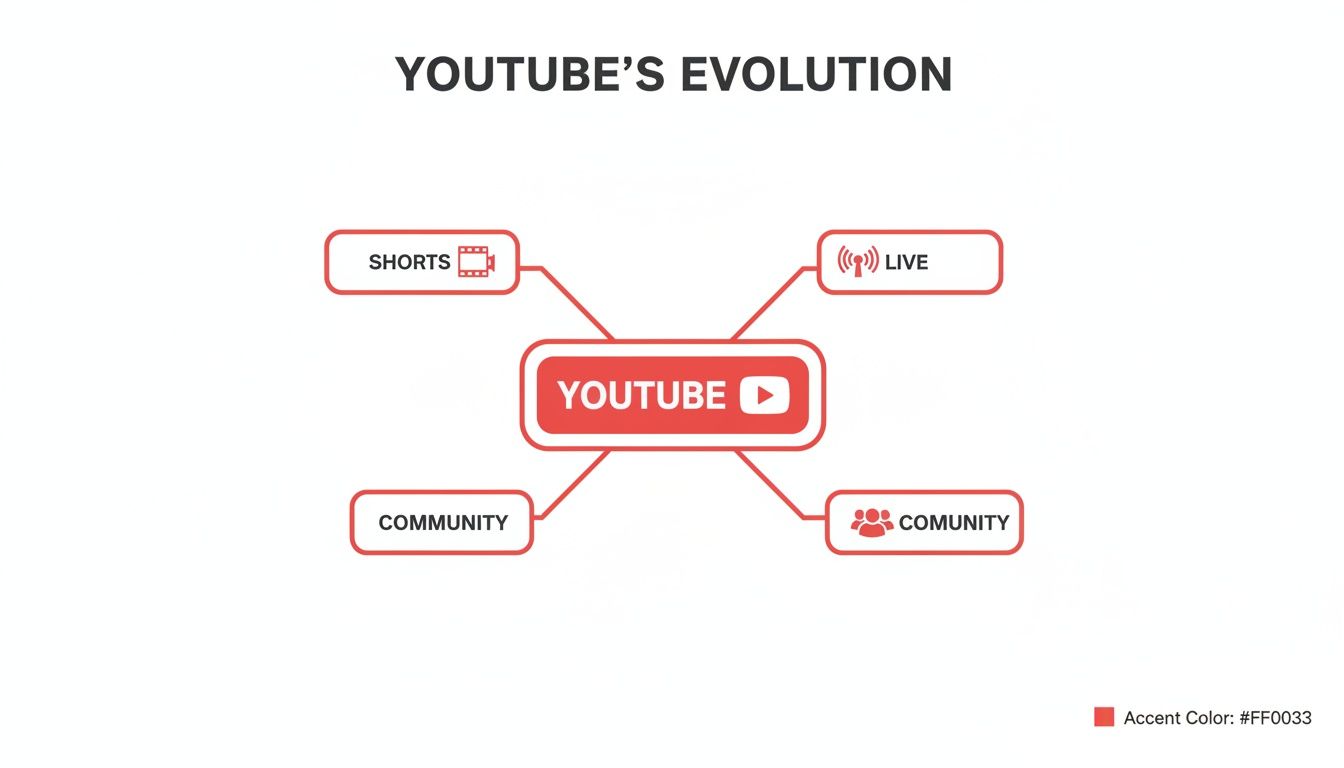
As you can see, a healthy channel now depends on a smart strategy that weaves together long-form content, Shorts, Live streams, and direct community engagement.
The Two Main Algorithmic Personalities
To make this easier to wrap your head around, let's break the system down into two main "personalities." Think of one as a thoughtful curator and the other as a lightning-fast matchmaker.
-
The Long-Form Algorithm (The Curator): This AI is all about creating a great viewing session. It wants to keep people on the platform by recommending high-quality, relevant videos that perfectly match their interests. It obsesses over session duration, audience retention, and all those satisfaction signals we just talked about.
-
The Shorts Algorithm (The Matchmaker): The Shorts AI, on the other hand, is built for speed and discovery. Its entire job is to introduce your channel to a massive new audience as quickly as possible. It looks for instant reactions—did they watch the whole thing, swipe away immediately, or watch it on a loop? It’s all about reach and first impressions.
Understanding this split is critical. Your long-form videos are for nurturing your dedicated audience, while your Shorts are your scouting party, out finding new people to bring into your world.
Building Topic Authority and Repeat Viewership
Knowing all this, two strategies become non-negotiable. First up is building topic authority. The algorithm needs to know, without a doubt, what your channel is about. When you consistently publish great videos on a specific subject, you're effectively teaching the AI to see you as an expert in that niche. This makes it far more likely to recommend your content to anyone interested in that topic.
The algorithm wants to find the best video for every viewer. When you establish clear topic authority, you're making it easy for the AI to choose your content.
This is where fundamentals like keywords and tags are still incredibly important. They’re the signposts that help the algorithm categorize your video right out of the gate. For a full breakdown, check out our guide on finding the best tags for YouTube.
Second, you have to be obsessed with repeat viewership. YouTube is now actively rewarding channels that can turn a first-time viewer into a returning fan. It's the ultimate signal of satisfaction. A healthy channel isn't just one that gets a viral hit; it's one that builds a loyal community that keeps coming back. It’s time to double down on encouraging subscriptions, using end screens strategically, and creating content that makes people excited for what's next.
Integrating Shorts Into Your Content Strategy
Let's be blunt: YouTube Shorts are no longer a side project or a fun experiment. They're a core part of the platform's DNA now. For creators, ignoring short-form video is like trying to fish without bait—you’re missing your biggest opportunity to get a bite. YouTube has retooled its entire discovery engine around Shorts, and you absolutely need a plan to make them work for you.
Think of Shorts as your channel's front door and your long-form videos as the main event inside. The Shorts algorithm is built for one thing above all else: massive, top-of-the-funnel reach. Its job is to put your content in front of a huge pool of people who have never seen your channel before. It’s a powerful first handshake.
Because of this unique role, Shorts play by a different set of rules. Your traditional videos are judged on things like viewer satisfaction and how long someone stays on YouTube after watching. Shorts, on the other hand, live and die by rapid-fire engagement. Did the viewer watch it again? Did they immediately swipe away? This fast-paced world is your ticket to finding a ton of new viewers.
Bridging The Gap From Short To Subscriber
I hear this all the time: creators are terrified that Shorts will "cannibalize" their main channel, training their audience to only want 30-second clips. It’s a fair point, but that only really happens when there’s no strategy connecting the two. The real skill is building a bridge that guides people from a quick, catchy Short to your deeper, long-form content.
Your mission is to create a seamless journey. Someone stumbles upon your viral Short, gets hooked, taps on your channel name, and lands on a library of amazing long-form videos just waiting for them.
Here are a few practical ways to build that bridge:
- Create Teaser Shorts: Pull the most exciting or mysterious clip from an upcoming long video and post it as a Short. End with a simple call-to-action like, "The full breakdown drops tomorrow!"
- Repurpose "Best Of" Moments: Dig into your analytics and find your best-performing long-form videos. Pull out the funniest, most valuable, or most shocking moments. Each one can be a killer Short that basically acts as a free ad for your best stuff.
- Answer a Single Question: Use a Short to give a quick, satisfying answer to one specific question in your niche. Then, point viewers to your latest long video for the full, detailed explanation.
When you design Shorts to complement your main videos, they stop being a distraction and become a powerful lead-generation machine for your channel. For a deeper dive on this, check out our complete guide on how to get more views on YouTube Shorts.
Your Shorts are the hook; your long-form videos are the reason they stay. One introduces them to your brand, the other turns them into a loyal fan.
Navigating Shorts Monetization And Content Creation
Monetization for Shorts is a different beast, too. You won't see pre-roll ads like on your longer videos. Instead, revenue comes from a "creator pool" funded by the ads that run between Shorts in the feed. Your cut is based on your share of the total Shorts views across the entire platform. While the payout per view is definitely smaller than long-form, the potential for massive volume means it can still add up to a serious income stream.
The way you create the content also requires a shift in thinking. You’re competing in a feed where the next video is just a flick of the thumb away. You have to get to the point—fast.
- Hook Within 3 Seconds: The first few seconds are everything. Don't waste them. Start with action, a bold claim, or a question that demands an answer.
- Focus on a Single Idea: Don't try to cram a 10-minute video's worth of information into 45 seconds. A Short should have one clear, simple takeaway.
- Optimize for Loops: Smart creators make content that’s satisfying to watch over and over. A seamless loop or a surprise ending can trick people into re-watching, which juices your watch time.
Figuring out the optimal lengths for YouTube Shorts is also a huge piece of the puzzle for keeping viewers engaged. A perfectly timed clip is far more likely to be watched all the way through, which is a massive signal to the Shorts algorithm. This focus on vertical, fast-paced content is make-or-break, especially when you consider the scale you're up against. Every single minute, over 500 hours of video are uploaded, and users watch more than 1 billion hours of content daily. In an environment that crowded, every second counts. Your Shorts strategy is your best weapon for getting noticed.
Unlocking New Monetization and Revenue Streams

Relying only on AdSense is a risky game. It's like trying to build a business on a foundation with just one support beam—it might hold for a while, but it’s far from stable. YouTube gets this, and recent changes are a massive signal that they want creators to build stronger, more diverse income models. Thankfully, they're giving us the tools to do it.
For years, the path to earning money was a serious grind. The classic goal was hitting 1,000 subscribers and 4,000 watch hours before you could even think about seeing a dime. That's not the reality anymore. YouTube has lowered the barrier to entry for its Partner Program (YPP), creating a new on-ramp for smaller channels to start generating income way sooner.
This new structure is a huge deal. It means you can start building a direct financial connection with your biggest fans long before ad revenue becomes a major factor. It’s all about creating a portfolio of income streams.
Tapping Into Fan Funding Sooner
The biggest change is getting early access to fan funding features. Once you hit a much lower threshold—think 500 subscribers and 3,000 watch hours—a whole suite of direct-support tools opens up.
- Channel Memberships: This is your own subscription service. Viewers can pay a monthly fee for exclusive perks like custom badges, emojis, or members-only videos, giving you a predictable, recurring revenue stream.
- Super Chat & Super Stickers: During live streams, these let viewers pay to have their messages or animated stickers stand out. It’s a fantastic way to generate income while boosting real-time engagement.
- Super Thanks: Think of this as a digital tip jar. Viewers can buy a cool one-time animation on your videos or Shorts to show a little extra appreciation for your work.
These tools completely change the dynamic. They let you monetize the loyalty of your core community long before you have the massive viewership needed for significant ad money.
The new YPP tiers are basically YouTube saying, "Your community's direct support is a legitimate business model." You no longer have to wait for huge view counts to start building something sustainable.
This thinking also applies to Shorts, which have their own monetization model. To really get a handle on it, understanding how to make money on YouTube Shorts is a must, as it’s a different beast with massive potential.
Integrating E-Commerce with YouTube Shopping
Beyond getting tips from fans, YouTube is leaning hard into e-commerce. The platform is quickly evolving from just a video site into a full-blown storefront where you can sell products directly to your audience.
With YouTube Shopping, you can link your own store (from platforms like Shopify) and tag products right in your videos and Shorts. When someone's watching and sees something they like, they can click to browse and buy without ever leaving the YouTube app.
It creates a buttery-smooth journey from discovery to checkout. Picture a DIY channel tagging the exact power drill used in a project, a beauty creator linking to their lipstick, or a gamer selling their own line of merch. The opportunities are endless.
These features transform your content from a passive viewing experience into an interactive, shoppable one. By weaving together ad revenue, fan funding, and e-commerce, you're building a much more resilient and scalable creator business—one that can easily adapt to whatever changes come next. This is the new formula for success on YouTube.
Keeping Up with YouTube's Ever-Changing Rulebook
Let's be honest: YouTube isn't just a platform for creativity; it's a governed digital nation with its own set of laws. Keeping up with its policies isn't just about dodging trouble—it's about building a channel that advertisers trust and that can thrive for years to come. These rules are constantly evolving to keep pace with new tech and societal norms, and pleading ignorance won't save you from a channel strike.
Think of the YouTube Community Guidelines as the living, breathing terms and conditions for your business. A small, even accidental, slip-up can get a video demonetized or taken down entirely. The latest changes in YouTube policy have zeroed in on transparency and safety, which means creators have to be more careful than ever.
The New Rules for AI-Generated Content
One of the biggest recent shifts is how YouTube handles content made with artificial intelligence. If you're using AI to create realistic content that could fool someone—like making it look like a person said or did something they didn't—you now have to officially label it. This is all about maintaining trust with the audience.
YouTube has rolled out a new disclosure tool right in Creator Studio to make this easy. When you upload, you can flag content that uses altered or synthetic media. Skipping this step can lead to real consequences, from having the content removed to getting kicked out of the YouTube Partner Program. This isn't an attack on creativity; it's a defense against the potential for believable deepfakes and misinformation.
The rule of thumb is pretty straightforward: if a viewer could reasonably get confused about whether what they're seeing is real, you need to disclose it. Transparency is your best policy here.
Stronger Protections for Younger Viewers
Protecting teens and children is a massive priority for YouTube, and their methods for doing so are getting smarter. In the US, the platform is now using machine learning to better guess a user's age based on their watch history and searches, not just the birthday they plugged in when they signed up.
This directly affects how your content is delivered. If the algorithm flags a viewer as a teen, it automatically tightens the guardrails:
- Personalized ads get shut off for that user on your video, which can impact revenue.
- Wellbeing features like "take a break" reminders are automatically enabled.
- Recommendations are limited to avoid sending them down rabbit holes of potentially harmful content, like videos fixated on body image or social aggression.
What does this mean for you? Some of your videos might be shown under these stricter conditions, even if you didn't mark them as "made for kids." The smartest strategy is to always create with a brand-safe filter in mind. Make sure your content is genuinely appropriate for your target audience and doesn't push the boundaries on sensitive subjects.
Your Quick Compliance Checklist
Staying on top of these rules has to be an active part of your workflow. A little bit of self-auditing now can prevent a massive headache later. Here's a simple checklist to run through:
- Check Your AI Footprint: Look at your recent uploads. Did you use AI to create a realistic scene, clone a voice, or alter someone's likeness? If so, does it need that new disclosure label?
- Audit Your Packaging: Are your titles and thumbnails an honest reflection of what's in the video? Or could they be interpreted as misleading clickbait? YouTube's getting stricter on this.
- Scan for Sensitive Content: Re-watch any videos that discuss topics like health, finance, or major news events. You have to be incredibly careful not to make claims that could be flagged as harmful or unsubstantiated.
And if you do get a warning or a strike, take a breath. The appeals process exists for a reason. When you file an appeal, be professional and specific. Clearly explain why you believe your content follows the guidelines, pointing to the exact rules. A calm, evidence-based appeal will always get you further than an emotional rant. Building compliance into your routine isn't just about following rules—it's about protecting your channel's future.
Your Action Plan for Success on the New YouTube
Knowing the why behind all these YouTube changes is one thing, but actually putting that knowledge to work is what separates the channels that stall from the ones that grow. This is where we get practical.
Instead of trying to do everything at once and feeling overwhelmed, we're going to build a clear roadmap. Think of it as a step-by-step guide to fine-tune your channel so it's perfectly aligned with where YouTube is headed.
The idea is to stop reacting to every little platform shift and start building a proactive strategy. We'll begin by looking at what you've already done, then create a sustainable content schedule that plays to the strengths of different formats. Let's dive in.
Step 1: Conduct a Content Audit
Before you can plan your next move, you have to understand your starting position. A content audit is your way of looking back at your own work to see what’s resonating with viewers and where the algorithm is already giving you clues.
This isn't about being critical of your old videos. It's about finding the gold that's already sitting in your analytics.
Here’s what to do this week:
- Find Your Heavy Hitters: Jump into YouTube Studio and pull up your top 5-10 videos based on views, watch time, and subscribers gained. What was it about them? The topic? The title? The format? These are your proven concepts.
- Look for Repurposing Gold: Scan those top-performing videos again. Every single one is a potential goldmine for Shorts. Your mission is to find at least three killer moments from just one of those videos that you can clip out and turn into a standalone Short.
- Check Your Topic Focus: Take an honest look at your last 20 videos. Do they tell a clear story about what your channel is? Or are they a bit scattered? The algorithm loves consistency, so you want your recent uploads to scream, "This is what I'm an expert in."
Step 2: Develop a Multi-Format Schedule
With your audit done, it's time to build a content calendar that works in this new multi-format world. A smart schedule doesn't just mean posting more; it means posting smarter across different formats to keep your loyal fans happy while constantly reaching new people.
Here’s a simple framework to start with:
- Set Your Anchor: Plan one high-quality, long-form video per week or maybe every two weeks. This is your flagship content, the stuff that builds deep connections. Give it the time and planning it deserves. A solid plan is everything; our guide on writing a great script for YouTube videos can really help here.
- Surround It with Shorts: For every big video you post, aim to release 3-5 related Shorts. These can be teasers before it drops, highlight clips after it's live, or even quick tips that dive deeper into a small point you made.
- Keep the Conversation Going: Schedule at least one Community tab post between your bigger video uploads. A simple poll or a behind-the-scenes photo keeps your channel active in the algorithm's eyes and makes your subscribers feel connected.
A winning YouTube strategy isn't just about chasing one viral hit. It's about creating a steady, predictable rhythm with different types of content that all work together to serve your audience and the platform.
This kind of system takes the guesswork out of content creation. Each piece you make supports the others, creating a growth loop that's sustainable. By taking these concrete steps, you’re setting your channel up to do more than just survive YouTube's changes—you're preparing it to thrive.
Your Top YouTube Questions, Answered
Keeping up with YouTube can feel like a full-time job. You're not alone in wondering what all these updates actually mean for your channel. Here are the straight-up answers to the questions we get asked most often.
So, Do I Really Have to Make Shorts to Grow?
Look, nobody's going to force you. But if you're not making Shorts, you're basically turning down free promotion on YouTube's biggest discovery engine. It's the most powerful way to get in front of fresh eyes right now.
The smartest play is to use Shorts as a hook—a gateway drug, if you will—that leads new viewers back to your long-form videos. You don't have to abandon your main content, but ignoring Shorts completely means leaving a ton of potential growth on the table.
Is Watch Time Still the King of All Metrics?
Watch time is still incredibly important, but it's not the absolute monarch it once was. The algorithm is now much more focused on a broader concept: viewer satisfaction. This is less about one number and more about a collection of signals that tell YouTube someone genuinely loved your video.
We're talking about things like strong audience retention, likes, shares, and a big one—repeat viewers. Are people coming back for more? That's a massive green flag for the algorithm. A video that keeps people happy and coming back can easily beat a longer video that people click away from. The name of the game is earning loyalty, and good watch time will naturally come with it.
How Do the New YPP Tiers Actually Help Small Channels?
For anyone just starting out, the new, lower-entry tiers for the YouTube Partner Program are a game-changer. Hitting a milestone like 500 subscribers used to just be a number on your dashboard. Now, it unlocks real monetization tools way sooner.
This gives you early access to fan funding features, including:
- Super Thanks: A simple way for viewers to tip you on your videos.
- Super Chat: Lets fans pay to have their messages highlighted during your live streams.
- Channel Memberships: Allows your most loyal fans to support you with a monthly subscription.
This is huge. It means you can start building a real, sustainable income directly from your core community long before you're eligible for ad revenue. It shifts the focus from chasing massive view counts to building a dedicated audience that wants to support you directly.
Trying to figure all this out on your own can be a real headache. ViewsMax gives you the AI-powered tools and clear, data-backed insights to stop guessing and start growing. You can see what's working, adapt your strategy, and optimize every video with confidence. Explore our features and see how we can help you thrive.