YouTube generated more than $60 billion in revenue in 2025, but an individual creator is profitable only when the business earns beyond advertising and tracks which content produces off-platform conversions. The platform is massively profitable. Your channel may not be.
The popular advice is to chase views, increase subscribers, and wait for AdSense to make the work worthwhile. That advice confuses attention with profit. A video can attract a large audience and still lose money after production costs, taxes, and unpaid labor. Another video with a smaller audience can generate leads, affiliate commissions, sponsorship revenue, or product sales that make the channel financially sustainable.
The right question isn't just “How much does YouTube pay per view?” Ask instead: Which formats attract valuable viewers, which offers convert them, and what remains after every cost?
The Profitability Gap Between Platform and Creator
YouTube is profitable at a corporate scale. That doesn't mean every channel is profitable at the creator level.
Alphabet reported that YouTube's advertising and subscription revenue exceeded $60 billion for full-year 2025, while Alphabet's total annual revenue reached $403 billion, up 15% year over year. The company also reported more than 325 million paid subscriptions across consumer services, led by Google One and YouTube Premium. YouTube's combined revenue even exceeded Netflix's $45.18 billion in 2025 revenue, according to the company's earnings disclosure filed with the U.S. Securities and Exchange Commission.
That scale proves the platform has a durable commercial engine. It doesn't prove that your upload schedule has a healthy margin.
Views don't equal business income
Recent creator-economy reporting places the median long-form creator's earnings at about $2.30 per 1,000 views, while also describing a highly concentrated payout environment in which top channels capture outsized shares of advertising income. The creator payment analysis from Gigapay also notes that the top tier can earn substantial annual advertising income and receive a disproportionate share of brand-campaign revenue.
That median figure isn't a promise or a universal rate. It illustrates the central problem: a channel can collect views without producing enough cash to pay its owner fairly. Geography, audience demand, subject matter, viewer intent, ad suitability, seasonality, and format all affect the result.
Subscriber count is an especially weak profitability metric. Subscribers can help distribution, but they don't automatically buy anything, click an affiliate link, join a membership, or hire you. A smaller audience with a clear commercial problem can be worth more than a broad audience that watches passively.
Practical rule: Treat every video as either an audience asset, a sales asset, or both. If it does neither, question why you're producing it.
Think like a media company
A serious channel needs more than a content calendar. It needs a revenue model, a cost structure, an editorial position, and a way to measure return on effort.
That means tracking:
- Revenue by source: Advertising, sponsorships, affiliates, memberships, services, and products.
- Revenue by video: Identify which topics and formats generate money, not just watch time.
- Production cost: Include editing, research, thumbnails, software, equipment, and your own labor.
- Conversion quality: Measure leads, sales, calls booked, or subscriptions produced by viewers.
- Format contribution: Separate long-form performance from Shorts performance instead of blending them into one channel average.
The platform's success gives creators access to a large monetization ecosystem. It doesn't remove the need for business discipline. If your only revenue line is AdSense, you're operating one part of a media business and calling it the whole company.
How YouTube Generates and Distributes Revenue
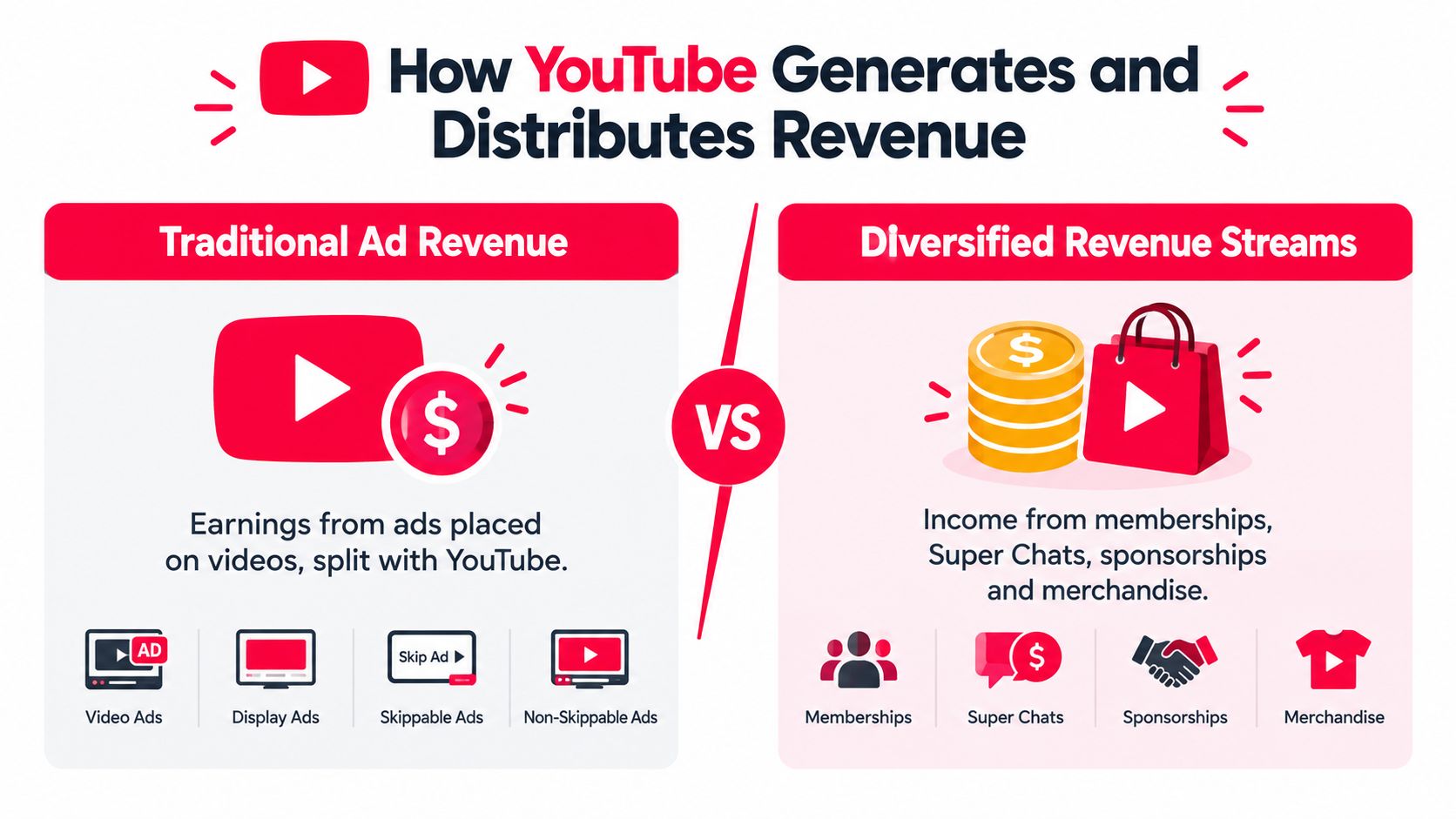
YouTube's money flows through several systems, and each system changes the creator's effective economics.
Long-form advertising uses a 55% creator and 45% platform revenue split for ad revenue, according to YouTube's official Partner Program guidance. Shorts uses a different pooled model, so a creator's effective share and revenue per view generally differ from long-form results.
Long-form and Shorts are different businesses
Long-form videos can carry advertising around the viewing experience and, when eligible, within longer content. That creates more opportunities to monetize a viewer session. The format also gives creators more room to explain a problem, establish trust, compare products, and direct viewers toward an offer.
Shorts can deliver discovery and reach, but its pooled revenue structure makes the economics different. A channel that evaluates Shorts only by raw view count may overestimate their direct financial contribution. Shorts can still be valuable when they introduce the right audience to long-form content, an email list, a product, or a service.
The strategic decision isn't “long-form or Shorts.” Use each format for the job it performs best:
- Long-form: Build authority, capture search intent, support deeper sponsorships, and drive conversions.
- Shorts: Test hooks, reach new viewers, create repeated exposure, and route attention toward stronger revenue assets.
- Live content: Encourage direct participation through fan funding and community interaction.
- Channel ecosystem: Turn individual videos into a sequence that moves viewers from discovery to trust to action.
CPM isn't your paycheck
CPM describes what advertisers pay for ad impressions. RPM is closer to the creator's realized revenue per thousand views, because it reflects what the channel receives across monetized and unmonetized views after YouTube's share and other delivery conditions.
Audience geography matters because advertiser demand differs between markets. Niche matters because a viewer researching a business tool or financial product may carry different commercial value from a viewer consuming broad entertainment. Advertiser suitability matters because restricted inventory can reduce monetization opportunities.
You can review a practical explanation of the metric in this guide to what CPM means on YouTube. Use it as a measurement starting point, not as a forecast.
YouTube's overall financial scale reinforces the ecosystem's durability. Alphabet reported YouTube advertising revenue of $8.1 billion in Q1 2024, $8.66 billion in Q2, $8.92 billion in Q3, and $10.47 billion in Q4, with Q4 advertising revenue up 13.8% year over year. Full-year 2024 advertising revenue reached about $36.15 billion, up 14.7% from the prior year, and combined advertising and subscription revenue surpassed $50 billion over the preceding four quarters by late 2024, as reported by Variety's coverage of Alphabet's earnings.
That growth supports infrastructure and creator payouts, but it doesn't guarantee an individual channel a living wage. Your format mix still determines how efficiently attention becomes revenue.
YouTube also reported more than $60 billion in total revenue in 2025, with approximately $40.4 billion from advertising, according to BBC reporting on the company's results. The remainder came from subscriptions and other monetization, which matters because the platform isn't dependent on advertising alone. Creators shouldn't be either.
Calculating Your True Margins and Hidden Costs
Gross revenue is not profit. Your YouTube Studio dashboard shows money entering the business, not what you keep after production, taxes, and the value of your time.
Start with a simple monthly profit and loss statement. Record every revenue source, then subtract direct production expenses, overhead, taxes, and a reasonable labor cost for your own work. If the result is negative, increasing the upload frequency may enlarge the loss rather than solve it.
Build the calculation from the bottom up
Use this sequence:
- Record realized revenue. Use the amount credited or received, not an advertiser's CPM estimate.
- Separate revenue streams. Keep advertising, sponsorships, affiliates, memberships, and products in distinct lines.
- Assign production costs. Include editors, writers, thumbnail designers, music licenses, props, travel, software, and payment processing.
- Allocate shared overhead. Studio rent, cameras, computers, lighting, internet, and subscriptions support multiple videos, so assign a reasonable portion to the channel.
- Value your labor. Count scripting, filming, editing, publishing, sales, community management, and administration.
- Reserve for taxes. Self-employment and income-tax obligations vary by location and structure, so obtain professional advice instead of treating pre-tax cash as take-home pay.
Equipment also loses value over time. A camera purchased for the channel isn't free because you paid for it once. Treat major purchases as business assets and allocate their cost across the period in which they support production.
A working margin template
The brief provides no verified percentages for individual creator cost categories, so don't pretend a universal split exists. Use your own records and replace the blank assumptions with actual amounts.
| Revenue / Cost Category | Percentage of Gross Ad Revenue | Impact on Bottom Line |
|---|---|---|
| Gross advertising revenue | 100% | Starting point, not profit |
| YouTube platform share | Not applicable to creator-reported revenue | Already reflected according to the revenue measure you use |
| Editing and post-production | Calculate from invoices or hours | Reduces contribution margin |
| Research, scripting, and production labor | Calculate from tracked time | Reveals whether the channel pays you fairly |
| Software, music, and subscriptions | Calculate monthly allocation | Creates recurring overhead |
| Equipment and studio allocation | Calculate depreciation or usage allocation | Prevents one-time purchases from hiding ongoing cost |
| Taxes and professional fees | Calculate for your jurisdiction | Reduces cash available for personal income |
| Net channel profit | Calculate after all costs | The number that determines sustainability |
Don't mix CPM with profit, and don't use subscriber count as a revenue forecast. A useful guide to how much a YouTuber makes per subscriber can help explain why subscriber totals alone don't establish income.
A profitable upload schedule is one that pays for production, compensates the creator, and leaves cash to reinvest.
Diversifying Income Beyond the AdSense Dashboard
Advertising is useful, but it gives you limited control. Advertisers, viewer behavior, platform policies, and market conditions influence the amount you receive. A channel becomes sturdier when it owns additional paths from viewer interest to revenue.
YouTube itself reported that it paid creators, artists, and media companies more than $100 billion over the four years ending in 2025, while its 2025 revenue exceeded $60 billion. The creator-economy data overview from Digital Applied emphasizes the practical implication for creators: platform economics include advertising, subscriptions, format-specific revenue sharing, and fan funding, not just CPM.
Compare the revenue options
Sponsorships can move the needle when your audience matches a brand's buying market. Sponsors care about relevance, trust, placement, and business outcomes, not only your public subscriber number. Build a concise media kit with audience characteristics, average performance by format, prior campaign results if available, and a clear deliverable list.
Affiliate marketing works best when your videos already answer purchase-intent questions. Reviews, comparisons, tutorials, and setup guides can naturally support tracked product links. The creator earns when a viewer completes the required action, so the offer and audience fit matter more than broad reach.
Memberships and fan funding suit channels with recurring community value. Behind-the-scenes material, direct interaction, exclusive streams, or member-led access can support recurring income, but only if you can deliver consistently without turning the channel into an exhausting service obligation.
Digital products, courses, and services offer the most control because you own the offer and the customer relationship. They also carry more responsibility. The product must solve a real problem, support quality delivery, and justify its price. A tutorial channel might sell a structured course, while a business channel might generate consulting leads or sell templates.
Merchandise fits identity-led communities better than purely informational channels. It can strengthen the brand, but inventory, fulfillment, returns, and customer support can destroy margins if you treat sales volume as profit.
A useful framework is to assign each revenue source a job:
- Advertising funds attention: It monetizes existing viewing activity.
- Affiliates monetize recommendations: They convert commercial intent without requiring you to build the product.
- Sponsors monetize trust: They connect a relevant brand to an audience that listens.
- Products monetize expertise: They turn your knowledge into an owned offer.
- Services monetize access: They produce revenue from a smaller number of high-value customers.
Don't add every option at once. Choose the stream that matches viewer intent, then measure whether it produces profit after fulfillment and support.
Your channel should lead viewers somewhere useful. This guide to earning money from a YouTube channel provides broader context on combining YouTube monetization with other income sources.
The strongest mix usually contains a discovery format, a trust-building format, and a conversion path. That structure reduces dependence on any single algorithmic or advertising outcome.
Tracking Attribution to Prove What Actually Sells
Most creators know which videos get views. Far fewer know which videos produce revenue.
Watch time helps you understand audience behavior, but it doesn't answer the commercial question. A high-retention video may create awareness without generating a lead. A modest tutorial may send qualified buyers to a checkout page for months. If you don't connect content to outcomes, you can't tell the difference.
Give every conversion path a source
Create a distinct trackable link for each important video or campaign. Place it in the description, pinned comment, channel profile, or relevant community post, then connect the destination to your lead form, booking system, affiliate page, or checkout process.
A practical workflow looks like this:
- Define the conversion: Sale, qualified lead, booked call, email signup, affiliate action, or membership.
- Create a unique link: Use a separate link for each video so clicks carry a content identifier.
- Use consistent naming: Include the topic, format, and publishing date in your internal campaign label.
- Place the link deliberately: Put the primary action near the top of the description and repeat it in a natural spoken call to action.
- Record downstream results: Capture clicks, leads, sales, refunds, and revenue rather than stopping at visits.
- Review by content: Compare revenue per video, conversion rate, and profit after content cost.
ViewsMax is one option for creating trackable links, monitoring clicks, and connecting leads or sales to the content that generated them. The important principle isn't the dashboard itself. It's the discipline of assigning a source to every meaningful conversion.
Choose an attribution model consciously
A viewer may discover you through a Short, watch a long-form tutorial later, click a link from a pinned comment, and purchase after returning through email. Last-click attribution would credit the final interaction. A first-touch model would credit discovery. A multi-touch model would distribute credit across the journey.
For creators with several content formats or sales channels, Otter A/B attribution modeling offers useful background on how different attribution approaches assign credit. You don't need an elaborate analytics department to begin. Start with first-touch and last-touch reporting, then add a simple assisted-conversion view once your volume justifies it.
Measurement principle: The video with the most views isn't automatically your best business asset. The best asset is the one that creates profitable outcomes at a sustainable production cost.
Review the data on a fixed schedule. Identify videos that produce clicks but few sales, sales without strong view counts, and high revenue with excessive production time. Then make decisions based on contribution margin, not applause.
Building a Sustainable and Profitable Channel Strategy
Profitability requires a channel strategy that protects cash, attention, and creative capacity. The goal isn't to publish as much as possible. The goal is to build a repeatable system in which each format supports a defined business outcome.
Start with a narrow audience and a clear promise. A specific viewer should understand what problem you solve and why your perspective is useful. Broad topics can attract attention, but focused positioning makes sponsorships, products, affiliates, and services easier to match with the audience.
Make the format mix earn its place
Give every format a responsibility:
- Long-form should build trust and commercial context. Use it for tutorials, comparisons, analysis, and stories that help viewers make decisions.
- Shorts should support discovery or testing. Keep the strongest hooks, then guide interested viewers toward deeper content or a relevant offer.
- Live sessions should deepen participation. Use them when real-time access creates more value than a scripted upload.
- Email and owned channels should preserve the relationship. YouTube can introduce the audience, but an owned list gives you a direct path to future offers.
Avoid viral chasing when the traffic has no connection to your niche or product. A trend can produce impressive surface metrics while attracting viewers who never return and never convert. Evergreen content with clear buyer intent often creates a more useful asset, even when it grows less dramatically.
Audit the business, not just the channel
Review these questions regularly:
- Which videos produced revenue, leads, or qualified conversations?
- Which topics attracted viewers who took action?
- Which uploads consumed the most time relative to their return?
- Does each major offer have a trackable content path?
- Can the business withstand a weak advertising period?
- Are you paying yourself for production and management work?
- Which tasks should remain in-house, and which should move to an editor or specialist?
Use AI tools carefully to improve production efficiency, not to flood the channel with repetitive material. Creators exploring automated workflows can review resources for AI video ads, then apply human judgment to scripting, claims, editing, and audience fit.
Your final decision rule should be blunt: keep producing a format when it creates durable audience value or profitable revenue, improve it when attribution shows potential, and stop it when the numbers remain weak after a fair test. YouTube is profitable for the platform because it combines advertising, subscriptions, and a global distribution system. Independent creators become profitable when they build a similar discipline at a smaller scale, with diversified revenue, controlled costs, and evidence connecting content to sales.
ViewsMax helps creators create trackable links, connect clicks and sales to individual videos, and manage content planning and publishing around real offers. Visit ViewsMax to start measuring which YouTube content drives revenue, then use that evidence to invest in the formats and topics that grow your business.