
YouTube pays $0 directly per subscriber. Revenue comes from monetized views, sponsorships, memberships, and sales, so the useful number is an engaged subscriber's indirect lifetime value, commonly benchmarked at roughly $0.50 to $5 per year, depending on niche and monetization strategy.
That answer feels unsatisfying when you've just reached a milestone. You may have spent months publishing, watched the subscriber counter climb, and then opened your revenue dashboard expecting the number to move with it. Instead, the income barely changes.
The reason is simple but easy to miss: subscribers are an audience asset, not a payment unit. A subscriber who never returns to watch, clicks a sponsor link, joins a membership, or buys something may generate no direct revenue at all. A smaller audience that watches consistently and trusts your recommendations can be worth far more.
Why the Per-Subscriber Question Is the Wrong One to Ask
A creator reaches 50,000 subscribers, checks the analytics, and sees stagnant income. That experience creates a natural question: “How much does a YouTuber make per subscriber?” The problem isn't the question's wording. It's the assumption underneath it, namely that YouTube attaches a payout to each name on your subscriber list.
It doesn't. YouTube revenue is tied to monetized views, ad impressions, and viewer behavior, not to the number of people who have clicked Subscribe. A silent subscriber who never watches a new upload doesn't create ad inventory, Premium watch time, a membership payment, an affiliate conversion, or a product sale. The direct value of that subscriber can therefore be $0, as explained in this breakdown of YouTube's per-subscriber economics.
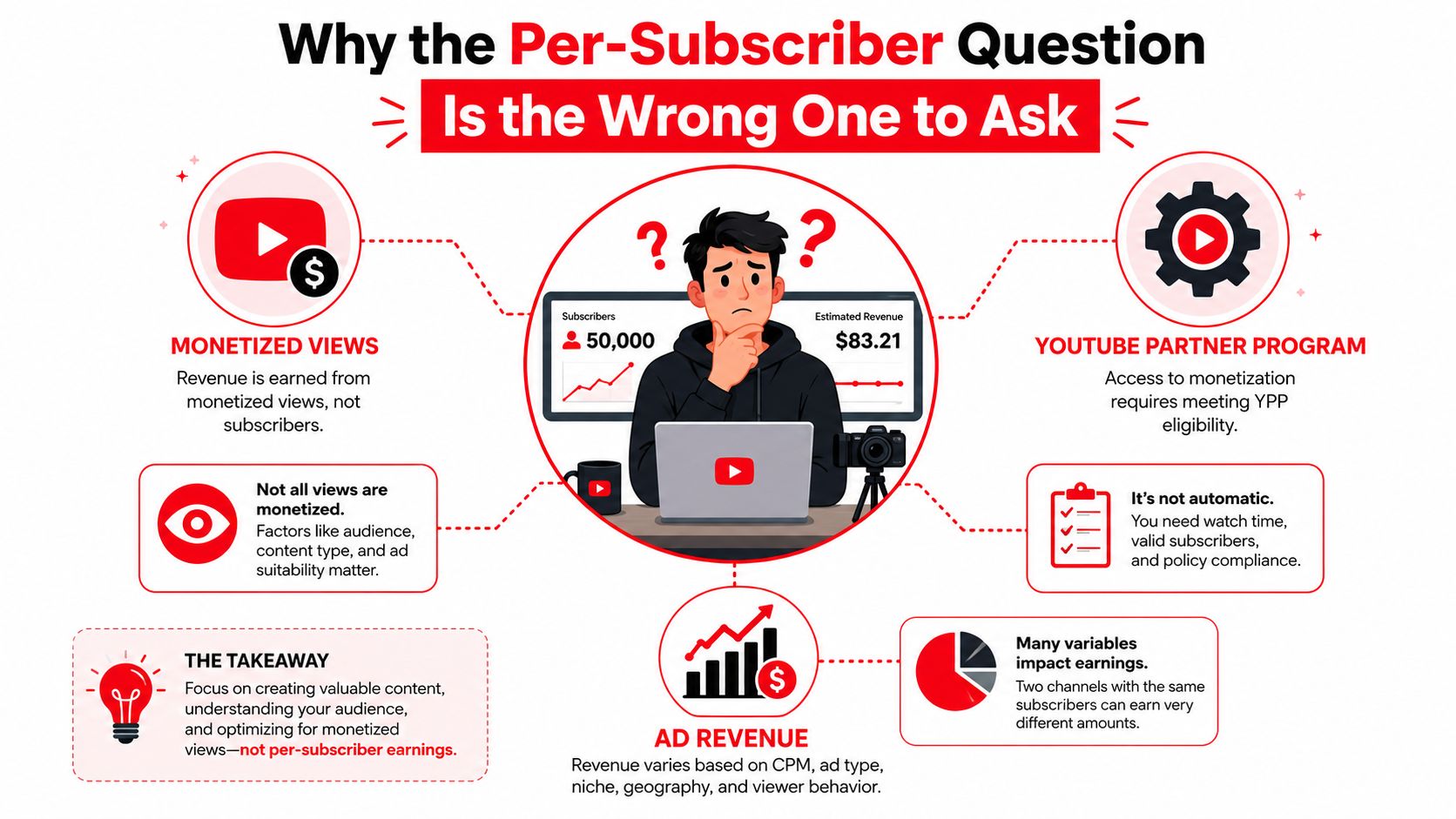
Subscribers create opportunities, not automatic income
A subscriber can still matter. Subscriptions may increase the chance that someone sees a new upload, returns to your channel, watches multiple videos, joins a paid community, or follows a recommendation. But those outcomes happen through engagement and conversion, not through the subscription itself.
Think of your subscriber base as a list of potential repeat customers. The list has no fixed cash value until people take actions that produce revenue. Those actions include:
- Returning views: A subscriber watches future uploads, creating monetizable attention.
- Commercial clicks: A viewer follows a sponsor, affiliate, or product link.
- Direct support: A loyal fan joins a membership or sends a Super Thanks.
- Business conversion: A viewer buys a course, service, product, or piece of merchandise.
The practical metric is therefore annual revenue per engaged subscriber, not platform payout per subscriber. An engaged subscriber is someone who repeatedly watches or takes a measurable commercial action. That's why creator-income benchmarks often place indirect subscriber value around $0.50 to $5 per year, with the result varying by niche and monetization mix, as summarized by Hashtag Network's creator-income analysis.
Practical rule: Treat subscriber count as a distribution opportunity. Treat returning views and attributed sales as revenue evidence.
Measure monetizable attention
Start with three questions in YouTube Analytics:
- How many subscribers watched during the period?
- How many views did those subscribers generate?
- What revenue did those views and downstream actions produce?
That sequence separates audience size from audience usefulness. A channel with fewer subscribers but stronger returning-viewer behavior can outperform a larger channel with an inactive audience.
A widely cited 2023 large-scale study of YouTube channels illustrates the concentration problem. Channels with 10 million or more subscribers accounted for 10.7% of total revenue, while channels with 1 million to 10 million accounted for 30.1%, 100,000 to 1 million accounted for 27.4%, 10,000 to 100,000 accounted for 19.2%, and 1,000 to 10,000 accounted for 12.5%. The same study reported average annual revenue ranging from $295 for channels with 1,000 to 10,000 subscribers to $1,707,446 for channels with 10 million or more, demonstrating that subscriber count is only a rough proxy for earnings. See the YouTube channel revenue concentration data.
The better question is: How much revenue does one engaged subscriber generate over a year, and which content caused that person to act? That framing leads directly to the RPM math.
The RPM Math Behind Real Subscriber Value
RPM means revenue per 1,000 views. It's the useful creator metric because it reflects what the channel earns after the platform's revenue share and across the monetized views included in the calculation.
CPM is different. CPM generally describes what advertisers pay per 1,000 ad impressions, while RPM describes the creator's realized revenue per 1,000 video views. A video can have a strong CPM and still produce a weaker RPM if many views don't receive ads, viewers leave early, or the content attracts limited monetized inventory.
Use this formula:
Monthly revenue per subscriber = (Monthly views ÷ Subscribers × RPM) ÷ 1,000
The first step is to calculate views per subscriber. The second is to multiply those views by RPM. The third is to divide by 1,000 because RPM is expressed per thousand views.
A finance example
Suppose a finance channel has 100,000 subscribers, averages 200,000 monthly views, and records a $12 RPM. The monthly ad calculation is:
200,000 ÷ 1,000 × $12 = $2,400 per month
Dividing that by 100,000 subscribers produces $0.024 per subscriber per month, or $0.288 per subscriber per year from that ad-revenue assumption.
The subscriber count didn't create the $2,400. The 200,000 views and the $12 RPM did. If the same audience generated fewer returning views, the per-subscriber figure would fall even though the subscriber total stayed unchanged.
For a simple comparison, an entertainment channel with the same 100,000 subscribers and 200,000 monthly views, but a $2 RPM, would generate:
200,000 ÷ 1,000 × $2 = $400 per month
That equals $0.004 per subscriber per month, or $0.048 per subscriber per year under the same assumptions. These are illustrative calculations using the RPM framework, not universal earnings promises. Benchmark discussions commonly place many monetized channels around $0.50 to $6 per 1,000 views in RPM, with finance and technology often commanding stronger advertiser demand, as described by LiveReacting's YouTube revenue calculator guide.
| Metric | Formula | What It Measures | Typical Finance Niche Range | Typical Entertainment Niche Range |
|---|---|---|---|---|
| RPM | Creator revenue ÷ views × 1,000 | Realized creator revenue per 1,000 views | Can be higher when advertiser demand is strong | Often lower when commercial intent is weaker |
| CPM | Advertiser spend ÷ ad impressions × 1,000 | Advertiser-side pricing for ad inventory | Often stronger for purchase-oriented audiences | Often weaker for broad entertainment audiences |
| Revenue per subscriber | Revenue ÷ subscribers | Indirect value of the subscriber base | Depends on returning views and conversion | Depends on repeat viewing and monetization mix |
For a deeper explanation of the underlying view-based model, see this guide to YouTube pay per 1,000 views.
Why subscriber averages can mislead
Revenue also concentrates in a small group of videos and viewers. A handful of evergreen uploads may generate most of a channel's monthly watch time, while many subscribers never watch them. That's why you should calculate revenue per active subscriber cohort, such as subscribers who watched during the last month, rather than dividing total revenue by every subscriber ever acquired.
Monetization Streams That Change Your Per-Subscriber Number
Ad revenue is only one layer of the business. A subscriber who watches a review may create advertising income, click an affiliate link, buy the product, and later join a membership. Counting only the ad impression would understate that person's economic value.
The main streams affect subscriber value in different ways:
- Ad revenue: This gives you a baseline tied to monetized views and RPM. It's scalable, but view volume and advertiser demand can change.
- Memberships and fan support: Channel memberships, Super Thanks, and similar tools turn loyalty into direct payments. Their value depends on how many viewers choose to pay and how long they remain active.
- Sponsorships: Brands pay for access to a relevant and attentive audience. A niche channel with strong engagement can be more attractive than a much larger channel with weak audience fit.
- Affiliate links: You earn when viewers take a qualifying action through a tracked link. The value comes from purchase intent, not subscriber count.
- Products and services: Courses, coaching, software, merchandise, and consulting can produce substantially different economics from ads because the creator controls the offer and price.
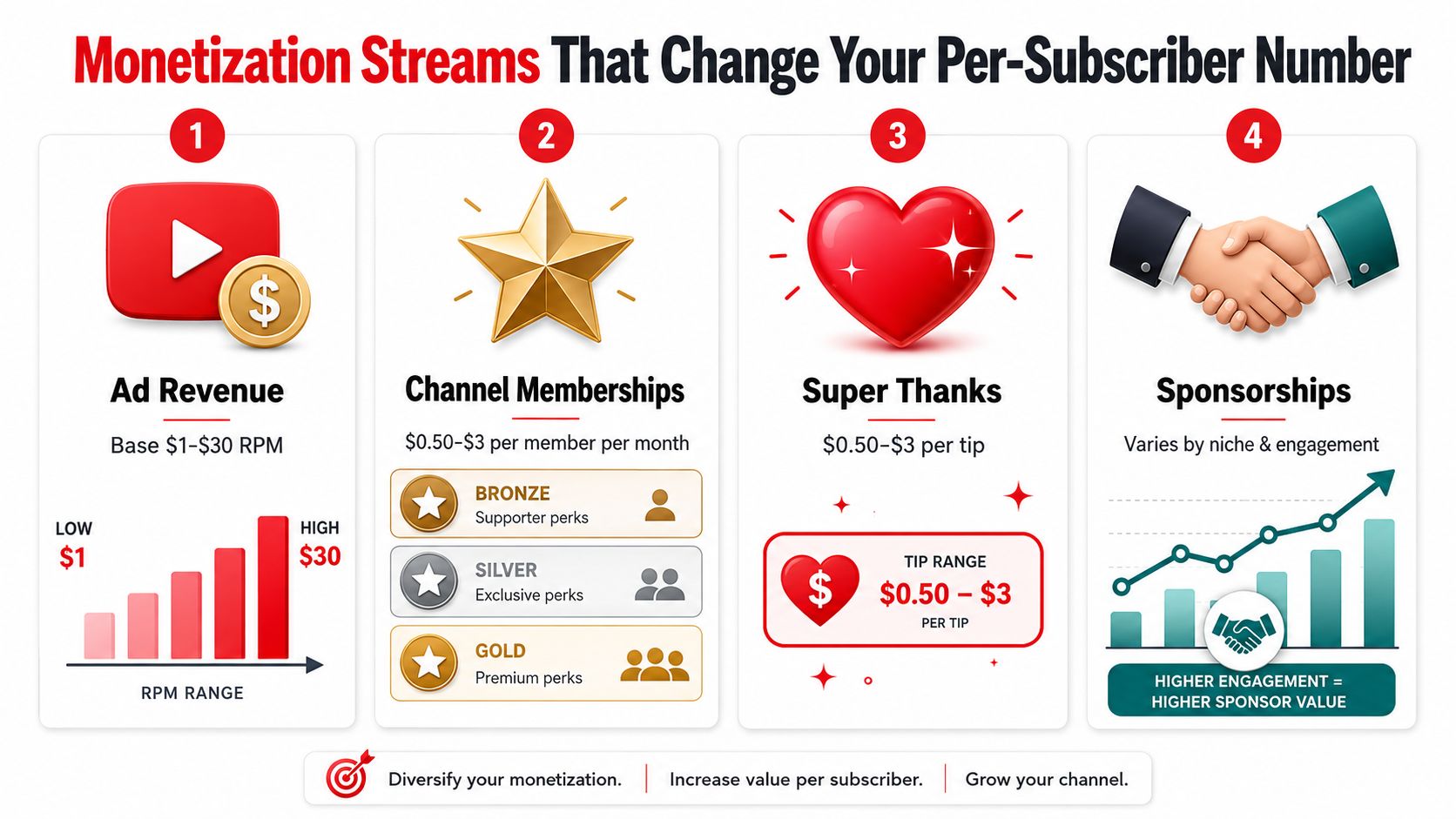
Compare streams by the action they require
Ad revenue asks a viewer to watch. Affiliate revenue asks the viewer to click and convert. Memberships ask for an ongoing commitment. Sponsorships monetize the creator's access to an audience, while products monetize the creator's expertise or brand.
That distinction matters because the same subscriber can participate in several streams. A tutorial viewer might watch the video for free, click a tool recommendation, and later buy a paid template. A gaming viewer may watch frequently but never purchase anything beyond generating ad inventory. Both subscribers are useful, but their value is produced differently.
YouTube also supports a broader monetization mix that includes Shorts revenue sharing, sponsorships, memberships, affiliate links, and other non-ad streams, making a single per-subscriber estimate even less reliable. The platform's economics are also connected to subscription viewing, with YouTube Premium subscription revenue reported at $11 billion in 2022, according to this overview of diversified YouTube monetization.
A subscriber becomes more valuable when your channel gives that person several relevant ways to continue the relationship.
Creators who want to compare approaches can use FLYP LTD monetization strategies as a practical reference for thinking beyond AdSense. For the mechanics of eligibility and revenue features, this YouTube monetization guide provides useful context.
Build a revenue-per-engaged-subscriber report
Create one row for each revenue stream and divide the attributed amount by active subscribers, not total subscribers. Keep the categories separate at first. If you combine ads, memberships, sponsorships, and sales into one number too early, you won't know which lever improved.
A clean report might track:
- Returning subscriber views
- Ad revenue from those views
- Membership revenue
- Sponsor revenue attributed to the channel
- Affiliate clicks and conversions
- Product or service sales from video links
The resulting figure is an operating metric, not a promise. It tells you what your current audience and offer structure produced during a defined period.
How Niche and Geography Reshape Subscriber Value
Two channels can have identical subscriber counts and very different economics because advertisers value audiences differently. A finance viewer who's researching an investment product, business service, or financial tool may attract stronger commercial demand than a viewer watching a broad entertainment clip.
The niche affects RPM through advertiser intent, audience purchasing behavior, and the type of products promoted. Geography adds another layer. Advertisers often bid differently across viewer markets, so a channel's audience mix can matter as much as its topic.
The supplied benchmark data supports a broad range of roughly $0.50 to $6 per 1,000 views in RPM, while finance and technology channels can achieve higher effective advertiser pricing in suitable circumstances. It doesn't justify promising a fixed RPM for every finance, gaming, or education creator. Your own Analytics data remains the correct input.
| Niche | RPM Range | Per-Subscriber Tier 1 | Per-Subscriber Tier 2/3 | Primary Drivers |
|---|---|---|---|---|
| Finance | Higher potential within the benchmark range | Often stronger when viewers show purchase intent | Can fall when advertiser demand or monetized viewing is weaker | Financial products, software, services, trust |
| Technology | Often commercially valuable | Stronger for software and product research audiences | Depends on viewer market and topic | Product intent, software, hardware |
| Education | Varies by subject and audience | Can benefit from course and tool conversions | Often depends on audience purchasing power | Learning outcomes, tools, courses |
| Beauty | Depends on product fit | Product recommendations can add value | Affiliate and retail demand vary | Product discovery, brand fit |
| Gaming | Often lower ad value than purchase-led niches | Community loyalty can support memberships | Watch volume may matter more than RPM | Repeat viewing, sponsorships, fan support |
| Entertainment | Frequently broad and less purchase-specific | Sponsorship fit can matter more than ads | Highly dependent on audience and format | Reach, attention, brand alignment |
A finance channel with 50,000 subscribers can therefore earn more than a gaming channel with the same count if its viewers return at similar rates but generate stronger RPM or purchase conversions. That doesn't make finance automatically superior. A gaming audience may produce exceptional repeat viewing, memberships, sponsorship fit, or merchandise demand.
The most useful comparison is revenue per engaged subscriber by audience segment. Split the data by country group, topic, video format, and traffic source. Then compare the revenue generated by viewers who arrived through search, recommendations, Shorts, or an external link.
For topic selection and audience-fit questions, review this guide to the best YouTube niches. Use it to form hypotheses, then validate them against your own RPM and conversion data rather than treating a niche list as a guarantee.
Three Worked Examples Across Subscriber Tiers
The safest way to model creator income is to separate assumptions from outcomes. The following examples are illustrative models, not reported earnings or promises. They use the RPM method above and show how a creator could calculate each stream, while leaving uncertain sponsorship, membership, and merchandise inputs visible.
A 10,000-subscriber education channel
Assume the channel generates 30,000 monthly views and records a $5 RPM. Ad revenue would be:
30,000 ÷ 1,000 × $5 = $150 per month
That equals $1,800 per year. Suppose the creator also attracts a small number of paid supporters and earns additional annual revenue from an education product. Those figures must come from the creator's actual records, so the model should enter them as measured values rather than pretend they're universal.
If total annual revenue across ads and those additional streams reaches $9,000, the result is $0.90 per subscriber per year. The important lesson at this stage is that a relevant offer can matter more than a small change in ad RPM.
A 100,000-subscriber technology channel
Now assume 250,000 monthly views at an $8 RPM. The ad calculation is:
250,000 ÷ 1,000 × $8 = $2,000 per month, or $24,000 per year.
Add sponsorships, affiliate income, and memberships only after measuring actual conversions or signed deal values. If the combined annual total reaches $280,000, the channel produces $2.80 per subscriber per year. At this size, sponsorship fit and affiliate intent can move the result substantially, but the creator should attribute those sales to specific videos instead of assigning them to the subscriber count as a whole.
A 1-million-subscriber finance channel
Assume 2 million monthly views at a $12 RPM:
2,000,000 ÷ 1,000 × $12 = $24,000 per month, or $288,000 per year from the RPM assumption.
If products, sponsorships, memberships, and affiliates bring the annual total to $6.4 million, the model yields $6.40 per subscriber per year. This is a hypothetical calculation designed to demonstrate the formula, not a claim about typical finance-channel income.
| Metric | 10K Education Channel | 100K Tech Channel | 1M Finance Channel |
|---|---|---|---|
| Monthly views assumption | 30,000 | 250,000 | 2,000,000 |
| RPM assumption | $5 | $8 | $12 |
| Annual ad revenue from assumption | $1,800 | $24,000 | $288,000 |
| Total annual revenue assumption | $9,000 | $280,000 | $6,400,000 |
| Annual revenue per subscriber | $0.90 | $2.80 | $6.40 |
The models show why the same subscriber count can support different outcomes. At the smaller tier, an education product may create the largest improvement. At the middle tier, sponsor and affiliate alignment can add emphasis. At the larger tier, the volume of monetizable attention and the breadth of the revenue mix dominate.
Use your actual monthly views, RPM, attributed sales, and active subscriber count. If a calculator asks only for subscribers, it's missing the variables that matter most.
Common Misconceptions About Subscriber Income
The phrase “per subscriber” encourages several bad assumptions. Each one disappears when you identify the action that creates revenue.
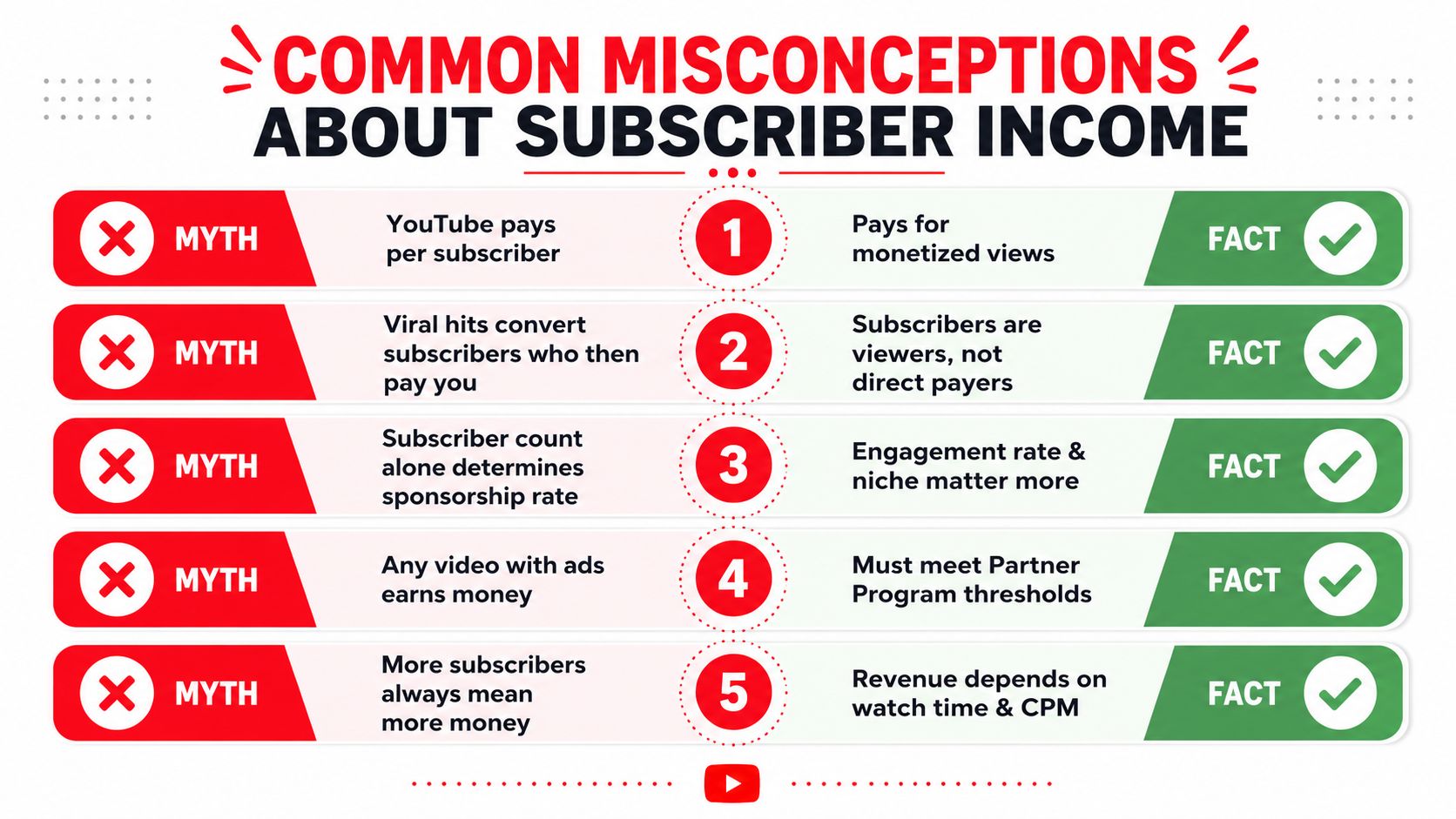
Myth one, YouTube pays for subscribers
Wrong belief: Every new subscriber adds a small payment.
Mechanism: YouTube pays through monetized viewing and related revenue features, not through the act of subscribing.
Better model: Calculate revenue from subscriber-generated views and attributable actions.
Myth two, viral subscribers automatically become paying fans
A viral video can bring many new subscribers who never watch the channel again. The useful question isn't how many people subscribed after the spike. It's how many returned, watched another relevant video, clicked an offer, or joined a paid feature.
Myth three, subscriber count sets the sponsorship price
Brands care about more than reach. They may assess niche relevance, audience geography, engagement, content fit, and the creator's ability to produce a commercial result. A smaller expert channel can sometimes offer a better match than a larger general channel.
Myth four, subscriber-only calculators are accurate
A calculator that asks for subscribers but ignores views, RPM, audience mix, and revenue streams can only produce a rough illustration. It may be useful for teaching the concept, but it shouldn't guide hiring, pricing, or business planning.
Myth five, inactive subscribers continue earning
An inactive subscriber doesn't generate a view, ad impression, click, membership, or sale. Keep inactive subscribers in your historical audience total, but exclude them from the active cohort used to calculate current subscriber value.
The number you want beside subscriber count is not a payout rate. It's an attribution trail.
The corrected KPI set is straightforward: returning subscriber views, revenue per 1,000 views, revenue per active subscriber, sponsor revenue by video, affiliate conversion by link, and product sales by traffic source. These metrics explain why income changed. Subscriber count alone doesn't.
Actionable Strategies to Raise Revenue per Subscriber
You don't need to chase a larger subscriber total before improving economics. Start by increasing the amount of monetizable attention and commercial intent produced by the audience you already have.
Improve the view-to-subscriber relationship
Review the videos that attract subscribers and compare them with the videos that generate returning views. A Short may win discovery, while a longer tutorial answers the question that brings people back. Build deliberate paths between those formats with relevant end screens, pinned comments, and descriptions.
Strong openings and clear promises also matter. If viewers leave before the useful section, the subscriber may never create another monetized view. Tight editing, specific titles, and thumbnails that accurately match the video can improve the chance that a new subscriber becomes an active viewer.
Add one revenue layer at a time
Start with the stream that matches viewer intent. A software tutorial may support an affiliate offer. A study channel may support a paid template or course. A personality channel may be better suited to memberships, sponsorships, or merchandise.
Don't add every possible offer at once. Track one link, one landing page, or one membership call to action so you can identify which videos produce action. The revenue optimization guide from Contesimal offers a useful framework for thinking about older content as an asset that can continue directing viewers toward relevant offers.
Tighten the audience promise
A broad channel can attract subscribers with very different needs. A tighter promise helps YouTube recommend related videos to the right viewers and helps sponsors understand the audience. It also makes affiliate and product selection easier because the creator knows which problem the viewer is trying to solve.
Higher advertiser demand can improve RPM, but don't choose a niche solely because a calculator lists a high range. You need credibility, repeatable topics, and an offer your audience wants.
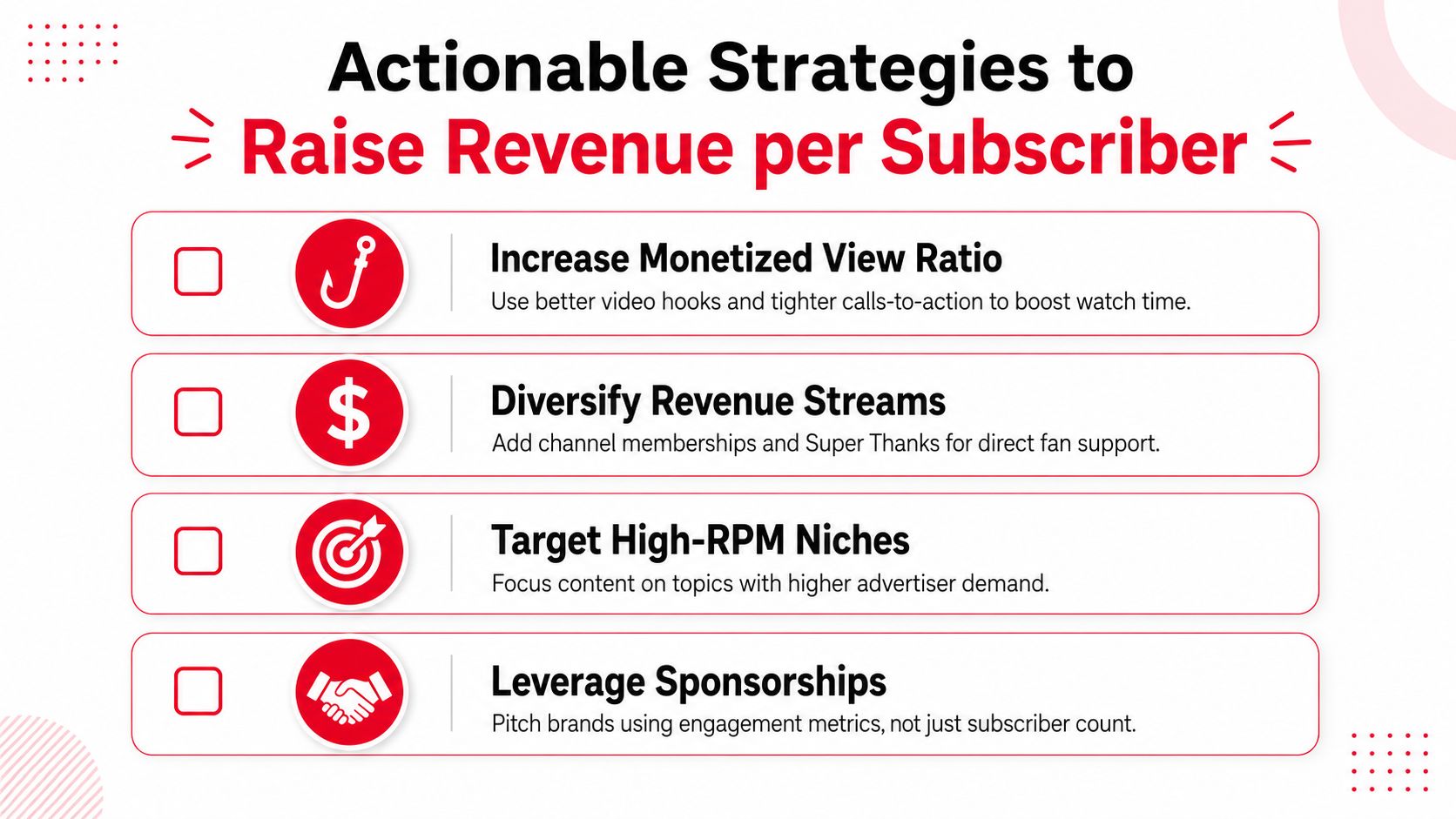
Attribute the result to the content
Create separate tracked links for videos, playlists, descriptions, and campaign placements. Record the originating video, traffic source, conversion, and revenue. That lets you distinguish a video that creates views from one that creates customers.
ViewsMax can help creators plan and publish content, create trackable links, and connect clicks, leads, calls, and sales to the content that generated them. That attribution is more useful than guessing which subscriber milestone should produce income.
Use a simple quarterly review:
- View efficiency: Which uploads create the most returning subscriber views?
- RPM efficiency: Which topics and formats earn the strongest realized RPM?
- Conversion efficiency: Which videos generate affiliate clicks, memberships, or sales?
- Offer fit: Which revenue stream matches the viewer's immediate problem?
- Content allocation: Which proven topics deserve more production time?
The answer to “how much does a YouTuber make per subscriber” is still $0 in direct platform payout. The business opportunity sits in the relationship that follows: repeat viewing, trust, clicks, memberships, sponsorships, and sales. Measure those actions, then improve the content and offers that produce them.
ViewsMax helps creators connect content to revenue by tracking clicks, leads, calls, and sales back to the specific videos and posts that generated them. Visit ViewsMax to see which content is selling, plan future campaigns around proven topics, and stop using subscriber count as a substitute for attribution.