ViewsMax
Sign In Sign Up Free

Tag: youtube subscriber growth

  • How to get lots of youtube subscribers: A proven growth playbook

    How to get lots of youtube subscribers: A proven growth playbook

    Want to know the real secret to getting a massive number of YouTube subscribers? It boils down to one simple, unwavering principle: consistently creating content that a specific group of people finds incredibly valuable. This isn't about chasing viral hits or gaming the system. It's about building a genuine community—a loyal audience that trusts you to solve their problems, make them laugh, or help them reach their goals.

    Build Your Foundation Around a Specific Audience

    Explosive subscriber growth doesn't start when you hit the record button. It begins way before that, with an almost obsessive focus on understanding a specific audience you can serve better than anyone else. This goes far beyond the tired old "find your niche" advice. It’s about creating a practical framework for getting inside your viewer's head.

    When someone watches one of your videos and thinks, "Wow, this was made just for me," they don't just watch. They subscribe.

    This entire foundational process is about deeply researching your target audience, building a content strategy that directly addresses their needs, and then showing up consistently with real value.

    A three-step process for audience foundation: Research, Strategy, and Value creation.

    Think of it as a simple but powerful engine for growth: Research, Strategy, and Value. Get this right, and everything else falls into place.

    Go Deeper Than Demographics

    Knowing your audience's age and location is surface-level stuff. The real magic happens when you understand their psychographics—their goals, their biggest frustrations, and what they truly desire. What problems keep them up at night? What are they desperately trying to achieve?

    Stop guessing and start listening. You need to become a fly on the wall in the online communities where your ideal viewers already hang out.

    • Forums and Subreddits: If your channel is about restoring classic cars, you should be living in subreddits like r/projectcar. Pay attention to the recurring questions, the common struggles people share, and even the specific slang they use.
    • Competitor Comment Sections: Go read the comments on the biggest videos in your niche. What questions are people asking that the creator never answered? What are they praising? These comments are a goldmine of content ideas and gaps you can fill.
    • Social Media Groups: Join related Facebook groups or Discord servers. Just by observing the conversations, you'll start to see trends and major pain points emerge.

    From this research, you can build a detailed "viewer persona." This is just a semi-fictional profile of your ideal subscriber. Give them a name, a job, and a core problem you are uniquely equipped to solve. For example, your persona could be "DIY Dave," a new homeowner who wants to tackle projects but is terrified of making a costly mistake. Now, every single video idea gets filtered through one simple question: "Would this genuinely help Dave?"

    Define Your Channel's Unique Value Proposition

    Once you have a crystal-clear picture of who you're talking to, you need to be able to articulate why they should choose your channel out of the millions of others. This is your value proposition. It's a clear, concise promise of what a viewer gets by hitting that subscribe button.

    A strong value proposition isn't just about what you make, but how you make it. It could be your unique personality, your simplified teaching style, or your access to exclusive information.

    Think about the big channels you admire. LegalEagle doesn't just explain the law; he breaks down the legal accuracy of movies and TV shows in an incredibly entertaining way. A cooking channel might focus only on 30-minute meals for busy parents. Their value is immediately obvious.

    To nail down your own, ask yourself these three questions:

    1. What specific problem am I solving for my audience?
    2. Who, exactly, am I solving it for?
    3. What makes my approach different or better than everyone else's?

    This clarity becomes your North Star. It guides your content, your branding, and how you talk about your channel. It's the reason someone moves from being a casual viewer to a loyal subscriber—they believe in the promise you're making.

    If you need a little help brainstorming, check out our guide on finding the best niche for your YouTube channel to get the ideas flowing. Honing this focus is the single most important thing you can do to learn how to get lots of YouTube subscribers.

    Win the Click with Irresistible Thumbnails and Titles

    Let's be blunt: your video's quality doesn't matter if no one ever clicks on it.

    Think about the last time you browsed YouTube. The homepage, your subscription feed, the search results—they're all battlegrounds for attention. In this endless scroll, your video is "packaged" by two things that make or break its success: the title and the thumbnail. This pair is your first impression, your digital billboard. Mastering this combo is how you win the click and get your incredible content in front of a potential new subscriber.

    Flat lay of hands holding a camera, with a tablet, notebook, and 'win the click' sign.

    If your video is the product, the title and thumbnail are the packaging. And we all know what happens to products with bad packaging—they gather dust on the shelf.

    The Psychology Behind a Great Thumbnail

    A thumbnail has one job: to make someone stop scrolling. In less than a second, it needs to convey an idea and spark an emotion—curiosity, shock, excitement, you name it. This isn't about clickbait; it's about being compelling.

    Here's what I've learned makes a real difference:

    • High-Contrast & Vibrant Colors: YouTube's interface is mostly white, grey, or black. Your thumbnail needs to pop with bright, contrasting colors to stand out. Dull, muddy tones will just blend in and get ignored.
    • Clear, Expressive Faces: We're hardwired to connect with other people. A thumbnail with a clear, relatable human emotion (like awe, confusion, or pure joy) creates an instant connection. It makes the viewer wonder, "Why are they making that face?"
    • Minimal, Bold Text: If you add text, keep it to three or four powerful words that add context to the title. The font needs to be huge and readable, even on a tiny phone screen.
    • Focus on a Single Subject: Don't try to cram everything into one little image. A clean thumbnail with one clear focal point is always more effective than a cluttered mess.

    Your thumbnail should tell a visual story or ask a question. If your video is "I Built a Secret Room in My House," don't just show a picture of a hammer. Show yourself looking shocked while pushing on a mysterious bookcase. We've got a whole guide on this, and you can dive deeper into these YouTube thumbnail best practices.

    Crafting Titles That Create a "Need to Know" Feeling

    While the thumbnail is the hook for the eye, the title is the hook for the brain. A great title creates a "curiosity gap"—it gives just enough information to get someone interested but holds back the key piece of the puzzle, forcing them to click for the answer.

    The title and thumbnail absolutely have to work together. Think of them as a one-two punch.

    Your title and thumbnail are not two separate items; they are one cohesive unit. One hooks the eye, the other hooks the brain. When they work together perfectly, a click becomes almost inevitable.

    Let's say your thumbnail shows a gorgeous, perfectly cooked steak. A good title wouldn't be "How to Cook a Steak." It would be "You're Using the Wrong Pan to Cook Steak." That combination immediately makes a viewer think, "Wait, what pan? Am I using the wrong one?" They have to click to find out.

    Don't Forget the YouTube Algorithm (SEO)

    Beyond pure human psychology, you also need to give the YouTube algorithm some clear signals about your video's topic. This is where basic YouTube SEO comes in, and it's a huge piece of the puzzle when learning how to get lots of YouTube subscribers.

    Your main tool here is keyword research. Put yourself in your ideal viewer's shoes. What would they actually type into the search bar to find you?

    • Start broad ("home renovation") then narrow it down ("DIY kitchen cabinet painting").
    • Use the YouTube search bar's autocomplete feature. As you type, YouTube suggests what real people are searching for. That's gold.
    • Check out the top-ranking videos for your target keywords. Look at their titles and descriptions for inspiration—don't copy, but learn from what's working.

    Once you have a primary keyword, weave it naturally into your title, ideally near the front. Then, use that keyword and a few related ones throughout your video description. Don't skimp on the description! Write a few detailed paragraphs explaining what the video covers. This is a massive signal to the algorithm.

    The impact of a well-optimized "video package" is enormous, often accounting for 70-80% of a video's click-through rate (CTR). I’ve seen creators boost their CTR by 25-50% just by A/B testing different thumbnail options—a process the ViewsMax AI toolkit can help automate.

    Title & Thumbnail Optimization Checklist

    To pull this all together, here’s a quick checklist you can run through before hitting "publish" on any video. This ensures you're giving your content the best possible chance to get seen and clicked.

    Element Best Practice ViewsMax Tool to Use
    Thumbnail Emotion Does it feature a clear, expressive human face? Does it spark curiosity or another strong emotion? Thumbnail Analyzer
    Visual Clarity Is the image high-resolution, high-contrast, and uncluttered? Is it easily understood in a split second? Thumbnail Grader
    Title Keywords Does the title include your primary keyword, preferably near the beginning, in a natural way? Keyword Explorer
    Curiosity Gap Does the title pose a question, promise a solution, or hint at a surprising outcome? Title Generator
    Title/Thumb Combo Do the title and thumbnail work together to tell a cohesive story and create intrigue? A/B Testing Suite
    Readability Is any text on the thumbnail massive and easy to read on mobile? Is the title under 70 characters? Thumbnail Grader

    Following these guidelines isn't just a suggestion; it’s a fundamental part of a successful YouTube strategy. Get this right, and you're already miles ahead of the competition.

    Create Videos That Turn Viewers into Subscribers

    Getting someone to click on your video is a huge win, but that's only half the battle. The real challenge—turning that viewer into a loyal subscriber—is decided by what happens inside the video itself. Your title and thumbnail make a promise. Now, your content has to deliver.

    The first few seconds are everything. Seriously. You have a razor-thin window of about 15-30 seconds before a viewer's attention starts to wander and they click away. There's no time for a slow, rambling intro. You have to grab them immediately, confirm they've come to the right place, and show them exactly what they're going to get.

    A man creating digital content, editing an image on a computer, with a camera set up.

    Nail the intro, and you’ve earned their attention. Fumble it, and that potential subscriber is already gone.

    Crafting a Powerful Hook

    A great hook is more than just a casual "Hey guys, welcome back." It’s a strategic, value-packed opening that snags attention and sets the stage for everything that follows. Your goal is to immediately answer the viewer's unspoken question: "Why should I watch this?"

    Here are a few hook formulas I’ve seen work time and time again:

    • The Problem/Promise Hook: Kick things off by calling out a common frustration your audience has, then instantly promise the fix. For a baking channel, you could say, "Tired of your cookies coming out flat and burnt? I'm about to show you the one simple trick that guarantees chewy, perfect cookies every single time."
    • The Cold Open Hook: Don't waste a second. Jump right into the most exciting, dramatic, or visually stunning part of your video. If you're building a wild DIY project, show off the incredible finished product first before you even think about explaining the process. It creates instant curiosity.
    • The Curiosity Hook: Start with a bold claim or a surprising statement that makes people lean in. A tech reviewer might open with, "This phone has a secret feature the manufacturer doesn't even advertise, and honestly, it's a total game-changer."

    The hook is the cornerstone of your video's entire structure. If you're looking for more frameworks to get this right, our deep-dive on writing a script for your YouTube videos is a great place to start.

    Keeping People Glued to the Screen

    Once you’ve hooked them, the next job is to keep them there. People get bored easily, so you need to constantly re-engage them with smart editing and what we call "pattern interrupts."

    A pattern interrupt is anything that breaks the visual or auditory flow just enough to reset the viewer's attention.

    Think of your video not as one long, continuous shot, but as a series of short, engaging moments. Your goal is to earn the viewer's attention for the next 15 seconds, over and over again.

    Here are a few simple but effective pattern interrupts you can start using right away:

    • Quick Cuts & Zooms: Even if you’re just sitting and talking to the camera, a subtle zoom-in or a quick cut to a slightly different angle every 10-20 seconds can make a world of difference. It keeps the shot from feeling static.
    • On-Screen Text & Graphics: Use bold text callouts to emphasize key points. Pop in simple graphics, relevant b-roll footage, or even a GIF to visually explain what you're talking about.
    • Sound Design: Don't underestimate the power of audio. A well-placed sound effect can add a punch of humor or emphasis. Shifting the background music to match the mood also keeps the viewer emotionally invested.

    These small editing decisions are a massive part of learning how to grow a YouTube channel fast because they create a dynamic experience that holds attention right to the very end.

    Build Trust by Delivering on Your Promise

    Every single video is a chance to build trust with your audience. If your title is "The Easiest Way to Edit Photos," your video better deliver a dead-simple, easy-to-follow tutorial. When you do that, you fulfill the promise you made.

    This creates a powerful feedback loop. The viewer feels their time was well-spent, and they start to see you as a credible, reliable source of information. This is how you earn subscribers—not by asking, but by deserving them.

    Just look at MrBeast. Hitting 460 million subscribers wasn't an accident. His growth is built on a foundation of making huge promises in his titles and then over-delivering in the videos. In a sea of 113.9 million YouTube channels, this is what it takes to stand out. For ViewsMax users, this means using AI-powered insights to spot the patterns that make these top creators so successful and applying them to your own content.

    When you consistently provide real value, asking for the subscription at the end of your video feels less like a sales pitch and more like a natural next step for someone you’ve already helped.

    Find Your Rhythm: A Guide to Consistent Publishing and Promotion

    Think of consistency as the heartbeat of your YouTube channel. It's the unspoken promise you make to your audience: "I'll be here, with great content, on a schedule you can count on." This rhythm does more than just keep your viewers happy; it signals to the YouTube algorithm that your channel is active, reliable, and worth recommending.

    But let's be clear: consistency isn't about burning yourself out trying to upload a new video every single day. It's about finding a cadence you can actually maintain. A channel that drops one fantastic video every Tuesday like clockwork will always beat a channel that uploads five videos in a week and then goes silent for a month. The goal is to choose a schedule you can realistically stick to for the long haul.

    Plan Ahead with a Content Calendar

    This is where a content calendar becomes your new best friend. It’s what turns a vague goal like "post more often" into a concrete, actionable plan. You don't need anything fancy—a simple spreadsheet or a Trello board works great.

    Start by mapping out your video ideas for the next month or two. Assign each idea a target recording date, an editing deadline, and a firm publishing date. This kind of forward-thinking saves you from the last-minute panic of figuring out what to post and keeps a steady stream of content flowing.

    The ViewsMax AI planner can give you an edge here, helping you map out your content calendar and even suggesting the best upload times based on when your specific audience is most likely to be online. This ensures your hard work gets in front of the most eyeballs right away.

    To really dig into this, you need to understand when your viewers are scrolling. For a deeper dive, check out this guide on the best times to upload YouTube videos.

    Don't Just Publish—Promote

    Hitting "publish" is a huge accomplishment, but the work isn't over yet. One of the biggest mistakes I see new creators make is thinking their great content will just promote itself. You have to actively guide people from other platforms to your new video.

    And no, just dropping a link isn't a strategy. You need to tailor your approach for each platform:

    • Instagram & Facebook: Post a compelling 60-second clip or a teaser on Reels and Stories. Use a clear call-to-action like, "Full breakdown is in my new video! Link in bio to watch."
    • TikTok: Snip the most surprising, valuable, or hilarious moment from your video and turn it into a short, punchy TikTok. This can send a massive wave of new viewers your way.
    • Email Newsletter: Your email list contains your most dedicated fans. Send them a personal note explaining why you made the video and what they'll learn, along with a direct link to watch.
    • Community Hubs (like Reddit): If you're already an active, helpful member of a relevant subreddit, you can share your video when it genuinely helps solve a problem. Just be sure to read and respect the community's rules on self-promotion.

    Cross-promotion isn’t about spamming your links everywhere. It’s about meeting your audience where they already hang out and giving them a great reason to check out your YouTube channel.

    On a platform with over 113.9 million other channels, a consistent schedule is your secret weapon. The data doesn't lie: channels that post at least once a week grow 79% faster than those that post sporadically. This consistency feeds the algorithm, which then pushes your content to more people, creating a powerful feedback loop that drives subscriber growth.

    Scale Your Growth with Community and Collaborations

    Great videos might get you views, but a real community is what gets you subscribers who stick around for the long haul. Lasting growth happens when people feel like they’re part of something special, not just another number on your dashboard. This is the pivot point where a good channel starts to become a great one.

    And it all begins in the simplest place you can imagine: your comment section.

    Every single comment is an opportunity to start a conversation. When you actually take the time to reply—even with a quick "thanks!" or a thoughtful answer—you're telling that person they matter. They’re no longer just shouting into the void; they’re actually connecting with you, the creator. This simple habit makes your channel feel incredibly personal and gets more people talking, and ultimately, subscribing.

    Turn Viewers into Active Participants

    Beyond just replying to comments, your job is to actively build that sense of belonging. The goal is to shift your channel from a one-way broadcast into a real, two-way dialogue. The YouTube Community Tab is an absurdly powerful tool for this, but so many creators just ignore it.

    Don't just use it to announce your new videos. Use it to create little experiences that pull your audience deeper into your world.

    • Run Polls: Seriously, just ask them what they want to see next. Not only does this give you fantastic, direct feedback, but it also makes them feel like they have a stake in your content.
    • Share Behind-the-Scenes Content: Post a quick photo from a video shoot or a short update on a project you're working on. It pulls back the curtain and makes the whole process feel more human and relatable.
    • Ask Engaging Questions: Post a simple, open-ended question that fits your niche. If you have a travel channel, something like, "What's the one place you're dreaming of visiting this year?" can spark a ton of engagement.

    These small interactions start to build a real culture around your channel. Before you know it, you'll have inside jokes and unique phrases that only your true fans get, making them feel like they're part of an exclusive club.

    Find Your Perfect Collaboration Partner

    One of the single fastest ways to get your channel in front of a fresh, highly-relevant audience is through a smart collaboration. The right partnership can expose you to thousands of potential new subscribers who are already primed to love what you do. The key word here, of course, is "smart."

    Don't just chase after channels with huge subscriber counts. Instead, look for partners who tick these three boxes:

    1. Audience Overlap: Do their viewers care about the same things yours do? A channel about DIY home repairs and a channel about interior design are a perfect match.
    2. Similar Size: Partnering with a channel in your same ballpark usually leads to a much more balanced and mutually beneficial exchange of subscribers. It feels more genuine.
    3. Content Chemistry: Does their style and tone actually vibe with yours? A great collaboration feels natural and fun, never forced or awkward.

    Once you've found a few potential partners, you need to craft a pitch that shows them the value right away. Don't just send a generic, "Hey, wanna collab?" email. Propose a concrete idea that clearly benefits both of your audiences.

    A great collaboration pitch isn't about what you can get; it's about what you can create together. Propose an idea so good that their first thought is, "My audience would absolutely love this."

    For instance, you could suggest a two-part video series. You show up on their channel to tackle one half of a project, and they come over to your channel to finish it. This simple structure gives both of your audiences a powerful reason to go check out the other channel and hit subscribe. When you pull this off, you can gain a lot of YouTube subscribers in a very short amount of time by tapping directly into an established, pre-qualified audience.

    Your Top YouTube Subscriber Questions, Answered

    Alright, even with the best game plan, you're going to have questions. Growing on YouTube is a marathon, not a sprint, and a few key questions always pop up along the way. Let's cut through the noise and get you some straight answers based on real experience.

    How Long Does It Really Take to Grow?

    Let’s be honest: there's no magic number here. Growth almost never happens overnight. For most new channels, grinding to that first 1,000 subscribers is the toughest part. It can easily take six months, a year, or even longer of putting in the work week after week. That initial phase is all about building a foundation and proving your content has value.

    The name of the game is momentum. Once the algorithm starts to figure out who your audience is and your videos gain a little traction, growth can really pick up. I’ve seen channels take a full year to hit 1,000 subscribers, only to cross 10,000 just a few months later. Patience and relentless consistency are your best friends in the early days.

    Is Buying YouTube Subscribers Ever a Good Idea?

    I'll make this simple: no. Buying subscribers is the fastest way to sabotage your own channel. You're not paying for real viewers; you're paying for bots and fake accounts that will never watch a second of your content, leave a real comment, or become part of your community.

    The damage this does to your channel's health is catastrophic.

    • Your audience retention will tank: When bots don't watch your videos, your average view duration plummets.
    • Your click-through rate gets destroyed: YouTube will serve your videos to these fake accounts, who obviously won't click, telling the algorithm your content is a dud.

    Think of it like this: buying subscribers is like filling a concert hall with mannequins. It looks impressive from a distance, but there's no applause, no energy, and absolutely zero chance of building a real fanbase.

    Ultimately, YouTube's algorithm sees these dead-end metrics and stops showing your videos to actual people who might have loved them. You’re essentially paying to become invisible.

    Do YouTube Shorts Actually Help You Get More Subscribers?

    Absolutely, Shorts can be a rocket ship for subscriber growth, but you have to be smart about it. The Shorts feed is built for discovery, giving a single 60-second video the potential to reach millions of new people who have never seen your channel before. A viral Short can bring in a massive wave of new subs, no question.

    The real challenge, though, is turning those "Shorts subscribers" into loyal viewers of your long-form videos. Someone swiping through Shorts is in a different mindset—they want quick hits of entertainment. The key is to make your Shorts act as a bridge. Use them as compelling teasers or value-packed clips that are directly related to your main content, making viewers curious enough to check out your full-length videos.

    What's the Single Most Important Metric to Track?

    It's so easy to get obsessed with the subscriber count, but if you want real, sustainable growth, you need to focus on two other numbers: Click-Through Rate (CTR) and Audience Retention.

    CTR shows whether your title and thumbnail are strong enough to earn the click. Audience Retention tells you if your video delivered on that initial promise and kept people watching. When you have a high CTR and high retention, you're sending the strongest possible signal to YouTube that you've made a great video. The algorithm sees that and immediately starts pushing it to a wider audience.

    Nail those two metrics, and subscriber growth will take care of itself.


    Ready to stop guessing and start growing with data that actually works? ViewsMax gives you the AI-powered toolkit to sharpen your titles, analyze your thumbnails, and make smarter content decisions. Start your journey to more subscribers today by exploring the ViewsMax toolkit.
  • How to Increase YouTube Subscribers That Actually Stick

    How to Increase YouTube Subscribers That Actually Stick

    Growing your YouTube subscriber count isn't about chasing a one-off viral hit. It's about building a solid, repeatable system. This system is built around four key areas: defining your unique value, creating content people can't stop watching, mastering YouTube’s search algorithm, and getting your videos in front of the right eyeballs. When you consistently nail these principles, you start turning casual viewers into a dedicated community.

    Your Framework For Consistent Subscriber Growth

    Let's get one thing straight: overnight success on YouTube is a myth. The most reliable way to gain more subscribers is by building a deliberate strategy that focuses on long-term value, not just jumping on fleeting trends. This isn't about luck; it's about building a well-oiled machine that consistently attracts your ideal audience and gives them a compelling reason to stick around.

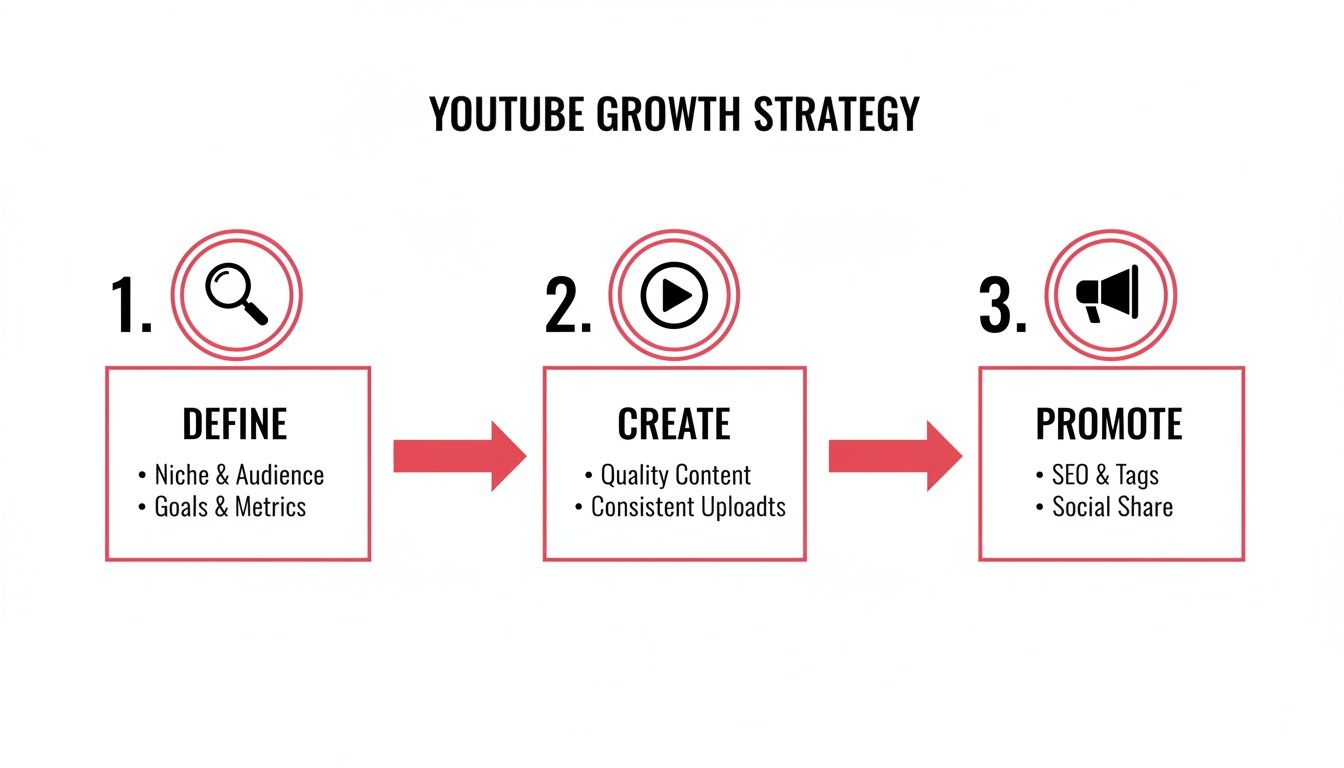
    A winning framework simplifies the entire process into three core phases: figuring out who you're talking to and what you'll make, creating videos that actually connect with them, and then promoting those videos to expand your reach.

    A step-by-step flowchart for YouTube growth strategy: define, create, and promote content.

    Think of this as your roadmap. Each stage builds on the last, creating a powerful cycle of growth where every video has a purpose beyond just getting views.

    The Four Pillars of YouTube Subscriber Growth

    To build this framework, you need to focus on four distinct but deeply connected areas. Each pillar supports the others, creating a powerful engine for growing your channel. It's like building a house—you need a rock-solid foundation before you can even think about the paint colors.

    Here’s a breakdown of the core strategies that form this foundation.

    Growth Pillar Core Action Why It Works
    Channel Strategy Define a specific niche and your ideal viewer. Laser-focused clarity attracts a dedicated audience that is far more likely to subscribe because your content feels like it was made just for them.
    Content Creation Produce high-retention videos in a consistent series or format. Binge-worthy content boosts your total watch time, which signals to YouTube that your channel provides value and is worth recommending to others.
    SEO & Discovery Optimize titles, descriptions, and tags for what people are searching for. Good SEO puts your videos right in front of potential subscribers at the exact moment they're looking for answers or entertainment.
    Promotion & CTAs Actively share your videos and include clear calls-to-action. Promotion expands your reach beyond YouTube's algorithm, while strong CTAs give viewers a direct nudge to hit the subscribe button.

    This structured approach takes the guesswork out of growth. Instead of wondering what to do next, you have a clear plan. Every video becomes a strategic piece of the puzzle, designed not just for views, but for turning viewers into subscribers.

    Key Takeaway: Real, sustainable subscriber growth comes from a system, not a single viral video. Focus on a clear strategy, high-value content, discoverability, and smart promotion to build a loyal audience that actually sticks around.

    Part of a consistent framework is a smart publishing schedule. To make sure your videos get in front of the most people, check out these tips for the best time to upload YouTube videos.

    Tools like ViewsMax can give you a serious edge here. It uses AI to pinpoint high-potential video topics and helps you nail your optimizations, allowing you to execute this entire framework with data-backed precision.

    Mastering YouTube SEO to Get Discovered

    You could film the most brilliant, life-changing video in your niche, but if nobody can find it, it's like it doesn't even exist. That's the hard truth. YouTube isn't just a video site; it's a massive search engine, second only to Google. Learning how to get your content discovered is the single most important skill for turning total strangers into loyal subscribers.

    This means you have to start treating every upload as a strategic SEO opportunity. It’s not about gaming the system or stuffing keywords where they don't belong. It's about understanding what your ideal viewers are actually searching for and then crafting your video's metadata—the title, description, and tags—to perfectly match their needs. When you nail this, the algorithm starts working for you.

    Finding the Right Keywords

    Before you even dream up a title, you need to get inside your audience's head. What words are they typing into that search bar? This is the bedrock of your entire discovery strategy. Don't guess; use data.

    Start broad. If your channel is all about home coffee brewing, your core topics might be things like "espresso," "pour over," or "coffee grinders." Now, head over to YouTube's search bar and start typing those terms. Pay close attention to the auto-suggestions that pop up. Those aren't random guesses; they are real searches from real people, giving you a direct line into what they want to know.

    • Look for "How-To" questions: People are constantly looking for solutions. Phrases like "how to increase youtube subscribers" or "how to dial in espresso" show clear intent.
    • Spot the "Best Of" searches: Terms like "best budget coffee grinder" or "best pour over technique" are goldmines for attracting viewers ready to make a decision.
    • Spy on your competition: Check out the top-performing videos in your niche. What keywords are they ranking for? You might uncover high-traffic topics you've completely overlooked.

    My best tip: Go after "long-tail keywords." These are longer, more specific phrases like "how to make latte art with almond milk." Sure, they get fewer searches, but the competition is way lower and the viewer is far more targeted. Someone searching for that is much more likely to subscribe because you've created the exact video they needed.

    Crafting Titles That Earn Clicks

    Your video title has two crucial jobs: first, it has to signal to the YouTube algorithm what your video is about using keywords. Second, and just as important, it has to convince a real person to actually click. The best titles strike a perfect balance between the two.

    Ditch vague titles like "My Coffee Routine." It tells me nothing. Instead, pack it with value and keywords. Something like, "My 5-Minute Morning Espresso Routine for Beginners" instantly tells both the algorithm and the viewer what to expect, who it's for, and how long it takes.

    A killer technique is to blend a keyword-rich phrase with an emotional hook. Instead of a flat "Fixing Under-Extracted Espresso," try something like, "Bitter Espresso? Here’s the 1 Mistake You're Making." See the difference? It speaks directly to a viewer's frustration and piques their curiosity, all while being optimized for search. Our guide on YouTube SEO optimization tips has a ton more strategies for writing titles that work.

    Writing Descriptions That Convert

    So many creators treat the description box as an afterthought, but it’s prime real estate for both SEO and for turning viewers into subscribers. The first two or three lines are critical because they show up directly in search results. You have to use this space to hook the viewer and repeat your most important keyword.

    Think of your description as a sales page for your video and your channel:

    1. The Hook: Start with a punchy sentence or two that expands on the title and naturally includes your main keyword.
    2. The Ask: Right after the hook, give a clear call-to-action. Don't be shy! A simple, "If you love making better coffee at home, be sure to subscribe for new videos every week!" is perfect.
    3. The Details: Use the rest of the space to give a more detailed summary, link to resources you mentioned, and even add timestamps for longer videos. This is a great place to weave in secondary and related keywords to help YouTube understand the full context of your content.

    On a platform with over 2.5 billion monthly active users, small tweaks have a massive impact. Improving your click-through rate (CTR) from 4% to 6% on a video with 50,000 impressions doesn't sound like much, but it means an extra 1,000 views. Every single one of those is a potential new subscriber.

    Ultimately, great SEO is about creating a clear, easy-to-follow path for your ideal viewer to find you. When your keywords, titles, and descriptions all align, you make it incredibly simple for YouTube to put your video in front of the people who will love it most—and hit that subscribe button.

    Creating Content That Earns Subscribers

    Getting your videos discovered is one thing; getting people to actually subscribe is another battle entirely. Great SEO might bring them to your door, but it’s the quality of your content that invites them in and convinces them to stay. A click is a first impression. A subscriber is someone who wants to be part of your community.

    The bridge between those two things is your value proposition. It's the silent promise you make to every single viewer: "Stick with my channel, and you'll consistently get [X]." That 'X' could be anything—time-saving tutorials, laugh-out-loud comedy, or in-depth reviews that prevent buyer's remorse. Without that clear promise, a channel just feels like a random assortment of videos.

    A man in glasses works on a laptop displaying YouTube, with a 'YouTube SEO' graphic.

    Nail the First 15 Seconds to Maximize Retention

    You have about 15 seconds. That's it. That's your window to convince someone to stick around. This is your "hook," and if you blow it with a generic, drawn-out intro, you can literally watch viewers drop off your analytics graph in real-time.

    A killer hook gets straight to the point—it either piques their curiosity or directly addresses the problem they came to solve.

    • Weak Hook: "Hey guys, welcome back to my channel. In this video, we're going to talk about how to increase YouTube subscribers." (They already know this from the title).
    • Strong Hook: "What if I told you one simple change to your video structure could double your subscriber conversion rate? Today, I'm showing you exactly what it is."

    This mindset should carry through the entire video. Every segment needs a purpose, smoothly guiding the viewer from one point to the next. This is where having a well-thought-out script for YouTube videos becomes non-negotiable for keeping your content tight and on-point.

    Key Insight: Treat your video like a story. It needs a killer opening (the hook), a meaty middle that delivers the goods (your core content), and a satisfying conclusion (summary and CTA). This natural flow is what keeps people watching.

    And when you've delivered that value, you have to ask for the sub. But how you ask makes all the difference. Ditch the robotic "don't forget to like and subscribe." Instead, connect your call-to-action (CTA) to the value you just provided. For example: "If this tutorial helped you out and you want more tips like this every week, hit that subscribe button so you don't miss the next one." This frames subscribing as a benefit for them, not a favor for you.

    Get People Binge-Watching with Series and Playlists

    One of the most powerful signals you can send the YouTube algorithm is that viewers watch multiple videos from your channel in one sitting. This "binge-watching" tells YouTube that your content is sticky and worth recommending to more people.

    The simplest way to engineer this is by creating content series.

    • Episodic Series: Think of a multi-part deep dive that tackles a huge topic one piece at a time. A "30-Day Fitness Challenge" with daily videos is a perfect example.
    • Pillar Content Series: This is a collection of videos centered around a core theme. A marketing channel could have a playlist dedicated to "Mastering Google Ads" and another on "SEO for Beginners."

    Once you have a series, organize it into a dedicated playlist. This is crucial. When a viewer finishes one video, YouTube will automatically tee up the next one in the playlist, creating a seamless viewing session. It’s a simple trick, but it's incredibly effective for boosting your channel's watch time and dramatically increasing the odds of earning a subscription.

    Evolve Your Content for How People Watch Now

    YouTube isn't just for phones and laptops anymore. A huge and growing trend is "lean-back" viewing on television screens. People are kicking back on the couch and settling in for longer, more immersive content.

    Consider this: viewers watch 1 billion hours of YouTube on their TVs every single day. Recognizing this shift, YouTube even found a 40% increase in people subscribing directly from their TV after they added an on-screen subscribe button.

    This means channels creating content fit for the big screen—longer episodes, high-production series, and graphics that are easy to read from a distance—have a statistical edge in converting casual viewers into loyal fans. You can dig into more of these YouTube statistics and trends to see just how much viewing habits are changing.

    This is where a tool like ViewsMax becomes your strategic partner. It helps you analyze trending topics and popular video formats in your niche, so you can figure out what your audience actually wants to watch, whether they're on their phone during a commute or on a 65-inch TV at home. This data-first approach helps ensure every video you create is built for engagement and designed to win subscribers.

    Designing Thumbnails and CTAs That Convert Viewers

    On a crowded YouTube homepage, your thumbnail and title are everything. They're your video's digital billboard, and you have about one second to convince someone to click on your content instead of the dozens of others surrounding it. Getting this right isn't just about making a pretty picture; it's about understanding the psychology of the click.

    Think of it as a lightning-fast sales pitch. Your goal is to spark curiosity and clearly communicate your video's value before the viewer scrolls on. So many creators miss this opportunity, using bland, auto-generated frames from their video that just blend in. You need to be the one thumbnail that pulls the eye in.

    A man records a video of himself with a camera on a tripod, aiming to earn subscribers.

    The Anatomy of a High-Converting Thumbnail

    A truly great thumbnail is a deliberate combination of design choices, all working to stop the scroll. It's not a screenshot; it’s a purpose-built advertisement for your video.

    So, what are the ingredients that make people click?

    • Emotional Faces: We're wired to connect with other people, especially faces showing strong emotions. Surprise, joy, shock—these create an instant human connection and make viewers want to know what caused that reaction.
    • Bold, Contrasting Colors: Don’t be shy with color. Bright, saturated hues pop against YouTube's interface. Think about basic color theory—complementary colors like blue and orange or purple and yellow create a high-contrast effect that’s hard to ignore.
    • Readable Text Overlays: If you add text, keep it incredibly brief—three to four words maximum. It has to be huge, bold, and easy to read even on a tiny phone screen. The text should add context or intrigue, not just repeat the title.
    • Clear Subject: Is the video about a person, a product, or a specific result? Whatever it is, that subject needs to be front and center, with no cluttered background to distract the viewer.

    The magic happens when you create a "curiosity gap." The thumbnail and title team up to pose a question that the viewer feels an urgent need to answer by clicking. A title like "I Tried the World's Spiciest Noodle" paired with a thumbnail of your face in pure agony is a classic example. You have to see what happens next.

    Crafting Calls-to-Action That Actually Work

    Getting the click is just the first step. The next challenge is turning that viewer into a loyal subscriber. A call-to-action (CTA) is your direct invitation for them to join your community, but timing and delivery are crucial.

    Just yelling "Subscribe!" at the start of your video is one of the least effective things you can do. You haven't earned their trust or provided any value yet. The best CTAs feel natural, not forced.

    Pro Tip: The perfect moment to ask for a subscription is right after you've delivered a major piece of value. This could be after a "wow" moment, the solution to a tricky problem, or a big reveal. The viewer's appreciation for your content is at its peak, making them far more likely to say yes.

    To help you nail this, we’ve put together a quick checklist comparing common mistakes with practices that actually drive subscriptions.

    Thumbnail and CTA Optimization Checklist

    Element Ineffective Practice (Avoid) Effective Practice (Implement)
    Thumbnail Imagery A random, low-contrast screenshot from the video. A custom-designed image with a clear, emotional focal point.
    Thumbnail Text Repeating the entire video title in a small font. 2-4 impactful words that add curiosity (e.g., "It Actually Worked!").
    Verbal CTA A generic "Like and subscribe" at the very beginning. "If you're getting value from this and want more tips, hit subscribe so you don't miss the next one."
    On-Screen Graphic A static subscribe button that's on-screen the entire time and becomes visual noise. A subtle, animated pop-up that appears when you verbally mention subscribing.
    End Screen An end screen with four videos, a playlist, and a subscribe button, creating choice paralysis. A focused end screen featuring one highly relevant video and a prominent subscribe element.

    By focusing on clear, compelling visuals and well-timed prompts, you guide viewers toward becoming part of your community.

    Testing Your Way to More Subscribers

    The best part is, you don't have to guess what works. One of the most powerful tactics for growth is A/B testing your thumbnails. This simply means creating two different versions for a video and letting YouTube show them to different segments of your audience to see which one gets more clicks.

    YouTube's own "Test & Compare" feature is a fantastic tool for this. You could test a thumbnail with your face against a more graphic-based design, or one with text versus one without.

    Over time, these tests will show you exactly what resonates with your specific audience. This data-driven approach takes the guesswork out of the equation and lets you systematically improve your click-through rate. For a deeper look at the metrics involved, check out our guide on how to improve click-through rate for more strategies. By constantly refining your visual pitch and your direct invitations, you create a powerful engine for turning casual viewers into dedicated subscribers.

    7. Amplify Your Reach Beyond the Algorithm

    Relying on the YouTube algorithm alone is a rookie mistake. It's like setting up a beautiful storefront on a back alley—you’ve done the hard work creating the video, but now you have to actually guide people to it. Think of proactive promotion as the engine that drives those critical first views, which in turn sends all the right signals to the algorithm.

    Don't fall into the "upload and pray" trap. Every time you hit publish, you need a game plan for getting that video in front of fresh eyes. This means looking beyond YouTube and sharing your content across the entire digital ecosystem.

    A man in a denim shirt looking at a tablet displaying social media content with a 'Convert Viewers' banner.

    Go Where Your Audience Hangs Out

    Just dropping a raw YouTube link on your social profiles is lazy and, frankly, ineffective. You have to play by the rules of each platform and tailor your approach.

    • Instagram & TikTok: These are visual, fast-paced platforms. Create a short, punchy vertical video—maybe a 30-second trailer or a key highlight—that teases the main event. Always include a clear on-screen call-to-action like, "Full video in my bio!"
    • Facebook & X (formerly Twitter): Here, you can post a compelling clip natively to get more engagement. Spark a conversation by asking a question directly related to your video's topic. Get them talking first.
    • Reddit & Niche Forums: This requires a delicate touch. You can't just show up and spam links. Find relevant subreddits where you're already an active, contributing member. Only share your video when it genuinely solves a problem or adds real value to a discussion.

    The golden rule of community promotion is to provide value before you ask for a view. Engage in discussions, answer questions, and build a reputation. When you finally share your content, people will see it as a helpful resource, not just another ad.

    Tap into Existing Audiences with Collaborations

    One of the fastest ways to grow your subscriber count is to tap into an audience that someone else has already built. Smart collaborations introduce your channel to a new, highly relevant group of potential fans who already trust the creator you're working with.

    There are a few ways to pull this off:

    • Be a Guest: Appear on another creator's channel in your niche. It’s a direct endorsement that can send a wave of new subscribers your way.
    • Team Up on a Project: Create a video together where each of you plugs the other's channel. A classic format is filming two related videos—one for your channel, one for theirs—and telling viewers to watch both.
    • Look Beyond YouTube: Partner with an influencer on a different platform like Instagram or TikTok to promote your YouTube video. You get to drive their engaged audience directly to your channel.

    This isn't just a theory; the data proves it works. Based on aggregated campaign data, cross-platform collaborations are associated with an average 15% subscriber gain, while teaming up with a creator in the same niche drives around 12%. For a channel with 10,000 subscribers, a single, well-executed partnership could add up to 1,500 new subscribers.

    To make things easier, platforms like ViewsMax can analyze audience overlap and engagement metrics, pointing you to high-potential partners whose viewers are most likely to love what you do.

    And if you really want to expand your horizons, consider this: translate videos to reach a global audience. This simple step can break down language barriers, making your content accessible to millions of new potential subscribers around the world. These proactive steps build momentum that the algorithm simply can't ignore.

    Common Questions About Growing Your YouTube Channel

    As you start getting serious about growing on YouTube, you'll find yourself running into the same questions over and over. It's easy to get lost in a sea of conflicting advice, so let's cut through the noise and tackle some of the biggest hurdles that creators face.

    Getting these fundamentals right is what separates the channels that grow from the ones that stall out.

    How Long Does It Realistically Take to Get 1000 Subscribers?

    I wish there were a magic formula, but the truth is, it's different for everyone. Your timeline depends heavily on your niche, how good your videos are, and how often you're publishing.

    That said, for a creator who is consistently putting out well-optimized, valuable content, hitting the 1,000-subscriber mark in 6 to 12 months is a pretty realistic goal.

    The beginning is always the hardest part. I always tell creators to think of it like pushing a giant boulder—it takes a massive effort to get it moving, but once it starts rolling, it picks up its own momentum. Once YouTube's algorithm figures out who your audience is, it starts doing the heavy lifting for you by recommending your videos.

    The trick is to find a consistent pace you can actually stick to, like one or two solid videos a week. Using a tool like ViewsMax can really help speed things up by making sure every video is dialed in for discovery from the moment you hit publish.

    Is It Better to Have More Videos or Longer Videos?

    This is the classic quality vs. quantity debate, but on YouTube, it’s a bit more nuanced. The metric that truly matters above all else is audience retention. The algorithm is obsessed with one thing: keeping people on the platform.

    A single 15-minute video that people watch for 8 minutes is infinitely more valuable than five 3-minute videos that people abandon after 30 seconds. A long watch time on one video sends a massive signal to YouTube that your content is compelling.

    So, how long should your videos be? As long as they need to be to deliver on their promise, and not a second longer. Don't add fluff just to hit a certain time.

    • Deep-dive tutorials or documentary-style videos naturally work well when they're longer (10-20 minutes).
    • Quick tips or news updates are perfectly fine being short and punchy.

    Your best guide here is your own YouTube Analytics. Dive in and see where people are dropping off. That data is gold—it tells you exactly how to structure your future videos to keep viewers hooked.

    Should I Buy YouTube Subscribers to Grow Faster?

    Let me be crystal clear: absolutely not. Buying subscribers is one of the fastest ways to kill your channel before it even has a chance. It’s a direct violation of YouTube’s rules and could get your channel completely shut down.

    But more importantly, you're not buying fans. You're buying bots and fake accounts that will never watch your videos, like, or comment. This completely wrecks your analytics. Your subscriber-to-view ratio will be terrible, signaling to the algorithm that your content is awful. As a result, YouTube will bury your videos, ensuring no real people ever see them.

    There are no shortcuts. Authentic, organic growth is the only way to build a real community that will support you for the long haul.

    How Important Is Community Engagement for Growth?

    It’s not just important—it’s everything. Engagement is the fuel that makes the algorithm work in your favor. When people are actively commenting, liking, and sharing, it tells YouTube that your content isn't just being watched; it's creating a connection.

    You have to be the one to start the conversation.

    • Actually respond to comments. It shows you're listening and makes people feel valued.
    • Pin a great comment. This rewards your most engaged viewers and encourages others to participate.
    • Ask a direct question in your video to prompt a discussion in the comments.

    Doing this turns passive viewers into a loyal tribe. People who feel seen and heard are the ones who will subscribe, turn on notifications, and become the advocates who help your channel grow.


    Ready to stop guessing and start growing with a data-driven strategy? ViewsMax gives you the AI-powered tools to optimize your titles, find high-potential keywords, and make smarter content decisions. Start turning your creative ideas into measurable channel growth today. Learn more at https://blog.viewsmax.com.