Let's get one thing straight: a video doesn't just "go viral" by accident. It happens when your content strikes a nerve, creating a powerful emotional reaction that makes people watch, engage, and—most importantly—share.
This wave of human activity is a massive signal to the YouTube algorithm that it's found something special. In response, the algorithm pushes your video out exponentially. It’s less about luck and more about understanding human psychology and what makes the algorithm tick.
The Three Pillars of YouTube Virality
Forget the idea of a "secret formula." True virality stands on three pillars that feed into each other, creating a powerful snowball effect. When you get all three right, a video doesn't just get views; it becomes a cultural moment.
We're going to break down exactly how this works, moving past the theory and into practical strategies you can actually use. For a deeper dive into the mechanics behind this, this resource on what makes a video go viral explained is a great starting point.
Understanding The Core Components
Virality is a chain reaction. A brilliant idea is useless if no one watches, and even a massive audience reaction fizzles out if the algorithm doesn't pick it up and run with it. Think of it like this:
- Content (The Spark): This is your big idea, your story, your hook. It has to be compelling enough to make someone feel something strong—laughter, shock, curiosity, you name it.
- Audience (The Fuel): This is how real people respond. We're talking clicks, watch time, likes, comments, and especially shares. This is the social proof that tells the algorithm your video is worth watching.
- Algorithm (The Amplifier): This is YouTube's recommendation engine. When it sees those strong audience signals, it acts like a megaphone, pushing your content to a much, much wider audience through recommendations and the homepage.
This hierarchy is crucial. It all starts with the content, which fuels the audience reaction, which in turn triggers the algorithm to amplify it.
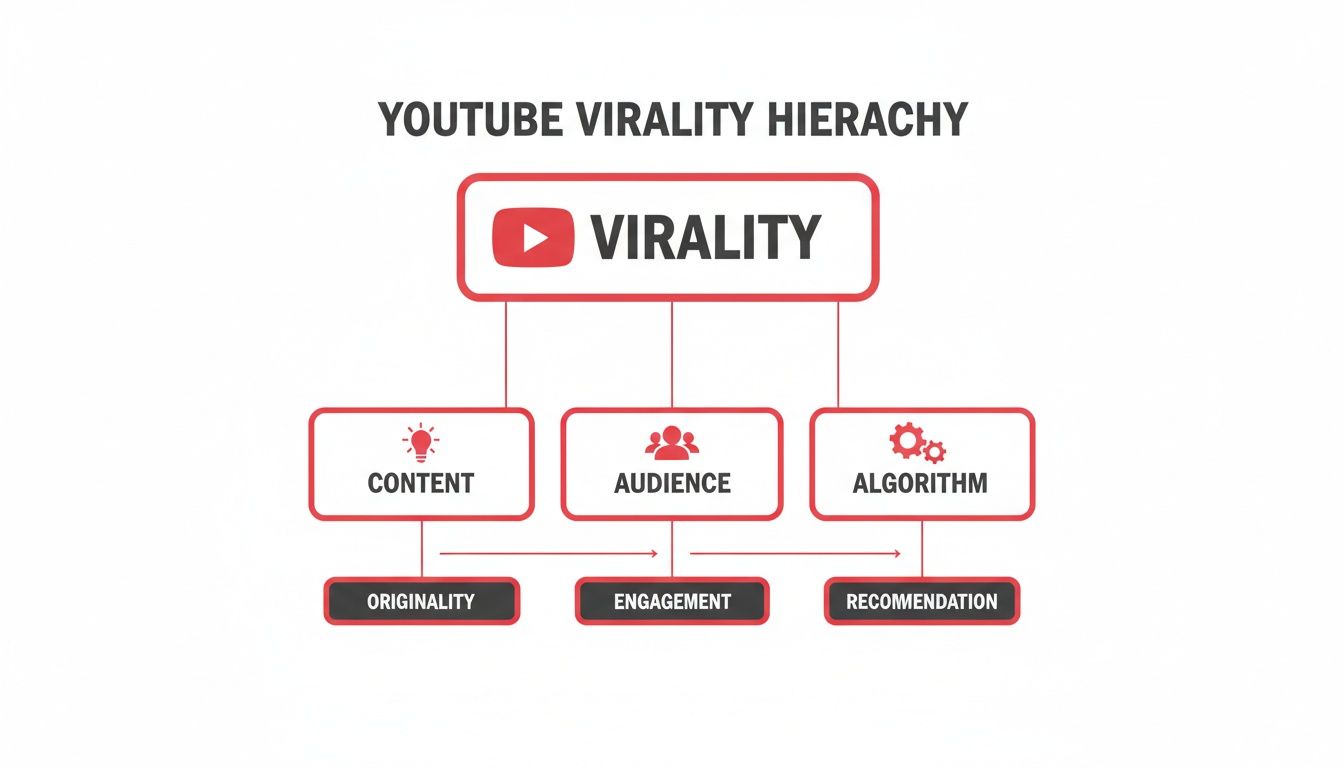
The image above perfectly illustrates the flow. You are in complete control of the content, but its potential for virality is ultimately decided by how both the audience and the algorithm react to it.
Here’s a simple table to summarize how these three elements work together.
The Three Pillars of YouTube Virality
| Pillar | What It Is | Why It Matters |
|---|---|---|
| Content | The creative core of your video—the idea, hook, story, and emotional trigger. | It's the spark. Without a compelling idea that resonates, the audience has no reason to engage. |
| Audience | The human reaction—clicks, watch time, shares, likes, and comments. | This is the fuel. Audience behavior provides the social proof that signals value to the algorithm. |
| Algorithm | YouTube's distribution system that promotes high-performing videos. | This is the amplifier. It takes the initial audience engagement and scales it to a massive, global level. |
Getting these three pillars to align is the real secret behind every video that's ever blown up.
Mastering the Art of the Click
Before your video gets a single view or logs a second of watch time, it has to win the most critical battle on YouTube: the battle for the click.
Think of your title and thumbnail as a digital movie poster. They have one job—to sell the story inside with a single, compelling glance and stop a user mid-scroll. This first impression is the spark that ignites a viral video. Without a solid click-through rate (CTR), even the most incredible content will just gather dust.
The title and thumbnail aren't two separate things; they're one powerful psychological punch. The thumbnail is the visual hook that grabs attention, while the title creates a story or an emotional promise that makes someone need to know more. When they work in perfect harmony, they make clicking feel like an irresistible impulse. This is the first, and arguably most important, signal you send to the YouTube algorithm.
The Psychology of a Viral Thumbnail
A truly great thumbnail is designed for the human brain, not just for looking pretty. It has to tell a story or convey an emotion in a fraction of a second. If someone can’t grasp the core idea of your video instantly, you've already lost them.
Here are the elements that consistently drive clicks:
- Expressive Human Faces: We are wired to connect with other people, especially faces showing big emotions like shock, joy, or confusion. A close-up of a face reacting to something creates an immediate emotional link and makes us desperately curious about what caused it.
- High-Contrast Colors: YouTube is a visually crowded place. Bright, saturated colors that pop—like bold yellows, reds, and blues against a dark background—are what draw the eye away from everything else on the page.
- Clear Visual Narrative: Your thumbnail should hint at the story without giving it all away. Think "before and after," a problem next to a solution, or the absolute peak of the action. Don't clutter it up; focus on one, single intriguing idea.
The biggest thumbnail mistake I see creators make is trying to cram too much in. They treat it like a collage instead of a billboard. Every single element needs to have a purpose, or it shouldn't be there.
Crafting Titles That Demand Attention
A killer title works with the thumbnail to create an itch that only a click can scratch. It goes way beyond just listing keywords and taps into raw human emotion and curiosity.
Your title's main job is to create a curiosity gap—that little space between what the viewer can see and what they desperately want to find out. For instance, a thumbnail showing a wrecked Lamborghini paired with the title "My First Day With a Supercar" creates an immediate, powerful need to know what on earth happened. It’s worlds more effective than a bland title like "Driving a Supercar."
Optimizing this first impression is a science. The best creators are constantly A/B testing different title and thumbnail combinations to see what their audience responds to. To get started on this, our detailed guide explains more about how to improve your click-through rate with practical testing strategies. If you're serious about growth, this isn't optional—it's essential.
Winning the First 15 Seconds

So, you got the click. Your killer title and thumbnail did their job. But now the real test begins: can you keep them watching?
Those first 5 to 15 seconds are everything. This isn't just a friendly hello; it's your one shot to prove your video is worth a viewer's time. Fail here, and they're gone. Succeed, and you earn higher audience retention, which is a metric the YouTube algorithm absolutely loves.
Think of it as a signal. When lots of people stick around past that initial mark, you're telling YouTube, "Hey, this video delivers on its promise." That's the green light the algorithm needs to start pushing your content to a much wider audience.
Hook Archetypes That Stop the Scroll
Your intro needs to hit like the opening scene of a great movie. It has to grab people immediately, create a little mystery, and promise that something good is coming. A slow, rambling intro is the quickest way to kill your video's momentum.
What you need is a powerful hook. The first few moments are where you win or lose the battle for attention. For a deeper dive, there are some great strategies out there for crafting viral hooks that stop the scroll.
Here are three battle-tested hook formulas that work like a charm:
- The In Medias Res Opening: Don't start at the beginning. Start right in the middle of the most exciting, chaotic, or visually stunning part of your video. Show the climax, then immediately cut back to explain how you got there.
- The Provocative Question: Kick things off with a question that pokes at a viewer's curiosity or challenges something they thought they knew. It makes them lean in, eager to hear your answer.
- The Shocking Statement or Statistic: Open with a bold claim or a wild statistic that makes people stop and think, "Wait, what?" This instantly frames your video as a must-watch.
Your hook is a promise to the viewer. It says, "Stick around for a few minutes, and I will deliver something you haven't seen before or solve a problem you've been struggling with."
A well-crafted intro is non-negotiable, and that's where having a tight script really pays off. If you need help structuring your ideas, our guide on how to write a script for YouTube videos is a great place to start.
The Power of Short-Form Retention
This obsession with a strong hook gets turned up to eleven with short-form content. The endless scroll on platforms like YouTube Shorts has trained our brains to have zero patience. If you don't grab them in the first second, they're already swiping to the next video.
This is exactly why Shorts are such a powerhouse for going viral. The data is pretty clear: YouTube Shorts average a massive 73% viewer retention rate. That's a number most long-form videos can only dream of.
That incredible retention sends a screaming signal to the algorithm about just how engaging the content is, triggering more re-watches, shares, and a huge promotional push.
At the end of the day, mastering the first 15 seconds is one of the most important skills you can develop. Cut the fluff, get straight to the hook, and you'll give both your audience and the algorithm every reason to believe your video is worth their time.
Decoding the YouTube Algorithm
If your title gets a viewer to click, it’s the YouTube algorithm that decides what happens next. Think of it as the ultimate gatekeeper. It can show your video to a handful of people or blast it out to the entire neighborhood. So, what's its secret? Simple: YouTube just wants to keep people watching.
Forget thinking of YouTube as just a video library. It's much more like a TV network, and its one and only goal is to keep viewers glued to their screens for as long as humanly possible. Your video is just one show in that network's primetime lineup. The algorithm is constantly asking, "Does this video keep the audience tuned in?"
When your video performs well on the key metrics, you’re sending a clear signal: "Hey, my stuff keeps people on YouTube!" The algorithm sees this, loves it, and rewards you with a firehose of new viewers. It's a powerful feedback loop you need to understand.
Watch Time: The Ultimate Satisfaction Metric
If there’s one number that matters above all else, it's Watch Time. This isn't just about how long someone watches; it's a direct reflection of how satisfied they are. A high watch time tells the algorithm that your video delivered on the promise you made in the title and thumbnail.
Imagine someone clicks on your 10-minute video but bails after 30 seconds. That’s a terrible signal. But if they stick around for seven or eight minutes? Now you're talking. You've just proven your content is genuinely engaging.
A high Click-Through Rate gets your foot in the door, but a high Watch Time is what gets you invited to the party. The algorithm values sustained attention above all else because it's the clearest sign that viewers are genuinely satisfied.
How do you get people to stick around? You have to build momentum. Drop in "mid-point hooks"—a surprising reveal or a juicy question—to keep people guessing. Use classic storytelling tricks like open loops, where you tease something early in the video that you don't fully pay off until the very end.
Engagement Signals That Matter More Than Likes
Sure, likes and comments are nice, but the algorithm sees them as pretty lightweight signals. It pays much closer attention to actions that show a real investment from the viewer. These are the "super-signals" that truly make a difference.
- Shares: When someone shares your video, they're putting their own reputation on the line and vouching for your content. It's one of the most powerful signals you can send, especially since it brings fresh eyes to the platform.
- Saves: A viewer saving your video to their "Watch Later" list or another playlist is a massive compliment. It tells YouTube your content is so valuable that they plan on coming back to it again.
These actions show that your video isn't just being passively consumed—it’s being actively valued. If you can create content that gives people "social currency" (making them look smart, funny, or in-the-know for sharing), you’ll be directly fueling your video’s viral potential.
Session Watch Time: The Holy Grail
Now we get to the big one, the metric that truly separates the viral hits from the flops: Session Watch Time. This measures the total time a viewer spends on YouTube after they started watching your video.
Think back to the TV network analogy. If a viewer watches your show and then immediately turns off the TV, your show just killed the viewing session. That’s a disaster for the network.
But what if they watch your video and then click on another one? Or better yet, another one of your videos? Bingo. You just extended the viewing session, helping YouTube achieve its main goal. The platform is always tweaking how it measures this, as highlighted by recent changes in the YouTube algorithm that double down on viewer satisfaction.
To nail this, get strategic with your end screens and recommend another one of your videos that they’ll love. Create playlists that are designed for binge-watching. When you do this, you’re not just making videos; you're building an experience that keeps people coming back for more.
Crafting Content People Need to Share
It’s easy to get lost in the weeds of algorithms and analytics, but let's be clear about one thing: algorithms don't share videos. People do. All those metrics are just a reflection of how well your content connects with a real, live human being.
A video goes viral when it strikes a chord so deeply that a viewer feels an almost physical need to pass it on. This isn't just luck. It's about understanding the psychology of why we share. When you can nail that "why," you unlock the real secret to explosive growth.
Tapping into Universal Emotions
At its core, viral content speaks the universal language of emotion. The videos that truly take off are the ones that make us feel something powerful. They transcend the screen and create a shared human experience.
Think about the last video you sent to a friend. I'm willing to bet it triggered one of these core emotions:
- Awe and Wonder: Content that shows you something so beautiful or mind-blowing it gives you goosebumps.
- Laughter: Genuinely funny, relatable humor creates an instant connection and an urge to spread the joy.
- Inspiration and Hope: Stories of people overcoming the odds or simple acts of kindness give us a lift we want to pass along.
- Curiosity: A fascinating mystery, a shocking piece of trivia, or a clever life hack that makes you want to say, "Hey, you've got to see this!"
When you can consistently evoke one of these feelings, your video stops being just a piece of content. It becomes a vessel for that emotion, and people will happily do the work of distributing it for you.
The Power of Social Currency
Beyond raw emotion, there's another powerful driver: social currency. People share things that make them look good. When someone shares your video, they're not just endorsing the content; they're making a statement about themselves. They're saying, "I'm funny," "I'm in the know," or "I find really smart, interesting things."
Your goal is to create content that gives your viewers social currency. When sharing your video makes someone else look good to their friends, you've created a powerful incentive that fuels organic growth.
This is exactly why videos that teach a surprising skill, reveal a little-known secret, or offer a unique perspective do so well. The viewer gets to be the cool friend who shares something valuable. It's a win-win that turns your audience into a volunteer marketing army.
Engineering Your Content for Shares
You have to think like a storyteller. Every great story has a beginning, a middle, and an end that guides the audience on an emotional journey. Your video should do the same. Think of it as a modern-day campfire story—so compelling and memorable that people can't wait to retell it to someone else.
This narrative structure makes your content "sticky." It's easy to remember and even easier to share. After all, truly viral videos don't just grow steadily; they erupt. The fastest viral YouTube video ever managed to rack up an unbelievable 400 million views in its first 24 hours. You can get more details on that kind of explosive growth and what drives it over on Descript.
This pattern shows that virality is a winner-takes-most game. Those first few shares create a snowball effect that can't be stopped. By consciously building your content around a clear emotional trigger and giving your audience some social currency, you dramatically increase your chances of starting that avalanche.
Frequently Asked Questions About Going Viral

Even after breaking down the mechanics of virality, there are always a few nagging questions that pop up. Let's tackle some of the most common ones I hear from creators, cutting through the noise to give you direct, actionable answers.
How Long Does It Take for a YouTube Video to Go Viral?
There's no stopwatch for virality, but its defining feature is always speed. The most explosive viral hits catch fire almost immediately, typically within the first 24 to 72 hours of being published.
That initial blast-off is the key. When a video gets a ton of clicks and keeps people watching right from the start, it sends a powerful signal to the YouTube algorithm that it's found a winner. This is when the system slams the accelerator, pushing your video into Browse Features and Suggested Videos for millions of new viewers.
Sure, some videos have a "slow burn" and gain momentum over weeks or months, but that’s not classic virality. That lightning-in-a-bottle explosion is almost always a sudden surge, fueled by a perfect storm of instant social sharing and aggressive promotion from the algorithm.
The first hour after you hit "publish" is the ultimate litmus test for a video's potential. Strong early engagement tells the algorithm your content is resonating, and that's the trigger for massive distribution.
Can Any Niche or Type of Video Go Viral?
Absolutely. Virality isn't just for comedy skits or mind-blowing stunts. Any niche, whether it's a deep dive into programming or a quiet personal vlog, has the potential to blow up.
The secret isn't the topic; it's the execution and the emotional hook. A video goes viral when it taps into a universal human feeling so powerfully that people feel an almost uncontrollable urge to share it.
Think about how different niches can pull this off:
- Educational Content: A tutorial can go viral if it explains something complex with such stunning clarity that it gives viewers a moment of awe or profound relief.
- Personal Vlogs: A simple daily vlog can go viral by capturing an act of authentic kindness that inspires viewers.
- Comedy Skits: A funny video becomes a phenomenon when the humor is so relatable that it creates a shared moment of laughter.
- Documentaries: A long-form piece can go viral if it uncovers a shocking truth or a fascinating mystery that sparks intense curiosity.
At the end of the day, it's not what you talk about, but how you talk about it. If you create something exceptional that connects on an emotional level, it can break free from its niche and find a global audience.
Do I Need a Lot of Subscribers to Go Viral?
Nope. A huge subscriber count is a nice head start, but it's definitely not a prerequisite for going viral. While your existing audience gives you that first push, the YouTube algorithm is built to find and promote incredible content, no matter how big or small the channel is.
Your subscribers are like the first ripple in the pond. Their initial views and engagement are important, but what happens next is what truly matters. When a video from a tiny channel puts up monster numbers—sky-high CTR, amazing watch time, and lots of shares—the algorithm pays attention.
It will start "testing" your video with wider audiences in their feeds and suggestions. If those new viewers love it too, your reach expands exponentially. Some of the most iconic viral videos ever came from channels that were complete unknowns before their breakout hit. A fantastic video can find its own audience.
Are Short or Long Videos Better for Going Viral?
This is a great question, and the answer is: both. Shorts and long-form videos have completely different pathways to virality, and the "right" choice depends on the story you're telling and where the platform is focusing its energy.
YouTube Shorts:
Shorts are a virality machine right now. Their quick, high-impact format is perfectly matched to how people watch content today. The commitment is tiny—just a few seconds—so retention rates can be much higher than on longer videos. Plus, the dedicated Shorts feed is a massive discovery engine that can rocket a single clip to millions of views in no time.
Long-Form Videos:
Videos over 10 minutes can absolutely go viral, but for a different reason. Think of in-depth documentaries, detailed video essays, or compelling stories. This kind of content generates a huge amount of total Watch Time. By keeping people glued to the platform for a long time, these videos deliver massive value to YouTube, and the algorithm rewards them with more promotion.
Here’s the most important piece of advice: let the content dictate the length. Never pad a three-minute idea into a ten-minute video to chase more ad revenue. Your audience retention will plummet, signaling to the algorithm that your video is a bore and killing any chance it had of taking off. Tell your story in the time it deserves, whether that's 60 seconds or 60 minutes.
Ready to stop guessing and start growing? ViewsMax provides the AI-powered tools and data-driven insights you need to optimize your titles, thumbnails, and content strategy. Turn your creative vision into measurable channel growth by visiting https://blog.viewsmax.com and see how our toolkit can help you create smarter content that gets noticed.