Cracking the code to more views on YouTube Shorts boils down to one thing: making content that stops the scroll. If you can hold a viewer's attention and get them to engage quickly, you've sent a powerful signal to the YouTube algorithm that your video is a winner. This kicks off a growth cycle that can turn a trickle of views into a flood.
Understanding the YouTube Shorts Flywheel
Before we get into the nitty-gritty tactics, you have to understand the engine that powers Shorts success. Getting views isn't just luck—it’s about consistently feeding the algorithm what it's looking for. This isn't a straight line; it's a self-reinforcing loop I like to call the "Shorts Flywheel." Once you get this flywheel spinning, you stop chasing views and start attracting them organically.
The opportunity here is just staggering. Shorts are now pulling in over 90 billion daily views from more than 2 billion monthly logged-in users. That’s a massive jump from 30 billion daily views back in 2021, which just shows how quickly audiences have embraced this format. With so much content out there, mastering the flywheel is your secret weapon to stand out.
The Core Signals Driving the Algorithm
The Shorts algorithm plays by a different set of rules than its long-form counterpart. It's all about immediate feedback. To win, you need to focus on two make-or-break metrics:
- Viewer Retention: This is simply the percentage of your video people actually watch. For a typical 30-second Short, you should be aiming for a retention rate above 85%. If people are swiping away in the first couple of seconds, the algorithm takes that as a sign that your content isn't hitting the mark and will stop pushing it.
- Engagement Velocity: This is all about how fast your Short racks up likes, comments, and shares right after you post it. A sudden burst of engagement tells YouTube your video is sparking immediate interest, which encourages the algorithm to show it to a much bigger audience.
This process—creating, engaging, and promoting—is what gets the flywheel moving.
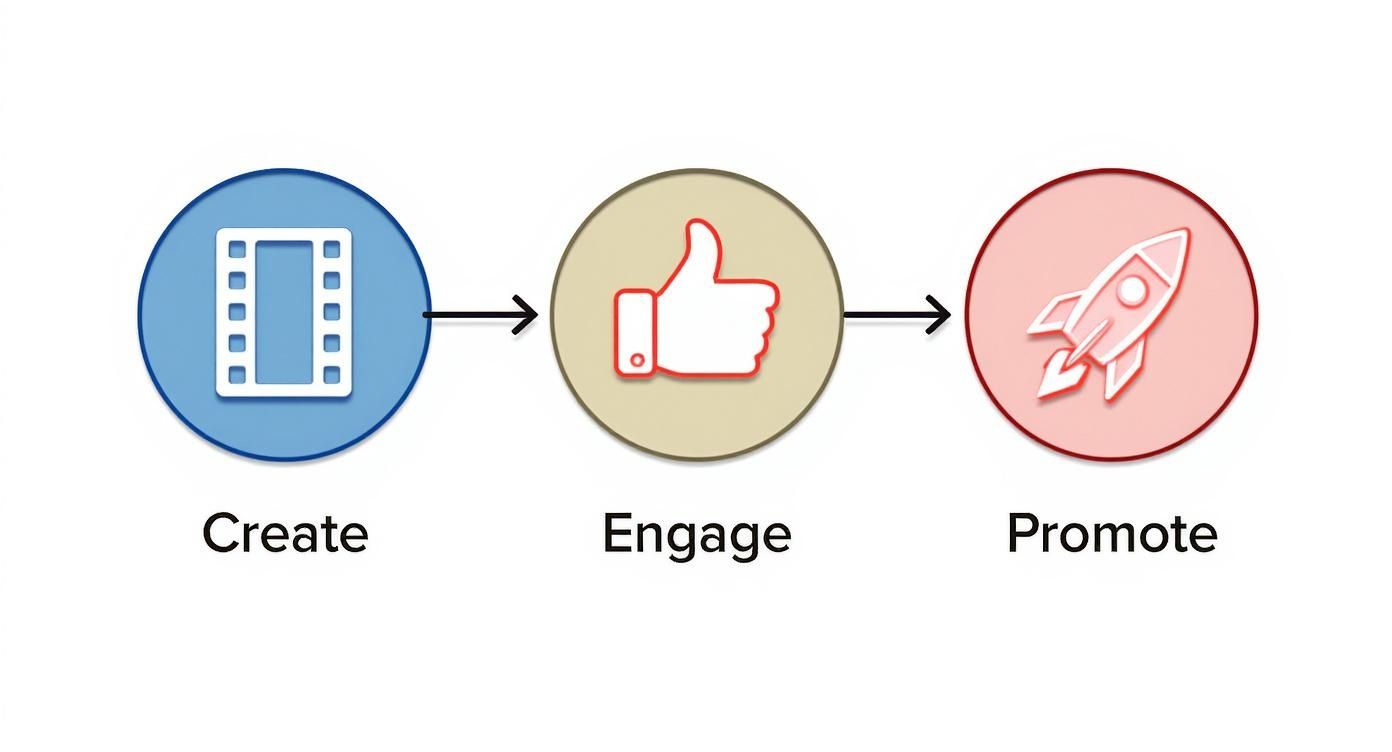
The diagram above really nails it: compelling content is the fuel. It sparks engagement, which in turn triggers the algorithm to promote your Short and expand its reach.
How the Flywheel Creates Momentum
Imagine trying to spin a giant, heavy wheel. That first push is always the toughest. Your first few Shorts might only get a handful of views while the algorithm tests the waters with a small group of people.
But if that initial audience watches all the way through and drops a like or a comment, the algorithm gives the wheel another shove, showing your Short to a slightly larger circle.
Each positive signal—every rewatch, like, and share—adds energy to your flywheel. The more energy it builds, the faster and more effortlessly it spins, delivering your content to thousands or even millions of viewers.
This cycle just keeps repeating. Each successful "test" expands your reach exponentially. A Short that does well with one viewer is likely to be pushed to others with similar tastes. This is exactly why you see some Shorts suddenly blow up days, or even weeks, after they were first posted—they've been quietly building momentum inside the flywheel. Our team of creators, featured at https://blog.viewsmax.com/author/developmenticlicksee-com/, have seen this pattern firsthand.
To get a deeper feel for how short-form video algorithms work, this guide on How to Go Viral on TikTok is a fantastic resource. The core principles for grabbing attention and satisfying the algorithm are almost identical, and the insights are directly applicable to getting your YouTube Shorts Flywheel spinning.
This table breaks down the core pillars of a successful Shorts strategy into a simple, at-a-glance format.
Core Pillars for Boosting Shorts Views
| Strategy Pillar | Key Action | Why It Works |
|---|---|---|
| Hook & Retention | Grab attention in the first 1-2 seconds and maintain it. | High retention signals to the algorithm that the content is valuable, encouraging wider distribution. |
| Fast Engagement | Encourage immediate likes, comments, and shares. | A quick burst of engagement (velocity) tells YouTube the content is resonating right now. |
| Algorithmic Triggers | Use trending audio, relevant hashtags, and strong keywords. | These elements help the algorithm categorize your content and show it to the right audience. |
| Consistency | Post regularly to keep the flywheel spinning. | Consistent uploads provide more data for the algorithm and keep your channel top-of-mind for viewers. |
By focusing on these four pillars, you're not just creating content; you're strategically building momentum that the YouTube algorithm can't ignore.
Crafting Hooks That Stop the Scroll
You get maybe a single second. That's it. In the endless scroll of the Shorts feed, if your first frame doesn't immediately jolt a viewer into paying attention, they’re gone. This isn't just an empty warning; it's the cold, hard reality of the format. Your hook is everything.
Think of that first second as a promise. You're telling the viewer, "Stick around, this is worth your time." A weak opening breaks that promise before it's even made. Nail it, and you’ll see your retention skyrocket—which is the number one signal the algorithm looks for.
The Psychology Behind a Killer Hook
The best hooks aren't just flashy; they tap directly into human nature. They create an "information gap" or a tiny bit of tension that the viewer’s brain feels an urgent need to resolve. You’re not just showing them something; you're making them feel curious, surprised, or even a little challenged.
Here are a few proven psychological triggers I've seen work time and time again:
- The "How'd They Do That?" Hook: Show an incredible final result right away, but don't explain how you got there. Imagine a baker showing a hyper-realistic cake that looks like a sneaker. The immediate thought is, "No way. I have to see how they made that." The brain needs to fill in the blanks.
- The Contrarian Question: Start with a question that goes against a popular belief. A fitness creator asking, "Is cardio actually killing your gains?" instantly hooks anyone with an opinion on the topic. They'll watch either to agree with you or to argue with you in their head. Either way, they're watching.
- The Pain Point Solution: Pinpoint a common frustration and offer a fast, simple fix. A Short that opens with "Fix your messy desktop in 30 seconds" is an instant must-watch for anyone drowning in digital clutter.
These aren't just tricks. They work because they turn a passive scroller into an active participant who's now invested in seeing what happens next.
Visuals and Text That Grab Attention
Beyond the psychology, what the viewer sees in that first second is make-or-break. A static, boring shot is a death sentence. You need immediate motion, energy, and clarity.
One of the most powerful techniques is starting in medias res—right in the middle of the action. Don't waste precious time on a slow pan or a "Hey guys!" intro. If the video is about a crazy basketball shot, the first frame better be that ball hanging in the air, inches from the hoop.
Text overlays are your secret weapon here. They act like a headline for your video, telling the viewer exactly what they’re getting.
A great text overlay eliminates all guesswork. It's your hook, title, and thumbnail all rolled into one, perfectly designed for the fast-paced Shorts feed.
For example:
- A travel Short shows a stunning, unknown beach with the text: "You won't believe where this is."
- A DIY video starts with a close-up on a tool with the overlay: "The one gadget every homeowner needs."
The goal is to be crystal clear. The viewer should know exactly why they need to keep watching before their thumb has a chance to swipe. To really dive deep into this, you can find more practical strategies on how to start a YouTube video effectively and grab viewers in seconds, because these principles are even more critical for Shorts.
Perfecting Your Pace and Delivery
A strong hook gets them in the door, but smart pacing is what keeps them there. While many Shorts hover around the 20-40 second mark, don't be afraid to go a little longer if the content is compelling.
Interestingly, Shorts that are 50 to 60 seconds long actually pull in the highest average views—around 1.7 million per video. This tells us that if your hook is strong enough, viewers will absolutely stick around for a well-told story. Right now, the entertainment category is crushing it, claiming 17% of all views, which proves that engaging content, regardless of length, wins.
To keep that energy up after the hook, your editing needs to be sharp. Use quick cuts, dynamic camera angles, and engaging sound to create a sense of forward momentum. Your delivery should be tight and energetic, with zero fluff. Every single second has to earn its place in the final cut.
Optimizing Your Shorts for Maximum Discovery
A great hook ensures people watch your video, but smart optimization ensures they find it in the first place. You can create the most engaging Short in the world, but if you neglect the basic mechanics of discovery, it will get lost in the noise. This is where a little bit of SEO-minded thinking goes a long way.
Think of YouTube as the world’s second-largest search engine. It’s constantly trying to categorize content and match it with the right viewers. Your job is to give it clear, strong signals so it knows exactly who your Short is for.

Writing Titles That Drive Clicks
Your title is one of the most powerful discovery tools you have. It needs to be intriguing enough to spark curiosity while also containing the keywords people are actually searching for. Striking this balance is key to getting more views on YouTube Shorts.
Avoid vague or "artsy" titles. Be direct and benefit-driven. Instead of "My Morning Brew," a much stronger title would be "How I Make the Perfect Pour-Over Coffee."
Here are a few title frameworks that work consistently:
- The "How-To" Title: Straightforward and effective. Example: "How to Edit a Short in 60 Seconds."
- The "Number and Benefit" Title: Listicles are easy to digest. Example: "3 Mistakes Ruining Your Workout."
- The "Curiosity Gap" Title: Poses a question the viewer needs answered. Example: "This One Tool Changed My Entire Workflow."
Remember, you're not just writing for a person; you're writing for a system. Tools like ViewsMax can help you identify high-traffic keywords and craft titles that satisfy both the algorithm and your audience.
Using Hashtags and Descriptions Strategically
Your description and hashtags provide crucial context for the algorithm. While many creators ignore the description box for Shorts, filling it out gives you a competitive edge.
Start your description with a clear, concise sentence that summarizes the video and includes your primary keyword. You don’t need to write an essay, but a sentence or two provides valuable information.
When it comes to hashtags, focus on relevance and specificity.
Your hashtag strategy shouldn’t be a random collection of popular tags. It should be a curated list that accurately describes your video's topic, niche, and format, giving the algorithm a clear roadmap to your ideal viewer.
Always include #shorts—this is non-negotiable. Beyond that, add a mix of broad and specific tags.
- Broad Tags: These describe your general category (e.g.,
#fitness,#cooking,#DIY). - Specific Tags: These narrow down your niche (e.g.,
#bodyweightworkout,#veganrecipes,#woodworkingprojects). - Branded Tags: Create a unique tag for your channel to group your content (e.g.,
#ViewsMaxTips).
Aim for a total of 3-5 highly relevant hashtags. Overloading with dozens of unrelated tags can confuse the algorithm and dilute the impact of your relevant ones.
The Underestimated Power of Video Tags
While YouTube has stated that video tags play a "minimal role" in discovery for long-form content, they can still provide helpful context, especially if your topic or channel name is commonly misspelled. Think of them as a final layer of metadata that reinforces your topic.
The best approach is to mirror the keywords from your title and description. If your title is "How to Grow Basil Indoors," your tags could include:
- How to grow basil
- Indoor gardening tips
- Herb garden
- Growing basil
This consistency across your title, description, and tags sends a unified signal to YouTube about what your content covers. This simple step can be the tiebreaker that helps your Short appear in search results over a competitor's, helping you steadily increase your views over time.
Building a Content Strategy That Lasts
Sure, going viral feels amazing. But relying on one-hit wonders is a fast track to burnout. The real key to getting more views on your YouTube Shorts over the long haul isn't just chasing viral moments—it's about building a sustainable content machine. You need a repeatable system that keeps the ideas flowing, your audience hooked, and turns those casual viewers into die-hard fans.
Trying to jump on every single trend that pops up is completely exhausting. A much smarter play is to establish a few core content pillars. Think of these as the main themes or topics your channel is built on. They're the foundation you can always come back to, making sure your content stays consistent and true to who you are as a creator.

Pinpointing Your Core Content Pillars
So, what should your pillars be? The sweet spot is right where your passions meet your audience's interests.
Let's say you're a fitness creator. Your pillars might look something like this:
- Quick Home Workouts: Short, punchy routines that don't require a ton of fancy equipment.
- No-Nonsense Nutrition: Simple meal prep hacks and busting common food myths.
- Mindset & Motivation: Real talk about staying consistent and breaking through plateaus.
Once you have these pillars locked in, creating content gets so much easier. Instead of staring at a blank screen, you can just ask, "What's one nutrition tip I can share in under 60 seconds?" This structure builds reliability, and reliability is what creates a loyal community.
Marrying Trends with Your Evergreen Content
Pillars give you stability, but trends? Trends give you reach. The trick is to adapt trends to fit your style and pillars, not just copy them blindly.
See a new sound or editing style taking off? Don't just jump on the bandwagon. Ask yourself how you can weave it into one of your core topics. For instance, a finance creator could use a trending comedic audio to dramatize the pain of filing taxes. This way, you get the discovery boost from the trend without selling out your channel's identity.
A great content strategy is like a balanced portfolio. Trend-based Shorts are your high-growth stocks that can bring in a flood of new viewers. Your pillar content is the stable, long-term bond that nurtures your core audience and keeps them coming back.
This blend is the engine for sustainable growth. Trends get new eyes on your channel, and your solid pillar content is what convinces them to hit subscribe. For a deeper dive into content frameworks, you can explore the resources in our ViewsMax guides.
How to Never Run Out of Ideas
With your pillars in place, you still need a system for generating fresh ideas. Don't wait for inspiration to strike—go out and find it.
Here’s my go-to research routine:
- Scroll the Shorts Feed (with purpose): Spend 15-20 minutes a day just watching Shorts in your niche. What’s doing well? What formats keep popping up? What are people asking in the comments?
- Check Google Trends: This is a goldmine. Type in a keyword from one of your pillars (like "air fryer recipes") and see what related searches are blowing up.
- Lurk in Community Hubs: Where does your audience hang out? Find them on Reddit, in Facebook groups, or on Discord. Look for common complaints, recurring questions, and passionate debates. Those are your next video ideas, right there.
This kind of consistent research keeps your content engine humming. The Shorts world is exploding—over 52 million channels have already jumped in, with the creator base growing by 50% year-over-year. Creators who build a real strategy are the ones who will capture a piece of that massive growth.
Using Analytics to Refine Your Approach
Making content based on a gut feeling is just throwing stuff at the wall and hoping it sticks. If you really want to know what gets you more views on YouTube Shorts, you have to start treating your channel like a lab and let the data do the talking. Your YouTube Analytics dashboard is a goldmine, but only if you know what you're looking for.
Instead of getting bogged down by a dozen different charts, you need to zero in on the key performance indicators (KPIs) that the Shorts algorithm actually cares about. These numbers paint a clear picture of what your viewers are doing—what hooks them, what bores them, and what finally convinces them to stick around.
Decoding the Metrics That Actually Matter
Diving into your analytics for the first time can feel a little overwhelming. Let's cut through the noise and focus on the numbers that give you real, actionable insights for your Shorts.
-
Viewed vs. Swiped Away: This is the big one. It's a straight-up percentage showing how many people watched your Short versus how many bailed immediately. A high "Viewed" percentage is a massive signal to YouTube that your hook is working. You should be aiming for 70% or more.
-
Audience Retention: This graph is your second-by-second truth serum. It shows you exactly where people are losing interest and dropping off. Is there a huge dip right after your hook? A slow bleed throughout the video? For a 30-second Short, you want to see a graph that stays relatively flat and high—ideally, hovering above 85-90%.
-
Traffic Sources: This tells you how people are finding your video. For Shorts, the Shorts feed needs to be your number one source by a long shot. If you see most of your views coming from "Browse features" or "Channel pages," it means your subscribers are watching, but the algorithm isn't pushing your Short out to a wider audience yet.
Understanding these numbers is step one. The real magic happens when you use them to build a smarter content plan.
Spotting Patterns and Connecting the Dots
Your analytics dashboard becomes a superpower when you stop looking at videos in isolation and start hunting for patterns. Don't just obsess over one video's retention curve; compare the graphs of your top five best-performing Shorts against your five worst.
The goal isn't just to collect data; it's to find the story the data is telling you. A single video's performance is an anecdote, but a consistent pattern across multiple videos is a strategy.
You might find that all your high-retention videos start with a question. Or maybe you'll notice that Shorts using a particular trending sound consistently bring in more subscribers. These aren't just coincidences; they're road signs pointing you toward what your audience genuinely wants to see.
This data-first approach is more critical than ever. The YouTube Shorts algorithm has gone through major changes that have shaken up viewership and creator strategies. These shifts can cause sudden, sharp drops in views, even for established channels. Data shows that these sustained performance declines are widespread, forcing creators to adapt quickly. You can read more about these algorithm shifts and their impact on creators.
The table below breaks down the most important analytics to watch. Think of it as your cheat sheet for turning raw numbers into strategic decisions.
Interpreting Key YouTube Shorts Analytics
| Metric | What It Measures | Actionable Insight |
|---|---|---|
| Views | The total number of times your Short was watched. | A good top-level indicator, but it doesn't tell the whole story. Use it to identify your best and worst performers at a glance. |
| Viewed vs. Swiped Away | The percentage of viewers who chose to watch versus those who swiped away. | This is your hook's report card. If the "Swiped Away" percentage is high, your first 1-2 seconds aren't compelling enough. |
| Average Percentage Viewed | The average portion of your Short that viewers watched. | A high percentage means your content is engaging from start to finish. A low number suggests the payoff wasn't worth the build-up. |
| Audience Retention Graph | A second-by-second visual of when viewers drop off. | Pinpoint the exact moments that bore your audience. Look for sharp dips and analyze what's happening on screen at that time. |
| Traffic Source: Shorts Feed | The percentage of views coming directly from the Shorts discovery feed. | A high percentage here means the algorithm is actively recommending your content to new viewers. This is your primary growth engine. |
| Subscribers Gained | The number of new subscribers your Short generated. | This tells you which content not only entertains but also converts viewers into community members. Double down on these formats. |
By regularly checking these metrics, you move from guessing what works to knowing what works, allowing you to build a content strategy that consistently delivers results.
Turning Insights into Action with Simple A/B Tests
Once you've spotted a pattern, you can test your theory. This is where A/B testing comes in, and it's not as complicated as it sounds. It just means changing one small thing at a time to see what performs better.
Here’s a simple way to do it:
- Form a Hypothesis: Start with an educated guess based on your data. For example, "My Shorts with bold text overlays in the first three seconds seem to get a higher 'Viewed' percentage."
- Create Two Versions: Film two nearly identical Shorts. The content, audio, and description should be the same. In one version, add the bold text overlay. In the other, leave it out.
- Publish and Analyze: Post both Shorts a day or two apart. After 48 hours, check the analytics. Did the version with the text overlay actually perform better?
You can test almost anything this way—different title formats, video lengths, calls to action, or even posting times. This systematic process takes the guesswork out of creation and helps ensure that every Short you publish is a little smarter than the last.
Common Questions About Growing on YouTube Shorts
As you get more serious about creating Shorts, you'll inevitably run into the same questions that every creator faces. It’s completely normal to wonder if you’re doing things right, especially when it feels like the rules of the game are always changing. Let's dig into some of the biggest questions I hear from creators trying to master the Shorts game.

We'll cut through the noise and give you some straightforward answers based on real-world experience, helping you sidestep common pitfalls and debunk a few myths.
How Often Should I Post Shorts?
Forget about finding a single "magic" number. The real key isn't frequency—it's consistency.
Honestly, posting three high-quality, thoughtfully produced Shorts a week will get you much further than seven rushed, sloppy ones. The algorithm feeds on strong engagement signals, and better content always gets better watch time and more interaction.
Find a rhythm that you can actually stick with. For most people, that looks something like this:
- 3-5 Shorts per week: This is a fantastic starting point. It's enough to gather meaningful data without leading to creative burnout.
- 1 Short per day: Once you have a streamlined workflow, this can really pour fuel on your growth, giving the algorithm more chances to find your audience.
Whatever you do, give your videos some breathing room. Dropping multiple Shorts in a single day just muddies your analytics and makes it impossible to tell what's actually working.
Do Shorts Hurt My Long-Form Videos?
This is a huge fear for so many creators, but the evidence points in the exact opposite direction. Think of Shorts and long-form content as two different tools that work together to build your channel.
Shorts are incredible for top-of-funnel discovery. They introduce your brand to a massive audience that probably would have never stumbled upon your longer videos through search or the browse page.
Here’s how to frame it:
- Shorts are the movie trailers—quick, punchy previews of your personality and what you offer.
- Long-form videos are the feature film—the deep-dive content that converts a casual viewer into a true subscriber.
When someone finds you through a Short and likes what they see, they're already primed to check out your other content. The trick is to maintain a consistent style and value promise across both formats so the transition feels natural.
What Should I Do If My Views Suddenly Drop?
First off, take a breath. It happens to everyone. Viewership ebbs and flows are a totally normal part of being on YouTube, often caused by tiny algorithm shifts or even seasonal changes in viewer habits.
When your views take a nosedive, it’s time to put on your detective hat and head straight to your analytics.
A sudden drop in views is a signal to diagnose, not despair. Use your data to understand the 'why' behind the numbers—look for patterns in retention, swipe-away rates, and traffic sources to identify where the disconnect is happening.
Look at what changed. Did you try a new topic that flopped? Did you get lazy with your hooks? More often than not, the fix is getting back to basics and focusing on what your data has already told you your audience loves. For more deep dives into building a strategy that lasts, check out the resources over on the ViewsMax blog.
Ready to stop guessing and start growing? ViewsMax gives you the AI-powered tools and data-driven insights you need to craft better titles, discover winning ideas, and track your performance like a pro. See how it works at https://blog.viewsmax.com.
Article created using Outrank
Leave a Reply