ViewsMax
Sign In Sign Up Free

Tag: content strategy

  • YouTube Watchtime Increaser: Proven Strategies

    YouTube Watchtime Increaser: Proven Strategies

    Most advice about a YouTube watchtime increaser starts in the wrong place. It tells creators to chase more views, publish longer videos, or accumulate raw watch hours as if every minute has equal commercial value. It doesn't. A passive viewer who watches half a broad entertainment video may contribute less to your business than a qualified prospect who watches a focused tutorial, clicks a tracked offer, and books a call.

    YouTube is already operating at enormous scale. Estimates for 2026 place daily viewing at roughly 1 billion to 2.43 billion hours, with average user time around 48.7 to 51.6 minutes per day, depending on the measurement method, as summarized by YouTube usage and watch-time data. That scale makes retention valuable, but it also makes measurement discipline essential. The practical question isn't how to generate more hours. It's which hours create return viewing, qualified clicks, leads, and sales.

    Why Raw Watch Hours Are the Wrong North Star

    Creators often treat monetization eligibility as the finish line, especially when they're focused on public watch hours. That threshold can be useful operationally, but it doesn't tell you whether your channel attracts the right audience or supports a viable business. A large total can conceal weak average view duration, early drop-offs, irrelevant traffic, and calls to action that nobody follows.

    A better model separates surface attention from qualified attention. Surface attention is the total time people spend with your content. Qualified attention comes from viewers who match your intended audience, reach the relevant part of the video, and take a meaningful next step. That step might be watching a related lesson, joining an email list, requesting a consultation, or purchasing an offer.

    YouTube Studio gives you the raw material for that diagnosis. Its Engagement report includes watch time and audience retention, while the retention calculation relates total watch time across views to the number of views and the video's length, as documented in YouTube's audience retention guidance. Average view duration, retention shape, traffic source, and downstream clicks tell you far more than a single accumulated number.

    Practical rule: Optimize the minute that precedes a valuable action, not merely the minute that inflates a dashboard.

    The distinction becomes clearer when you compare scenarios:

    Metric Type Example Scenario Business Outcome
    Raw watch hours Broad traffic watches passively but leaves without interacting High visibility with little commercial value
    Engaged watch time A relevant viewer reaches the solution and watches related content Stronger trust and deeper session behavior
    Attributed watch time A viewer watches, clicks a tracked offer, and becomes a lead Measurable contribution to pipeline or sales

    This is why a video with fewer total hours can outperform a high-volume upload commercially. A guide to public watch hours on YouTube helps clarify the eligibility metric, but eligibility shouldn't become your business strategy.

    YouTube's changing view-count environment reinforces the point. Recent coverage describes a global shift toward counting a view when playback starts, while monetization calculations continue to rely on qualified and engaged watch hours rather than inflated surface views, as reported by TechCrunch's coverage of YouTube's watch-hour update. Your reporting should therefore connect retention to outcomes. Track which videos produce clicks, leads, and sales, then give those videos more strategic attention than content that merely keeps people watching.

    Setting Realistic Retention Benchmarks by Format

    Retention isn't a universal score. A short clip and a detailed tutorial ask viewers for different commitments, so comparing them against one global average creates bad decisions. Public 2026 benchmark summaries place strong retention around 65% to 75% for videos under 5 minutes, 50% to 60% for videos from 5 to 10 minutes, 40% to 50% for videos from 10 to 15 minutes, and 35% to 45% for videos longer than 15 minutes. Shorts often sit around 70% to 85%, according to 2026 YouTube retention benchmarks.
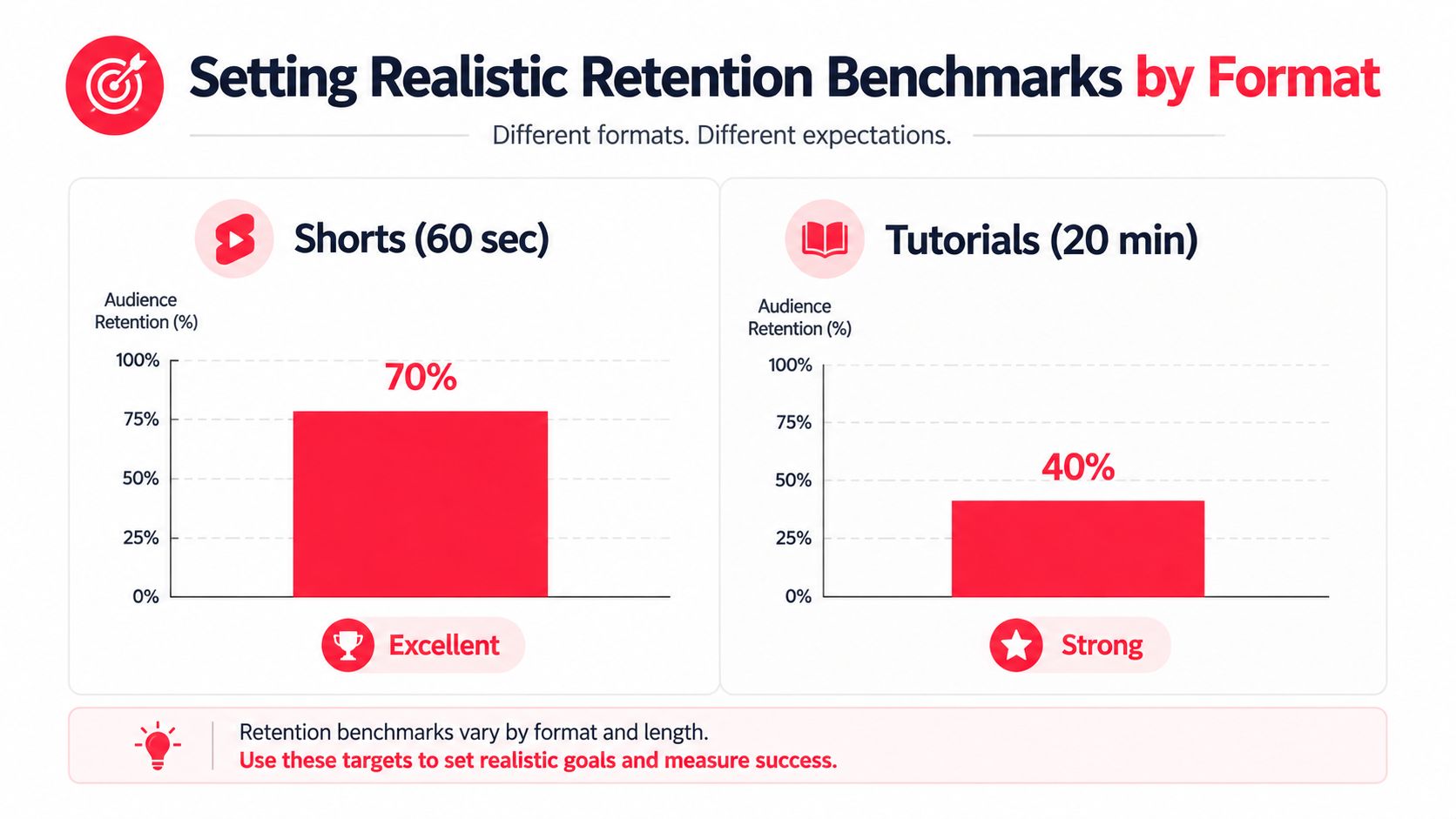
    A chart comparing audience retention benchmarks for 60-second YouTube Shorts versus 20-minute tutorial videos.

    Those bands aren't promises. They're diagnostic ranges. A 45% retention rate on a 12-minute educational video can sit in a healthy range, while the same percentage on a short-form clip would signal a weaker hold. The right comparison is always format, duration, topic, and audience intent together.

    Read the curve, not just the average

    The average percentage gives you a summary. The retention graph shows the story. A sharp opening decline usually points to a mismatch between the promise and the first moments of delivery. A gradual slide may indicate ordinary viewer filtering. A sudden mid-video dip can reveal a slow explanation, an irrelevant tangent, or a transition that asks too much patience.

    The first 15 to 30 seconds deserve special attention. Benchmark coverage reports that roughly 55% of viewers leave within the first minute, while average retention across the platform is about 23.7%, so an opening that confirms the click quickly has disproportionate value. Use the recommended video length guidance to keep runtime aligned with the amount of substance your topic can support.

    Build a channel-specific baseline

    Start by grouping videos into comparable sets. Separate Shorts, concise explainers, standard tutorials, long-form lessons, and livestream recordings. Then compare retention curves within each group rather than selecting a single target for the entire channel.

    Traffic source and device context matter as well. Search viewers may arrive with a precise problem, while Browse viewers may need faster confirmation that the video is relevant. A television viewer may accept a slower visual rhythm than someone watching on a phone. You don't need to force every format into the same retention shape. You need to identify the audience and structure that produce qualified attention.

    A 2018 study cited in benchmark discussions found limited evidence that higher percentage retention or average watch time per view necessarily leads to more views. That doesn't make retention unimportant. It means you should pair it with click-through rate, topic fit, session continuity, and conversion behavior instead of treating it as a standalone growth guarantee.

    Restructuring Videos Around Retention Drop-Off Points

    A retention graph becomes useful only when it changes your edit. Many creators open Analytics, notice a dip, and move on without watching the corresponding moment. The practical workflow is more direct: locate the loss, inspect the footage, identify the viewer's likely objection, and change the structure that caused it.
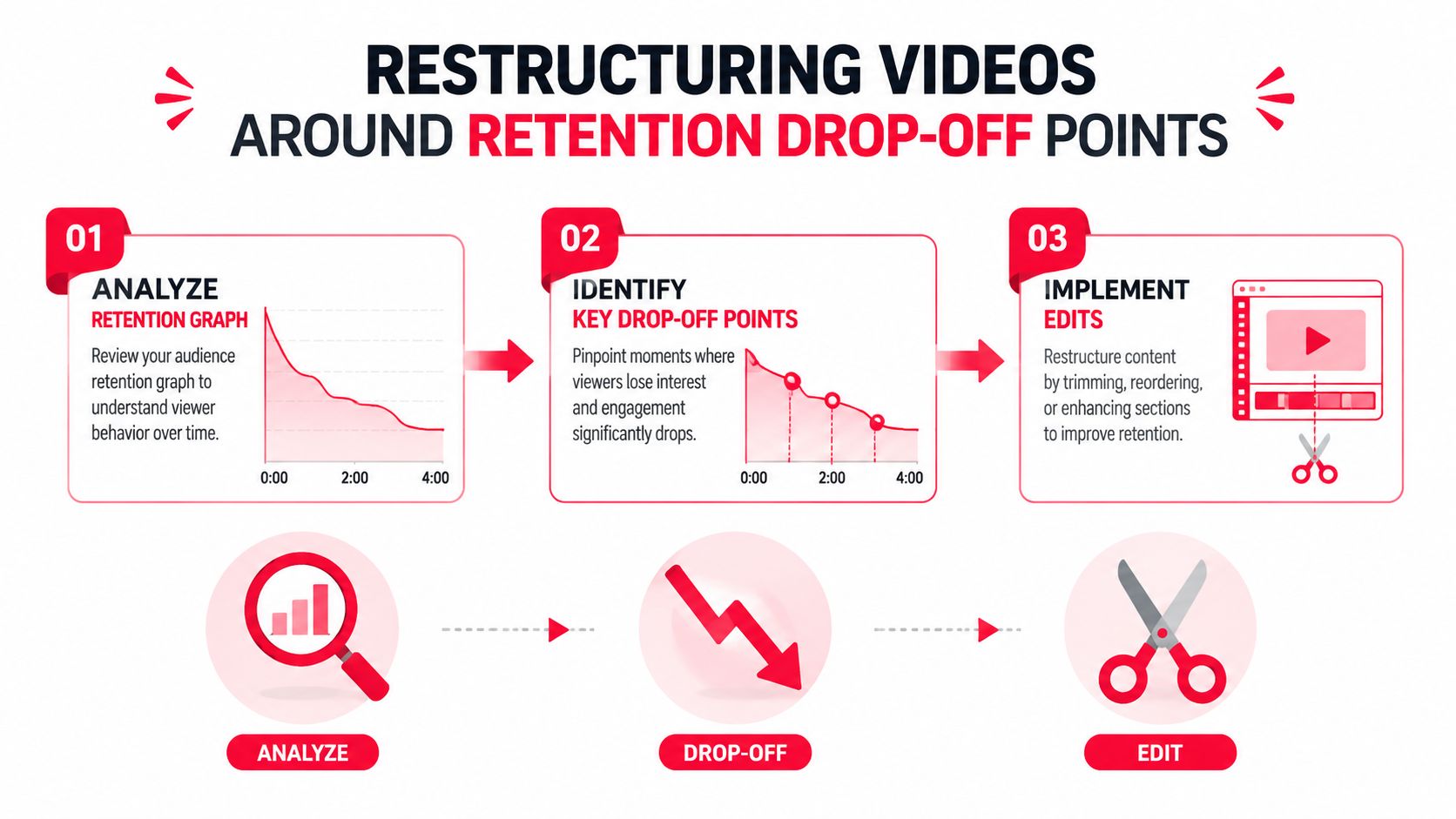
    An infographic showing a three-step process for restructuring videos to improve audience retention and viewer engagement.

    Start with the opening

    Open the video at the first steep decline. If viewers leave during the introduction, check whether you delayed the answer, repeated the title, inserted branding, or explained background before establishing the payoff. Rewrite the opening so it states the problem, names the result, and gives the viewer an immediate reason to continue.

    A strong opening doesn't need manufactured drama. It needs alignment. If the thumbnail promises a specific result, show evidence of that result early. If the title promises a process, demonstrate the first useful step before offering context.

    Diagnose the middle valley

    A middle-video dip often appears where the creator believes the viewer is already committed. That assumption leads to long transitions, repeated points, static visuals, or a sequence that no longer matches the original promise. Cut material that doesn't advance the viewer toward the outcome.

    Use a simple edit pass:

    1. Mark the timestamp: Note the exact point of the decline and the sentence or visual immediately before it.
    2. Review the promise: Ask whether the current segment still serves the title, thumbnail, and opening outcome.
    3. Change one structural element: Reorder a section, tighten a transition, replace a long explanation with a demonstration, or remove redundant context.
    4. Add a visual reset: Use relevant B-roll, a screen recording, a diagram, a camera-angle change, or on-screen text when the viewer needs a fresh representation of the idea.
    5. Compare future uploads: Don't attribute every improvement to one edit unless the test isolates that variable.

    Pattern interrupts can help, but they shouldn't become decoration. A cut, zoom, or graphic only earns its place when it clarifies the idea or restores attention. Random motion may hold the eye briefly while weakening comprehension, which is a poor exchange for educational and commercial content.

    A drop-off isn't automatically a failure. If a section filters out viewers who aren't qualified for your offer, preserving the right audience may be more valuable than retaining everyone.

    Treat the final section as a bridge

    A sharp decline near the CTA often means the recommendation arrived too late or feels disconnected from the video. Introduce the next step while the viewer is still engaged, then make the offer specific to what they just learned. A tutorial about a problem should lead to the next tutorial, resource, or offer that solves the natural follow-up problem.

    Don't hide the useful material until the final seconds just to manufacture completion. That tactic may increase shallow completion while damaging trust. Put the first payoff early, build the explanation around useful progression, and use the ending to direct qualified viewers toward a relevant next action.

    The following video demonstrates the broader principle of using structure and editing decisions to protect engagement:

    Extending Sessions with Playlists and On-Page SEO

    A playlist shouldn't function as a storage folder. It should answer the viewer's next question before they leave the platform. The strongest structures reflect intent, not upload chronology. A beginner lesson can lead to implementation, troubleshooting, and a decision-oriented video, creating a coherent path through the channel.

    Design around viewer intent

    Audit existing playlists first. Remove duplicate themes, fix misleading titles, and separate videos that attract completely different audiences. Then build clear sequences such as:

    • Awareness: Explain the problem and define the vocabulary.
    • Consideration: Compare approaches, tools, or workflows.
    • Decision: Demonstrate implementation, outcomes, or the next commercial step.

    Put the strongest session-start video first. It should make sense to a new viewer, deliver an early result, and create a natural reason to continue. The second video should resolve a follow-up question rather than being the next upload chronologically.

    If you need a practical reference for playlist setup and organization, the BeyondComments YouTube playlist guide offers a useful operational walkthrough. The strategy still depends on editorial judgment. A technically correct playlist with no narrative momentum won't hold attention.

    Optimize the playlist as a search asset

    Write titles around the shared viewer problem, then use the description to explain what the sequence covers and who should watch it. Include related language naturally, but don't turn the description into a keyword list. Search optimization works best when the playlist accurately describes a useful viewing path.

    Apply the same principle to the surrounding page elements. Place a contextual next-video link in the description, pin a comment that names the next logical lesson, and use end screens to continue the exact journey. If a viewer watched a setup tutorial, don't send them to an unrelated popular upload because it has more views.

    Chapters can improve navigation when they help a viewer find a relevant segment without making the video feel fragmented. Use this guide to adding YouTube chapters to structure longer lessons clearly, then make the chapter sequence support the playlist's broader progression.
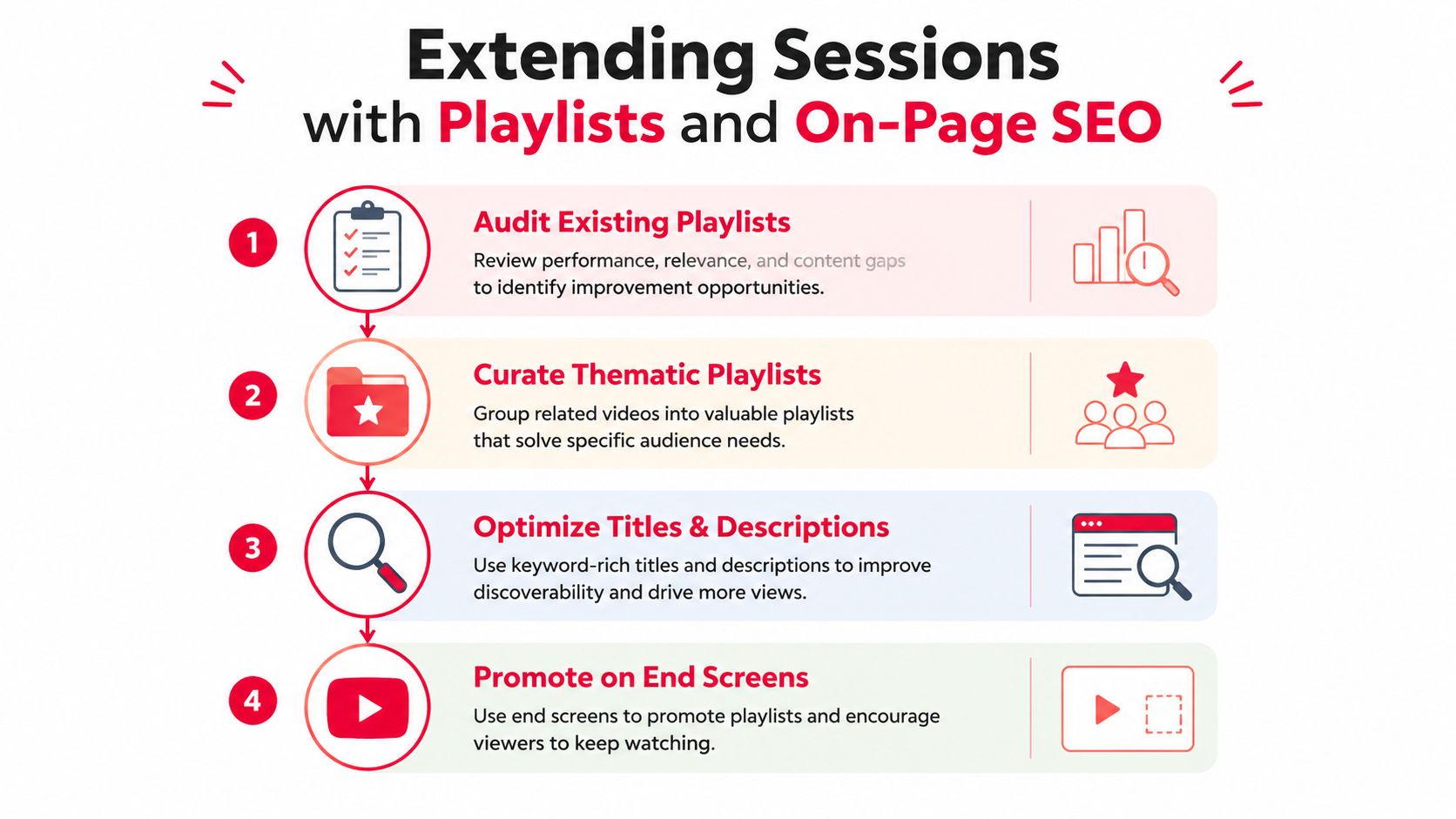
    A four-step infographic showing how to extend YouTube session watch time using playlists and on-page SEO strategies.

    ViewsMax's keyword scoring and tag analysis tools can be used alongside YouTube Studio to evaluate playlist themes, adjacent search intent, and content opportunities. The important practice is to connect discovery with session design. A playlist that earns a search impression but fails to move viewers into a relevant second video hasn't solved the watch-time problem.

    Building a Testing and Attribution Feedback Loop

    Watch time without attribution is incomplete reporting. You need a feedback loop that connects the creative decision, the audience response, and the business action. That means testing one meaningful change at a time, reviewing the retention curve, and tracing qualified viewers beyond the video.

    Start with a testing log. Record the video, audience promise, variable changed, launch context, retention observations, clicks, leads, and sales. YouTube's built-in title testing can help isolate packaging decisions, while editorial tests should focus on the opening, segment order, pacing, or CTA placement. Don't change the hook, thumbnail, title, and offer simultaneously if you want to know which decision affected the result.

    Separate content problems from audience problems

    A dip during a technical explanation may indicate that the explanation needs a clearer example. A strong opening followed by weak downstream clicks may indicate that the video attracts curiosity without attracting buying intent. A steady retention curve paired with poor conversion can point to offer mismatch, unclear positioning, or a CTA that asks for too much commitment.

    The answer depends on the relationship between signals. High retention with low click activity isn't automatically a success. It may mean viewers enjoyed the content but had no reason to continue commercially. Conversely, a modest total audience can still produce valuable results when the viewers who remain are a close match for the offer.

    Track the action after the view

    Use a unique UTM-tagged link for each video or campaign placement. Put it in the description, pinned comment, or relevant on-screen destination, then connect those visits to your analytics and CRM. Record not just clicks, but lead submissions, calls booked, purchases, and the content that introduced or assisted the conversion.

    Test Variable What to Measure Attribution Signal
    Opening promise Early retention and average view duration Clicks from viewers who reached the first offer mention
    Segment order Retention at each major section Leads from viewers exposed to the revised sequence
    CTA placement Retention around the CTA and link clicks Offer visits, inquiries, or purchases
    End-screen destination End-screen clicks and next-video starts Continued session plus later conversion activity

    A useful dashboard places these signals beside one another rather than burying them in separate reports. ViewsMax can provide an attribution layer with trackable links that connects activity back to specific content, allowing creators to compare watch behavior with clicks, leads, and attributed sales. That makes the optimization question concrete: which video deserves another edit, another promotion, or a follow-up offer?

    Your 30-Day Watch Time Optimization Plan

    A month is enough to establish a disciplined workflow, not enough to declare a permanent winner. Use the first week to audit your library, starting with videos that already receive meaningful impressions or traffic. Pull the retention curves, average view duration, click-through data, and conversion activity, then mark the recurring points where viewers leave or stop taking action.
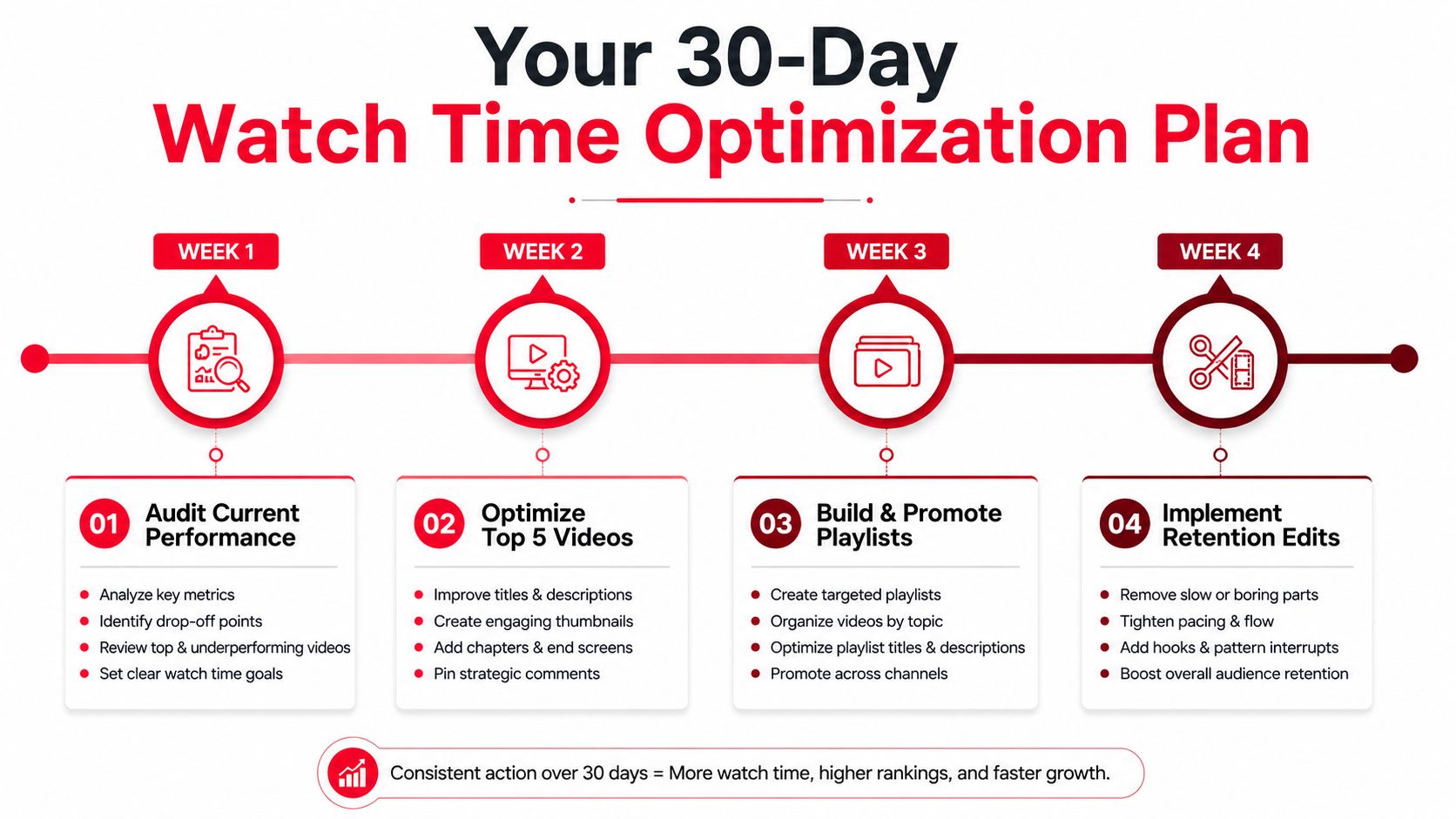
    A 30-day plan infographic illustrating steps to optimize and improve YouTube watch time through four weeks.

    Week one, audit current performance

    Create a simple inventory of your strongest existing videos. Look for repeated opening problems, mid-video stalls, weak transitions, and CTAs that attract little response. Don't begin with videos that have no meaningful audience signal. High-traffic assets give you clearer evidence and a larger opportunity for improvement.

    Week two, optimize the top five candidates

    Rewrite and re-edit the first moments of the five videos with the best combination of audience relevance and business potential. Remove slow setup, show the promised outcome earlier, and tighten the path to the first useful payoff. Keep the creator's natural voice. Over-editing can make a trustworthy expert sound like a trailer narrator.

    Week three, build the viewing paths

    Create intent-based playlists and connect them with descriptions, pinned comments, verbal recommendations, and end screens. Check every link and destination from a viewer's perspective. The next video should feel inevitable, not random.

    Week four, launch the feedback loop

    Document a single test for each selected video, attach unique tracking links to relevant offers, and review both retention and downstream behavior. Give the data enough time to become interpretable. Early movement can be noise, especially when traffic sources change.

    For additional tactical ideas, these proven watch-time tactics from Thumbo AI can supplement your testing backlog. Avoid buying artificial watch time or using tactics that attract viewers who have no relationship with your subject. Inflated hours don't establish qualified demand, and they can obscure the signals you need to make sound editorial decisions.

    Use progress tracking to compare the original structure with the revised version, but judge success on more than total hours. A valuable improvement may appear as stronger retention among the intended audience, more next-video starts, better link engagement, or additional attributed leads even when overall views remain stable.


    ViewsMax helps creators plan content, publish across channels, and connect trackable links to clicks, leads, and sales, so watch time can be evaluated as a business signal rather than a vanity total. Visit ViewsMax to see how your YouTube content can be tied to the actions and revenue it generates.
  • YouTube Algorithm Change: What Creators Need to Know in 2026

    YouTube Algorithm Change: What Creators Need to Know in 2026

    A reported up to 80% reduction in long-form recommendation slots on YouTube's home page reframes the platform's latest change. The central question for creators in 2026 isn't only whether a video earns strong retention or satisfaction signals. It's whether the video gets enough discovery surface to generate impressions in the first place, as described in recent reporting on YouTube's home-feed changes.

    That distinction has direct revenue consequences. A video can attract the right audience, hold attention, and support a valuable offer, yet produce less business impact if fewer viewers encounter it through Home or Browse. The modern YouTube strategy therefore has two connected layers: earning ranking strength and protecting access to distribution real estate.

    Why the YouTube Algorithm Change Is About Discovery Surface

    A reported reduction in long-form recommendation slots makes the latest YouTube change a distribution issue before it becomes a content-quality issue. Fewer Home placements mean creators compete for a smaller set of visible opportunities. A video can retain viewers effectively once displayed, yet receive fewer chances to enter those viewers' consideration.

    This distinction changes how performance data should be read. Falling impressions do not by themselves prove that a title weakened, a thumbnail lost persuasive power, or viewer satisfaction declined. The interface can limit how often a long-form video is presented. Ranking signals influence outcomes only after exposure is available.

    Distribution has become an economic variable

    Recommendation performance functions as more than a content score. It is also an allocation decision. YouTube determines which formats receive valuable Home-feed positions, and that allocation affects how many opportunities long-form videos have to generate views, watch time, leads, and sales.

    Three measures should remain separate:

    • Content efficiency asks how well a video performs after an impression.
    • Content volume asks how many relevant viewers receive that impression.
    • Revenue efficiency asks whether those viewers take a commercially valuable action.

    A video can improve the first measure while losing ground on the second. That creates an attribution problem for creators. If fewer qualified viewers reach the video, downstream revenue may decline even when the video's conversion rate among exposed viewers remains stable.

    The practical distinction is simple: separate “viewers did not choose this video” from “viewers had fewer chances to see this video.” Repeated thumbnail changes may raise the conversion of available impressions, but they cannot restore distribution that the interface no longer supplies.

    Why long-form creators feel the change first

    Long-form content generally requires more deliberate commitment than a short vertical clip. It can support education, product demonstrations, consultations, or lead-generation journeys, but each outcome depends on enough qualified viewers entering the video.

    A smaller recommendation footprint can also distort format comparisons. Shorts may occupy more visible feed space, while long-form videos provide stronger commercial context for some businesses. The relevant issue is format-specific access to attention, not an automatic victory by one format over the other.

    Measure impressions by surface, rather than relying on total views alone. Track Home, Suggested, Search, playlists, external referrals, and direct links, then compare each source with the business actions that follow. If Home impressions fall while Search and external traffic bring high-intent viewers, the evidence points toward a distribution redesign. A complete content overhaul may solve the wrong problem.

    The Timeline Behind the YouTube Algorithm Change

    YouTube changed recommendation priorities through three major phases: 2012, 2015 and 2016, and 2019. Each phase expanded the system's prediction target, from sustained viewing to broader behavior and then to the viewer's immediate intent. That progression improved relevance, while also making distribution more dependent on context and audience fit.

    The 2012 watch-time pivot

    In August 2012, YouTube publicly shifted its recommendation focus from raw view count to watch time. The platform began favoring videos that kept viewers watching longer instead of attracting clicks, as documented in this research paper on YouTube's recommendation history.

    View-count optimization rewarded an initial visit even when the viewing experience failed to satisfy the viewer. Watch time connected distribution more closely to sustained attention and total minutes viewed. A longer video with consistent viewing could therefore compete with, or outperform, a shorter video that generated the same number of views.

    For creators, the change affected more than video length. Titles and thumbnails still needed to earn the click, while the opening and subsequent viewing experience had to justify the expectation created by that packaging. Metadata became part of a promise system. Packaging set the expected value, and retention showed whether the video delivered it.

    Neural networks and broader engagement signals

    By 2015 and 2016, YouTube had moved beyond watch time as a standalone measure. Google's research described two neural networks, one for candidate generation and one for ranking. Together, they showed how machine learning could identify and order recommendations at scale. The technical model appears in the Google research paper on deep neural networks for YouTube recommendations.

    The system also incorporated broader engagement and satisfaction-related inputs, including shares, likes, and dislikes. Video length therefore became only one component of performance. Recommendations could favor content that connected with a specific audience, even when another video accumulated more passive minutes.

    This introduced an attribution problem for creators and marketers. A view became less informative without its source, session context, and downstream action. If a recommendation produced attention but failed to create a return viewer, subscriber, lead, or purchase, its revenue value could differ from the headline view total.

    The 2019 move toward intent

    A further redesign arrived in 2019, when YouTube's recommendation system began using intent-aware ranking. In the Stanford-reported Google experiment, the system first predicted whether a viewer sought familiarity or novelty before ranking videos. The approach increased daily active users by 0.05%, according to Stanford's report on intent-aware YouTube recommendations.

    The same viewer may want continuity in one session and exploration in another. A familiar series can suit the first state, while a new topic can suit the second. Creators can respond by aligning topics, openings, and follow-up videos with the viewer's immediate purpose.

    For marketers tracking discovery measurement, latest site improvements offer additional context on how optimization tools change alongside recommendation systems. The commercial implication is direct: stronger intent alignment may improve the value of exposed impressions, while a smaller long-form discovery surface can reduce the number of impressions available for attribution. Algorithm literacy therefore requires tracking both relevance and the revenue produced after a viewer arrives.

    What Signals Drive Reach Now

    Durable reach depends on more than accumulated watch time. Recommendation ranking is better understood as a combination of attention, satisfaction, relevance, and audience affinity, with each signal addressing a different part of the viewer decision.

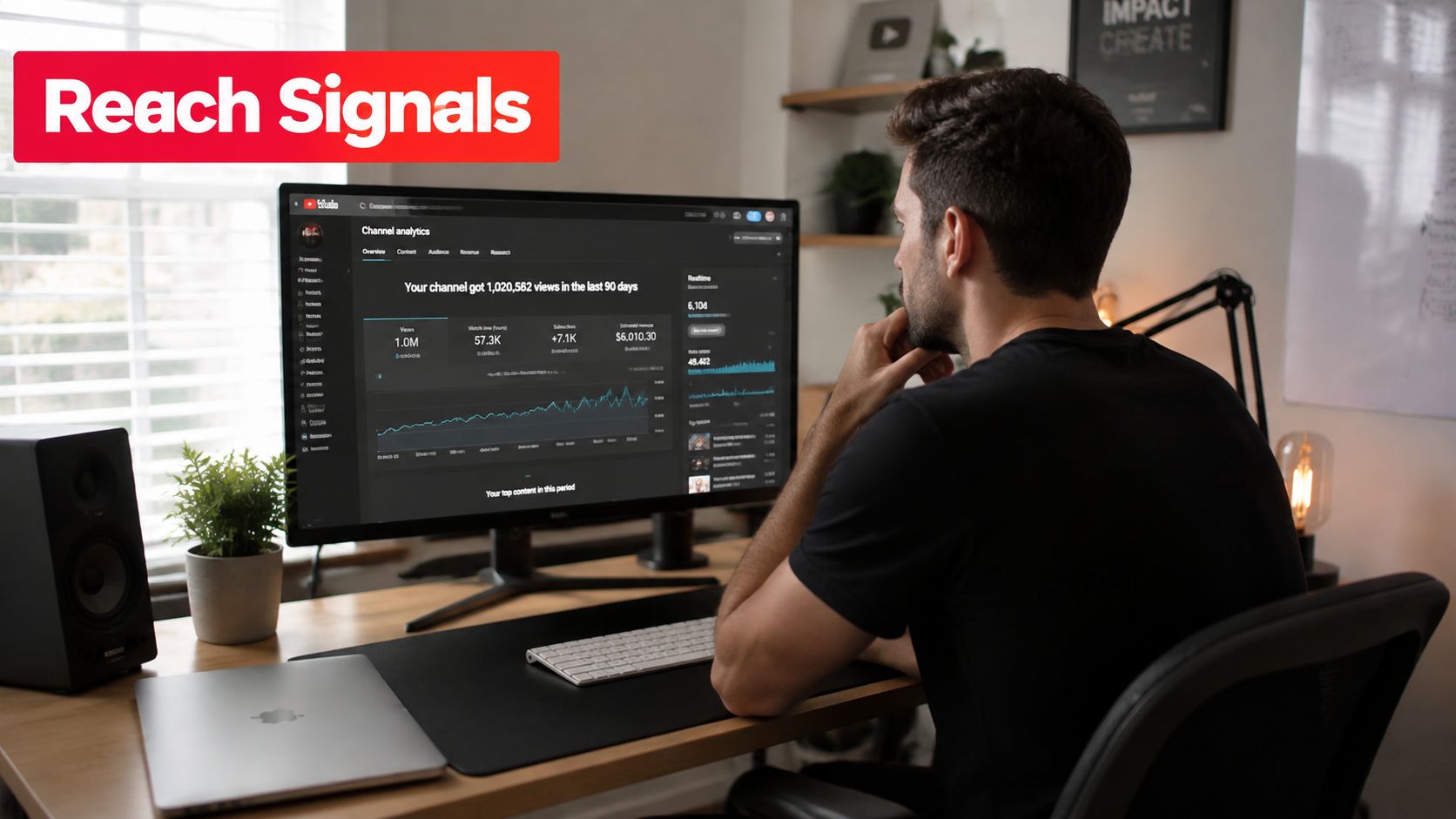
    A man sitting at his desk working on a computer showing YouTube channel analytics and statistics.

    Signal family Question it helps answer Creator implication
    Watch behavior Did the viewer continue watching? Build a clear opening and remove unnecessary delay.
    Satisfaction Did the experience feel valuable and accurate? Deliver the promised outcome instead of stretching the video.
    Engagement Did the viewer take an active step? Invite relevant responses, shares, or repeat viewing.
    Relevance Does the video match the viewer's context? Frame the topic for a specific audience need.
    Affinity Does this viewer already show interest in related content? Build connected topic clusters rather than isolated uploads.

    Watch time and satisfaction measure different outcomes

    Watch time measures quantity. Satisfaction reflects the quality of the experience inferred from behavior and feedback. A viewer who stays through a long video but leaves disappointed generates a different signal pattern from someone who watches a shorter, focused answer and returns for related content.

    Recent analysis describes satisfaction through surveys, repeat viewership, share actions, and session value, while noting that YouTube does not expose one transparent satisfaction score to creators. Direct optimization is therefore limited. Creators must rely on observable proxies, including whether viewers continue to another relevant video, return to the channel, or share the material.

    A minute watched is useful evidence. It isn't proof that the viewer valued the experience.

    This distinction matters for attribution. A recommendation can produce strong attention while generating little downstream value if the viewer has no reason to continue, subscribe, or take a commercial action. Conversely, a smaller pool of highly relevant viewers can create more useful revenue signals than broad exposure with weak intent.

    Affinity limits algorithmic “hacks”

    A 2024 causal study found that, since YouTube's recommender changes in 2019, individual consumption patterns mostly reflected user preferences. Recommendations played at most a moderating role rather than acting as the dominant driver. The study is available through this causal analysis of YouTube recommendation effects.

    Creators should identify viewers most likely to value a topic and build continuity around their interests. A channel about advanced camera workflows, for example, can connect setup, shooting, editing, and distribution topics for people already working through that problem space. This approach improves intent alignment, while the available long-form discovery surface still determines how many qualified impressions the channel can receive.

    Timing can influence the first audience available to a new upload, so creators may find maximize YouTube views with timing useful as one input. Timing affects when a video enters the market. Relevance and satisfaction influence whether viewers continue choosing it.

    Creators should compare surface-level attention with business intent through YouTube view statistics. A large audience with weak relevance may create impressive dashboard activity but limited commercial value. A smaller, focused audience may produce stronger downstream actions, making reach quality as important as reach volume.

    The Hidden Truth About Shorts and Long-Form Competition

    Shorts and long-form videos compete for different placements across YouTube's interface. The practical question is how those placements change the number of opportunities a long-form video has to reach a qualified viewer. Format performance therefore depends on both viewer intent and the amount of available recommendation space.

    Recent reporting on which long-form discovery placements changed describes fewer long-form recommendations and more Shorts placement on YouTube's home feed in 2025 and 2026, including a reported reduction of up to 80% in long-form recommendation slots. That figure is an observation from the reporting, not a universal description of every viewer's home page.

    The format may not be the actual bottleneck

    A long-form video can retain strong viewer satisfaction yet receive fewer impressions when the interface gives its format less space. This points to a distribution constraint rather than a retention failure. The video may still satisfy its existing audience, while the channel has fewer chances to place it in front of new viewers.

    That distinction matters for attribution economics. If fewer qualified impressions enter the funnel, downstream views, clicks, subscriptions, and product actions can decline even when the content's quality remains stable. Revenue then reflects both audience response and the number of opportunities the platform creates for that response to occur.

    Shorts can introduce a topic and direct viewers toward a deeper video, but the connection must be specific. A broad clip may generate attention without producing continuity. Viewers can enjoy the Short and still show no interest in the longer tutorial, offer, or series.

    Rebuild the route to the viewer

    Home should be treated as one acquisition surface among several. Search, Suggested, playlists, email, communities, embedded videos, and relevant social posts provide alternative entry points, each with a different level of intent and attribution clarity.

    Useful adaptations include:

    • Search-led topics: Answer a defined problem using language that matches the viewer's need.
    • Connected series: Give each video a logical next step, allowing one successful entry to lead to another.
    • Shorts bridges: Present a specific long-form outcome instead of collecting unrelated views.
    • External distribution: Send qualified audiences directly to a video when homepage supply is constrained.

    Creators comparing vertical-video ecosystems can use analysis of which short-form platform wins to examine format differences. The commercial decision should still follow audience behavior, offer fit, and measurable downstream action. For practical guidance on Shorts discovery, this guide to getting more views on YouTube Shorts provides additional context.

    Long-form creators do not need to treat Shorts as an enemy. They need more routes to qualified viewers, clearer bridges between formats, and attribution that distinguishes inexpensive attention from revenue-relevant intent.

    Tactical Adaptations for Titles, Thumbnails, and Retention

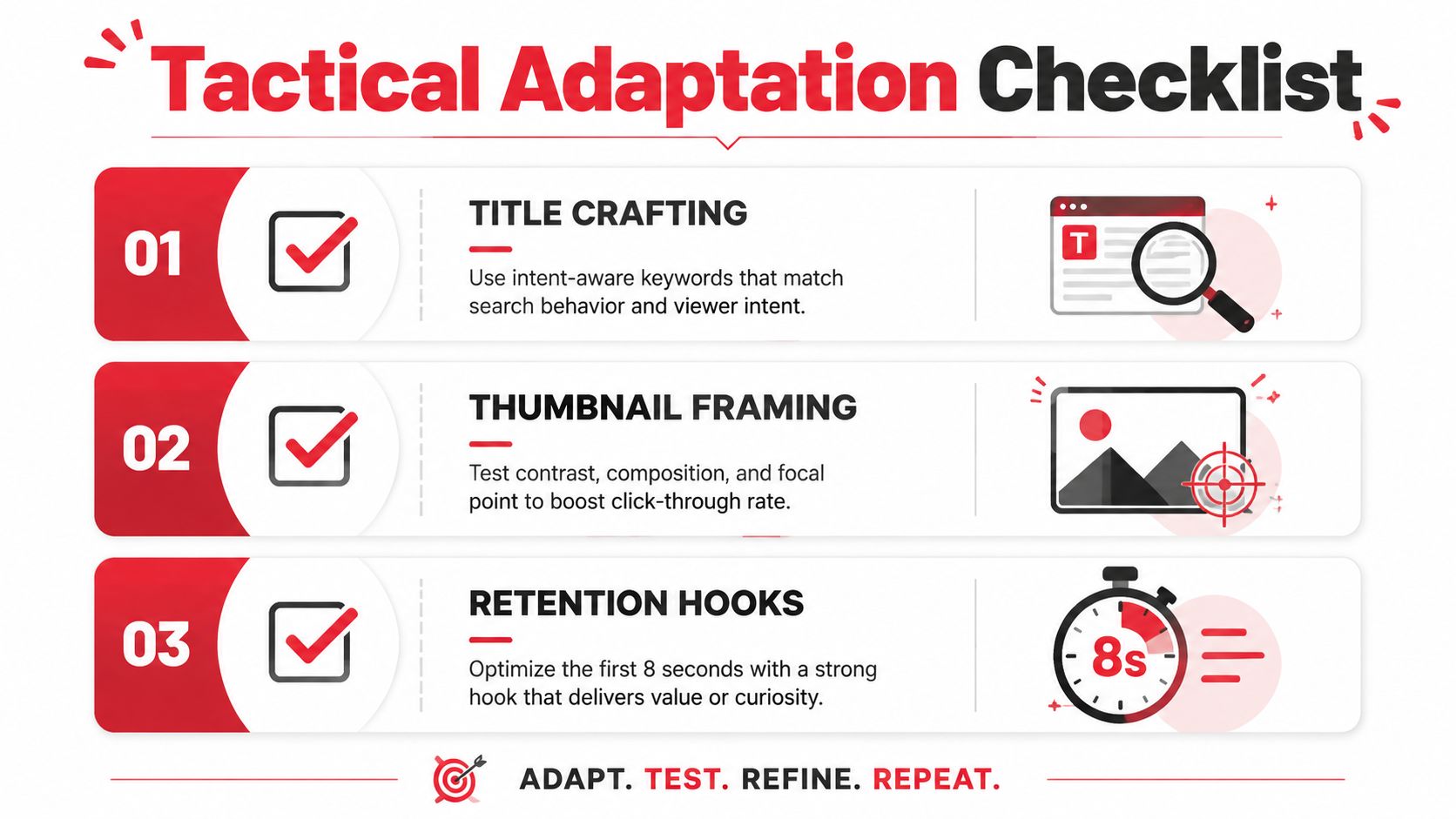
    Intent-aware ranking makes packaging a matching problem. A title and thumbnail shouldn't appeal to everyone. They should help the right viewer recognize that the video fits the question, mood, or objective they have at the moment of exposure.

    A checklist showing three tactical steps for optimizing YouTube content, including title crafting, thumbnail framing, and retention hooks.

    Start with the viewer's immediate intent

    Before writing a title, define the state that produces the click. Is the viewer trying to solve a problem, compare options, learn a process, or explore a new perspective? The same subject can require different framing depending on that purpose.

    A practical title workflow looks like this:

    1. Name the specific problem. Replace broad subjects with a recognizable situation.
    2. Promise a concrete outcome. Tell the viewer what they'll understand, create, compare, or avoid.
    3. Match the thumbnail's job to the title. Let the thumbnail communicate the visual tension or result instead of repeating the headline.
    4. Remove ambiguity. If the video serves advanced users, beginners, or a defined use case, make that audience visible.

    Metadata should reinforce the same interpretation. Use the description, chapters, captions, and spoken introduction to establish the topic clearly, but don't fill those fields with disconnected keywords. Relevance works best when the language describes the video accurately.

    Treat the opening as a contract

    The first seconds determine whether the viewer sees the video as a credible answer to the promise they just accepted. A long greeting, unrelated montage, or delayed explanation can create a mismatch before the content has had a chance to demonstrate value.

    Open with three elements:

    • The outcome: State what the viewer will gain.
    • The evidence or destination: Show the result, argument, or transformation the video will deliver.
    • The first useful step: Begin the substance before attention fades.

    Retention architecture also needs progression. Use sections, examples, visual changes, demonstrations, or questions when they clarify the argument. Pattern changes should support comprehension, not create noise.

    Opening test: If the first moments were shown without the title or thumbnail, would a viewer still understand why the video matters?

    Optimize for the next decision

    A satisfying video doesn't merely keep a viewer inside the current upload. It helps the viewer decide what to do next. That may mean watching a related tutorial, saving a process, sharing a useful explanation, or visiting an offer.

    Review the difference between packaging and delivery in this guide to improving click-through rate. Click-through performance is only one part of the chain. If a stronger thumbnail attracts viewers who don't fit the topic, the video may gain exposure while weakening retention and satisfaction.

    After publishing, compare impressions, clicks, early retention, traffic sources, and downstream actions. Don't change every variable at once. A title revision may affect the audience entering the video, while an opening revision affects whether that audience stays. Treat each adjustment as a test of one hypothesis.

    Closing the Loop Between Views and Revenue With ViewsMax

    Algorithmic performance is an incomplete business metric. A video can accumulate attention without producing leads, sales, booked calls, or meaningful movement toward an offer. Another video may attract fewer viewers but reach people with a clearer commercial problem.

    That difference matters more when long-form discovery surface shrinks. If impressions become harder to obtain, creators can't evaluate content only by asking which upload received the largest audience. They need to know which audience produced the most valuable result.

    Attribution changes the optimization question

    Without attribution, a creator might keep investing in a high-watch-time video because it looks healthy in YouTube Analytics. With trackable links attached to videos, descriptions, posts, or profiles, the creator can connect content exposure to clicks, leads, and sales. The analysis then moves from “Which video got attention?” to “Which video attracted viewers who acted?”

    ViewsMax provides that attribution layer by letting creators create trackable links and connect resulting activity to specific content. It also supports content planning, cross-platform publishing, and performance monitoring in a single workflow, according to the publisher's product description.

    A useful evaluation table might look like this:

    Video outcome Likely interpretation Business response
    High watch time, weak commercial action Strong attention, unclear offer fit or weak transition Review audience intent and the next step.
    Modest views, strong conversions Narrow but valuable audience Create related videos and protect that topic cluster.
    Strong clicks, weak leads Curiosity without sufficient qualification Clarify the promise and landing-page alignment.
    Low impressions, strong conversion rate Distribution constraint may be limiting demand Expand search, partnerships, and external promotion.

    The point isn't to turn every upload into a sales pitch. Educational and entertainment content can build trust before a viewer is ready to buy. Attribution helps identify which topics contribute to that journey, so creators don't confuse immediate conversion with total strategic value.

    The video below adds a practical visual layer for creators reviewing content performance and planning decisions.

    Revenue attribution also changes how you respond to the YouTube algorithm change. If a video loses Home impressions but continues generating sales from Search or direct links, it may still deserve investment. If another video wins recommendation traffic but produces no meaningful business outcome, its role may be awareness rather than conversion.

    That distinction prevents a common mistake: optimizing every upload for the same metric. The right target depends on the video's place in the audience journey.

    Building Sustainable Growth Beyond the Latest Update

    Sustainable growth depends on how well a channel connects viewer intent, content roles, and revenue evidence. A creator can change one variable at a time, preserve a clear audience problem, and identify which adjustment affected performance. That discipline becomes more valuable as long-form discovery occupies less surface area while intent matching grows more precise.

    Build a mapped viewer journey

    Connected videos give recommendations stronger context and give viewers a relevant reason to continue. One video can introduce a problem, another can explain the method, and a third can help the viewer evaluate an offer or apply the solution. The sequence also creates clearer attribution, because later actions can be related to the topics and videos that preceded them.

    Consider a coaching channel focused on business systems. A broad productivity video may attract casual interest, while a focused guide to preparing a first client workflow may reach fewer viewers and produce clearer intent. If it leads naturally to implementation guidance and an offer, its commercial value can exceed its view count.

    Each upload can serve a different role:

    • Discovery videos introduce a defined problem to new viewers.
    • Trust videos demonstrate experience, reasoning, or a process.
    • Conversion videos answer objections and clarify the offer.
    • Continuity videos give existing viewers a relevant next step.

    This structure links algorithm performance to attribution economics. A video with limited recommendation reach may still contribute revenue through Search, direct links, or a later conversion. A high-reach video may instead create awareness without producing an immediate sale. Both outcomes matter, but they support different decisions.

    Use algorithm literacy as an operating discipline

    The strongest response to the current environment is a repeatable review process:

    1. Identify the intended viewer and immediate need before production.
    2. Align the title, thumbnail, opening, and delivery around that need.
    3. Connect the video to a related next step.
    4. Track recommendation behavior alongside commercial outcomes.
    5. Revise one part of the system when evidence points to a specific weakness.

    This process limits overreaction to interface changes. If Home provides less long-form discovery, creators can place more weight on Search, Suggested continuity, direct distribution, and audience-owned relationships. If intent matching becomes more precise, topic clusters and clear promises deserve more attention than broad publishing.

    The long-term advantage belongs to creators who can explain which viewers a video reached, what they wanted, and what they did afterward. That knowledge turns algorithm changes into planning inputs, while shrinking discovery surface becomes a measurable attribution problem.

    ViewsMax helps creators attach trackable links to YouTube videos, descriptions, and posts so clicks, leads, and sales can be connected to the content that generated them. Visit ViewsMax to measure revenue alongside recommendation performance and make the next content decision with evidence.

  • How to Get Lots of Subscribers on YouTube A Proven Growth Guide

    How to Get Lots of Subscribers on YouTube A Proven Growth Guide

    Forget the idea of a "viral hit." Growing a loyal subscriber base on YouTube isn't about luck; it's a craft. It all boils down to a pretty straightforward loop: create truly valuable content for a specific group of people, and then make sure they can actually find it. Over and over again.

    This guide is your playbook for mastering that loop, from the foundational strategy to the nitty-gritty of getting your videos discovered.

    Building Your Channel's Strategic Foundation

    Before you even think about hitting that record button, the real work begins. Trying to get subscribers without a clear strategy is like driving cross-country without a map—you'll burn a lot of gas and end up frustrated. The channels you see with steady growth and engaged communities? They all started with a rock-solid plan.

    This isn't just about picking a topic you find interesting. It’s about getting crystal clear on your channel's purpose, knowing your audience better than they know themselves, and carving out a unique corner on the platform. This upfront work is what will guide every title you write, every video you film, and every thumbnail you create.

    Defining Your Channel's Core Purpose

    Let's get straight to it: what problem are you solving? With thousands of other channels out there, why should someone watch yours? Your answer is your channel value proposition—it's the promise you make to every single person who clicks on your video.

    A weak proposition is vague, like "a channel about cooking." A strong one is specific and gets an immediate nod of understanding, like "the channel that teaches busy professionals how to cook healthy meals in 30 minutes." That kind of clarity is a magnet for the right audience and gives them a reason to stick around.

    Key Takeaway: A subscriber is someone who trusts you to deliver consistent value. Your channel's strategy is the blueprint for earning and keeping that trust.

    Conducting Meaningful Audience Research

    You can't solve a problem if you don't understand it from your audience's point of view. This means going way beyond just looking at keywords. You need to become part of the communities where your ideal viewers already are.

    • Become a Comment Section Detective: Dive into the comments on channels similar to yours. What questions pop up again and again? Those are content ideas and pain points served up on a silver platter.
    • Hang Out in Forums: Browse Reddit, Quora, and other online forums in your niche. Pay close attention to phrases like "how do I," "I'm struggling with," or "can anyone recommend."
    • Spot the Content Gaps: What are the big channels in your space not covering? Is there a topic they only touch on briefly, or an angle they've completely missed? That's your opening to become the go-to expert.

    Doing this kind of deep-dive research ensures you're making videos people are desperately searching for, not just content you assume they want. Taking the time to find the https://blog.viewsmax.com/best-niche-for-youtube/ is a non-negotiable first step that will pay off for years.

    Establishing Your Content Pillars and Brand

    Your content pillars are the 2-4 core topics your channel will be known for. If you run a home repair channel, your pillars might be "DIY Plumbing Fixes," "Beginner Woodworking Projects," and "Essential Tool Reviews." These pillars give your channel a predictable structure, which is exactly what makes a viewer feel confident enough to subscribe.

    Your brand is the personality that weaves it all together. It shows up in everything you do:

    • Visual Identity: The consistent colors, fonts, and logos across your channel banner, thumbnails, and in-video graphics.
    • Tone of Voice: Are you the serious, authoritative teacher, or the funny, relatable friend?
    • Editing Style: Do you lean toward fast cuts and high-energy music, or a more cinematic, laid-back feel?

    A cohesive brand makes your channel instantly recognizable and signals that you’re a serious creator.

    To help you nail this down, I've put together a quick checklist. Run through these questions to make sure your foundation is solid.

    Core Channel Strategy Checklist

    Strategy Element Key Question to Answer Example (DIY Home Repair Channel)
    Value Proposition What specific problem do I solve for a specific audience? "I help first-time homeowners fix common issues themselves to save money and gain confidence."
    Target Audience Who am I talking to? What are their biggest frustrations? New homeowners (25-40) who are on a budget and feel intimidated by home maintenance.
    Content Pillar 1 What is a core recurring topic? "Emergency Fixes" (e.g., leaky faucet, running toilet)
    Content Pillar 2 What is another core recurring topic? "Simple Upgrades" (e.g., installing a new light fixture, painting a room)
    Content Pillar 3 What is a third core recurring topic? "Tool Basics" (e.g., what's in a beginner's toolkit, how to use a drill)
    Unique Angle What makes my channel different from others? My focus is on absolute beginners, using only basic tools. I explain the "why" behind each step.

    Thinking through these elements gives you a powerful filter for every future decision. When you have a clear foundation, you can then build a smart plan for how to grow your YouTube channel fast by making sure every video aligns with your core strategy. You're not just creating content; you're building a resource.

    Creating Content That Actually Earns Subscriptions

    Your channel strategy is the roadmap, but your content is the fuel. Let's be real: subscribers are earned one video at a time, and that only happens when you consistently deliver the goods. It's not about having the flashiest gear or a Hollywood budget. It's about getting into the head of your viewer and understanding what makes them go from a one-time visitor to a loyal fan.

    This whole process kicks off way before you even think about hitting the record button. It starts with an idea that provides genuine value to your target audience, structured in a way that respects their time and hooks them from the very first second. This is how you build a library of binge-worthy content that turns a single click into a full-blown viewing session.

    Brainstorming Ideas That Resonate

    The best video ideas aren't pulled out of thin air; they come from listening. Your audience is constantly dropping clues about what they want to see—you just have to know where to look. Instead of throwing darts at a wall, start with what's already proven to work.

    • Solve a Specific Problem: People subscribe to channels they see as a resource. Stop thinking in broad topics and start thinking in terms of problems. A video titled "How to Fix a Wobbly Ceiling Fan in Under 10 Minutes" will always outperform a generic "Ceiling Fan Maintenance" video. It's specific and actionable.
    • Find Your Performance Gaps: Pull up your analytics and look at your most popular videos. What’s the common thread? Now, do the same for your least popular ones. The difference between the two tells a powerful story about what your audience truly wants from you.
    • Use Keyword Research as a Compass: Tools are great for showing you what people are searching for, but your job is to give it a human touch. If everyone is searching for "best budget microphones," your angle could be "The Only 3 Microphones Under $100 You Actually Need." It’s opinionated, specific, and instantly more valuable.

    To keep your content ideas flowing without getting bogged down, you might want to look into some of the newer AI script-to-video tools. They can help turn your outlines into a solid visual starting point, freeing you up to focus more on the high-level strategy and research.

    Structuring Videos for Maximum Retention

    Getting someone to click is only half the battle. The real magic happens when you can keep them watching. Audience retention is a massive signal to the YouTube algorithm that your content is worth pushing to more people, which is your fast track to more subscribers.

    The first 15 seconds are, without a doubt, the most important part of your video. You have to immediately prove to the viewer that they made the right choice by clicking and clearly state the value they’re about to get.

    Pro Tip: Open your video by directly addressing the promise you made in your title. If the title is "5 Mistakes Beginner Gardeners Make," your opening line should be something like, "In the next few minutes, you're going to learn the five mistakes that are killing your plants, and I'll show you exactly how to fix each one."

    Once you've hooked them, the body of your video needs to keep that momentum going. Don't be afraid to use quick cuts, B-roll, on-screen text, and sound effects to keep the energy high. Every section should flow logically into the next, building up to a satisfying payoff. Honestly, just having a detailed outline can be a game-changer. Learning how to write a great script for your YouTube videos is one of the single best ways to improve your pacing and keep people watching longer.

    Production Quality That Builds Trust

    Let’s be clear: "high production value" doesn't mean you need a RED camera. It just means you need to remove any distractions that might pull the viewer out of the experience. When you're starting out, only two things truly matter:

    1. Clear Audio: People will forgive grainy video, but they will click away instantly from terrible audio. A decent microphone is one of the best investments you can make. Just make sure there's no background hum, echo, or hiss.
    2. Good Lighting: A well-lit shot just makes you look more professional and trustworthy. You don't need a pro lighting kit—a simple ring light or even just facing a window can make a night-and-day difference.

    Master these two fundamentals before you even think about upgrading your camera. That clarity and professionalism build the subconscious trust that turns a viewer into a subscriber. This focus on the viewer's experience is more important than ever.

    Just look at the explosive growth of YouTube's own subscription services. The number of YouTube Premium subscribers is projected to jump from just 18 million in 2019 to an incredible 125 million by 2025. That's a 594% increase. These are super-users who contribute heavily to watch time, a metric the algorithm absolutely loves. Channels that deliver a premium, high-retention experience are the ones that get rewarded. It’s a clear sign that a dedicated audience is a powerful signal of a channel's quality.

    Get Found: A Deep Dive into YouTube SEO and Discoverability

    Making a great video is just half the battle. If nobody can find it, it's like hiding a masterpiece in a closet. This is where getting a handle on YouTube SEO becomes your secret weapon for growing your subscriber count. It’s less about "gaming the system" and more about giving YouTube clear, powerful signals that your content is exactly what people are looking for.

    At the end of the day, YouTube’s job is simple: keep people on the platform. To do that, its algorithm zeroes in on two critical viewer signals: click-through rate (CTR) and watch time. A high CTR proves your title and thumbnail are grabbing attention, while solid watch time shows your content delivers on the promise. Nail both, and YouTube will start showing your videos to whole new audiences.

    Titles and Thumbnails: Your One-Two Punch

    Think of your title and thumbnail as your video's billboard on a very crowded highway. They have one job: to make someone stop scrolling and click. The best ones work together to create a "curiosity gap"—that irresistible urge to find out the answer or see the result.

    A great title is sharp, packed with relevant keywords, and usually has a hook that piques interest. The thumbnail needs to be visually striking, with clean text and an expressive image that complements the title without just repeating it.

    For instance, a title like "Gardening Tips" is bland and will get lost in the noise.

    • Better: "5 Common Gardening Mistakes That Are Killing Your Plants"
    • Even Better: "Stop Making These 5 Gardening Mistakes (Your Plants Will Thank You)"

    That second title creates a sense of urgency and feels personal. Pair it with a thumbnail showing a sad, wilted plant next to a thriving, vibrant one, and you’ve created an emotional hook that makes clicking almost a reflex.

    Write Descriptions for People First, Algorithm Second

    The video description is some of the most valuable, and most wasted, real estate on YouTube. It’s your opportunity to give your viewers a ton of value while also feeding the algorithm exactly what it needs to understand your video.

    Those first two or three sentences are gold—they're what show up in search results. Use this space to summarize the video's core promise and naturally weave in your most important keywords.

    My Go-To Strategy: I structure every description for easy scanning. I use timestamps to create video chapters, link out to any tools or resources I mentioned, and drop in a quick "about my channel" pitch at the bottom. This turns a boring text block into a genuinely useful resource for the viewer.

    Think of the description as the full story behind your title's headline. By filling it with helpful context, relevant keywords, and useful links, you're not just helping your search rankings; you're building trust with your audience. For a much deeper look, our guide on YouTube SEO optimization tips covers more advanced strategies.

    A No-Nonsense Approach to Video Tags

    Tags used to be a huge ranking factor, but now their role is more subtle, yet still important. Their main job is to give YouTube extra context about your video, helping it connect your content with similar videos and the right audience.

    I've found the most effective strategy is to break tags into three simple buckets:

    1. Broad Tags: These are the high-level categories for your niche (e.g., "Home Repair," "DIY Projects"). They help YouTube understand the general ballpark your video plays in.
    2. Specific Tags: This is where you get granular with long-tail keywords that describe exactly what's in the video (e.g., "how to fix a leaky faucet," "leaky kitchen sink repair," "Delta faucet drip fix").
    3. Channel Tags: Don't be afraid to include the names of a few larger, well-respected channels in your space. This is a subtle hint to YouTube that your video might be a good recommendation to show after someone watches one of their videos.

    This structured approach makes sure you're covered from all angles, from the big-picture category down to the specific problem you're solving.

    How Playlists Drive Binge-Watching

    Playlists are one of the most powerful and criminally underused tools for growth. When a viewer watches a video in a playlist, the next one automatically starts playing. This is a huge win for boosting session watch time—the total amount of time a person spends on YouTube in one sitting.

    High session time sends a massive signal to the algorithm that your channel is great at keeping people engaged. By grouping your videos into logical, themed playlists, you're basically engineering binge-watching sessions.

    Here are a few playlist ideas that always work well:

    • Series Playlists: An obvious one. If you have a multi-part series, put it in a playlist.
    • Topic Playlists: Group videos around your main content pillars (e.g., "Beginner Woodworking," "Advanced Plumbing Fixes").
    • "Greatest Hits" Playlists: Create a playlist of your most popular videos to give new viewers a perfect starting point.

    When you organize your videos into playlists, you transform your channel from a random collection of videos into a curated library of content. That makes it a destination—and a much more compelling reason for someone to subscribe.

    Smart Promotion: Getting Your Videos Seen

    Hitting "publish" is just the beginning. So many creators put all their energy into making a video, but then they just let it sit there, hoping the algorithm finds it. That's a recipe for stagnation. If you want your channel to grow, you need to actively get your content in front of the right people.

    This isn't about spamming your links everywhere you can think of. It's about a smart, strategic plan to place your video where your ideal viewers are already hanging out and to strengthen the connection you have with your existing fans.

    Don't Just Build an Audience, Build a Community

    Your most dedicated subscribers—the ones who watch every video and tell their friends about you—don't just feel like viewers. They feel like part of something. That sense of community is your secret weapon, and it starts right in your comment section.

    Make it a non-negotiable rule to reply to as many comments as you can, especially within the first day a video is live. It's a simple act, but it shows you're listening and that you value their time. This little touch encourages more people to join the conversation, which is a massive signal to the YouTube algorithm that your video is worth pushing.

    Your Community tab is another goldmine for this. Don't let it collect dust.

    • Spark a conversation: Post a poll or ask a question related to your niche. "What topic should I cover next?" or "What's the one thing you struggle with when it comes to [your topic]?"
    • Show them the real you: A quick photo from behind the scenes or a short text update about your next project makes the channel feel human and authentic.
    • Breathe life into old content: Remind your audience about a great video they might have missed from a few months back.

    This steady interaction turns casual viewers into true fans who become your biggest advocates.

    Slice and Dice: Repurpose Your Content for Every Platform

    Your long-form YouTube video is a treasure trove of smaller content pieces. Instead of just dropping a raw link to your new video on Instagram, you need to chop it up and serve it in a way that feels native to each platform. This creates multiple doorways that all lead back to your main channel.

    Think about it: a single 10-minute video can become an entire week's worth of content for your other social media accounts.

    1. Clip it for a TikTok or Reel: Find the most compelling 30-60 second moment in your video. Add some captions, maybe throw in a trending sound, and you've got a short-form video with a real shot at going viral.
    2. Create an Instagram Carousel: Pull out 3-5 key points or takeaways and turn them into a simple, swipeable graphic post. The final slide? A clear call-to-action to check out the full video on YouTube for the deep dive.
    3. Share a Quote Graphic: Did you say something particularly insightful or funny? Pull that quote, put it on a clean background, and share it on Twitter or Facebook.

    Each one of these repurposed pieces is a breadcrumb. You're leading new audiences from platforms where they already are directly to your YouTube channel.

    The Ultimate Growth Hack: Collaborations

    While all the other tactics create steady, solid growth, nothing skyrockets a channel faster than a great collaboration. When you partner with another creator, you get an introduction to their entire audience—a group of people who already trust that creator's taste. It’s like a warm referral, and it can give you a massive subscriber boost almost overnight.

    The trick is finding the right partner. You're looking for someone who is in a similar ballpark in terms of channel size and whose audience overlaps with yours without being identical. For instance, if you review tech gadgets, collaborating with someone who teaches video editing is a perfect match. The audiences have a clear shared interest, creating a natural and valuable crossover.

    Expert Insight: When you reach out to someone about a collaboration, make your pitch all about them. The worst thing you can do is send a generic "wanna collab?" message. Instead, come with a specific video idea that would provide immense value to their audience and play to their strengths. A well-thought-out pitch proves you respect their work and are serious about creating something great together.

    The data backs this up, especially when you think beyond just YouTube-to-YouTube collabs. Research shows that cross-platform collaborations are one of the most powerful growth strategies out there. In fact, these partnerships can drive an average subscriber gain of 15%, which is significantly higher than collaborations with creators in the exact same niche (12%). The real power comes from tapping into unique fanbases on platforms like TikTok or Instagram, creating new funnels to bring people to your channel. You can dive deeper into these YouTube statistics and insights on DataGlobeHub to see the full picture.

    Using Analytics to Fuel Continuous Growth

    You can't grow what you don't measure. If you're serious about getting more subscribers, you have to move beyond guesswork and start listening to what your data is telling you. Once your videos are live, they become a goldmine of information. Learning to read your YouTube Analytics is probably the single most powerful skill you can develop.

    It’s not about getting lost in endless spreadsheets. It’s about building a feedback loop: you publish a video, analyze its performance, and use those insights to make the next one even better. This is how you stop guessing what your audience wants and start giving them exactly what their viewing habits say they love.

    The Two Metrics That Matter Most

    Forget about vanity metrics for a moment. To really understand what's working, you need to look at Click-Through Rate (CTR) and Average View Duration (AVD) as a team. They tell a complete story.

    A high CTR means your thumbnail and title were fantastic—they grabbed attention and earned the click. A high AVD means your content delivered on that initial promise and kept people glued to the screen.

    Here’s how to diagnose your videos using this combo:

    • High CTR, Low AVD: You've got a classic "clickbait" problem, even if it's unintentional. Your packaging (title/thumbnail) is great, but the video itself isn't holding attention. The issue isn't discovery; it’s the content's hook, pacing, or value.
    • Low CTR, High AVD: This one is almost more frustrating. It means the people who did click absolutely loved your video. The content is solid, but your title and thumbnail are failing to convince people to even start watching.
    • High CTR, High AVD: This is the magic formula. You've nailed it. A great idea was packaged perfectly, leading to tons of clicks and fantastic watch time. The YouTube algorithm loves this signal and will push your content to more people.

    When you think this way, you can stop blindly "improving" and start making targeted fixes to the weakest part of your strategy.

    Going Deeper: Reading the Audience Reports

    Beyond CTR and AVD, two specific reports in YouTube Analytics will give you an almost unfair advantage: Traffic Sources and Audience Retention.

    Your Traffic Sources report shows you precisely how people are finding you. Is it through YouTube search? Are your videos popping up as suggested content next to other popular videos? This tells you which of your strategies are actually paying off. For instance, if "Browse features" is a top source, it means your thumbnails are compelling enough to stop people from scrolling on their homepage.

    But the Audience Retention graph? That’s the most brutally honest feedback you’ll ever get. It’s a line graph showing you, second-by-second, where people are dropping off.

    Pro Tip: Look for the sharp dips. A huge drop in the first 15 seconds means your intro is too long or doesn't deliver on the title's promise. A sudden dip halfway through might highlight a boring segment or a confusing explanation. These are your exact moments to fix in future content.

    By spotting these patterns, you learn what bores your audience and can start creating tighter, more engaging videos that people watch all the way through.

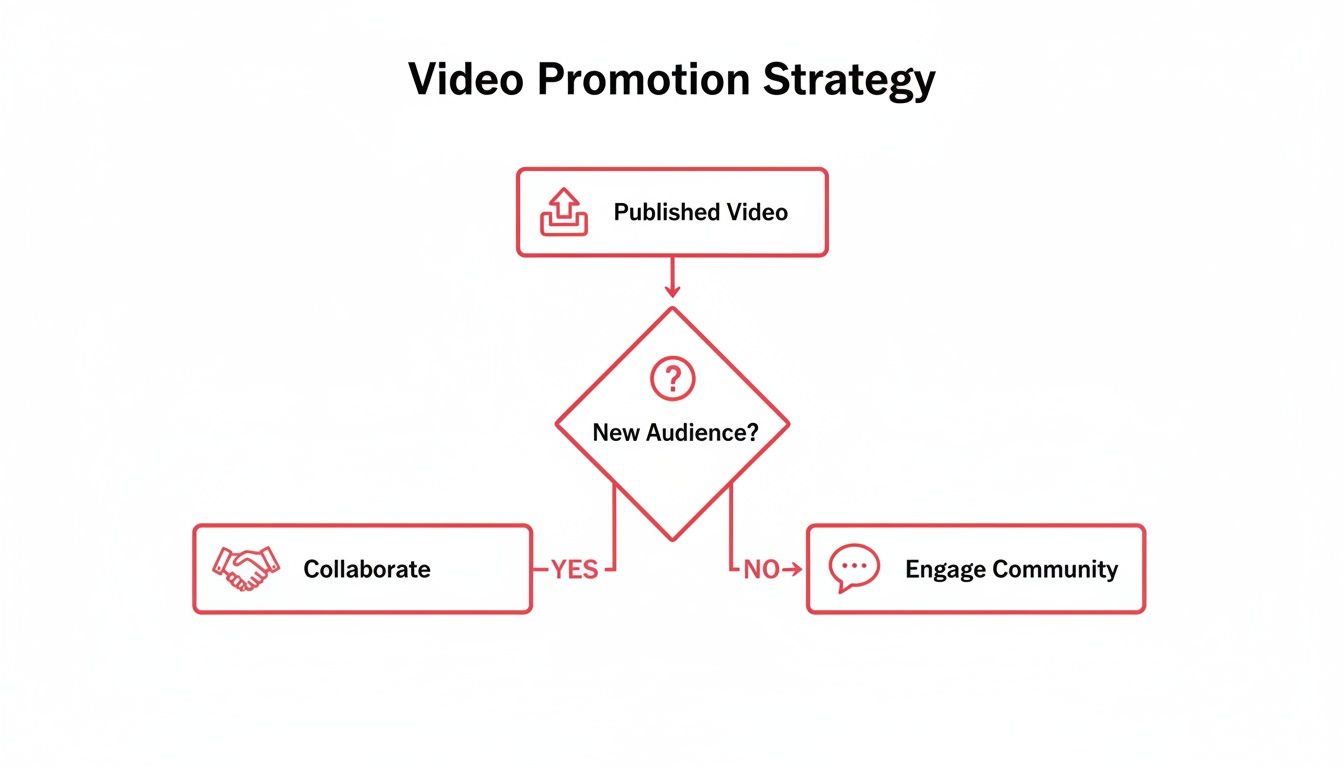
    After publishing, your next move depends on your immediate goal. This simple decision tree can help you decide where to focus your energy.

    Flowchart outlining a video promotion strategy: publish, then decide whether to collaborate or engage the community.

    As the flowchart shows, you have a choice: either rally your existing community to build momentum or collaborate with another creator to tap into a fresh audience. Both are powerful tactics for growth.

    To bring it all together, think of your analytics as a diagnostic tool. The table below provides a simple framework for interpreting common metric combinations and turning them into a clear plan of action.

    YouTube Analytics Diagnosis Framework

    Metric Combination Potential Problem Actionable Solution
    High CTR, Low AVD The video's intro or content didn't meet the promise of the title/thumbnail. Re-evaluate your first 15-30 seconds. Tighten up the intro, get to the point faster, or ensure the core topic is addressed immediately.
    Low CTR, High AVD Your content is great, but the packaging (title/thumbnail) isn't compelling enough to earn clicks. A/B test new thumbnails. Try different title formulas (e.g., question-based, listicle, controversial statement). Study what's working for top channels in your niche.
    Low CTR, Low AVD There's a fundamental disconnect between the topic, packaging, and the content itself. This is a sign to re-evaluate the video idea itself. Was it a topic your audience actually cares about? Research new topic ideas based on what has performed well in the past.
    High Impressions, Low CTR The YouTube algorithm is showing your video to many people, but they aren't clicking. Your thumbnail and title are the weak link. The topic has potential, but the "advertisement" for it is failing. Redesign them to be more eye-catching and intriguing.
    Low Impressions, High CTR The few people who see your video are clicking, but it's not being shown to a wider audience. The issue is likely discoverability. Improve your SEO by targeting more relevant, high-traffic keywords in your title, description, and tags to help the algorithm understand who to show it to.

    By regularly running your videos through this diagnostic process, you'll build an intuitive sense of what works for your channel, turning data into a reliable engine for subscriber growth.

    Common Questions About Gaining YouTube Subscribers

    So, you're trying to grow your channel and get more subscribers. It’s a journey, and along the way, a lot of the same questions tend to pop up. People always want to know about timelines, what kind of content to make, and whether certain growth hacks actually work. Let’s clear the air and set some realistic expectations so you can focus on what really moves the needle.

    Quality Over Quantity: The Unspoken Rule

    One of the first dilemmas every creator faces is whether to pump out a ton of videos or focus on making a few really good ones. Let me be blunt: quality always wins. I've seen it time and time again.

    One killer video that’s well-researched and polished will do more for your channel's future than three rushed, mediocre uploads. Why? Because low-quality content gets poor engagement. Viewers click away, and that tells the YouTube algorithm your videos aren't worth recommending. It's a channel killer.

    My advice? Start with a schedule you can actually stick to without burning out, like one fantastic video a week. Once you get your workflow down pat, you can think about upping the frequency. But never sacrifice the quality that got people to subscribe in the first place.

    How Long Does It Take to Get 1000 Subscribers?

    Ah, the big question. Everyone wants to know when they'll hit that first major milestone. The honest answer is… it depends. There's no set timeline. It hinges entirely on your niche, how good your videos are, and how you're getting them out there.

    Some creators nail it in a few months. For others, it’s a year or more. The two things that make the biggest difference are consistency and a willingness to actually look at your analytics and learn from them.

    Want to speed things up? Find a specific, underserved niche. I’ve seen channels blow up by serving a small but passionate audience. On average, if you're consistently posting 1-2 high-quality videos a week, you can realistically expect to hit 1,000 subscribers within six to twelve months. Remember, it’s a marathon, not a sprint.

    A huge mistake I see people make is chasing viral trends that have nothing to do with their channel. Sure, you might get a temporary spike in views, but those viewers aren't subscribing. They're just passing through. Stick to what your channel is about to build an audience that actually wants to stick around.

    Do Shortcuts Like "Sub4Sub" Actually Work?

    This one comes up constantly, especially with new creators looking for a quick win. Let me save you the trouble: No, they absolutely do not work.

    Tactics like "sub4sub" or, even worse, buying subscribers, will actively sabotage your channel. You're essentially filling your subscriber list with ghosts—accounts that will never, ever watch your content.

    This completely tanks your engagement metrics, especially crucial ones like watch time and audience retention. When YouTube sees your "subscribers" aren't watching, it assumes your content is bad and stops showing it to anyone. Plus, it's a blatant violation of YouTube's rules and can get your channel deleted. There are no shortcuts. The only real path is building a genuine community of people who care about what you create.


    At ViewsMax, we focus on helping you build that authentic audience, but faster. Our AI-powered toolkit gives you the data-driven insights to optimize your titles, descriptions, and tags for better discovery. We help you make content that viewers genuinely love, turning casual clicks into loyal subscribers. Ready to grow smarter? Learn more about how ViewsMax works.