ViewsMax
Sign In Sign Up Free

Tag: youtube seo

  • How to Get Lots of Subscribers on YouTube A Proven Growth Guide

    How to Get Lots of Subscribers on YouTube A Proven Growth Guide

    Forget the idea of a "viral hit." Growing a loyal subscriber base on YouTube isn't about luck; it's a craft. It all boils down to a pretty straightforward loop: create truly valuable content for a specific group of people, and then make sure they can actually find it. Over and over again.

    This guide is your playbook for mastering that loop, from the foundational strategy to the nitty-gritty of getting your videos discovered.

    Building Your Channel's Strategic Foundation

    Before you even think about hitting that record button, the real work begins. Trying to get subscribers without a clear strategy is like driving cross-country without a map—you'll burn a lot of gas and end up frustrated. The channels you see with steady growth and engaged communities? They all started with a rock-solid plan.

    This isn't just about picking a topic you find interesting. It’s about getting crystal clear on your channel's purpose, knowing your audience better than they know themselves, and carving out a unique corner on the platform. This upfront work is what will guide every title you write, every video you film, and every thumbnail you create.

    Defining Your Channel's Core Purpose

    Let's get straight to it: what problem are you solving? With thousands of other channels out there, why should someone watch yours? Your answer is your channel value proposition—it's the promise you make to every single person who clicks on your video.

    A weak proposition is vague, like "a channel about cooking." A strong one is specific and gets an immediate nod of understanding, like "the channel that teaches busy professionals how to cook healthy meals in 30 minutes." That kind of clarity is a magnet for the right audience and gives them a reason to stick around.

    Key Takeaway: A subscriber is someone who trusts you to deliver consistent value. Your channel's strategy is the blueprint for earning and keeping that trust.

    Conducting Meaningful Audience Research

    You can't solve a problem if you don't understand it from your audience's point of view. This means going way beyond just looking at keywords. You need to become part of the communities where your ideal viewers already are.

    • Become a Comment Section Detective: Dive into the comments on channels similar to yours. What questions pop up again and again? Those are content ideas and pain points served up on a silver platter.
    • Hang Out in Forums: Browse Reddit, Quora, and other online forums in your niche. Pay close attention to phrases like "how do I," "I'm struggling with," or "can anyone recommend."
    • Spot the Content Gaps: What are the big channels in your space not covering? Is there a topic they only touch on briefly, or an angle they've completely missed? That's your opening to become the go-to expert.

    Doing this kind of deep-dive research ensures you're making videos people are desperately searching for, not just content you assume they want. Taking the time to find the https://blog.viewsmax.com/best-niche-for-youtube/ is a non-negotiable first step that will pay off for years.

    Establishing Your Content Pillars and Brand

    Your content pillars are the 2-4 core topics your channel will be known for. If you run a home repair channel, your pillars might be "DIY Plumbing Fixes," "Beginner Woodworking Projects," and "Essential Tool Reviews." These pillars give your channel a predictable structure, which is exactly what makes a viewer feel confident enough to subscribe.

    Your brand is the personality that weaves it all together. It shows up in everything you do:

    • Visual Identity: The consistent colors, fonts, and logos across your channel banner, thumbnails, and in-video graphics.
    • Tone of Voice: Are you the serious, authoritative teacher, or the funny, relatable friend?
    • Editing Style: Do you lean toward fast cuts and high-energy music, or a more cinematic, laid-back feel?

    A cohesive brand makes your channel instantly recognizable and signals that you’re a serious creator.

    To help you nail this down, I've put together a quick checklist. Run through these questions to make sure your foundation is solid.

    Core Channel Strategy Checklist

    Strategy Element Key Question to Answer Example (DIY Home Repair Channel)
    Value Proposition What specific problem do I solve for a specific audience? "I help first-time homeowners fix common issues themselves to save money and gain confidence."
    Target Audience Who am I talking to? What are their biggest frustrations? New homeowners (25-40) who are on a budget and feel intimidated by home maintenance.
    Content Pillar 1 What is a core recurring topic? "Emergency Fixes" (e.g., leaky faucet, running toilet)
    Content Pillar 2 What is another core recurring topic? "Simple Upgrades" (e.g., installing a new light fixture, painting a room)
    Content Pillar 3 What is a third core recurring topic? "Tool Basics" (e.g., what's in a beginner's toolkit, how to use a drill)
    Unique Angle What makes my channel different from others? My focus is on absolute beginners, using only basic tools. I explain the "why" behind each step.

    Thinking through these elements gives you a powerful filter for every future decision. When you have a clear foundation, you can then build a smart plan for how to grow your YouTube channel fast by making sure every video aligns with your core strategy. You're not just creating content; you're building a resource.

    Creating Content That Actually Earns Subscriptions

    Your channel strategy is the roadmap, but your content is the fuel. Let's be real: subscribers are earned one video at a time, and that only happens when you consistently deliver the goods. It's not about having the flashiest gear or a Hollywood budget. It's about getting into the head of your viewer and understanding what makes them go from a one-time visitor to a loyal fan.

    This whole process kicks off way before you even think about hitting the record button. It starts with an idea that provides genuine value to your target audience, structured in a way that respects their time and hooks them from the very first second. This is how you build a library of binge-worthy content that turns a single click into a full-blown viewing session.

    Brainstorming Ideas That Resonate

    The best video ideas aren't pulled out of thin air; they come from listening. Your audience is constantly dropping clues about what they want to see—you just have to know where to look. Instead of throwing darts at a wall, start with what's already proven to work.

    • Solve a Specific Problem: People subscribe to channels they see as a resource. Stop thinking in broad topics and start thinking in terms of problems. A video titled "How to Fix a Wobbly Ceiling Fan in Under 10 Minutes" will always outperform a generic "Ceiling Fan Maintenance" video. It's specific and actionable.
    • Find Your Performance Gaps: Pull up your analytics and look at your most popular videos. What’s the common thread? Now, do the same for your least popular ones. The difference between the two tells a powerful story about what your audience truly wants from you.
    • Use Keyword Research as a Compass: Tools are great for showing you what people are searching for, but your job is to give it a human touch. If everyone is searching for "best budget microphones," your angle could be "The Only 3 Microphones Under $100 You Actually Need." It’s opinionated, specific, and instantly more valuable.

    To keep your content ideas flowing without getting bogged down, you might want to look into some of the newer AI script-to-video tools. They can help turn your outlines into a solid visual starting point, freeing you up to focus more on the high-level strategy and research.

    Structuring Videos for Maximum Retention

    Getting someone to click is only half the battle. The real magic happens when you can keep them watching. Audience retention is a massive signal to the YouTube algorithm that your content is worth pushing to more people, which is your fast track to more subscribers.

    The first 15 seconds are, without a doubt, the most important part of your video. You have to immediately prove to the viewer that they made the right choice by clicking and clearly state the value they’re about to get.

    Pro Tip: Open your video by directly addressing the promise you made in your title. If the title is "5 Mistakes Beginner Gardeners Make," your opening line should be something like, "In the next few minutes, you're going to learn the five mistakes that are killing your plants, and I'll show you exactly how to fix each one."

    Once you've hooked them, the body of your video needs to keep that momentum going. Don't be afraid to use quick cuts, B-roll, on-screen text, and sound effects to keep the energy high. Every section should flow logically into the next, building up to a satisfying payoff. Honestly, just having a detailed outline can be a game-changer. Learning how to write a great script for your YouTube videos is one of the single best ways to improve your pacing and keep people watching longer.

    Production Quality That Builds Trust

    Let’s be clear: "high production value" doesn't mean you need a RED camera. It just means you need to remove any distractions that might pull the viewer out of the experience. When you're starting out, only two things truly matter:

    1. Clear Audio: People will forgive grainy video, but they will click away instantly from terrible audio. A decent microphone is one of the best investments you can make. Just make sure there's no background hum, echo, or hiss.
    2. Good Lighting: A well-lit shot just makes you look more professional and trustworthy. You don't need a pro lighting kit—a simple ring light or even just facing a window can make a night-and-day difference.

    Master these two fundamentals before you even think about upgrading your camera. That clarity and professionalism build the subconscious trust that turns a viewer into a subscriber. This focus on the viewer's experience is more important than ever.

    Just look at the explosive growth of YouTube's own subscription services. The number of YouTube Premium subscribers is projected to jump from just 18 million in 2019 to an incredible 125 million by 2025. That's a 594% increase. These are super-users who contribute heavily to watch time, a metric the algorithm absolutely loves. Channels that deliver a premium, high-retention experience are the ones that get rewarded. It’s a clear sign that a dedicated audience is a powerful signal of a channel's quality.

    Get Found: A Deep Dive into YouTube SEO and Discoverability

    Making a great video is just half the battle. If nobody can find it, it's like hiding a masterpiece in a closet. This is where getting a handle on YouTube SEO becomes your secret weapon for growing your subscriber count. It’s less about "gaming the system" and more about giving YouTube clear, powerful signals that your content is exactly what people are looking for.

    At the end of the day, YouTube’s job is simple: keep people on the platform. To do that, its algorithm zeroes in on two critical viewer signals: click-through rate (CTR) and watch time. A high CTR proves your title and thumbnail are grabbing attention, while solid watch time shows your content delivers on the promise. Nail both, and YouTube will start showing your videos to whole new audiences.

    Titles and Thumbnails: Your One-Two Punch

    Think of your title and thumbnail as your video's billboard on a very crowded highway. They have one job: to make someone stop scrolling and click. The best ones work together to create a "curiosity gap"—that irresistible urge to find out the answer or see the result.

    A great title is sharp, packed with relevant keywords, and usually has a hook that piques interest. The thumbnail needs to be visually striking, with clean text and an expressive image that complements the title without just repeating it.

    For instance, a title like "Gardening Tips" is bland and will get lost in the noise.

    • Better: "5 Common Gardening Mistakes That Are Killing Your Plants"
    • Even Better: "Stop Making These 5 Gardening Mistakes (Your Plants Will Thank You)"

    That second title creates a sense of urgency and feels personal. Pair it with a thumbnail showing a sad, wilted plant next to a thriving, vibrant one, and you’ve created an emotional hook that makes clicking almost a reflex.

    Write Descriptions for People First, Algorithm Second

    The video description is some of the most valuable, and most wasted, real estate on YouTube. It’s your opportunity to give your viewers a ton of value while also feeding the algorithm exactly what it needs to understand your video.

    Those first two or three sentences are gold—they're what show up in search results. Use this space to summarize the video's core promise and naturally weave in your most important keywords.

    My Go-To Strategy: I structure every description for easy scanning. I use timestamps to create video chapters, link out to any tools or resources I mentioned, and drop in a quick "about my channel" pitch at the bottom. This turns a boring text block into a genuinely useful resource for the viewer.

    Think of the description as the full story behind your title's headline. By filling it with helpful context, relevant keywords, and useful links, you're not just helping your search rankings; you're building trust with your audience. For a much deeper look, our guide on YouTube SEO optimization tips covers more advanced strategies.

    A No-Nonsense Approach to Video Tags

    Tags used to be a huge ranking factor, but now their role is more subtle, yet still important. Their main job is to give YouTube extra context about your video, helping it connect your content with similar videos and the right audience.

    I've found the most effective strategy is to break tags into three simple buckets:

    1. Broad Tags: These are the high-level categories for your niche (e.g., "Home Repair," "DIY Projects"). They help YouTube understand the general ballpark your video plays in.
    2. Specific Tags: This is where you get granular with long-tail keywords that describe exactly what's in the video (e.g., "how to fix a leaky faucet," "leaky kitchen sink repair," "Delta faucet drip fix").
    3. Channel Tags: Don't be afraid to include the names of a few larger, well-respected channels in your space. This is a subtle hint to YouTube that your video might be a good recommendation to show after someone watches one of their videos.

    This structured approach makes sure you're covered from all angles, from the big-picture category down to the specific problem you're solving.

    How Playlists Drive Binge-Watching

    Playlists are one of the most powerful and criminally underused tools for growth. When a viewer watches a video in a playlist, the next one automatically starts playing. This is a huge win for boosting session watch time—the total amount of time a person spends on YouTube in one sitting.

    High session time sends a massive signal to the algorithm that your channel is great at keeping people engaged. By grouping your videos into logical, themed playlists, you're basically engineering binge-watching sessions.

    Here are a few playlist ideas that always work well:

    • Series Playlists: An obvious one. If you have a multi-part series, put it in a playlist.
    • Topic Playlists: Group videos around your main content pillars (e.g., "Beginner Woodworking," "Advanced Plumbing Fixes").
    • "Greatest Hits" Playlists: Create a playlist of your most popular videos to give new viewers a perfect starting point.

    When you organize your videos into playlists, you transform your channel from a random collection of videos into a curated library of content. That makes it a destination—and a much more compelling reason for someone to subscribe.

    Smart Promotion: Getting Your Videos Seen

    Hitting "publish" is just the beginning. So many creators put all their energy into making a video, but then they just let it sit there, hoping the algorithm finds it. That's a recipe for stagnation. If you want your channel to grow, you need to actively get your content in front of the right people.

    This isn't about spamming your links everywhere you can think of. It's about a smart, strategic plan to place your video where your ideal viewers are already hanging out and to strengthen the connection you have with your existing fans.

    Don't Just Build an Audience, Build a Community

    Your most dedicated subscribers—the ones who watch every video and tell their friends about you—don't just feel like viewers. They feel like part of something. That sense of community is your secret weapon, and it starts right in your comment section.

    Make it a non-negotiable rule to reply to as many comments as you can, especially within the first day a video is live. It's a simple act, but it shows you're listening and that you value their time. This little touch encourages more people to join the conversation, which is a massive signal to the YouTube algorithm that your video is worth pushing.

    Your Community tab is another goldmine for this. Don't let it collect dust.

    • Spark a conversation: Post a poll or ask a question related to your niche. "What topic should I cover next?" or "What's the one thing you struggle with when it comes to [your topic]?"
    • Show them the real you: A quick photo from behind the scenes or a short text update about your next project makes the channel feel human and authentic.
    • Breathe life into old content: Remind your audience about a great video they might have missed from a few months back.

    This steady interaction turns casual viewers into true fans who become your biggest advocates.

    Slice and Dice: Repurpose Your Content for Every Platform

    Your long-form YouTube video is a treasure trove of smaller content pieces. Instead of just dropping a raw link to your new video on Instagram, you need to chop it up and serve it in a way that feels native to each platform. This creates multiple doorways that all lead back to your main channel.

    Think about it: a single 10-minute video can become an entire week's worth of content for your other social media accounts.

    1. Clip it for a TikTok or Reel: Find the most compelling 30-60 second moment in your video. Add some captions, maybe throw in a trending sound, and you've got a short-form video with a real shot at going viral.
    2. Create an Instagram Carousel: Pull out 3-5 key points or takeaways and turn them into a simple, swipeable graphic post. The final slide? A clear call-to-action to check out the full video on YouTube for the deep dive.
    3. Share a Quote Graphic: Did you say something particularly insightful or funny? Pull that quote, put it on a clean background, and share it on Twitter or Facebook.

    Each one of these repurposed pieces is a breadcrumb. You're leading new audiences from platforms where they already are directly to your YouTube channel.

    The Ultimate Growth Hack: Collaborations

    While all the other tactics create steady, solid growth, nothing skyrockets a channel faster than a great collaboration. When you partner with another creator, you get an introduction to their entire audience—a group of people who already trust that creator's taste. It’s like a warm referral, and it can give you a massive subscriber boost almost overnight.

    The trick is finding the right partner. You're looking for someone who is in a similar ballpark in terms of channel size and whose audience overlaps with yours without being identical. For instance, if you review tech gadgets, collaborating with someone who teaches video editing is a perfect match. The audiences have a clear shared interest, creating a natural and valuable crossover.

    Expert Insight: When you reach out to someone about a collaboration, make your pitch all about them. The worst thing you can do is send a generic "wanna collab?" message. Instead, come with a specific video idea that would provide immense value to their audience and play to their strengths. A well-thought-out pitch proves you respect their work and are serious about creating something great together.

    The data backs this up, especially when you think beyond just YouTube-to-YouTube collabs. Research shows that cross-platform collaborations are one of the most powerful growth strategies out there. In fact, these partnerships can drive an average subscriber gain of 15%, which is significantly higher than collaborations with creators in the exact same niche (12%). The real power comes from tapping into unique fanbases on platforms like TikTok or Instagram, creating new funnels to bring people to your channel. You can dive deeper into these YouTube statistics and insights on DataGlobeHub to see the full picture.

    Using Analytics to Fuel Continuous Growth

    You can't grow what you don't measure. If you're serious about getting more subscribers, you have to move beyond guesswork and start listening to what your data is telling you. Once your videos are live, they become a goldmine of information. Learning to read your YouTube Analytics is probably the single most powerful skill you can develop.

    It’s not about getting lost in endless spreadsheets. It’s about building a feedback loop: you publish a video, analyze its performance, and use those insights to make the next one even better. This is how you stop guessing what your audience wants and start giving them exactly what their viewing habits say they love.

    The Two Metrics That Matter Most

    Forget about vanity metrics for a moment. To really understand what's working, you need to look at Click-Through Rate (CTR) and Average View Duration (AVD) as a team. They tell a complete story.

    A high CTR means your thumbnail and title were fantastic—they grabbed attention and earned the click. A high AVD means your content delivered on that initial promise and kept people glued to the screen.

    Here’s how to diagnose your videos using this combo:

    • High CTR, Low AVD: You've got a classic "clickbait" problem, even if it's unintentional. Your packaging (title/thumbnail) is great, but the video itself isn't holding attention. The issue isn't discovery; it’s the content's hook, pacing, or value.
    • Low CTR, High AVD: This one is almost more frustrating. It means the people who did click absolutely loved your video. The content is solid, but your title and thumbnail are failing to convince people to even start watching.
    • High CTR, High AVD: This is the magic formula. You've nailed it. A great idea was packaged perfectly, leading to tons of clicks and fantastic watch time. The YouTube algorithm loves this signal and will push your content to more people.

    When you think this way, you can stop blindly "improving" and start making targeted fixes to the weakest part of your strategy.

    Going Deeper: Reading the Audience Reports

    Beyond CTR and AVD, two specific reports in YouTube Analytics will give you an almost unfair advantage: Traffic Sources and Audience Retention.

    Your Traffic Sources report shows you precisely how people are finding you. Is it through YouTube search? Are your videos popping up as suggested content next to other popular videos? This tells you which of your strategies are actually paying off. For instance, if "Browse features" is a top source, it means your thumbnails are compelling enough to stop people from scrolling on their homepage.

    But the Audience Retention graph? That’s the most brutally honest feedback you’ll ever get. It’s a line graph showing you, second-by-second, where people are dropping off.

    Pro Tip: Look for the sharp dips. A huge drop in the first 15 seconds means your intro is too long or doesn't deliver on the title's promise. A sudden dip halfway through might highlight a boring segment or a confusing explanation. These are your exact moments to fix in future content.

    By spotting these patterns, you learn what bores your audience and can start creating tighter, more engaging videos that people watch all the way through.

    After publishing, your next move depends on your immediate goal. This simple decision tree can help you decide where to focus your energy.
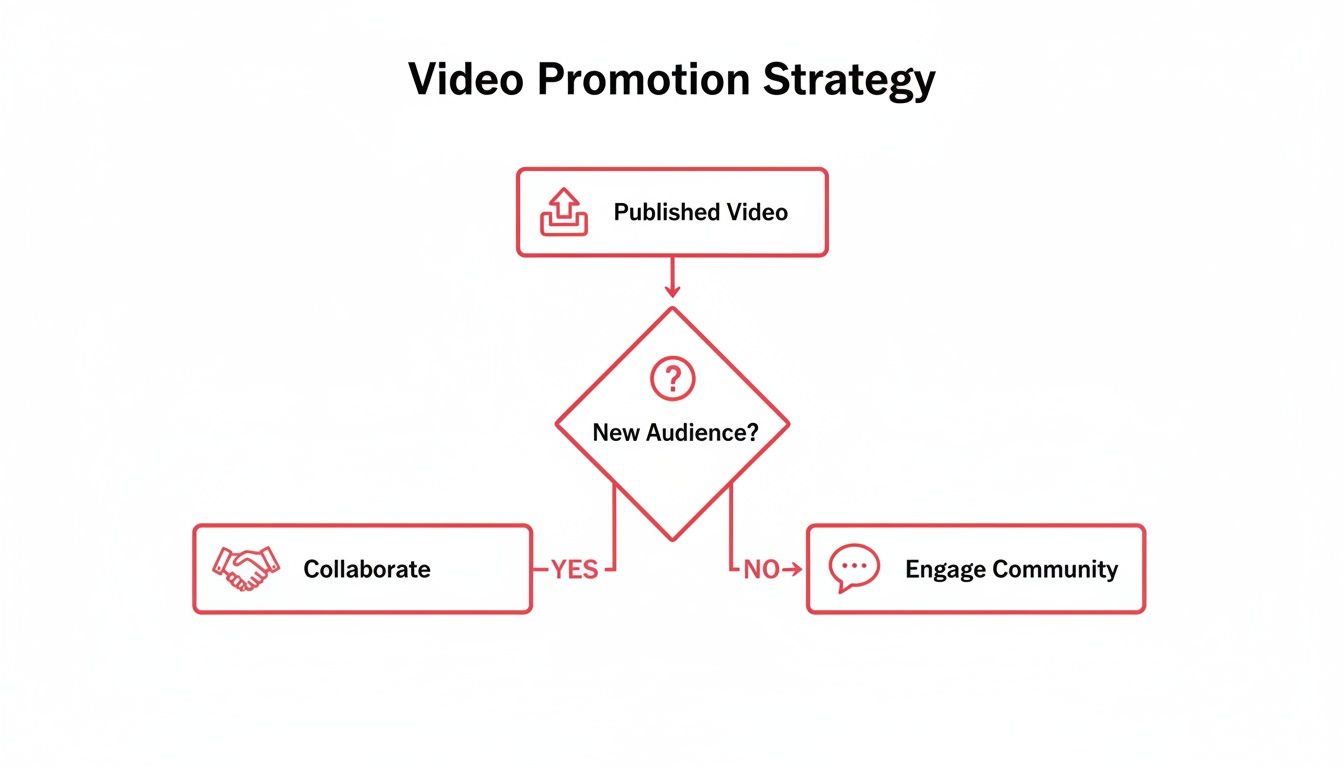
    Flowchart outlining a video promotion strategy: publish, then decide whether to collaborate or engage the community.

    As the flowchart shows, you have a choice: either rally your existing community to build momentum or collaborate with another creator to tap into a fresh audience. Both are powerful tactics for growth.

    To bring it all together, think of your analytics as a diagnostic tool. The table below provides a simple framework for interpreting common metric combinations and turning them into a clear plan of action.

    YouTube Analytics Diagnosis Framework

    Metric Combination Potential Problem Actionable Solution
    High CTR, Low AVD The video's intro or content didn't meet the promise of the title/thumbnail. Re-evaluate your first 15-30 seconds. Tighten up the intro, get to the point faster, or ensure the core topic is addressed immediately.
    Low CTR, High AVD Your content is great, but the packaging (title/thumbnail) isn't compelling enough to earn clicks. A/B test new thumbnails. Try different title formulas (e.g., question-based, listicle, controversial statement). Study what's working for top channels in your niche.
    Low CTR, Low AVD There's a fundamental disconnect between the topic, packaging, and the content itself. This is a sign to re-evaluate the video idea itself. Was it a topic your audience actually cares about? Research new topic ideas based on what has performed well in the past.
    High Impressions, Low CTR The YouTube algorithm is showing your video to many people, but they aren't clicking. Your thumbnail and title are the weak link. The topic has potential, but the "advertisement" for it is failing. Redesign them to be more eye-catching and intriguing.
    Low Impressions, High CTR The few people who see your video are clicking, but it's not being shown to a wider audience. The issue is likely discoverability. Improve your SEO by targeting more relevant, high-traffic keywords in your title, description, and tags to help the algorithm understand who to show it to.

    By regularly running your videos through this diagnostic process, you'll build an intuitive sense of what works for your channel, turning data into a reliable engine for subscriber growth.

    Common Questions About Gaining YouTube Subscribers

    So, you're trying to grow your channel and get more subscribers. It’s a journey, and along the way, a lot of the same questions tend to pop up. People always want to know about timelines, what kind of content to make, and whether certain growth hacks actually work. Let’s clear the air and set some realistic expectations so you can focus on what really moves the needle.

    Quality Over Quantity: The Unspoken Rule

    One of the first dilemmas every creator faces is whether to pump out a ton of videos or focus on making a few really good ones. Let me be blunt: quality always wins. I've seen it time and time again.

    One killer video that’s well-researched and polished will do more for your channel's future than three rushed, mediocre uploads. Why? Because low-quality content gets poor engagement. Viewers click away, and that tells the YouTube algorithm your videos aren't worth recommending. It's a channel killer.

    My advice? Start with a schedule you can actually stick to without burning out, like one fantastic video a week. Once you get your workflow down pat, you can think about upping the frequency. But never sacrifice the quality that got people to subscribe in the first place.

    How Long Does It Take to Get 1000 Subscribers?

    Ah, the big question. Everyone wants to know when they'll hit that first major milestone. The honest answer is… it depends. There's no set timeline. It hinges entirely on your niche, how good your videos are, and how you're getting them out there.

    Some creators nail it in a few months. For others, it’s a year or more. The two things that make the biggest difference are consistency and a willingness to actually look at your analytics and learn from them.

    Want to speed things up? Find a specific, underserved niche. I’ve seen channels blow up by serving a small but passionate audience. On average, if you're consistently posting 1-2 high-quality videos a week, you can realistically expect to hit 1,000 subscribers within six to twelve months. Remember, it’s a marathon, not a sprint.

    A huge mistake I see people make is chasing viral trends that have nothing to do with their channel. Sure, you might get a temporary spike in views, but those viewers aren't subscribing. They're just passing through. Stick to what your channel is about to build an audience that actually wants to stick around.

    Do Shortcuts Like "Sub4Sub" Actually Work?

    This one comes up constantly, especially with new creators looking for a quick win. Let me save you the trouble: No, they absolutely do not work.

    Tactics like "sub4sub" or, even worse, buying subscribers, will actively sabotage your channel. You're essentially filling your subscriber list with ghosts—accounts that will never, ever watch your content.

    This completely tanks your engagement metrics, especially crucial ones like watch time and audience retention. When YouTube sees your "subscribers" aren't watching, it assumes your content is bad and stops showing it to anyone. Plus, it's a blatant violation of YouTube's rules and can get your channel deleted. There are no shortcuts. The only real path is building a genuine community of people who care about what you create.


    At ViewsMax, we focus on helping you build that authentic audience, but faster. Our AI-powered toolkit gives you the data-driven insights to optimize your titles, descriptions, and tags for better discovery. We help you make content that viewers genuinely love, turning casual clicks into loyal subscribers. Ready to grow smarter? Learn more about how ViewsMax works.
  • The 12 Best Chrome Extensions for YouTubers in 2026

    The 12 Best Chrome Extensions for YouTubers in 2026

    YouTube is more than a platform; it's a competitive ecosystem where efficiency and optimization separate thriving channels from stagnant ones. Juggling research, search engine optimization (SEO), analytics, and content creation can quickly become overwhelming for creators at any level. The right tools, however, can transform this workflow from a chaotic scramble into a streamlined, data-driven process, allowing you to focus on what truly matters: creating compelling content.

    This comprehensive guide moves beyond generic feature lists to provide a deep dive into the best Chrome extensions for YouTubers. We will explore a curated selection of tools designed to enhance every stage of your creative process, from initial idea generation to post-publication analysis. We'll examine powerful extensions like TubeBuddy and vidIQ for channel management, Keywords Everywhere for SEO research, and innovative tools like Glasp for content summarization. Each entry includes an honest assessment of its strengths and weaknesses, practical use-case scenarios, and clear screenshots to illustrate its functionality.

    Forget sifting through countless options in the Chrome Web Store. This article is your definitive resource for finding the perfect extensions to match your specific needs as a creator. Whether you're a new vlogger trying to find your footing or a seasoned pro looking to refine your strategy, these browser-based tools are your secret weapon for creating smarter, growing faster, and reclaiming hours of valuable time. Let’s explore how to integrate these powerful assistants directly into your browser to unlock your channel's full potential.

    1. ViewsMax YouTube Video Title Generator

    For creators who understand that a video’s success often hinges on its title, the ViewsMax YouTube Video Title Generator is an indispensable tool. It distinguishes itself by seamlessly integrating an AI-powered brainstorming engine directly into the YouTube Studio upload interface. This eliminates the disruptive workflow of switching between your channel dashboard and external idea generators, making it one of the best chrome extensions for YouTubers focused on efficiency and optimization.

    Instead of facing a blank title field, you can instantly generate a list of compelling, data-informed title options tailored to your video's content. The extension analyzes best practices and successful title formats, providing suggestions designed to maximize click-through rates (CTR) and improve discoverability in YouTube’s search and recommendation algorithms.

    ViewsMax YouTube Video Title Generator

    Why It Stands Out as a Top Choice

    What makes ViewsMax a standout is its deep integration and practical application. The one-click insertion feature is a significant time-saver, allowing you to apply a chosen title directly to your upload without any manual copy-pasting. This seemingly small function streamlines the publishing process, reducing friction and helping you maintain creative momentum.

    Furthermore, it's not just a standalone title tool. It functions as a key component of the broader ViewsMax creator suite, which includes tools for tag generation and description optimization. This cohesive ecosystem ensures your on-page SEO is aligned from title to tags, creating a powerful, unified strategy for every video.

    Real-World Application: Imagine you've just finished editing a complex tutorial on "Advanced Photoshop Techniques." Instead of brainstorming from scratch, you can generate 10-15 title variations directly in YouTube Studio. You might get options ranging from "Unlock Photoshop's Hidden Tools" to "5 Pro-Level Photoshop Tricks You Never Knew," giving you immediate, optimized choices to test.

    Key Features & Considerations

    Feature Description Best For
    In-Studio AI Generation Generates title ideas directly within the YouTube upload page. Creators seeking maximum workflow efficiency.
    One-Click Title Insertion Applies a selected title to the video's metadata field instantly. YouTubers publishing content frequently.
    Data-Informed Suggestions Provides titles based on proven formats and SEO best practices. Channels focused on search-based growth.
    Integrated SEO Toolkit Works alongside ViewsMax's other tools for tags and descriptions. Users wanting an all-in-one optimization solution.

    Pros:

    • Saves significant time by eliminating context-switching during uploads.
    • Suggestions are grounded in data, improving your video's discovery potential.
    • Seamless integration into the native YouTube Studio workflow feels intuitive.
    • Part of a larger toolkit for comprehensive on-page SEO.

    Cons:

    • Requires the Google Chrome browser and granting extension permissions.
    • AI suggestions are a powerful starting point but may need minor human edits to perfectly match your channel's unique voice.

    You can learn more and install the extension at ViewsMax.

    2. Chrome Web Store – “Transform YouTube” collection

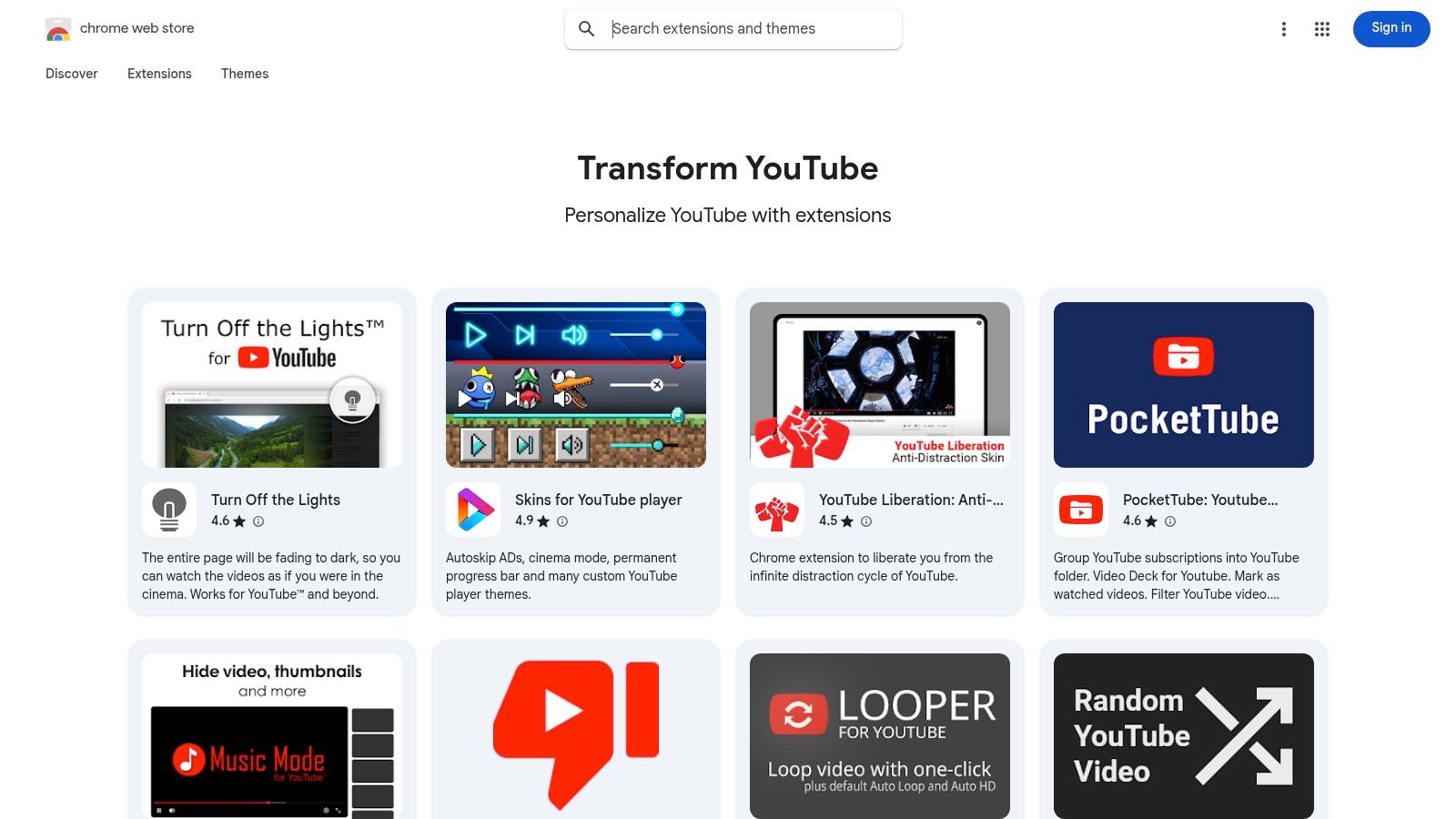
    Before diving into individual tools, the best place to start your search is Google’s own Chrome Web Store, specifically its curated “Transform YouTube” collection. This handpicked list serves as a vetted, centralized hub where creators can discover and compare many of the most popular and effective best chrome extensions for YouTubers, all in one place. It’s the safest and most direct starting point for enhancing your YouTube workflow.

    Chrome Web Store – “Transform YouTube” collection

    What makes this collection so valuable is the built-in trust and transparency. Every extension listed is verified by Google, and you can instantly see crucial details like user ratings, review summaries, the total number of users, and the last update date. This information allows you to quickly gauge an extension's reliability and popularity without leaving the page. The one-click install process and automatic updates simplify management, especially for creators using multiple Chrome profiles for different channels.

    Key Features & Use Cases

    • Curated Discovery: The collection aggregates a diverse range of tools, from SEO and analytics overlays to productivity enhancers and video captioning utilities. This saves you from sifting through thousands of unrelated extensions.
    • Security First: As the official marketplace, it provides unparalleled security. Permissions required by each extension are clearly listed, so you know exactly what data it can access before you install.
    • Side-by-Side Comparison: The standardized layout makes it easy to open multiple extension pages in different tabs and directly compare their features, user counts, and reviews.

    Practical Considerations

    While the collection is an excellent resource, remember that it isn't exhaustive and the listings can change over time. Additionally, detailed pricing information is often not available directly on the store page; you may need to visit the extension's official website to understand subscription costs.

    Website: https://chromewebstore.google.com/collection/youtube

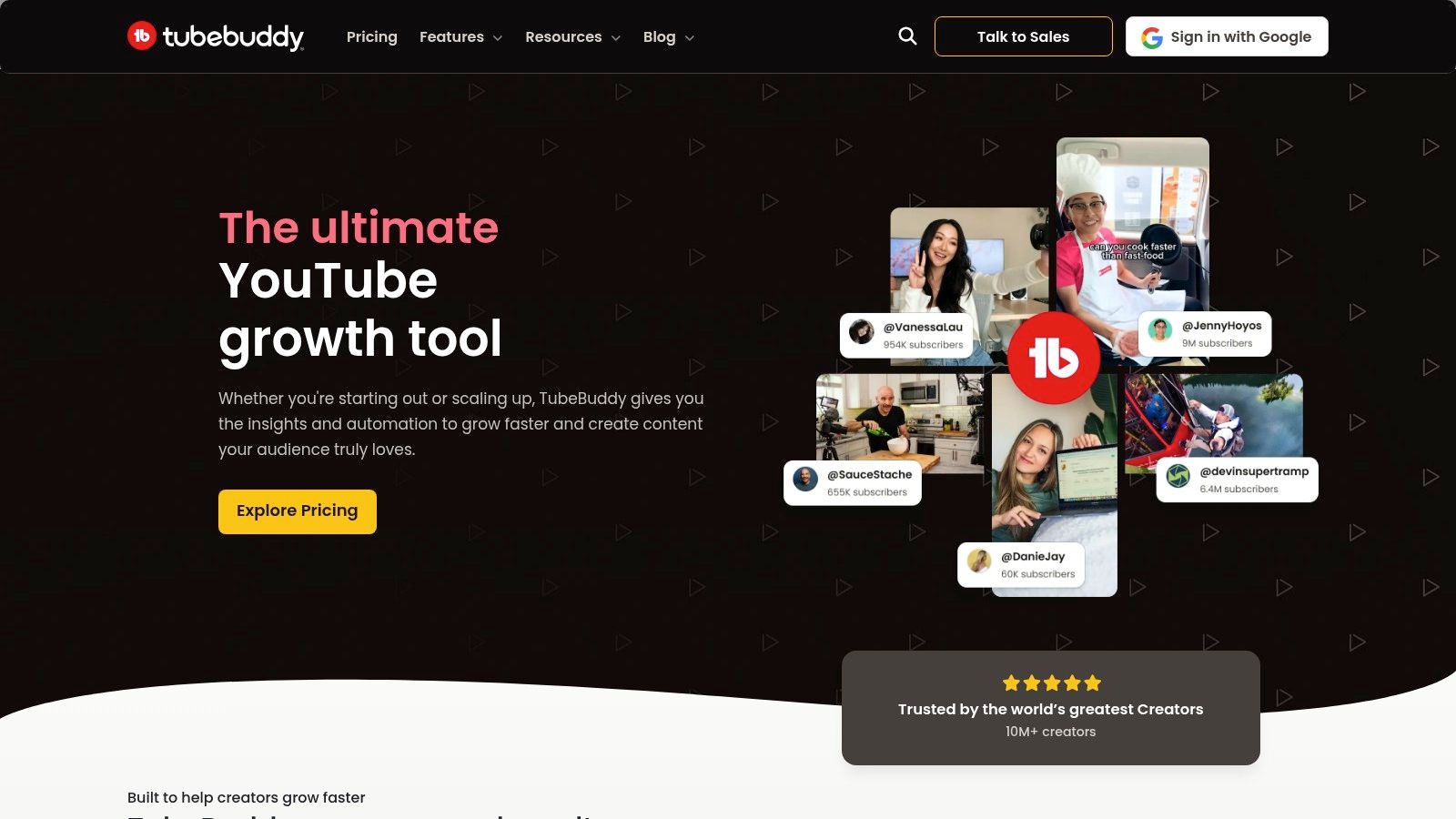
    3. TubeBuddy

    TubeBuddy is an all-in-one optimization and management toolkit that integrates directly into your YouTube Studio interface. As a browser extension, it acts as a co-pilot for your channel, embedding a powerful suite of tools next to your videos, analytics, and comments. It is one of the most widely adopted and best chrome extensions for YouTubers because it streamlines complex tasks like keyword research, competitor analysis, and bulk metadata updates without ever needing to leave YouTube.

    TubeBuddy

    What sets TubeBuddy apart is its focus on workflow efficiency and actionable data. The extension provides real-time SEO scores as you write titles and descriptions, suggests relevant tags based on search volume, and offers an interactive upload checklist to ensure you follow best practices every time. For creators of all sizes, this direct integration transforms the native YouTube dashboard into a more powerful, data-driven command center for channel growth. Its popularity stems from its clear upgrade path, starting with a robust free version and scaling to professional-grade tools.

    Key Features & Use Cases

    • Keyword Explorer: Research and discover high-value video topics by analyzing search volume, competition, and related queries directly within YouTube.
    • A/B Video Testing: Available on paid plans, this feature lets you test different thumbnails, titles, and descriptions to see which version performs best and drives more clicks.
    • Bulk Processing Tools: Save hours of manual work by applying changes to cards, end screens, and video descriptions across multiple videos simultaneously.
    • SEO Studio: Get guided optimization recommendations as you prepare your video for upload, ensuring you target your chosen keyword effectively for maximum visibility.

    Practical Considerations

    While the free version offers significant value, many of TubeBuddy's most powerful features, like A/B testing and advanced analytics, are locked behind paid subscriptions. The tool officially ended its support for Firefox, making it a Chrome-first platform, though it also works on Microsoft Edge and other Chromium-based browsers.

    Website: https://www.tubebuddy.com

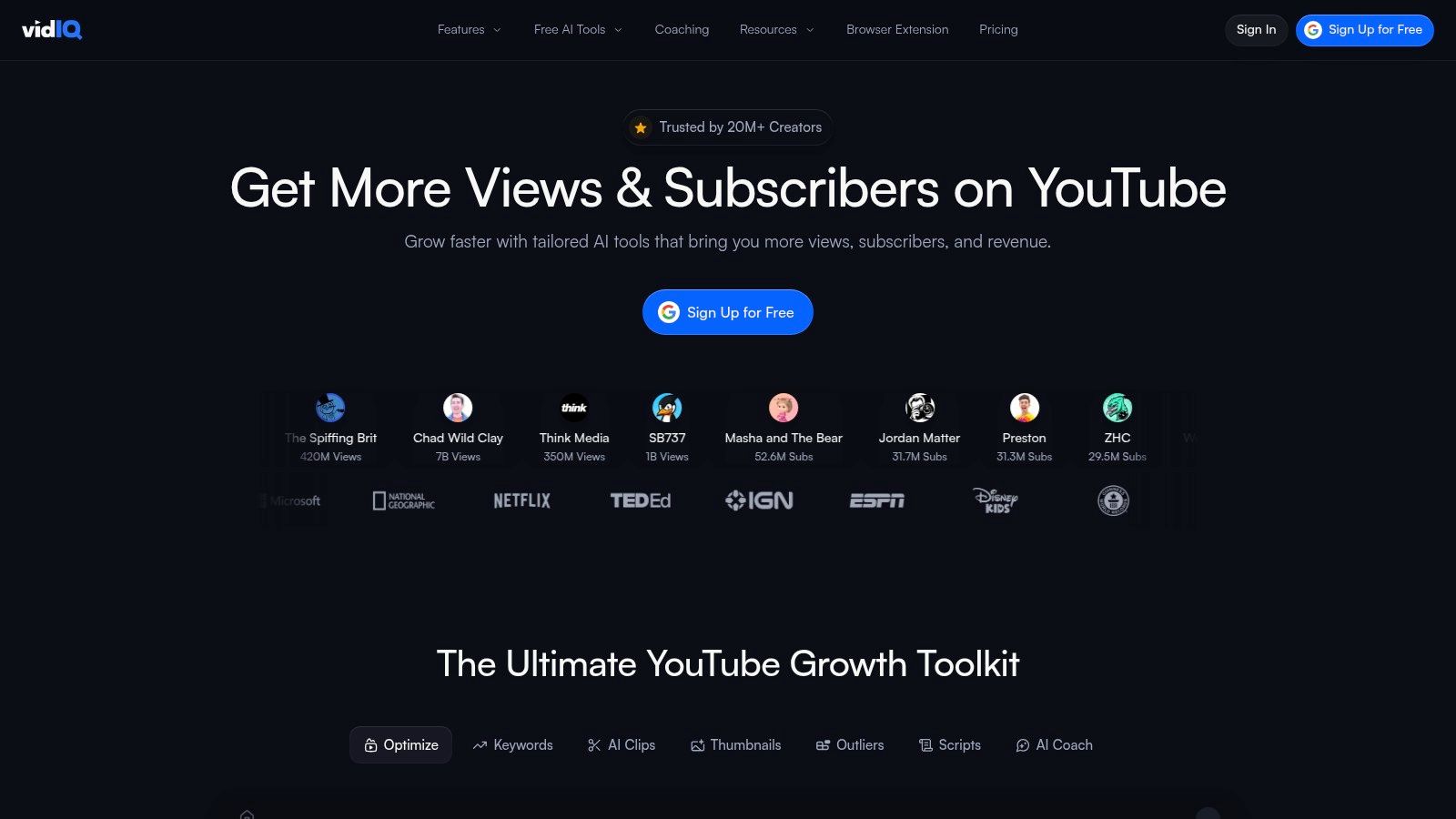
    4. vidIQ

    vidIQ is an AI-powered growth toolkit designed to provide YouTubers with actionable, data-driven insights directly within the YouTube interface. As one of the most popular best chrome extensions for YouTubers, it adds a comprehensive analytics sidebar to video pages, search results, and your own creator studio. This sidebar gives you an instant, at-a-glance performance overview, including an overall SEO score, keyword rankings, and competitor benchmarks.

    vidIQ

    What sets vidIQ apart is its blend of real-time data and AI-driven recommendations. The extension not only shows you how a video is performing but also suggests actionable steps to improve it. Features like the AI Coach and Daily Ideas provide personalized topic suggestions and title recommendations based on your channel's niche and audience behavior, making it a proactive partner in your content strategy. This integration of analytics with creative assistance helps bridge the gap between understanding data and implementing it effectively.

    Key Features & Use Cases

    • Real-Time SEO Scorecard: Instantly see a video’s optimization score (out of 100) and get a checklist of improvements, perfect for analyzing both your own content and that of competitors.
    • Competitor Analysis: Quickly view key metrics like views per hour, engagement rates, and top keywords for any video, allowing you to benchmark your performance and identify successful strategies in your niche.
    • AI-Powered Idea Generation: The AI Coach and Daily Ideas features suggest video topics and titles with high growth potential, helping you overcome creative blocks and align your content with trending interests. For a deeper understanding of this process, see this guide on how to choose the right YouTube video keywords.

    Practical Considerations

    While vidIQ offers a robust free tier that is excellent for beginners, many of its most powerful AI features, such as the AI Content Generator and advanced trend alerts, are locked behind paid subscriptions (Pro, Boost, and Max plans). The extension is actively maintained for Chrome and Edge, but users on other browsers might experience limited functionality.

    Website: https://vidiq.com

    5. Keywords Everywhere

    Keywords Everywhere is a freemium keyword research tool that integrates directly into your browser, overlaying valuable search data on YouTube and other major platforms. It excels at providing on-the-spot validation for video topics by showing search volume, cost-per-click (CPC), and competition metrics right within the YouTube search results. This allows creators to gauge audience interest and competition levels without leaving their research workflow.

    Keywords Everywhere

    Unlike comprehensive channel management suites, Keywords Everywhere focuses on one thing and does it well: delivering keyword data where you need it. Its unique credit-based system means you only pay for the data you use, making it a highly scalable option for solo creators or those on a tight budget. Beyond YouTube, it provides insights on Google, Amazon, and other sites, offering a holistic view of a topic's search landscape. Beyond Keywords Everywhere, explore a comprehensive list of the best SEO tools to further enhance your video discoverability on YouTube and beyond.

    Key Features & Use Cases

    • On-Page Metrics: Instantly view monthly search volume, CPC, and competition data directly under the YouTube search bar and on video pages.
    • Keyword Discovery Widgets: Use the "Related Keywords" and "People Also Search For" widgets to find long-tail keyword opportunities and related topic ideas for your content calendar.
    • Tag Extraction: Analyze the tags of top-ranking videos to inform your own tagging strategy and improve discoverability.
    • Credit-Based Pricing: Purchase credits for on-demand access to detailed metrics, ensuring you only pay for what you need, with credits that last for a year.

    Practical Considerations

    The free version of the extension is limited, primarily offering related keyword suggestions without the crucial volume and competition data. The pay-as-you-go credit system is cost-effective but requires mindful usage, as credits can be depleted quickly during extensive research sessions if you're not careful.

    Website: https://keywordseverywhere.com

    6. Social Blade (extension hub)

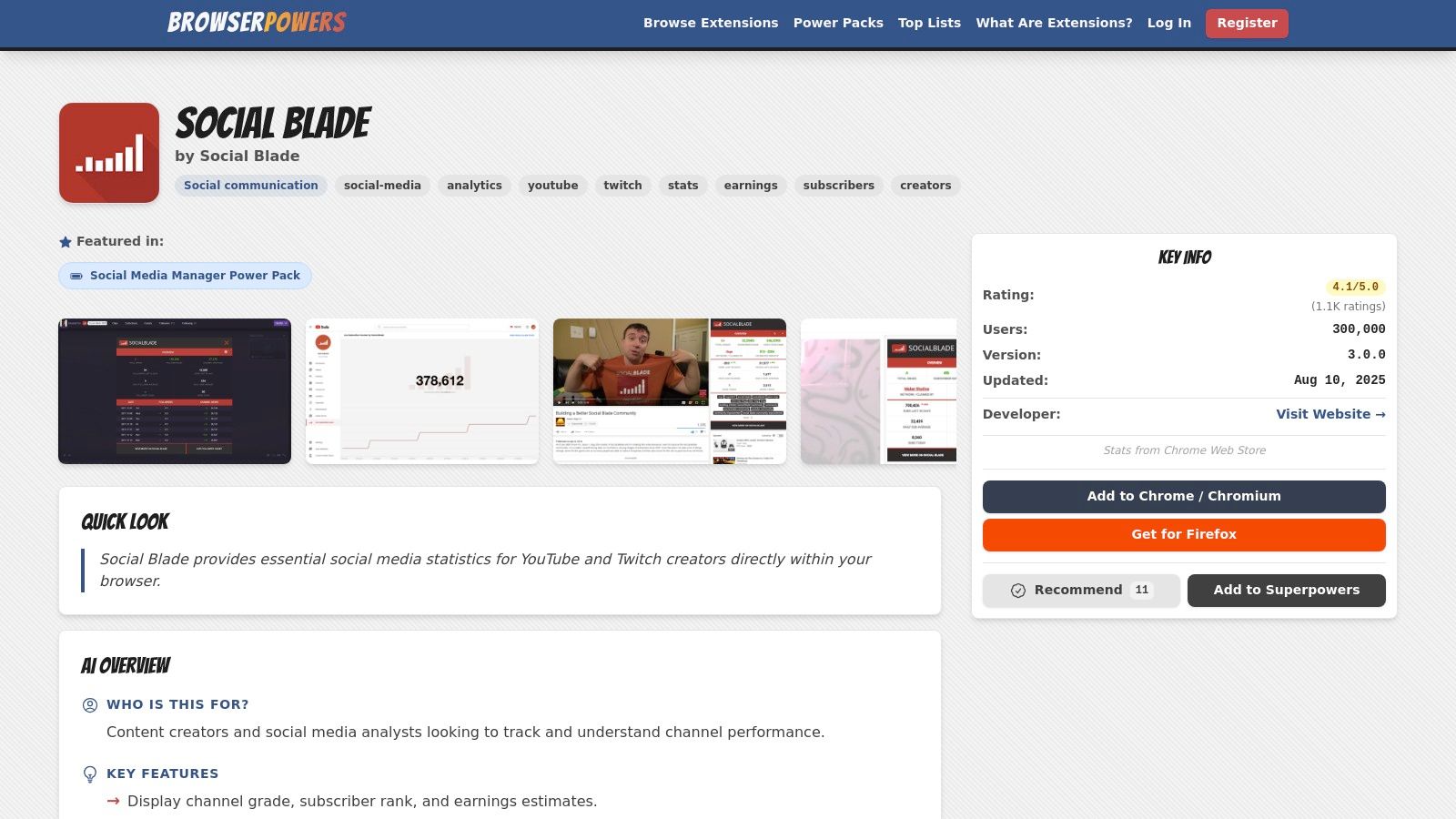
    Social Blade is a household name for YouTubers focused on analytics, and its browser extension brings that powerful data directly into the YouTube interface. It embeds a concise statistics box on video and channel pages, offering a quick-glance view of key performance indicators. This makes it an indispensable tool for competitor analysis, collaboration vetting, and tracking your own channel’s public-facing momentum without leaving YouTube.

    Social Blade (extension hub)

    The extension’s main strength lies in its simplicity and the familiarity of its metrics. You can instantly see a channel's "SB Rank," grade, estimated monthly earnings, and recent subscriber and view counts. This immediate context is perfect for creators who need to quickly assess a channel's size and trajectory, turning raw data into one of the best chrome extensions for YouTubers focused on competitive research. Integrating this data directly into your workflow provides essential insights for your own YouTube channel growth tips.

    Key Features & Use Cases

    • On-Page Channel Snapshot: View a channel’s Social Blade grade, subscriber rank, video view rank, and estimated earnings directly on their YouTube page.
    • 30-Day Performance Summary: Quickly check the subscriber and view gains over the last 30 days, providing a clear indicator of a channel's current momentum.
    • One-Click Deeper Analysis: The embedded panel includes a direct link to the full Social Blade profile, allowing you to seamlessly transition from a quick overview to an in-depth statistical breakdown.

    Practical Considerations

    The Social Blade extension has experienced some functionality disruptions as it transitions to Chrome's new Manifest V3 platform. Users might encounter limited features or temporary inconsistencies until the updated version is fully rolled out. While its core "at-a-glance" value remains strong, it's best used as a quick benchmarking tool rather than a comprehensive analytics suite.

    Website: https://browserpowers.com/extensions/social-blade

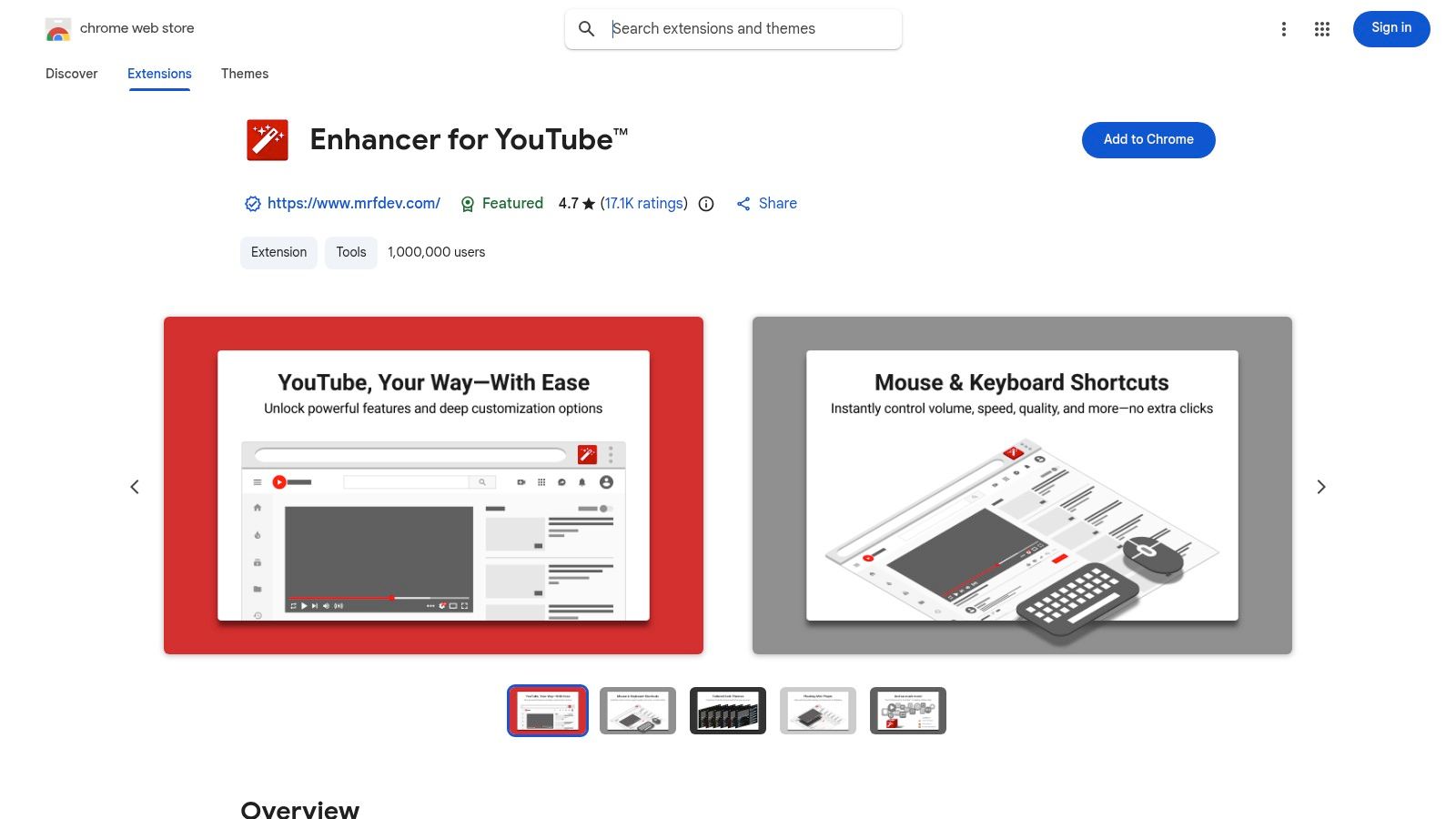
    7. Enhancer for YouTube (by Maxime RF)

    Enhancer for YouTube is a powerful productivity tool that gives creators and power-viewers granular control over the YouTube interface and playback experience. While not strictly an SEO or analytics tool, it’s invaluable for content research, competitor analysis, and streamlining the process of reviewing footage. Its ability to set defaults and create custom shortcuts makes it one of the best chrome extensions for YouTubers focused on workflow efficiency.

    Enhancer for YouTube (by Maxime RF)

    What sets this extension apart is its focus on micro-optimizations that add up to significant time savings. Imagine needing to review hours of competitor content; you can set a default playback speed of 1.5x for all videos, control volume with your mouse wheel, and instantly reverse playlists to watch older content first. These small tweaks remove repetitive clicks and keep you focused on the content itself, not the interface.

    Key Features & Use Cases

    • Playback Control: Set default playback quality, speed, and volume for every video you open. This is perfect for creators who consistently review B-roll or tutorials and need a standardized setup.
    • Custom Shortcuts: Create custom keyboard shortcuts for actions like taking a screenshot, looping a video segment, or navigating frames, which speeds up the video editing and review process.
    • UI Customization: Remove UI elements like annotations or end cards to create a cleaner viewing environment, minimizing distractions during content analysis or research.
    • Playlist Management: Instantly reverse playlist order or use other playback controls to more efficiently analyze a competitor’s content library from a different perspective.

    Practical Considerations

    The extension is highly configurable, which can be overwhelming for new users. It's best to start by changing one or two settings at a time. Because it heavily modifies the YouTube UI, its features can sometimes break or behave unexpectedly after a major YouTube platform update, though the developer is generally quick to release fixes.

    Website: https://chromewebstore.google.com/detail/enhancer-for-youtube/ponfpcnoihfmfllpaingbgckeeldkhle

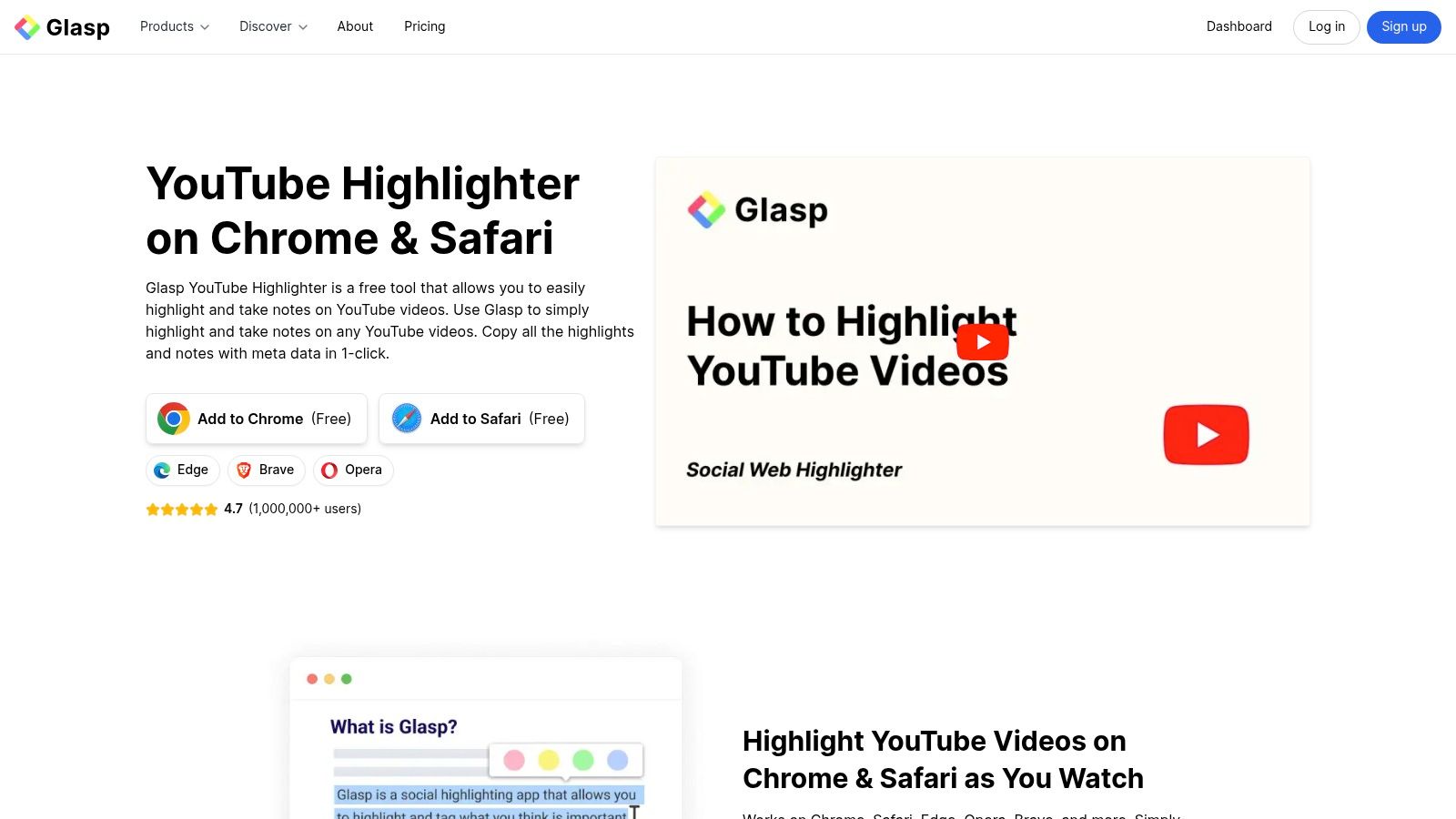
    8. Glasp – YouTube Summary & Highlighter

    Glasp is an indispensable research tool that transforms how creators consume and repurpose video content. It allows you to highlight text directly from YouTube transcripts and take timestamped notes, effectively turning passive video watching into an active research session. This is incredibly useful for drafting video outlines, collecting sources for commentary, or creating detailed show notes without leaving the YouTube player.

    Glasp – YouTube Summary & Highlighter

    What makes Glasp one of the best chrome extensions for YouTubers is its seamless integration of transcription, note-taking, and AI-powered summarization. A dedicated sidebar appears next to the video, showing the full transcript and an AI summary panel. Creators can quickly generate a concise overview of any video, saving hours of manual research and helping to rapidly build a knowledge base for their next project. All highlights and notes are synced to a personal online hub for easy access.

    Key Features & Use Cases

    • Timestamped Notes & Highlights: Select key phrases from a video’s transcript and add your own notes, which are automatically linked to the exact timestamp for quick reference.
    • One-Click AI Summaries: Generate summaries using AI models like ChatGPT, Claude, or Gemini directly on the YouTube page to quickly grasp the core message of a video.
    • Centralized Knowledge Hub: All your highlights and notes from across the web are saved to your Glasp profile, creating a personal, searchable library of insights.

    Practical Considerations

    The extension is free to start, which is a major benefit for creators on a budget. However, its more advanced AI summarization features may rely on your own API keys for external models. Additionally, like many extensions that modify the YouTube UI, occasional site updates can temporarily affect widget placement or functionality until the extension is updated. For those who want more control over their content's accessibility and repurposing, learning how to build a YouTube transcript AI offers advanced customization.

    Website: https://glasp.co/youtube-highlighter

    9. Language Reactor

    For YouTubers creating multilingual content, or those who need to verify the accuracy of their translated captions, Language Reactor is an indispensable tool. This powerful extension transforms the standard YouTube player into a robust language-learning and translation-verification environment. It overlays dual-language subtitles directly onto the video, allowing you to see your native language and a target language side-by-side in real time.

    What sets Language Reactor apart is its focus on granular control and comprehension. Creators can instantly click on any word in the subtitles to get a detailed dictionary definition and usage examples, making it perfect for checking nuanced translations. This functionality is a game-changer for ensuring your captions are not just literally translated but also culturally and contextually accurate, enhancing the experience for your international audience.

    Key Features & Use Cases

    • Dual-Language Subtitles: Display two sets of subtitles simultaneously to compare and contrast translations. This is essential for creators who outsource captioning and need an efficient way to proofread the final product.
    • Pop-up Dictionary: Hover over or click any word in the subtitles to get an instant translation and definition, helping you confirm that specific terminology is correct.
    • Precise Playback Controls: The extension adds shortcuts to repeat specific lines of dialogue, slow down playback, and navigate captions with precision, streamlining the quality assurance process.

    Practical Considerations

    Language Reactor is an incredibly powerful tool, but its reliance on YouTube's interface means it can sometimes experience temporary glitches after a major YouTube UI update. While the developers are generally quick to push fixes, be prepared for occasional inconsistencies. The free version is highly functional, but a Pro version is available to unlock additional features like saving words and phrases.

    Website: https://www.languagereactor.com

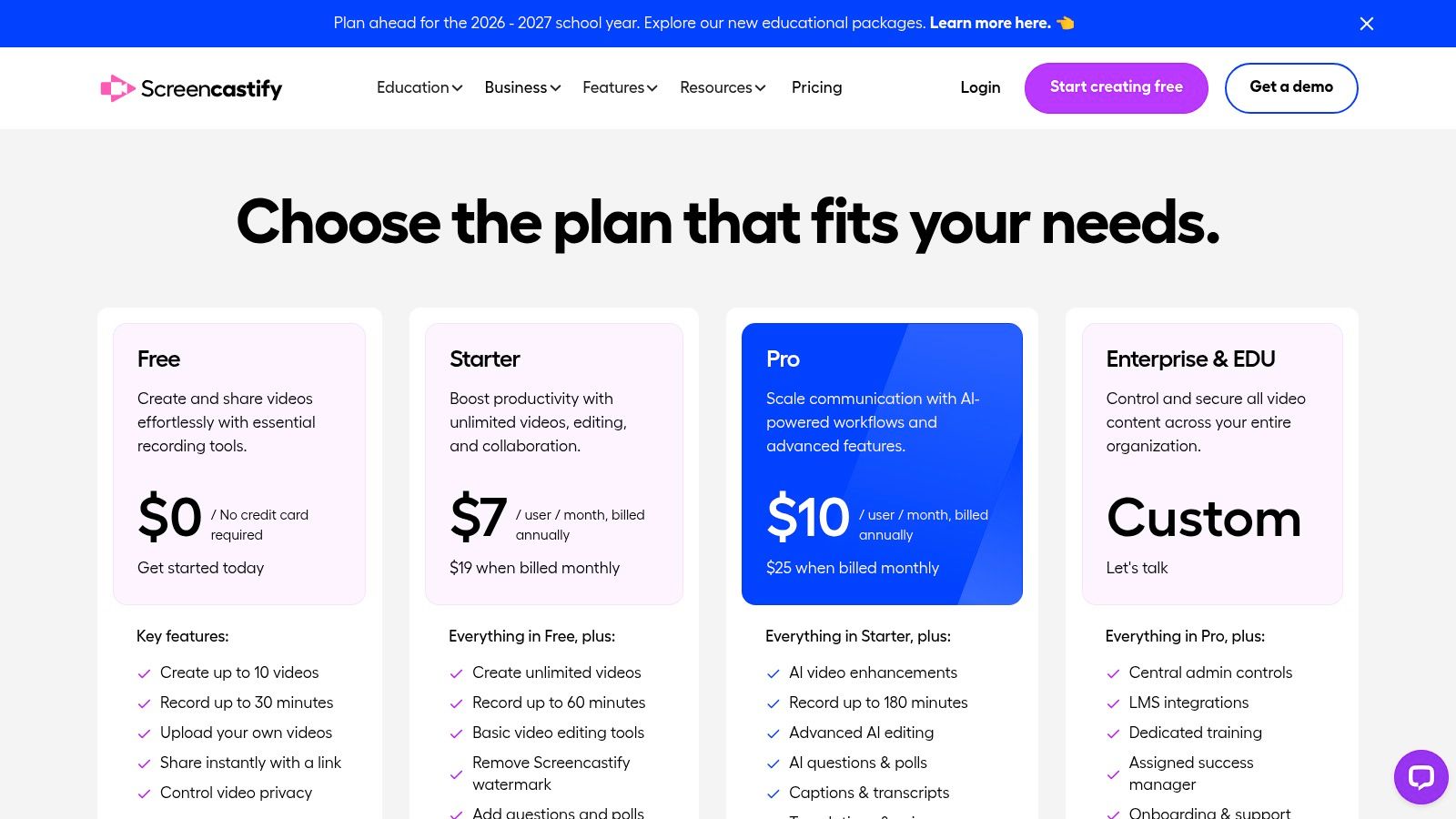
    10. Screencastify

    For creators focused on tutorials, software walkthroughs, or educational content, Screencastify is a highly efficient, browser-based screen recorder. It simplifies the process of capturing your screen and webcam, making it one of the best chrome extensions for YouTubers who need to produce how-to videos quickly without complex desktop software. Its long-standing reputation in the education sector means it’s built for simplicity and reliability.

    Screencastify

    What sets Screencastify apart is its streamlined workflow. You can record, perform basic edits like trimming, and export directly to YouTube or Google Drive from a single interface. This eliminates the need for downloading large files and re-uploading them. For creators producing scripted tutorials, knowing how to write a script for YouTube videos first can make the recording and editing process with a tool like Screencastify incredibly fast and efficient. The platform also offers a cloud library for easy storage and sharing.

    Key Features & Use Cases

    • Integrated Screen & Webcam Recording: Easily capture your entire screen, an application window, or a specific browser tab, with or without your webcam feed overlaid.
    • Simple In-Browser Editing: Trim the start and end of your videos, merge clips, and add text overlays without leaving your Chrome browser.
    • Direct Cloud Integration: Save recordings directly to your Google Drive and get a shareable link instantly, or upload straight to your YouTube channel.

    Practical Considerations

    Screencastify is built for speed and convenience, not for advanced video production. The free plan has significant limitations, including a cap on the number and length of videos you can create and a watermark on all exports. While its education-focused compliance (FERPA/COPPA) is a major plus for that niche, its analytics are minimal compared to dedicated video hosting platforms.

    Website: https://www.screencastify.com/pricing

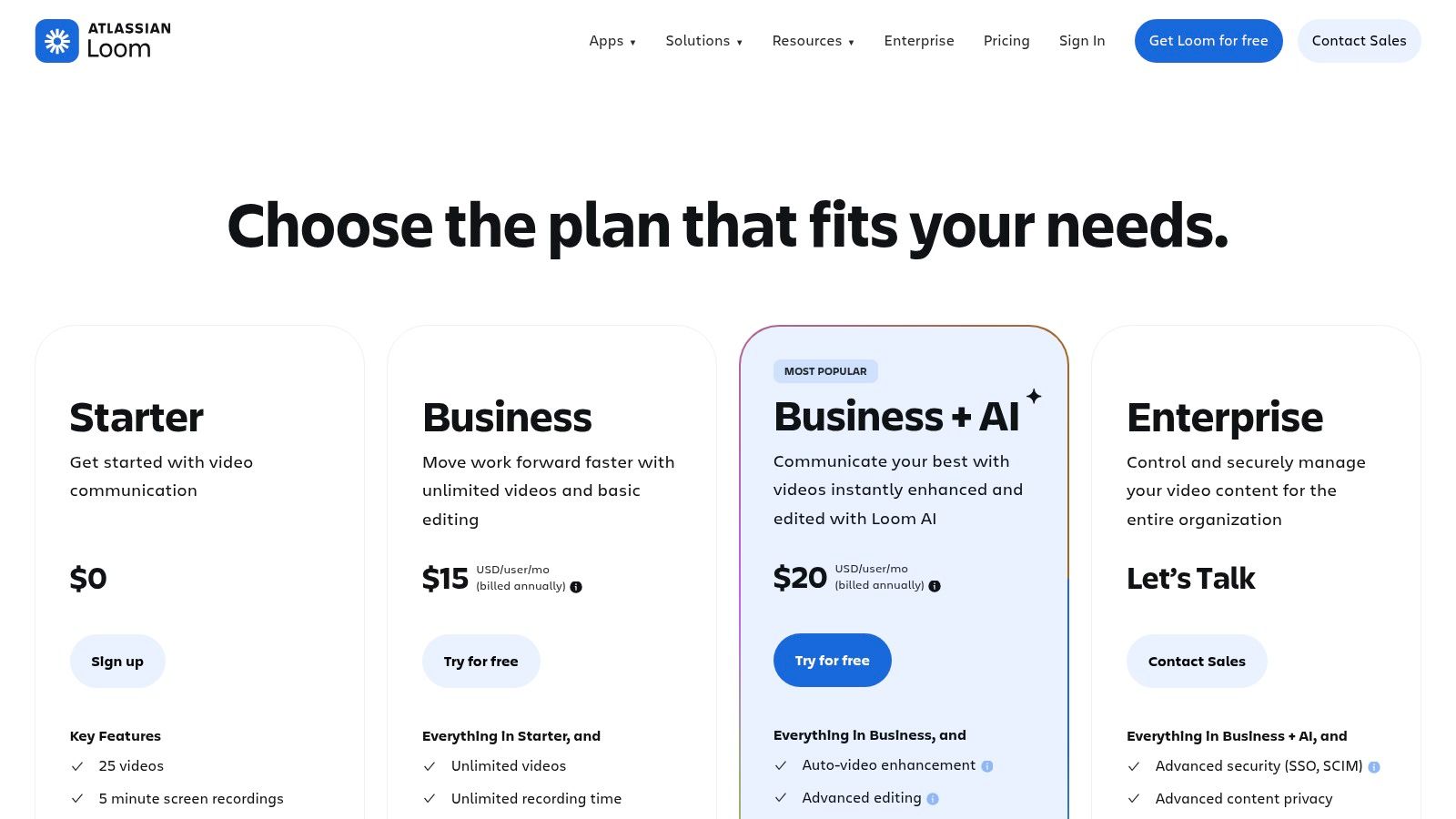
    11. Loom

    For YouTubers who collaborate with editors, brands, or team members, Loom offers an exceptionally fast way to record and share feedback, instructions, or video drafts. It functions as a powerful screen and camera recorder that lives right in your browser, enabling you to create instant video messages that eliminate the need for lengthy emails or meetings. This makes it an essential tool for streamlining the pre-production and post-production approval process.

    Loom

    Loom’s core strength is its speed. Once a recording is finished, a shareable link is instantly ready, complete with auto-generated transcripts and AI-powered summaries, titles, and chapters. This is invaluable for sending a quick clip to an editor with visual notes or getting a sponsor's approval on a specific segment before the final upload. The platform’s robust integrations with tools like Slack and Notion further embed it into a creator’s workflow.

    Key Features & Use Cases

    • Instant Screen & Camera Recording: Quickly record your screen, camera, or both to provide visual feedback on edits, demonstrate a workflow, or send a personalized update to your community.
    • AI-Enhanced Sharing: Automatic transcripts, titles, and chapter summaries make your shared videos easily searchable and digestible for collaborators, saving everyone time.
    • Collaborative Feedback: Viewers can leave time-stamped comments and emoji reactions directly on the video, creating a clear and contextual feedback loop.

    Practical Considerations

    The free plan is quite restrictive, limiting users to 25 videos per person and a maximum recording length of five minutes. To unlock 4K recording and unlimited videos, a paid plan is necessary. Additionally, be aware that there can be administrative differences depending on whether you purchase a plan directly from Loom or through its parent company, Atlassian.

    Website: https://www.loom.com/pricing

    12. Vidyard

    Vidyard is a powerful video platform whose Chrome extension bridges the gap between creating YouTube content and managing professional video communications. While not exclusively for YouTube, its screen and camera recording capabilities are excellent for creators who also handle sponsorship pitches, client updates, or sell premium content. The extension allows you to quickly record, trim, and share videos directly from your browser, making it a versatile tool for tasks beyond public publishing.

    Vidyard

    What sets Vidyard apart is its focus on analytics and engagement for privately shared videos. When you send a pitch to a potential sponsor, you can track exactly who watched it, for how long, and which parts they re-watched. This business-centric approach makes it one of the best chrome extensions for YouTubers who are serious about monetizing through brand deals and professional services, offering insights that YouTube’s native analytics don’t provide for off-platform communications.

    Key Features & Use Cases

    • Screen & Webcam Recording: Instantly record your screen, webcam, or both to create quick tutorials, personalized thank-you messages for patrons, or video pitches for sponsors.
    • Actionable Analytics: Receive notifications and detailed analytics when someone views your shared video, providing invaluable feedback for sales or outreach efforts.
    • Branded Sharing & CTAs: Host your videos on customizable sharing pages with your branding and add clickable calls-to-action (CTAs) to direct viewers to a specific link.

    Practical Considerations

    Vidyard is fundamentally a sales and marketing tool, so its feature set is geared more toward business workflows than public content creation. While the free plan is generous for basic recording, advanced features like in-depth team analytics, CRM integrations, and custom branding require a paid subscription.

    Website: https://www.vidyard.com/pricing

    Top 12 Chrome Extensions for YouTubers — Feature Comparison

    Item Core features ✨ UX / Quality ★ Value / Price 💰 Target audience 👥 Unique selling point 🏆
    Unlock the YouTube video title generator ✨ AI title brainstorming, one‑click insert, templates ★★★★ — Studio‑embedded 💰 Free extension / part of ViewsMax 👥 Creators seeking higher CTR 🏆 In‑Studio, data‑informed title optimization
    Chrome Web Store – “Transform YouTube” collection ✨ Curated YouTube extensions, reviews, one‑click install ★★★★★ — Trusted distribution 💰 Free marketplace (extensions may charge) 👥 Discoverers & cautious installers 🏆 Official curated hub for safe discovery
    TubeBuddy ✨ Keyword explorer, A/B tests, bulk edits, checklists ★★★★★ — Deep Studio integration 💰 Freemium → paid tiers (Pro/Legend/Enterprise) 👥 Growth‑focused creators & power users 🏆 Comprehensive upload & bulk workflow tools
    vidIQ ✨ SEO scores, trend alerts, AI Coach, competitor insights ★★★★★ — Data‑driven metrics 💰 Freemium → higher plans for AI features 👥 Data‑oriented creators & teams 🏆 Real‑time metrics + competitor/trend alerts
    Keywords Everywhere ✨ Volume/CPC overlays, related queries, tag extraction ★★★★ — Cross‑platform research 💰 Credit‑based pay‑as‑you‑go 👥 Solo creators needing on‑demand keywords 🏆 Scales cost with usage; platform‑agnostic overlays
    Social Blade (extension hub) ✨ Channel snapshot, ranks, est. earnings, 30‑day summaries ★★★ — Quick benchmarking at a glance 💰 Free extension (site paid features) 👥 Benchmarkers & partnership evaluators 🏆 Familiar public metrics beside videos
    Enhancer for YouTube ✨ Playback presets, shortcuts, UI tweaks, screenshots ★★★★ — Highly configurable 💰 Free (community‑driven) 👥 Power‑viewers & editors 🏆 Speedups for editorial review & review workflows
    Glasp – YouTube Summary & Highlighter ✨ Timestamped highlights, transcripts, AI summaries ★★★★ — Speeds research & outlines 💰 Free start; premium AI integrations 👥 Researchers & creators drafting outlines 🏆 Integrated note‑taking + AI summaries
    Language Reactor ✨ Dual subtitles, side translations, playback & dictionary ★★★★ — Great for multilingual checks 💰 Free / freemium features 👥 Multilingual creators & caption editors 🏆 Side‑by‑side subtitles for caption validation
    Screencastify ✨ Screen/webcam recorder, basic editor, cloud library ★★★★ — Simple, education‑compliant 💰 Free tier limits; paid removes watermark 👥 Educators & tutorial creators 🏆 Education compliance + easy sharing
    Loom ✨ Fast recorder, auto‑captions, AI titles/summaries, 4K ★★★★ — Quick sharing & integrations 💰 Free tier limits; paid for advanced use 👥 Creators needing fast drafts/reviews & teams 🏆 Rapid recording + AI summarization
    Vidyard ✨ Recording/trimming, branded pages, CTAs, analytics ★★★★ — Enterprise analytics & integrations 💰 Freemium → enterprise pricing 👥 Creators doing sponsorships & business video 🏆 Branded share pages + viewer analytics for business

    Building Your Ultimate Creator Toolkit

    Navigating the competitive landscape of YouTube requires more than just great content; it demands a strategic, data-informed approach. The Chrome extensions we've detailed in this guide are the building blocks for that strategy. They are not merely add-ons but powerful co-pilots designed to streamline your workflow, demystify the algorithm, and amplify your creative efforts. From the deep analytical power of TubeBuddy and vidIQ to the instant keyword insights from Keywords Everywhere, each tool serves a specific, vital function in the modern creator's arsenal.

    The true takeaway is not to install every extension on this list. Doing so would likely slow down your browser and create a cluttered, overwhelming workflow. Instead, the goal is to thoughtfully construct a personalized toolkit that addresses your unique challenges and goals as a YouTuber. This is the essence of finding the best chrome extensions for youtubers – it's about what is best for you.

    Your Action Plan: From Information to Implementation

    To move from reading this list to actively improving your channel, follow these deliberate steps. This structured approach will help you integrate these tools effectively without disrupting your creative process.

    1. Identify Your Biggest Bottleneck: Start by performing a self-audit. Where do you spend the most time with the least return? Is it agonizing over titles and thumbnails? Is it the tedious process of keyword research? Or perhaps it's analyzing post-performance data to understand what works. Pinpoint your single greatest pain point first.
    2. Choose Your "First-Round" Pick: Select just one or two extensions that directly solve that primary bottleneck.

      • Struggling with SEO and discovery? Your choice is between TubeBuddy and vidIQ.
      • Need to generate compelling titles fast? The ViewsMax YouTube Video Title Generator is your starting point.
      • Overwhelmed by content consumption for research? Glasp can revolutionize how you capture ideas.
    3. Integrate and Master: Commit to using your chosen extension(s) for at least two to three video uploads. Watch tutorials, explore every feature, and actively apply its tools to your pre-production, production, and post-production phases. True mastery comes from consistent application, not passive installation.

    Key Considerations for Building Your Toolkit

    As you add more extensions, keep these crucial factors in mind to maintain an efficient and secure workflow.

    • Performance Impact: Every extension consumes system resources. Periodically check your browser's task manager to see which extensions are resource-heavy. Be ruthless about disabling or removing tools you aren't actively using.
    • Permissions and Privacy: Always review the permissions an extension requests upon installation. Reputable tools like the ones listed here are generally safe, but it's a good practice to understand what data they can access.
    • Workflow Synergy: The ultimate goal is a toolkit where each extension complements the others. For example, you might use Keywords Everywhere for initial broad topic research, then dive deeper with TubeBuddy's Keyword Explorer, and finally perfect your title with a dedicated title generator. The tools should work together, not create redundant steps.

    Ultimately, these Chrome extensions are powerful force multipliers. They handle the complex data analysis, automate repetitive tasks, and provide the competitive intelligence needed to grow. This frees up your most valuable resource: the creative energy required to produce amazing content that resonates with your audience. Use this guide to build a smarter, more efficient workflow, and get back to what you do best-creating.


    Ready to supercharge your video titles and thumbnails, the two most critical elements for click-through rate? The tools mentioned here are a great start, but for an AI-powered solution built specifically for virality, check out the free tools from ViewsMax. Our suite, including the YouTube Video Title Generator, is designed to give you a data-driven creative edge in seconds. Explore ViewsMax and start crafting better titles today!

  • Do Hashtags Work on YouTube? An Actionable Guide

    Do Hashtags Work on YouTube? An Actionable Guide

    Let's settle the debate once and for all: do hashtags actually work on YouTube? The short answer is yes, they absolutely do. But how they work is where most creators get tripped up.

    It's best to think of hashtags not as magic wands for instant virality, but as helpful signposts for the YouTube algorithm. They provide that extra layer of context, helping YouTube figure out precisely what your video is about and, more importantly, who it should be shown to.

    The Real Deal on Using YouTube Hashtags for Growth

    Laptop on desk displaying videos, with a 'HASHTAGS HELP' speech bubble including a YouTube icon, notebook, and pen.

    A lot of creators feel let down by hashtags because they expect them to function like they do on Instagram or TikTok, where they are a primary engine for discovery. On YouTube, their role is far more subtle, but no less critical.

    Think of it this way: your title and thumbnail are the flashy billboard on the highway designed to grab a viewer's attention. Your hashtags, on the other hand, are the street signs that guide the right traffic—your ideal audience—straight to your video. They're a supporting player, not the star of the show.

    In essence, hashtags are just another form of metadata. They help YouTube’s algorithm group your video with other, similar content. This increases the odds it will show up on dedicated hashtag pages or as a suggested video after someone watches a related clip.

    For a complete strategy, it’s crucial to understand how hashtags fit into the wider world of YouTube SEO best practices. When used correctly, they complement your other efforts to boost rankings and channel growth.

    Setting the Right Expectations

    It's easy to get lost in the weeds with YouTube strategy, so let's clear up exactly what hashtags do and what they don't. The table below breaks down their true function versus some common myths.

    YouTube Hashtags Function vs Misconception

    True Function (How They Really Work) Common Misconception (What They Don't Do)
    Categorize Content: They act as clear labels, helping the algorithm instantly classify your video's topic and niche. Guarantee Virality: A hashtag alone will never make a low-performing video go viral. Quality content is still king.
    Aid in Discovery: Your video becomes clickable on hashtag-specific pages, creating another path for viewers to find you. Replace SEO: Hashtags are a piece of the SEO puzzle, not a substitute for strong keywords in your title and description.
    Group Your Videos: A unique branded hashtag (#YourChannelName) lets you create a private feed of all your related content. Drive Massive Traffic: Unlike on other platforms, they won't trigger a sudden flood of views. Their impact is more gradual and targeted.

    So, what's the takeaway? The real power of hashtags comes from adding clarity for YouTube's system after you’ve already nailed the essentials like a great title, description, and thumbnail. Their main jobs are to:

    • Improve Categorization: Help the algorithm quickly understand what your video is about.
    • Boost Discoverability: Get your video seen on specific hashtag pages.
    • Connect Your Content: Link your videos together with a unique branded hashtag.

    And this isn't just theory—the data backs it up. One study showed that adding a hashtag to a video can increase views by 26% and boost comment engagement by 14% compared to videos that don't use them.

    Ultimately, a smart hashtag won't save a bad video, but it can give a great video the extra algorithmic nudge it needs to find its audience. As the platform evolves, staying on top of important changes in YouTube is key, and you'll find that metadata like this remains a consistent factor for success.

    How YouTube's Algorithm Actually Reads Your Hashtags

    When you add a hashtag to your video, you’re doing more than just adding a trendy label. You're giving the YouTube algorithm a clear, direct signal about what your video is about. Think of each hashtag as a signpost that points the algorithm toward your content's core topic and context.

    The algorithm uses these signposts to categorize your video and connect it to a whole universe of similar content. By understanding your hashtags, it knows to put your video on that hashtag's dedicated results page. So, if you use #DIYBookNook, your video instantly gets a spot on the page where people are actively looking for DIY book nook ideas.

    This opens up brand new ways for viewers to find your channel. It also helps YouTube group your content with other creators in your niche, suggesting your videos alongside theirs.

    Where You Put Your Hashtags Matters

    Placement is everything. YouTube gives you three main spots to put your hashtags, and each one tells the algorithm—and your viewers—something a little different. Getting this right is a huge part of figuring out do hashtags work on YouTube for your specific channel.

    Here are your options:

    • Above the Title: This is prime real estate. The first three hashtags you put in your description automatically show up here, making them impossible to miss.
    • In the Title: You can also put a hashtag right in the video title itself. This makes the hashtag a core part of the video's identity and is great for tying it to a major trend.
    • In the Description: This is where you can add more hashtags (up to a point) to give the algorithm extra context without making your title look messy.

    Each of these has its own strategic advantage. Hashtags above the title offer amazing visibility, but you only get three slots, so you have to choose wisely. Putting a hashtag in the title is powerful, especially for trending topics, but it eats up character space you might need for other descriptive keywords.

    By using hashtags, you are essentially telling the algorithm: "My video is about this specific topic, so please show it to people who are interested in this topic." This direct communication is a simple yet effective way to influence your video's discoverability.

    Choosing the Right Placement Strategy

    So, what's the best approach? It really depends on what you're trying to achieve with that specific video.

    If you're jumping on a viral challenge, putting #ViralChallenge directly in the title makes a lot of sense. On the other hand, if you've made a detailed tutorial, you might put three hyper-specific hashtags like #SolderingTips, #ElectronicsRepair, and #BeginnerCircuits in the description so they appear prominently above the title.

    To see what's working for others in your niche, you can check out different YouTube tag extractor tools that show you what the top-ranking videos are using. This kind of insight shows you how successful creators are labeling their content for the algorithm. Once you get the hang of these mechanics, you can turn hashtags into an active part of your growth strategy.

    Crafting Your Optimal Hashtag Strategy

    Alright, now that we've covered the mechanics, let's talk about building a smart, repeatable process for your hashtags. A winning strategy isn't about throwing everything at the wall to see what sticks; it's about surgical precision. Your goal is to send the clearest possible signal to YouTube's algorithm about what your video is and who it's for.

    A classic mistake I see all the time is "hashtag stuffing." Creators get caught up in the idea that more tags magically equal more views. That's a myth, and it can actually torpedo your video's performance. When you cram dozens of semi-related tags into your description, you don't help the algorithm—you just confuse it. A confused algorithm has no idea who to show your video to, so it often ends up showing it to almost no one.

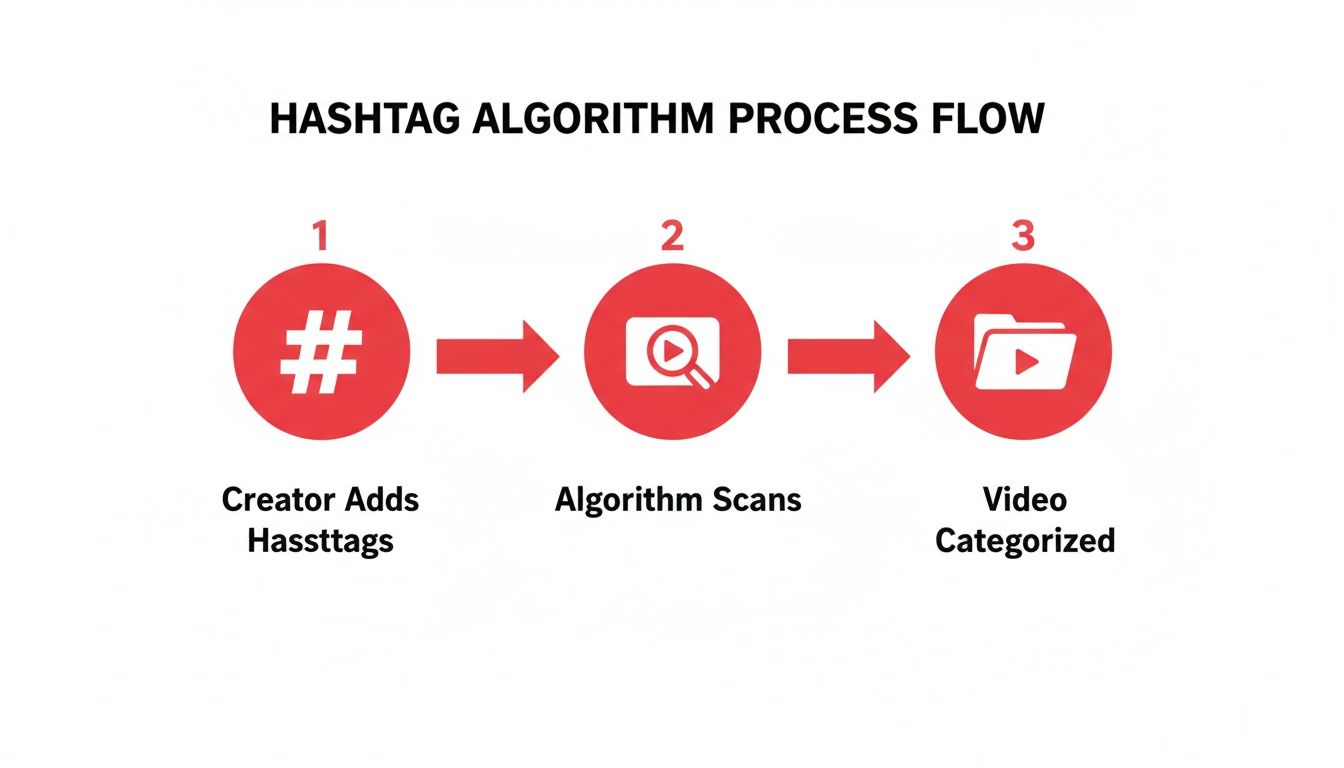
    Think of it this way: hashtags are one of the first and most direct inputs you give the algorithm to help it categorize your content. This flowchart breaks down that simple process.

    Flowchart depicting the three-step hashtag algorithm process for video content categorization.

    As you can see, what you choose directly informs how YouTube sorts and classifies your video right from the start.

    The Art of Hashtag Research

    Finding the right hashtags means getting inside the head of your ideal viewer. What words are they actually typing into the search bar to find a video like yours? Good research involves a balanced mix of broad, specific, and branded tags.

    • Broad Hashtags: These are your high-level, high-volume terms that cover the general topic, like #TechReviews or #DIYCrafts. They cast a wide net but also come with a ton of competition. It’s usually best to use just one to set the overall category.

    • Niche-Specific Hashtags: This is where the magic happens. Instead of a generic #TechReviews, you get hyper-focused with something like #iPhone15ProMaxCameraTest. Rather than #DIYCrafts, you use #ResinCoasterTutorial. The search volume is lower, but the audience you attract is far more qualified and ready to watch.

    • Branded Hashtags: This is a tag that's all yours, like #ViewsMaxTips. It's a fantastic way to group all your related content and build a community. Essentially, it turns into a clickable, unofficial playlist for your biggest fans.

    A solid strategy pulls from all three buckets. For instance, a video reviewing a new gaming mouse might use #GamingGear (broad), #RazerViperV2ProReview (niche-specific), and #YourChannelGaming (branded). That combination tells the algorithm everything it needs to know: the general topic, the specific subject, and how this video connects to the rest of your channel.

    Less Is More: The Rules of the Game

    When creators ask me if hashtags really work on YouTube, the answer often comes down to whether they're playing by the platform's rules. YouTube is not a fan of spammy behavior.

    The platform has a hard limit: use more than 60 hashtags, and YouTube will simply ignore all of them. But honestly, the real rule among creators who know what they're doing is to stay far, far below that number. The consensus from most experts is that 3-5 highly relevant hashtags give you the biggest bang for your buck. One study on YouTube hashtag usage backs this up with data.

    The takeaway is simple: a few laser-focused hashtags are way more powerful than a dozen generic ones. Aim for precision over quantity, every single time.

    This minimalist approach ensures you’re sending strong, clear signals that help the algorithm do its job. Of course, hashtags are just one piece of the puzzle. They work best when paired with strong video tags in the dedicated "tags" section. To round out your strategy, I highly recommend checking out our guide on finding the best tags for YouTube.

    Adapting Hashtags for Your Channel Size

    What works for a creator with millions of subscribers probably won’t work for you. It's a hard truth, but a successful hashtag strategy isn't a one-size-fits-all template; it has to be tailored to where you are right now.

    Ignoring your channel's size is like a tiny sailboat trying to cut through a busy shipping lane—you’ll just get lost in the wake of the giant container ships. The secret is to adapt your approach as you grow, making sure you're always using the right tools to get noticed without fighting battles you can't win.

    Strategy for Small or New Channels

    When you're just starting out, your main goal is getting found by a small but passionate audience. This means that chasing huge, popular hashtags like #Gaming or #Fitness is a recipe for disappointment. You’re competing against millions of other videos, and YouTube's algorithm will almost always favor the big, established players.

    Your mission, then, is to hunt for hyper-niche, low-competition hashtags. Think of them as a secret handshake with a dedicated community that’s already looking for exactly what you make.

    Your goal isn't to be a small fish in a massive ocean. It's to be a big fish in a small pond. That's how you build a loyal following from scratch.

    Here’s what that looks like in practice:

    • Instead of #RetroGaming: Try something specific like #SNESGameCollecting or #DreamcastHiddenGems.
    • Instead of #HomeWorkout: Niche down to #KettlebellWorkoutForBeginners or #NoEquipmentApartmentWorkout.
    • Instead of #VeganRecipes: Get targeted with #HighProteinVeganMealPrep or #OilFreeVeganDesserts.

    This approach puts your content directly in front of the people who will actually appreciate it, giving your videos a real chance to stand out.

    When to Compete for Broader Hashtags

    As your channel picks up steam and you build a solid subscriber base, your strategy can start to shift. Once the algorithm sees you as a credible source with consistent viewership, you can begin dipping your toes into more competitive waters.

    This is the time to mix in one or two broader hashtags alongside your more specific ones. You'll keep that strong connection with your core audience while reaching out to a much larger group of potential fans who might be interested in your topic.

    The Power of Hashtags for Emerging Creators

    This isn't just a theory—the data backs it up. The effectiveness of hashtags is often directly tied to channel size, and it's the smaller creators who see the biggest boost.

    For instance, one analysis showed that social profiles with under 5,000 followers saw 36.85% more reach per post when using hashtags. That's a huge lift! For larger accounts, the improvement was much smaller, which really underscores how vital a smart hashtag strategy is for building that initial momentum. If you want to dive deeper, you can discover more insights about hashtag performance on GRIN.co.

    How to Measure Your Hashtag Performance

    A desk setup with a tablet displaying charts and “Measure Impact,” laptop, notebook, and magnifying glass.

    So, you've got a hashtag strategy. Great. But it's pretty useless if you can't tell what’s actually working. Instead of just guessing, you can—and should—dive into your YouTube Analytics to find real data on your hashtag performance.

    This is where theory gets put to the test. The best place to start is the Traffic Sources report inside YouTube Studio. This is your command center for understanding exactly how viewers are finding your videos, offering solid clues about whether your hashtags are hitting the mark.

    Pinpointing Hashtag Impact in Your Analytics

    Now, YouTube doesn't give you a nice, clean report labeled "hashtag traffic." That would be too easy. Instead, we have to do a bit of detective work by looking for evidence in a few key areas that are heavily influenced by good hashtagging.

    Keep a close eye on these two traffic sources:

    • YouTube Search: Are you seeing more views coming from search, especially for the exact keywords you used as hashtags? That's a huge win. It’s a direct signal that your tags are successfully connecting with what people are actually looking for.

    • Suggested Videos: If your video starts popping up next to other videos that share the same hashtags, you’ll see a bump here. This tells you the algorithm is correctly categorizing your content and putting it in front of the right audience.

    The key is to connect your actions to these results. When a video suddenly takes off, dig into its traffic sources. Did views from search spike right after you added a trending hashtag? There's your answer. For a deeper dive into what these numbers mean, you can benchmark your performance with a YouTube engagement rate calculator.

    A Simple Framework for Testing

    If you want definitive proof, nothing beats a straightforward A/B test. It sounds technical, but it’s not. Just pick two similar videos from your back catalog that have comparable performance.

    1. Video A (Your Control): Don't touch a thing. Leave its original hashtags just as they are.
    2. Video B (Your Test): Go in and update it with a new, carefully chosen set of 3-5 hashtags.

    Now, watch what happens. Monitor both videos for the next 30 days. Pay attention to impressions, click-through rates, and, most importantly, traffic from YouTube Search and Suggested Videos.

    If Video B shows a clear lift in these key metrics, you’ve found a winning formula you can start using on other videos. This is how you stop guessing and start building a hashtag strategy based on what actually works for your channel.

    Common Questions About YouTube Hashtags

    Even with a solid plan, a few nagging questions can hold you back. Let's clear up some of the most common things creators ask about hashtags so you can move forward with total confidence.

    Where's the Best Place to Put Hashtags on YouTube?

    For the biggest discovery boost, your video description is prime real estate. The first three hashtags you put in the description get special treatment—YouTube displays them right above your video title, making them highly visible to potential viewers.

    You can also put them in the title itself. This works well for jumping on a huge trend, but just remember it eats up valuable space you could use for a compelling, clickable title. Any other hashtags you add further down in the description will still feed the algorithm useful information, they just won't be displayed as prominently.

    Should I Use the Same Hashtags on Every Video?

    Definitely not. Think of it this way: each video is unique, so its hashtags should be too. It’s a great idea to have one consistent branded hashtag (like #ViewsMaxTips, for example) to build your community, but the rest need to be specifically chosen for that video's topic.

    Copying and pasting the same generic list of tags on every single video is one of the worst things you can do. It tells the YouTube algorithm that you're not putting in the effort, and it confuses the system about what each video is actually about.

    This lazy tactic can backfire, preventing the algorithm from properly categorizing your content and showing it to the right people.

    How Many Hashtags Should I Use on a YouTube Video?

    This is a classic case of quality over quantity. The sweet spot, and the widely accepted best practice, is to stick to 3 to 5 hyper-relevant hashtags.

    Sure, YouTube lets you add more, but stuffing your description with dozens of tags just dilutes your message. A focused set of 3 to 5 sends a crystal-clear signal to the algorithm about your video's core topic. Going overboard can look spammy and actually confuse the algorithm, which is the exact opposite of what you want.

    Do Hashtags Work in YouTube Shorts?

    They absolutely do. In fact, you could argue they're even more important for YouTube Shorts than for traditional long-form videos. The Shorts feed is a fast-moving environment, and the algorithm leans heavily on hashtags to figure out what your content is and who to show it to.

    You always want to include the #shorts tag—that's non-negotiable. But the real magic happens when you add a few other specific, topical hashtags that help your Short find its perfect audience. A good hashtag strategy is essential if you want your Shorts to take off.


    Ready to stop guessing and start growing? ViewsMax offers AI-powered tools to help you find the perfect hashtags, optimize your video descriptions, and analyze your performance with real data. Take the guesswork out of your YouTube strategy by visiting us at https://blog.viewsmax.com.

  • How Long Should a YouTube Video Be for Maximum Impact

    How Long Should a YouTube Video Be for Maximum Impact

    Let's get one thing straight right away: when someone asks, "How long should my YouTube video be?" the only real answer is this: as long as it needs to be to deliver its value, and not a single second longer.

    There's no magic number. A viral 30-second Short and a gripping 30-minute documentary can both be wildly successful. This proves that the content itself—not a stopwatch—is what truly determines the perfect length.

    Why There Is No Magic Number for Video Length

    Laptop displaying YouTube logo, a 'NO MAGIC NUMBER' sign, notebook, pen, and glasses on a wooden desk.

    One of the biggest mistakes new creators make is chasing a specific minute count they heard was "optimal." The perfect video length is a moving target. It shifts based on your goals, your video's format, and, most importantly, what your audience has come to expect from you. A snappy product review and an in-depth tutorial serve different purposes, so of course, they should have different runtimes.

    Think of yourself as a storyteller. Some stories are best told as a quick, witty anecdote. Others need the breathing room of a full-length novel to really land. If you chop a novel down to a single paragraph, you lose all its depth. But if you stretch a simple anecdote into a 20-page chapter, it becomes a boring slog. Your job is to be the editor who knows exactly what the story needs.

    The Real Metrics That Matter

    Instead of obsessing over the clock, you need to focus on what the YouTube algorithm actually cares about. It's all about two key metrics that are directly tied to your video's length and quality:

    • Watch Time: This is the grand total of all the minutes people have spent watching your videos. For YouTube, this is a massive signal that you're creating quality content that keeps people on the platform.
    • Audience Retention: This is the percentage of your video that, on average, people stick around to watch. A high retention rate tells the algorithm your video is genuinely engaging from start to finish.

    The core idea is simple: A video's ideal length is the duration that maximizes both watch time and audience retention. It has to be long enough to feel substantial but tight enough to keep people from clicking away.

    Setting the Stage for Your Channel

    Getting a feel for this trade-off is the first real step toward finding your channel's sweet spot. A longer video has the potential to rack up a ton of watch time, but it also comes with a much bigger risk of viewers getting bored and leaving early, which tanks your retention.

    On the flip side, a super short video might get fantastic retention rates, but it won't contribute much to your channel's overall watch time. It's a balancing act.

    In the next sections, we'll dive into how to manage these competing metrics. We'll look at some data-backed starting points for different kinds of videos and, crucially, show you how to use your own channel's analytics to let your audience's behavior guide your strategy.

    Why Watch Time Is Your Most Important Metric

    A person holds a tablet displaying a red clock icon with the text "WATCH TIME MATTERS".

    Before we can even talk about the perfect video length, we need to get inside YouTube's head. Think of YouTube as a gigantic, global television network. Its main goal? Keep people watching for as long as humanly possible. The more they watch, the more ads YouTube can show, and the more money it makes. Simple as that.

    Your channel is a business partner in this mission, and your primary contribution is a metric called watch time. This isn't about how many people click play; it's the total, cumulative number of minutes people spend watching your videos. When your content keeps people on the platform, the algorithm sees your channel as a valuable partner and rewards you for it.

    Retention vs. Watch Time: The Critical Difference

    So many creators get hung up on Audience Retention, which is the percentage of a video that people watch. A high percentage seems great, but it's only one piece of a much larger puzzle. The total minutes watched almost always carries more weight.

    Let's look at a quick example.

    • Video A: A 3-minute video with a fantastic 90% retention.
    • Video B: A 10-minute video with a decent 50% retention.

    Instinct might tell you Video A is the winner, but let's do the math. The average viewer of Video A sticks around for 2.7 minutes. But the average viewer of Video B watches for a full 5 minutes. Video B generates nearly double the watch time from every single view. That’s a powerful signal to the YouTube algorithm.

    High watch time is the ultimate vote of confidence. You're not just telling YouTube that your content is interesting enough to click on—you're proving it's engaging enough to hold someone's attention.

    This is exactly why longer videos often have a higher ceiling for growth. They simply have more potential to rack up the massive watch time totals that get YouTube's attention and fuel your discoverability.

    Monetization and The 8-Minute Mark

    Watch time isn't just about pleasing the algorithm; it directly impacts your wallet. Once you're in the YouTube Partner Program, videos that are over eight minutes long can have mid-roll ads placed throughout the content, not just at the start.

    This gives you far more opportunities to earn revenue from a single video. Of course, this only works if your video is compelling enough to keep viewers watching through those ad breaks. This is where good pacing and structure become essential. For these longer videos, knowing how to properly add chapters to a YouTube video can make a world of difference for the viewer experience.

    Ultimately, by focusing on content that keeps people watching longer, you create a win-win scenario. You provide more value to your audience, generate more watch time for YouTube's algorithm, and open up more revenue for your channel. While length is a key part of this, it's just one element of a larger strategy for how to grow YouTube subscribers.

    Matching Your Video Length to Your Content Format

    A desk with a plant, camera, smartphone showing photos, tablet, and text 'MATCH YOUR FORMAT'.

    Before you can even begin to answer, "how long should my YouTube video be?", you need to ask a much more important question: what kind of video am I actually making? It’s a simple question, but the answer changes everything.

    Someone clicking on a quick tech tutorial has a totally different mindset—and a different amount of time to spare—than a viewer settling in for a long-form documentary. The secret isn't finding a single magic number; it's about aligning your video's length with its format to meet your audience's expectations head-on.

    Think of it this way: a steak needs a few minutes of intense heat, while a good stew needs to simmer for hours. If you get those two mixed up, you’re left with a mess. Your content works the same way. The format is your recipe, and it dictates the ideal cooking time.

    Quick and Engaging Formats

    For content meant to be consumed on the fly, brevity is your best friend. These formats are all about delivering a quick hit of value, a laugh, or a key piece of information before the viewer scrolls on.

    • YouTube Shorts (Under 60 seconds): This one is a hard rule set by YouTube itself. Shorts are designed for pure, unadulterated speed. You've got less than a minute to land a single idea, a punchline, or a "wow" moment. There's no room for a fancy intro—you have to hook them in the first three seconds and get straight to it.

    • Product Reviews (5-10 minutes): When someone is thinking about buying something, they want a clear, no-fluff summary of the pros and cons. A solid 5-10 minute video gives you just enough time to cover the essential features, show the product in action, and give your final verdict without dragging it out.

    Deep Dive and Storytelling Formats

    When your goal is to teach a complex skill, tell a compelling story, or offer a deep analysis, you've got a lot more runway. Viewers clicking on these videos are prepared to invest more of their time, but only if you keep them engaged and deliver on your promise.

    Your video should be as long as it takes to tell the full story and not a second more. If a section doesn't serve the core message, it’s a candidate for the cutting room floor, regardless of your target runtime.

    This is where looking at platform-wide data can be a huge help. It might surprise you to learn that the average YouTube video length hovers around 11.7 minutes. That number isn't an accident. It reflects that delicate balance creators strike between providing detailed content and holding onto their audience's attention. Videos in that 5-15 minute sweet spot often nail this balance, and the algorithm tends to reward them for it.

    Educational and In-Depth Content

    These types of videos succeed only when they provide a complete, satisfying answer to a viewer's problem. If you rush it, you'll leave them feeling like they didn't get what they came for.

    • Tutorials and How-To Guides (10-18 minutes): If you’re teaching something complicated, you need the time to do it right. This length allows you to break down each step, show clear examples, and troubleshoot common issues without making the viewer feel overwhelmed. A tight script is absolutely critical here to keep things moving. A great place to start is our guide on how to write a script for your YouTube videos.

    • Vlogs and Personal Stories (8-15 minutes): With vlogs, the real goal is to build a personal connection. This duration gives you enough time to craft a genuine narrative arc—a clear beginning, middle, and end—that makes your audience feel like they've just shared a meaningful experience with you.

    At the end of the day, these are just guidelines, not strict rules. The perfect length is always going to be unique to your channel, your topic, and your audience. But by starting with a length that matches your format, you’re giving yourself a massive head start.

    Using Your Analytics to Find What Works

    Forget industry averages for a second. The most powerful data for figuring out how long your YouTube videos should be is already sitting in your dashboard, waiting for you. Your own audience is giving you the answer with every single view. It's time to put on your detective hat and dive into YouTube Studio.

    Your primary tool in this investigation is the Audience Retention graph. Think of this as your secret weapon. It shows you, second-by-second, the exact moment a viewer’s attention starts to wander. It's like having a live focus group for every video you post, showing you what’s working and, more importantly, what’s causing people to click away.

    By digging into this data, you can stop guessing and start making decisions based on how your viewers actually behave.

    Decoding Your Audience Retention Graph

    Picture your Audience Retention graph as the story of your video's engagement. The line always starts at 100%—that’s everyone who clicked play. As the video goes on, the line will naturally dip as people leave. Your job is to keep that line as high as possible for as long as possible.

    Here’s what a typical retention graph looks like inside the YouTube Studio dashboard.

    This visual tells a crystal-clear story, showing where the video held attention and where it fell flat. It's full of clues for your next video.

    So, what are you actually looking for? The trick is to spot patterns not just in a single video, but across your entire channel.

    • Sudden Dips: A sharp, steep drop is a huge red flag. Jump to that exact timestamp in your video. What happened there? A long, boring intro? A confusing point? A sponsor read that felt jarring? These dips are your audience shouting, "This part wasn't for me."
    • Gradual Slopes: A slow, steady decline is completely normal, but you still need to pay attention to where the drop-off accelerates. If your 12-minute videos consistently lose a huge chunk of viewers around the 7-minute mark, that’s a powerful signal. It could mean your audience has a shorter attention span, or maybe your videos just need a "re-hook" around that point to pull them back in.
    • Flat Plateaus and Spikes: Ever see moments where the line stays flat or even bumps up? These are your golden nuggets. It means viewers are actually re-watching that specific part. Go figure out what you did right. Was it a brilliant joke, an incredibly clear explanation, or a stunning visual? Whatever it was, bottle that magic and do more of it.

    Comparing Videos to Find Your Sweet Spot

    The real breakthrough happens when you start comparing the retention graphs of different videos. Open up two tabs: one for your best-performing long video and one for your best-performing short video.

    Your analytics don't just show you what happened; they tell you why. By comparing the retention curves of successful and unsuccessful videos, you can build a blueprint for what your specific audience wants to see.

    Don't get fixated on just the final retention percentage. The shape of the curve tells the real story. Does your 15-minute video suffer a massive drop in the first two minutes, while your 7-minute video holds strong almost to the end? That’s a strong hint that your shorter, punchier content is doing a much better job of grabbing and holding your audience's attention.

    On the other hand, if a longer video maintains a high, flat retention plateau for over 10 minutes, your audience is clearly hungry for that kind of in-depth content. Let this data be your guide. If your viewers are telling you they love your 12-minute deep dives by sticking around, lean into it. If they consistently bail after 5 minutes, it’s time to be more ruthless in your editing and get to the point faster. Your data holds the answer to "how long should my YouTube videos be?" for your channel.

    How to Systematically Test Your Video Lengths

    Looking at your past performance is a fantastic starting point. But to truly nail down how long your YouTube videos should be, you have to move from just looking at data to actively testing your assumptions. The best way I’ve found to do this is with simple A/B tests—it’s a methodical way to see what your audience actually wants, not just what you think they want.

    The idea is pretty simple. You create two videos on a very similar topic, but you intentionally make them different lengths. This helps you isolate the video’s duration as the main thing you’re testing.

    Setting Up Your A/B Test

    First, you'll need to pick a topic that you already know your audience enjoys. It also needs to be a topic that you can present in both a quick, to-the-point version and a more detailed one.

    Let’s say you run a cooking channel. You could create two different videos about making the perfect pizza dough.

    • Video A (The Short Version): This one would be a snappy, 7-minute video. It gets straight to the recipe and the core techniques, with no fluff or extra chatter.
    • Video B (The Long Version): This is your 12-minute deep dive. It covers the same recipe but also gets into the science of fermentation, compares different flour types, and walks through common mistakes to avoid.

    It’s this process—analyze, identify, and tailor—that gets you closer to your ideal video length.

    A three-step infographic outlining how to find your ideal video length by analyzing data, identifying content types, and tailoring content.

    The image here really breaks it down: you look at your data, spot the patterns, and then adjust your video length to give your audience exactly what they’re sticking around for. To produce different versions quickly for testing, you might find that some text-to-video tools can help speed up the workflow.

    Measuring Your Test Results

    After both videos are published, you need to give them some time—at least a few weeks—to collect enough meaningful data. Once that’s done, jump into your YouTube Studio analytics and put them side-by-side, focusing on a few key metrics.

    Don't just look at the view count. A shorter video might get more initial clicks, but the deeper metrics will tell you which one actually provided more value to your viewers and the algorithm.

    Here’s exactly what you need to be looking at:

    1. Average View Duration (AVD): This is your number one metric. Did the 12-minute video hold people for an average of 6 minutes, while the 7-minute one only kept them for 3? If so, the longer video generated way more total watch time per viewer.
    2. Audience Retention at Key Moments: Pull up the retention graphs for both videos. Does the longer one have a massive drop-off halfway through, or does it hold steady? The shape of that curve tells you if your extra details were genuinely engaging or just felt like filler.
    3. Click-Through Rate (CTR): This is a good secondary metric. Are viewers more drawn to a title that promises a quick answer, or one that signals a comprehensive guide? This gives you a clue about what they were looking for when they clicked.

    By comparing these numbers, you're essentially letting your audience vote with their attention. Do this a few times, and you’ll start to build a clear, data-backed understanding of what works for your channel. Making these little experiments a regular part of your strategy is a game-changer. And if you need a hand staying organized with it all, you might want to use something like a YouTube content calendar template.

    It’s About Value, Not a Stopwatch

    So, after all that talk about analytics, testing, and different video formats, what's the real answer? How long should your YouTube video actually be?

    The truth is, the perfect length isn't a number you can just look up. It’s however long it takes you to deliver a complete, compelling experience to your audience. Nothing more, nothing less.

    Your number one job is to respect the viewer’s time. Think about it this way: if you can explain a concept brilliantly in four minutes, don't drag it out to eight just to squeeze in another ad. You'll kill your audience retention and, worse, you'll break their trust. On the flip side, cramming a complex tutorial that needs fifteen minutes into a rushed five-minute video just leaves everyone confused and frustrated.

    Stop chasing a magic number. Start listening to what your content and your audience are telling you. The perfect length is the one that makes your viewer feel like their time was well spent—leaving them satisfied, informed, and genuinely excited for what you post next.

    The Real Goal

    Ultimately, you want to make your video as long as it needs to be and not a single second longer.

    When you focus on creating a tight, value-packed video, the watch time and retention metrics naturally fall into place. The data-driven strategies we've talked about aren't for hitting some arbitrary time target; they're for figuring out how much detail your audience truly wants.

    Think of your analytics as your compass. It will always point you toward creating videos that are perfectly paced for the people who matter most—your viewers. When they feel you've valued their time, they’ll reward you with the kind of engagement that truly grows a channel.

    Frequently Asked Questions

    Even with a solid game plan, you're bound to have some lingering questions about video length. Let's tackle a few of the most common ones I hear from creators.

    Does Making Videos Over 8 Minutes Automatically Make More Money?

    In short, no. It’s a common misconception. While hitting the 8-minute mark unlocks the potential for mid-roll ads, you only get paid if people actually watch them.

    If your audience clicks away before the first mid-roll even has a chance to play, that magic 8-minute mark means nothing for your bottom line. Your real focus should be on making a video that's so engaging people want to stick around. When you nail that, the watch time and ad revenue will naturally follow.

    Think engagement first, ad placements second. A truly captivating video will always outperform one that's just stretched to hit a certain timestamp.

    Should I Break a Really Long Video Idea Into a Series?

    Absolutely. This is one of the smartest moves you can make for a deep-dive topic. If you feel a video is creeping past the 25-30 minute mark and you’re worried about losing people, splitting it up is the way to go. A tight series of 10-15 minute episodes often works wonders.

    Here’s why that approach is so powerful:

    • It gets people hooked: A great Part 1 almost guarantees a click on Part 2. Hello, binge-watching!
    • It juices your channel's watch time: All those minutes add up across the entire series, sending positive signals to the algorithm.
    • It gives you more chances to be found: Every video you upload is another lottery ticket in the YouTube discovery game.

    Can I Re-upload a Shorter Cut of a Video That Flopped?

    You can, but don't just trim it and hit "upload" again. YouTube's system can flag that as duplicate content, which you definitely want to avoid.

    Instead, treat it as a brand-new creation. Go back to the drawing board and re-edit the core ideas into a snappier, more engaging video. Figure out what went wrong the first time—was the hook too slow? Did a section in the middle drag on forever? Fix that core problem. Then, give it a completely fresh title, thumbnail, and description and send it out into the world.


    Ready to stop guessing and start growing? ViewsMax provides AI-powered tools to help you find the perfect video length, optimize your titles, and analyze your performance. Get the insights you need to grow faster on ViewsMax.

  • 10 Actionable YouTube Search Engine Optimization Tips for 2026

    10 Actionable YouTube Search Engine Optimization Tips for 2026

    YouTube is more than a video-sharing site; it's the world's second-largest search engine. Every minute, millions of users search for answers, entertainment, and tutorials. For creators, this presents a massive opportunity for organic growth that isn't dependent on viral luck or paid promotion. Mastering the platform's algorithm through smart optimization is the most reliable path to building a sustainable audience and achieving long-term channel success. This is where a deep understanding of youtube search engine optimization tips becomes your most powerful tool.

    This comprehensive guide moves beyond generic advice to provide a prioritized roundup of actionable strategies you can implement immediately. We will break down the exact methods for turning your channel into a discoverable, high-performing asset. You will learn how to strategically balance keywords and click-through rates in your titles, write compelling descriptions that convert, and design thumbnails that demand attention.

    We’ll also cover advanced tactics for boosting critical ranking signals, such as maximizing average view duration through smart content pacing and leveraging playlists to increase session watch time. The goal is simple: to provide a clear, step-by-step framework for making the YouTube algorithm work for you, not against you. Each tip is designed to improve your video's visibility in search results, suggested videos, and the browse feed, systematically increasing your reach. Get ready to transform your approach and unlock consistent, meaningful growth for your channel.

    1. Optimize Video Titles with Keywords and Click-Through Rate (CTR) Balance

    Your video title is the most crucial piece of metadata for YouTube SEO, acting as the primary signal to both the algorithm and potential viewers. It must achieve a delicate balance: satisfying search engine relevance with targeted keywords while also being compelling enough to earn a human click. An effective title tells YouTube what your video is about and convinces viewers it's worth watching over the competition.

    Person typing on a laptop with a red sign saying 'Click-Worthy Titles' and a green smartphone.

    The YouTube algorithm weighs both keyword matching and user engagement signals like Click-Through Rate (CTR) heavily. A title stuffed with keywords but lacking appeal will fail to attract views, signaling to the algorithm that the content is undesirable. Conversely, a catchy title without relevant keywords may never get discovered through search in the first place. This is a core pillar of any effective YouTube search engine optimization tips strategy.

    How to Create Balanced Titles

    A successful title often places the primary keyword within the first 60 characters to avoid truncation in search results and sidebars. This ensures immediate clarity for both users and the algorithm. From there, the goal is to add a compelling benefit, a curiosity-driven hook, or a clear promise of value. For instance, MrBeast's "I Survived 50 Hours in Antarctica" uses a proven formula, while Ali Abdaal’s "How to Study for Exams – Evidence-Based Revision Tips" combines a core keyword with a value proposition.

    Actionable Tips for Title Optimization

    • Front-Load Your Keyword: Place your main target keyword or phrase as close to the beginning of the title as possible without sounding unnatural.
    • Use Autocomplete for Phrasing: Type your main topic into the YouTube search bar and see what suggestions appear. This reveals how real users are searching for your content.
    • Balance Keywords and Emotion: After your keyword, add emotional triggers like numbers, questions, or powerful adjectives ("Ultimate," "Simple," "Fastest") to spark curiosity.
    • Analyze Competitor Formats: Search for your keyword and identify the title patterns used by the top-ranking videos. Do they use brackets? Are they listicles?
    • Keep It Under 60 Characters: Aim for concise titles that display fully on all devices, ensuring your full message is seen. You can learn more about crafting titles that drive engagement and how to improve click-through rate to master this skill.

    2. Develop Comprehensive Video Descriptions with SEO Keywords and CTAs

    Your video description is a powerful yet often underutilized tool for YouTube SEO. It serves two critical functions: providing contextual information to the YouTube algorithm and guiding your viewers toward specific actions. A well-crafted description helps YouTube understand your video's topic for better ranking while simultaneously acting as a resource hub and engagement driver for your audience.

    The algorithm scans your description to find secondary keywords and confirm the topical relevance established by your title. For viewers, the first few sentences are crucial, as they appear "above the fold" before the "Show more" button. This prime real estate must immediately communicate value and include your most important links, making it a key component of any YouTube search engine optimization tips strategy.

    How to Create Powerful Descriptions

    An effective description strategically front-loads the most important information. The first 1-2 sentences should summarize the video's value proposition and include your primary keyword naturally. The rest of the description can then be structured with clear sections using timestamps, links to resources, and calls-to-action (CTAs). For instance, a creator like Graham Stephan often links to financial tools in the first line, while educational channels like Khan Academy use extensive timestamps to help viewers navigate complex topics.

    Actionable Tips for Description Optimization

    • Front-Load Your Keywords: Write a compelling 1-2 sentence summary of your video, including your main target keyword, to appear before the "Show more" cutoff.
    • Add Timestamps (Chapters): Break your video into logical sections with timestamps. This improves user experience and can result in "key moments" appearing directly in Google search results.
    • Structure for Scannability: Use line breaks, short paragraphs, and clear headings (e.g., "RESOURCES MENTIONED," "CONNECT WITH ME") to make the text easy to read.
    • Include Strategic CTAs: Guide viewers to subscribe, watch a related video or playlist, or visit an external site. Avoid overwhelming them with too many links. To efficiently craft engaging video descriptions, consider utilizing an AI-powered tool like a specialized Youtube Post Generator from OneUp.
    • Use Relevant Hashtags: Add 3-5 relevant hashtags at the very end of your description. YouTube may display these above your video title, aiding discoverability. You can streamline this entire process by referencing a proven YouTube video description template to ensure all SEO elements are covered.

    3. Strategic Keyword Research and Implementation Across Video Metadata

    Keyword research is the foundational blueprint for your YouTube SEO strategy, allowing you to discover the exact terms and phrases your target audience uses to find content. Unlike traditional Google SEO, YouTube research prioritizes user intent, search volume within the platform, and competitive relevance. A solid keyword strategy involves identifying primary (main topic), secondary (related queries), and long-tail (specific, low-competition) keywords to build a comprehensive content plan.

    Effective implementation means strategically placing these keywords across all your video metadata, including your title, description, and tags. This sends strong, consistent relevance signals to the YouTube algorithm, helping it understand what your video is about and who it should be shown to. This process is a non-negotiable part of any list of YouTube search engine optimization tips for creators serious about growth.

    How to Implement a Keyword Strategy

    A successful approach begins with identifying a primary keyword for each video, like "home workouts." You would then support this with long-tail variations like "HIIT cardio no equipment" or "15 minute apartment friendly workout." For instance, a gaming channel might target the broad term "Baldur's Gate 3" but create a specific video focused on the long-tail keyword "best early game warlock build Baldur's Gate 3." This layered strategy captures both broad interest and high-intent niche searches.

    Actionable Tips for Keyword Research

    • Use YouTube Autocomplete: Type your core topic into the YouTube search bar and analyze the suggestions. These are real, popular queries from users, giving you direct insight into audience intent.
    • Analyze Competitor Metadata: Search for your target keyword and examine the top-ranking videos. Use browser extensions like VidIQ or TubeBuddy to see the exact tags and keywords they are using.
    • Target the "Sweet Spot": For medium-sized channels, prioritize keywords with a monthly search volume between 500 and 10,000. These terms have an engaged audience without the overwhelming competition of high-volume keywords.
    • Build Keyword Clusters: Group related keywords together to plan a content series. This builds topical authority, encouraging YouTube to recommend your other videos to viewers.
    • Integrate Audience Insights: To truly grasp audience intent and emerging trends, integrating social listening practices can significantly enhance your keyword research.

    4. Create Compelling Custom Thumbnails with Text, Color Psychology, and Brand Consistency

    Your video thumbnail is arguably more important than the title for attracting initial attention. It's the visual billboard for your content in a crowded feed, and its primary job is to stop the scroll and earn a click. The YouTube algorithm heavily factors Click-Through Rate (CTR) into its ranking and recommendation engine, making a powerful, custom-designed thumbnail a non-negotiable component of any serious YouTube search engine optimization tips strategy.

    Workspace with an iPad displaying a custom thumbnail, a camera, and a red "Custom Thumbnails" sign.

    While YouTube can generate automatic thumbnails from your video, they are rarely optimized for performance. A well-designed custom thumbnail can outperform an auto-generated one by a significant margin, directly signaling to the algorithm that your content is engaging viewers from the very first impression. This involves a strategic combination of visual elements designed to communicate value and evoke emotion instantly.

    How to Create High-CTR Thumbnails

    An effective thumbnail blends human psychology with clear design principles. Creators like MrBeast have mastered this by using high-contrast colors, expressive or shocked faces, and minimal, bold text to create an instantly recognizable and intriguing package. Similarly, educational channels like Graham Stephan often use large numbers, arrows, and percentages to clearly communicate the video's value proposition. The goal is to make the thumbnail's core message understandable in under a second, even on a small mobile screen. Brand consistency, through repeated use of fonts, color palettes, or logo placement, also helps build audience recognition and trust over time.

    Actionable Tips for Thumbnail Optimization

    • Prioritize High Contrast: Use powerful color combinations like red and yellow, blue and orange, or stark black and white to make your thumbnail pop in the feed.
    • Limit Text: Keep text to 2-5 impactful words in a large, bold, and easily readable font. Ensure it’s legible even when scaled down on a smartphone.
    • Show Human Emotion: Feature a clear, expressive face whenever possible. Human brains are wired to connect with faces and emotions, which can dramatically increase clicks.
    • Establish Brand Consistency: Develop a consistent style using a specific font, color palette, or layout. This makes your videos instantly recognizable to your subscribers.
    • Test and Analyze: Don't just set it and forget it. Review your CTR in YouTube Analytics. Test different design variations every 10-20 videos to see what resonates most with your audience.
    • Embrace Simplicity: In the visually noisy environment of YouTube, a simple, clean, and uncluttered design often performs best. Avoid overloading the thumbnail with too many elements.

    5. Optimize Video Tags with Primary, Secondary, and Brand Keywords

    Video tags are crucial metadata signals that provide context to YouTube's algorithm about your video's content, category, and overall topic. While not as heavily weighted as titles or descriptions, they play a vital role in associating your video with related content, helping it appear in recommendation feeds and clarifying its subject matter. An effective tag strategy is a fundamental part of any comprehensive YouTube search engine optimization tips arsenal.

    Think of tags as keywords that work behind the scenes. They connect your video to a broader network of similar content, reinforcing the topics mentioned in your title and description. A well-tagged video helps YouTube understand not just what the video is, but who it is for, increasing its chances of being suggested to the right audience.

    How to Create a Balanced Tagging Strategy

    A successful tagging strategy involves a mix of specific and broad keywords. Your primary keyword should always be the first tag, as YouTube gives it the most weight. Follow this with secondary, long-tail variations that potential viewers might use in their searches. For instance, a video about baking sourdough could have a primary tag of "sourdough bread recipe," followed by "how to make a sourdough starter" and "easy beginner sourdough."

    Actionable Tips for Tag Optimization

    • Prioritize Quality Over Quantity: Aim for 5-10 highly relevant tags rather than stuffing the 500-character limit with irrelevant terms. Precision is more effective than volume.
    • Front-Load Your Main Keyword: Always place your most important target keyword as the very first tag in your list to give it maximum SEO weight.
    • Include Brand and Competitor Tags: Add your channel name as a consistent tag on all videos to aid channel discovery. When relevant, you can also add the names of 2-3 competitor channels to appear in their "suggested videos" sidebar.
    • Use Keyword Research Tools: Leverage tools like TubeBuddy or VidIQ to analyze the tags of top-ranking competitor videos and identify high-value keywords you may have missed.
    • Audit and Update Old Tags: Periodically review the tags on your older, evergreen content. Update them with new keywords to ensure they remain relevant and continue to perform well in search. For more ideas, you can explore guides on how to find great tags for YouTube to refine your strategy.

    6. Maximize Average View Duration Through Strategic Content Pacing and Retention Structure

    Average View Duration, the average amount of time each viewer spends watching your video, is one of YouTube's most influential ranking signals. A high duration tells the algorithm that your content is valuable and engaging, prompting it to push your video into search results and recommendation feeds. This metric directly reflects audience satisfaction and is a cornerstone of any sustainable YouTube search engine optimization tips strategy.

    A desk setup with an Apple monitor displaying a YouTube graph and 'BOOST WATCH TIME' text, along with a coffee cup and notebooks.

    The goal is to design videos that hold attention from the first second to the last. This isn't about just making longer videos; it's about making viewers want to watch for longer. Channels that master this achieve higher retention rates. For example, TED-Ed uses compelling visual storytelling to maintain over 80% retention, while gaming creators use quick cuts and reactive commentary to keep viewers hooked.

    How to Structure for High Retention

    A video structured for high retention starts with a powerful hook, delivers on its promise through well-paced segments, and ends cleanly. The first 5-10 seconds are critical to confirm the viewer's choice and create curiosity. From there, you must consistently re-engage them. This involves using "pattern interrupts" like changing camera angles, adding B-roll, or introducing on-screen graphics to prevent viewer fatigue and maintain a dynamic pace.

    Actionable Tips for Boosting Watch Time

    • Analyze Your Retention Graph: Go to YouTube Studio and study the "Audience retention" graph for your videos. Identify where viewers drop off and analyze what caused it, then adjust future content accordingly.
    • Hook Viewers Immediately: Start your video with a clear value proposition, a compelling question, or a preview of the most exciting part. This secures initial commitment.
    • Use Pattern Interrupts: Intentionally break the visual or auditory pattern every 15-20 seconds. This can be a simple zoom, a graphic overlay, a sound effect, or a cut to a different shot.
    • Segment Your Content: Use visual transitions, chapter markers, or on-screen text to break your video into clear, digestible sections. This helps viewers follow the narrative and feel a sense of progress.
    • End with a Strong Call-to-Action (CTA): Avoid long, rambling outros where viewers typically click away. End your video concisely and immediately after delivering the final piece of value, followed by a clear CTA.

    7. Leverage YouTube's Topic and Content Category Tags for Topical Authority

    Beyond standard tags, YouTube provides powerful classification tools: Topic tags and the Video Category setting. These are crucial for building topical authority, signaling to the algorithm that your channel is an expert in a specific niche. Unlike viewer-added tags, which can be inconsistent, these are official classifications that carry significant weight in how YouTube understands and recommends your content.

    Topic tags are linked to a standardized taxonomy (similar to Wikipedia categories), providing a clear, authoritative signal about your video's subject matter. When you consistently apply relevant topics like "Digital Marketing" or "Physical fitness" across your videos, you create a content cluster. This helps YouTube confidently recommend your videos to users interested in that specific subject, a core component of advanced YouTube search engine optimization tips.

    How to Build Topical Authority

    The goal is to create a strong, consistent thematic signal for your entire channel. A technology channel that consistently uses the "Software" and "Consumer electronics" topics for relevant videos builds a clear profile. When they upload a new video with those same topics, YouTube's algorithm already understands its context and target audience, improving its initial distribution and search ranking potential. This is far more effective than using a scattergun approach with miscellaneous tags.

    Actionable Tips for Topic and Category Optimization

    • Find Official Topics: In the video details editor, scroll down to the "Tags" section and start typing your subject. YouTube will suggest official topics, often accompanied by a small building or globe icon.
    • Apply 1-2 Primary Topics: Choose one or two highly relevant, official Topic tags that accurately define the video's core subject. Avoid adding broad, unrelated topics.
    • Maintain Channel Consistency: Use the same core set of Topic tags across all relevant videos in your library to reinforce your channel's niche authority over time.
    • Set Your Video Category: In the "Advanced settings" tab for your upload, ensure you've selected the correct "Category" (e.g., "Howto & Style," "Science & Technology," "Gaming"). This is a broad but essential classification.
    • Audit Top Competitors: Analyze the video descriptions of top-ranking channels in your niche. Often, YouTube will display the official Topic tags they've used, giving you insight into their strategy.

    8. Build Strategic Playlists to Increase Watch Time and Session Watch Duration

    Playlists are one of the most underutilized tools for YouTube SEO, acting as powerful assets that group related videos and rank independently in search results. When a viewer watches videos sequentially from a playlist, it significantly boosts "session watch time," a key metric signaling to YouTube that your channel provides a high-value, engaging experience. This keeps users on the platform longer, which is a primary goal for the algorithm.

    Strategic playlists guide viewers through a logical journey, transforming a single video view into an extended viewing session. By organizing content around specific topics, series, or skill levels, you create a sticky ecosystem that increases overall channel watch time and improves your ranking potential for both individual videos and the playlist itself. This is a foundational practice within any comprehensive list of youtube search engine optimization tips.

    How to Structure Effective Playlists

    A successful playlist is more than just a random collection of videos; it’s a curated experience. For example, an educational channel might create a "Beginner Python" playlist that naturally leads into an "Intermediate Python" one, guiding a user’s learning path. Similarly, a gaming channel can create a "Sekiro: All Boss Fights" playlist, satisfying a specific search intent and encouraging binge-watching. The key is to organize videos by logical progression, not just by publication date.

    Actionable Tips for Playlist Optimization

    • Create 3-5 Core Playlists: Focus on your primary content pillars or topics. This creates a clear structure for new viewers and the YouTube algorithm.
    • Use SEO-Driven Playlist Titles: Name your playlists with searchable keywords, just as you would with a video title. For example, "Easy Vegan Meal Prep for Beginners."
    • Write Keyword-Rich Descriptions: Add a detailed, keyword-optimized description to each playlist, explaining its value and what viewers will learn.
    • Order Videos Logically: Arrange the videos in a sequence that makes sense to a new viewer. Place your strongest, most engaging video first to hook them.
    • Promote Playlists in Videos: Use end screens and cards to direct viewers to a relevant playlist, encouraging them to continue their viewing session.
    • Analyze Playlist Performance: Use YouTube Analytics to check which playlists have the highest watch time and completion rates. Identify where viewers drop off and consider reordering or removing underperforming videos.

    9. Develop a Consistent Publishing Schedule to Signal Authority and Build Audience Habit

    Consistency is a powerful, yet often overlooked, signal for YouTube SEO. A predictable publishing schedule does more than organize your workflow; it trains both your audience and the algorithm to anticipate your content. When viewers know when to expect a new video, they are more likely to return, engage with notifications, and watch your video shortly after it goes live.

    This initial burst of engagement is a critical ranking factor. A high velocity of early views and interactions signals to YouTube that your content is valuable and relevant, prompting the algorithm to push it to a wider audience through recommendations and search. Channels with erratic schedules miss this opportunity, as they fail to build the viewing habits that generate this crucial early momentum. This makes a consistent schedule a foundational element of any long-term YouTube search engine optimization tips.

    How a Schedule Boosts Your Channel

    A reliable schedule builds trust and transforms casual viewers into a loyal community. When an audience knows you publish every Friday evening, for example, they begin to integrate your content into their weekly routine. This learned behavior leads to higher notification click-through rates and more direct traffic, feeding the algorithm positive signals. For example, Ali Abdaal’s weekly Thursday uploads trained his audience to expect new content on that specific day, while gaming channels often publish on Friday evenings to align with their audience's peak leisure time.

    Actionable Tips for Building a Consistent Schedule

    • Choose a Realistic Cadence: Prioritize consistency over frequency. It is far better to publish one video per week without fail than to aim for three and miss deadlines. Choose a schedule you can maintain for the long term.
    • Create a Content Buffer: Before committing to a schedule, produce and edit 2-4 videos in advance. This buffer protects your schedule from unexpected delays, illness, or creative blocks.
    • Communicate Your Schedule: Announce your publishing days and times in your channel banner, "About" section, and in a pinned comment. This sets clear expectations for your viewers.
    • Use the "Schedule" Feature: Upload your finished videos in advance and use YouTube Studio’s scheduling tool to ensure they go live at the optimal time, even if you are unavailable.
    • Analyze Early Performance: Monitor your video’s performance in the first 24 hours. Pay attention to view velocity to identify the best days and times to publish for your specific audience.
    • Stay Consistent for at Least 3 Months: It takes time to form a new habit. Stick to your chosen schedule for a minimum of three months before making any adjustments to give your audience time to adapt.

    10. Encourage and Respond to Comments to Increase Engagement Signals and Community Growth

    Comments are a powerful, direct signal to the YouTube algorithm that your content is resonating with viewers. A video with a vibrant comment section is often prioritized in search and discovery because it demonstrates high levels of user engagement. Beyond the algorithmic boost, actively managing your comments builds a loyal community, fosters viewer loyalty, and provides invaluable feedback for future content.

    The YouTube algorithm doesn't just count comments; it assesses the quality and velocity of the interaction. A video that quickly accumulates thoughtful comments and creator responses signals relevance and authority. This community-building aspect is a vital component of any sustainable YouTube search engine optimization tips strategy, turning passive viewers into an active, engaged audience.

    How to Foster an Active Comment Section

    Building a thriving comment section starts with proactively inviting interaction. This means going beyond a simple "leave a comment" call-to-action. The goal is to ask specific, open-ended questions within your video, pinned comment, or description that prompt a thoughtful response. For example, educational creators can pin a comment asking, "What was the most surprising fact you learned in this video?" which encourages more than a one-word answer.

    Responding to comments, especially within the first 24 hours of publishing, is equally critical. This not only encourages the original commenter to return but also shows other viewers that you are an active and engaged creator. As seen with creators like Ali Abdaal, who frequently replies to top comments, this simple act makes viewers feel heard and valued, strengthening their connection to the channel.

    Actionable Tips for Comment Engagement

    • Ask Specific Questions: End your video with a direct, engagement-triggering question like, "What topic should I cover next?" or "Share your biggest challenge with X."
    • Respond Promptly: Prioritize replying to the first wave of comments within a few hours of uploading to kickstart the conversation and set a positive tone.
    • Pin High-Quality Comments: Each day, pin a thoughtful or interesting viewer comment. This rewards good contributions and encourages others to participate meaningfully.
    • Use Comments for Content Research: Monitor your comment section for frequently asked questions or recurring themes. These are proven ideas for future videos your audience wants to see.
    • Give Substantive Replies: Avoid generic replies like "Thanks!" Instead, ask a follow-up question or add to their point to deepen the engagement.
    • Encourage Viewer-to-Viewer Interaction: "Heart" comments where viewers are helping each other, and occasionally reply to a thread to encourage the community dialogue.

    10-Point YouTube SEO Comparison

    Strategy Implementation Complexity 🔄 Resource Requirements ⚡ Expected Outcomes 📊 Effectiveness ⭐ Ideal Use Cases 💡
    Optimize Video Titles with Keywords and CTR Balance Low–Medium — iterative testing and monitoring Low — time for research & analytics Higher search CTR and improved discoverability; quick measurable CTR lifts ⭐⭐⭐⭐ Improving organic clicks for search/recommendation traffic
    Develop Comprehensive Video Descriptions with SEO Keywords & CTAs Medium — craft + format + timestamps per video Low–Medium — writing time, templates/tools Better long-tail rankings, clearer viewer actions, more watch-time from timestamps ⭐⭐⭐⭐ Tutorials, long-form videos, driving traffic/subscribers
    Strategic Keyword Research & Metadata Implementation Medium — ongoing audits and mapping Medium–High — keyword tools and analyst time Sustainable search-driven growth; faster ranking on long-tail terms ⭐⭐⭐⭐⭐ Channel content planning, niche targeting, new-channel growth
    Create Compelling Custom Thumbnails (text/color/branding) Low–Medium — design templates + iteration Medium — design tools or freelance time Typically 5–20% CTR improvement; stronger channel recognition ⭐⭐⭐⭐⭐ Channels prioritizing CTR, branding, and high-volume uploads
    Optimize Video Tags (primary/secondary/brand) Low — quick metadata step during upload Low — minimal time; tag tools optional Minor ranking boosts; improved related-video/recommendation signals ⭐⭐⭐ Supplementing metadata for niche discovery and related-video matches
    Maximize Average View Duration (pacing & retention) High — requires content restructure & testing Medium–High — editing, scripting, analytics effort Significant ranking uplift, better recommendations, faster monetization ⭐⭐⭐⭐⭐ Educational, long-form, and monetization-focused channels
    Leverage YouTube Topic & Category Tags for Topical Authority Low — select accurate topics consistently Low — small research effort per video Builds topical authority over time; stronger recommendation clustering ⭐⭐⭐⭐ Channels building subject-matter authority or series content
    Build Strategic Playlists to Increase Session Watch Duration Low–Medium — plan order and descriptions Low — curation time, optional thumbnails Increased session watch duration; playlist-level discovery ⭐⭐⭐⭐ Course-style content, series, or progressive skill playlists
    Develop a Consistent Publishing Schedule Medium — planning, production cadence Medium — content buffer, workflow discipline Better early momentum, higher notification CTR, predictable growth ⭐⭐⭐⭐ Creators wanting habitual audience return and steady growth
    Encourage & Respond to Comments to Boost Engagement Medium — ongoing moderation & replies Medium–High — time or moderators at scale Stronger engagement signals, community growth, content ideas ⭐⭐⭐⭐ Community-driven channels and creators seeking feedback/loyalty

    Putting Your YouTube SEO Strategy into Action

    We've explored a comprehensive roadmap of ten essential youtube search engine optimization tips, moving from foundational metadata to advanced audience retention strategies. The journey from an undiscovered channel to a thriving content hub is not about finding a single secret hack; it's about consistently applying a holistic system of best practices. Each video you publish is a new data point for the YouTube algorithm, a fresh opportunity to signal your value, and another chance to connect with your target audience.

    The true power of this guide lies in its interconnectedness. A fantastic, keyword-rich title is amplified by a compelling thumbnail that boosts CTR. A high-CTR video is then rewarded by the algorithm, but only if its content is structured to maximize watch time and average view duration. That hard-earned watch time can be extended even further through strategic playlists, while consistent publishing schedules build audience anticipation and loyalty. Engagement from comments and likes adds another layer of positive signals, completing a powerful feedback loop.

    From Knowledge to Execution: Your Next Steps

    Merely understanding these concepts is not enough. The key to sustainable growth is turning this knowledge into a repeatable workflow. Avoid feeling overwhelmed by trying to implement everything at once. Instead, adopt a phased approach to integrate these youtube search engine optimization tips into your content creation process.

    Your Action Plan:

    1. Audit Your Last Five Videos: Start with a simple review. Using the principles we discussed, how could you improve the titles, descriptions, and tags of your recent content? What about the thumbnails? This retrospective analysis will make the concepts tangible and reveal your biggest opportunities for immediate improvement.
    2. Focus on Pre-Production SEO: For your very next video, make keyword research the absolute first step. Before you even hit record, know your primary and secondary keywords. Let this research inform your video's title, script, and core talking points, ensuring your content is aligned with audience search intent from the very beginning.
    3. Commit to One Retention Tactic: Select one strategy from the guide aimed at increasing watch time. Whether it's adding a strong hook in the first 15 seconds, using pattern interrupts like B-roll and on-screen graphics, or structuring your content around a compelling narrative arc, focus on mastering just one tactic per video until it becomes second nature.
    4. Schedule a Monthly Analytics Review: Block out time on your calendar each month to dive into your YouTube Analytics. Look specifically at your Traffic Sources to see which keywords are bringing you views. Analyze your Audience Retention graphs to identify where viewers are dropping off. This data-driven approach transforms SEO from guesswork into a precise science.

    The Long-Term Vision: Building a Discovery Engine

    Mastering YouTube SEO is about more than just ranking for a few keywords; it's about building a sustainable, long-term engine for organic discovery. When you consistently apply these principles, you are not just optimizing a single video, you are teaching the YouTube algorithm exactly who your content is for. Over time, YouTube will begin to proactively recommend your videos to new, relevant audiences through Suggested Videos and the Browse Features, creating an exponential growth effect that far surpasses the initial impact of search traffic.

    This strategic approach transforms your channel from a content repository into a valuable asset that works for you 24/7, attracting new subscribers, building a loyal community, and driving your brand's goals. The effort you invest today in mastering these youtube search engine optimization tips is a direct investment in the future visibility and success of your channel. You have the blueprint; now it's time to build.


    Ready to supercharge your workflow and get AI-powered insights for every video? ViewsMax provides the tools you need to research keywords, optimize metadata, and analyze performance faster than ever before. Stop guessing and start growing by leveraging the ultimate toolkit for YouTube creators at ViewsMax.

  • Mastering the Right Keyword for YouTube Video

    Mastering the Right Keyword for YouTube Video

    Choosing the right keyword for your YouTube video is the one thing that can make or break its success. It's how you tell both the YouTube algorithm and your potential audience what your content is all about. Nail this, and you tap directly into a stream of viewers who are already looking for you.

    Why Keyword Selection Is a Game Changer

    A man in a brown sweater sits at a desk with a laptop displaying photos, and a red sign says 'FIND YOUR AUDIENCE'.

    In a sea of endless videos, the right keyword is your video's lifeline. It's the difference between shouting into an empty room and having a meaningful conversation with an audience that actually wants to listen. This isn’t just some tedious SEO task; it's the heart of a winning content strategy.

    The competition is staggering. By 2025, it’s estimated YouTube will host 5.1 billion videos—a mind-boggling jump from just half a billion back in 2015. With almost 950 million new videos uploaded every single year, you can't just hope to be found. You need a plan. You can dig deeper into YouTube's growth on seo.ai if you're curious.

    The Foundation of Your Video Strategy

    Think of your keyword as the foundation of a house. You can have a brilliant script, slick editing, and an eye-catching thumbnail, but without a solid foundation, the whole thing is likely to collapse. A carefully chosen keyword for a YouTube video does a few critical things for you:

    • Signals Relevance: It clearly tells the YouTube algorithm who your video is made for, which massively boosts its chances of being recommended to the right people.
    • Drives Targeted Traffic: It pulls in viewers who are already searching for your topic, which naturally leads to better watch time and higher engagement.
    • Builds Channel Authority: When you consistently show up for certain keywords, you start to establish your channel as the go-to expert in that niche.

    Choosing a keyword isn’t about trying to trick an algorithm. It's about clearly communicating your video's value to the people who will get the most out of it.

    This is where tools like ViewsMax come in. They take the guesswork out of this crucial first step and replace it with data. Instead of crossing your fingers and hoping for an audience, you can strategically place your content right in front of the viewers searching for it. That foresight makes all your hard work count, influencing everything from your initial view count to your channel's long-term growth.

    Building Your Initial Keyword Idea List

    The best keyword ideas don’t just pop into your head while you're staring at a blank screen. They come from putting yourself in your audience's shoes and digging into what they’re already looking for. This first step isn't about finding that one perfect keyword; it's about casting a wide net and building a solid list of possibilities.

    We need to get past what we think people are searching for and find out what they’re actually typing into that YouTube search bar. It’s a bit of detective work, but it’s worth it. Your entire content strategy will be built on real viewer demand, not just guesswork.

    Let’s start by looking at what’s already working for others.

    Mine Competitor Channels for Gold

    Your competitors are sitting on a goldmine of proven keyword ideas. They’ve already spent the time and money testing topics, so you can learn from what’s worked for them. First, pull up 3-5 successful channels in your niche.

    Head over to their "Videos" tab and sort by "Most Popular." This is your cheat sheet, showing you the exact videos that have pulled in the most eyeballs. Take a close look at the titles.

    • Spot the patterns: Are their biggest hits "how-to" videos? Product reviews? Top 10 lists? The format itself is often a clue.
    • Pull out specific phrases: Pay attention to the precise wording. If a top video is called "Best Budget Camera for YouTube 2024," you can bet "best budget camera for youtube" is a keyword worth exploring.

    Make a list of these high-performing topics and title formulas. The goal isn’t to copy them, but to understand the language that clicks with the audience you're trying to reach. To get a better handle on this, you can learn more about what people are searching on YouTube in our detailed guide.

    Let YouTube Search Be Your Guide

    Believe it or not, the YouTube search bar is one of the best free keyword tools out there. As you type, the autocomplete feature (or "search predictions") shows you what other people are searching for in real-time.

    Try typing a broad term from your niche, like "home workout," but don't hit enter. Just watch what YouTube suggests:

    • "home workout for beginners"
    • "home workout no equipment"
    • "home workout for weight loss"

    These aren't just random guesses. They are the most common phrases people are actively using to find content. Every suggestion is a validated keyword idea that points directly to a specific audience need.

    Pro Tip: Go a step further. Type your seed keyword followed by a space and then the letter 'a' (e.g., "home workout a"), then 'b', then 'c', and so on. This simple trick can unearth a ton of long-tail keyword variations you might have otherwise missed.

    This little exercise gives you a direct peek into the viewer’s mind, helping you create a list of keywords that already have an audience waiting. Of course, you can speed this all up with a tool like ViewsMax, which scrapes these suggestions and related terms for you, saving you a bunch of manual effort.

    Seed Keyword Generation Methods

    There are several ways to come up with those initial "seed" keywords. Each method has its own strengths, depending on what you're trying to achieve.

    Method Description Best For
    Competitor Analysis Reviewing top-performing videos from channels in your niche. Finding proven topics and title formulas that already resonate with your target audience.
    YouTube Autocomplete Typing a broad term into the search bar and noting the suggestions. Uncovering high-demand, specific search queries directly from user behavior.
    Audience Comments Reading comments on your own videos or competitors' videos. Identifying pain points, questions, and content gaps directly from the community.
    Community Forums Browsing sites like Reddit or Quora for discussions related to your topic. Discovering the raw, unfiltered language and problems your audience is talking about.

    Ultimately, a mix of these methods will give you the most comprehensive list to start with. Don't just rely on one; pull ideas from all of them to build a well-rounded foundation for your research.

    Validating Keywords with Real Data and Search Intent

    Having a list of keyword ideas is a great first step, but it's just that—a starting point. To transform those raw ideas into a real strategy, you need to anchor them in data and, critically, understand what viewers are actually looking for. An idea without validation is a guess, and guessing is an expensive way to run a YouTube channel.

    It's so easy to fall into the trap of chasing keywords with enormous search volumes. But that's usually a recipe for disappointment. High volume almost always means brutal competition from creators with massive head starts. The real magic happens when you find that sweet spot: a keyword with enough demand that you can realistically rank for, creating a clear path from your video to the people who need to see it.

    This whole validation process is about making sure you’re not just making content, but making content for an audience that already exists.

    This flowchart lays out the process perfectly. It shows how to filter your raw ideas through competitor analysis and audience needs to land on keywords that are actually worth targeting.

    Flowchart outlining a YouTube keyword strategy, guiding content ideas based on competitor and audience analysis.

    Think of it as a decision tree that takes you from broad concepts to specific, data-backed keywords ready for your next video.

    Decoding Search Intent: The Why Behind the Click

    More important than any number is search intent. This is the why behind a viewer's search. What do they really want? Are they looking for a quick answer, a step-by-step tutorial, a product review, or just something to watch on their lunch break?

    Getting the intent wrong is a classic mistake. It’s why some videos rank well but have terrible watch time. If someone searches for a "how-to" and your video is a 15-minute unboxing, they're gone in seconds. That's a negative signal to YouTube's algorithm, telling it your video wasn't a good match, and it will kill your video's momentum.

    A high click-through rate is useless if your audience retention is in the gutter. The key to turning a click into a loyal subscriber is matching your content to the viewer's intent.

    To get this right, start thinking about your keywords in terms of these categories:

    • Informational: The viewer needs to learn something (e.g., "how to edit video on iphone").
    • Navigational: They're trying to find a specific channel or brand (e.g., "ViewsMax channel").
    • Commercial: They're researching before they buy (e.g., "sony fx30 vs blackmagic 6k").
    • Transactional: They're ready to pull the trigger on a purchase (e.g., "buy adobe premiere pro").

    Using Tools to Analyze the Competitive Landscape

    Now it's time to roll up your sleeves and see what you're up against. A quick, manual search on YouTube is a good first look, but to get the full picture, you really need to bring in some specialized tools.

    Using one of the best YouTube SEO tools like ViewsMax gives you an immediate advantage. You can see estimated search volumes, a keyword difficulty score, and who the top-ranking creators are for any term. This data lets you make a smart call. Do you go head-to-head, find a less crowded long-tail version of the keyword, or pivot entirely?

    For instance, trying to rank for "best budget camera" is a massive uphill battle against giant tech channels. But a more focused term like "best vlogging camera under $500 for beginners" could be your ticket to owning a valuable, underserved niche.

    Weaving Your Keywords into Your Video Metadata

    Alright, you've nailed down the perfect keyword. Now for the fun part: actually putting it to work. This means strategically weaving it into your video’s title, description, and tags. This isn’t about just spamming your keyword everywhere you can. It’s a craft. You’re sending clear signals to both the YouTube algorithm and, just as importantly, to the human you want to watch your video.

    Think of your metadata as the packaging for your content. You could have the most amazing video in the world, but if the box it comes in is confusing or unappealing, no one's going to open it. Getting this right is how you make sure all your hard work actually finds its audience.

    Crafting a Title That Demands a Click

    Your title is your first impression. It’s your handshake, your billboard, and often your only shot at getting someone to stop scrolling. A great title has to do two things at once: satisfy the search algorithm and pique human curiosity.

    Try to get your main keyword for youtube video as close to the front of the title as you can. YouTube gives more weight to the words that appear first. Once that's in place, add a hook—something that promises a benefit, creates intrigue, or solves a problem.

    Here are a few title formulas I've seen work time and time again:

    • The "How-To": [Your Keyword] | A Beginner's Step-by-Step Guide
    • The Listicle: 7 [Your Keyword] Tips That Actually Work in 2024
    • The Problem/Solution: Can't Figure Out [Common Problem]? This [Your Keyword] Trick Works Every Time

    A title has two jobs. The first is to get your video ranked by telling the algorithm what it's about. The second, and more important job, is to get a human to actually click on it. Never sacrifice clickability for the sake of keyword placement.

    Writing a Description That Informs and Ranks

    So many creators treat the video description as an afterthought, but it’s an absolute SEO powerhouse. This is your space to give YouTube all the rich context it needs to understand your video, while also reinforcing your main keyword and sprinkling in related ones. Don't just toss in a single sentence and call it a day.

    Your very first line should be a clear, compelling sentence that includes your primary keyword. This is what often shows up as the snippet in search results, so it needs to pack a punch. After that, open up into a couple of paragraphs that really sell the video, explaining what the viewer is going to learn or see.

    A solid description structure often looks like this:

    1. The Hook: Start with that strong, keyword-rich sentence.
    2. The Summary: Write two or three paragraphs about the video's value. This is a great place to naturally work in your secondary keywords.
    3. Timestamps: Break down the video into chapters. This is fantastic for user experience and helps your video rank for specific moments.
    4. Calls to Action: Add links to subscribe, check out another video, or visit your website.

    On a related note, if you can transcribe your YouTube video, that text gives search engines even more content to crawl, which can seriously boost your video's discoverability.

    Making Sense of Your Video Tags

    Tags are another signal you send to YouTube about your video's content. Their importance has waxed and waned over the years, but they still play a key role in helping the algorithm understand the nuances of your topic and connect it to other, similar videos.

    Your very first tag should always be your exact-match primary keyword. No exceptions. From there, branch out. Add a few variations and some related long-tail keywords. Think about the broader categories your video fits into. For instance, if your video is about "beginner landscape photography," your tags could include things like "photography for beginners," "landscape photography tips," and "how to shoot landscapes."

    A tool like ViewsMax can be a huge time-saver here, generating a whole list of relevant, high-impact tags based on your main keyword. For a deeper dive, check out our guide on YouTube SEO optimization tips.

    Just look at the world of music on YouTube for proof of how powerful the right topic can be. 'Baby Shark Dance' has racked up over 16.22 billion views, and an incredible 48.2% of global users watch music videos weekly. This shows that tapping into popular trends, even through sounds or genres in your videos, can be a game-changer for getting discovered.

    Tracking Your Keywords and Refining Your Strategy

    A man monitors performance data and analytics on a computer screen, showing a line graph.

    So, you've published your video. Now what? Hitting "publish" isn't the end of the road; it's just the beginning. Your initial keyword research was your best-educated guess. Now it's time to see how that guess holds up in the real world and use that data to get smarter for the next video.

    This is where you stop guessing and start knowing. Your primary tool for this mission is your YouTube Analytics dashboard. It's easy to get lost in the sea of numbers, so let's focus on the metrics that actually matter for keyword performance.

    The Metrics That Tell the Real Story

    Forget vanity metrics like total views for a moment. To see if your keyword for a youtube video is actually pulling its weight, you need to dig a little deeper into how people are finding you.

    Here's what I always check first:

    • Traffic Sources: YouTube Search: This is your report card. It tells you what percentage of your views came directly from someone typing a query into YouTube's search bar. Even better, it shows you the exact terms they used. This is pure gold.
    • Impressions and Click-Through Rate (CTR): Impressions are the number of times your video's thumbnail appeared on someone's screen. The CTR is the percentage of those people who chose to click. A solid CTR means your title and thumbnail are hitting the mark for that search query.
    • Average View Duration & Audience Retention: These tell you if you delivered on the promise. If people click but leave within the first 30 seconds, the algorithm notices. High retention signals that your video was exactly what the viewer was looking for based on the keyword.

    A high CTR with terrible audience retention is a huge warning sign. It's the classic clickbait signal—you made a promise with your title and thumbnail that the video itself didn't keep. This tells the algorithm your video isn't a good result for that keyword.

    From Data Points to Smart Decisions

    Looking at these numbers isn't just an academic exercise; it's about finding opportunities.

    Maybe you'll spot a surprising keyword in your Traffic Sources report that's driving a ton of views. That's a clear sign from your audience telling you, "Hey, make more content about this!" To keep a close eye on these trends and the overall health of your channel, using dedicated tools for YouTube monitoring can be a real game-changer.

    This data-driven approach has a direct impact on your bottom line. YouTube's ad revenue hit an incredible $36.1 billion in 2024, which is a 14.6% increase from the previous year. For creators who are dialed into their keyword strategy, this growth means a bigger pie to share. By optimizing for the right terms, you can attract more valuable ads and boost your channel's revenue.

    Finally, don't be afraid to go back and breathe new life into your old videos. If a video isn't performing well in search, it's not a lost cause. Do some fresh keyword research and update the metadata. A simple tweak to the title, a rewritten description, or a new set of tags can completely change its trajectory and help the algorithm rediscover its relevance.

    Your Top YouTube Keyword Questions, Answered

    When you start digging into YouTube SEO, a lot of questions pop up. It's easy to get bogged down in the details, but getting clear answers is what separates a frustrating process from a confident, repeatable strategy.

    Let's cut through the noise and tackle some of the most common questions I hear from creators about picking and using keywords.

    How Many Keywords Should I Actually Use?

    It's tempting to cast a wide net, but when it comes to keywords, less is more. For every video, you should be laser-focused on one primary keyword. This is your North Star. It's the phrase that should be front and center in your title and pop up within the first couple of sentences of your description.

    From there, you can support that main target with 3-5 secondary, related keywords. Think of these as close variations or longer, more specific phrases that add extra context for the algorithm.

    • Your Primary Keyword: "beginner sourdough recipe"
    • A Few Secondary Keywords: "easy sourdough for beginners," "how to make a sourdough starter," "no-knead sourdough bread"

    Weave these secondary terms naturally into your description and use them as a starting point for your video tags. The idea isn't to cram as many keywords in as possible; it's to signal to YouTube exactly what your video is about and who it's for.

    What Is the Difference Between a Keyword and a Tag?

    This one trips up a lot of people, but the difference is actually pretty straightforward. Your keyword is the strategic search phrase you're trying to rank for. It's the core theme of your entire video, influencing everything from the title to the script itself.

    Tags, however, are descriptive labels you add in the dedicated "tags" section when you upload. They're all about giving YouTube extra context to help it categorize your video and show it to the right people.

    Here's a simple way to think about it: Your primary keyword is the title of a book chapter. Your tags are all the individual entries in the index that point to specific topics covered within that chapter.

    So, if your primary keyword is "Sony FX3 review," your tags might look like: "Sony FX3," "FX3 review," "best cinema camera 2024," "full-frame camera," and "filmmaking gear." They all support the main topic.

    Can I Change Keywords on an Old YouTube Video?

    Yes, you absolutely can—and you should! This is a seriously underrated tactic for breathing new life into older videos that never quite took off.

    Head over to your YouTube Analytics and hunt for videos where the percentage of views from "YouTube search" is disappointingly low. That's a huge red flag that your original keyword choice missed the mark.

    Do some fresh keyword research for that topic. You might discover a better, less competitive phrase or a new search trend that perfectly matches your content. Go back into that video and update the title, description, and tags with your new primary keyword. While you're at it, consider creating a fresh, more clickable thumbnail. This quick optimization can completely change a video's trajectory, helping it finally find its audience.


    Ready to stop guessing and start growing? ViewsMax provides the AI-powered tools and data-driven insights you need to find the right keywords, optimize your videos, and build a successful YouTube channel. Discover how ViewsMax can transform your content strategy.

  • Your Ultimate YouTube Video Description Template for More Views

    Your Ultimate YouTube Video Description Template for More Views

    A YouTube video description template is basically a pre-written framework you can reuse for every upload. It’s a huge time-saver that ensures you never forget to include your crucial SEO keywords, affiliate links, and calls-to-action. More importantly, using a consistent template helps the YouTube algorithm figure out what your content is about, which is key to getting discovered.

    Why Your Video Description Is a Growth Engine

    A laptop displaying a YouTube page next to a red 'GROWTH ENGINE' sign and a white coffee mug.

    It’s easy to treat the video description as an afterthought—just a few sentences you throw together before you hit "Publish." Honestly, that's a massive mistake. Your description is so much more than a simple text box; it’s a direct line of communication to both your audience and the YouTube algorithm.

    Think of it as the ultimate sales pitch for your video. A great description hooks viewers by telling them exactly what they’ll get out of watching, and it feeds the algorithm the rich context it needs to rank your video in search. It's often the deciding factor between a video that sinks without a trace and one that finds its perfect audience.

    The Algorithm's Best Friend

    YouTube's algorithm is working 24/7 to understand your video so it can show it to the right people. Your description is one of the main places it looks for clues. When you weave in relevant keywords and phrases naturally, you're essentially giving the algorithm a clear map to your content's topic.

    This simple act helps your videos pop up in more searches and suggested video feeds. A well-written description is a non-negotiable part of figuring out how to get more views on YouTube and growing your channel.

    Enhancing The Viewer Experience

    Beyond pleasing the algorithm, a thoughtfully crafted description is a service to your audience. It's a place where you can:

    • Provide Timestamps: Let viewers skip directly to the parts they care about most. This is a huge win for watch time and user satisfaction.
    • Offer Resources: Link out to the products you mentioned, articles you referenced, or the tools you used in the video.
    • Build Community: Spark a conversation by asking questions or directing people to your social media channels.

    With 500 hours of video hitting YouTube every single minute, the competition is absolutely wild. Consider this: 82% of users are on YouTube just for entertainment, while 37% of people aged 30-49 use it to catch up on news. Your description is your secret weapon for connecting with your slice of that audience.

    Key Takeaway: Channels that stick to a consistent youtube video description template often see 25-40% better performance in search rankings. It’s a small effort for a huge potential payoff.

    To get it right every time, you need to know what goes into a killer description. Here's a quick cheat sheet covering the essentials.

    Essential Elements of an Optimized YouTube Description

    This table breaks down the key components every creator needs to include for maximum impact on SEO and viewer experience.

    Component Purpose Example Snippet
    Hook & Keyword-Rich Intro Grabs attention and tells the algorithm what the video is about right away. "In this video, I'm breaking down the best budget vlogging camera for 2024. If you're looking for an affordable camera that…"
    Detailed Summary Expands on the intro, offering more context and a chance to include secondary keywords. "We'll compare image quality, battery life, and audio options for the top three contenders under $500…"
    Timestamps / Chapters Improves user experience by making your video skimmable and boosts SEO. 00:00 Intro
    01:15 Camera 1 Review
    04:30 Camera 2 Review
    Calls-to-Action (CTAs) Guides viewers to subscribe, comment, or visit your website. "🔔 Subscribe for more tech reviews: [Your Subscribe Link]"
    Relevant Links Drives traffic to your social media, affiliate products, or other videos. "📸 Follow me on Instagram: [Link]
    💻 My Full Gear List: [Link]"
    Hashtags Helps YouTube categorize your content and surface it in relevant searches. #vloggingcamera #techreview #budgetcamera

    Having these elements in your back pocket, ready to go in a template, ensures you're checking all the boxes without having to reinvent the wheel for every single upload.

    How to Write a Killer YouTube Description from Scratch

    A wooden desk with an open notebook, pen, potted plant, laptop, and a banner that says 'WRITE THE HOOK'.

    Before you jump into using templates, it’s crucial to understand what makes a description actually work. Stop thinking of it as a boring summary. A great description is a powerful tool that hooks viewers, satisfies the YouTube algorithm, and tells your audience exactly what to do next. It's less about writing and more about engineering.

    The whole process starts with your most valuable real estate: the first 150 characters. This tiny bit of text is all anyone sees in search results or right below your video before they click "Show more." This is no place for a slow, rambling introduction. It has to be a direct, powerful hook that grabs attention, includes your main keyword, and instantly tells someone what's in it for them.

    Nail the Hook

    Your opening lines have one job: to make someone stop scrolling and pay attention. They need to confirm the viewer is in the right place and promise a solution, an answer, or a great story. A weak hook is a missed opportunity, no matter how amazing your video is.

    Let's look at an example for a video about baking sourdough:

    • Weak Hook: "Hey everyone, in this video I'm going to show you how I make sourdough bread at home."
    • Strong Hook: "Bake a perfect loaf of sourdough bread on your first try with this no-fail recipe. I’m sharing the simple technique that finally worked for me."

    See the difference? The second one is specific, hits on a common frustration (failure), and immediately shows its value.

    Build a Structure for Skimming and SEO

    Once your hook is set, the rest of the description needs to give more context without turning into a giant wall of text. This is where you’ll want to naturally work in your secondary keywords. If you're not sure how to find what people are actually searching for, check out our guide on finding the right YouTube video keywords.

    After a few short paragraphs expanding on your hook, it’s time to add elements that make the viewer's life easier.

    Timestamps are absolutely essential for longer videos. They turn a daunting 20-minute video into an easy-to-navigate resource, which keeps people watching longer and makes them happier. The YouTube algorithm loves this and often rewards chaptered videos with better visibility.

    To get the most out of your description, follow this simple structure:

    • Compelling Summary: A few short sentences that build on the hook.
    • Video Chapters (Timestamps): Break your video down into key moments with clear titles.
    • Calls-to-Action (CTAs): Explicitly tell people what you want them to do next.

    This layout guides the viewer through a journey. First, they see the value. Then, they can easily find the parts that matter most to them. Finally, you give them clear next steps, whether it's subscribing, watching another video, or visiting your website. This is how you turn a casual viewer into a real fan—and it's the core idea behind every effective youtube video description template.

    5 Ready-to-Use Description Templates for Any Niche

    Alright, let's get practical. Theory is great, but sometimes you just need something that works right now. Instead of staring at a blank description box, you can grab one of these templates, tweak it to fit your video, and get back to creating.

    I’ve designed these frameworks based on what actually performs well in different niches. They're more than just placeholders; each youtube video description template is structured to do a specific job, whether that’s building a loyal community, explaining a complex topic, or driving sales for your business.

    A red box labeled 'COPY-PASTE TEMPLATES' sits behind a tablet and several design template cards on a wooden desk.

    1. The Vlogging Template (For Building Community)

    Vlogs are all about personal connection. Your description should feel like an extension of you—inviting, a little bit informal, and full of ways for your viewers to become part of your world. Think of it less as a summary and more as a conversation starter. This template puts your social links and engagement prompts front and center.

    Here’s a little inside baseball: with people spending an average of 27 hours a month on YouTube, vlogging channels that maintain a consistent format and description style can see up to 40% faster growth. This is especially true in the massive "People & Blogs" category. You can dig into more of these fascinating YouTube statistics on Recurpost.com.

    Here's a simple structure you can adapt:

    A little peek into [Brief, Engaging Summary of the Vlog's Story or Main Event]. Come along with me as I [Action Verb + What You Did].

    It was a wild day! Let me know in the comments what you thought about [Specific Moment from Video].

    👇 LETS BE FRIENDS 👇
    📸 Instagram: [Your Instagram Link]
    🐦 Twitter: [Your Twitter Link]
    🎵 TikTok: [Your TikTok Link]

    🎶 The awesome music I used in this video:
    [Link to Music Source, e.g., Epidemic Sound]

    ☕️ Support the channel:
    [Link to Patreon, Buy Me a Coffee, etc.]

    #Vlog #DayInTheLife #[YourNiche]

    2. The Educational Tutorial Template (For Maximum Clarity)

    When someone watches a tutorial, they want answers, and they want them fast. Your description needs to be their roadmap. This template is built around detailed timestamps and resource links, transforming your description from a simple text box into a genuinely useful companion guide for the video.

    Learn how to [Solve a Specific Problem] with this step-by-step tutorial on [Your Main Keyword]. By the end of this video, you'll be able to [Achievable Outcome].

    TIMESTAMPS // WHAT YOU'LL LEARN
    00:00 – Introduction & What to Expect
    01:25 – Step 1: [Name of First Step]
    04:10 – Common Mistake to Avoid
    06:45 – Step 2: [Name of Second Step]
    09:20 – Final Results & Key Takeaways

    🛠️ TOOLS & RESOURCES MENTIONED

    🔔 SUBSCRIBE for more tutorials on [Your Topic]: [Your Subscribe Link]

    #HowTo #[YourTopic] #[Software/Tool Name]

    3. The Product Review Template (For Trust and Sales)

    A good product review walks a fine line between authentic opinion and helpful information. This template is designed to build trust by clearly laying out the good and the bad. It also makes it easy for viewers to find your affiliate links, which is crucial for monetizing your hard work.

    Is the [Product Name] actually worth the hype? I spent [Amount of Time] testing it to find out. In this honest review, we'll cover everything from [Feature 1] to [Feature 2].

    ✅ PROS vs ❌ CONS

    • Pro: [List a key benefit]
    • Pro: [List another positive]
    • Con: [List a drawback or limitation]

    🛒 GET THE [PRODUCT NAME] HERE:
    [Your Affiliate Link]
    (Note: As an affiliate, I may earn a commission from qualifying purchases. This helps support the channel!)

    🎥 WATCH NEXT

    #ProductReview #[ProductName] #[YourNiche]

    4. The Gaming Walkthrough Template (For Engagement)

    For gaming content, descriptions need to be scannable and community-oriented. Your audience wants to find key moments in your playthrough without scrubbing through the whole video. This template helps them do just that while also pointing them toward your other gaming hangouts like Twitch and Discord.

    Welcome to my playthrough of [Game Name]! In this episode, we're tackling the [Mission/Boss/Level Name] and trying to [Objective of the Video].

    🔥 KEY MOMENTS IN THIS VIDEO 🔥
    00:00 – Mission Start
    08:30 – Finding the [Secret Item/Easter Egg]
    15:45 – The Big Boss Fight!
    22:10 – Mission Complete & Loot

    🔴 WATCH ME LIVE ON TWITCH: [Your Twitch Link]
    💬 JOIN OUR DISCORD COMMUNITY: [Your Discord Link]

    My PC Specs & Gaming Gear:
    [Link to Your Gear List]

    #Gaming #[GameName] #Walkthrough

    5. The Lead Generation Template (For Business Growth)

    If your goal on YouTube is to grow your business, then your description has one primary job: convert viewers into leads. This template gets straight to the point, placing a strong, clear call-to-action right at the top to capture interest while it's still hot.

    In this video, I reveal the 3 secrets to [Achieving a Business Goal] without [Common Pain Point]. Learn the exact framework I use with my own clients.

    👉 WANT MORE? Download my FREE [Name of Lead Magnet] guide to get started:
    [Link to Your Landing Page]

    This guide gives you the templates and checklists you need to implement this strategy yourself.

    ⭐ CONNECT WITH ME

    • Website: [Your Website Link]
    • LinkedIn: [Your LinkedIn Profile]
    • Book a Consultation: [Your Calendar Link]

    Subscribe for weekly tips on growing your [Industry/Business Type].

    #[YourIndustry] #BusinessTips #LeadGeneration

    Moving Beyond Templates with AI Optimization

    While having a solid template is a great starting point, it's just that—a starting point. A template is static. In a space as crowded as YouTube, the real wins come from optimizing every single video with fresh, data-driven insights. This is where AI tools have become a creator's secret weapon, turning a decent description into a powerful engine for growth.

    Think of it this way: a template is like a generic map. An AI tool like ViewsMax, on the other hand, is like a live GPS. It doesn't just give you a pre-set route; it analyzes your video's content, finds the keywords people are actually searching for right now, and builds a unique, SEO-friendly description just for that video.

    This approach shaves hours off your workflow. Instead of getting lost in keyword research rabbit holes, a good AI tool suggests the most effective terms right inside your YouTube Studio dashboard.

    How AI Gives Your Descriptions an Edge

    The real magic of AI is its ability to see patterns in massive amounts of data that we'd easily miss. An AI description generator doesn't just string words together; it strategically engineers a description to get your video discovered.

    • It understands your content: The AI can analyze your video transcript to grasp what you're talking about, making sure the description it writes is genuinely relevant.
    • It provides real-time keyword ideas: It taps into current search trends, letting you target the phrases and questions viewers are using today, not last month.
    • It speaks the algorithm's language: The generated text is structured in a way that YouTube’s discovery system loves, like front-loading your most important keywords in the first few lines.

    This kind of precision ensures your metadata is perfectly synced with what both viewers and the platform are looking for. If you're curious about what's out there, we've put together a list of the best YouTube SEO tools that have these smart features built-in.

    As you can see, a tool like ViewsMax can offer up several description options in seconds. Your job shifts from tedious manual writing to making a smart, strategic choice from already-optimized options.

    Why This Is a Game-Changer for Channel Growth

    With millions of videos uploaded every day, your metadata is what helps you stand out. The YouTube algorithm has to sort through this flood of content at lightning speed, and a keyword-rich description is one of its most important signposts.

    The right metadata can make a huge impact. For example, recent data shows that YouTube Shorts between 50-60 seconds can pull in 1.7 million average views. While the content format is key, the metadata is what gets it in front of all those eyeballs in the first place.

    By automating the most time-consuming parts of SEO, you get to spend more time on what actually matters: creating incredible videos. Let the AI handle the optimization so every upload has the best possible chance of finding a new audience.

    To get a feel for the bigger picture of how this technology is changing the game, it's worth reading up on AI for content creation. Embracing these tools means you’re no longer just following best practices—you’re using real-time data to get ahead of the competition.

    Your Final Pre-Publish Optimization Checklist

    A flat lay of a desk with a laptop, smartphone, notebooks, pen, and a pre-publish checklist.

    Before you hit that "Publish" button, take a minute for one last look. This final check can be the difference between a video that takes off and one that just… sits there. Think of this as your pre-flight inspection, a quick but critical rundown to make sure your description is actually ready to do its job.

    This isn’t about starting over. It’s a fast, systematic scan to ensure you’ve nailed the fundamentals across four key areas: SEO, readability, engagement, and monetization. Getting these right gives you the best possible shot at hitting your channel's goals.

    Here’s a simple checklist I run through for every video. It’s saved me from countless silly mistakes and has genuinely boosted my videos' performance over time.

    Pre-Publish Optimization Checklist

    Category Check Point Why It Matters
    SEO & Discoverability Primary keyword in the first sentence? This is a huge signal for the YouTube algorithm. It immediately confirms what your video is about.
    2-3 secondary keywords included? Adds context for the algorithm without sounding spammy, helping you rank for related searches.
    3-5 relevant hashtags at the end? Groups your content with similar videos, making it easier for new audiences to find you.
    Readability & UX Timestamps (chapters) added? A massive win for viewer experience. It lets people jump to what they need, keeping them on your video longer.
    Paragraphs are short (1-3 sentences)? Breaks up walls of text. Short, scannable paragraphs are essential for holding attention on mobile.
    Formatting used (bold, bullets, emoji)? Guides the viewer's eye and makes key information pop, encouraging them to actually read your description.
    Engagement A question is included to spark comments? Directly asks for engagement. A simple prompt can dramatically increase your comment count.
    Social media or community links are clear? Turns a one-time viewer into a follower. Make it easy for them to connect with you off of YouTube.
    Monetization & CTA All affiliate links are correct? Broken or missing links mean zero commissions. Double-check them!
    Necessary affiliate disclosures included? Builds trust with your audience and is often required by platform terms of service. Don't skip this.
    Primary Call-to-Action (CTA) is strong? A clear, compelling CTA is directly tied to a higher click-through rate. What's the #1 thing you want them to do?

    Running through this quick checklist ensures every part of your description is optimized before it goes live.

    A strong CTA, for instance, is absolutely essential. It has a direct impact on your click-through rate, which is a key metric for your channel's growth. If you want to dive deeper into that, we have a whole guide on how to improve your click-through rate on YouTube.

    Got Questions About YouTube Descriptions? We've Got Answers

    Even with the best templates in hand, you're bound to run into a few specific questions. Let's be honest, we all have. Getting these details right is what separates a good workflow from a great one. Below, I’m tackling some of the most common questions I hear from creators about getting their video descriptions just right.

    Think of this as your go-to troubleshooting guide for everything from description length to whether or not you should link out to your website.

    How Long Should a YouTube Video Description Be?

    YouTube gives you a massive 5,000-character limit, but don't feel like you need to write a novel. The truth is, most of it will be hidden behind that "Show more" click.

    The real magic happens in the first 150 characters. This is the prime real estate that shows up in search results and right below your video. You absolutely must get your main keyword and a killer hook in this space to grab attention and earn the click. For the rest? Aim for a solid 200-500 words that provide extra context, like timestamps and helpful links.

    Should I Use Hashtags in My Description?

    Yes, but don’t just throw them in randomly. The sweet spot is 3-5 super-relevant hashtags placed at the very end of your description. Think of them as signposts that help YouTube understand what your video is about and who should see it.

    Pay special attention to the first three you list. YouTube often pulls these and displays them right above your video title, giving them a ton of visibility. Resist the urge to stuff your description with trending but irrelevant tags—it'll just confuse the algorithm and could do more harm than good.

    My Two Cents: I always recommend a mix of broad and specific hashtags. For a video about making sourdough bread, for example, you could use #Baking (broad), #Sourdough (niche), and #BeginnerSourdoughRecipe (hyper-specific). This strategy helps you capture viewers from all corners of the interest pool.

    Can I Go Back and Edit Old Video Descriptions?

    Not only can you, but you absolutely should! This is one of the most overlooked SEO strategies on the platform. If you have older, evergreen videos that are still pulling in views, giving their descriptions a facelift can breathe new life into them.

    Go back and add better keywords, clear timestamps, and maybe even links to your newer, related videos. This can boost their ranking in search and create a binge-watching trail for viewers to follow. It’s a simple, low-effort way to squeeze more performance out of content you've already put the hard work into creating.

    Do External Links Hurt My Video's Performance?

    This is a big one, and the answer is no—if you're smart about it. External links won't penalize your video as long as they're relevant and genuinely helpful to your audience. The real danger is sending people away from YouTube too soon, which can kill your session watch time.

    The best practice is to place links to your website, social media profiles, or affiliate products after the important stuff like your summary and timestamps. Prioritize giving value on the platform first. Even better, whenever you can, link to other content on your own channel, like a related video or a playlist. This sends a powerful signal to the algorithm that your channel is great at keeping viewers engaged.


    Ready to stop guessing and start growing? ViewsMax uses AI to generate perfectly optimized titles and descriptions in seconds, helping you save time and get more views. Discover how ViewsMax can transform your YouTube strategy.

  • Guide: how to optimize youtube channel for rapid growth

    Guide: how to optimize youtube channel for rapid growth

    Optimizing a YouTube channel is so much more than just uploading videos and hoping for the best. It's a strategic mix of strong branding, smart video SEO, and creating consistent content that truly resonates with a specific audience. When you get it right, your channel stops being a simple video library and transforms into a discovery engine that works for you, signaling to YouTube’s algorithm that your content is valuable and worth pushing to more people.

    Building Your YouTube Growth Blueprint

    Before you even think about tweaking a video title or designing a new thumbnail, you need to lay a solid foundation. So many creators fall into the trap of obsessing over individual video performance, but that's a shortsighted view. YouTube's algorithm looks at your channel as a complete package.

    A well-thought-out, holistic optimization strategy tells YouTube exactly who you are, who you're trying to reach, and why your videos deserve a spot on people's homepages. This big-picture approach is what separates random viral hits from sustainable, long-term growth.

    It all starts with a crystal-clear vision. What value are you offering? Who is your ideal viewer? Answering these questions is non-negotiable because it forces you to define your niche. A well-defined niche is one of the most powerful signals you can send the algorithm, helping it categorize your channel and serve your content to the right people. If you're still figuring this part out, our guide on choosing the best niche for YouTube is packed with actionable advice.

    To give you a clearer picture, here’s a quick breakdown of the core pillars that support a thriving channel.

    Core Pillars of YouTube Channel Optimization

    A quick look at the fundamental areas of channel optimization and how they contribute to growth.

    Optimization Pillar Core Activity Impact on Growth
    Branding & Identity Creating a professional banner, logo, and "About" page. Builds trust and recognizability, encouraging subscriptions.
    Content Strategy Defining your niche and content formats. Signals authority to the algorithm, attracting a loyal audience.
    Video SEO Optimizing titles, descriptions, and tags. Improves discoverability in search results and recommendations.
    Viewer Engagement Crafting compelling thumbnails and engaging content. Boosts key metrics like CTR and Audience Retention.

    As you can see, each pillar supports the others to create a channel that's built for discovery from the ground up.

    Understanding The Metrics That Matter

    If you want to optimize your channel effectively, you have to learn to speak the algorithm's language. It really boils down to two key performance indicators (KPIs) that drive nearly every recommendation on the platform:

    • Click-Through Rate (CTR): This is the percentage of people who click on your video after seeing its thumbnail and title. A high CTR tells YouTube that your packaging is compelling and relevant to what viewers are looking for.
    • Audience Retention: This metric shows you exactly how long people stick around to watch your videos. High retention is a massive signal to YouTube that your content is engaging and delivers on the promise you made.

    Think of these two metrics as a team. A sky-high CTR doesn't mean much if everyone clicks away after 30 seconds. Likewise, an amazing video with high retention won't get seen if the thumbnail and title are too weak to earn the click. The goal is to create a seamless experience where a compelling promise (CTR) is fulfilled by genuinely valuable content (retention).

    Why Channel-Level Optimization Drives Discoverability

    When you optimize your channel as a whole, you create a powerful feedback loop. A viewer watches one of your videos, enjoys it, and clicks over to your channel page. If they find a professional, well-organized space that’s clearly focused on a topic they care about, they’re far more likely to watch another video.

    This behavior massively increases your channel's overall session watch time—a huge ranking factor.

    YouTube’s number one goal is to keep users on the platform for as long as possible. By optimizing everything from your banner art to your playlists, you make it easy for the algorithm to serve up your content back-to-back, creating a binge-worthy experience for viewers.

    This is especially critical when you consider the competition. YouTube has 2.85 billion monthly active users, making it the second most visited website online with a staggering 74.8 billion monthly visits. In an ecosystem that massive, you have to be strategic to stand out. The algorithm rewards channels that consistently demonstrate authority in a specific niche.

    For anyone serious about making progress, this guide on how to grow a YouTube channel fast offers some great complementary tactics. By establishing a clear brand, defining your niche, and zeroing in on CTR and retention from day one, you build a channel that the algorithm can't help but promote. This initial blueprint is the most important asset you have for long-term success.

    Crafting a Memorable Brand Identity

    Your channel's branding is the first handshake you have with a potential subscriber. Long before they watch a single second of your content, they’ve already made a snap judgment based on your profile icon, channel banner, and the overall vibe of your page. A strong brand identity does more than just look good; it instantly builds trust and signals what you're all about to both viewers and the YouTube algorithm.

    Think of your channel page as your digital storefront. If it looks sloppy or thrown together, people are going to click away. But when you present a sharp, cohesive brand, you're telling everyone you're a serious creator worth their time.

    Designing Your Visual Cornerstones

    Your profile icon and channel art (the banner at the top) are the two biggest pieces of your visual real estate. They show up everywhere—from a tiny phone screen to a giant smart TV—so they have to be clean, compelling, and look great at any size.

    Your profile icon needs to be simple and instantly recognizable. If you're a personal brand, a crisp, high-quality headshot is usually the best bet. For a channel with a unique name, a clean logo is the way to go. Just avoid cramming in a bunch of tiny text or a busy image that turns into a blurry mess when it's shrunk down.

    Your channel art is your chance to pitch your channel's value in a single glance. A new visitor should be able to figure out three things almost immediately:

    • Who are you? Put your name or face front and center.
    • What's your channel about? Use images or a short tagline to show your niche (e.g., "Authentic Italian Cooking" or "No-Nonsense Tech Reviews").
    • When do you upload? Adding a simple schedule like "New Videos Every Tuesday" is a pro move that sets expectations and gives people a reason to come back.

    This blueprint shows how powerful branding works together with click-through rate (CTR) and audience retention to build a successful channel.

    A YouTube growth blueprint infographic showing CTR, retention, and brand pillars, all driven by engaging content.

    As you can see, great branding isn't just window dressing. It's a core pillar that directly impacts whether someone decides to click on your video and stick around.

    Writing an About Page That Converts

    So many creators treat the 'About' page as an afterthought, and it's a huge mistake. This page is a goldmine for YouTube SEO. It’s your chance to tell the algorithm exactly what your channel is about by loading it with the keywords your ideal audience is searching for.

    Even more importantly, it's where you sell your story to potential subscribers and collaborators. A well-written 'About' page should be easy to read, packed with personality, and straight to the point.

    Your 'About' section is your elevator pitch. You need to hook them in the first two sentences, explain the value you bring to the table, and wrap up with a strong call to action telling them why they should subscribe.

    Keep your paragraphs short. Kick things off with a powerful opener that sums up your channel's mission. Use the middle part to talk about the kinds of videos you make and what makes your take on the topic unique. Finally, add links to your social media or website and give them that final nudge to hit the subscribe button.

    The Art of the Channel Trailer

    A channel trailer is that short, punchy video that automatically plays for anyone who lands on your channel but isn't subscribed yet. Its one and only job is to turn those visitors into subscribers. The best ones are tight—usually between 30 and 60 seconds—and follow a tried-and-true formula.

    • Open with a Hook: Grab their attention immediately. Ask a question, make a bold claim, or hit them with a fast-paced montage of your absolute best moments.
    • Introduce Yourself & Your Value: Quickly say who you are and what your channel offers. Frame everything around the viewer—what will they get out of watching?
    • Show, Don't Just Tell: This is key. Use exciting clips from your best videos to showcase your content, your personality, and your production quality.
    • Finish with a Strong Call to Action: Don't be shy. Explicitly ask them to subscribe and tell them what they can expect, maybe by reinforcing your upload schedule one last time.

    By creating a consistent visual theme and a compelling story across your banner, 'About' page, and trailer, you start building brand recognition from the very first impression. This is a crucial part of optimizing your YouTube channel for long-term loyalty and growth. Since visuals are so important, you can get more tips in our guide to YouTube video thumbnail sizes and best practices.

    Mastering YouTube SEO for Discoverability

    Great branding might bring people to your channel page, but it's smart YouTube SEO that gets their eyeballs on your videos in the first place. A lot of creators forget that YouTube is basically the world's second-biggest search engine. If you're not intentionally optimizing your video’s metadata—the title, description, and tags—you're leaving billions of potential viewers in the dark.

    This isn't about gaming the algorithm. It's about giving YouTube clear, strong signals about what your video is and who it’s for. When you nail this, the algorithm thanks you by putting your content in front of the right people, which translates directly into more views, longer watch time, and real channel growth.

    A tablet displaying 'YOUTUBE SEO' and a play button, on a wooden desk with office supplies.

    Uncovering What Your Audience Really Wants

    Solid YouTube SEO starts with knowing what people are actually typing into that search bar. This is way more than just guessing a few keywords. You need to become a detective and figure out the exact questions and problems your audience is trying to solve.

    An easy place to start is right in YouTube's search bar. Type in a broad topic from your niche and watch what the autofill suggestions tell you. Those aren't random guesses; they're real searches from actual users. For example, typing "how to edit video" might reveal popular searches like "how to edit video on iphone" or "how to edit video for beginners."

    Another goldmine? The comments section on popular videos in your niche. Scour them for the questions viewers are asking and the frustrations they're sharing. These comments give you a direct line to content ideas and long-tail keywords you know are in demand. For a deeper dive, our guide on choosing the right YouTube video keywords will help you build a killer strategy.

    Writing Titles That Demand a Click

    Think of your video title as its headline. It has two incredibly important jobs: first, to clearly tell the algorithm what your video is about, and second, to spark enough curiosity to make a real person click. The sweet spot is a title that’s both keyword-rich and genuinely compelling.

    I see so many creators make the mistake of using a bland title like "My Garden Tour." A much stronger, SEO-driven alternative would be something like, "Small Balcony Garden Tour | 10 Must-Have Plants for Urban Gardeners." This version hits multiple keywords ("small balcony garden tour," "urban gardeners") and makes a specific promise of value ("10 Must-Have Plants").

    The best titles often merge a clear benefit with a dash of intrigue. They answer the viewer's first question—"What's this about?"—while making them ask a new one—"What are those ten plants I need?"

    Crafting a Powerful Video Description

    Your video description is probably the most overlooked SEO tool you have. YouTube gives you a massive 5,000 characters to explain your video's context, and you should use every bit of it you can. The algorithm actually reads this text to understand your content, so a thoughtfully written description can give your visibility a serious boost.

    Structure your description to appeal to both people and search algorithms. Here's a framework that works:

    • The Hook (First 2-3 Lines): Start strong. Write a compelling, keyword-rich summary of the video. This is the snippet people see before they click "Show more," so make it grab them.
    • Detailed Summary: Now, elaborate. Write a few natural-sounding paragraphs that weave in your main and secondary keywords. Talk about what viewers will learn or see.
    • Timestamps: Break your video into chapters with clickable timestamps. This not only improves the viewing experience but can also get your video featured as "key moments" in Google search results.
    • Important Links: Add links to your social media profiles, website, affiliate products, or other relevant videos on your channel. This is great for driving traffic and keeping people in your ecosystem.

    For creators really looking to maximize their reach, an advanced tactic is repurposing your video's script. Learning about converting YouTube video to text can help you turn your spoken content into blog posts or show notes, further boosting your SEO footprint.

    Using Tags and Playlists Strategically

    While YouTube themselves have said that tags play a "minimal role in video discovery," they aren't useless. They still help the algorithm with categorization, especially for commonly misspelled keywords related to your topic. A good practice is to use your main target keyword as your very first tag, followed by a mix of broader and more specific tags.

    Finally, don't sleep on playlists. Playlists are one of the most effective ways to increase your channel's session watch time. When one video in a playlist ends, the next one starts automatically, keeping viewers on your channel longer. Grouping related videos into a binge-worthy series sends a powerful signal to the algorithm that your content is engaging and valuable.

    Using Analytics to Fuel Your Growth

    Stop guessing what works and start letting the data drive your strategy. For many creators, YouTube Analytics looks like a confusing mess of charts and numbers, but it’s hands-down the most powerful tool you have for growing your channel. When you learn how to read it, you stop being just a content creator and become a content strategist.

    This isn't about getting obsessed with view counts. It's about digging into the story behind those numbers. When you figure out why a video popped off, you can replicate that magic. And when you see exactly where viewers are dropping off, you can fix what's broken.

    A desk with a computer displaying YouTube Analytics Insights, a keyboard, notebook, and plants.

    Decoding Your Audience Retention Graph

    If you only look at one thing in your analytics, make it the Audience Retention graph. This report is your video's pulse, showing you the exact percentage of viewers still watching at any given second. It's a real-time report card on how engaging your content truly is.

    Keep an eye out for these common patterns:

    • The Steep Intro Drop: See a massive nosedive in the first 10-15 seconds? Your hook isn't working. You're losing people before you even get to the good stuff. Time to make that intro shorter and punchier.
    • Sudden Dips: A sharp drop mid-video is a huge red flag. It points to a specific segment that was boring, confusing, or just dragged on too long. Did you go on a tangent? Did the audio quality suddenly get worse? That’s your cue to be ruthless with your editing next time.
    • Spikes and Bumps: Those little hills in the graph are pure gold. A spike means people are actually rewinding to re-watch a specific part. Whatever you did there was incredibly valuable or entertaining—do more of that!

    Learning to read these graphs gives you a clear blueprint for your next video. This is a core skill when you're learning how to optimize your YouTube channel for what viewers really want.

    Analyzing Your Traffic Sources

    Where are your views actually coming from? The Traffic Sources report answers this question, and the answer tells you where to focus your energy.

    Think of your Traffic Sources report as a map showing you all the different roads people take to find your channel. If 80% of your views are from YouTube Search, you know your SEO is on point. If most come from Suggested Videos, the algorithm trusts your content enough to recommend it after other popular videos.

    Pay close attention to these key sources:

    • YouTube Search: This shows you which keywords are leading viewers to you. It's direct, unfiltered feedback on whether your SEO strategy is hitting the mark.
    • Suggested Videos: This is the holy grail for channel growth. When you see this number climb, it means YouTube is actively promoting your content for you.
    • Browse Features: These are views from the YouTube homepage and subscription feed. Getting traffic here means your thumbnails and titles are compelling enough to win the click in a very crowded space.

    If one source is outperforming the others, double down on it. If another is lagging behind, you've just found a new area to work on.

    Building Your Ideal Viewer Profile

    So, who are you actually talking to? The Audience tab turns your anonymous viewers into real people by showing you their age, gender, and where they're watching from.

    This data is crucial for making your content resonate. For instance, if you find out 75% of your audience is between 18-24 years old, you might want to adjust your editing style, humor, and cultural references to connect with them better. Seeing your top countries can also be a nudge to add translated captions or subtitles.

    Using YouTube Analytics effectively is a game-changer. Newer metrics around Shorts remixes and cross-platform views allow for incredibly precise adjustments. The platform now weighs viewer satisfaction—measured through surveys and replay behavior—just as heavily as traditional signals like watch time. We’ve seen channels boost engagement by up to 35% simply by segmenting their data for subscribers versus non-subscribers and tailoring content accordingly. You can find more deep-dive guides on YouTube analytics and channel growth on Gyre.pro.

    Finally, pull all this data together to shape your content strategy. Go find your top 5 videos by watch time. What do they all have in common? Is it the topic? The format? The way you structured the title? Pinpoint that winning formula and use it as a template for what you create next. This data-backed approach is the secret to real, sustainable growth.

    Advanced Strategies: From Views to a Real Community

    Alright, you've built a solid foundation. Your channel looks great, your videos are optimized, and people are starting to find you. Now, we shift gears from just getting views to building something that lasts: a real, engaged community.

    This is where the magic happens. We're moving beyond basic SEO and into strategies that turn a casual viewer into a loyal fan. This is how you transform a content library into a sustainable, and hopefully profitable, business. The goal is simple: create an experience that keeps people watching, interacting, and coming back for more.

    Let's dive into the specific tools and tactics that get you there.

    Guiding Viewers and Boosting Watch Time

    Your job isn’t done when the video ends. In fact, that's one of the most critical moments. You need to tell your audience exactly what to do next. YouTube gives you some powerful tools to point them in the right direction, which massively boosts your session watch time.

    Two of the most important features here are End Screens and Cards.

    • End Screens: These are the clickable elements that pop up in the final 5-20 seconds of your video. Don't just slap random videos on there. Think like a viewer. If they just finished your video on "beginner camera settings," the most logical next step is a video on "easy lighting setups for beginners." Guide them on a journey.
    • Cards: Think of these as little, non-intrusive pop-ups that can appear during your video. They are perfect for referencing a related video or a specific product you mention. For example, if you say, "I talked all about this in my last video," a card can appear linking directly to it.

    Using these tools thoughtfully sends a huge signal to the YouTube algorithm that your channel offers a binge-worthy experience. The platform loves that.

    It's a Community, Not Just a Comment Section

    True engagement is so much more than view counts and likes. A powerful, loyal community is forged in the trenches of your comment section and on your Community Tab. This is where you connect with your audience on a human level and get priceless feedback to make your next video even better.

    Responding to comments is non-negotiable. I can't stress this enough. That initial flurry of interaction in the first few hours after publishing can give your video a serious boost. But don't just give a generic "thanks!" Ask follow-up questions. Acknowledge their ideas. Use the "heart" feature to show you appreciate the great comments.

    And don't sleep on the Community Tab. It's basically your channel's private social media feed. Use it!

    • Run polls to see what video topic your audience is most excited about.
    • Share behind-the-scenes photos to make your channel feel more personal.
    • Post quick updates, ask questions, or share interesting thoughts.

    A channel with a lively Community Tab feels like it has a pulse. It shows you genuinely care about your audience beyond their watch time, and that's the secret sauce for turning a casual viewer into a dedicated subscriber who feels like they're part of something special.

    Getting Your Channel Ready for Monetization

    For many creators, making money is a key goal. But before you can join the YouTube Partner Program (YPP), you have to hit a few key milestones and play by the rules.

    Here are the current thresholds you need to meet:

    1. Subscribers: You'll need at least 1,000 subscribers.
    2. Watch Time: This is a big one. You need either 4,000 valid public watch hours over the last 12 months OR 10 million valid public Shorts views in the last 90 days.
    3. Compliance: Your channel must strictly adhere to all YouTube monetization policies. No shortcuts here—avoid spam, scams, and harmful content.

    But don't just stop at ad revenue. The most successful creators build multiple streams of income right on the platform. As you grow, start thinking about:

    • Channel Memberships: Let your biggest fans support you with a monthly fee for exclusive perks like custom badges, emojis, and members-only videos.
    • Super Chat & Super Stickers: During live streams, viewers can pay to have their comments pinned and highlighted. It's a great way to interact directly with your most engaged fans.
    • Merch Shelf: Sell your own products—t-shirts, mugs, you name it—directly below your videos by integrating with a supported merch provider.

    By mastering these on-platform engagement tools and planning your monetization strategy from the get-go, you're setting yourself up for real, long-term success on YouTube.

    Answering Your Top Channel Optimization Questions

    Diving into YouTube optimization can feel like a maze, and it's natural to have a ton of questions. Getting clear answers is the first step toward building a real strategy that works. Let's walk through some of the most common things creators wonder about when they're trying to grow their channel.

    How Often Should I Refresh the SEO on My Old Videos?

    You definitely don't need to be constantly tinkering with every single video you've ever uploaded. That's a recipe for burnout. Instead, be strategic and focus your efforts on your evergreen content—those solid videos that reliably pull in views week after week, month after month.

    A good practice is to give your top-performing older videos a quick check-up every 6 to 12 months. Dive into your YouTube Analytics and look specifically at their click-through rate (CTR). If you spot a gradual but steady decline, that’s your cue. A simple refresh—like a more modern thumbnail or a rephrased title—can often breathe new life into a video and get it picked up again by the algorithm.

    Will YouTube Penalize Me for Keyword Stuffing?

    Yes, they will, and it's not worth the risk. YouTube’s algorithm is smarter than ever and is laser-focused on viewer experience. Jamming keywords unnaturally into your titles and descriptions is a huge red flag that screams "spam." This almost always backfires, pushing your content down in the rankings instead of up.

    Your mantra should be: write for people first, search engines second. Keywords should fit seamlessly into your sentences, providing context for both viewers and the algorithm. For instance, a clunky title like "DIY Desk Build, Woodworking Desk, Computer Desk" is awful. A much more natural and compelling title is "Building My Dream DIY Desk | A Beginner's Woodworking Guide."

    Think of keywords as signposts, not filler. They're there to help the algorithm understand what your video is about, but the language you use needs to grab a real person who's just scrolling by.

    What's More Important for Growth: Thumbnails or Titles?

    This is like asking what's more important on a car, the engine or the wheels. They're a team, and one is useless without the other.

    Your thumbnail is the visual hook. It's the billboard that has to stop someone mid-scroll and create an instant emotional connection. But once you have their attention, the title seals the deal by providing context and a clear promise of what they'll get by clicking.

    A mind-blowing thumbnail with a lazy, boring title won't get the click. And a fantastic, intriguing title paired with a dull thumbnail will just get ignored. You have to nail both. The only way to figure out what works for your audience is to constantly experiment with different combinations and see what gets you the best CTR.

    How Long Until I Actually See Results from All This?

    YouTube is a marathon, not a sprint, so patience is absolutely essential. The time it takes to see results really hinges on what you’re changing.

    Some tweaks can show an impact almost immediately. Swapping out an underperforming thumbnail for a better one, for example, can boost a video's CTR in as little as 24 to 48 hours.

    But the bigger-picture changes—like overhauling your channel's branding, refining your content niche, or building out thoughtful playlists—are long-term plays. If you stick with it, consistently applying these optimization principles and uploading quality videos, you should start seeing a noticeable upward trend in your views and subscribers within one to three months.


    Ready to stop guessing and start growing? ViewsMax provides the AI-powered tools and actionable insights you need to optimize your content, improve discoverability, and build a thriving channel. Take the next step in your YouTube journey by visiting us at ViewsMax.

  • 8 Types of Great Tags for YouTube to Dominate Search in 2026

    8 Types of Great Tags for YouTube to Dominate Search in 2026

    YouTube's algorithm is a complex beast, but one of its most vital signals remains surprisingly direct: video tags. Many creators treat this section as an afterthought, a quick brain-dump of single words that barely scratches the surface of their content's potential. This common mistake is precisely why so many high-quality videos fail to find their audience. Effective tagging isn't just about telling YouTube what your video is about; it's about strategically telling the algorithm who your video is for.

    This guide moves beyond generic advice. We will provide a comprehensive breakdown of the essential types of great tags for YouTube, complete with categorized, copy-ready examples designed for specific niches and video goals. You will learn not just what to write, but why certain tags work and how to combine them into a powerful strategy that maximizes discoverability.

    Inside, you will find a complete toolkit for transforming your tags from a simple keyword list into a precision-guided system for channel growth. We will cover:

    • Keyword-Rich Primary Tags: The foundational building blocks.
    • Long-Tail Keyword Tags: Capturing highly specific search intent.
    • Brand and Channel-Specific Tags: Creating a cohesive content ecosystem.
    • Competitor and Benchmarking Tags: Learning from what already works.
    • Trending and Seasonal Tags: Capitalizing on timely interest.
    • Niche-Specific Community Tags: Speaking the language of your core audience.
    • Problem-Solution and Intent-Based Tags: Answering the questions viewers are asking.
    • Hashtag-Based Discovery Tags: Leveraging social-style discovery.

    Prepare to stop guessing and start implementing a tagging methodology that tells YouTube exactly who needs to see your content.

    1. Keyword-Rich Primary Tags

    Primary tags are the cornerstone of your video's discoverability strategy. These are the first 1-3 tags you should add, and they need to be hyper-specific, directly matching your video's main topic and the most common search queries your target audience uses. Think of them as the headline for your video's metadata; they carry the most weight with YouTube's algorithm, signaling your content's core subject matter with precision.

    These tags should align perfectly with your video's title and description. This consistency reinforces your video's topic, making it easier for YouTube to categorize your content and recommend it to the right viewers. Choosing the right primary tags is a crucial first step in finding great tags for YouTube, as it sets the foundation for both search ranking and suggested video placement.

    Strategic Application and Examples

    The key is to think like your viewer. What exact phrase would they type into the search bar to find your video? That phrase is likely your best primary tag.

    • For a "How-To" Video: If your video teaches how to bake sourdough bread, your primary tags should be how to bake sourdough bread, sourdough bread for beginners, and easy sourdough recipe. These are direct, high-intent keywords.
    • For a Gaming Guide: A video on a specific "Elden Ring" boss fight should use Elden Ring Malenia boss guide, how to beat Malenia, and Malenia cheese strategy as its primary tags.
    • For a Product Review: Reviewing the latest iPhone? Use iPhone 15 Pro review, is the iPhone 15 Pro worth it, and iPhone 15 Pro camera test.

    Actionable Takeaways

    To effectively implement keyword-rich primary tags, follow these best practices:

    1. Prioritize Placement: Always place your most important, specific keyword phrase as the very first tag. This gives it maximum algorithmic weight.
    2. Conduct Keyword Research: Use tools like TubeBuddy or Google Trends to validate that your chosen primary tags have sufficient search volume. You can find a deeper dive into this process by learning more about YouTube video keywords on ViewsMax.
    3. Analyze Competitor Transcripts: To uncover a wider array of keyword-rich primary tags, especially by analyzing your own content or competitor videos, consider leveraging a YouTube video to text converter for keyword insights. This can reveal the exact language successful creators use.
    4. Maintain Consistency: Ensure your primary tags are also present, naturally, within your video title and the first few sentences of your video description for maximum SEO impact.

    2. Long-Tail Keyword Tags

    Long-tail keyword tags are your secret weapon for cutting through the noise in crowded niches. These are longer, more specific phrases (typically 3-6 words) that target niche search queries. While they attract lower search volumes than broad primary tags, they capture viewers with very specific intent, leading to higher engagement and conversion rates. Think of them as the detailed questions your audience is asking; answering them directly with your tags puts your content right in front of the most qualified viewers.

    These tags are crucial for discoverability because they face less competition. While thousands of videos might compete for "gaming," far fewer compete for "growing a gaming channel with less than 1000 subscribers." Using long-tail keywords is a smart way to find great tags for YouTube, allowing new or smaller channels to rank for specific terms and build a dedicated audience before tackling broader, more competitive keywords.

    Strategic Application and Examples

    The strategy here is to address a viewer's specific pain point, question, or interest with precision. Go beyond the main topic and consider the context, user level, and desired outcome.

    • For a Tech Tutorial: Instead of just email marketing, a video targeting small business owners should use long-tail tags like email marketing tutorial for e-commerce businesses, how to build an email list from scratch, and best free email marketing software 2024.
    • For a Finance Channel: A video about investing could use how to start investing with little money, best index funds for beginners, and passive income ideas for college students. These tags speak directly to a specific demographic's needs.
    • For a Creator-Focused Channel: A video on YouTube growth should use tags like how to get your first 100 subscribers on YouTube, YouTube SEO tips for small channels, and what to do after uploading a YouTube video.

    Actionable Takeaways

    To effectively implement long-tail keyword tags and improve your video's reach, follow these best practices:

    1. Think in Questions: Use tools like AnswerThePublic or Google's "People Also Ask" section to discover the exact questions your audience is searching for. Frame your tags as answers to these questions.
    2. Analyze Your Analytics: Dive into your YouTube Studio's analytics. Look at the "Search" traffic source to see the exact long-tail phrases viewers are already using to find your content and create more tags around those topics.
    3. Allocate Tag Space: Dedicate a significant portion of your tag block, around 30-40%, to a variety of long-tail keyword phrases. This diversifies your chances of ranking in niche searches.
    4. Create Variations: Include multiple variations of a long-tail phrase. For example, if your tag is best budget camera for YouTube, also add affordable vlogging camera 2024 and cheapest 4k camera for content creators.

    3. Brand and Channel-Specific Tags

    Brand and channel-specific tags are the digital signature for your content ecosystem. These tags include your channel name, unique series titles, and any proprietary terms you've coined. They serve a crucial function: linking your videos together, reinforcing your brand identity, and encouraging viewers to binge-watch more of your content. By creating this internal web, you help YouTube's algorithm understand that your videos are related, increasing the chances of them being recommended alongside each other in the "Up Next" sidebar.

    A flat lay of a desk with a laptop, microphone, camera, notepad, and a red card displaying 'Brand Tags'.

    Consistently using these tags builds a powerful association between your content and your brand name. When a viewer watches one video, your branded tags tell YouTube, "Hey, the person watching this might also like these other videos from the same creator." This is a key strategy for transforming a one-time viewer into a loyal subscriber and is an essential component when selecting great tags for YouTube, as it focuses on audience retention and channel authority.

    Strategic Application and Examples

    The goal is to create a unique identifier that is exclusive to your channel. Think about what makes your content distinct and turn that into a tag. This helps you "own" a specific tag in YouTube's search results, making it easier for dedicated fans to find all content related to you or a specific series.

    • For a Channel Brand: A marketing channel like 'HubSpot Academy' should consistently use tags like HubSpot Academy and HubSpot in every video to unify their entire content library.
    • For a Recurring Series: If you have a weekly series called "Marketing Monday," you must use the tag Marketing Monday on every episode. This groups them together for both the algorithm and viewers who search for the series.
    • For a Personal Brand: A creator like Gary Vaynerchuk uses GaryVee, Vaynerchuk, and VaynerMedia to ensure all his content, regardless of the topic, is interconnected and builds his personal brand's digital footprint.
    • For a Proprietary Concept: If you teach a unique method like the 'Deep Work Method', using that exact phrase as a tag on all related videos helps establish you as the authority on that concept.

    Actionable Takeaways

    To leverage brand and channel-specific tags for maximum impact, integrate these practices into your workflow:

    1. Be Consistent: Choose one specific variation of your channel name (e.g., CreatorChannel, not Creator Channel or creatorchannel) and use it as a tag in every single video you upload.
    2. Create Unique Series Tags: If you launch a new video series, give it a distinct name and create a corresponding tag. Use this tag exclusively for videos within that series to create a virtual playlist.
    3. Cross-Promote in Collaborations: When you collaborate with another creator, include your primary brand tag in the video's tag block. This helps lead their audience back to your channel's content ecosystem.
    4. Reinforce in Description: Mention your brand and series names naturally within your video description and consider adding your brand tag to a pinned comment to further solidify the association for both viewers and the algorithm.

    4. Competitor Analysis and Benchmarking Tags

    Leveraging competitor analysis is one of the most powerful ways to inform your tagging strategy. These tags are those used by successful, high-ranking videos in your specific niche. By strategically analyzing and benchmarking against what’s already working, you can position your content alongside established players, tapping into proven pathways for discoverability without simply copying. This approach validates your topic and helps YouTube's algorithm understand where your video fits within your content ecosystem.

    Benchmarking tags act as a guide, revealing the language and keyword combinations that resonate with your shared target audience. It's a method for reverse-engineering success, providing a data-driven foundation for your own tag list and ensuring you're using terms that have already been proven effective. This makes it a crucial step in finding great tags for YouTube that connect with viewers.

    Strategic Application and Examples

    The goal is to identify patterns and core concepts, not to duplicate a competitor's tag list verbatim. Analyze the tags from the top 5-10 videos ranking for your target keyword to find the common denominators.

    • For Productivity Content: Analyzing videos from creators like Ali Abdaal or Thomas Frank might reveal consistent use of tags like productivity tips, how to stop procrastinating, study techniques, and notion tutorial. You can then adapt these to fit your video's unique angle.
    • For Finance Education: Researching top finance channels like Graham Stephan might show a pattern of tags such as how to invest for beginners, stock market basics, building wealth in your 20s, and real estate investing.
    • For a Niche Gaming Channel: If you create content for the game "Baldur's Gate 3," analyzing top guides would likely uncover tags like Baldur's Gate 3 build guide, BG3 best class, BG3 honor mode tips, and best BG3 party composition.

    Actionable Takeaways

    To effectively use competitor analysis for tag inspiration, follow these best practices:

    1. Use Inspector Tools: Leverage browser extensions like TubeBuddy or VidIQ to easily view the exact tags used on any public YouTube video. This eliminates guesswork.
    2. Focus on Top Performers: Prioritize your analysis on competitors' most-viewed videos or those ranking highest in search for your target keywords, as their tags have proven algorithmic effectiveness.
    3. Find the Overlap: Look for keywords and phrases that appear consistently across multiple successful competitors. These overlapping tags are often the most valuable and should be considered for your own list.
    4. Adopt, Don't Copy: Your goal is to find inspiration and validation. Combine benchmarked tags (about 50% of your list) with your own unique primary and specific tags to create a balanced and authentic strategy.

    5. Trending and Seasonal Tags

    Trending and seasonal tags are your ticket to capitalizing on short-term, high-volume search interest. These tags tap into current events, holidays, viral challenges, or zeitgeist topics relevant to your niche, allowing your content to ride a wave of popularity. They connect your video to a larger, ongoing conversation, giving it a powerful discoverability boost during peak interest periods.

    Unlike evergreen tags that provide steady traffic over time, these are designed for strategic, timely impact. Integrating them effectively requires agility and awareness, as their relevance can be fleeting. Using these great tags for YouTube can expose your channel to a massive new audience that is actively searching for content related to a specific moment in time.

    Strategic Application and Examples

    The goal is to anticipate or quickly react to what's capturing public attention. This involves planning for predictable events and staying nimble for unexpected trends.

    • For a Tech Channel: As a new iPhone launches, use tags like new iPhone 16 features, iOS 18 update review, and iPhone 16 unboxing. This positions the video directly in the path of massive, concentrated search traffic.
    • For a Finance Channel: During Q4, effective tags would be Black Friday deals 2024, holiday budgeting tips, and end of year tax advice. These align with predictable, seasonal financial interests.
    • For a Lifestyle or DIY Channel: Leading up to a holiday, use DIY Halloween costumes, easy Thanksgiving recipes, or Christmas decor ideas. During a viral moment, a tag like quiet luxury trend explained would be timely.

    Actionable Takeaways

    To effectively implement trending and seasonal tags, focus on timing and relevance:

    1. Monitor Trend Indicators: Regularly check YouTube's "Trending" tab and use Google Trends to spot emerging topics in your niche. Set up alerts for keywords related to your content vertical.
    2. Plan Your Content Calendar: Map out major holidays, seasonal events, and predictable industry moments (like tech conferences or movie releases) months in advance to prepare relevant content.
    3. Act Quickly: The window for a trending tag is often small. Aim to publish your video within the first 24-48 hours of a trend's emergence to maximize its initial velocity.
    4. Combine with Evergreen Tags: Don't rely solely on trends. Pair a tag like Grammy awards reaction with evergreen tags like music commentary and pop culture analysis to give your video long-term relevance after the initial buzz fades.

    6. Niche-Specific and Community Tags

    Niche-specific tags are your direct line to highly engaged, specialized audiences. These tags move beyond broad search terms and tap into the specific language, subcultures, and communities that define a particular interest. They connect your content with dedicated viewers who are actively seeking information tailored to their hobbies, professional fields, or lifestyle, making them powerful for building a loyal subscriber base.

    Using these community-centric terms signals to both the YouTube algorithm and potential viewers that you are an insider. It shows you understand the nuances of the topic, which builds trust and authority. These are some of the great tags for YouTube because they attract viewers with a higher potential for engagement, as the content directly serves their specific passion.

    Strategic Application and Examples

    The goal is to speak the language of the subculture you're targeting. Think about the jargon, acronyms, and specific terminology that an enthusiast would use but a casual observer wouldn't know.

    • For an Indie Developer Log: A video about creating a game on a small budget should use tags like indie game development, devlog, bootstrapped saas, and indie hacker community.
    • For a Creator Economy Channel: A video on selling digital products would benefit from solopreneur journey, digital product business, online course creator, and creator economy tips.
    • For a Niche Fitness Video: Content focused on bodyweight exercises should include calisthenics training, natural bodybuilding, bodyweight fitness, and progressive overload.

    Actionable Takeaways

    To master the use of niche-specific and community tags, immerse yourself in the culture of your audience:

    1. Become a Community Insider: Actively participate in Reddit (r/[yourniche]), Discord servers, and Facebook Groups related to your topic. Listen to how members talk and note the recurring terminology.
    2. Use Authentic Language: Tag your videos with terms recognized by the community, not just the generic outsider terminology. This shows authenticity and attracts the right people.
    3. Allocate Tag Space: Dedicate a significant portion, around 40-50%, of your tag character limit to these highly specific niche terms to solidify your position within that community.
    4. Find Your Focus: Choosing the right community to target is the first step. For more guidance, explore this detailed breakdown of the best niche for YouTube on ViewsMax.
    5. Track Engagement Metrics: Pay close attention to which niche tags drive the most comments, likes, and watch time, not just views. This indicates you're connecting with a passionate and engaged audience segment.

    7. Problem-Solution and Intent-Based Tags

    Moving beyond simple topic descriptions, problem-solution tags tap directly into the user's intent. These tags are structured around the specific problems, questions, or needs that viewers are actively trying to solve. By framing your tags as answers to "how to," "best way to," or "how do I" queries, you align your content with high-intent searches, capturing an audience that is primed for engagement and long watch times.

    This approach transforms your tagging strategy from being merely topic-focused to becoming deeply user-centric. Instead of just telling YouTube what your video is about, you're telling it what problem your video solves. This distinction is crucial for getting your content recommended to viewers who will find it most valuable, making it a powerful method for finding great tags for YouTube that drive meaningful results.

    Strategic Application and Examples

    The core of this strategy is empathy. Put yourself in the viewer's shoes and identify their specific pain points. What language would they use to describe their frustration or question? This is the key to unlocking powerful, intent-driven tags.

    • For a Channel Growth Tutorial: A video helping new creators should use tags like how to grow YouTube channel from 0 to 1000 subscribers, fix low YouTube CTR problem, and struggling with video editing software. These directly address common creator struggles.
    • For a Marketing Guide: If your content explains a business concept, use tags like how do I calculate ROI on paid ads, best way to manage a remote team, and easiest project management tool for small business. These target specific professional queries.
    • For a Tech Tutorial: A video about free software could be tagged with best way to edit videos on Mac for free and free video editor no watermark. This anticipates the user's need for cost-effective solutions.

    Actionable Takeaways

    To effectively implement problem-solution and intent-based tags, follow these best practices:

    1. Map Content to Pain Points: Before you even start tagging, write down the specific problem your video solves. This will be the foundation for your tag list.
    2. Use Question-Based Research: Utilize Google and YouTube's search autocomplete to see what questions people are asking. Start typing "how do I…" or "best way to…" related to your topic to find popular queries.
    3. Combine Problems and Solutions: Create a mix of tags that state the problem (e.g., low audience engagement) and tags that present the solution (e.g., how to increase YouTube engagement).
    4. Validate Your Solution: Ensure your content delivers a clear and effective solution to the problem you're tagging. Failing to do so can lead to poor audience retention and negative signals to the algorithm. For a deeper understanding of user search behavior, you can learn more about what people are searching on YouTube on ViewsMax.

    8. Hashtag-Based and Discovery Tags

    Hashtag-based tags are a modern addition to your YouTube SEO toolkit, designed to improve visibility within YouTube's evolving discovery systems. While hashtags placed in your video description are visible to viewers, adding hashtag-formatted keywords (#topic) into your tag section signals to the algorithm that your content is part of a broader, trending conversation. This enhances your video's chances of appearing on dedicated hashtag pages and being recommended alongside other content using the same hashtags.

    A red 'HASHTAG DISCOVERY' sign rests on a smartphone, with social media icons in the background.

    These tags act as a bridge between traditional keyword search and community-driven discovery. By including them, you optimize for both viewers who actively search for terms and those who browse content through topics and trends. Using hashtag tags is an effective way to generate a set of great tags for YouTube that taps into both search intent and community engagement, broadening your potential reach.

    Strategic Application and Examples

    The goal is to align your video with popular and relevant content hubs that viewers browse. Think about the broad communities your content belongs to.

    • For a Marketing Tutorial: A video on social media strategy could use #SocialMediaMarketing, #DigitalMarketing, and #ContentCreation. These connect your specific tutorial to the larger marketing and content creator communities.
    • For a Productivity Video: If your content shares time management tips, using tags like #ProductivityHacks, #TimeManagement, and #LifeHacks helps YouTube categorize it within the popular self-improvement niche.
    • For a Gaming Stream Highlight: A video from a Twitch stream could use #GamingCommunity, #Twitch, and #Streaming to attract viewers interested in the general gaming and streaming culture, beyond just the specific game played.

    Actionable Takeaways

    To effectively leverage hashtag-based and discovery tags, follow these best practices:

    1. Limit and Focus: Use only 2-3 highly relevant hashtag-formatted tags per video. Overloading with hashtags can dilute their impact and appear spammy to the algorithm.
    2. Research Trending Hashtags: Use YouTube's search bar to see what hashtags are popular in your niche. You can also look at trending topics on platforms like TikTok and X (formerly Twitter) for inspiration, as trends often cross-pollinate.
    3. Create a Branded Hashtag: Develop 1-2 unique hashtags for your channel or a specific video series (e.g., #CreatorWeeklyTips). This encourages viewers to find all related content from your channel easily.
    4. Combine with Keyword Tags: Do not replace your standard keyword tags with hashtags. Use them together to create a comprehensive strategy that covers specific search queries and broad topic discovery for a complete set of great tags for YouTube.

    8-Point Comparison of YouTube Tag Types

    Tag Type 🔄 Implementation complexity ⚡ Resource & speed 📊 Expected outcomes 💡 Ideal use cases ⭐ Key advantages
    Keyword-Rich Primary Tags Low–Moderate — pick 1–3 exact-match phrases Moderate — requires basic keyword research tools Higher search visibility and CTR for core topic Core-topic videos and tutorials aiming for targeted search traffic Strong ranking signal; aligns with title/description
    Long-Tail Keyword Tags Moderate — research niche 3–6+ word phrases Low per-tag effort but time-consuming research Better ranking in low-competition queries; engaged viewers Growing channels, saturated niches, specific how‑to queries Attracts intent-driven viewers with less competition
    Brand and Channel-Specific Tags Low — create consistent branded variations Low — minimal ongoing effort; benefits accrue over time Improves channel discoverability and series cohesion Established channels, series content, cross-promotion Builds owned search terms and channel identity
    Competitor Analysis & Benchmarking Tags Moderate–High — extract and analyze top competitors Moderate — needs tools (TubeBuddy/VidIQ) and review time Faster validation of effective tags; improved positioning New channels benchmarking niche leaders; strategy refinement Leverages proven tag patterns; reduces guesswork
    Trending & Seasonal Tags High — requires rapid timing and alignment High — real-time monitoring and fast production Short-term traffic spikes and viral potential Time-sensitive campaigns, holidays, breaking trends Captures peak interest and increased recommendation reach
    Niche-Specific & Community Tags Moderate — requires deep community language knowledge Moderate — time in forums/communities to research terms High engagement and loyal audience; easier top rankings in niche Community-driven channels, specialist professional content Builds authority and strong audience retention within niche
    Problem-Solution & Intent-Based Tags Moderate — map tags to viewer pain points and queries Moderate — question research and validation needed Improved watch‑through, retention, and satisfaction How‑tos, troubleshooting, product demos and tutorials Aligns with user intent; boosts session time and relevance
    Hashtag-Based & Discovery Tags Low — add 2–3 hashtag-formatted tags per video Low — quick to implement; supports cross-platform reuse Better hashtag browsing and Shorts/short-form discovery; lower search weight Shorts, social repurposing, community browsing and campaigns Enhances hashtag discovery and cross-platform visibility

    Your Blueprint for an Unbeatable Tagging Strategy

    Navigating the world of YouTube tags can feel like a complex puzzle, but as we've explored, it's a puzzle you can solve with a clear, strategic blueprint. You've moved beyond the outdated idea of "keyword stuffing" and now possess a sophisticated understanding of how to build a powerful tagging framework that communicates directly with the YouTube algorithm and resonates with your ideal viewer.

    The journey from a blank tag field to a fully optimized set of keywords is no longer about guesswork. It's about intentionality and structure. By mastering the different categories of tags, you create a multi-layered net designed to capture viewers from every possible angle of discovery.

    Weaving Your Tagging Tapestry

    The core takeaway from our deep dive is that the most great tags for youtube are not individual keywords, but a cohesive collection working in concert. Think of your tagging strategy as a pyramid:

    • The Foundation: Your Primary and Long-Tail Keyword Tags form the broad, stable base. These are the non-negotiable terms that define your video's core topic and answer the most common search queries.
    • The Core Structure: Your Niche-Specific and Problem-Solution Tags build upon this foundation. They signal to YouTube that you are an authority within a specific community and that your content provides tangible value, answering questions viewers didn't even know they had.
    • The Strategic Layers: Adding Brand and Competitor Tags is a sophisticated move. This layer reinforces your channel's identity while strategically positioning your content alongside established players in your space, creating opportunities for "suggested video" placements.
    • The Dynamic Peak: Finally, Trending, Seasonal, and Hashtag-Based Tags sit at the very top. These are your agile, timely keywords that capitalize on current conversations and cultural moments, giving your evergreen content a powerful, immediate discovery boost.

    From Theory to Tangible Growth

    Merely understanding these categories is not enough; the real power lies in their balanced implementation. Your goal is to create a tag profile that is both broad and deep, general and specific. This blend tells the algorithm exactly what your video is about, who it’s for, and why it's relevant right now. The difference between a video that languishes in obscurity and one that finds its audience often comes down to this level of strategic detail.

    Remember, effective tagging is a crucial component of a much larger ecosystem. For a holistic approach to increasing your YouTube channel's visibility and search performance, explore additional comprehensive YouTube SEO best practices to ensure every element of your content is optimized for success. Combining a stellar tagging strategy with strong titles, compelling descriptions, and engaging thumbnails is the ultimate formula for sustainable channel growth.

    You now have the blueprint. You have the examples, the strategies, and the insights to stop throwing random keywords at the wall and start building a deliberate, data-driven approach. Each video you publish is a new opportunity to refine your process, to learn what resonates with your audience, and to tell the YouTube algorithm a clearer, more compelling story. Go forward and tag with intent, confidence, and the knowledge that you are in control of your content's discoverability.


    Ready to take the guesswork out of finding great tags for youtube and automate your optimization process? ViewsMax uses powerful AI to analyze your content and competitors, generating the perfect blend of high-impact tags in seconds. Stop spending hours on research and start spending more time creating by visiting ViewsMax to see how our tools can revolutionize your channel's growth.

  • 10 Actionable YouTube Channel Growth Tips for 2026

    10 Actionable YouTube Channel Growth Tips for 2026

    Growing a YouTube channel today feels more competitive than ever. With millions of creators vying for attention, relying on guesswork is a recipe for stagnation. The key to breaking through is not about finding a single 'hack'; it's about implementing a consistent, data-driven strategy that aligns with YouTube's algorithm and builds a loyal audience. This guide cuts through the noise to provide 10 proven youtube channel growth tips that are actionable, measurable, and designed for creators at every stage.

    We will move beyond generic advice like 'make great content' and dive into the specific mechanics of what works now. You will learn everything from optimizing your metadata with surgical precision to structuring your videos for maximum watch time and audience retention. Each tip is broken down into a simple, effective framework: what to do, why it works, and quick implementation steps to get you started immediately. This approach ensures you understand the strategy and can apply it directly to your content.

    Furthermore, we'll cover key performance indicators (KPIs) for each tactic, so you can track your progress and make informed decisions. We will also highlight how a dedicated tool like ViewsMax can streamline these processes, turning complex analytics and research into simple, actionable steps. This allows you to spend less time guessing and more time focusing on what you do best: creating. Whether you are just starting or looking to scale an existing channel, this blueprint provides the strategic clarity needed to build a thriving community.

    1. Optimize Video Titles and Descriptions for Click-Through Rate (CTR) and SEO

    Your video’s title and description are the first points of contact with potential viewers, making them critical for both human engagement and algorithmic discovery. An effective title grabs attention and sparks curiosity, while the description provides essential context for YouTube’s search and recommendation systems. This combination directly influences your discoverability, click-through rate (CTR), and initial viewer retention, all of which are key signals the algorithm uses to rank your content.

    For example, MrBeast often uses curiosity-driven titles like "I Built 100 Wells in Africa" that clearly state a massive accomplishment, making viewers want to see the result. In the tech space, Marques Brownlee (MKBHD) combines a specific product name with a compelling benefit, such as "iPhone 15 Pro Review: The Good, The Bad, & The Ugly," which sets clear expectations for an in-depth analysis. These strategies balance searchability with intrigue.

    Quick Implementation Steps

    To implement one of the most effective youtube channel growth tips, focus on optimizing these two core elements from the start.

    • Keyword Research: Use the YouTube search bar's autocomplete feature to see what users are actively searching for. Type in your primary topic and note the suggested long-tail keywords.
    • Title Construction: Place your primary keyword within the first 60 characters to ensure it’s fully visible on all devices. Frame it with an emotional hook or a clear benefit.
    • Description Strategy: Write a compelling 2-3 line summary that appears above the "Show more" fold. This is your secondary pitch. Below, add timestamps for key moments, links to resources, and secondary keywords to provide deeper context for the algorithm. For optimizing your video titles and descriptions, along with improving search visibility, consider utilizing comprehensive services for video transcription for subtitles to make your content even more accessible and searchable.
    • Test and Refine: Use YouTube's built-in A/B testing feature to experiment with different title and thumbnail combinations to see what resonates most with your audience. For a deeper dive into this process, you can learn more about how to improve your click-through rate on blog.viewsmax.com.

    2. Develop a Consistent Upload Schedule and Content Calendar

    Consistency is one of YouTube's most powerful, yet often overlooked, ranking factors. A predictable upload schedule does more than just keep your channel active; it trains your audience to expect and anticipate your content, building a loyal community. It also signals to the YouTube algorithm that your channel is reliable and a consistent source of value, leading to better algorithmic promotion and discoverability over time.

    A laptop displays a calendar on its screen, next to a red folder labeled 'UPLOAD SCHEDULE' and office supplies.

    For example, TED-Ed publishes on a strict schedule of two to three videos per week, allowing viewers to integrate their educational content into their regular routines. On the high-frequency end, Linus Tech Tips uses editorial calendars planned eight weeks in advance to manage a daily upload cadence, dominating the tech niche. These channels prove that a disciplined content calendar prevents burnout and ensures a steady flow of high-quality uploads, which is a cornerstone of sustainable YouTube channel growth tips.

    Quick Implementation Steps

    To implement a consistent schedule, focus on planning ahead and creating a sustainable workflow rather than chasing an unrealistic daily upload goal.

    • Establish a Sustainable Cadence: Start with a goal you can realistically maintain, such as one or two high-quality uploads per week. Consistency is more important than frequency, especially when you are just starting out.
    • Create a Content Calendar: Use a simple tool like Google Sheets, Trello, or Notion to plan content themes at least one month in advance. Your calendar should include video topics, target keywords, thumbnail concepts, and CTA strategies.
    • Schedule in Advance: Use YouTube Studio’s scheduling feature to upload videos during your audience's most active hours. This ensures your content goes live at the optimal time for initial engagement, even if you are not available to publish it manually.
    • Build a Content Buffer: Aim to have two to four videos fully edited and ready for publication at all times. This buffer provides a crucial safety net for unexpected delays or disruptions, ensuring your schedule remains unbroken.
    • Analyze and Adjust: Use your YouTube Analytics to track which upload days and times generate the highest viewership and engagement in the first 48 hours. Adjust your schedule based on this data to maximize your content's impact.

    3. Create Custom Thumbnails That Stand Out and Drive Higher CTR

    Your video’s custom thumbnail is its digital billboard. It’s the primary visual element that convinces a potential viewer to click, making it one of the most significant factors influencing your click-through rate (CTR). A well-designed thumbnail communicates your video's topic and value proposition in a split second, standing out in a crowded feed of recommendations. The YouTube algorithm heavily weighs CTR, meaning a compelling thumbnail directly contributes to increased visibility and channel growth.

    A desk with an Apple iMac displaying custom image thumbnails, a camera, keyboard, and notebooks.
    For example, MrBeast uses bright, high-contrast colors and emotionally charged facial expressions to create instantly recognizable and clickable visuals. Ali Abdaal takes a minimalist approach with clean backgrounds and bold, readable text, establishing strong brand consistency. Similarly, Veritasium blends scientific imagery with high-contrast graphic overlays to spark curiosity about the video's topic. These strategies prove that a successful thumbnail is a deliberate design choice, not an afterthought.


    Quick Implementation Steps

    To turn your thumbnails into a powerful growth engine, focus on creating designs that are clear, compelling, and consistent. This is one of the most critical youtube channel growth tips for capturing audience attention.

    • Prioritize High Contrast: Use a simple, bold color palette (2-3 primary colors) to make your thumbnail pop. High-contrast combinations like yellow text on a dark background or a vibrant subject against a muted setting are highly effective.
    • Leverage Human Emotion: If relevant, include a high-quality photo of a human face showing a clear emotion like surprise, excitement, or curiosity. Viewers are naturally drawn to faces, and this connection can significantly boost CTR.
    • Keep Text Minimal and Bold: Limit your text to 3-5 words that summarize the video's core hook. Use a bold, sans-serif font (like Impact or Helvetica) that remains legible even on small mobile screens.
    • Maintain Brand Consistency: Develop a consistent visual style, whether it's a specific color scheme, font, or a branded element like a logo or border. This helps your videos become instantly recognizable to subscribers in their feeds.
    • Test and Iterate: Use YouTube's built-in A/B testing feature for titles and thumbnails. Test different images, text, and color schemes to discover what resonates best with your specific audience and refine your approach based on data.

    4. Leverage Keywords and Tags Strategically for Search Discovery

    Keywords and tags are essential signposts that guide YouTube's algorithm, helping it understand your video's topic, category, and relevance to specific search queries. While tags have become less prominent than they once were, a cohesive keyword strategy across your video's title, description, and tag list remains crucial for boosting discoverability. This optimization process directly impacts your ability to appear in search results, connecting your content with viewers actively looking for it.

    For instance, SEO authority Neil Patel consistently ranks for high-value terms like "SEO tutorial" by embedding this primary keyword across all metadata. Similarly, WIRED’s "Autocomplete Interview" series leverages tags to capture dozens of long-tail keyword variations related to celebrity searches, expanding its reach. Creators using tools like TubeBuddy or VidIQ often report 20-40% improvements in search rankings after implementing targeted keyword suggestions, showcasing the power of this foundational YouTube growth tip.

    Quick Implementation Steps

    To effectively harness search traffic, embed relevant keywords throughout your video's metadata to create a clear, consistent signal for the YouTube algorithm.

    • Keyword Research: Use the YouTube search bar's autocomplete feature to uncover what users are actually searching for. These suggestions are real, high-intent keywords.
    • Strategic Tag Placement: Place your most important primary keyword in your title, description, and as one of your first three tags, which carry the most algorithmic weight. Aim for a total of 8-12 tags: a mix of primary, secondary, and branded keywords.
    • Leverage Video Chapters: Use chapter titles to naturally incorporate secondary keywords and long-tail phrases. This adds another layer of context for the algorithm and improves the viewer experience.
    • Analyze Performance: Regularly check your YouTube Studio analytics under "Reach" to see which search terms are driving traffic to your videos. Double down on the keywords that are performing well and bringing in engaged viewers.

    5. Optimize Watch Time Through Strategic Video Structure and Retention Hooks

    Watch time is one of YouTube's most powerful ranking signals, directly communicating content quality and audience satisfaction to the algorithm. Optimizing for watch time requires more than just creating good content; it demands a strategic video structure designed to hook viewers immediately and hold their attention. This involves a strong opening, deliberate pacing, and engaging elements that encourage viewers to watch until the very end, which is a critical factor for accelerated channel growth.

    Man working on a laptop with 'Boost Watch Time' text on a red background, a camera nearby.

    For example, VSauce captivates audiences by posing unexpected intellectual questions in the first few seconds, creating a curiosity gap that sustains an average view duration of over 70%. Similarly, TED-Ed videos maintain high watch-through rates by constantly varying animations, narrative tension, and pacing, ensuring viewers remain engaged from start to finish. These channels prove that a deliberate structure is key to maximizing watch time.

    Quick Implementation Steps

    To implement this crucial YouTube channel growth tip, focus on meticulously planning your video's flow to maximize viewer retention from the first second to the last.

    • Front-load the Hook: Grab attention within the first 3-5 seconds. Ask a compelling question, present a shocking statistic, or tease the final result of your video to give viewers a clear reason to keep watching.
    • Use Pattern Interrupts: Prevent viewer fatigue by changing the visual or auditory experience every 5-10 seconds. Use B-roll, zoom effects, text overlays, sound effects, or cuts to different camera angles to keep the content dynamic.
    • Analyze Retention Graphs: Go to your YouTube Analytics for each video and study the Audience Retention graph. Identify the exact moments where viewers drop off and analyze why. Use this data to restructure future content, perhaps by moving key information earlier.
    • Plan Your Narrative Arc: Structure your video with mini-hooks, a rising action, a climax (the main value proposition), and a concluding call-to-action. To learn more about how to structure your content effectively, read about crafting the perfect script for YouTube videos on blog.viewsmax.com.

    6. Build Community Through Engagement: Comments, Community Posts, and Interaction

    YouTube is a social platform, and its algorithm heavily rewards channels that cultivate an active, loyal community. Engaging with comments, utilizing the Community tab, and fostering direct interaction signals to YouTube that your content resonates deeply with viewers. This active feedback loop indicates content quality and viewer investment, leading to greater algorithmic promotion and a sustainable audience that returns for more than just the videos.

    For example, Linus Tech Tips masterfully uses Community posts to run polls about future content and share behind-the-scenes updates, keeping subscribers engaged between major uploads. Similarly, MrBeast’s team is known for responding to hundreds of comments on new videos, making individual viewers feel seen and encouraging thousands more to join the conversation. This strategy transforms passive viewers into an active, invested community.

    Quick Implementation Steps

    To implement this crucial YouTube channel growth tip, focus on turning your channel into a two-way conversation rather than a one-way broadcast.

    • Prioritize Early Engagement: Respond to as many comments as possible within the first few hours of a video's release. This initial activity spike is a powerful positive signal to the algorithm.
    • Set the Tone: Pin one or two thoughtful, high-quality comments on each video. This highlights the type of discussion you want to encourage and rewards positive contributions.
    • Activate the Community Tab: Use the Community tab 2-3 times per week. Post polls, ask questions, share sneak peeks, or post text-based updates to keep your audience connected even when you don't have a new video.
    • Prompt Discussion: End your videos with a specific, open-ended question that encourages viewers to share their own opinions or experiences in the comments. Avoid generic "leave a comment" calls-to-action.
    • Moderate for Health: Actively manage your comments section by removing spam and addressing negativity. A healthy, positive environment is essential for fostering genuine community interaction.

    7. Collaborate with Other Creators to Access New Audiences

    Collaborations are one of the most powerful youtube channel growth tips for tapping into established, relevant audiences. By partnering with another creator, you introduce your content to their subscribers, creating a direct path for new viewers to discover and subscribe to your channel. This cross-promotion generates mutual benefits, as both channels gain exposure, content variety keeps existing audiences engaged, and YouTube’s algorithm often rewards the high cross-audience watch time that results from a successful partnership.

    For example, gaming streamers like Valkyrae and Sykkuno frequently collaborate on YouTube videos, exposing their distinct yet overlapping audiences to each other’s content. In the education space, channels like SmarterEveryDay and Mark Rober have collaborated on massive projects, merging their creative styles and scientific curiosity to reach millions of combined viewers who share a passion for engineering and discovery. These partnerships work because they feel authentic and provide immense value to both communities.

    Quick Implementation Steps

    To effectively leverage collaborations, approach them with a clear strategy that benefits both you and your potential partner.

    • Identify Aligned Partners: Research 5-10 creators with a similar audience size and a complementary, non-competing niche. Their content should appeal to your target viewers without being a direct substitute for your own.
    • Craft a Specific Pitch: When you reach out, avoid generic requests. Propose a concrete video idea that clearly outlines the concept and highlights how it will benefit both of your audiences.
    • Ensure Mutual Benefit: Structure the collaboration so that both creators contribute and gain equally. This includes production effort, promotion, and audience exposure. A balanced partnership is more likely to lead to future collaborations.
    • Plan Aggressive Cross-Promotion: Don't just rely on the video itself. Promote the collaboration heavily across all your platforms, including in the video description, pinned comments, community posts, and other social media channels. Tag each other everywhere to maximize reach.
    • Track Performance: Analyze the collab video’s performance metrics, paying close attention to referral traffic, subscriber gain, and audience retention. Use this data to identify which partnership formats and creator types resonate most with your viewers.

    8. Analyze and Act on YouTube Analytics Data to Inform Content Strategy

    Data-driven decision-making is what separates fast-growing channels from stagnant ones. YouTube Analytics is your command center, offering crucial insights into audience demographics, traffic sources, watch time patterns, retention curves, and click-through rates. Regularly interpreting this data transforms guesswork into a precise, measurable optimization strategy, allowing you to create content that your audience and the algorithm both love.

    For example, Ali Abdaal often shares his analytics on his channel, demonstrating how specific data points directly influence his upcoming video topics and formats. Similarly, Sean Cannell of VideoCreators uses weekly analytics reviews to spot trending content styles within his niche and adapt quickly. This proactive approach ensures their content strategies are always informed by real viewer behavior, not just intuition. Analyzing your data is one of the most powerful youtube channel growth tips you can implement.

    Quick Implementation Steps

    To turn analytics into actionable growth, integrate a weekly data review into your content creation workflow.

    • Schedule a Weekly Review: Dedicate a specific time each week to dive into your analytics. Look for patterns over 4-week periods rather than reacting to daily fluctuations.
    • Prioritize Audience Retention: Your audience retention graph is the most honest feedback you'll get. Identify where viewers drop off. Are your intros too long? Is a certain segment boring? Use this data to refine your video structure and pacing.
    • Analyze Traffic Sources: Look at where your views are coming from. If "Browse Features" and "Suggested Videos" are high, the algorithm is promoting your content. If "YouTube Search" is a top source, double down on SEO for those high-performing topics.
    • Connect CTR and Watch Time: A high CTR with low watch time means your title and thumbnail are great, but the video content didn't deliver on the promise. A low CTR with high watch time means the content is excellent, but your packaging needs improvement. Use this insight to diagnose and fix performance issues.

    9. Diversify Content Formats, Explore Series/Playlist Strategy, and Utilize YouTube Shorts

    Relying on a single content format limits your audience reach and leaves potential growth on the table. Diversifying your content portfolio with a mix of long-form videos, structured series, and YouTube Shorts allows you to cater to different viewer preferences and consumption habits. This multi-format approach not only keeps your existing audience engaged but also creates new entry points for discovery, with Shorts acting as a powerful top-of-funnel tool and playlists encouraging binge-watching to boost session watch time.

    For example, Linus Tech Tips masterfully combines daily short-form videos and tech news updates with in-depth, long-form reviews. This satisfies both viewers looking for quick, digestible content and those seeking detailed analysis. Similarly, educational channels like TED-Ed organize their content into thematic playlists such as "History," "Science," and "Literature," which often drive over half of their total watch time through the platform's auto-play feature.

    Quick Implementation Steps

    To implement this crucial YouTube channel growth tip, strategically expand your content types without overwhelming your production workflow.

    • Identify Core Formats: Start by identifying 3-4 content formats that align with your niche and expertise, such as tutorials, reviews, vlogs, or interviews.
    • Create a Series: Develop an explicit series with at least 5-7 episodes on a specific topic. This encourages viewers to watch multiple videos and subscribe for future installments. Organize these into a clearly labeled playlist.
    • Integrate YouTube Shorts: Use Shorts as a discovery engine. Post 3-5 Shorts per week, leveraging trending audio and fast-paced editing to hook viewers in the first two seconds. These can be highlight clips, quick tips, or behind-the-scenes moments that funnel viewers to your long-form content.
    • Optimize for Binge-Watching: Organize all of your content into thematic playlists. This makes it easier for viewers to find related videos and significantly increases session duration through auto-play. For more tips on maximizing your Shorts strategy, you can get more views on YouTube Shorts on blog.viewsmax.com.
    • Analyze Performance: Monitor which formats drive the most subscribers versus the most watch time. To fully utilize YouTube Shorts for maximum growth, explore current YouTube Shorts best practices to make your content stand out.

    10. Maintain Authenticity and Audience Trust to Build Sustainable Long-Term Growth

    Sustainable channel growth depends on genuine audience trust more than any short-term algorithmic hack. Channels that rely on clickbait, misleading thumbnails, or artificial engagement tactics often suffer from high unsubscribe rates and poor watch time, which ultimately signals to the YouTube algorithm that the content is low-value. Authenticity, on the other hand, involves delivering on promises, being transparent, and building a real connection with your viewers, creating a loyal community that supports your channel through algorithmic shifts.

    For example, Casey Neistat’s commitment to his “vlog every day” promise, coupled with his raw and authentic storytelling, created unshakable audience loyalty. Similarly, Hank Green (of Vlogbrothers and Crash Course) built a massive community through a genuine passion for education and complete transparency about his projects and motivations. This approach builds subscriber lifetime value and fosters retention, which are powerful long-term growth metrics.

    Quick Implementation Steps

    To implement one of the most foundational youtube channel growth tips, focus on building a genuine relationship with your audience from day one.

    • Create with Conviction: Only produce content you genuinely believe in and find interesting. Your passion is contagious and forms the bedrock of authenticity.
    • Deliver on Your Promises: Ensure your content accurately reflects the promise made in your title and thumbnail. This single action is the most effective way to avoid being labeled as clickbait.
    • Practice Full Transparency: Clearly disclose all sponsorships, affiliate relationships, and partnerships. Viewers appreciate honesty, and it’s often required by platform guidelines.
    • Share the Whole Journey: Don’t just showcase your successes. Sharing failures, mistakes, and learning moments makes you more relatable and humanizes your brand.
    • Engage with Feedback: Respond authentically to comments and criticism, both positive and negative. Use feedback as a tool for genuine improvement and to show your audience that their opinions matter.

    YouTube Growth Tips — 10-Point Comparison

    Strategy Implementation Complexity (🔄) Resource Requirements (⚡) Expected Outcomes (⭐📊) Ideal Use Cases (💡) Key Advantages
    Optimize Video Titles and Descriptions for CTR and SEO Moderate 🔄 — keyword research & testing Low ⚡ — time + SEO tools High ⭐📊 — improved discoverability & CTR Search-driven content; existing libraries High ROI; boosts search & recommendation relevance
    Develop a Consistent Upload Schedule and Content Calendar Moderate 🔄 — planning discipline required Medium ⚡ — production time, team or buffer High ⭐📊 — better retention & algorithm favor Channels scaling production; growing audiences Builds viewer habits; predictable revenue opportunities
    Create Custom Thumbnails That Stand Out and Drive Higher CTR Low 🔄 — design process & templates Low-Medium ⚡ — design time/software or designer High ⭐📊 — 30–50% CTR lift typical Attention-driven niches; all videos Immediate CTR gains; brand recognition
    Leverage Keywords and Tags Strategically for Search Discovery Moderate 🔄 — research + tool use Low ⚡ — keyword tools & time Medium-High ⭐📊 — higher organic search traffic SEO-focused niches; long-tail topics Cost-effective, evergreen discovery channel
    Optimize Watch Time Through Strategic Video Structure and Retention Hooks High 🔄 — editing, pacing psychology Medium-High ⚡ — editing, analytics, testing Very High ⭐📊 — strong algorithm boost & faster growth Channels prioritizing retention & monetization Directly improves rankings, CPM, and growth rate
    Build Community Through Engagement: Comments, Community Posts, Interaction Moderate 🔄 — ongoing moderation & interaction Medium ⚡ — time for replies, posts, moderation High ⭐📊 — higher promotion; loyal audience Channels seeking sustainable long-term growth Deep loyalty, organic ideas, stronger retention
    Collaborate with Other Creators to Access New Audiences Moderate 🔄 — coordination & outreach Medium ⚡ — scheduling, shared production costs High ⭐📊 — rapid audience access & subscriber growth Similar-sized creators; complementary niches Mutual exposure; production/value boost
    Analyze and Act on YouTube Analytics Data to Inform Content Strategy Moderate 🔄 — analytics literacy & routine Low-Medium ⚡ — time + analytics tools High ⭐📊 — data-driven optimizations & growth Channels ready to iterate and scale Removes guesswork; identifies high-impact changes
    Diversify Content Formats, Series/Playlists, and Utilize YouTube Shorts High 🔄 — multiple format strategies High ⚡ — varied production, editing, formats High ⭐📊 — broader reach; Shorts accelerate discovery Established creators expanding reach Audience diversification; binge & discovery potential
    Maintain Authenticity and Audience Trust to Build Sustainable Long-Term Growth Moderate 🔄 — consistent values & transparency Low ⚡ — time and honest communication Very High ⭐📊 — sustained retention & LTV All channels aiming for long-term sustainability Deep trust, better sponsorships, resilient growth

    Your Next Steps to Sustainable YouTube Growth

    You have now journeyed through a comprehensive roadmap of actionable youtube channel growth tips, each designed to build momentum and foster a thriving community. We've moved beyond generic advice and delved into the specific mechanics of what makes a channel successful, from the granular details of keyword optimization to the high-level strategy of building authentic audience relationships. The journey from a handful of subscribers to a loyal, engaged community is built on these foundational pillars, brick by brick, video by video.

    The core lesson is this: sustainable growth is not accidental. It is the direct result of a strategic, repeatable process. It’s about treating your channel like a business, where creativity is your product and data is your guide. The most successful creators are not just talented; they are diligent students of their audience and the YouTube algorithm. They understand that a compelling thumbnail is just as crucial as the content itself and that a well-structured video designed for high watch time is the key to platform promotion.

    Synthesizing the Strategy: From Tactics to a Growth Engine

    Let's distill the most critical takeaways from this guide. True YouTube success rests on the powerful synergy between three key areas: Discoverability, Engagement, and Retention.

    • Discoverability (Tips 1, 4, 7): This is about getting your videos in front of the right people. Mastering SEO with strategic titles, descriptions, and tags ensures your content appears in search results and suggested video feeds. Collaborating with other creators acts as a powerful amplifier, introducing your channel to pre-qualified, interested audiences.
    • Engagement (Tips 3, 6, 10): This is the crucial step of turning a viewer into a community member. Eye-catching thumbnails earn the click, but your authenticity and direct interaction in comments and community posts build the trust that makes people subscribe and return. This is where you transform passive viewers into genuine fans who feel a personal connection to you and your content.
    • Retention (Tips 2, 5, 8, 9): This is what convinces the YouTube algorithm that your channel is valuable. A consistent upload schedule trains your audience to anticipate your content, while strategically structured videos with strong hooks keep them watching longer. By analyzing your analytics and diversifying your content with formats like Shorts and playlists, you create a rich viewing experience that maximizes watch time and encourages binge-watching sessions.

    Your Action Plan for the Next 30 Days

    Feeling overwhelmed by the sheer number of youtube channel growth tips is natural. The secret is to avoid trying to implement everything at once. Instead, adopt a focused, incremental approach. Your mission for the next month is to choose one or two of these strategies and execute them with absolute consistency.

    For example, you could:

    1. Focus on Thumbnails and Titles: For your next four videos, spend an extra hour on thumbnail design, creating three different versions and asking for feedback. Simultaneously, use a tool like ViewsMax to research and craft highly optimized, click-worthy titles for each one.
    2. Commit to Community Engagement: Dedicate 30 minutes every single day to responding to comments, hearting your favorites, and posting one engaging poll or question in your Community tab each week.
    3. Master Your Analytics: Schedule a weekly "data deep dive." Go into your YouTube Studio analytics and identify the exact moments where viewers are dropping off in your top three videos. Use this insight to structure your next video to avoid that same pitfall.

    By isolating a single area, you can dedicate your full creative energy to mastering it. You will see clearer results, learn faster, and build positive habits that become a permanent part of your workflow. This methodical approach transforms abstract advice into tangible skills, creating a foundation for long-term, sustainable channel growth. You have the blueprint; now it's time to start building.


    Ready to turn these insights into measurable results? Stop guessing and start strategizing with ViewsMax. Our AI-powered platform provides the competitive analysis, keyword insights, and performance tracking you need to implement these youtube channel growth tips with precision and confidence. Sign up for ViewsMax today and accelerate your journey to YouTube success.