Shorts commonly earn roughly $0.03 to $0.10 per 1,000 views, and YouTube allocates 45% of Shorts revenue to creators while retaining 55%. That headline range isn't a fixed rate, though, because Shorts earnings depend on the shared ad pool, music licensing, audience geography, eligible view share, and what those viewers do after watching.
You post a Short every day, one of them takes off, and the view counter climbs past two million. Then you open YouTube Studio expecting a dramatic payout and see only a modest balance. The result feels wrong until you understand that Shorts weren't designed like traditional videos, where an ad can be associated more directly with a particular upload.
The better question isn't only how much does YouTube pay for Shorts. It's also what those views are worth when they introduce people to your channel, newsletter, product, service, affiliate offer, or long-form library. Shorts can produce weak direct ad revenue and still become an efficient discovery channel.
What Shorts Actually Pay Per 1,000 Views
A Short can pass a million views and still produce a payout that feels surprisingly small. Independent creator benchmarks commonly place Shorts RPM around $0.03 to $0.10 per 1,000 views, with some reports reaching as low as $0.01. The Hootsuite overview of YouTube Shorts monetization provides context for that benchmark range.
Results vary by audience and content. U.S.-heavy audiences, finance or technology topics, and limited music licensing often support stronger RPMs. Broad entertainment and music-heavy Shorts commonly fall nearer the lower end because licensing and advertiser demand affect the amount available for distribution.
At those benchmark levels, a million-view Short could generate roughly $30 to $100, before taxes, currency conversion, or other deductions. The basic estimate is:
Estimated Shorts revenue = views ÷ 1,000 × Shorts RPM
That formula helps with planning, but it does not describe a fixed price for each thousand views. Shorts ads run across the feed rather than attaching to one video in the same direct way as many long-form ads. YouTube combines the advertising revenue, accounts for music licensing, and allocates the remaining pool according to each creator's share of eligible Shorts views. The creator receives a portion of that allocation, while YouTube retains the rest, as described in YouTube's Shorts monetization documentation.
Practical rule: Treat a Shorts RPM estimate as a planning range, not a promise attached to every thousand views.
Shorts RPM at a glance
| Video format | Typical RPM range | Notes |
|---|---|---|
| YouTube Shorts | $0.03 to $0.10 per 1,000 views | Pool-based allocation, affected by music, geography, eligible views, and advertiser demand |
| Long-form YouTube video | Qualitatively higher in many channels | More direct ad placement and different monetization mechanics |
| Music-heavy Short | Often lower within the Shorts range | Licensing can reduce the pool before creator allocation |
| Finance or technology Short | Can perform toward the higher end | Audience intent and advertiser demand may support stronger payouts |
The more useful question is what those views do after the Short ends. Shorts are often a top-of-funnel format, helping new viewers discover a channel, newsletter, product, service, affiliate offer, or long-form library. A creator may earn little from the feed itself while gaining subscribers, email signups, product interest, affiliate clicks, or service inquiries.
That is why Shorts can make business sense even with a low RPM. Long-form videos often work better for direct ad revenue and deeper viewing, while Shorts can supply reach and introduce people to offers that pay more than the initial view. Evaluate both outcomes before deciding whether a Short performed well.
How Shorts Monetization Got Here
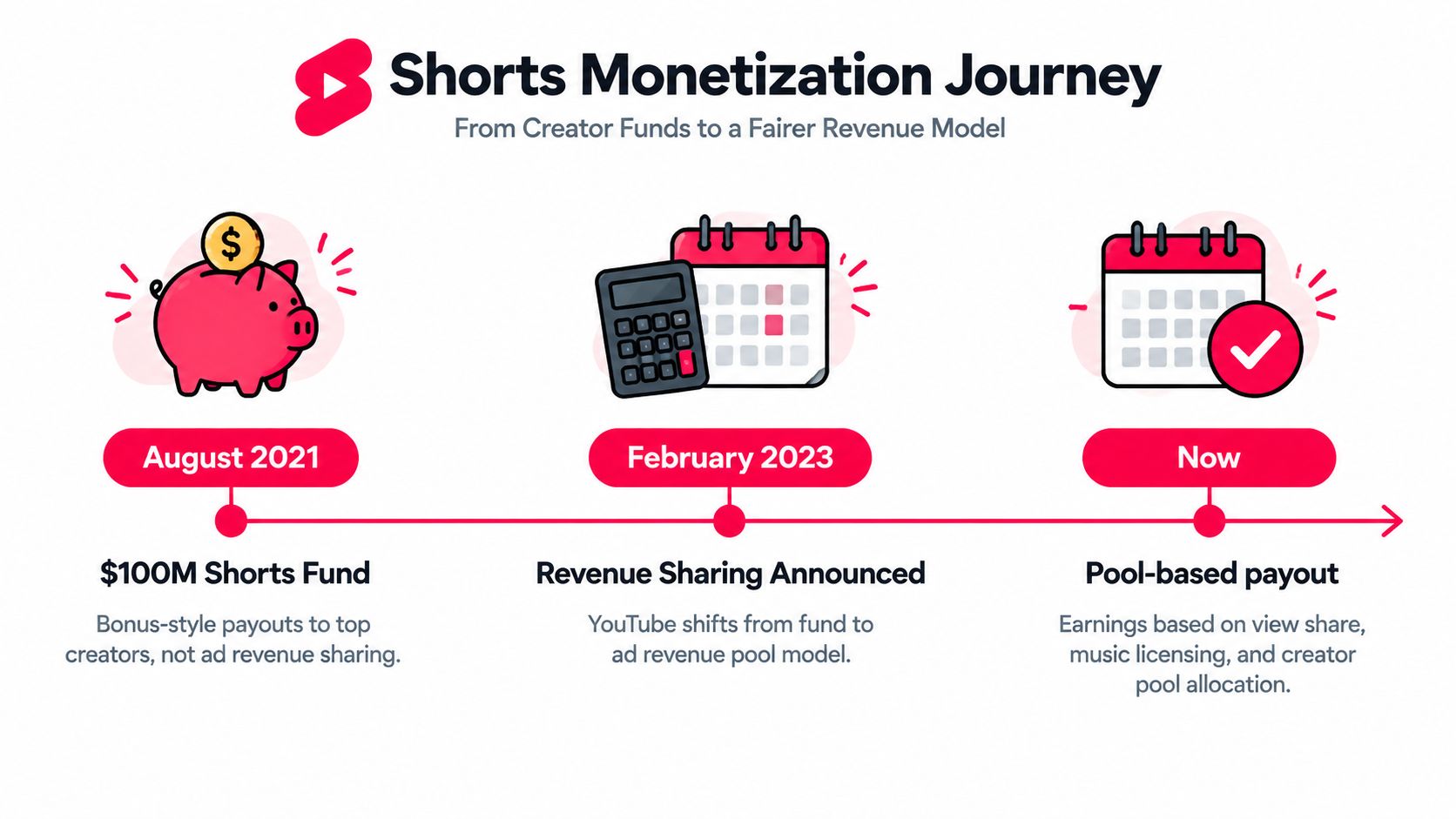
A creator publishing Shorts in the early days could attract millions of views without seeing a consistent advertising payout. In August 2021, YouTube introduced the $100 million Shorts Fund, a bonus-style pool designed to reward creators whose Shorts gained attention. It encouraged participation, yet it did not connect every eligible channel's views to a clear advertising calculation.
That difference shaped the next stage. A bonus could recognize selected creators, while a revenue-sharing system could follow advertising activity across the Shorts feed. As viewing grew, YouTube moved toward a model that treated Shorts more like a shared advertising marketplace than a promotional experiment.
The move to revenue sharing
In February 2023, YouTube introduced formal Shorts ad-revenue sharing. Advertising revenue from the Shorts feed entered a shared pool, music licensing was accounted for, and creator earnings were allocated according to eligible view share. Creators received 45% of their allocated revenue, replacing the discretionary structure of the earlier fund. The official YouTube help documentation describes this pool-based arrangement.
The change made payouts repeatable, though not fixed. Earnings could vary with the size of the overall pool, a channel's eligible views, its audience mix, and whether its Shorts used music. Two channels with similar public view counts could therefore receive different results.
That variability also explains why a single Shorts RPM is only a planning estimate. The system rewards participation in a large feed, but each creator's share depends on more than the view counter.
From launch feature to meaningful channel revenue
By March 28, 2024, YouTube said that more than 25% of channels in the YouTube Partner Program were earning through Shorts revenue sharing. YouTube also said Shorts averaged over 70 billion daily views at that time. The Business Insider reporting on early Shorts monetization documents these milestones and the early payout experience.
The historical shift clarifies Shorts' role today. Monetization became more formal than the old bonus model, while the format remained built for broad distribution. A Short's value may come from its feed payout, but also from new subscribers, visits to long-form videos, leads, or sales that happen later.
Shorts became easier to monetize, but not necessarily more valuable per view. Their strategic advantage remains distribution and audience entry.
How YouTube Calculates Your Shorts Earnings
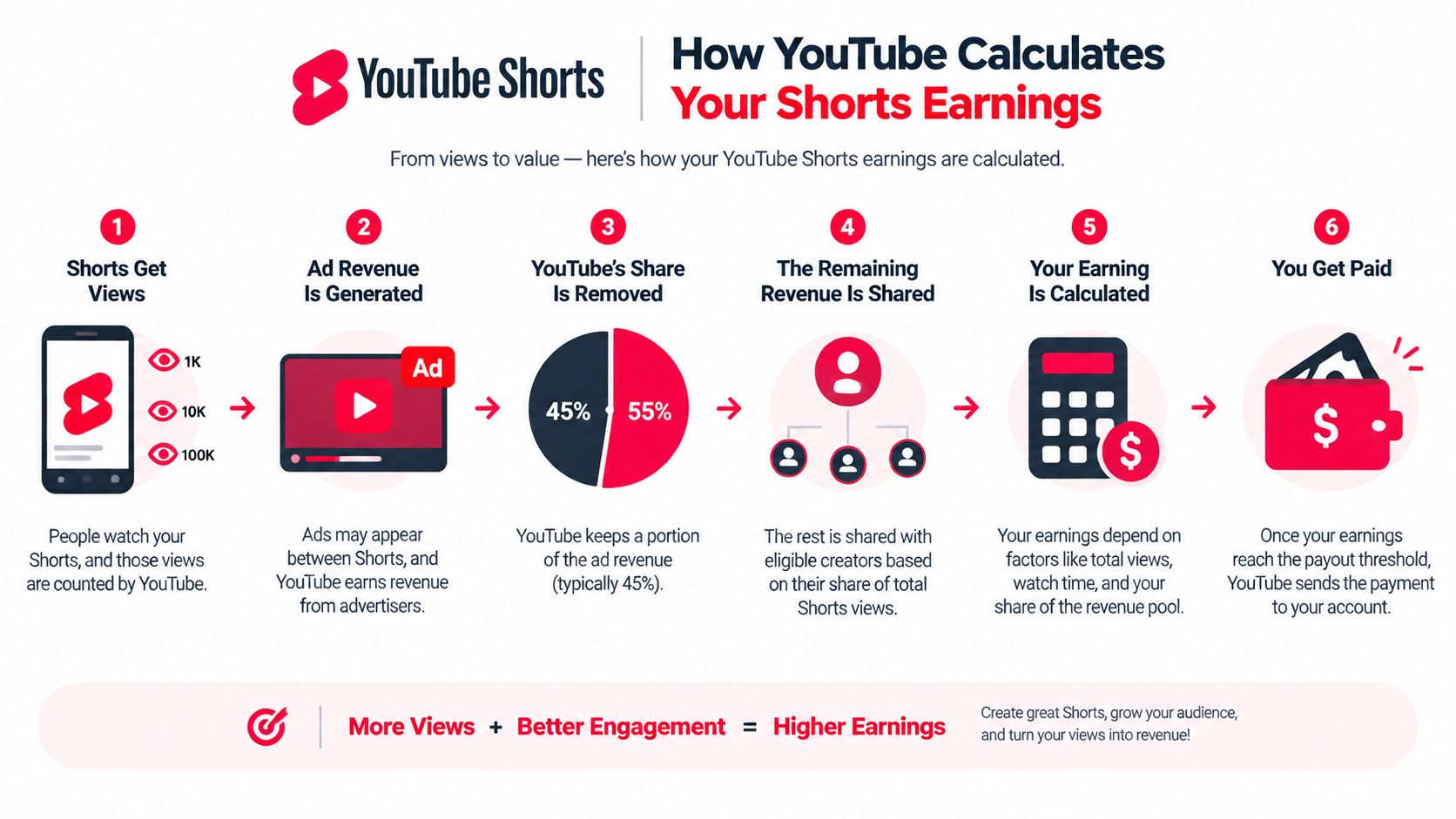
A Short can attract a large audience while producing a modest direct payout. The reason is simple: YouTube does not attach a fixed payment to each upload. It collects advertising revenue from the Shorts feed, adjusts the available amount under its music-rights arrangements, and distributes the creator portion according to eligible view share.
The calculation works in four stages:
- YouTube gathers Shorts advertising revenue. Ads appear between videos in the Shorts feed, and the related revenue enters a shared pool.
- Music licensing is accounted for. Shorts that use licensed music may send part of the available revenue toward the applicable rights arrangements.
- YouTube assigns the creator portion. Creators receive 45% of their allocated amount, while YouTube retains 55%, as explained in YouTube's explanation of Shorts revenue sharing.
- The creator portion follows eligible view share. Your allocation depends on your eligible Shorts views compared with the eligible activity represented in the wider pool.
A simplified pool example
Suppose a hypothetical creator pool contains $10 million after advertising revenue has been gathered and music-related costs have been handled. YouTube does not divide that amount evenly across every raw view. It calculates each creator's share of eligible Shorts views, then applies the creator portion to that allocation.
A channel contributing a larger share of eligible views receives a larger allocation. If the overall eligible-view volume is enormous, the same pool is divided across more activity. That is why Shorts RPM can remain only a few cents even when view counts look impressive.
Music can change the result as well. Two Shorts with the same number of views may produce different earnings if one uses licensed music and the other uses original audio or a rights arrangement with different economics. A million views is therefore a reach milestone, not a universal payout unit.
Creators should also separate RPM from CPM. RPM describes what the creator receives per thousand views after the relevant platform calculations, while CPM refers to an advertiser-facing cost metric. The guide explaining what CPM means on YouTube can help clarify that distinction. To compare the possible business value of traffic beyond the feed payout, try the Auspia traffic value calculator.
The practical formula is:
Estimated earnings = Shorts RPM × (eligible views ÷ 1,000)
This formula estimates an outcome after the allocation mechanics have already shaped the RPM. It does not turn Shorts into a fixed-rate product. Studio data gives you a better planning base because it reflects your audience, category, music usage, and eligible-view mix. More importantly, Shorts can pay off through reach, subscribers, leads, or later sales when direct feed revenue is small.
Who Qualifies for Shorts Revenue Sharing
Shorts ad-revenue sharing isn't automatic for every creator who uploads vertical video. You generally need to be accepted into the YouTube Partner Program, be located where the relevant features are available, and meet YouTube's current eligibility and policy requirements.
YouTube can adjust requirements and availability by region, so creators should verify the latest rules inside YouTube Studio and the YouTube Partner Program application guidance. Don't build a revenue forecast from an old screenshot or a threshold copied from another country.
The qualification path
The process usually includes several separate checks:
- Reach the applicable audience threshold: YouTube evaluates the subscriber requirement and the relevant watch-hour or Shorts-view route for the features you're applying for.
- Secure the account: Two-step verification helps satisfy account requirements and protects access to monetization tools.
- Accept the revenue terms: Shorts creators must accept the terms that govern Shorts ad-revenue sharing.
- Connect AdSense: An approved AdSense account is needed for payments through YouTube's monetization system.
- Pass channel review: YouTube reviews content for originality, policy compliance, and suitability for monetization.
Approval doesn't make every view payable. A channel can be inside the Partner Program while an individual Short receives limited or no eligible revenue because of policy issues, reused content, artificial engagement, or other restrictions.
Common problems that delay or limit earnings
Reused material is a frequent risk. Uploading another person's clip with minimal changes may not demonstrate enough original contribution, even if the edit includes a caption or a visual effect. Commentary, meaningful transformation, original presentation, and clear editorial value create a stronger foundation than simple reposting.
Misleading metadata, unsafe demonstrations, and artificial engagement can also affect monetization. A sudden view count isn't useful if the traffic violates platform rules or fails to qualify as legitimate engagement.
Views earned before monetization approval generally don't become retroactively payable. Check the monetization status for your channel and individual uploads in YouTube Studio before assuming that a high-performing Short has accumulated an unpaid balance.
Shorts RPM Compared With Long-Form Video
A Short can attract a million views and still earn less than a long-form video with a fraction of that reach. RPM helps explain why. It puts different view totals on the same basis, but it is an average outcome, not a guaranteed price. It also differs from CPM, which measures the advertiser-side cost rather than the creator's realized revenue.
Shorts usually have a much lower RPM than long-form video. Shorts earnings come from a shared feed pool, while long-form videos can support more direct ad placement and different inventory conditions. Geography, topic, advertiser demand, seasonality, and viewer intent all affect the gap.
A 2026 analysis of 274 mixed-format channels found that Shorts RPM was only 3% to 14% of long-form RPM in almost every niche. In those results, creators needed roughly 11,000 to 34,000 Shorts views to match the revenue from 1,000 long-form views. The findings appear in AIR Media-Tech's 2026 Shorts and long-form RPM analysis.
A direct comparison
| Metric | YouTube Shorts | Long-form video |
|---|---|---|
| Revenue structure | Shared Shorts ad pool | More direct video ad monetization |
| Typical view economics | Often around $0.03 to $0.10 RPM | Commonly higher, depending on channel and audience |
| Strongest strategic role | Discovery, reach, subscriber entry, funnel activity | Deeper viewing, stronger ad value, conversion support |
| Main variables | Eligible view share, music, geography, topic, pool size | Ad inventory, watch time, topic, geography, viewer intent |
| Best planning question | What downstream action did the Short create? | What revenue did this viewing session generate? |
The difference becomes clear in a simple comparison. One million Shorts views at $0.05 RPM produces about $50, while 100,000 long-form views at a hypothetical $5 RPM produces about $500. These are examples, not forecasts. Equal view totals can represent very different commercial value.
Shorts can still win on reach. A brief clip may find viewers who would not click a long video from an unfamiliar creator. If those viewers continue to a detailed tutorial, email sequence, product page, or consultation, the Short's direct RPM becomes only one part of its return. For many creators, Shorts work as the discovery and lead-capture layer, while long-form carries more of the advertising and conversion load.
Realistic Earnings With Example Calculations
A Short can reach a million views and still produce less direct ad revenue than a smaller long-form video. Use the RPM range as a planning scenario, not a promise. The calculation is simple, while the inputs vary with audience location, music use, eligible views, advertiser demand, and the size of the shared pool.
Scenario one, one million views
At $0.03 RPM, one million views works out as:
1,000,000 ÷ 1,000 × $0.03 = $30
At $0.10 RPM, the same view count works out as:
1,000,000 ÷ 1,000 × $0.10 = $100
The $0.03 to $0.10 range is a benchmark, not guaranteed take-home income. YouTube's calculation depends on eligible activity within the Shorts system, so two channels with the same public view count can receive different estimates.
Scenario two, a ten-million-view month
Suppose a channel receives 10 million views across its Shorts in one month. At $0.05 RPM, the estimate is $500. At $0.08 RPM, it is $800.
| Scenario | Shorts RPM | Views | Estimated revenue |
|---|---|---|---|
| Lower-range month | $0.03 | 1,000,000 | $30 |
| Upper-range benchmark | $0.10 | 1,000,000 | $100 |
| Mixed-audience month | $0.05 | 10,000,000 | $500 |
| Stronger mixed-audience month | $0.08 | 10,000,000 | $800 |
The spread reflects different audience and content conditions inside a pool-based system. A U.S.-heavy audience, a commercially valuable topic, limited music exposure, and stronger eligible-view performance can produce a different result from broad entertainment traffic.
Scenario three, the long-form comparison
At 100,000 qualified views, a Short earning $0.06 RPM would produce $6. A long-form video earning a hypothetical $5 RPM would produce $500.
| Scenario | Shorts RPM | Views | Estimated revenue |
|---|---|---|---|
| Shorts comparison | $0.06 | 100,000 | $6 |
| Long-form comparison | $5 | 100,000 | $500 |
These examples exclude taxes, withholding, currency conversion, and applicable deductions. They also leave out the value of a Short that creates a subscriber, lead, or sale. That is why Shorts often make more sense as a reach and lead-capture layer than as an advertising paycheck by themselves.
For your own baseline, export the last 30 days of qualified views and estimated revenue from YouTube Studio. Divide estimated revenue by qualified views, then multiply by 1,000. Your channel's RPM is more useful for forecasting than a generic range because it reflects your audience and format mix. Use it to judge whether Shorts are paying through ads, or whether their stronger return comes from sending viewers to a tutorial, email sequence, product page, or consultation.
Factors That Move Your Shorts Pay Up or Down
A Short can receive strong distribution and still produce a small AdSense payout. The result depends on who watches, what the video is about, how much licensed music is involved, and whether viewers keep watching. These variables affect either the value of eligible views or the number of eligible views your Short earns.
Audience geography
Advertiser demand differs by market, so viewer location can shift Shorts earnings substantially. U.S.-heavy audiences generally produce stronger advertising value than audiences concentrated in lower-demand markets. You cannot fully choose where viewers live, but you can make the content understandable and relevant to the audience you want.
Language, examples, cultural references, titles, and posting context all influence who discovers the Short. Treat those choices as audience filters, not just packaging.
Topic and advertiser intent
Finance, technology, and business topics often attract more commercial interest than broad entertainment. The same view count can therefore produce different advertising value. That does not make comedy or gaming a poor choice. A sustainable format with a clear audience usually beats a higher-value topic you cannot produce consistently.
Topic value also affects revenue beyond AdSense. A creator teaching software workflows may send viewers to an affiliate offer, software trial, or consulting service. That downstream result can matter more than a small change in Shorts RPM. For many creators, Shorts work best as the top of a path, not the entire business.
Music and original audio
Music usage affects the pool before the creator allocation. Music-heavy content can therefore fall toward the lower end of available benchmarks. The Miraflow breakdown of Shorts RPM and licensing estimates that a million-view music Short may generate only $15 to $30 net after licensing effects.
Original narration, original sound design, or music used under a suitable arrangement gives you more control. It still does not guarantee a higher payout, because audience and eligible-view performance remain part of the calculation.
Hook and retention
The first seconds determine whether a viewer stays long enough to understand the promise. Continued viewing helps the Short remain competitive in the feed. Immediate swipes can limit distribution before RPM becomes meaningful.
Open with the specific result, remove slow introductions, and make the payoff clear. Review early retention rather than guessing which line failed.
Posting consistency and audience fit
Consistency creates more chances to test topics, openings, and formats. Frequency alone does not raise payment, and publishing weak Shorts can consume production time without improving business results.
Relevant subscribers may help a new upload find an initial audience. Subscribers do not receive a direct payment or guarantee reach, but a well-matched subscriber base can help move viewers from a Short to a longer video, email list, product, or service.
For a focused 30-day test, track:
- Geography: Compare audience locations with your channel RPM.
- Audio: Separate original-audio Shorts from music-heavy uploads.
- Topics: Group results by niche and viewer intent.
- Openings: Review early retention and rewrite the first line.
- Downstream actions: Measure clicks, signups, and long-form sessions, not only views.
Creators who want more ideas can review how to make money on YouTube Shorts. The practical test is simple: improve the variables you control, then judge Shorts by the business outcome they create, including reach, leads, and sales rather than ad revenue alone.
Turning Shorts Into Real Revenue With ViewsMax
A Short can earn only a few dollars directly and still be responsible for valuable activity elsewhere. That's why a serious Shorts dashboard should place direct Shorts RPM beside downstream results, including long-form viewing, channel subscriptions, link clicks, leads, and sales.
ViewsMax is designed for that attribution problem. It lets creators create trackable links for offers, place those links in descriptions, bios, and posts, and connect clicks, leads, and sales to the content that generated them. For a Shorts strategy, the useful question becomes less “How much did this Short earn in AdSense?” and more “What did this Short cause a viewer to do next?”
A practical attribution setup
Start by giving each campaign, offer, or content series a trackable destination. Use distinct links for different Shorts or content groups so the resulting traffic doesn't disappear into one undifferentiated total.
Then pair the link data with YouTube Studio metrics:
- Shorts views and RPM: Record the direct platform payout.
- Long-form movement: Identify viewers who continue into deeper videos.
- Subscriber activity: Watch whether the Short attracts the audience your channel serves.
- Clicks and leads: Connect viewers with the offer, newsletter, booking page, or product.
- Attributed revenue: Compare the money generated downstream with the Short's production cost.
A dashboard organized this way can change your publishing decisions. A Short with a low RPM but strong click-through and lead quality may deserve more production attention than a high-view Short that creates no meaningful next step.
Consider a hypothetical month in which a creator receives $4 in direct Shorts payout and attributes $220 in channel revenue to viewers who arrived through Shorts. The direct AdSense number looks disappointing in isolation. The combined view shows a discovery asset that helped create a much more valuable revenue path.
That's the key use case for attribution. Shorts don't have to carry the entire business through feed advertising. They can introduce the right viewer, while long-form content, products, services, sponsorships, or email capture complete the commercial journey.
ViewsMax helps creators connect content with measurable clicks, leads, and sales instead of judging Shorts only by RPM or view count. Visit ViewsMax to track which Shorts and other content contribute to revenue, then use that evidence to plan your next publishing cycle.