ViewsMax
Sign In Sign Up Free

Tag: youtube growth

  • Unlocking YouTube Watch Hours A Creator’s Guide

    Unlocking YouTube Watch Hours A Creator’s Guide

    Let's cut right to it: YouTube watch hours are simply the total amount of time people have collectively spent watching your videos. Think of it as the ultimate measure of how captivating your content really is.

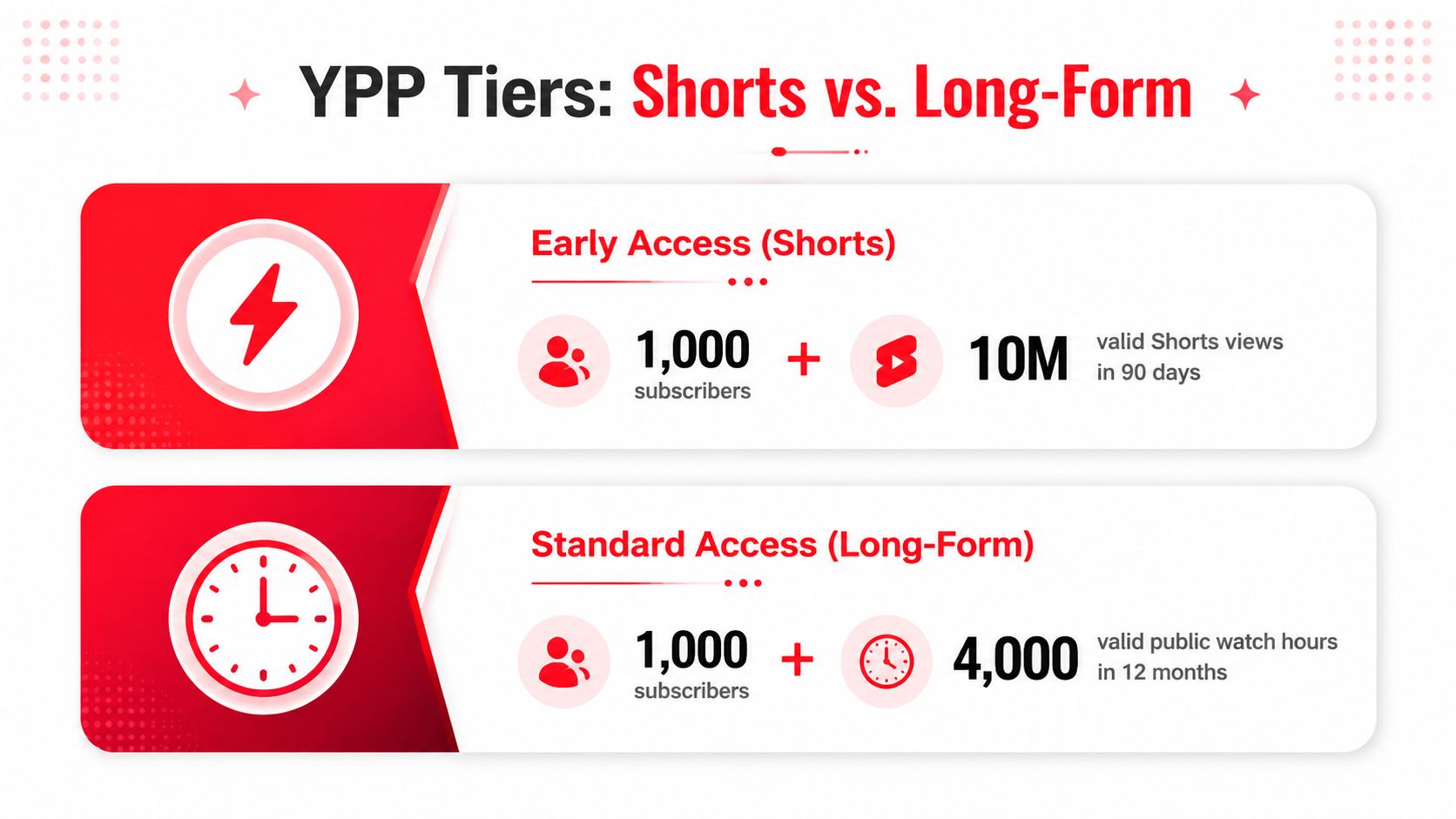
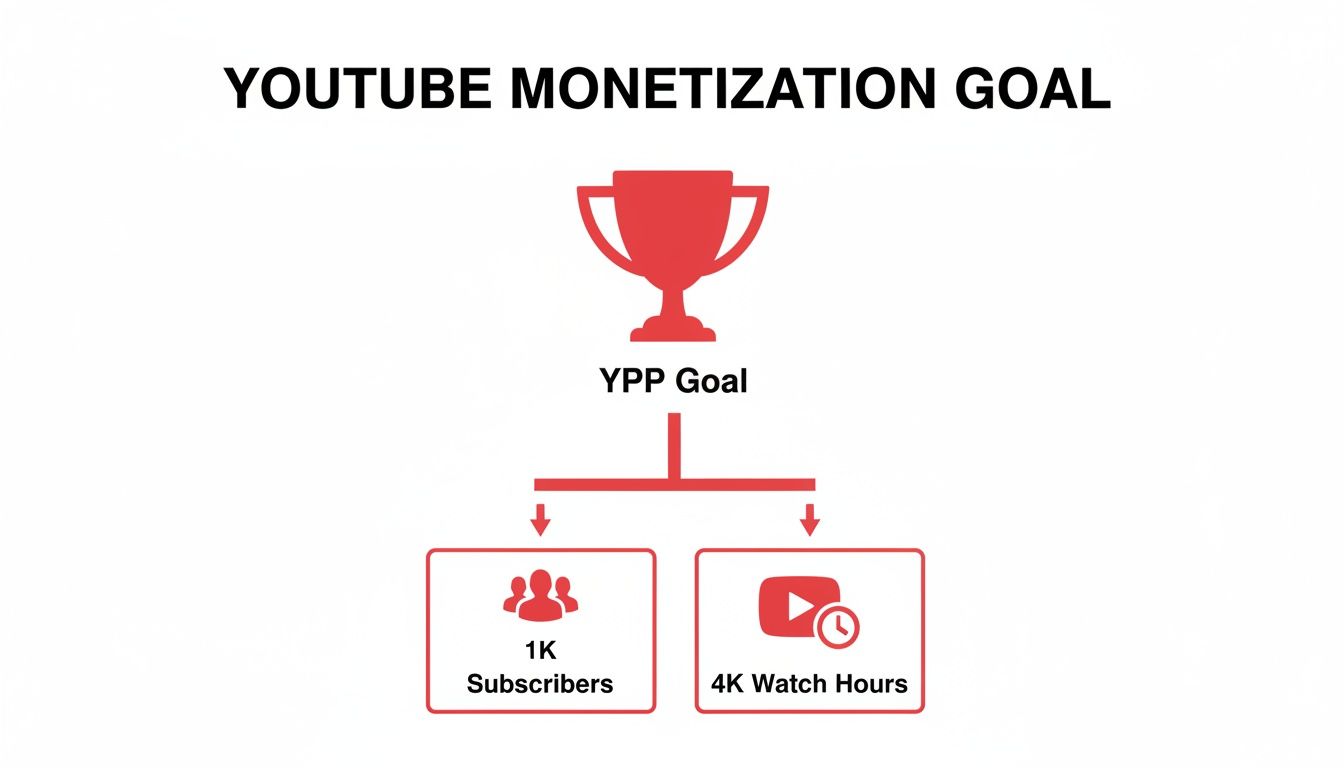
    To get into the YouTube Partner Program (YPP) and start making money, you need to hit 4,000 public watch hours within the last 12 months, plus have 1,000 subscribers. This isn't just an arbitrary number—it's YouTube's way of verifying that you're creating content people genuinely want to watch.

    Why Watch Hours Are The Most Important YouTube Metric

    A man works on a laptop at a studio table with a camera, alongside a "WATCH HOURS" graphic.

    It’s easy to get caught up chasing views and subscriber counts, but watch time is the real currency on YouTube. A view just means someone clicked play. Watch time tells you if they stuck around.

    Think about it. A video with a million views but an average watch time of 10 seconds is a red flag for the algorithm. It screams "clickbait" or signals that the content didn't live up to the title's promise. On the flip side, high watch hours prove your content is valuable and holds people's attention, which is exactly what YouTube's business model is built on.

    The YouTube algorithm's primary job is to keep people on the platform. When your videos rack up serious watch time, you're basically sending a direct signal to the algorithm: "Hey, people love this stuff. You should show it to more of them."

    This kicks off a powerful growth cycle. More watch time leads to more algorithmic recommendations, which brings in more views, which then leads to more subscribers and even more watch time. It all feeds itself.

    The Two Pillars Of Watch Time Success

    For every creator, mastering watch time is the key to unlocking two huge milestones:

    • Monetization Eligibility: That magic number of 4,000 hours of valid public watch time in a 12-month window is your ticket to applying for the YPP and turning your passion into a revenue stream.
    • Algorithmic Discoverability: The algorithm is designed to reward channels that keep viewers engaged. The more watch hours you accumulate, the more your videos will pop up on the homepage, in "Up Next" suggestions, and at the top of search results.

    This is why a laser focus on youtube watch hours is so much more effective than just chasing a one-hit viral video. It builds a healthy, sustainable channel that the algorithm wants to promote.

    To give you an idea of the scale, here's a quick summary of how watch hours impact your channel's growth.

    The Impact of Watch Hours on Your Channel

    Area of Impact Why Watch Hours Are Critical
    Monetization The 4,000-hour requirement is the main gatekeeper for the YouTube Partner Program.
    Algorithm High watch time is the strongest signal to the algorithm that your content is high-quality.
    Discoverability The algorithm promotes high-retention videos across the platform (homepage, suggestions, search).
    Audience Growth Keeping viewers watching longer builds a loyal community and naturally leads to more subscribers.
    Channel Authority Consistent high watch time establishes your channel as a trusted source in your niche.

    Ultimately, every aspect of your channel's success is tied back to your ability to hold a viewer's attention.

    The Scale Of YouTube Engagement

    The battle for eyeballs is intense. Every single day, people watch over 1 billion hours of video on YouTube. It's a staggering figure that shows just how central the platform is to our daily lives.

    And here's a crucial detail: a whopping 70% of all YouTube watch time now happens on mobile devices. This means your titles and thumbnails have to grab attention on a small screen, or you'll get scrolled right past. Getting even a tiny slice of this massive viewership pie requires a smart strategy built around quality and retention. You can dive deeper into these kinds of revealing YouTube statistics to understand just how big the opportunity is.

    How To Track Your Watch Time Progress In YouTube Studio

    Before you can even think about growing your YouTube watch hours, you need to know where you stand. Think of your YouTube Studio as your channel's command center; it has all the vital stats you need to hit your monetization goal. Flying blind is not a strategy.

    The first step is simply knowing where to look. Your analytics dashboard is packed with data, from viewer demographics to traffic sources, but we're zeroing in on one key number for now.

    Finding Your Core Watch Time Metric

    Let's get straight to the big picture—how close are you to that 4,000-hour finish line?

    1. Log into your YouTube Studio.
    2. Look for the Analytics tab on the left-hand menu and click it.
    3. Right there on the main overview page, you'll see a card for Watch time (hours).

    By default, this number shows you the last 28 days. That’s helpful for checking recent trends, but it's not the number that matters for the YouTube Partner Program.

    To see your true monetization progress, you have to adjust the time frame. Click the date range in the top right corner and change it to “Last 365 days.” This is the number YouTube looks at—your total public watch hours over the past year.

    This is your main progress bar. Keep an eye on it. Watching this number climb tells you if your strategy is actually working and turns that big, intimidating goal into something you can track and influence week by week.

    Analyzing Individual Video Performance

    Knowing your total is one thing, but the real magic happens when you figure out which videos are doing the heavy lifting. Diving into the stats for each video helps you spot your winners so you can make more of what your audience loves.

    By heading over to the "Content" tab inside Analytics, you can sort all your videos by "Watch time (hours)." This immediately shows you your watch time champions—the videos that are truly captivating your viewers.

    On the flip side, you can also spot videos with tons of views but disappointing watch time. That’s a classic sign of a misleading thumbnail or title. This isn't just about looking at charts; it's about turning data into a playbook for creating better, more engaging content.

    Mastering Audience Retention to Keep Viewers Hooked

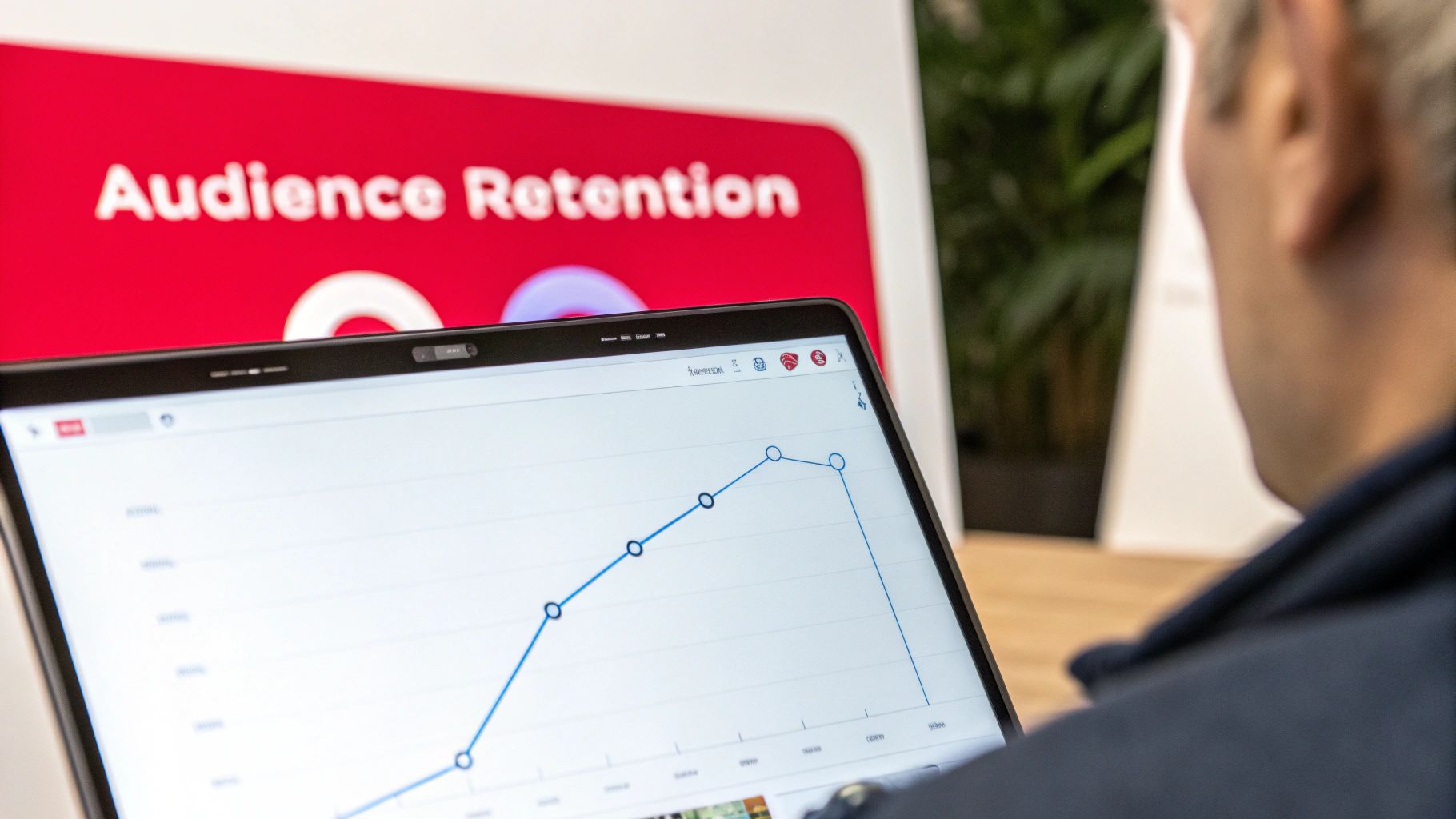
    A person views a laptop displaying a line graph, with a red 'Audience Retention' sign in the background.

    Getting someone to click on your video is just the first hurdle. The real challenge—and where the magic happens—is convincing them to stick around. The secret to racking up massive YouTube watch hours isn't about getting more clicks; it's about mastering audience retention.

    Think of audience retention as the average percentage of your video that people actually watch. A high retention rate sends a powerful signal to the YouTube algorithm that your content is valuable and engaging, which in turn leads to more recommendations.

    Your video is like a rollercoaster. The first few seconds are the initial climb, and they need to build immediate anticipation. If that climb is slow and boring, your viewers will hop off before the ride even gets good. This is precisely why your introduction, or "hook," is the single most important part of your video.

    Crafting an Unskippable Hook

    You’ve got about 15 seconds. That’s it. That's your window to prove your video is worth watching. If you fumble the intro, you'll see a massive, steep drop-off in your retention graph right at the beginning. A killer hook doesn't just grab attention; it clearly sets the stage for what's to come.

    The good news is you don't have to reinvent the wheel. There are several tried-and-true formulas for creating a powerful hook that you can adapt to your own style.

    • Ask a Compelling Question: Jump right in with a question that your ideal viewer is dying to have answered. Something like, "Are you sick of your videos getting stuck at 100 views?"
    • Preview the "Aha!" Moment: Show a quick, tantalizing clip from later in the video that reveals the final result or the most valuable nugget of information. This creates an "information gap" that makes viewers want to stick around to see how you got there.
    • Start with a Bold Statement: Kick things off with a surprising or even controversial claim related to your topic. It immediately piques curiosity and makes people want to see if you can back it up.

    The mission here is simple: stop the scroll. Give the viewer a rock-solid reason to invest their time in your video over the millions of others.

    Keeping Viewers Engaged With Storytelling

    Okay, so you've hooked them. Now what? You have to keep that momentum going. This is where strategic storytelling and dynamic editing become your best friends. A long, monotonous talking head is a one-way ticket to low watch time. You have to constantly jolt the viewer's attention.

    A fantastic technique for this is using pattern interrupts. These are small, unexpected changes that break the flow and re-engage a viewer's brain.

    A pattern interrupt can be as simple as changing the camera angle, popping up some on-screen text, adding B-roll footage, or using a quick sound effect. These little shifts prevent viewer fatigue and keep your video feeling fresh and dynamic.

    Another great storytelling tool is the open loop. This is where you introduce an idea or a story near the beginning but deliberately hold off on the conclusion until the very end. By leaving that loop open, you create a subtle tension that keeps people watching just to get the payoff.

    Delivering on Your Promise

    Every single time you pair a title with a thumbnail, you're making a promise. If your title is "How to Bake the Perfect Sourdough," your video had better deliver a clear, easy-to-follow guide on baking sourdough.

    Failing to deliver on that promise is the quickest way to demolish trust and your watch time. When viewers feel like they've been tricked, they don't just click away—they remember. They become less likely to click on any of your future videos. This is why clickbait is a terrible long-term strategy for any channel that wants to grow.

    To truly maximize your YouTube watch hours, your content has to deliver clear, undeniable value from the first second to the last. To dive deeper into how video length impacts what viewers expect, check out our guide on how long a YouTube video should be.

    At the end of the day, incredible retention boils down to a strong start, an engaging middle, and a satisfying ending that fulfills the promise you made upfront. When you master this flow, you stop just making videos and start crafting experiences that turn casual viewers into loyal fans.

    How to Optimize Your Videos for Maximum Watch Time

    Getting someone to watch one video all the way through is a great start. But the secret to racking up serious YouTube watch hours is getting them to watch the next video, and then the one after that. This is where your video’s packaging comes in—everything from the title to the end screen is a chance to turn a single view into a full-blown watching session.

    It all begins with a killer combination: a magnetic title and a thumbnail they can't resist clicking. These two work together to earn that all-important first click. Without that initial pull, even the most incredible video will just sit there, and all that potential watch time will go to waste.

    Building the Perfect Binge-Watching Trap

    So you've earned the click and kept them watching. Fantastic. Now, the last 20 seconds of your video are pure gold. This is when the End Screen pops up, giving you a prime opportunity to tell your audience exactly where to go next. Instead of letting them wander off, you can guide them deeper into your world.

    A common mistake is just linking to your most recent upload. A much smarter move is to point them toward a hand-picked playlist.

    By linking to a playlist, you’re not just suggesting one more video; you're inviting them into a seamless, lean-back viewing experience. The next video starts automatically, removing the friction of choice and significantly increasing the chances of them watching multiple videos in a row.

    This one simple change can multiply the YouTube watch hours you get from a single viewer. You're no longer just thinking about one video's retention; you're optimizing for an entire viewing session.

    Designing Playlists for Seamless Viewing

    A good playlist isn't just a random assortment of videos. It needs to feel like a mini-series, where each video flows logically into the next. Think about arranging your videos to build on each other, creating a storyline or a learning path that keeps people hooked and ready for what's next.

    Here’s how to make playlists that really work:

    • Group by Theme: Bundle together videos that tackle different angles of the same big topic. For example, a "Beginner's Guide to Photography" playlist could have separate videos on camera settings, composition, and lighting.
    • Create a Series: If you make content that comes in episodes, a dedicated series playlist is essential. It lets viewers catch up and watch everything in the right order, just like a Netflix show.
    • Order Strategically: Put your videos with the highest audience retention right at the beginning of the playlist. This gets viewers hooked early on and makes it more likely they’ll stick around for the whole thing.

    Treat each playlist like a carefully planned journey. The smoother and more engaging you make that journey, the more you encourage the kind of binge-watching that the YouTube algorithm absolutely loves.

    Using Cards to Keep the Momentum Going

    While End Screens are your closers, Cards are your secret weapon for re-engaging people in the middle of a video. They are those small, clickable notifications you can pop up at specific moments in your timeline. If you happen to mention a related topic or a past video, you can drop in a card that links right to it.

    This is a great way to prevent viewers from dropping off. If someone’s interest is sparked by a side topic, a Card gives them a direct path to explore it on your channel, rather than leaving to search for it somewhere else. Using them well helps squeeze every last second of watch time out of every view. For more tips on this, learn how you can add chapters to your YouTube video to give your audience even more ways to navigate your content.

    Beyond what’s on your video page, timing is huge. Knowing the best time to upload YouTube videos can give you that initial burst of engagement that’s so important for watch time.

    And believe me, the audience is out there. Globally, YouTube mobile app users watched for an average of over 27 hours per month. Viewers in South Korea are leading the charge, spending a staggering 43 hours and 26 minutes monthly on the app, with US users not far behind at around 24.43 hours. These numbers show just how much watch time is available if you can grab and hold people's attention. You can see more on these global viewing habits on Statista.

    Using Different Content Formats To Accelerate Growth

    When you're trying to hit that 4,000-hour milestone, you quickly learn that not all videos are created equal. You need to be strategic about the types of content you create, mixing different styles to capture and hold your audience’s attention.

    Relying only on short, snappy videos can feel like trying to fill a swimming pool with a teaspoon. To really speed things up, you have to embrace formats that are built for longer watch times.

    The Power Of Long-Form Content

    Think about the kind of videos that naturally keep people watching. I'm talking about deep-dive tutorials, comprehensive product reviews, feature-length documentaries, and even video podcasts. These are your watch time goldmines.

    Why? Because a single person watching your 45-minute guide can give you more watch hours than a dozen people watching a three-minute clip. Viewers who click on this kind of in-depth content are already planning to stick around, which means your average view duration shoots up, giving your channel's total watch time a serious boost.

    Capitalizing On The Live Stream Advantage

    If you want the single fastest way to rack up public watch hours, look no further than live streaming. Let’s do some quick math: a single two-hour live event with just 50 people watching at any given time instantly generates 100 hours of watch time. You’d need thousands of views on your regular videos to get anywhere near that.

    Live streams work so well because they’re interactive. The real-time chat, live Q&As, and sense of community keep people glued to their screens far longer than they would for a pre-recorded video. It's a powerful tool for any creator trying to hit their monetization goals faster.

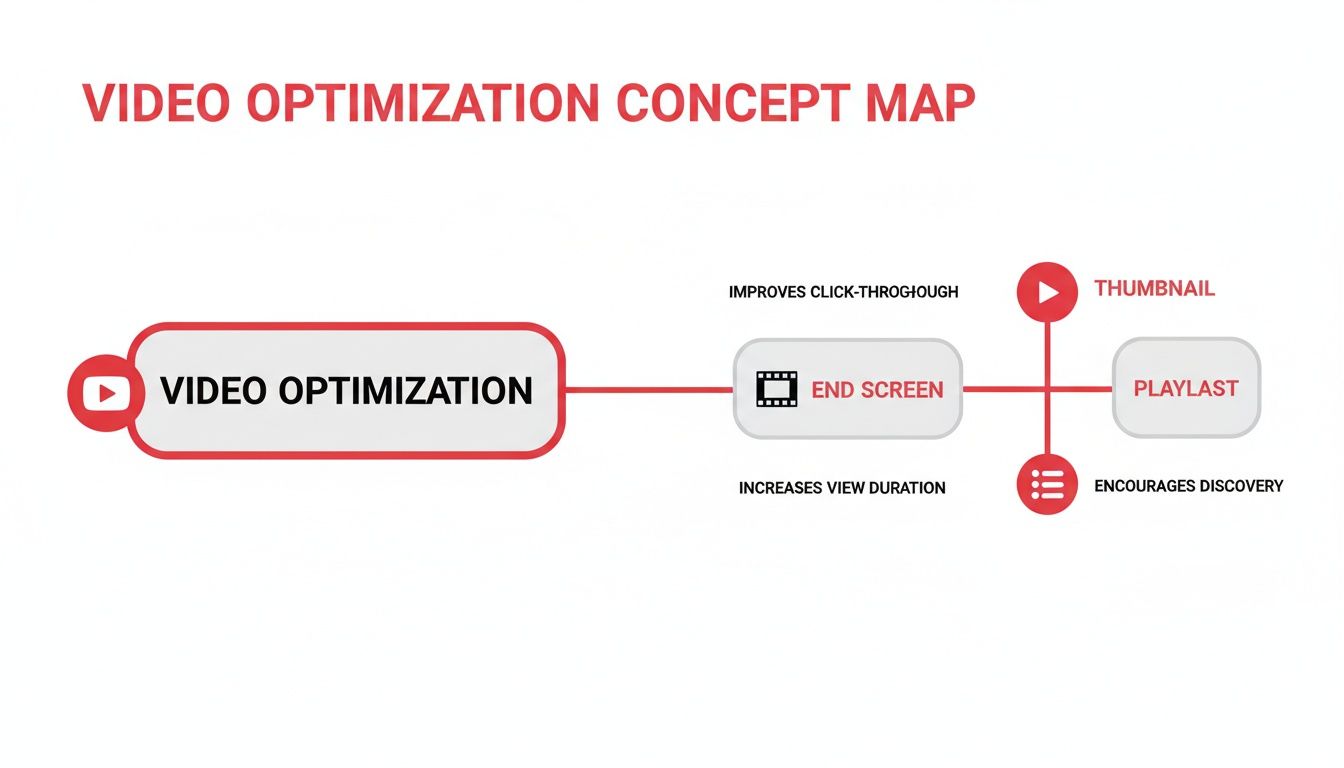
    A concept map showing video optimization strategies with end screens, thumbnails, and playlists to improve engagement.

    This image really breaks down how everything works together. A great thumbnail gets the click, but it's the playlists and end screens that keep people in your ecosystem, multiplying your watch time.

    Using YouTube Shorts As A Discovery Engine

    This is a huge point of confusion for many creators, so let’s get it straight: watch time from your videos viewed in the Shorts feed does not count toward your 4,000-hour requirement. So, why even make them? Simple. They are one of the best discovery tools YouTube has ever given us.

    Think of your Shorts as commercials for your main channel. Their bite-sized, shareable nature is perfect for getting your content in front of a massive new audience that has never even heard of you.

    The goal with Shorts isn't to rack up watch hours directly. It's to be a magnet at the top of your funnel, pulling in new viewers who then dive into your longer, monetizable videos.

    Here’s how you build that bridge from a Short to your main content:

    1. Create Teasers: Clip the most exciting, valuable, or intriguing moments from your longer videos. Give viewers a taste that makes them hungry for the full story.
    2. Use The "Related Video" Feature: Don't leave them hanging! Pin a comment or use YouTube's built-in feature to link from your Short directly to the full-length video it came from.
    3. End with a Clear Call to Action: Literally tell people where to go next. A simple, "For the full breakdown, check out the video on my channel!" can work wonders.

    This strategy turns a view that doesn't count for monetization into a potential long-term fan who contributes to your YouTube watch hours. On top of creating new content, you can also think about safely downloading your YouTube videos to repurpose them for other platforms, which can extend their reach even further. By combining long-form videos, live streams, and a smart Shorts strategy, you create a powerful system for earning watch time way faster.

    Common Questions About YouTube Watch Hours Answered

    Navigating the rules around YouTube watch hours can feel like trying to solve a puzzle. With so many different content formats and specific guidelines, it’s easy to get confused about what counts, what doesn’t, and which strategies actually move the needle.

    Let's cut through the noise. Here are direct, clear answers to the most common questions creators have about racking up watch time, so you can focus your energy on what truly matters for growing your channel.

    Do YouTube Shorts Count Towards The 4000 Watch Hours?

    This is easily one of the most frequent questions out there, and the answer is a straightforward no. Watch hours gained from viewers swiping through the Shorts feed do not count toward the 4,000 public watch hours you need for the YouTube Partner Program (YPP).

    But don't write them off just yet. Think of Shorts as the billboard or the movie trailer for your channel. They are an incredible tool for discovery and often reach audiences who have never seen your content before.

    The real magic happens when someone finds your channel through a Short and then clicks over to watch your regular, long-form videos. Every minute they spend on those longer videos absolutely counts. This makes Shorts a powerful way to pull in new subscribers who will then contribute to your monetizable watch time.

    What Exactly Are Public Watch Hours?

    The key word here is "public." To be eligible for monetization, you need 4,000 public watch hours, which are the valid hours your viewers spend watching videos you have set to "Public."

    This means that any time spent on certain types of content won't be included in your official YPP tally.

    • Private Videos: Watch time from videos set to "Private" doesn't count.
    • Unlisted Videos: Hours from "Unlisted" videos are also excluded.
    • Deleted Videos: If you delete a video, any watch hours it earned are wiped from your total.
    • Ad Campaigns: Watch time you get from promotional campaigns, like Google Ads, is not counted.

    This distinction is critical. YouTube wants to see that you can earn your hours organically from a real audience that is actively choosing to watch your public content. It's a system built to reward genuine engagement, not manufactured views. For a deeper dive, check out our guide on what public watch hours are on YouTube.

    How Long Does It Take To Get 4000 Watch Hours?

    Honestly, there's no single answer. The timeline can be wildly different from one channel to another. It really comes down to your niche, how good your videos are, how often you upload, and your ability to hook people and keep them watching.

    Let's break down the math to make the goal feel a bit more real. Say you upload a 15-minute video that gets 1,000 views with a solid average watch time of 6 minutes (that's 40% retention). That one video just earned you 100 hours of watch time.

    To hit your 4,000-hour goal, you would need 40 videos performing at that same level. For some creators, a single viral hit could get them there in a few weeks. For others, a steady grind of publishing great content might take several months or even a year.

    The focus shouldn't be on speed but on building something sustainable. The real goal is to create a library of valuable videos that consistently earns watch time day in and day out, creating a solid foundation for your channel.

    Should I Buy YouTube Watch Hours?

    The answer to this is a firm, absolute no. Buying watch hours is a serious violation of YouTube's Fake Engagement policy, and it can have catastrophic consequences for your channel's future.

    These services use bots or click farms to generate views, which provide zero real engagement. YouTube's algorithm is incredibly sophisticated and can easily spot this artificial activity, sending powerful negative signals about your channel.

    The risks are severe and just not worth it.

    • Channel Termination: YouTube can and will shut down channels that violate its policies.
    • Permanent YPP Ban: You could be banned from ever applying to the YouTube Partner Program.
    • Credibility Destruction: Any real audience you have will lose trust in you, and your reputation will be toast.

    True, lasting growth only comes from earning authentic watch time from real people who value your content. Investing your time and effort into making better videos is the only legitimate path to building a successful channel.


    Ready to stop guessing and start growing your YouTube watch hours with a data-driven strategy? ViewsMax is the AI-powered toolkit that helps you create smarter, optimize faster, and monetize with confidence. From intelligent title recommendations to in-depth analytics, we give you the insights you need to turn your passion into a thriving channel. Start making videos that viewers click and watch by visiting us at https://blog.viewsmax.com.

  • How to craft a script for a youtube video that actually gets views

    How to craft a script for a youtube video that actually gets views

    A great script for a youtube video is your blueprint. It’s the secret sauce that turns a good idea into content that feels intentional, delivers real value, and keeps people glued to their screens. A script is what separates a video that gets a passing click from one that earns a loyal subscriber, and that difference is everything to the YouTube algorithm.

    Why Your Script Is the Key to YouTube Growth

    In a world drowning in content, a cool idea just isn’t enough to cut through the noise. What really makes a video stand out is a solid script. I like to think of it as "engineered engagement"—it’s your tool for strategically placing hooks, controlling the pace, and taking your audience on a journey from the first second to the last.

    If you just wing it, you risk rambling, losing your train of thought, and, worst of all, losing your audience.

    Laptop displaying a video conference, an open notebook with a pen, and a 'Script DRIVES GROWTH' sign.

    From Idea to Impact

    A common myth I hear from creators is that scripting kills spontaneity and makes you sound robotic. It’s actually the opposite. A well-written script frees you up to be your best self on camera. You can focus on your delivery and personality because you're not scrambling to remember what to say next. It's your safety net, making sure every word you say has a purpose.

    This prep work gives you a huge advantage in a few key areas:

    • Clarity of Message: The act of writing forces you to sharpen your ideas into a logical flow. This makes your content way easier for viewers to follow and absorb.
    • Better Pacing: You can intentionally build excitement, hit your key points with impact, and cut out all the awkward pauses and "ums" that make people click away.
    • YouTube SEO Boost: A script lets you weave in your target keywords and phrases naturally. This is a massive signal to YouTube's algorithm, helping it understand what your video is about and who should see it.

    Standing Out in a Crowded Space

    Let's be real: the competition on YouTube is fierce. By late 2025, the platform was home to an incredible 29 billion videos. The data shows that the top 1% of those videos get 91% of all viewing time, while the other 99% of us are left fighting for the remaining 9%.

    That stat alone shows why scripting isn't just a "nice to have"—it's a critical step if you want a shot at breaking into that top tier.

    A script isn't just a document; it's a strategic tool. It transforms a raw idea into a polished piece of content designed to maximize viewer retention and satisfy the algorithm.

    Once you have a great video, you can squeeze even more value out of it. For example, it’s easy to transcribe YouTube videos and turn that text into blog posts, social media updates, or email newsletters. This guide will give you the practical, no-fluff steps to turn your ideas into scripts that build a real, engaged audience.

    The Pre-Scripting Blueprint for a Viral Video

    Before you write a single word of your script, you need a plan. This is the part everyone wants to skip, but trust me, the groundwork you lay here is what separates a video that flops from one that has a real shot at going viral. It's all about connecting your creative idea with what actual people are searching for.

    Overhead view of a workspace with a one-page plan notebook, pen, phone, and colorful sticky notes.

    This whole process boils down to one simple, focused question: What is the one thing this video needs to achieve? It's so tempting to cram everything in, but a video that tries to educate, entertain, and sell usually fails at all three.

    Defining a singular goal is the most crucial step in crafting a high-performing script. Every word, every scene, and every call to action must serve this primary objective. If it doesn't, it's just noise.

    Know Who You Are Talking To

    Forget about generic demographics. Knowing your audience is "creators aged 25-34" tells you almost nothing useful. A truly effective script for a youtube video needs to feel like it's speaking directly to one person about their specific problems and goals.

    To get inside their head, ask yourself a few questions:

    • What are their biggest frustrations? Get specific about the pain points related to your topic.
    • What questions are they literally typing into YouTube? Frame your content around the answers they're already looking for.
    • What's the "quick win" they want? Your video should deliver a tangible piece of value they can use right away.

    When you can answer these, your script stops feeling like a lecture and starts feeling like a helpful conversation. You're solving a real problem, and viewers feel that.

    Finding Your Content Gap

    Smart research is the engine of this blueprint. You're looking for that sweet spot where what you're passionate about overlaps with what your audience is dying to watch. This is where keyword research becomes your secret weapon, turning your gut feelings into data-backed ideas.

    A great place to start is by seeing what your competition is up to. Go to YouTube, search for your video idea, and watch the top 3-5 videos. But don’t just watch them—dissect them.

    • What common themes or questions do they all cover?
    • What did they miss? This is your opening.
    • What are people saying in the comments? Are they confused? Are they asking for more?

    The comments section is a goldmine. It shows you exactly where the existing content is falling short, revealing the perfect gap for your video to fill. Understanding what people are searching on YouTube is the foundation for creating something people actually want to click on.

    Once you’ve done this homework, pull it all together into a simple, one-page outline. This isn't the final script; it’s the roadmap. It should have a working title, the main goal, a quick profile of your ideal viewer, a few key talking points, and what you want them to do at the end. This little document keeps you on track and ensures your script is built for success from the ground up.

    Crafting a Hook That Stops the Scroll

    Let's be blunt: you don't have minutes to grab someone's attention on YouTube. You have seconds. The first 5 to 15 seconds of your video are the most valuable real estate you'll ever own. This opening, your hook, is your only chance to stop the scroll and convince a viewer that your video is worth their time.

    Get it wrong, and they're gone. A weak hook leads to an instant click-away, tanking your audience retention and signaling to the YouTube algorithm that your content isn't hitting the mark.

    The sheer volume of content you're up against is staggering. Every single day, users watch over 1 billion hours of video on YouTube—that’s a collective 5 billion videos watched daily. And with Shorts adding another 70 billion daily views to the pile, a powerful hook isn't just nice to have; it's a survival tool.

    A truly great hook does more than just state the topic. It creates a psychological itch—an "open loop"—in the viewer's mind. It poses a question or sparks a curiosity so compelling that they feel an urge to see it through. This is what turns a passive scroller into an engaged viewer, leaning in to hear what you have to say next.

    Proven Hook Formulas for Higher Retention

    You don't need to reinvent the wheel every time you sit down to write. The best creators have a toolkit of proven hook formulas they adapt to their content. This approach ensures your script for a youtube video starts with a punch, every single time.

    To get you started, I've put together a table of a few battle-tested hook formulas that consistently work. Think of these as frameworks you can mold to fit your specific video topic and style.

    | Proven Hook Formulas for Higher Retention |
    | :— | :— | :— |
    | Hook Formula | Description | Example |
    | The Controversial Statement | Start with a bold, counterintuitive opinion that challenges the viewer's assumptions and makes them want to hear your reasoning. | (Tech Channel): "This brand new, thousand-dollar smartphone is actually a downgrade from last year's model." |
    | The In Medias Res Opening | Latin for "in the middle of things," this technique drops the viewer right into the most exciting part of the action or story. | (Travel Vlogger): Opens with a shot of being lost in a crowded market "Okay, I have no idea where I am, and my flight leaves in two hours." |
    | The Shocking Statistic | Grab attention with a surprising number or a little-known fact that immediately establishes your authority on the subject. | (Finance Channel): "Did you know that 50% of Americans in their 50s have zero dollars saved for retirement? Today, we're going to fix that." |

    The key is to pick a hook that aligns perfectly with the promise you made in your title and thumbnail. You want the viewer to feel like they’ve landed in exactly the right place.

    From Hook to Introduction

    Once you've hooked them, you need a smooth transition into your introduction. This is where you set expectations and deliver your value proposition—the "what's in it for me" for the viewer. Resist the temptation to waste this crucial moment with a long, animated intro or by immediately asking for likes and subscribes.

    Your introduction has one job: answer the viewer's unspoken question, "Why should I keep watching?" Be direct, be clear, and promise a specific outcome. This builds immediate trust.

    A powerful intro really only needs two parts. First, tell them what the video is about and who it's for. Second, explain the benefit they'll walk away with.

    Let’s look at an example for a creator making a video about YouTube Shorts.

    Weak Intro: "Hey guys, welcome back to my channel. In this video, we're going to talk all about YouTube Shorts. Before we start, don't forget to like and subscribe!"

    Strong Intro: "If you're tired of your Shorts getting stuck at 100 views, this video is for you. By the end, you'll know the three scripting tricks I used to take my own Shorts from a handful of views to over 50,000."

    See the difference? The strong intro connects with a pain point, promises a real solution, and even adds a bit of social proof. It respects the viewer's time and gets straight to the point. When scripting, pour your energy into these first few lines. Their impact on your video's success is massive, and they're essential if you want to get more views on YouTube Shorts.

    Structuring Your Content for Maximum Engagement

    Alright, you’ve nailed the hook. Your viewer is intrigued and has decided to stick around for more than five seconds—that's a huge win. But now comes the hard part: delivering on that initial promise. A killer intro followed by a rambling, disorganized body is a surefire way to send your audience retention plummeting.

    Think of your video's structure as the roadmap for a journey. You wouldn't send someone on a trip without directions, and you shouldn't expect a viewer to follow your content without clear signposts. This framework is what turns a collection of ideas into a cohesive, easy-to-follow experience.

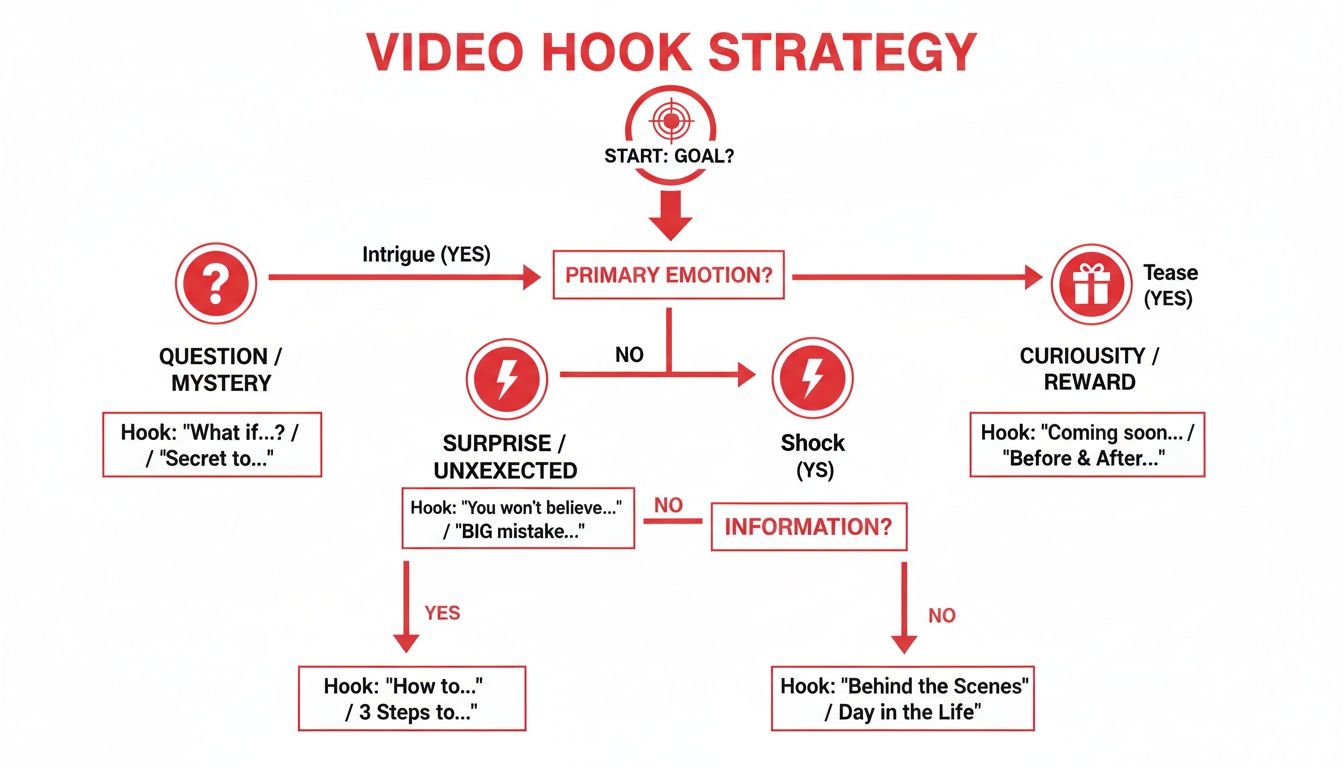
    The hook you chose actually sets the stage for the entire structure. If you promised a shocking result, the body of your video needs to build up to that reveal logically. This decision tree shows just how interconnected your hook and your content structure really are.

    Flowchart illustrating a video hook strategy, guiding through emotional paths and providing example hook phrases.

    As you can see, the emotional trigger of your hook—whether it's curiosity, shock, or empathy—directly informs the kind of journey your script needs to take the viewer on.

    Frameworks That Keep Viewers Watching

    You wouldn't use the same script structure for a personal vlog and a complex software tutorial, right? Choosing the right narrative framework is about more than just organizing your points; it's about creating a psychological flow that keeps people glued to the screen.

    Here are a few battle-tested frameworks I’ve seen work wonders on YouTube:

    • Problem-Agitate-Solve (PAS): This is pure gold for tutorials, reviews, or any content that solves a problem. Start by defining a pain point everyone recognizes (the Problem). Really dig into why it’s so frustrating (the Agitate part). Then, you ride in like a hero with the Solution—the core value of your video.
    • What-Why-How: Perfect for educational content. You start simple by defining the concept (What is it?). Then you sell them on its importance (Why does it matter?). Finally, you deliver the goods with actionable steps (How do you do it?). It’s clean, logical, and incredibly effective.
    • Chronological Storytelling: This is the natural fit for vlogs, travel diaries, or case studies. You’re simply walking the viewer through events as they happened. The magic here is in building a narrative with a clear beginning, a messy and interesting middle, and a satisfying end.

    Picking one of these frameworks upfront makes the entire scripting process a thousand times easier. It gives you a backbone to build upon, ensuring your final video feels complete and satisfying.

    A well-chosen structure does more than just organize your talking points. It creates a rhythm and pace that guides the viewer's emotional journey, making your content feel more compelling and memorable.

    Maintaining Momentum with Pacing and Transitions

    Your structure is the skeleton, but pacing is the heartbeat that keeps your video alive. Nothing kills a video faster than a long, monotonous section or a jarring jump between topics. You have to actively manage the viewer's energy from start to finish.

    A simple but powerful trick is to use verbal signposts. These are just short phrases that orient the viewer. Something as simple as, "Okay, now that we've covered the basics, let's get into the advanced stuff…" works wonders. It signals a shift and gives the viewer's brain a micro-second to reset and re-engage.

    Another must-have tool is the pattern interrupt. This is any change—visual or auditory—that breaks up the flow and jolts the viewer back to attention.

    Here are a few ways to script these in:

    • Change of Scenery: In your script, make a note to cut to a B-roll shot or punch in with a different camera angle.
    • On-Screen Text: I often write things like [TEXT ON SCREEN: Key Takeaway] directly into my script to remind me to add visual emphasis later.
    • Sound Effects: A quick "whoosh" or "ding" when a graphic appears can be surprisingly effective at recapturing focus.

    These little interruptions are like mini-refreshers that prevent viewing fatigue. By planning them in your script, you're not just hoping for an engaging video—you're engineering one.

    Writing an Outro That Drives Action

    Let's be honest, the end of your video is just as crucial as the beginning. A weak ending just… fizzles out. It leaves your viewer staring at a grid of suggested videos, ready to click away and forget all about you. But a powerful ending? That’s your chance to turn a casual viewer into a real part of your community, converting a single view into a long-term fan.

    So many creators throw away their final seconds with a tired, forgettable "Thanks for watching, like and subscribe!" It’s a plea, not a plan. Think of your outro as prime real estate. You need to guide your audience toward one specific, meaningful action that actually matters to your channel's goals. Don't just ask them to do something; tell them exactly what to do and why it's the best next step for them.

    Moving Beyond the Generic CTA

    A strong Call to Action (CTA) isn't a desperate request; it's a confident recommendation. It should feel like the natural next step in the journey you just took your viewer on. When you're scripting this part of your script for a youtube video, the golden rule is to keep it singular and crystal clear. Hitting them with "like, comment, subscribe, hit the bell, and follow me on Instagram" just creates decision paralysis, and they'll end up doing nothing at all.

    Instead, pick one primary goal for that specific video and lean into it.

    • Want more watch time? "If you found this helpful, you're going to love my deep-dive on [Related Topic]. I've linked it right here on the screen—it's the perfect video to watch next."
    • Need to boost engagement? "I'm genuinely curious—what's the single biggest challenge you're facing with [Topic]? Drop a comment below, I read every single one and I'd love to help out."
    • Trying to grow your email list? "I actually put together a free one-page checklist that walks you through this entire process. You can grab it by clicking the first link in the description."

    See the difference? Each example is direct and continues to offer value. You’re not just asking for a favor; you're handing them another resource. This simple shift frames the action as a win for the viewer, not just for you.

    Summarize and Reinforce Value

    Right before you hit them with that CTA, take a quick beat to summarize the video's core takeaway. This does two things: it reinforces the value you just provided and makes the viewer feel smart for having watched. It solidifies the main point in their mind and reminds them that their time was well spent.

    This isn't a long, drawn-out recap. A single, punchy sentence is all you need.

    A killer outro serves two purposes: it recaps the value you delivered and provides a clear path forward. It makes the viewer feel accomplished and gives them a reason to stick around.

    For a cooking video, it might be as simple as, "And there you have it—three simple steps to a perfect sourdough starter. Just remember, patience and consistent feeding are everything." This neatly packages the entire video before you pivot to what you want them to do next.

    Scripting for YouTube's End Screen

    You have to script with YouTube's end screen elements in mind. Those clickable video or playlist suggestions pop up in the final 5-20 seconds of your video, and if you haven't planned for them, they'll just awkwardly appear over your face while you're still talking.

    Design the last few lines of your script to perfectly accommodate these visuals. The best creators I know verbally direct attention right to them. It feels incredibly natural.

    Here’s how that might sound in a script:

    "So that's my complete breakdown of how I plan my content. Now, if you want to see this exact method in action, you should watch my video on scripting next. I've put it right up here on the screen for you. And to make sure you don't miss future guides, just click my face over here to subscribe. Thanks for watching, and I'll see you in the next one."

    This simple technique transforms the end screen from a passive feature into an interactive part of your content. When you plan for it in your script, you create a seamless, professional finish that actively encourages viewers to keep watching—a huge signal to the YouTube algorithm that your content is worth binging.

    Using AI to Write Better Scripts, Faster

    Let's shift from theory to technology. AI tools have become a creator's secret weapon for writing a high-quality script for a youtube video without the usual burnout. This isn't about having a robot do all the work. It's about having a creative co-pilot to help you navigate the tricky parts, from brainstorming ideas to adding that final polish.

    Think about it. You're staring at a blank page, totally stuck on a video idea. An AI idea generator can take one simple keyword and spit out dozens of potential titles, hooks, and content angles in seconds. This is how you instantly smash through writer's block. You're not starting from scratch anymore; you have a foundation to build on. It's all about boosting your own creativity, not replacing it.

    Fine-Tuning Your Script with Data

    Beyond just brainstorming, AI is incredible at optimization. Let's say you have a few strong title ideas. A good tool can analyze which one is most likely to catch a viewer's eye based on actual search behavior. Right from the start, you're building your script around a concept people are already looking for, which massively boosts your video's chances of getting discovered.

    This data-first approach takes a lot of the guesswork out of the equation. You're no longer just hoping your script will land with your audience; you're making smart decisions backed by real-world search patterns. We've actually put together a deep dive on how to use a YouTube video title generator that shows exactly how this works.

    The ViewsMax AI Script Generator, for instance, can create a full outline based on a title you know has potential.

    As you can see, you can pop in a title and get a structured script with an intro, main points, and an outro. Think of all the time that saves.

    Key Takeaway: The real power of AI scriptwriting tools is in ideation and structure. They build the skeleton; you add the personality, stories, and unique insights that make it your content.

    As you start working with AI, knowing how to rewrite AI text to sound perfectly human is the most important skill you can develop. The goal is to let the AI handle the speed and structure, then you come in and infuse it with your own voice. This hybrid approach lets you create better, more optimized videos in a fraction of the time, so you can focus more on what you love—filming and connecting with your audience.

    Got Questions? We've Got Answers

    Diving into scriptwriting for YouTube can feel a bit overwhelming, and it's natural for questions to pop up. Let's tackle some of the most common ones we hear from creators.

    How Long Should My YouTube Script Actually Be?

    If you're looking for a quick rule of thumb, aim for about 150 to 170 words for every minute of video. That means a typical 10-minute video script would be around 1,500 to 1,700 words long.

    But that's just a guideline, not a hard-and-fast rule.

    The real answer is hidden in your YouTube Analytics. Check out your audience retention graphs—they’ll show you exactly where people stop watching. This data is gold because it reveals the sweet spot for video length that keeps your specific audience hooked.

    Full Script vs. Bullet Points: Which is Better?

    This one really boils down to your personal style and the type of video you're making. Honestly, there's no single right way to do it, and you'll find top creators in both camps.

    • A full, word-for-word script is a lifesaver when you're starting out. It takes all the pressure off, so you can focus on your delivery. It's also perfect for really detailed, technical topics or sponsored videos where you need to get the messaging just right.

    • A bullet-point outline gives you a much more spontaneous, off-the-cuff feel. This is great for vlogs, commentary, or live streams where you want your personality to come through loud and clear without sounding like you're reading from a teleprompter.

    Pro-Tip: Try a hybrid approach. Many seasoned creators fully script their intro and outro—to nail the hook and CTA—but use bullet points for the main body. It's the best of both worlds, giving you structure where it counts and freedom where you need it.

    Can AI Genuinely Help with Writer's Block?

    Yes, one hundred percent. Think of AI tools as the ultimate brainstorming partner. When you're staring at a blinking cursor with no idea where to start, an AI idea generator can spit out dozens of video titles, fresh angles on a topic, or killer hooks from just one keyword.

    You can also have it generate a complete outline for your video. It gives you a solid skeleton to work with, which is way less intimidating than a blank page.


    Ready to put this into action and start writing scripts that get results? The AI-powered tools from ViewsMax are designed to help you brainstorm, outline, and refine your content in a fraction of the time. Start creating smarter scripts with ViewsMax today.

  • Best video ideas for youtube: how to boost views and subscribers

    Best video ideas for youtube: how to boost views and subscribers

    Every successful YouTube channel is built on a foundation of great ideas. Yet, staring at a blank content calendar can be one of the most daunting tasks for any creator, from independent vloggers to established brands. The pressure to innovate, engage, and align with the ever-shifting algorithm can lead to creative burnout before you even press record. But what if you had a proven playbook of high-impact video concepts that consistently resonate with viewers and drive channel growth? Finding your next hit requires more than just luck. To truly find your next viral hit, it's essential to understand the principles behind how to create viral content that resonates with a broad audience.

    This guide moves beyond generic advice. It's a strategic breakdown of the 12 best video ideas for YouTube, meticulously categorized by format and goal to give you a clear path forward. We'll explore why each format works, who it's best for, and provide actionable templates, filming tips, and title examples to help you move from brainstorming to publishing faster. This isn't just about filling your schedule; it's about making every video count.

    Whether you're just starting and need foundational concepts or you're a seasoned creator looking to scale and diversify your content, these proven frameworks will help you create videos that not only get clicked but also build a loyal, engaged community. We will dissect each idea, offering you a complete toolkit to execute with precision and confidence, turning that blank slate into your next breakthrough video.

    1. Tutorial and How-To Videos

    Tutorial and how-to videos are evergreen content powerhouses and one of the best video ideas for YouTube creators seeking sustainable growth. This format directly addresses a user's need by providing step-by-step instructions to solve a problem, learn a skill, or complete a task. Because viewers actively search for solutions, these videos generate highly targeted, long-term traffic.

    From Marques Brownlee breaking down new tech features to a niche channel teaching a specific crochet stitch, tutorials build authority and trust. They establish you as the go-to expert in your field. This format works across nearly every niche, including tech, beauty, finance, cooking, and gaming.

    How to Implement This Idea

    • Hook with the Result: Start your video by showing the finished product or the successful outcome. A 10-second clip of the perfectly decorated cake or the flawlessly running software immediately validates your expertise and hooks the viewer.
    • Structure for Clarity: Break down complex processes into simple, numbered steps. Use on-screen text and graphics to highlight key actions, tools, or commands. This makes the information easier to follow and retain.
    • Optimize for Search: Title your video as a direct answer to a question (e.g., "How to Change a Flat Tire" instead of "My Guide to Car Maintenance"). Add timestamps in the description to help viewers navigate to specific steps and boost your video's SEO.
    • Write a Detailed Outline: A well-structured plan is crucial for a clear tutorial. To learn how to create an effective outline, check out our guide on how to script for YouTube videos.

    2. Trend-Jacking and Current Events Commentary

    Tapping into current events and viral trends is a powerful strategy and one of the best video ideas for YouTube creators aiming for explosive short-term growth. This format involves creating timely content that comments on, explains, or reacts to trending topics, news stories, or internet challenges. The key is capitalizing on the massive, temporary surge in search volume and viewer interest for that topic.

    This approach works because it leverages the algorithm's tendency to promote fresh, relevant content that people are actively seeking out. From Philip DeFranco breaking down complex news stories to gaming channels reacting to a surprise game announcement, trend-jacking positions your channel at the center of the conversation. It's a high-risk, high-reward strategy that can rapidly introduce your channel to a massive new audience.

    How to Implement This Idea

    • Act with Speed and Precision: Timing is everything. Use tools to monitor emerging trends in your niche and prepare content templates for a fast turnaround. The goal is to publish your video while the topic is peaking, not after it has faded.
    • Offer a Unique Perspective: Don't just repeat what everyone else is saying. Add your unique analysis, humor, or expertise to stand out. Ask yourself: "What new value or different angle can I bring to this conversation?"
    • Optimize for Trending Keywords: Your title and the first few lines of your description are critical. Integrate relevant trending keywords and names naturally to capture search traffic. A title like "My Honest Reaction to the New Apex Legends Trailer" is more effective than "New Game Trailer Thoughts."
    • Balance with Evergreen Content: While trending videos can generate huge view spikes, they have a short lifespan. To understand the dynamics behind these explosive view counts, explore our guide on what makes a YouTube video go viral.

    3. Deep Dive Analysis and Expert Breakdown Videos

    Deep dive analysis videos are comprehensive, long-form explorations of a specific topic, product, or event. This format moves beyond surface-level explanations to offer in-depth research and expert commentary, establishing the creator as a true authority. These videos are some of the best video ideas for YouTube because they attract a dedicated audience seeking thorough, well-researched content.

    This format thrives in niches where complexity and nuance are appreciated. Channels like Johnny Harris, who creates investigative journalism pieces, and Vsauce, who breaks down complex scientific concepts, build immense loyalty by providing unparalleled value. Viewers don't just watch these videos for a quick answer; they watch them to achieve a complete understanding.

    How to Implement This Idea

    • Structure as a Narrative: Frame your analysis like a story or investigation. Start with a compelling question or mystery, present evidence and data throughout the middle, and conclude with a satisfying synthesis or answer. This keeps viewers engaged through longer runtimes.
    • Visualize Complex Data: Use motion graphics, charts, and archival footage to make complex information digestible. Visual aids are crucial for maintaining clarity and preventing viewer fatigue during detailed explanations.
    • Optimize for Long-Form Content: Your title should clearly state the topic and promise a thorough analysis (e.g., "The Complete History of the Console Wars: An Expert Breakdown"). Use timestamps and chapters in the description to help viewers navigate the video. This improves user experience and provides valuable SEO data to YouTube.
    • Show Your Work: Reference your sources, show your research process, and explain your methodology. This transparency builds credibility and trust, reinforcing your position as a reliable expert on the subject.

    4. Personal Story and Vlog Content

    Personal story and vlog content are among the best video ideas for YouTube because they forge a powerful, direct connection with an audience. This format centers on your authentic life experiences, daily routines, challenges, and personal growth. By sharing your journey, you invite viewers into your world, building strong parasocial relationships that translate into a dedicated and loyal community.

    This narrative-driven approach is what propels channels like Casey Neistat’s daily vlogs and Emma Chamberlain’s relatable lifestyle content. It moves beyond simple information delivery and creates an emotional investment. Viewers don't just watch for a specific solution; they return for you, the creator, and the ongoing story you are telling. This format excels at building a true fanbase that supports you long-term.

    How to Implement This Idea

    • Find Your Narrative Arc: Don't just record your day. Structure your vlog around a mini-story with a beginning, middle, and end. Whether it's tackling a specific challenge or working towards a goal, a clear narrative hook will keep viewers engaged.
    • Embrace Authenticity: Share genuine vulnerabilities and struggles, not just a highlight reel. Audiences connect deeply with realness. This builds trust and makes your successes feel more earned and inspiring.
    • Establish a Consistent Rhythm: Vlogs thrive on consistency. A regular upload schedule, whether daily or weekly, creates a viewing habit. Your audience begins to look forward to your content as part of their routine.
    • Balance Personal and Value-Driven Content: While the focus is on your story, weave in valuable takeaways for the viewer. For example, a travel vlog can also offer travel tips, or a "day in the life" of a programmer can include productivity hacks. This broadens your appeal and provides tangible value.

    5. Challenge and Experiment Videos

    Challenge and experiment videos tap into our innate curiosity, making them a powerful format for generating viral potential and high engagement. This idea involves undertaking a specific, rule-based task or test with a clear beginning, middle, and end. Viewers are drawn in by a compelling question: What will happen if…? This format thrives on suspense, entertainment, and the satisfaction of seeing a definitive outcome.

    Whether it's MrBeast attempting an audacious philanthropic stunt or a fitness creator trying a celebrity's workout routine for 30 days, these videos create a natural story arc. They are shareable, highly replayable, and work across countless niches, from gaming and science to lifestyle and comedy. This is one of the best video ideas for YouTube if you want to create memorable, high-impact content.

    A man preparing food at a wooden table, with camera equipment and a "The Challenge" sign in the background.

    How to Implement This Idea

    • Define Clear Stakes and Rules: Open the video by immediately stating the challenge, the rules, and what's at stake. For example, "I'm going to eat only gas station food for 24 hours to see if it's possible to eat healthy on the road." This creates an instant hook.
    • Document the Journey, Not Just the Result: The most engaging challenge videos show the struggle, the funny moments, and the unexpected setbacks along the way. Use B-roll, confessionals, and progress updates to build a compelling narrative that keeps viewers invested.
    • Engineer a Satisfying Climax: Structure your video to build tension toward the final reveal or outcome. Use dramatic music, quick cuts, and a clear "before and after" comparison to make the conclusion feel impactful and worthwhile for the viewer.
    • Leverage Trends: Keep an eye on popular challenges within your niche or on platforms like TikTok and adapt them for your channel. Adding your unique spin to a trending challenge can expose your content to a much wider audience.

    6. Comparison and Ranking Videos

    Comparison and ranking videos are a cornerstone for channels aiming to become a trusted authority in their niche. This format directly assists viewers in their decision-making process by evaluating multiple products, services, or ideas against each other based on specific criteria. Because these videos address high-intent search queries like "Product A vs. Product B" or "Best [Category] of the Year," they attract a highly engaged audience actively looking for a definitive answer.

    From tech reviewers like Marques Brownlee ranking smartphones to finance channels comparing investment platforms, this format builds credibility and serves a direct viewer need. They are an excellent choice for creators looking to generate affiliate revenue, as they naturally lead into purchase decisions. This is one of the best video ideas for YouTube creators who want to establish themselves as an expert.

    How to Implement This Idea

    • Establish Clear Criteria: Before you begin, define a transparent scoring or ranking system. Tell your audience exactly what metrics you are using to judge the items, such as price, performance, ease of use, and overall value. This makes your final ranking feel objective and trustworthy.
    • Visualize the Comparison: Use split screens, tables, and on-screen graphics to show side-by-side comparisons. Visual data helps viewers quickly understand the key differences and reinforces your points more effectively than just talking about them.
    • Address Common Questions: Research the most common "versus" queries in your niche. Structure your video to answer the questions your audience is already asking, such as which option is better for beginners, for a specific budget, or for advanced users.
    • Balance Data with Opinion: Present hard data and quantifiable metrics, but don't be afraid to include your subjective experience. A personal recommendation based on your expertise often provides the final piece of information a viewer needs to make a decision.

    7. Educational Series and Course-Style Content

    Creating an educational series is one of the best video ideas for YouTube creators aiming to build a loyal, dedicated community. This format delivers a comprehensive curriculum on a specific topic over multiple, sequential videos, transforming your channel into a go-to learning hub. Unlike one-off tutorials, a course-style series encourages binge-watching, significantly boosting watch time and session duration.

    This structured approach positions you as a definitive expert, fostering deep trust with your audience. Channels like Crash Course, which breaks down complex subjects like history and biology, or coding instructors who offer complete web development series, use this format to cultivate a highly engaged subscriber base that returns week after week for the next lesson.

    How to Implement This Idea

    • Create a Clear Curriculum: Before filming, outline the entire series from start to finish. Plan each video as a self-contained lesson that logically builds on the previous one. This ensures a cohesive learning experience and helps viewers track their progress.
    • Organize with Playlists: Group all videos from a series into a single, ordered playlist. Title your videos clearly (e.g., "Lesson 1: Introduction to Python," "Lesson 2: Variables and Data Types"). This makes navigation intuitive and encourages viewers to watch the next episode.
    • Hook with the Final Skill: Begin your series trailer or the first video by showcasing the impressive final skill or project viewers will be able to master by the end. This provides a powerful incentive for them to commit to the entire course.
    • Foster a Learning Community: Encourage viewers to ask questions in the comments and consider creating a dedicated space like a Discord server or Facebook Group. This community aspect adds immense value and keeps learners engaged between lessons.

    8. Reaction and Commentary Videos

    Reaction and commentary videos are a popular format where creators record themselves watching and responding to another piece of media. This could be a movie trailer, a viral TikTok, a music video, or even another YouTube video. While simple in concept, the best reaction videos offer more than just passive viewing; they provide unique insight, expert analysis, or genuine comedic value that transforms the original content into something new.

    This format thrives on leveraging existing trends and popular culture, making it one of the best video ideas for YouTube creators looking to tap into a pre-existing audience. From a music producer breaking down the layers of a hit song to the Try Guys reacting to bizarre internet trends, these videos build a connection with viewers through shared experience and authentic, in-the-moment responses. They establish the creator's personality and point of view.

    How to Implement This Idea

    • Add Genuine Value: Don't just watch silently. Provide a unique perspective that the audience can't get elsewhere. If you're a fitness coach, react to celebrity workout routines with professional critiques. If you're a comedian, find the humor in viral clips. Your commentary is the product.
    • Use a Picture-in-Picture Format: Ensure your face and reactions are clearly visible and engaging throughout the video. Your expressions are a key part of the storytelling. Position your camera feed in a corner so it doesn't obstruct important parts of the source media.
    • Respect Fair Use: To avoid copyright strikes, only use short, transformative clips of the original content. Add significant commentary, criticism, or parody to justify its inclusion. Never re-upload the entire original video with your camera feed on top.
    • Optimize for a Specific Angle: Your title should clearly state your unique perspective. Instead of a generic "Reacting to New Taylor Swift Song," use a more specific and searchable title like "Vocal Coach Reacts to Taylor Swift's New Song."

    9. Listicle and Top 10/25/100 Videos

    Listicle videos are a cornerstone of discoverable content and one of the best video ideas for YouTube creators aiming for broad appeal. This format packages information into an easily digestible, numbered list that ranks or compiles items, products, or concepts. Viewers are naturally drawn to the structure and curiosity of rankings, making titles like "Top 10" or "5 Best" incredibly click-friendly and shareable.

    This format thrives on its versatility and searchability. From WatchMojo's pop culture rankings to a tech channel's "Top 5 Gadgets of the Year," listicles create anticipation and discussion. They work exceptionally well because they promise a finite, organized, and valuable piece of content, encouraging high click-through rates and session watch times as viewers wait to see what makes the cut.

    How to Implement This Idea

    • Create a Compelling Hook: Start by teasing the number one pick or a controversial entry in your list within the first 15 seconds. This creates immediate intrigue and gives viewers a strong reason to watch until the end to see the full ranking and justification.
    • Structure for Engagement: Strategically order your list to maintain viewer interest. You might place a surprising or lesser-known item in the middle to break up expectations. Use chapter markers in your description so viewers can easily navigate the video.
    • Optimize for Search: Title your video with clear numerical and ranking keywords like "Top 10 [Topic] for 2024" or "7 Best Ways to [Achieve Goal]." This directly targets high-intent search queries from users looking for curated recommendations.
    • Keep it Visually Dynamic: Use on-screen graphics to display the number and title of each item as you introduce it. Incorporate relevant B-roll, images, or short clips for each list entry to keep the visual presentation fresh and engaging, preventing viewer drop-off.

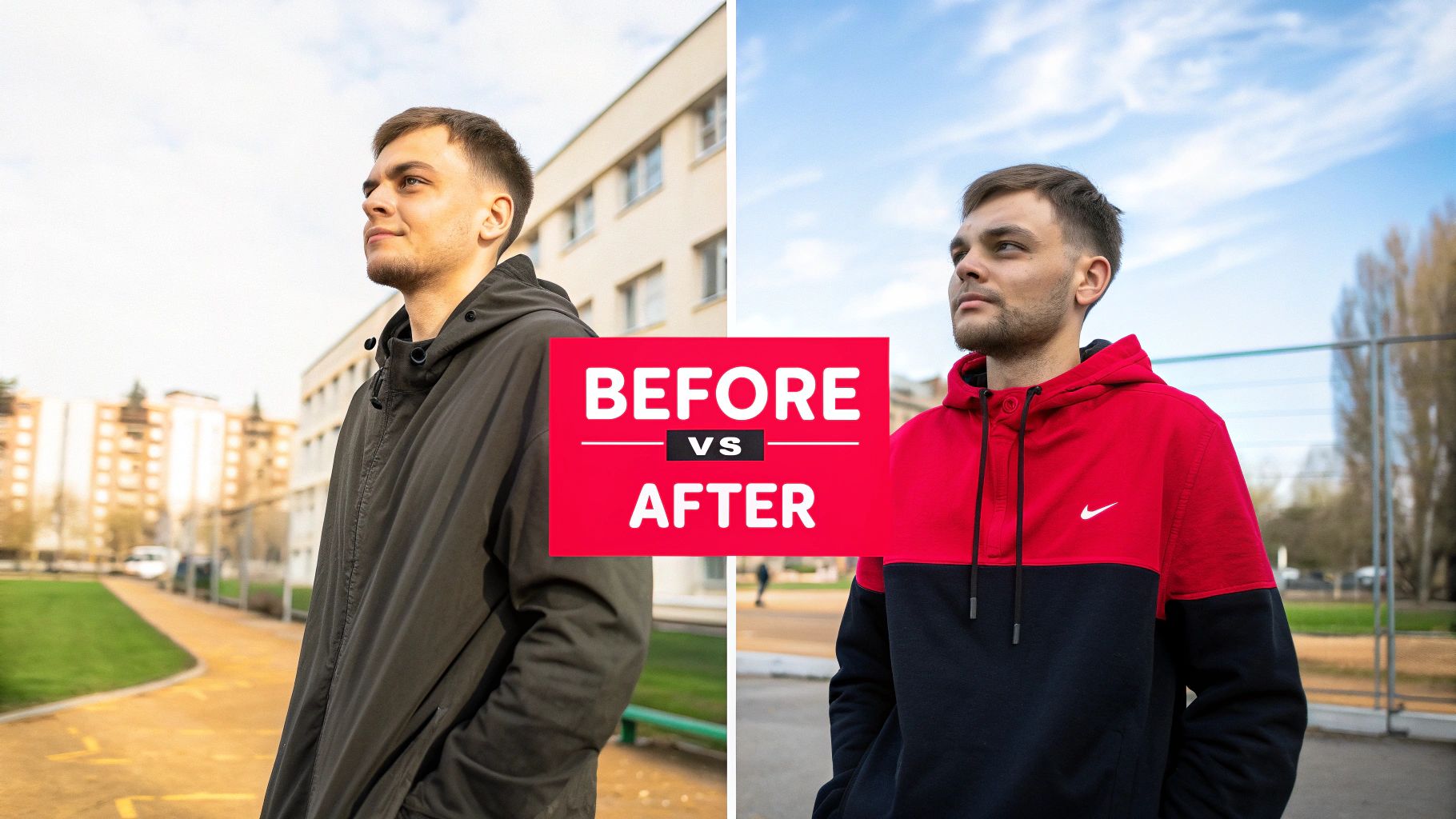
    10. Before and After Transformation Videos

    Transformation videos are one of the best video ideas for YouTube because they tap into a fundamental human desire for growth and improvement. This format documents a significant change over time, showing a clear "before" state, the journey, and the final "after" result. The built-in narrative arc is inherently satisfying and provides viewers with motivation, inspiration, and a tangible sense of accomplishment.

    A split image showing a man's fashion transformation from a black jacket to a red Nike hoodie.

    This idea works across countless niches, from Chloe Ting's legendary fitness challenges to HGTV-style home renovations and personal finance debt-free journeys. The key is showcasing a measurable and visually compelling change that resonates with your audience's goals and aspirations, establishing a powerful emotional connection.

    How to Implement This Idea

    • Document the "Before" Thoroughly: Don't rush the starting point. Capture high-quality footage of the "before" state from multiple angles. For a room makeover, this means empty shots, close-ups of problem areas, and wide views. For a fitness journey, it means recording initial stats, feelings, and goals.
    • Show the Process, Not Just the Result: The transformation journey is where the story unfolds. Create a series or compile clips that show the work being done, including the struggles and small victories. This authenticity builds trust and makes the final reveal more impactful.
    • Create a Compelling Narrative: Frame the transformation with a story. Explain why you started this journey. What was the motivation or pain point? This context gives viewers a reason to invest emotionally in your success.
    • Be Honest About Setbacks: Perfection is not relatable. Share moments when things went wrong, progress stalled, or you felt discouraged. Discussing these challenges makes the content more authentic and provides valuable lessons for viewers on their own journeys.

    11. Niche Expertise and Authority Content

    Establishing yourself as an authority in a specific, underserved area is one of the best video ideas for YouTube creators looking to build a loyal and highly engaged audience. This format involves creating focused content that showcases your specialized knowledge, credentials, or skills, turning your channel into a go-to resource for a dedicated community seeking expert information.

    Channels like Patrick Boyle on finance or Kurzgesagt on complex science demonstrate the power of this approach. By diving deep into topics that mainstream creators only touch on, you build immense credibility and attract viewers who value substance over spectacle. This strategy is perfect for professionals, academics, or passionate hobbyists who possess deep knowledge in a particular field.

    How to Implement This Idea

    • Validate Niche Demand: Before committing, ensure there's an audience actively searching for your expertise. A niche with passionate searchers is more valuable than a broad topic with passive viewers. To discover untapped areas, explore our list of YouTube channel ideas for inspiration.
    • Establish Credibility Early: In your video introduction, briefly state your qualifications or experience. For example, an architect could say, "As a licensed architect with 15 years of experience, I'm going to show you three common mistakes in home design." This immediately builds trust.
    • Create Pillar Content: Develop comprehensive, foundational videos that cover the core principles of your niche. These "pillar" videos act as a definitive resource that you can link back to in future content, reinforcing your authority and boosting watch time across your channel.
    • Cite Sources and Data: Back up your claims with evidence, research, and data. Displaying sources on-screen or linking to them in the description strengthens your arguments and positions you as a trustworthy educator, not just an opinionated dispenser of information.

    12. Collaborative and Crossover Videos

    Collaborative videos are a powerful growth accelerator and one of the best video ideas for YouTube creators looking to expand their reach exponentially. This format involves partnering with another creator to produce content together, effectively cross-promoting to each other's audiences. This strategy introduces your channel to a new, yet relevant, group of viewers who are likely to subscribe because they already trust your collaborator's recommendation.

    From massive creator events hosted by MrBeast to a niche expert co-hosting a video with a peer, collaborations build community and generate excitement. They break up your regular content schedule with a fresh dynamic and allow you to create something that wouldn't be possible alone. This format is effective across all niches, as it leverages the simple power of a trusted endorsement.

    How to Implement This Idea

    • Find a Strategic Partner: Identify creators whose audience demographics overlap with your target but aren't direct competitors. Look for channels similar in size and engagement to propose a mutually beneficial partnership. Ensure their brand values align with yours to maintain authenticity.
    • Create Unique, Blended Content: Brainstorm a video concept that merges both of your styles and expertise. A challenge video, a joint review, or a debate-style discussion can showcase both personalities effectively. The goal is to create content that feels special and distinct from your usual uploads.
    • Establish Clear Expectations: Before filming, create a simple agreement outlining content ownership, the publishing schedule (e.g., one video on each channel), and the promotional strategy. Decide who is responsible for editing and how both channels will be tagged and linked.
    • Maximize Cross-Promotion: Both creators should promote the collaboration heavily on all social media platforms before, during, and after the launch. Tease the video with behind-the-scenes content and encourage both audiences to check out the other creator's channel and video.

    12 YouTube Video Ideas Comparison

    Format 🔄 Implementation Complexity ⚡ Resource Requirements 📊 Expected Outcomes (impact) 💡 Ideal Use Cases ⭐ Key Advantages
    Tutorial and How-To Videos Moderate — structured scripting and clear steps Moderate — camera, screen capture, editing time High evergreen traffic; strong SEO and retention Educators, tech/software, DIY, gaming Builds authority; consistent monetization
    Trend-Jacking and Current Events Commentary High — fast turnaround and monitoring required Low–Moderate — quick editing & trend tools Short-term explosive visibility; unpredictable longevity News, entertainment, gaming launches Rapid reach and new audience acquisition
    Deep Dive Analysis and Expert Breakdown Videos High — extensive research and sourcing High — research time, high production quality Strong authority, long watch time, loyal viewers Tech, business, educational channels High credibility; sponsorship-friendly
    Personal Story and Vlog Content Moderate — consistent schedule and narrative planning Low–Moderate — portable gear; regular editing Slow-to-steady subscriber growth; high loyalty Personal brands, lifestyle, wellness Deep audience connection; repeat viewership
    Challenge and Experiment Videos Moderate — careful rules and ethical planning Moderate–High — props, production, sometimes budget High engagement and viral potential; variable ROI Entertainment, lifestyle, gaming Very shareable; strong CTR and series potential
    Comparison and Ranking Videos Moderate — clear criteria and fair testing Moderate — access to multiple items or data High purchase-intent traffic; strong affiliate potential Tech, finance, product review channels Excellent SEO for "vs"/"best" queries; conversion-friendly
    Educational Series and Course-Style Content High — curriculum design and sequencing High — sustained production and materials Highest retention and binge rates; course upsell potential Course creators, programming, language learning Long-term authority and predictable revenue
    Reaction and Commentary Videos Low — minimal setup; quick edit possible Low — basic recording/editing tools Fast to publish but often lower watch time and monetization Entertainment, niche expert reactions Quick content cadence; leverages existing trends
    Listicle and Top 10/25/100 Videos Low — simple structure and ordering Low–Moderate — research and concise edits High CTR and evergreen search traffic; crowded space Pop culture, tech, lifestyle, gaming Easy production; strong clickability and series potential
    Before and After Transformation Videos High — long-term commitment and documentation Moderate — recurring production over time Very high engagement and emotional impact; series growth Fitness, makeover, business pivots, renovations Strong completion rates and shareability
    Niche Expertise and Authority Content High — deep subject mastery required Moderate–High — research, credibility-building Smaller audience but high engagement and premium deals Professional, academic, consultant channels Low competition; high perceived value and retention
    Collaborative and Crossover Videos High — coordination, brand alignment, logistics Moderate — shared resources; cross-promo effort Immediate audience expansion; variable long-term gain Entertainment, growth-focused creators, education Rapid subscriber growth; creative freshness through partners

    From Idea to Impact: Your Next Steps to YouTube Growth

    You've just navigated a comprehensive library of the best video ideas for YouTube, from in-depth Tutorials and authority-building Deep Dives to engaging Challenge videos and community-focused Vlogs. This list is more than just a collection of concepts; it's a strategic toolkit designed to equip you for consistent, sustainable growth on the world's largest video platform. The journey from a stagnant channel to a thriving community begins with a single, well-executed idea, and now you have dozens to choose from.

    The most crucial takeaway is this: success on YouTube is not about finding one "magic" video format. Instead, it’s about building a robust and diverse content ecosystem. Think of your channel as a portfolio where different video types serve distinct but complementary purposes.

    • Attraction Videos: These are your wide-net assets. Trend-Jacking, Listicle, and Comparison videos are excellent for capturing search traffic and attracting new viewers who are looking for specific answers or entertainment.
    • Authority Videos: These formats establish your credibility. Deep Dive Analyses, Niche Expertise content, and Educational Series position you as a go-to resource, building trust with your audience.
    • Connection Videos: These build your community. Personal Stories, Vlogs, and behind-the-scenes content foster a loyal subscriber base that tunes in for you, not just for the topic.

    Turning Concepts into High-Performing Content

    Having a list of ideas is the starting point, but execution is what separates fleeting interest from lasting impact. The difference often lies in your ability to adapt and innovate. Don't be afraid to blend formats. A Personal Story can be woven into a Tutorial to make it more relatable. A Reaction video can be elevated with Deep Dive analysis to provide more value than a simple surface-level response.

    Furthermore, maximizing the reach of each video is non-negotiable for growth. Every long-form video you create is a potential goldmine of shorter, more shareable content. For example, a 15-minute "Top 10 Gadgets" listicle can be broken down into ten individual Shorts, each highlighting a single product. A powerful strategy for repurposing content and reaching new audiences is to learn how to create YouTube Shorts from existing videos, allowing you to multiply your output without multiplying your workload.

    Your Action Plan for YouTube Growth

    To move from passive reading to active creation, here are your immediate next steps:

    1. Select Your "Trifecta": Choose three distinct video ideas from the list above. Pick one for attraction, one for authority, and one for connection. This ensures you are building a balanced content strategy from the start.
    2. Plan Your Angle: For each chosen idea, define your unique perspective. What fresh take can you bring to a "Before and After" video? How can your personal experience make a "Deep Dive" more compelling?
    3. Commit to a Schedule: Consistency is the engine of the YouTube algorithm. Map out these first three videos on a calendar and commit to producing and publishing them. The momentum you build is invaluable.

    The path to YouTube success is a marathon, not a sprint. It's built upon a foundation of smart ideas, consistent execution, and a deep understanding of what your audience values. Use this guide as your blueprint, experiment with different formats, and never stop learning. Your next breakout video is not a matter of luck; it's a matter of strategic creation.


    Ready to turn these ideas into high-performing videos with less guesswork? ViewsMax is the ultimate AI toolkit for YouTube creators, helping you analyze trends, generate unlimited data-driven video ideas, and write scripts that captivate your audience. Stop guessing what works and start creating content you know will perform.

  • How to Start a Successful youtube channel: Quick Growth Tips

    How to Start a Successful youtube channel: Quick Growth Tips

    Starting a YouTube channel is about more than just hitting the record button—it's about building a brand from the ground up. The journey breaks down into three core phases: defining your niche, getting to know your specific audience, and then building a content plan that speaks directly to them. Nail this foundation, and you're already ahead of the game.

    Laying the Foundation for YouTube Success

    Before you even think about cameras or fancy editing software, the real work begins. This initial planning phase is your channel's blueprint; it provides the purpose and clear direction you'll need to stand out. It’s easy to get lost in the sea of generic advice, but a strategic start is what separates channels that thrive from those that just… exist.

    The secret sauce is balancing your genuine passion with what people are actually searching for. You have to find that sweet spot where what you love to create meets an audience that's hungry for it. Sure, you might be passionate about competitive dog grooming, but if only a handful of people are looking for it, building a sustainable channel will feel like an endless grind.

    Define Your Unique Niche

    Your niche is your specific corner of the internet. It's the topic that makes your channel the go-to resource for a particular group of people. Getting this right is what makes a viewer click on your video instead of the ten others in their feed. When you focus on a specific subject, you attract a dedicated, highly engaged audience that actually cares about what you have to say.

    Think about it this way—don't just be broad, get specific:

    • Instead of "Cooking," try "30-Minute Vegan Meals for Busy Professionals."
    • Instead of "Gaming," how about "Indie Horror Game Walkthroughs with No Commentary"?
    • Instead of "Fitness," you could do "Low-Impact Workouts for Seniors with Joint Pain."

    A focused niche helps the YouTube algorithm figure out exactly who to show your videos to, which can really kickstart your early growth. From day one, it's crucial to understand how to grow a YouTube channel fast with proven strategies. For more inspiration, we have a detailed guide on finding the https://blog.viewsmax.com/best-niche-for-youtube/.

    This whole foundational process—from niche to audience to plan—is a flow.

    A visual guide to the YouTube channel launch process, detailing steps for Niche, Audience, and Plan.

    As you can see, a solid content plan is built on a clear niche and a deep understanding of your audience.

    To help you think through this, here's a simple framework comparing how different types of niches stack up against key criteria.

    Niche Selection Framework Passion vs Profitability

    Evaluation Criteria High Potential Niche (Example: Gaming) Medium Potential Niche (Example: DIY Home Repair) Low Potential Niche (Example: Personal Vlogs)
    Audience Size Massive and diverse Large but more defined Small, limited to personal network
    Competition Level Extremely high Moderate to high Low to moderate
    Monetization Viability High (ads, sponsors, merch) High (affiliates, sponsors) Low (difficult to monetize)
    Personal Passion Varies by creator Depends on interest High, but niche is yourself

    This table isn't meant to discourage you from personal vlogs, but to highlight the trade-offs. A high-potential niche like gaming has a huge audience but intense competition, while a niche like DIY home repair strikes a good balance for many creators.

    Create Your Ideal Viewer Persona

    Once your niche is locked in, you can get crystal clear on who you're making videos for. Don't just settle for broad demographics like "men aged 18-34." Go deeper. Create a detailed "viewer persona"—give them a name, a job, and a backstory. What are their biggest frustrations? What other channels do they binge-watch? What makes them hit that subscribe button?

    Let's go back to our "30-Minute Vegan Meals" channel. Your persona might be "Stressed-Out Sarah," a 29-year-old marketing manager who works long hours. She wants to be healthy but is totally overwhelmed by complicated recipes. She needs quick, nutritious solutions that don't require a trip to a specialty grocery store.

    From now on, every video idea gets filtered through one simple question: "Would Sarah find this genuinely helpful?"

    Building a successful YouTube channel isn't about appealing to everyone. It's about becoming indispensable to a specific group of people who share a common interest or problem.

    If you’re worried you missed the boat, don't be. The numbers show there's still a massive opportunity. As of January 2025, YouTube's global ad reach hit a staggering 2.53 billion users, and there are around 2.7 billion people logging in every month. With over 113 million active channels out there, the key isn't just to exist, but to carve out your own dedicated space. By laying this strategic foundation, you position yourself to capture a loyal slice of that audience from your very first upload.

    Crafting Content That Captivates Your Audience

    Now that you've laid the groundwork, it's time for the fun part: making the videos. Great content is the heart and soul of any YouTube channel. It's the magnet that pulls in casual viewers and, over time, turns them into a community of loyal subscribers.

    The secret isn't some flash of creative genius for every single upload. Honestly, that’s a recipe for burnout. Instead, the pros build a repeatable workflow—a system for brainstorming, filming, and editing that feels natural and consistently produces high-quality videos.

    Never Run Out of Video Ideas

    Staring at a blank content calendar can be intimidating. The key is to stop thinking about what you want to make and start thinking about what your audience is desperately searching for. What problems are they trying to solve? What questions keep them up at night?

    Here are a few proven frameworks to get your brainstorming sessions rolling:

    • Problem/Solution: Find a common frustration in your niche and offer a clear, step-by-step solution. For a home repair channel, think "How to Finally Fix That Annoying Leaky Faucet." It's direct and solves a real-world problem.
    • Aspirational Content: Give your viewers a glimpse of what's possible. A channel about remote work could create a video like, "A Realistic Day in the Life of a Digital Nomad in Bali."
    • Tutorials & How-To Guides: These are absolute goldmines for evergreen traffic. Break down a complicated process into simple, bite-sized steps that anyone can follow.
    • Reviews & Comparisons: Your audience wants to make smart decisions. Help them by reviewing products, software, or services they're already considering.

    Once you've got a list, run each idea through a simple filter: Would "Stressed-Out Sarah" (our viewer persona from earlier) click on this? If it's a resounding "yes," you've got a winner.

    How to Structure a Video People Actually Watch

    A well-structured video is your best weapon for keeping people watching, which sends a massive positive signal to the YouTube algorithm. Don't just wing it. A little bit of planning makes a world of difference in your audience retention.

    I always recommend the classic Hook, Content, Call-to-Action (CTA) model. It's simple, and it just works.

    1. The Hook (First 15-30 seconds): You have to grab their attention immediately. Start with a bold claim, ask a provocative question, or show them the incredible end result they're about to learn how to achieve.
    2. The Content (The Meat of the Video): This is where you deliver on the promise of your title and thumbnail. Keep your energy high, use visuals to explain your points, and make sure the information is easy to digest.
    3. The CTA (The Big Finish): Don't just let the video end. Tell your viewers exactly what you want them to do next. Ask them to subscribe, leave a comment with their own experience, or check out another one of your videos.

    The first 30 seconds of your video are everything. Analytics consistently show that this is where the biggest drop-off happens. If you can hook them in that initial window, you'll see your average view duration climb dramatically.

    The easiest way to nail this structure is with a script. It doesn't have to be a word-for-word manuscript—even a bulleted list of your main talking points will keep you on track and prevent you from rambling. For a much deeper look, we've put together a full guide on how to write a script for YouTube videos that keeps viewers glued to the screen.

    The Essentials of Production and Editing

    You don't need a Hollywood-level studio to make great videos. In fact, some of the biggest creators started with nothing more than a smartphone. The trick is to focus on the two things that have the biggest impact on how professional your video feels: audio and lighting.

    Here’s a simple breakdown of gear you can get without breaking the bank:

    Equipment Category Budget-Friendly Option (Under $100) Why It Matters
    Audio Lavalier Microphone for Smartphones People will forgive so-so video, but they will not tolerate bad audio. It's an instant click-off.
    Lighting Ring Light or Small LED Panels Good lighting is like magic. It makes even a basic phone camera look sharp and professional.
    Stability Small Tripod or GorillaPod Shaky, handheld footage just looks amateur. A cheap tripod is an easy fix for this.

    When you get to the editing stage, remember that your job is to clarify your story, not to add a million flashy effects. Simple, clean cuts to remove pauses and mistakes are your best friend. Add some light background music to set the tone, and use text on screen to highlight important takeaways.

    Free software like DaVinci Resolve or CapCut is more than powerful enough to get you started. Your main goal is a clean, well-paced video that's easy to follow.

    Mastering the YouTube Algorithm for Maximum Discoverability

    You’ve poured hours into creating an incredible video. That’s a huge win, but it’s just the beginning. To really grow, you need to get your content in front of the right people, and that means understanding the single most powerful force on the platform: the YouTube algorithm.

    Think of the algorithm less as a gatekeeper and more as a very busy matchmaker. Its entire job is to connect viewers with videos they’ll love, keeping them watching for as long as possible. Your goal isn't to "beat" it; it's to give it crystal-clear signals about what your video is and who it's for. When you optimize your content, you’re essentially handing the algorithm a roadmap that leads directly to your ideal audience.

    A vlogger's desk setup featuring a DSLR camera on a tripod, a laptop editing video, and office supplies.

    A great production setup is essential, but discoverability is won after you hit export. It's all about how you package and present your video to both viewers and the algorithm.

    Cracking the Code of Titles and Thumbnails

    Your title and thumbnail are your video's first impression, its digital billboard. They work as a team to make a promise to a potential viewer, and their only job is to earn the click. This is measured by your click-through rate (CTR), arguably one of the most vital metrics for your channel's growth.

    A high CTR tells YouTube, "Hey, when people see this, they want to watch it!" In response, the algorithm shows it to more people. A low CTR sends the opposite signal, suggesting your packaging isn't hitting the mark, and the algorithm will likely stop recommending your video.

    So how do you craft a killer title? It's a blend of art and science. You need to include your main keyword for searchability but also inject some curiosity or an emotional hook to grab attention. Don't be afraid to experiment with different angles that spark interest.

    Your thumbnail has to back up the title's promise. We’re talking high-contrast colors, expressive faces (if you're on camera), and minimal, easy-to-read text. Remember, most people will see it on a tiny phone screen, so it has to be legible and compelling at a glance.

    The Power of Descriptions and Tags

    While they aren't as flashy as your thumbnail, your description and tags are a goldmine for the algorithm. Your video description is where you can really give YouTube the full context of what your video is about.

    Pay close attention to the first two or three lines—that's what shows up in search results. Make them count by summarizing the video's value and naturally including your primary keyword.

    From there, flesh out the rest of the description. It's a great place to add:

    • Timestamps: Help viewers find exactly what they're looking for in longer videos.
    • Helpful Links: Point to resources you mentioned, affiliate products, or your other content.
    • A Call-to-Action: Gently nudge people to subscribe or connect with you elsewhere.

    Tags have become less critical over the years, but they still help provide some extra context. Think of them as supplemental keywords. Add your main keyword, a few variations, and some broader related topics. Just be sure to keep them relevant; keyword stuffing won't do you any favors. For a deeper dive, check out our guide on how to find the right YouTube video keywords.

    A Quick On-Page SEO Checklist

    To make sure you’re hitting all the right notes every single time you upload, it helps to have a system. Following a quick checklist can turn optimization from a chore into a habit, ensuring you give every video its best shot at success.

    On-Page SEO Checklist For Every Video

    Optimization Element Best Practice Impact on Algorithm
    Title Combine a primary keyword with a compelling, curiosity-driven hook. Strong signal for search ranking and a key driver of CTR.
    Thumbnail Use a high-contrast, clear, and emotionally resonant image with minimal text. The #1 factor influencing a viewer's decision to click. High CTR is rewarded.
    Description Write a detailed, keyword-rich summary. Put the most important info in the first 2-3 lines. Provides deep context, improves search visibility, and can house valuable links.
    Tags Use a mix of specific and broad keywords relevant to the video topic. Offers supplemental context to help categorize and recommend your content.
    Timestamps Break down your video into chapters for easy navigation. Improves user experience and can lead to higher audience retention.

    This checklist isn't about gaming the system; it's about communicating clearly. When you consistently provide these signals, you're building a foundation for long-term discovery.

    The takeaway is simple: YouTube rewards videos that keep people on the platform longer. Every element—from your title and thumbnail to your description and tags—should be optimized to attract the right viewer and deliver an experience that makes them stick around.

    Mastering these on-page elements is a repeatable skill. It transforms uploading from a simple task into a strategic move, drastically increasing your chances of reaching the audience you’ve worked so hard to build.

    Getting Your Videos Seen: Launch and Promotion Strategy

    Modern desk with two computer monitors, keyboard, notebook, and pen, one screen displaying 'Boost Discoverability' for video content.

    Hitting "publish" isn’t the end of your work—it’s actually where the real hustle begins. That first 24 to 48 hours after a video goes live is a make-or-break window. During this time, the YouTube algorithm is watching closely, testing your content with a small slice of your audience. The initial numbers—views, watch time, and click-through rate—tell the algorithm whether your video is a hit or a miss.

    A big wave of early engagement sends a clear signal that people are loving your content, which convinces YouTube to show it to more and more viewers. Just sitting back and hoping for views is a recipe for failure. If you want to build a successful channel, you need a plan to give your video a serious push the second it drops.

    Create a Strategic Publishing Schedule

    Consistency is one of the most repeated pieces of advice on YouTube, but it's not just about uploading frequently. It's about being strategically consistent. Stop uploading the minute you finish an edit. Instead, figure out when your audience is actually online and ready to watch.

    Once you’ve published a handful of videos, your YouTube Studio Analytics will become your secret weapon. Head over to the "Audience" tab. You'll find a chart showing the exact days and hours your viewers are most active. If that chart lights up on Thursdays around 6 PM, guess what? You just found your new upload time.

    A smart publishing schedule isn't just for the algorithm. It trains your audience. They learn when to expect new content, turning them from casual viewers into loyal fans who show up on time for every new video.

    This one simple change—aligning your schedule with your audience’s habits—can make a huge difference in your initial view count and give the algorithm all the right signals.

    Use Other Platforms for an Initial Boost

    Don't box your promotion efforts into YouTube itself. The social media accounts, email list, or online communities you already have are goldmines for driving that critical early traffic. The trick is to share your content in a way that feels helpful, not spammy.

    Tailor your approach for each platform:

    • Social Media: Never just drop a link and run. Create a short, punchy teaser—think a 15-30 second highlight reel—and post it natively to platforms like Instagram Reels, TikTok, or X (formerly Twitter). Hook them with the best part, then end with a clear call-to-action to watch the full video on your channel.
    • Email Newsletter: The people on your email list are your core supporters. When a new video is live, send them an email explaining why it's worth their time and what they'll learn from it.
    • Online Communities: Find the Reddit, Facebook, or Discord communities where your people hang out. But first, become a real member. Participate, add value, and then, when it makes sense, share your video. Frame it as a solution or a helpful resource, not just a plug for your channel.

    This approach creates a web of entry points, funneling people from all over the internet to your video right when it matters most.

    The Power of Creator Collaborations

    Want a shortcut to a brand-new, perfectly matched audience? Collaborate with another creator. When someone your audience already knows and trusts gives you a co-sign, it builds instant credibility for your channel.

    Start by looking for creators who are roughly the same size as you and serve a similar audience, but aren't direct competitors. For example, if your channel is all about "budget travel hacks," you could team up with a creator who reviews "minimalist travel gear." The audiences are a perfect match, but the content is different enough to be complementary.

    When you reach out, don't just say "let's collab." Pitch a specific idea that provides real value to both audiences. It could be as simple as a shoutout, a guest appearance in each other's videos, or even a co-hosted livestream. This kind of cross-promotion is a classic win-win, giving both of you exposure to a new group of engaged viewers who are likely to stick around.

    Analyzing Your Performance to Fuel Growth

    Hitting "publish" on a video isn't the finish line—it's the starting gun. A truly successful YouTube channel is built on data, not just gut feelings. Diving into your YouTube Analytics is like getting a report card directly from your audience. It tells you exactly what they loved, what bored them, and what you should do next.

    Instead of getting overwhelmed by a sea of numbers, you need to zero in on the metrics that actually move the needle. These are the numbers that tell the real story behind your views and hand you a clear roadmap for what to create next.

    The Metrics That Truly Matter

    Look, not all analytics are created equal. A rising subscriber count feels fantastic, but it's often just a vanity metric. Real, sustainable growth comes from understanding the behavior that drives the numbers.

    Here are the core metrics you should become obsessed with:

    • Click-Through Rate (CTR): This is simple: what percentage of people who saw your thumbnail actually clicked on it? A strong CTR, typically above 5%, is proof that your title and thumbnail are doing their job and grabbing attention.
    • Audience Retention: This graph is your best friend. It shows you, second by second, when people are clicking away. High retention is a massive signal to the YouTube algorithm that your content is engaging and delivers on the promise you made.
    • Average View Duration (AVD): This is the average amount of time people spend watching your video. A longer AVD tells YouTube your content is high-quality and worth recommending to more viewers.

    When you look at these metrics together, that's where the powerful insights live. For example, a video with a killer CTR but terrible audience retention is a classic sign of "clickbait." People were intrigued enough to click, but they left in a hurry because the content wasn't what they expected.

    Your YouTube Analytics dashboard isn't just a pile of data; it's a direct conversation with your audience. Learn to listen to what the numbers are telling you, and you'll never run out of ideas that connect.

    Turning Data Into Actionable Content Decisions

    The real magic happens when you let this data guide your creative choices. Your analytics can inform everything from your next video topic to how you structure the first 15 seconds of your intro. It takes the guesswork out of building a successful channel and replaces it with a repeatable, data-backed strategy.

    Let’s walk through a real-world scenario. Imagine you run a channel about urban gardening. You post a video, "5 Common Balcony Gardening Mistakes," and notice it has an unusually high audience retention rate, especially during the part where you discuss pest control.

    That's a massive signal from your viewers. They're telling you they want more on that specific topic. Your next move is obvious: create a deep-dive video like "The Ultimate Guide to Natural Pest Control for Balcony Gardens."

    The YouTube Studio dashboard gives you a clean overview of these performance indicators.

    This dashboard lets you spot trends and identify your top-performing videos at a glance, making it easy to see what’s working and what’s not.

    How to Conduct a Regular Channel Audit

    To make this a sustainable habit, block off a little time each month for a simple channel audit. This isn't about getting lost in spreadsheets; it's about spotting trends and finding opportunities for your next batch of content.

    Here’s a simple framework for your monthly review:

    1. Find Your Top 3 Videos: Which videos brought in the most views and subscribers in the last 30 days? What do they have in common? Is it the topic? The format? The thumbnail style?
    2. Check Your Traffic Sources: Where are people finding you? Is it from YouTube search, browse features (like the homepage), or suggested videos? If you're getting a lot of traffic from browse and suggested, it means the algorithm is on your side.
    3. Review Retention on Your Last 5 Videos: Look for patterns. Are viewers consistently dropping off in the first 30 seconds? Your hooks probably need some work. Do you see spikes where people re-watch a certain part? That's a golden nugget of high engagement you need to replicate.

    This regular check-in keeps your strategy sharp and ensures you’re always adapting to what your audience craves. As you grow, you might also look for ways to expand your reach. Learning how to crosspost YouTube to TikTok can be a game-changer, helping you repurpose your best-performing content for an entirely new audience.

    Frequently Asked Questions About Starting on YouTube

    Overhead shot of a workspace with a tablet showing key metrics graphs, coffee, notebooks, and glasses.

    Jumping into YouTube for the first time brings up a ton of questions. I get it. Getting straight answers is the best way to build momentum and sidestep the common mistakes that trip up so many new creators.

    This section is all about tackling those big, pressing questions. We'll cover everything from gear to monetization, giving you the practical insights you need to get started with confidence.

    What Equipment Do I Really Need to Start?

    Let's clear this up right away: you do not need a professional studio to get started. Some of the biggest names on YouTube began with just a smartphone, and so can you. The most critical investments aren't in a high-end camera but in two areas that make a much bigger difference to your audience.

    Before you spend a dime on a camera, focus on these two things:

    • Clear Audio: Viewers will put up with so-so video quality, but they will absolutely not tolerate bad audio. It's an instant click-off. A simple lavalier microphone that plugs right into your phone can be a game-changer.
    • Good Lighting: You don't need to buy expensive studio lights. The best light source is free—just film in front of a window with natural daylight. If you need something more consistent for filming at night, a basic ring light is a fantastic and affordable next step.

    Once you’ve got a good workflow and start seeing some growth, then you can think about upgrading your camera. But for now, what you already have is more than enough to make great content.

    The quality of your ideas and the clarity of your audio will always, always matter more than the camera you use. Start simple, prove your concept, and upgrade your gear as your channel grows.

    How Often Should I Post New Videos?

    This is a big one. It's so tempting to think more is better, but consistency will always beat frequency. Trying to post daily is a surefire recipe for burnout, and it's a mistake I see countless creators make. It's far better to choose a realistic schedule you can actually stick to, whether that's once a week or even twice a month.

    When you post on a predictable schedule, your audience learns when to expect new content, which builds that all-important loyalty. It also gives the YouTube algorithm a clear signal. Start with a manageable goal, like one solid video per week, and just nail that rhythm.

    When Can I Start Making Money?

    Making money on YouTube is a marathon, not a sprint. The main way creators earn is through the YouTube Partner Program (YPP), which lets you run ads on your videos. But you have to qualify first.

    To get into the YPP, you need to hit two key milestones:

    1. 1,000 subscribers
    2. 4,000 hours of public watch time within the last 12 months

    Hitting these numbers can take a few months for some or over a year for others—it really depends on your niche and how consistently you create valuable content. Don't forget, there are other ways to earn, like affiliate marketing or selling your own products, which you can start exploring long before you qualify for the YPP.

    How Do I Get My First 100 Subscribers?

    Getting those first 100 subscribers can feel like the toughest climb. The secret isn't to appeal to everyone; it's the exact opposite. You need to create content that provides undeniable value for a very specific type of person in a well-defined niche.

    Make it a point to engage with every single comment you get. This is how you start building a real community from day one. You can also share your videos in relevant places like Reddit communities or Facebook groups where your ideal viewer hangs out—just make sure you're being helpful and not spammy. Your first wave of growth will come from being an active, valued member of a community, not just someone dropping links.


    Ready to stop guessing and start growing? ViewsMax gives you the AI-powered tools and data-driven insights you need to optimize your titles, find the right keywords, and make smarter content decisions. Build your successful YouTube channel with confidence by visiting https://blog.viewsmax.com.

  • Your Essential YouTube Content Calendar Template for Growth

    Your Essential YouTube Content Calendar Template for Growth

    So, what exactly is a YouTube content calendar template? Think of it as a pre-built roadmap for your channel, usually in a spreadsheet or a project management tool. It's designed to help you plan, schedule, and keep track of all your videos in one place. This isn't just about jotting down dates; a great template helps you turn the chaos of random uploading into a smooth, organized process that prevents burnout and keeps you on track.

    It’s where you’ll brainstorm ideas, track your production status, and even map out your SEO keywords to give every video the best possible chance to succeed.

    Why a Content Calendar Is Your Secret Weapon for Growth

    Let's be real for a second: uploading videos whenever you feel like it gets you random, unpredictable results. If you're tired of staring at flatlining analytics and wondering what you're doing wrong, the answer isn't always to work harder—it's to work smarter. A content calendar is the strategic engine that signals to both the YouTube algorithm and your viewers that you're a reliable creator. It’s what separates the hobbyists from the pros.

    A laptop showing a content calendar, a 'PLAN for GROWTH' sign, coffee, and a notebook on a desk.

    Flying without a plan means you're always in reactive mode. You're constantly scrambling, and that dreaded "what should I post today?" paralysis sets in. This kind of inconsistency is a red flag for the YouTube algorithm, which heavily favors channels that publish on a predictable schedule.

    Turning Chaos into a Streamlined Machine

    Having a structured plan completely changes the game. It opens the door to batching your content—a life-saving technique where you knock out similar tasks in dedicated time blocks. Imagine spending a Monday just scripting four videos, and then using Tuesday to film all of them. This is infinitely more efficient than tackling one video from start to finish, then starting all over again.

    This approach is your best defense against creator burnout. By taking the daily pressure of what to create off your shoulders, your calendar becomes your guide, telling you exactly what needs to get done and when.

    A content calendar isn’t about restricting creativity; it's about creating a structure that gives your creativity the space to flourish. When you don't have to worry about the 'what' and 'when,' you can focus entirely on making your videos great.

    The Power of Predictable Publishing

    On YouTube, consistency is king. When your audience knows you drop a new video every Tuesday and Friday, they’re far more likely to subscribe and hit that notification bell. You're building a reliable appointment with them, creating a loyal community that actually looks forward to your content.

    The algorithm pays close attention to this, too. Regular uploads tell YouTube your channel is active and delivering value, which often results in your videos getting recommended more frequently. I once worked with a small gaming creator who was stuck with sporadic uploads and stagnant views. After we implemented a simple calendar and committed to three videos a week, their views jumped by 35% in just a couple of months. It’s proof that the algorithm rewards that kind of discipline.

    Laying the Foundation for Strategic Growth

    Your calendar is much more than a simple schedule; it's a strategic growth document. This is where you can intentionally plan a diverse mix of content to keep your audience hooked.

    A healthy mix might include:

    • Pillar Content: Your big, in-depth, high-value videos that are evergreen and designed to attract new subscribers.
    • Community Content: Things like Q&As, behind-the-scenes vlogs, or live streams that nurture the audience you already have.
    • Trending Topics: Quick-turnaround videos that let you tap into viral trends or news within your niche.

    Plotting this mix out on your calendar ensures you maintain a balanced strategy that fuels long-term growth. To really kick things into high gear, incorporating actionable YouTube Shorts best practices into your calendar can make a huge difference.

    It lets you zoom out, see the bigger picture, spot content gaps, and build a library of videos that all work together to grow your channel. This disciplined approach is the foundation for everything else you do.

    Choosing the Right Content Calendar Template for You

    Your workflow is unique, and your content calendar should be too. A solo creator filming vlogs on a phone has a completely different set of needs than a small agency juggling multiple client channels. The best youtube content calendar template is the one that slots right into how you already work—not one that shoehorns you into a rigid, complicated system.

    The point isn't just to have a schedule. It's to build a central hub for your entire video production machine. This is where you'll track everything from half-baked ideas and script drafts to SEO keywords and thumbnail variations. Getting the format right from the start is the first step toward making that happen.

    Your Downloadable Template Options

    To get you up and running right away, we’ve put together three different templates. Each one is built for a different style of creator, so there’s no single “best” option—just the one that’s best for you.

    • Google Sheets Template: Perfect for collaborators and anyone who loves simplicity and needs access from anywhere. It’s the classic spreadsheet approach, but supercharged for teamwork with real-time edits and comments.

    • Notion Template: This one is for the all-in-one organizer. If you want to connect your calendar directly to scripts, mood boards, and task lists, Notion is your answer. Think of it less like a spreadsheet and more like a dynamic, interconnected database for your entire channel.

    • Excel Template: The go-to for offline power users and data nerds who live by formulas, filtering, and keeping everything self-contained on their own computer.

    So, which one should you pick? It really boils down to your team size, how you manage your other creative files, and whether you need to be in the cloud 24/7.

    Don't overcomplicate it. The best content calendar is the one you actually stick with. Start with the format that feels most intuitive, and you can always add more bells and whistles later on.

    Comparison of Content Calendar Template Formats

    To help you decide, let's look at what really sets these formats apart. Each one has its own strengths and weaknesses, depending on what you’re trying to accomplish.

    This quick table breaks it all down.

    Template Format Best For Pros Cons
    Google Sheets Solo creators and small teams needing easy collaboration and cloud access. • Free and universally accessible
    • Real-time collaboration is seamless
    • Easy to customize and share
    • Can get sluggish with tons of data
    • Lacks advanced database features
    Notion Creators who want an all-in-one workspace to manage the entire content lifecycle. • Highly visual and flexible
    • Can link calendar entries to other documents
    • Excellent for project management
    • Steeper learning curve
    • Can be overkill if you just need a simple schedule
    Excel Data-focused creators or those who prefer working offline without cloud dependency. • Powerful data sorting and filtering
    • Works entirely offline
    • Familiar interface for many users
    • Collaboration is clunky and difficult
    • Not built for real-time team updates

    Ultimately, your choice should feel like it's helping your creative process, not getting in the way. If you're a team of one, the robust project management features in Notion might be more than you need. But if you're trying to coordinate with a scriptwriter and an editor, the real-time commenting in Google Sheets could be a total game-changer for your workflow.

    The best part? You can always switch. Give one a try, and if it doesn't click, don't be afraid to jump to another.

    Bringing Your Video Ideas to Life Inside the Calendar

    Alright, this is where your planning pays off. A filled-out YouTube content calendar template is a great start, but now we need to turn that list of ideas into a real, functioning production line that consistently puts out great, optimized videos. This isn't just about filling in a spreadsheet; it's about creating a system that frees up your brainpower for the creative stuff.

    It all begins with your 'Video Ideas' column. Don't let this become a digital junk drawer. Instead, treat it like a curated gallery of validated topics. Put yourself in a viewer's shoes: What problems are they trying to solve? What are they curious about? I often use tools like Google Trends or just peek at YouTube’s own search suggestions to see what people are actually typing into that search bar.

    So, if you run a cooking channel, "cake recipe" is way too broad. Think more specific, searchable titles like "10-Minute Mug Cake Recipe" or "How to Bake a Vegan Chocolate Cake." Those are the kinds of ideas that get clicks.

    From Vague Idea to Video in Production

    Once you’ve got a solid bank of ideas, the calendar starts to work its magic. The real trick is to physically move an idea across your production status columns. Seeing that visual progress is incredibly motivating and stops you from feeling buried by the sheer amount of work that goes into one video.

    A typical workflow I see with successful creators looks something like this:

    • Idea: The initial concept, confirmed to have audience interest.
    • Outline/Scripting: The video's skeleton gets built. Here you’ll jot down key points, calls-to-action, and the story you want to tell.
    • Filming: Time to get the raw footage.
    • Editing: You piece it all together, add graphics, and create the final cut.
    • Ready for Upload: The finished video, just waiting for its big debut.

    Let’s walk through a real-world example. A tech reviewer has an idea: "New Smartphone Teardown." They drag it from the idea list into 'Scripting.' They outline the key components to show off and the tests they'll run on camera. After filming, the card moves to 'Editing,' where they'll add B-roll and graphics. This step-by-step tracking ensures nothing important gets missed in the final push.

    Get a Head Start on Your SEO

    This is a big one. So many creators treat SEO as something they slap on at the last minute. Your calendar is the perfect place to do this work upfront. Every single video idea should have dedicated spots for its core SEO elements. By getting this done early, you make sure every video is ready for discovery the second it goes live.

    Your YouTube content calendar is more than a schedule; it’s a pre-optimization tool. Filling out titles, descriptions, and tags during the planning phase turns a last-minute chore into a strategic advantage.

    Make sure your template has fields for these essentials:

    • Target Keyword: The main search phrase you want to rank for.
    • Video Title: A working title that's catchy and includes your keyword.
    • Description Outline: A basic template for the description, complete with links, timestamps, and a keyword-rich summary.
    • Tags: A list of 5-10 relevant tags, mixing broad terms with more specific ones.

    Honestly, this pre-planning is a total game-changer. For a DIY channel planning a "Build a Bookshelf" video, the target keyword might be "DIY bookshelf." While scripting, they can draft a title like "How to Build a Simple DIY Bookshelf in a Weekend" and list out tags like "DIY projects," "woodworking for beginners," and "bookshelf build."

    The infographic below shows how to pick the right tool to manage all this. It's a simple choice, but an important one.

    Infographic showing a three-step calendar template selection process, including Sheets, Notion, and Excel.

    As you can see, the tool you choose—whether it's Sheets, Notion, or Excel—really just needs to fit how you work and who you're working with.

    Don't Forget Different Content Formats

    Your calendar should also be flexible enough to handle different video formats, especially YouTube Shorts. Since Shorts are usually way faster to produce, they need their own lightweight workflow. I like to use a 'Format' column or simply color-code my entries. This lets me see my content mix at a glance and make sure I’m balancing those epic long-form videos with quick, discoverable short-form content.

    If you need some inspiration, check out our guide with some killer YouTube Shorts ideas you can drop right into your new calendar.

    Finally, as you’re bringing these ideas to life, always keep the platform's rules in mind. The planning stage is the perfect time to source royalty-free music or double-check that your clips fall under fair use. There are some great tips on how to avoid copyright strikes on YouTube that can prevent a lot of future pain. Add this to your pre-production checklist in the calendar, and you'll be building a much safer, more sustainable channel.

    Finding Your Ideal Publishing Rhythm for Maximum Impact

    Let's get one thing straight: "post consistently" is terrible advice. It's not wrong, but it's not helpful either. What does "consistently" even mean for you? Your ideal publishing rhythm isn't about hitting some arbitrary quota that leads to burnout. It's about finding a sustainable pace that your audience learns to expect and the YouTube algorithm learns to trust.

    This is where your YouTube content calendar template becomes your best friend. It’s the perfect place to map out different scheduling models and find that sweet spot between making great videos and, you know, having a life. Some creators absolutely crush it with a high-volume schedule; others build empires on one fantastic video a week. There's no single right answer.

    Balancing Deep Dives with Quick Hits

    So many creators fall into the trap of thinking it's an either/or game: long-form videos or Shorts. The truth is, the most successful channels are blending both beautifully.

    A fantastic starting point for most channels is a rhythm of two videos per week—one meaty, in-depth piece and one or two Shorts to supplement it. This approach is powerful because it caters to two different viewer mindsets: the person searching for a detailed solution and the person scrolling for a quick hit of entertainment.

    Think about it. Your long-form videos are what build your authority and create a real community. But your Shorts? They're your discovery engine. With Shorts pulling in an incredible 200 billion daily views and accounting for 10% of all watch time on the platform, you're leaving a massive audience on the table by ignoring them.

    Sample Cadences for Different Channel Types

    What works for a daily vlogger would be a recipe for disaster for someone creating animated documentaries. Your niche plays a huge role in dictating a realistic and effective schedule.

    Here are a few real-world examples you can plug into your own calendar and adapt:

    • The Educator/Tutorial Channel: Drop one comprehensive, evergreen tutorial every Tuesday. Then, follow it up with two Shorts on Thursday and Saturday that pull out quick, actionable tips from that main video. It's a brilliant way to reinforce your core content.
    • The Gaming Channel: Post two longer "Let's Play" episodes on Monday and Friday. Throughout the week, pepper in daily Shorts showcasing funny moments, epic wins, or quick game tips. This gives dedicated fans the deep dives they want while using clips to attract new viewers.
    • The Lifestyle/Vlog Channel: Release one main weekly vlog on Sunday. Then, publish 3-4 Shorts during the week with "day in the life" clips, an outfit of the day, or a quick product find. This keeps your channel feeling active and personal between the big uploads.

    The real goal here is to build an appointment with your audience. When they know you have a new video coming every Friday morning, they’ll start showing up for it. Your calendar is how you lock in those appointments and prove you're reliable.

    Integrating Shorts for Maximum Discovery

    Please, don't treat Shorts as an afterthought. They are one of the most powerful tools you have for getting in front of people who would never have found your channel otherwise. Use your calendar to be strategic about when they go live. A great tactic is to schedule them during peak mobile usage times, like lunch breaks or evening commutes.

    The secret is figuring out when your specific audience is most active. You can get a much clearer picture by reading our guide on the best time to upload YouTube videos to really dial in those golden hours. Use your calendar to test different posting slots for your Shorts and pay close attention to how they perform in the first few hours.

    Ultimately, your perfect rhythm is the one you can stick with for the long haul. Use your content calendar not just for scheduling, but for experimenting. Try a new cadence for a month, watch your analytics like a hawk, and see how your audience—and your own energy levels—respond. Your calendar isn't set in stone; it's a living document that should grow and change right along with your channel.

    How to Automate and Optimize Your Calendar Workflow

    Having a solid YouTube content calendar template is a great first step, but let's be honest—if it just creates more admin work, what's the point? The real magic happens when your calendar stops being a static spreadsheet and starts working for you. It should be a dynamic tool that actively helps your channel grow, not just a list of dates.

    It's time to build a smarter, more automated workflow.

    A laptop displaying a content calendar, a smartphone, and a notebook on a wooden desk with a red banner stating "AUTOMATE & OPTIMIZE".

    The first and easiest win is to eliminate those last-minute panics. We’ve all been there: a video is set to go live in an hour, and you suddenly realize you completely forgot to make the thumbnail. A few simple automations can make that a thing of the past.

    Set Up Automated Reminders and Notifications

    Whether you're using a tricked-out Google Sheet, Notion, or a dedicated tool like Monday.com, most have automation features you can tap into. The goal is to get the right notifications to the right people at the right time.

    For instance, you could set up a simple trigger. As soon as you change a video's status from 'Filming' to 'Ready for Edit,' your editor automatically gets an email. No more chasing people down on Slack—the system keeps the production line humming along.

    Here’s a simple but effective reminder schedule I’ve seen work wonders:

    • 7 days before publish: Ping the team to finalize the video edit and get the thumbnail designed.
    • 3 days before publish: Nudge yourself to write the final title, description, and tags.
    • 1 day before publish: A final alert to schedule the video in YouTube Studio.

    Suddenly, your calendar isn't just a passive document. It’s an active project manager that keeps everyone on track.

    Create a Powerful Performance Feedback Loop

    This is where your calendar graduates from an organizational tool to a strategic weapon. Instead of only looking forward, you need to use it to analyze what's already happened. The best way to do this is by adding a new section or a few columns dedicated to post-publish analytics.

    Your calendar shouldn't just be a place to plan what's next. It should be a dashboard that tells you what worked, what didn't, and why—turning historical data into your roadmap for future success.

    After a video has been live for a set period—say, 7 or 30 days—go back and fill in the numbers. This creates an incredibly powerful feedback loop that will directly inform your next round of video ideas.

    I recommend tracking these core metrics for every video:

    • Views (First 24h): A raw look at how well your title and thumbnail grabbed initial attention.
    • Watch Time (Hours): The ultimate measure of whether your content was actually engaging.
    • Average View Duration: Pinpoints exactly how much of your video people are watching and where they might be dropping off.
    • Subscriber Gain/Loss: Did this video attract new, long-term fans to your channel?

    After just a few months, your calendar will become a goldmine of data. You’ll be able to sort your entire content library by performance and see, at a glance, which topics, formats, or thumbnail styles are actually working.

    Use Data to Identify Content Pillars and Series

    With this performance data right in your calendar, you can finally stop guessing. You'll start making strategic choices backed by real numbers.

    Look for the patterns. Did that one tutorial on a specific software get double your average watch time? That’s a massive signal from your audience to create a whole series around it. Did a quick-tip Short go viral? You've just found a content pillar you need to lean into.

    This approach gives you the confidence to plan long-term series and build a cohesive content library that drives consistent growth. On the flip side, if a certain video style consistently flops, you have the data to prove it's time to cut your losses and focus your energy elsewhere.

    To really dig into the keywords and topics behind your best videos, check out our guide on the best YouTube SEO tools to use alongside your calendar.

    Got Questions? I've Got Answers

    Even with the best template in hand, you're bound to run into a few questions as you start planning. I get it. Here are some of the most common things creators ask when they're building out their YouTube content calendar for the first time.

    How Far Out Should I Actually Plan My Videos?

    This is a classic question, and the honest answer is: it depends, but there's a definite sweet spot. For most channels, planning your content 4 to 6 weeks in advance is the magic number. This gives you plenty of runway to script, shoot, and edit in batches without that last-minute panic setting in. It also leaves you nimble enough to pivot and jump on a trending topic if something blows up in your niche.

    But what if you run a news or commentary channel? In that case, a super long-term plan is pointless. You'd probably be better off with a shorter, 2-week rolling calendar. The whole point is to find a rhythm that feels sustainable for you. A calendar should reduce stress, not create it.

    What are the "Must-Have" Columns for My Calendar?

    Okay, let's talk essentials. If you're starting from scratch, there are a few columns you absolutely cannot skip. These are your non-negotiables:

    • Video Topic: The big idea. What's the video about?
    • Status: Where are you in the process? (e.g., Idea, Scripting, Filming, Editing, Published).
    • Publish Date: The day it all goes live.
    • Final Video Link: Trust me, you'll want this later for easy access.

    Now, if you want to level up from just scheduling to actually growing, you need to add a few more details. I always recommend columns for Target Keywords, a link to your script, and a couple of post-publish metrics like "Views in 24h" and "Watch Time." This is how your calendar becomes a real strategic tool.

    The best content calendars don't just organize your uploads—they track your results. By adding a few simple analytics columns, you create a powerful feedback loop that shows you what’s working, so your future videos are based on data, not just a gut feeling.

    Should I Bother Putting YouTube Shorts on My Calendar?

    Yes! A thousand times, yes. With the way Shorts are driving discovery right now, not planning them is a huge missed opportunity.

    You don't need a separate calendar for them, either. The easiest way to handle it is by adding a "Format" column to your main template. Or, if you're a visual person, just color-code your Shorts entries. This lets you see at a glance how you're mixing short-form and long-form content.

    For example, you can strategically schedule a Short to act as a teaser for an upcoming long-form video. A common tactic that works really well is publishing 3-5 Shorts per week in between your bigger video uploads to keep the engagement flowing.

    How Can I Stick to the Plan When I'm Just Not Feeling It?

    Creator burnout is no joke. We’ve all been there. The trick is to use your calendar as a support system, not another source of pressure.

    First, embrace batching. I can't stress this enough. Set aside one day to script four videos, and another day just to film them. It's so much easier to build and maintain momentum this way than trying to start the entire creative process from zero every few days.

    Second, keep a running list of simple, low-effort video ideas right in your calendar. Think of this as your "burnout backlog." When you're having a low-energy day, you can grab one of these and still get something done. And finally, look at your own data! Scroll back through your calendar's analytics columns and look at your past wins. Seeing how far you've come is often the best motivation there is.


    Ready to stop guessing and start growing? The ViewsMax AI-powered toolkit helps you plan, optimize, and analyze your content with confidence. Get intelligent recommendations for titles, descriptions, and tags to increase your channel's discoverability. Build your strategic YouTube content calendar template with ViewsMax today.

  • What Are Public Watch Hours on YouTube and How to Get Them

    What Are Public Watch Hours on YouTube and How to Get Them

    So, what exactly are "public watch hours" on YouTube? Think of it as the total time, in minutes and hours, that people have spent actively watching your public videos. This isn't just a vanity metric; it's one of the most critical factors for growing your channel and, more importantly, unlocking the ability to earn money.

    Unlocking YouTube Monetization With Watch Hours

    Ever wonder why some channels are plastered with ads while others aren't? The answer almost always comes back to public watch hours. This metric is more than just a number; it's a direct measure of how engaging your content truly is.

    While views can be fleeting and subscribers can go dormant, watch time is solid proof that your videos are compelling enough to hold someone's attention. YouTube sees this as a sign of quality, and it's how they decide if your channel is a good place for advertisers to spend their money.

    That’s why there's a specific goalpost for getting into the YouTube Partner Program (YPP). To start monetizing your channel, you need to hit 4,000 valid public watch hours within the last 12 months, along with reaching 1,000 subscribers. You can discover more insights about YouTube's massive viewing statistics on Senalnews.com.

    Why Watch Hours Matter More Than Views

    Many new creators fall into the trap of chasing views, hoping for that one viral hit. But YouTube's algorithm is much smarter than that; it prioritizes sustained engagement over quick, shallow views.

    Think about it: a video with 10,000 views where everyone clicks away after 30 seconds isn't very valuable. A different video with only 2,000 views, but where the average viewer watches for a full 10 minutes, is a goldmine. The second video accumulates far more watch time, sending a powerful signal to YouTube that the content is genuinely good.

    In essence, watch time is YouTube's currency for content quality. A high watch time tells the algorithm that your videos are satisfying viewers, which encourages it to promote your content to a wider audience.

    We can break down why watch hours are the superior metric with a quick comparison.

    Why Watch Hours Outweigh Other Metrics

    Metric What It Really Measures Its Role in Monetization
    Watch Hours True Engagement: How long you can hold a viewer's attention and deliver value. Direct Requirement: A core pillar for YPP eligibility (4,000 hours). Signals a high-quality, ad-friendly channel.
    Views Initial Interest: How many times a video was clicked on. Can be misleading due to clickbait or short watch times. Indirect Role: High views are great, but without watch time, they mean little for monetization.
    Subscribers Audience Potential: The number of people who want to see more of your content in the future. Direct Requirement: A key YPP metric (1,000 subs), but doesn't guarantee your content is being watched.

    At the end of the day, a healthy subscriber count and a steady stream of views are fantastic, but they don't paint the full picture. It's the watch hours that truly demonstrate your channel's ability to engage and retain an audience, which is precisely what YouTube wants to see before it lets you monetize.

    Understanding what is monetization on YouTube really begins here. It's a reward for creating content people stick around for. Building up those 4,000 hours is your first major milestone in turning a creative hobby into a real, sustainable venture. You're proving your value not just to your viewers, but to YouTube itself.

    What Actually Counts Toward Your 4000 Hours

    Getting to the 4,000-hour mark can feel like a marathon, and the last thing you want is to realize some of your hard-earned watch time doesn't even count. It’s a common tripwire for new creators. Not all watch time is created equal in YouTube's eyes, especially when it comes to qualifying for the YouTube Partner Program (YPP).

    Think of it this way: YouTube wants to see that you can build a real, engaged audience that genuinely wants to watch your content. So, the rules are set up to measure just that. The main source of "valid" public watch hours comes from your standard, long-form public videos. Every second someone spends watching a video you’ve set to "Public" gets added to your running total. It's that simple.

    Beyond your regular uploads, YouTube Premieres are another solid source. The watch time accumulated during the live premiere event and all the views it gets afterward as a regular public video both count. The same goes for public livestreams. Every minute viewers watch you live, plus all the time people spend watching the replay, gets tallied up for your YPP goal.

    What YouTube Doesn't Count for YPP

    Now for the tricky part. It's just as critical to know what doesn't count so you don't pour your energy into the wrong buckets. Many creators get a nasty surprise when they check their monetization progress, only to find the number is lower than they expected.

    This is the core challenge: reaching 1,000 subscribers and hitting 4,000 watch hours are the two pillars you have to build before you can even apply to monetize.

    Diagram illustrating YouTube's monetization goal (YPP) with requirements: 1K subscribers and 4K watch hours.

    To make sure you're focused on the right things, let’s get specific. Here's a breakdown of the video types and view sources that YouTube excludes from the 4,000-hour calculation.

    Valid vs Invalid Watch Hour Sources

    Understanding this distinction is the key to a smart content strategy. This table breaks down exactly what helps you and what doesn't on your path to monetization.

    Content Type Does It Count for YPP? Key Takeaway for Creators
    Public Videos Yes This is your bread and butter. Focus on creating engaging long-form content.
    Public Livestreams Yes Both the live viewing and the archived replay contribute. A great way to rack up hours.
    YouTube Premieres Yes The initial event and all subsequent views count. Build hype and watch time simultaneously.
    Private Videos No If the public can't see it, the watch time is invisible to the YPP counter.
    Unlisted Videos No Similar to private videos, unlisted content doesn't contribute to your public total.
    Deleted Videos No Any watch hours a video earned are permanently erased from your YPP total if you delete it.
    YouTube Shorts No Shorts are amazing for discovery, but their watch time does not apply to the 4,000-hour goal.
    Ad Campaign Views No Views from Google Ads are paid, not organic, so they don't count toward YPP eligibility.

    At the end of the day, the rules are designed to reward creators who build a genuine community around their long-form content. By focusing your efforts on public videos, premieres, and livestreams, you can be sure that every minute of your audience's attention is pushing you closer to your monetization goal.

    How to Track Your Watch Time in YouTube Studio

    Alright, you know the rules of the game. Now, how do you check the score? This is where YouTube Studio comes in. It's your mission control for turning the abstract goal of "getting more watch hours" into a concrete, data-driven strategy.
    Your first stop should always be the Earn tab. Think of this as your official report card for the YouTube Partner Program (YPP). It cuts through the noise and shows you exactly where you stand with your public watch hours and subscriber count. No fluff, just the facts.

    Finding Your Monetization Progress

    Getting to this dashboard is a piece of cake. Seriously, it's just a few clicks.

    1. Log into your account and open up YouTube Studio.
    2. Look at the menu on the left and click the Earn tab (it has a little dollar sign icon).
    3. Scroll down a bit to the "How to join" section. You'll see two progress bars: one for subscribers and one for public watch hours.

    This is the screen you'll be checking obsessively, showing your climb toward those magic numbers.

    A man tracking YouTube watch time on his laptop at a desk with office supplies.

    This simple view clearly lays out how close you are to hitting the 4,000-hour and 1,000-subscriber milestones.

    Digging Deeper with Analytics

    The Earn tab tells you what your progress is, but the Analytics tab tells you why. This is where the real detective work begins. Here, you can pinpoint your powerhouse videos and figure out which ones are falling flat.

    Just head to Analytics > Content, and you can sort all of your videos by watch time. This immediately reveals your top performers.

    The real secret isn't just watching the total watch hours tick up; it's figuring out which specific videos are doing the heavy lifting. I’ve seen channels where one or two breakout videos account for the vast majority of their total watch time.

    Once you identify these "watch time heroes," you can start looking for patterns. Are they all long-form tutorials? Maybe they're part of a specific series that really resonates with your audience? Finding these common threads gives you a blueprint for what to create next.

    If you want to get your content seen by more people in the first place, our guide on YouTube SEO for beginners is a great starting point.

    Beyond YouTube's own platform, it's also helpful to understand how other general analytics tools work to get a wider view of content performance. Within YouTube Analytics itself, pay close attention to the audience retention graphs. They show you the exact second viewers are clicking away, giving you invaluable feedback to tighten up your intros and keep people hooked longer.

    Proven Strategies to Increase Your Public Watch Hours

    Desk setup with open notebook, pen, 'INCREASE WATCH HOURS' sign, and display of video thumbnails.

    Knowing what watch hours are is one thing, but actually making them climb is the real challenge. There's no secret "hack" here. It all comes down to building a solid content strategy that genuinely keeps people watching.

    The core idea is simple: create videos so valuable that viewers can't help but stick around. This not only racks up your watch time but also sends fantastic signals to the YouTube algorithm, telling it to show your content to more people.

    Create Longer, Value-Packed Videos

    One of the most straightforward ways to get more watch time is to simply make longer videos. It’s just math—a 15-minute video has more potential to earn watch hours than a 5-minute one, but only if you can hold the viewer's attention.

    The goal isn't to add fluff just to increase the runtime. Instead, think about creating deep-dive tutorials, comprehensive product reviews, or detailed "how-to" guides that justify the length. Audiences are more than willing to invest their time in quality content, and the algorithm often rewards videos that contribute to longer viewing sessions.

    Leverage the Power of Playlists

    Playlists are your secret weapon for boosting watch hours, and honestly, they're criminally underused. When you group your videos into a logical sequence, you create an effortless binge-watching experience for your viewers.

    Once one video ends, the next one in the playlist automatically cues up. It's a brilliant way to guide people through your content library without them having to lift a finger.

    Try a few of these playlist ideas:

    • A Multi-Part Series: Think "Learn Guitar – Part 1," "Part 2," and so on.
    • Themed Collections: Group videos around a central topic, like "Beginner Woodworking Projects" or "Advanced SEO Techniques."
    • Problem-to-Solution Guides: Structure a playlist that walks a viewer from a common problem to the ultimate solution over several videos.

    This simple trick can turn a single view into an entire viewing session, multiplying your watch hours on the spot.

    By strategically curating playlists, you're not just organizing content; you're designing a user journey. You're telling the viewer, "If you liked this, you're going to love what's next," which is a powerful way to increase public watch hours on YouTube.

    Master Your Video Structure and Pacing

    You have to earn a viewer's attention second by second. A strong hook in the first 15-30 seconds is non-negotiable—it's your chance to stop the scroll. Tell them exactly what the video is about and why they should stick around.

    From there, keep things dynamic. Use "pattern interrupts" like switching up your camera angle, adding on-screen text or graphics, or cutting to B-roll footage. These small changes reset the viewer's attention and keep them locked in.

    A well-planned script for your YouTube videos is the backbone of good pacing. It prevents you from rambling and ensures your points land clearly and logically. To make sure people find your amazing videos in the first place, check out these YouTube SEO tips. Combining a great script with smart SEO gets people to click and gives them a reason to watch all the way to the end.

    Using Live Streams for Rapid Watch Hour Growth

    A smiling man is shown with live streaming equipment and a 'LIVE Streams' banner.

    If getting watch time from regular videos is a marathon, then live streaming is the sprint. It’s probably the single most powerful tool you have for racking up a huge number of public watch hours in a short amount of time.

    Let's do some simple math. A standard video is a one-to-one deal: one viewer watches for a specific duration. A live stream, on the other hand, acts like a multiplier. If you go live for two hours and manage to keep an average of 50 concurrent viewers, you’ve just banked 100 public watch hours in a single session. It's the event-like atmosphere and real-time interaction that keeps people watching for way longer than they would on a pre-recorded video.

    The Double Benefit of Live Content

    The real beauty of live streaming is how it boosts your watch time in two distinct phases. First, you get that massive initial surge of hours while the stream is actually happening. People tune in, hang out in the chat, and become part of a live community, all of which adds directly to your total.

    But it doesn't stop when you hit the "End Stream" button. The replay of your stream becomes a regular public video on your channel, where it can continue to collect watch hours from new viewers. This turns a one-time event into a long-term asset that keeps working for you. For brands, marketers, and especially gaming channels using growth tools like ViewsMax, this makes live streaming a clear and direct path to monetization. The scale here is hard to ignore; YouTube Live generated over 5 billion watch hours in two out of three months in early 2025. You can dig deeper into YouTube Live's impressive stats over on ElectroIQ.com.

    Best Practices for a Successful Stream

    Of course, just hitting the "Go Live" button isn't a guarantee for success. You need a game plan to keep your audience engaged and tuned in. A great stream is all about solid preparation and active interaction.

    Live streaming transforms passive viewing into active participation. When a viewer feels seen and heard in the chat, their reason for staying shifts from just consuming content to being part of a shared experience. That connection is what drives marathon watch sessions.

    Before you even think about starting, plan your stream around a topic that your audience is genuinely excited about. Don't forget to promote it on your other social media channels for a few days beforehand to build some buzz.

    Once you're live, make interaction your absolute priority:

    • Acknowledge Viewers: Welcome people by name when they pop into the stream. A simple shout-out goes a long way.
    • Answer Questions: Keep one eye on the chat at all times and respond to questions as they come in.
    • Run Polls: Use YouTube's built-in poll feature. It's a fantastic way to get instant feedback and make your audience feel like they're part of the show.

    This community-first approach does more than just boost what are public watch hours on youtube; it builds a stronger bond with your most loyal fans, ensuring they’ll be back for the next video or stream.

    Common Watch Hour Myths That Hurt Your Channel

    When you're chasing that 4,000-hour goal, it feels like everyone has a "secret trick" or a shortcut. Unfortunately, a lot of that advice is just plain wrong and can do more harm than good. Let's cut through the noise and bust some of the most common myths that trip creators up.

    Myth 1: Buying Watch Hours is a Smart Shortcut

    This is probably the most dangerous myth out there. You'll see services online promising to deliver thousands of watch hours overnight. It sounds tempting, but it's a trap.

    These services use bots and click farms, and YouTube's detection system is incredibly good at spotting this kind of fake engagement. Getting caught violates their policies, and the consequences are severe. At best, YouTube will just remove the fake hours. At worst? You could get a channel strike or even have your entire channel terminated. It's just not worth the risk.

    Myth 2: You Need a Viral Video to Succeed

    So many creators think they need that one-in-a-million viral hit to get monetized. While a video exploding to millions of views would definitely get you there fast, banking on it is like trying to win the lottery. It's not a strategy.

    A much more reliable—and frankly, better—approach is to focus on consistency. When you consistently publish quality content that serves a specific audience, you build a loyal community. People subscribe and come back for more, video after video.

    Think about it: ten solid videos that each pull in 400 hours of watch time from a dedicated community get you to the same place as one viral video with 4,000 hours from a fleeting audience. Consistency builds a real channel; virality is just a lucky break.

    Myth 3: YouTube Shorts Will Get You to 4,000 Hours

    Finally, let's talk about Shorts. They're an amazing tool for getting your channel discovered and gaining subscribers quickly. But when it comes to the 4,000-hour requirement for the YouTube Partner Program, they're a completely different ballgame.

    It's crucial to understand the two separate paths to monetization:

    • Long-Form Videos: The watch time from these videos counts directly toward the 4,000 public watch hours goal.
    • YouTube Shorts: Their views count toward a separate goal: 10 million views in the last 90 days.

    The bottom line? Use Shorts to attract a new audience and get people interested in your channel. But to hit that magic 4,000-hour number, you need to focus on creating compelling long-form content that keeps people watching. Steer clear of these myths, and you'll be able to focus your effort on what actually works.

    Got Questions? We've Got Answers

    Let's tackle some of the most common questions that pop up for creators grinding toward that 4,000-hour mark. Chances are, if you're wondering about it, so are thousands of other YouTubers.

    How Often Does YouTube Update Watch Hours?

    You might notice that your watch hours in the YouTube Studio Earn tab don't update instantly. That's totally normal. There's usually a processing delay, so you can expect to see your numbers refresh every 24-48 hours.

    So, if one of your videos suddenly takes off, don't sweat it if the stats don't reflect it right away. Just give the system a day or two to catch up.

    Do Public Watch Hours Expire?

    Yes, they do, but it's more of a "rolling window" than a hard expiration date. The YouTube Partner Program requires 4,000 hours within the last 365 days.

    Think of it like this: every new day that starts, the watch hours from 366 days ago fall off your total. Your job is to keep that number above the threshold within the most recent 12-month period, not just accumulate hours indefinitely.

    This rolling 365-day window is YouTube's way of checking if a channel is still relevant. It ensures monetized channels are actively keeping an audience engaged, not just living off the glory of a single viral video from years ago.

    Can I Get Kicked Out of the YPP if My Hours Drop?

    Good news here. Once you're in the YouTube Partner Program (YPP), you won't be automatically booted out if your watch hours dip below 4,000 for a little while. Phew.

    However, there is a catch. YouTube wants to see that you're still an active creator. If your channel goes completely inactive for six months and you fall below the YPP thresholds, you run the risk of being removed from the program. The key is to stay active.


    Ready to turn those analytics into a real growth strategy? ViewsMax gives you the AI-powered tools to create smarter content, increase your watch time, and reach your monetization goals faster. Learn more and start growing today.

  • Top 10 YouTube Thumbnail Best Practices to Explode Your CTR in 2026

    Top 10 YouTube Thumbnail Best Practices to Explode Your CTR in 2026

    In the crowded landscape of YouTube, your thumbnail is the single most critical factor determining whether a viewer clicks on your video or scrolls past. It’s a digital billboard competing for attention against millions of others, and getting it right is a science blending psychology, design, and data analysis. A high-performing thumbnail can dramatically increase your Click-Through Rate (CTR), signaling to the YouTube algorithm that your content is valuable and deserves wider promotion. A great thumbnail doesn't just earn a click; it starts a chain reaction that fuels channel growth.

    This comprehensive guide breaks down the top 10 YouTube thumbnail best practices that elite creators use to consistently win the click. We will move beyond generic advice like "use bright colors" and provide you with actionable frameworks, real-world examples, and the strategic thinking needed to turn your thumbnails from a mere afterthought into your channel's most powerful growth engine. Think of each thumbnail as a meticulously crafted advertisement for the valuable content behind it.

    You will learn exactly how to:

    • Master color contrast and emotional triggers using strategic facial expressions.
    • Implement a robust A/B testing system to let data guide your design choices.
    • Optimize for mobile viewing and ensure your text is instantly readable on any screen.
    • Develop consistent branding that makes your content immediately recognizable.

    From leveraging psychological triggers to avoiding the pitfalls of deceptive clickbait, these practices will equip you with the skills to create thumbnails that don't just look good-they get results. Let's dive into the strategies that separate stagnant channels from the fastest-growing creators on the platform.

    1. High Contrast and Bold Colors

    In the fast-paced, visually dense environment of YouTube, your thumbnail’s primary job is to interrupt a viewer’s scroll. The most effective way to achieve this is through the strategic use of high contrast and bold colors. This principle isn't just about making things bright; it's a core component of effective visual communication that ensures your thumbnail is legible and eye-catching, even at the minuscule size it appears on a mobile feed. High contrast designs create an immediate visual hierarchy, guiding the viewer's eye exactly where you want it to go.

    A person uses a tablet with a stylus on a wooden desk. A 'High Contrast' text box is visible.

    This technique is one of the most fundamental youtube thumbnail best practices because it directly impacts a video's click-through rate (CTR). Think of creators like MrBeast, who masterfully pairs vibrant yellows and reds against deep, dark backgrounds. Similarly, tech channels like Linus Tech Tips often leverage the classic complementary pairing of orange and blue to create a distinct and instantly recognizable visual signature. The goal is to create a powerful "pop" that separates your thumbnail from the sea of competing content.

    Actionable Tips for Implementation

    To apply this principle effectively, follow these specific guidelines:

    • Limit Your Palette: Stick to a maximum of two to three dominant colors. Overloading a thumbnail with too many colors creates visual noise and reduces its impact.
    • Isolate Your Subject: To make your subject stand out and create high visual impact, consider leveraging powerful background removal tools to isolate your main subject and create striking visual separation. This allows you to place a crisp, clear image against a simple, high-contrast backdrop.
    • Utilize Complementary Colors: Use a color wheel to find complementary colors (those opposite each other), such as blue and orange, red and green, or purple and yellow. These pairings are naturally high in contrast and are very pleasing to the eye.
    • Test for Legibility: Before publishing, shrink your thumbnail down to the size of a smartphone screen (roughly 320×180 pixels) to ensure it's still clear and compelling. If you can’t make out the details, your audience won’t be able to either.
    • Check Accessibility: Use a free online contrast checker to ensure your text and key elements meet Web Content Accessibility Guidelines (WCAG). This not only helps viewers with visual impairments but also guarantees your design is clear for everyone.

    2. Strategic Face Expression and Emotion

    Humans are instinctively drawn to faces. This hardwired trait makes featuring a human face, especially one showing a strong emotion, one of the most powerful tools in your thumbnail design arsenal. A thumbnail displaying a genuine and often exaggerated emotional expression, such as shock, excitement, or curiosity, creates an immediate emotional connection with the viewer. This connection piques their interest and generates a "curiosity gap," compelling them to click to understand the story behind the reaction.

    Close-up of a surprised man with wide eyes and open mouth, wearing a red hoodie, with text 'Genuine Reaction'.

    This technique is a cornerstone of modern youtube thumbnail best practices, famously popularized by creators like MrBeast, whose wide-eyed, open-mouthed expressions have become iconic. Similarly, beauty gurus like Nikkie Tutorials leverage dramatic looks of joy or surprise to sell the impact of a product. The key is authenticity; viewers are adept at spotting forced expressions, which can cheapen the content. The goal is to convey an emotion that accurately reflects the video's most impactful moment, inviting the audience to share in that experience.

    Actionable Tips for Implementation

    To effectively integrate emotional faces into your thumbnails, apply these targeted strategies:

    • Capture Authentic Reactions: Plan to capture your thumbnail photo during your video recording. Pause and capture your genuine reaction immediately after a surprising or exciting moment in your content.
    • Prioritize Facial Clarity: Ensure your face occupies a significant portion of the thumbnail, ideally between 40% and 60%. The expression needs to be clearly visible and easily interpreted, even on small mobile screens.
    • Establish Eye Contact: A direct gaze toward the camera can create a strong connection with the viewer. Alternatively, directing your gaze toward another key element in the thumbnail can guide the viewer's attention.
    • Test for Small-Screen Readability: Before publishing, shrink your thumbnail to mobile size. If the emotion is lost or the face becomes unclear, you need to adjust the framing or expression.
    • Analyze Performance: Track the click-through rates (CTR) of thumbnails with different emotional expressions. Over time, you'll discover which emotions resonate most effectively with your specific audience.

    3. Strategic Text Overlay and Typography

    Beyond compelling imagery, a well-placed text overlay is one of the most powerful tools for communicating a video's value proposition instantly. Strategic typography acts as a direct headline, answering the viewer's unspoken question: "Why should I click this?" It clarifies the video's core premise, poses a tantalizing question, or highlights a key outcome, all before the viewer even reads the title. This technique is about creating an immediate information hook that complements the visual narrative.

    A man with a beard being filmed by a camera, standing next to a red sign with 'BOLD TYPOGRAPHY'.

    This is a cornerstone of modern youtube thumbnail best practices because it drastically reduces viewer ambiguity and boosts click-through rates. Channels like MrBeast have built empires on this principle, using short, capitalized text like "LAST TO LEAVE" or "$1 VS $1,000,000" to create immediate intrigue. Similarly, educational and tech channels use text to promise a specific solution or outcome, such as "FIX THIS NOW!" or "SECRET FEATURE," making the video's benefit crystal clear. The goal is to make the text an integral, impactful part of the visual story.

    Actionable Tips for Implementation

    To effectively integrate text and typography into your thumbnails, follow these guidelines:

    • Keep It Punchy: Limit your text to a maximum of three to four impactful words. The text should convey the video's primary hook, not a detailed summary. Think keywords, not sentences.
    • Prioritize Readability: Choose bold, clean, and chunky typefaces like Montserrat Bold, Impact, or Bebas Neue. Avoid thin, script, or overly decorative fonts that are difficult to read at small sizes.
    • Add an Outline or Backdrop: Apply a thin (2-3px) solid outline or a subtle drop shadow to your text. This creates separation from the background image, ensuring legibility regardless of the colors behind it.
    • Test on a Small Scale: Before publishing, always shrink your thumbnail to the size it would appear on a mobile phone (around 320×180 pixels). If you can’t easily read the text, it’s not effective.
    • Mind Your Margins: Place text away from the edges of the thumbnail. Leave a safety margin of about 10-15% on all sides to prevent it from being cut off on different devices or interfaces.

    4. Strategic Use of Numbers, Symbols, and Visual Elements

    Beyond color and imagery, the strategic placement of numbers, symbols, and other visual cues acts as a powerful form of cognitive shorthand. These elements serve as immediate hooks, triggering curiosity and efficiently communicating the video's core value proposition without the viewer needing to read a single word of the title. Numbers signal lists ('Top 5'), comparisons ('$1 vs $1,000,000'), or progression ('Day 7'), while symbols like arrows or circles direct the viewer’s eye, creating a clear visual narrative within the small canvas of a thumbnail.

    This technique is a cornerstone of effective youtube thumbnail best practices because it taps into fundamental human psychology. Our brains are hardwired to seek patterns and quantify information, making numbers inherently compelling. When a viewer sees a big, bold number, it creates a "curiosity gap" that can only be satisfied by clicking. Creators in the finance space use dollar signs and percentage symbols to instantly convey value, while ranking channels leverage numbered badges to establish authority and structure.

    Actionable Tips for Implementation

    To integrate these visual shortcuts effectively, apply the following guidelines:

    • Make Numbers a Focal Point: Use a single, large, and bold number rather than complex text. To make it stand out even more, place the number inside a contrasting shape like a circle or a box.
    • Guide the Viewer's Eye: Use arrows, lines, or circles to draw attention to the most important part of the thumbnail, whether it's a specific product, a surprising outcome, or a facial expression.
    • Combine Numbers and Text: For clarity, pair numbers with a concise descriptive word. For instance, instead of just "7," use "7 DAYS" or "TOP 7" to provide immediate context.
    • Ensure Symbolic Clarity: Choose symbols that are universally understood. A green checkmark implies success, a red "X" implies failure, and a question mark signals a mystery or a problem to be solved.
    • Strategic Placement: Position these elements where they complement, rather than obscure, key parts of the image, like a person's face or the main subject. The corners or an area with a simple background are often ideal locations.

    5. Consistent Branding and Template Systems

    In a feed saturated with content, your thumbnail doesn't just represent one video; it represents your entire channel. Developing a consistent branding and template system is crucial for building brand recognition and creating a loyal audience. When viewers can instantly identify your content just by glancing at the thumbnail's layout, color scheme, or font, you’ve established a powerful visual identity that encourages repeat viewership. Consistency transforms your individual videos into a cohesive, professional-looking library.

    This strategy is one of the most powerful youtube thumbnail best practices for long-term channel growth. Think of major creators like Linus Tech Tips, whose signature blue and orange color palette makes their tech reviews immediately recognizable. Similarly, Vsauce uses a minimalist design with a consistent purple branding that signals a deep, thought-provoking video. The goal is to create a visual shortcut in the viewer's mind, associating your specific style with the quality and type of content you produce, making their click decision faster and easier.

    Actionable Tips for Implementation

    To build a strong and recognizable brand identity through your thumbnails, follow these steps:

    • Create Brand Guidelines: Establish a simple document outlining your channel’s core visual elements. Define your primary color palette (2-3 main colors), specific fonts for titles, and preferred layout structures.
    • Develop Template Variations: Design three to five core thumbnail templates for different content types (e.g., tutorials, reviews, vlogs). This allows for consistency while giving you flexibility to match the thumbnail to the specific video topic.
    • Use Automation Tools: Leverage features in design software to maintain consistency efficiently. Use Canva templates, Photoshop actions, or Figma components to automate the application of your brand's fonts, colors, and logos.
    • Audit Your Existing Thumbnails: Look at your last 20 video thumbnails. Identify recurring patterns, colors, and layouts that perform well and use that data to refine your official template system.
    • Follow the 70/30 Rule: Aim for 70% consistency in your core branding elements (logo placement, font, primary colors) while allowing for 30% variation. This keeps your brand recognizable but prevents your feed from looking stale or repetitive.
    • Include a Brand Signature: Always include a small, non-intrusive brand element, like your channel logo or a unique graphic icon, in a consistent location (e.g., the bottom-right corner) on every thumbnail.

    6. Avoiding Clickbait While Maintaining Curiosity

    In the competitive landscape of YouTube, generating clicks is crucial, but doing so deceptively can destroy your channel's long-term health. The art lies in avoiding misleading clickbait while still building powerful curiosity. This practice involves creating a thumbnail that accurately represents the video's content while hinting at its most compelling moments, creating an ethical "curiosity gap" that entices viewers to click without feeling tricked. An honest thumbnail builds trust and improves key metrics like watch time and audience retention, which the YouTube algorithm heavily rewards.

    This approach is one of the most vital youtube thumbnail best practices for sustainable growth. While a sensationalized, misleading thumbnail might boost initial clicks, it leads to high bounce rates when viewers realize the content doesn't match the promise. This signals to YouTube that your video provides a poor user experience, hurting its promotion. Creators like Vsauce excel at this, using intriguing imagery that poses a question (e.g., "What Is The Speed of Dark?") that is genuinely and thoroughly answered within the video, satisfying the viewer's curiosity and building credibility.

    Actionable Tips for Implementation

    To build curiosity without resorting to clickbait, integrate these strategies:

    • Design After Editing: Create your thumbnail after your video is complete. This ensures you can pull the most exciting and authentic moments to represent the final product accurately.
    • Ask the Satisfaction Question: Look at your final thumbnail and ask, "Will a viewer who clicks on this feel satisfied and that their expectations were met by my video?" If the answer is no, it’s clickbait.
    • Use Strategic Curiosity Gaps: Show a compelling moment without revealing the final outcome. For instance, show the setup for a science experiment right before the reaction, or a gamer's shocked face without showing what caused it.
    • Match Emotional Tone: The energy and emotion conveyed in your thumbnail (excitement, seriousness, humor) should directly align with the tone of the video content.
    • Monitor Post-Click Metrics: Pay close attention to your Average View Duration and Audience Retention graphs. A sharp, immediate drop-off within the first 30 seconds is a strong indicator that your thumbnail is misleading your audience.

    7. Strategic Thumbnail Variations and A/B Testing

    Relying on intuition alone to create the perfect thumbnail is a recipe for missed opportunities. Strategic A/B testing eliminates the guesswork by providing hard data on what truly motivates your specific audience to click. This process involves creating multiple thumbnail variations for a single video and systematically testing them to see which one performs best. It's an iterative approach that compounds your knowledge over time, turning thumbnail creation from an art into a data-backed science.

    This methodical practice is one of the most powerful youtube thumbnail best practices for long-term channel growth because it directly optimizes for a higher click-through rate (CTR). Top creators and consultants like Derral Eves and the team at Think Media constantly test different text, colors, and facial expressions to refine their approach. For instance, a gaming channel might test a bright, action-packed scene against a darker, more mysterious one, while a business channel could test a version with a human face against one featuring a bold numerical statistic to see what drives more engagement.

    Actionable Tips for Implementation

    To implement A/B testing and make data-driven decisions, follow these specific guidelines:

    • Isolate One Variable: To get clean, understandable data, change only one major element at a time per test. Test a red background vs. a blue one, or a smiling face vs. a surprised one, but don't change both simultaneously.
    • Use YouTube's Testing Feature: Leverage the "Test & Compare" feature directly in YouTube Studio. It allows you to upload up to three thumbnail variations and will automatically show them to different segments of your audience to determine a winner based on CTR.
    • Establish a Baseline: Before you start testing, know your channel's average CTR. This baseline will help you accurately measure whether your new variations are actually improving performance.
    • Document Everything: Keep a simple spreadsheet to track your tests. Note the video, the element you changed (e.g., text color, facial expression), and the resulting CTR and watch time for each variation. This log becomes an invaluable playbook for your channel's visual strategy. For a deeper dive into CTR, you can learn more about how to improve your click-through rate on viewsmax.com.
    • Test for Statistical Significance: Ensure each variation receives enough impressions (aim for at least 1,000) before declaring a winner. Making decisions based on a small data set can be misleading. For advanced strategies, exploring multivariate ad testing tools can provide deeper insights into how combinations of elements perform.

    8. Optimizing for Mobile Viewing and Accessibility

    With over 70% of YouTube viewership occurring on mobile devices, designing for a small screen isn't optional; it's the default. A thumbnail that looks stunning on a 27-inch monitor can become a cluttered, illegible mess on a smartphone, where it’s often displayed at a mere 320×180 pixels. Optimizing for mobile first ensures that the core message and visual appeal of your thumbnail remain intact, capturing attention where it matters most. This approach is fundamental to youtube thumbnail best practices because a failure to design for the smallest screen means alienating the majority of your potential audience.

    This principle extends beyond just size to include accessibility, which helps your content reach a broader audience, including those with visual impairments. Channels like Wired excel at this, using large, clear portraits and bold, readable text that works at any scale. Similarly, top gaming channels often use simple, iconic visual elements instead of chaotic screenshots, ensuring instant recognition on a mobile feed. By prioritizing mobile legibility and accessible design, you guarantee your thumbnail performs its primary job: earning the click, regardless of how or where it's viewed.

    Actionable Tips for Implementation

    To ensure your thumbnails are effective on any device, follow these specific guidelines:

    • Design and Preview at Mobile Size: Always shrink your design down to its approximate mobile size (around 320×180 pixels) during the creation process. This is the ultimate test of its clarity and impact.
    • Use Bold, Chunky Typefaces: Avoid thin, delicate, or script fonts. Opt for bold, sans-serif fonts with thick strokes that remain legible even when scaled down. A minimum 3px font stroke is a good rule of thumb.
    • Keep Text Minimal: Stick to a maximum of three to four powerful words. The goal is to evoke curiosity, not to provide a full summary. More text becomes unreadable on mobile.
    • Employ the 40% Rule: Ensure your main subject or focal point occupies at least 40% of the thumbnail canvas. This creates a clear visual anchor that is easy to process quickly.
    • Consider Colorblind Viewers: Use a free online simulator to see what your thumbnail looks like with different types of color blindness. High-contrast designs that don’t rely solely on color to convey information are more universally accessible.
    • Check Different Screen Settings: Preview your thumbnail on various devices and at different brightness levels to ensure it holds up under real-world viewing conditions.
    • Know Your Dimensions: Mastering the various display sizes is key to mobile optimization. You can learn more about the specifics from this detailed guide on YouTube thumbnail sizes.

    9. Niche, Trend, and Seasonality Optimization

    A successful thumbnail doesn't exist in a vacuum; it speaks the language of its intended audience and reflects the current cultural moment. Optimizing your thumbnails for niche conventions, trending topics, and seasonal events is a powerful strategy to boost relevance and click-through rates. This approach involves understanding the established visual cues within your specific content category while strategically incorporating timely elements that capture immediate viewer interest. Aligning your design with what’s current makes your video feel fresh, relevant, and highly discoverable.

    This tactic is one of the most dynamic youtube thumbnail best practices because it directly ties your content to periods of peak interest. Think of gaming channels that adopt the art style and color palette of a newly released game, or beauty creators who use festive reds and greens in their thumbnails during the holidays. This signals to viewers that your content is not just evergreen but also perfectly timed. The key is to balance established niche expectations with a fresh, trendy twist that makes your thumbnail stand out.

    Actionable Tips for Implementation

    To apply this principle effectively, follow these specific guidelines:

    • Analyze Niche Conventions: Study the top 30 thumbnails in your specific niche to identify common design patterns. For instance, tech reviews often feature clean product shots and spec text, while educational channels favor minimalist designs. For a deeper understanding of category-specific expectations, it's crucial to research the visual language of your YouTube niche to establish a strong baseline.
    • Monitor Current Trends: Dedicate time each week to browse the YouTube Trending tab and social media platforms. Look for recurring meme formats, color palettes, or visual styles that you can subtly incorporate into your designs without making them the sole focus.
    • Plan Seasonal Variations: Prepare seasonal thumbnail templates in advance for major holidays or events like Halloween, Christmas, or summer. This allows you to quickly update evergreen content to capture seasonal search traffic, a simple yet effective way to revitalize older videos.
    • The 70/30 Rule: Aim for a design that is 70% timeless and consistent with your brand, and 30% trendy or seasonal. This ensures your thumbnail remains recognizable while still feeling current and relevant to what's happening now.
    • Track Performance: When you experiment with a trend or seasonal element, carefully monitor your video’s CTR. Document which specific visual cues led to a noticeable increase in clicks, creating a data-backed playbook for future thumbnail designs.

    10. Psychological Triggers and Curiosity Gap Strategy

    Beyond simple aesthetics, the most compelling thumbnails tap into human psychology to generate an irresistible urge to click. The "curiosity gap" strategy is a powerful technique that involves presenting viewers with an intriguing but incomplete piece of information. This creates a mental itch or a question in the viewer's mind that can only be resolved by watching the video, effectively turning curiosity into a click.

    This method is one of the most sophisticated youtube thumbnail best practices because it moves beyond visual appeal and leverages cognitive biases. Unlike blatant clickbait, a well-executed curiosity gap sets an honest expectation that the video will fulfill. Creators like MrBeast are masters of this, with titles like "$1 vs $1,000,000 Hotel Room!" The thumbnail creates a stark visual contrast, and the title poses an implicit question: "What is the difference, and is it worth it?" This triggers a genuine desire to see the comparison resolved.

    Actionable Tips for Implementation

    To ethically and effectively leverage psychological triggers, focus on creating genuine intrigue:

    • Create Small Information Gaps: Present a clear "before" but obscure the "after," show a problem without revealing the solution, or feature a surprising juxtaposition that demands an explanation (e.g., a laptop submerged in water).
    • Use Visual Question Marks: Employ visual elements like arrows pointing to a blurred area, a circle highlighting a tiny detail, or a person with an exaggerated expression of shock or confusion. This signals that there is something important the viewer is missing.
    • Combine with a Clear Value Proposition: Your curiosity element should complement, not replace, the video's core topic. A thumbnail for a "PC Build Guide" could show a finished, glowing PC next to a single, mysterious-looking component with a question mark over it.
    • Promise and Deliver: The most crucial rule is to ensure your video directly and satisfyingly answers the question posed by the thumbnail. Failing to close the curiosity gap will erode viewer trust and harm your channel's reputation.
    • Test Different Triggers: Experiment with various curiosity angles. Does a question in the text work better than a partially obscured object? Does a "before and after" comparison outperform a surprising outcome? Use your analytics to see which psychological triggers resonate most with your audience.

    10-Point YouTube Thumbnail Best-Practices Comparison

    Technique Implementation Complexity 🔄 Resource Requirements ⚡ Expected Outcomes 📊 Ideal Use Cases Key Advantages ⭐ Quick Tips 💡
    High Contrast and Bold Colors Easy Minimal design skill, color tools, branding assets; quick to apply Very High CTR (≈+20–40%) Attention‑focused thumbnails, mobile-first feeds, broad-audience videos Strong visibility and instant brand recognition Test at 320×180, use 2–3 colors, check contrast
    Strategic Face Expression and Emotion Medium On-camera talent, photography/editing time Very High CTR (≈+30–50%) Vlogs, reaction, beauty, gaming, personality-driven content Builds emotional connection and parasocial trust Use genuine expressions; fill 40–60% of frame
    Strategic Text Overlay and Typography Easy–Medium Design tools (Canva/PS/Express), readable fonts Medium–High CTR (≈+15–25%) Tutorials, how‑tos, informative and instructional videos Conveys value instantly; aids accessibility Limit to 2–4 words; add 2–3px outline; test legibility
    Numbers, Symbols & Visual Elements Easy Simple graphic overlays, templates, icons High CTR (≈+20–35%) Listicles, challenges, finance, countdowns, rankings Universal curiosity trigger; guides viewer eye Use single bold numbers; isolate in circle/box; avoid clutter
    Consistent Branding & Template Systems Medium–High Brand guidelines, initial design investment, team coordination Medium–High CTR (+10–20%) and faster production over time Channels seeking long‑term recognition, high‑volume creators Builds instant channel recognition; streamlines workflow Create 3–5 templates; audit regularly; refresh 6–12 months
    Avoiding Clickbait While Maintaining Curiosity Medium Strategic planning, analytics review, time Medium CTR; higher watch time and retention Educational, professional, trust‑focused channels Preserves audience trust; improves watch time and sustainability Design after editing; ensure thumbnail truthfulness; monitor WTD
    Thumbnail Variations & A/B Testing Medium Testing tools (TubeBuddy/YouTube Studio), analytics skills, time High, compounding CTR gains (≈+15–40% over time) Channels with sufficient traffic wanting data‑driven growth Removes guesswork; reveals audience preferences Change one variable per test; require 100–500 impressions; document results
    Optimizing for Mobile Viewing & Accessibility Easy–Medium Device testing, accessibility checks, simplified layouts High CTR (mobile readability increases clicks) Mobile‑first audiences; broad reach content Ensures legibility and inclusivity across devices Design/preview at 320×180; use bold fonts; follow 40% focal rule
    Niche, Trend & Seasonality Optimization Medium Trend monitoring, fast turnaround, niche research Medium–High during trend windows; boosts discoverability Timely/seasonal content, trend‑driven niches (gaming, news) Capitalizes on peak interest; aligns with audience expectations Balance 70% evergreen / 30% trendy; plan seasonal variations
    Psychological Triggers & Curiosity Gap Strategy Medium–High Behavioral insight, strategic design, careful testing Very High CTR (≈+25–50% possible) Reveal/story formats, comparisons, challenge and mystery content Ethically leverages curiosity to drive clicks and engagement Create small gaps; ensure video resolves the promise; combine cues

    Turning Your Thumbnails into a System for Sustainable Growth

    We've explored a comprehensive landscape of youtube thumbnail best practices, moving far beyond generic advice into the realm of strategic, data-informed decision-making. The journey from a novice creator to a seasoned professional is often paved with the lessons learned from thousands of tiny, yet crucial, choices. Your thumbnail is the most important of these choices, acting as the digital handshake that invites a potential viewer into your world.

    Mastering this single element is not about finding a magic formula or a one-size-fits-all template. Instead, it’s about building an interconnected system. The bold colors you choose aren't just for attention; they communicate a mood. The facial expression you feature isn't just a picture; it’s an emotional promise. The text you overlay isn't just a title; it's a direct, compelling question posed to the viewer. Each element works in concert with the others.

    From Individual Tactics to a Cohesive Strategy

    The true power of these best practices is unlocked when they are integrated into a repeatable workflow. A single high-performing thumbnail might feel like a lucky break, but a channel that consistently produces high-performing thumbnails is operating on a system of excellence.

    Consider the key pillars we've discussed:

    • Emotional Connection: Leveraging strategic facial expressions and psychological triggers to create an immediate, human connection that sparks curiosity.
    • Visual Clarity: Using high-contrast colors, clean composition, and legible typography to ensure your message is understood in less than a second, especially on mobile devices.
    • Brand Consistency: Developing a recognizable visual identity through consistent branding and template systems, which transforms a casual viewer into a loyal subscriber who can spot your content in a crowded feed.
    • Intelligent Optimization: Moving beyond guesswork by implementing strategic A/B testing, analyzing your Click-Through Rate (CTR), and adapting to niche trends to continuously refine your approach.

    By internalizing these pillars, you shift your mindset from "What should this thumbnail look like?" to "What system can I build to create consistently effective thumbnails?" This systemic approach saves you time, reduces creative burnout, and, most importantly, provides a reliable engine for channel growth. You stop chasing virality and start engineering it.

    Your Action Plan for Thumbnail Mastery

    The sheer volume of information can feel overwhelming, but progress is made through small, intentional steps. Don't try to overhaul your entire thumbnail strategy overnight. Instead, focus on incremental improvements that will compound over time.

    Here is a simple, actionable plan to get started:

    1. Conduct a Thumbnail Audit: Look back at your last 10-15 videos. Which thumbnails had the highest CTR? Which had the lowest? Identify patterns related to color, text, and composition. What can you learn from your own data?
    2. Pick One Practice to Implement: Choose one single strategy from this guide to apply to your next three videos. Perhaps it's focusing on high-contrast color combinations or incorporating a more emotionally expressive face.
    3. Track and Measure: Pay close attention to the CTR of those next three videos within the first 24-48 hours. Compare it to your channel's average. Did the change make a positive impact?
    4. Iterate and Expand: Once you have validated a new technique, integrate it into your regular workflow. Then, pick another practice from the list and repeat the process.

    This methodical process of implementing, testing, and iterating is the core of mastering youtube thumbnail best practices. It transforms thumbnail design from a frustrating art into a predictable science. Your thumbnail is no longer just a static image; it's a dynamic tool for audience growth, a direct line of communication to your next million views. Treat it with the strategic importance it deserves, and it will become one of the most powerful assets in your creator toolkit.


    Ready to take the guesswork out of your thumbnail strategy? ViewsMax uses powerful AI to analyze your channel's data, providing you with data-driven insights and specific recommendations to create thumbnails that get clicked. Stop guessing and start growing by discovering what resonates with your audience at ViewsMax.

  • Your Ultimate YouTube Video Description Template for More Views

    Your Ultimate YouTube Video Description Template for More Views

    A YouTube video description template is basically a pre-written framework you can reuse for every upload. It’s a huge time-saver that ensures you never forget to include your crucial SEO keywords, affiliate links, and calls-to-action. More importantly, using a consistent template helps the YouTube algorithm figure out what your content is about, which is key to getting discovered.

    Why Your Video Description Is a Growth Engine

    A laptop displaying a YouTube page next to a red 'GROWTH ENGINE' sign and a white coffee mug.

    It’s easy to treat the video description as an afterthought—just a few sentences you throw together before you hit "Publish." Honestly, that's a massive mistake. Your description is so much more than a simple text box; it’s a direct line of communication to both your audience and the YouTube algorithm.

    Think of it as the ultimate sales pitch for your video. A great description hooks viewers by telling them exactly what they’ll get out of watching, and it feeds the algorithm the rich context it needs to rank your video in search. It's often the deciding factor between a video that sinks without a trace and one that finds its perfect audience.

    The Algorithm's Best Friend

    YouTube's algorithm is working 24/7 to understand your video so it can show it to the right people. Your description is one of the main places it looks for clues. When you weave in relevant keywords and phrases naturally, you're essentially giving the algorithm a clear map to your content's topic.

    This simple act helps your videos pop up in more searches and suggested video feeds. A well-written description is a non-negotiable part of figuring out how to get more views on YouTube and growing your channel.

    Enhancing The Viewer Experience

    Beyond pleasing the algorithm, a thoughtfully crafted description is a service to your audience. It's a place where you can:

    • Provide Timestamps: Let viewers skip directly to the parts they care about most. This is a huge win for watch time and user satisfaction.
    • Offer Resources: Link out to the products you mentioned, articles you referenced, or the tools you used in the video.
    • Build Community: Spark a conversation by asking questions or directing people to your social media channels.

    With 500 hours of video hitting YouTube every single minute, the competition is absolutely wild. Consider this: 82% of users are on YouTube just for entertainment, while 37% of people aged 30-49 use it to catch up on news. Your description is your secret weapon for connecting with your slice of that audience.

    Key Takeaway: Channels that stick to a consistent youtube video description template often see 25-40% better performance in search rankings. It’s a small effort for a huge potential payoff.

    To get it right every time, you need to know what goes into a killer description. Here's a quick cheat sheet covering the essentials.

    Essential Elements of an Optimized YouTube Description

    This table breaks down the key components every creator needs to include for maximum impact on SEO and viewer experience.

    Component Purpose Example Snippet
    Hook & Keyword-Rich Intro Grabs attention and tells the algorithm what the video is about right away. "In this video, I'm breaking down the best budget vlogging camera for 2024. If you're looking for an affordable camera that…"
    Detailed Summary Expands on the intro, offering more context and a chance to include secondary keywords. "We'll compare image quality, battery life, and audio options for the top three contenders under $500…"
    Timestamps / Chapters Improves user experience by making your video skimmable and boosts SEO. 00:00 Intro
    01:15 Camera 1 Review
    04:30 Camera 2 Review
    Calls-to-Action (CTAs) Guides viewers to subscribe, comment, or visit your website. "🔔 Subscribe for more tech reviews: [Your Subscribe Link]"
    Relevant Links Drives traffic to your social media, affiliate products, or other videos. "📸 Follow me on Instagram: [Link]
    💻 My Full Gear List: [Link]"
    Hashtags Helps YouTube categorize your content and surface it in relevant searches. #vloggingcamera #techreview #budgetcamera

    Having these elements in your back pocket, ready to go in a template, ensures you're checking all the boxes without having to reinvent the wheel for every single upload.

    How to Write a Killer YouTube Description from Scratch

    A wooden desk with an open notebook, pen, potted plant, laptop, and a banner that says 'WRITE THE HOOK'.

    Before you jump into using templates, it’s crucial to understand what makes a description actually work. Stop thinking of it as a boring summary. A great description is a powerful tool that hooks viewers, satisfies the YouTube algorithm, and tells your audience exactly what to do next. It's less about writing and more about engineering.

    The whole process starts with your most valuable real estate: the first 150 characters. This tiny bit of text is all anyone sees in search results or right below your video before they click "Show more." This is no place for a slow, rambling introduction. It has to be a direct, powerful hook that grabs attention, includes your main keyword, and instantly tells someone what's in it for them.

    Nail the Hook

    Your opening lines have one job: to make someone stop scrolling and pay attention. They need to confirm the viewer is in the right place and promise a solution, an answer, or a great story. A weak hook is a missed opportunity, no matter how amazing your video is.

    Let's look at an example for a video about baking sourdough:

    • Weak Hook: "Hey everyone, in this video I'm going to show you how I make sourdough bread at home."
    • Strong Hook: "Bake a perfect loaf of sourdough bread on your first try with this no-fail recipe. I’m sharing the simple technique that finally worked for me."

    See the difference? The second one is specific, hits on a common frustration (failure), and immediately shows its value.

    Build a Structure for Skimming and SEO

    Once your hook is set, the rest of the description needs to give more context without turning into a giant wall of text. This is where you’ll want to naturally work in your secondary keywords. If you're not sure how to find what people are actually searching for, check out our guide on finding the right YouTube video keywords.

    After a few short paragraphs expanding on your hook, it’s time to add elements that make the viewer's life easier.

    Timestamps are absolutely essential for longer videos. They turn a daunting 20-minute video into an easy-to-navigate resource, which keeps people watching longer and makes them happier. The YouTube algorithm loves this and often rewards chaptered videos with better visibility.

    To get the most out of your description, follow this simple structure:

    • Compelling Summary: A few short sentences that build on the hook.
    • Video Chapters (Timestamps): Break your video down into key moments with clear titles.
    • Calls-to-Action (CTAs): Explicitly tell people what you want them to do next.

    This layout guides the viewer through a journey. First, they see the value. Then, they can easily find the parts that matter most to them. Finally, you give them clear next steps, whether it's subscribing, watching another video, or visiting your website. This is how you turn a casual viewer into a real fan—and it's the core idea behind every effective youtube video description template.

    5 Ready-to-Use Description Templates for Any Niche

    Alright, let's get practical. Theory is great, but sometimes you just need something that works right now. Instead of staring at a blank description box, you can grab one of these templates, tweak it to fit your video, and get back to creating.

    I’ve designed these frameworks based on what actually performs well in different niches. They're more than just placeholders; each youtube video description template is structured to do a specific job, whether that’s building a loyal community, explaining a complex topic, or driving sales for your business.

    A red box labeled 'COPY-PASTE TEMPLATES' sits behind a tablet and several design template cards on a wooden desk.

    1. The Vlogging Template (For Building Community)

    Vlogs are all about personal connection. Your description should feel like an extension of you—inviting, a little bit informal, and full of ways for your viewers to become part of your world. Think of it less as a summary and more as a conversation starter. This template puts your social links and engagement prompts front and center.

    Here’s a little inside baseball: with people spending an average of 27 hours a month on YouTube, vlogging channels that maintain a consistent format and description style can see up to 40% faster growth. This is especially true in the massive "People & Blogs" category. You can dig into more of these fascinating YouTube statistics on Recurpost.com.

    Here's a simple structure you can adapt:

    A little peek into [Brief, Engaging Summary of the Vlog's Story or Main Event]. Come along with me as I [Action Verb + What You Did].

    It was a wild day! Let me know in the comments what you thought about [Specific Moment from Video].

    👇 LETS BE FRIENDS 👇
    📸 Instagram: [Your Instagram Link]
    🐦 Twitter: [Your Twitter Link]
    🎵 TikTok: [Your TikTok Link]

    🎶 The awesome music I used in this video:
    [Link to Music Source, e.g., Epidemic Sound]

    ☕️ Support the channel:
    [Link to Patreon, Buy Me a Coffee, etc.]

    #Vlog #DayInTheLife #[YourNiche]

    2. The Educational Tutorial Template (For Maximum Clarity)

    When someone watches a tutorial, they want answers, and they want them fast. Your description needs to be their roadmap. This template is built around detailed timestamps and resource links, transforming your description from a simple text box into a genuinely useful companion guide for the video.

    Learn how to [Solve a Specific Problem] with this step-by-step tutorial on [Your Main Keyword]. By the end of this video, you'll be able to [Achievable Outcome].

    TIMESTAMPS // WHAT YOU'LL LEARN
    00:00 – Introduction & What to Expect
    01:25 – Step 1: [Name of First Step]
    04:10 – Common Mistake to Avoid
    06:45 – Step 2: [Name of Second Step]
    09:20 – Final Results & Key Takeaways

    🛠️ TOOLS & RESOURCES MENTIONED

    🔔 SUBSCRIBE for more tutorials on [Your Topic]: [Your Subscribe Link]

    #HowTo #[YourTopic] #[Software/Tool Name]

    3. The Product Review Template (For Trust and Sales)

    A good product review walks a fine line between authentic opinion and helpful information. This template is designed to build trust by clearly laying out the good and the bad. It also makes it easy for viewers to find your affiliate links, which is crucial for monetizing your hard work.

    Is the [Product Name] actually worth the hype? I spent [Amount of Time] testing it to find out. In this honest review, we'll cover everything from [Feature 1] to [Feature 2].

    ✅ PROS vs ❌ CONS

    • Pro: [List a key benefit]
    • Pro: [List another positive]
    • Con: [List a drawback or limitation]

    🛒 GET THE [PRODUCT NAME] HERE:
    [Your Affiliate Link]
    (Note: As an affiliate, I may earn a commission from qualifying purchases. This helps support the channel!)

    🎥 WATCH NEXT

    #ProductReview #[ProductName] #[YourNiche]

    4. The Gaming Walkthrough Template (For Engagement)

    For gaming content, descriptions need to be scannable and community-oriented. Your audience wants to find key moments in your playthrough without scrubbing through the whole video. This template helps them do just that while also pointing them toward your other gaming hangouts like Twitch and Discord.

    Welcome to my playthrough of [Game Name]! In this episode, we're tackling the [Mission/Boss/Level Name] and trying to [Objective of the Video].

    🔥 KEY MOMENTS IN THIS VIDEO 🔥
    00:00 – Mission Start
    08:30 – Finding the [Secret Item/Easter Egg]
    15:45 – The Big Boss Fight!
    22:10 – Mission Complete & Loot

    🔴 WATCH ME LIVE ON TWITCH: [Your Twitch Link]
    💬 JOIN OUR DISCORD COMMUNITY: [Your Discord Link]

    My PC Specs & Gaming Gear:
    [Link to Your Gear List]

    #Gaming #[GameName] #Walkthrough

    5. The Lead Generation Template (For Business Growth)

    If your goal on YouTube is to grow your business, then your description has one primary job: convert viewers into leads. This template gets straight to the point, placing a strong, clear call-to-action right at the top to capture interest while it's still hot.

    In this video, I reveal the 3 secrets to [Achieving a Business Goal] without [Common Pain Point]. Learn the exact framework I use with my own clients.

    👉 WANT MORE? Download my FREE [Name of Lead Magnet] guide to get started:
    [Link to Your Landing Page]

    This guide gives you the templates and checklists you need to implement this strategy yourself.

    ⭐ CONNECT WITH ME

    • Website: [Your Website Link]
    • LinkedIn: [Your LinkedIn Profile]
    • Book a Consultation: [Your Calendar Link]

    Subscribe for weekly tips on growing your [Industry/Business Type].

    #[YourIndustry] #BusinessTips #LeadGeneration

    Moving Beyond Templates with AI Optimization

    While having a solid template is a great starting point, it's just that—a starting point. A template is static. In a space as crowded as YouTube, the real wins come from optimizing every single video with fresh, data-driven insights. This is where AI tools have become a creator's secret weapon, turning a decent description into a powerful engine for growth.

    Think of it this way: a template is like a generic map. An AI tool like ViewsMax, on the other hand, is like a live GPS. It doesn't just give you a pre-set route; it analyzes your video's content, finds the keywords people are actually searching for right now, and builds a unique, SEO-friendly description just for that video.

    This approach shaves hours off your workflow. Instead of getting lost in keyword research rabbit holes, a good AI tool suggests the most effective terms right inside your YouTube Studio dashboard.

    How AI Gives Your Descriptions an Edge

    The real magic of AI is its ability to see patterns in massive amounts of data that we'd easily miss. An AI description generator doesn't just string words together; it strategically engineers a description to get your video discovered.

    • It understands your content: The AI can analyze your video transcript to grasp what you're talking about, making sure the description it writes is genuinely relevant.
    • It provides real-time keyword ideas: It taps into current search trends, letting you target the phrases and questions viewers are using today, not last month.
    • It speaks the algorithm's language: The generated text is structured in a way that YouTube’s discovery system loves, like front-loading your most important keywords in the first few lines.

    This kind of precision ensures your metadata is perfectly synced with what both viewers and the platform are looking for. If you're curious about what's out there, we've put together a list of the best YouTube SEO tools that have these smart features built-in.

    As you can see, a tool like ViewsMax can offer up several description options in seconds. Your job shifts from tedious manual writing to making a smart, strategic choice from already-optimized options.

    Why This Is a Game-Changer for Channel Growth

    With millions of videos uploaded every day, your metadata is what helps you stand out. The YouTube algorithm has to sort through this flood of content at lightning speed, and a keyword-rich description is one of its most important signposts.

    The right metadata can make a huge impact. For example, recent data shows that YouTube Shorts between 50-60 seconds can pull in 1.7 million average views. While the content format is key, the metadata is what gets it in front of all those eyeballs in the first place.

    By automating the most time-consuming parts of SEO, you get to spend more time on what actually matters: creating incredible videos. Let the AI handle the optimization so every upload has the best possible chance of finding a new audience.

    To get a feel for the bigger picture of how this technology is changing the game, it's worth reading up on AI for content creation. Embracing these tools means you’re no longer just following best practices—you’re using real-time data to get ahead of the competition.

    Your Final Pre-Publish Optimization Checklist

    A flat lay of a desk with a laptop, smartphone, notebooks, pen, and a pre-publish checklist.

    Before you hit that "Publish" button, take a minute for one last look. This final check can be the difference between a video that takes off and one that just… sits there. Think of this as your pre-flight inspection, a quick but critical rundown to make sure your description is actually ready to do its job.

    This isn’t about starting over. It’s a fast, systematic scan to ensure you’ve nailed the fundamentals across four key areas: SEO, readability, engagement, and monetization. Getting these right gives you the best possible shot at hitting your channel's goals.

    Here’s a simple checklist I run through for every video. It’s saved me from countless silly mistakes and has genuinely boosted my videos' performance over time.

    Pre-Publish Optimization Checklist

    Category Check Point Why It Matters
    SEO & Discoverability Primary keyword in the first sentence? This is a huge signal for the YouTube algorithm. It immediately confirms what your video is about.
    2-3 secondary keywords included? Adds context for the algorithm without sounding spammy, helping you rank for related searches.
    3-5 relevant hashtags at the end? Groups your content with similar videos, making it easier for new audiences to find you.
    Readability & UX Timestamps (chapters) added? A massive win for viewer experience. It lets people jump to what they need, keeping them on your video longer.
    Paragraphs are short (1-3 sentences)? Breaks up walls of text. Short, scannable paragraphs are essential for holding attention on mobile.
    Formatting used (bold, bullets, emoji)? Guides the viewer's eye and makes key information pop, encouraging them to actually read your description.
    Engagement A question is included to spark comments? Directly asks for engagement. A simple prompt can dramatically increase your comment count.
    Social media or community links are clear? Turns a one-time viewer into a follower. Make it easy for them to connect with you off of YouTube.
    Monetization & CTA All affiliate links are correct? Broken or missing links mean zero commissions. Double-check them!
    Necessary affiliate disclosures included? Builds trust with your audience and is often required by platform terms of service. Don't skip this.
    Primary Call-to-Action (CTA) is strong? A clear, compelling CTA is directly tied to a higher click-through rate. What's the #1 thing you want them to do?

    Running through this quick checklist ensures every part of your description is optimized before it goes live.

    A strong CTA, for instance, is absolutely essential. It has a direct impact on your click-through rate, which is a key metric for your channel's growth. If you want to dive deeper into that, we have a whole guide on how to improve your click-through rate on YouTube.

    Got Questions About YouTube Descriptions? We've Got Answers

    Even with the best templates in hand, you're bound to run into a few specific questions. Let's be honest, we all have. Getting these details right is what separates a good workflow from a great one. Below, I’m tackling some of the most common questions I hear from creators about getting their video descriptions just right.

    Think of this as your go-to troubleshooting guide for everything from description length to whether or not you should link out to your website.

    How Long Should a YouTube Video Description Be?

    YouTube gives you a massive 5,000-character limit, but don't feel like you need to write a novel. The truth is, most of it will be hidden behind that "Show more" click.

    The real magic happens in the first 150 characters. This is the prime real estate that shows up in search results and right below your video. You absolutely must get your main keyword and a killer hook in this space to grab attention and earn the click. For the rest? Aim for a solid 200-500 words that provide extra context, like timestamps and helpful links.

    Should I Use Hashtags in My Description?

    Yes, but don’t just throw them in randomly. The sweet spot is 3-5 super-relevant hashtags placed at the very end of your description. Think of them as signposts that help YouTube understand what your video is about and who should see it.

    Pay special attention to the first three you list. YouTube often pulls these and displays them right above your video title, giving them a ton of visibility. Resist the urge to stuff your description with trending but irrelevant tags—it'll just confuse the algorithm and could do more harm than good.

    My Two Cents: I always recommend a mix of broad and specific hashtags. For a video about making sourdough bread, for example, you could use #Baking (broad), #Sourdough (niche), and #BeginnerSourdoughRecipe (hyper-specific). This strategy helps you capture viewers from all corners of the interest pool.

    Can I Go Back and Edit Old Video Descriptions?

    Not only can you, but you absolutely should! This is one of the most overlooked SEO strategies on the platform. If you have older, evergreen videos that are still pulling in views, giving their descriptions a facelift can breathe new life into them.

    Go back and add better keywords, clear timestamps, and maybe even links to your newer, related videos. This can boost their ranking in search and create a binge-watching trail for viewers to follow. It’s a simple, low-effort way to squeeze more performance out of content you've already put the hard work into creating.

    Do External Links Hurt My Video's Performance?

    This is a big one, and the answer is no—if you're smart about it. External links won't penalize your video as long as they're relevant and genuinely helpful to your audience. The real danger is sending people away from YouTube too soon, which can kill your session watch time.

    The best practice is to place links to your website, social media profiles, or affiliate products after the important stuff like your summary and timestamps. Prioritize giving value on the platform first. Even better, whenever you can, link to other content on your own channel, like a related video or a playlist. This sends a powerful signal to the algorithm that your channel is great at keeping viewers engaged.


    Ready to stop guessing and start growing? ViewsMax uses AI to generate perfectly optimized titles and descriptions in seconds, helping you save time and get more views. Discover how ViewsMax can transform your YouTube strategy.
  • YouTube SEO for Beginners A Complete Growth Guide

    YouTube SEO for Beginners A Complete Growth Guide

    Think of YouTube SEO as the practice of making your videos, playlists, and your entire channel more visible in YouTube's search results. It’s all about figuring out what your ideal audience is typing into that search bar and then using those exact phrases to shape your video's title, description, and tags. The whole point is to make it crystal clear to YouTube's algorithm what your video is about so it can show it to the right people.

    Why YouTube SEO Is Your Secret Weapon for Growth

    A man wearing glasses works on a laptop at a desk with plants and a phone, displaying 'Be Discoverable'.

    Starting a new YouTube channel can feel like shouting into an empty room. You pour hours into making an amazing video, hit that publish button, and then… crickets. It's a common story. Many new creators get caught up chasing the dream of "going viral," but that's a lottery ticket, not a strategy for long-term success.

    There's a much smarter way to grow.

    You need to shift your perspective and see YouTube for what it truly is: the world's second-largest search engine. This one mental switch changes everything. Instead of praying for a lucky break, you can strategically place your videos directly in the path of people who are actively searching for them. That’s the entire game when it comes to YouTube SEO for beginners.

    The Algorithm Wants What Viewers Want

    At the end of the day, YouTube’s goal is simple: keep people on the platform as long as possible. Why? More watch time means more ad revenue. To do this, its algorithm is constantly learning to identify and promote videos that people find genuinely valuable and engaging.

    So, your job is to convince the algorithm that your videos are the answer to a viewer's search. It looks for specific signals to figure this out:

    • Click-Through Rate (CTR): What percentage of people who see your video actually click on it? A high CTR tells YouTube your title and thumbnail are doing their job and grabbing attention.
    • Watch Time & Audience Retention: Once someone clicks, how long do they stick around? A video that holds a viewer's attention sends a massive signal that the content is top-notch.
    • Engagement: Comments, likes, shares, and new subscribers are all proof that your video is connecting with people on a deeper level.

    When you focus on SEO, you're not trying to cheat the system. You're building a sustainable engine that consistently brings in the right viewers by giving the algorithm exactly the signals it's looking for.

    The Scale of Opportunity on YouTube

    To really grasp why SEO is so crucial, you have to understand the mind-boggling scale of YouTube. The platform handles over 3 billion searches every single month. On top of that, a staggering 500 hours of video are uploaded every minute.

    In a sea of content that vast, just uploading a video and hoping for the best is a recipe for failure. But all that search traffic also represents a massive opportunity. Creators who learn to optimize their content can tap into this endless stream of viewers. Plus, with YouTube being owned by Google, the ripple effects of good SEO are huge. You can dive deeper into these YouTube statistics on SEMrush to see the full picture.

    How to Find Video Ideas People Are Actually Searching For

    Overhead view of a person typing on a laptop with a 'Find Keywords' banner and a magnifying glass, surrounded by a plant and coffee.

    This is the first, most crucial step in any YouTube SEO for beginners playbook. Forget guessing what people want to watch. Real growth comes from discovering the exact phrases your audience is already typing into the search bar. Think of it as finding the question so you can show up with the perfect answer.

    Amazing content is completely wasted if no one can find it. When you ground your video ideas in solid keyword research, you're not just creating content you hope will work—you're creating content you know people are looking for.

    Start with YouTube’s Own Search Bar

    The easiest place to find video ideas is staring you right in the face: the YouTube search bar. Its autocomplete feature is a goldmine because it shows you what real people are actively searching for, right now.

    Just type in a broad topic related to your channel. Let’s say you run a channel about home coffee brewing. Start typing "french press coffee."

    Before you even hit enter, YouTube gives you a list of suggestions:

    • french press coffee ratio
    • french press coffee recipe
    • french press coffee for beginners
    • french press coffee grinder

    These aren't random guesses. They're popular, real-world search queries. Each one is a potential video topic with a built-in audience ready to watch. That last one, "french press coffee for beginners," is a perfect example of a long-tail keyword. It's specific, less competitive, and attracts a viewer who knows exactly what they want to learn.

    Pro-Tip: Don't stop there. Try typing your main topic followed by different letters of the alphabet (e.g., "french press coffee a," "french press coffee b"). You'll uncover tons of hidden gems and variations that people are searching for.

    Legally Spy on Your Competitors

    Another brilliant tactic is simply learning from what’s already working. There's no need to reinvent the wheel. Analyzing successful channels in your niche gives you a proven roadmap to topics that resonate with your ideal viewers.

    Head over to a competitor's channel and click on their "Videos" tab. Now, sort their library by "Most Popular." This instantly shows you their greatest hits—the videos that have earned them the most views and engagement.

    Pay close attention to the titles of these home-run videos. What keywords are they built around? If a channel like yours has a video called "The Ultimate Sourdough Starter Guide for Beginners" with a million views, you can bet that "sourdough starter guide" is a validated topic.

    This simple trick accomplishes two things:

    1. It proves there's a huge audience for a specific topic.
    2. It gives you a benchmark for what a successful video on that topic looks like.

    The goal isn't to copy them. It's to find that winning keyword and then create your own, unique, and even better video on the subject. For a deeper dive, check out our complete guide to discovering effective YouTube video keywords.

    The Sweet Spot: Balancing Search Volume and Competition

    Once you have a list of potential keywords, the next challenge is finding that sweet spot between search volume (how many people search for it) and competition (how many other videos are targeting it).

    As a new creator, targeting a massive keyword like "weight loss" is a recipe for failure. Your video will be instantly buried by thousands of others from huge, established channels.

    Instead, look for topics with healthy interest but less cutthroat competition. A quick way to check is to search for your keyword on YouTube. How many results are there? Now look at the top-ranking videos. Are they all from channels with millions of subscribers? If so, you might want to find a more specific angle.

    Getting this right can have a massive impact. Good SEO can drive 157% more organic traffic from search engines. It's a key strategy because YouTube ranks for over 187 million keywords, pulling in an incredible 1.7 billion monthly organic visits. For creators, this is a lead-generation machine, with 51% of video professionals calling it their highest ROI content. You can learn more about these powerful video SEO statistics on Vidico. This data proves why finding the right keywords isn’t just a small step—it’s the foundation of your channel’s growth.

    Building Your Video's 'Digital Storefront' for Maximum Impact

    A person optimizes a video page on a desktop computer, with a plant and notebook on a wooden desk.

    Alright, you've done your homework and found a great keyword. Now what? The next step is all about execution—building a video page that screams to YouTube, "Hey, my video is exactly what people are searching for!"

    Think of your video's title, thumbnail, description, and tags as its digital storefront. Each piece needs to work together to pull people in and convince the algorithm that your content is the right choice.

    This is where your keyword research pays off. Getting these on-page elements right is how you translate all that data into actual views. You're essentially making a case to both people and the algorithm that your video deserves to be seen. Let's dig into how you do that.

    Titles That Make People Need to Click

    Your title is your first impression, your opening line. It has to do two jobs at once: grab a viewer's attention and signal relevance to YouTube. It’s a delicate balance between searchability and raw curiosity.

    A killer title always does two things well:

    • It weaves your main keyword in naturally, ideally somewhere near the beginning. This gives the algorithm an immediate clue about your video's subject.
    • It promises a solution, sparks intrigue, or offers a clear benefit that makes someone feel like they're missing out if they don't click.

    For instance, "Making French Press Coffee" is fine, but it’s forgettable. A much better title is "The Perfect French Press Coffee Ratio (Beginner's Guide)." It targets a specific keyword ("french press coffee ratio") while also clearly defining the audience and the value they'll get.

    Your title and thumbnail are a dynamic duo. The title makes a promise, and the thumbnail visually delivers on it. When they're in perfect sync, your click-through rate (CTR) can absolutely soar.

    Descriptions That Actually Help You Rank

    So many creators treat the description box as an afterthought, tossing in a single sentence or a few links. This is a huge mistake and a massive missed opportunity for SEO. The description is your secret weapon for feeding YouTube more context about your video.

    Your goal should be a detailed, naturally-written summary of what’s in the video. I always aim for at least 200-250 words to give the algorithm plenty to work with.

    Here’s a simple structure I use for my descriptions:

    • The Hook (First 2-3 lines): Start strong. Reiterate your primary keyword and get straight to the point about the video's value. This is the snippet people see before clicking "Show more," so make it count.
    • The Details (The Body): This is where you can expand on the topics you cover. It's the perfect place to sprinkle in secondary keywords and answer related questions you found during your research.
    • Video Chapters (Timestamps): Breaking your video into timestamped chapters is a game-changer. It makes for a better viewing experience and can even help your video show up for more specific, long-tail searches.
    • Links & Calls-to-Action: Finish up with links to your social media, other relevant videos, or a simple request for viewers to subscribe.

    This approach gives both the algorithm and your viewers everything they need.

    How to Use Tags for Better Discovery

    YouTube tags can feel a bit mysterious, but their job is pretty straightforward: they help YouTube figure out the broader context of your video. Think of them as signposts. While they aren't as critical as your title and description, they still play a key role in getting your video to appear in the "Suggested Videos" feed next to similar content.

    A smart tagging strategy is all about variety. When combined with a strong title and description, the right tags help the algorithm connect the dots. If you want to go deeper, there are fantastic guides out there that cover all the different types of good tags for YouTube and how to use them.

    Here's my go-to method:

    1. Primary Keyword: Your very first tag should always be your exact target keyword (e.g., "youtube seo for beginners").
    2. Broad Tags: Add a few tags that describe the general category (e.g., "youtube marketing," "video seo").
    3. Specific Tags: Include longer, more descriptive phrases that people might search for (e.g., "how to rank youtube videos," "youtube optimization tips 2024").

    You're basically casting a net—the specific tags catch the precise searches, while the broad ones help YouTube find a wider, but still relevant, audience for you.

    Thumbnails That Stop the Scroll

    Let’s be honest: your thumbnail is your video’s billboard. In a sea of search results, an eye-catching thumbnail is what makes someone slam the brakes on their scrolling and pay attention to your video. It's no surprise that over 90% of the best-performing videos on YouTube use custom thumbnails.

    You don't need to be a Photoshop wizard, but you do need to understand what works.

    Here's a quick checklist to reference as you create your thumbnails. Think of it as your on-page SEO cheat sheet.

    On-Page SEO Element Checklist

    Element Beginner Goal Pro-Tip
    Title Include your main keyword near the beginning. Add a number or a bracketed phrase like "[2024 Guide]" to stand out.
    Description Write 200+ words with your main keyword in the first sentence. Add timestamps to create video chapters for better navigation and SEO.
    Tags Use a mix of 5-8 broad and specific tags, with your main keyword first. "Spy" on top-ranking videos for your keyword to see what tags they're using.
    Thumbnail Use a high-contrast image and bold, readable text (3-5 words max). Test different facial expressions. Surprised or curious faces tend to boost clicks.

    By mastering these four elements—title, description, tags, and thumbnail—you're giving your video the best possible chance to succeed from the second you hit "Publish."

    Keeping Viewers Glued to the Screen: Watch Time and Engagement

    Getting the click is a great start, but it's only half the job. Now for the real challenge: keeping them watching. The single most important signal you can send to the YouTube algorithm is that your videos are so good, people watch them all the way through. This is what we call audience retention.

    When your video keeps people on YouTube longer, the platform's algorithm sits up and takes notice. It sees that high watch time as a big thumbs-up for quality content, which means it will start recommending your video to a wider audience. If you want to get serious about YouTube SEO, you absolutely have to master this.

    The First 15 Seconds: Make or Break

    You have a tiny window of opportunity to convince someone they've landed on the right video. Those first 15 seconds? They're everything. If you waste that time with a generic, drawn-out intro or talking about yourself, you'll see viewers drop off in droves, and your audience retention graph will take a nosedive.

    You have to open with a hook that grabs them immediately. I've seen these techniques work time and time again:

    • Lead with the "Why": Get straight to the point. Tell them exactly what problem you're about to solve for them. Instead of the tired "Hey guys, welcome back," try something like, "In the next five minutes, I'll show you the one camera setting that will make your photos look professional."
    • Try a Cold Open: Jump right into the most exciting part. If it's a DIY video about building a desk, show the stunning finished product first, then rewind and walk them through how you did it.
    • Ask a Question They're Already Thinking: Connect with your viewer instantly. For a video on personal finance, you could open with, "Ever get to the end of the month and have no idea where your money went?"

    A strong hook doesn't just grab attention; it sets the tone and reassures the viewer that their time is in good hands.

    Fight Off Viewer Boredom with Pattern Interrupts

    Okay, you've got their attention. Now, how do you keep it? Viewers often click away for one simple reason: boredom. The video just becomes monotonous. The secret weapon against this is using pattern interrupts—small, strategic shifts that jolt the viewer's brain and reset their attention.

    Think about it. If you're just a talking head on screen for ten minutes straight, it's easy for someone's mind to wander. You have to keep things moving, both visually and audibly.

    A well-structured video isn't just about what you say; it's about how you present it. The pacing, visuals, and audio all work together to create an experience that either holds attention or loses it.

    The best way to bake these elements into your content is to plan them out from the start. For a deeper dive, check out our guide on how to write a compelling script for YouTube videos.

    How to Structure Your Video for Maximum Engagement

    Thoughtful content structure is just as crucial as the information you're sharing. When you break your video into clear, digestible chunks, it’s much easier for viewers to follow along and stay locked in. Luckily, YouTube gives you some great built-in tools for this.

    Video Chapters Are Your Friend
    By adding timestamps to your video description, you create chapters that viewers can see right on the progress bar. This is a game-changer for a few reasons:

    • It massively improves the viewing experience by letting people jump to the sections they care about most.
    • It spoon-feeds the YouTube algorithm more data about your video's content, helping you rank for more specific search terms.
    • It acts like a "table of contents," making your video appear more professional and well-organized at a glance.

    Use End Screens and Cards Strategically
    Never let your video just fade to black. The final 20 seconds are prime real estate to tell your viewer what to do next. Use end screens to point them to another one of your videos or a relevant playlist. This is a fantastic way to boost your channel's overall session time—the total time a viewer spends on YouTube after starting with one of your videos.

    Bad Audio Will Kill Your Watch Time

    I can't stress this enough: you can have the most stunning, 4K video ever shot, but if the audio is terrible, people will click away. It's just that simple. Hissing, echoes, background noise, or muffled voices create a jarring experience that sends viewers running.

    Since bad audio can so drastically hurt viewer experience and watch time, mastering effective noise reduction for video is a crucial skill for any creator looking to improve their quality. Seriously, investing in a decent microphone and learning some basic audio editing will give you one of the biggest returns on investment you can make for your channel.

    Your Post-Publish Checklist for Long-Term Success

    That feeling of hitting the "Publish" button is amazing, but it's not the finish line. In reality, it’s the start of a brand new race. What you do right after your video goes live can make or break its long-term performance. It’s all about sending immediate, positive signals to the YouTube algorithm that your content is valuable and deserves a bigger audience.

    Think of it this way: all your prep work got the video ready for the algorithm. Now, you have to give it that initial nudge to get the flywheel spinning. This phase is about sparking that first wave of engagement and then digging into the data to see what really happened.

    The Critical First 24 Hours

    The first day is everything. I can't stress this enough. YouTube watches how viewers react right out of the gate. If you get strong initial performance—especially with watch time and click-through rate—the algorithm is far more likely to start showing your video to a wider audience beyond your subscribers.

    Your one and only goal here is to drive high-quality traffic to your new video as quickly as you can. You want people who are actually going to watch a good chunk of it.

    • Your Email List: If you have one, this is your secret weapon. These are your true fans, and they're the most likely to watch your video all the way through. That sends an incredible retention signal to YouTube.
    • Relevant Social Media: Don't just blast the link everywhere. Be strategic. If your video is about graphic design tips, share it on your design-focused Instagram or to a professional group on LinkedIn. Match the content to the platform.
    • Community Engagement: Jump into relevant Reddit subs or Facebook Groups. If your video genuinely solves a problem or adds value to a conversation, share it. But remember the golden rule: be helpful first, promotional second.

    This entire process is about creating a journey for the viewer, from the initial hook all the way to keeping them engaged.

    Infographic showing viewer retention process steps: hook, engage, and retain with metrics.

    As you can see, once you've hooked someone, the real work is in providing continuous value to hold their attention, which is what ultimately drives those all-important retention metrics.

    Making Sense of YouTube Analytics

    After a few days, it’s time to pop the hood and see how your video is actually doing. Heading into YouTube Analytics can feel like drinking from a firehose, but for YouTube SEO for beginners, you really only need to zero in on a couple of key metrics.

    Find the video in your YouTube Studio and focus on these two numbers above all else:

    1. Click-through rate (CTR): This is the percentage of people who saw your thumbnail and title and then actually clicked to watch. If your CTR is low (think below 2-3%), it’s a strong sign that your thumbnail or title just isn’t grabbing people's attention.
    2. Average view duration: This tells you how long, on average, people are sticking around. Dive into the audience retention graph here—it shows you the exact moments where viewers are bailing. A huge drop in the first 30 seconds? Your hook isn't working.

    Don’t look at these numbers as a final grade. They're not. Think of them as free, direct feedback from your audience. Every single video is a chance to learn what they love and what makes them click away.

    Turning Data Into Action

    Analytics are totally useless if you don't do anything with them.

    See a video with a surprisingly high CTR? Go back and study that thumbnail and title. What did you do differently? Figure out what made it so clickable and apply those lessons to your next video.

    If another video has an amazing average view duration, re-watch it from the perspective of a viewer. Pinpoint the exact moments that kept people hooked and lean into that style or format in the future.

    Over time, this cycle—publish, promote, analyze, and adapt—is how you build a successful channel. It’s how you stop guessing and start building a real, data-driven strategy. For those who want to get a little more advanced, exploring some of the best YouTube SEO tools can give you even deeper insights to make smarter decisions, faster.
    By constantly refining your process based on what your viewers actually do, you'll turn every upload into a stepping stone toward real, sustainable growth.

    A Few Common YouTube SEO Questions Answered

    Diving into YouTube SEO can feel like learning a new language. You hear all these terms—CTR, tags, algorithms—and it's easy to get a little lost. I get it. To help you out, I've pulled together answers to the questions I hear most often from new creators.

    Let's cut through the noise and get you some clear, straightforward answers.

    How Long Does It Take for YouTube SEO to Actually Work?

    This is the big one, and the honest answer is: it takes patience. YouTube SEO isn't like flipping a switch; it's more like planting a tree. You won't see a massive surge of traffic overnight.

    Realistically, you should expect to see significant, steady results in about 3-6 months. Why so long? Because YouTube's algorithm is learning. It's watching how people react to your videos, figuring out who your ideal audience is, and testing where to place your content.

    A quick tip from my own experience: Don't get discouraged if your first few videos feel like a dud. Just keep creating and optimizing. The momentum builds on itself as you create a library of content that the algorithm understands.

    Are Video Tags Still Important in 2024?

    Yes, they are—but their job has changed. A few years ago, tags were a huge ranking factor. Now, your title and description carry much more weight. Think of tags as a supporting player, not the star of the show.

    They still give YouTube valuable context, especially for getting your video to appear in the "Suggested Videos" sidebar next to similar content. A good tagging strategy is simple:

    • Lead with your main keyword. Make the very first tag your primary target phrase.
    • Add a few broad tags. These define the general category (e.g., "Content Marketing," "Home Cooking").
    • Get specific with long-tail tags. Describe exactly what the video covers (e.g., "how to batch record youtube videos," "easy sourdough recipe for beginners").

    Tags are basically your final chance to whisper a few extra clues to the algorithm about what your video is about.

    Can I Go Back and Optimize My Old Videos?

    You absolutely can, and you absolutely should! This is one of the most underrated growth hacks on YouTube. Going back to update your older content is a brilliant use of your time.

    Got videos from a few months or a year ago? Their titles, thumbnails, and descriptions are probably not pulling their weight anymore.

    A great place to start is in your YouTube Analytics. Look for videos with a low click-through rate (CTR). These are perfect candidates for an optimization refresh. Try this:

    1. Design a brand new, eye-catching thumbnail.
    2. Rewrite the title to be more compelling and include a strong keyword.
    3. Beef up the description with more details, links, and keywords.

    I've seen creators double the daily views on an old video just by giving it a new thumbnail and title. It's an incredible way to get more mileage out of the work you've already done and a core part of any smart YouTube SEO for beginners playbook.


    I know this can seem like a lot to take in at first, so here’s a quick-glance table to help summarize some of the most common questions beginners have about getting started with YouTube SEO.

    Common YouTube SEO Questions Answered

    Question Quick Answer
    What is the most important SEO factor? Watch time and click-through rate (CTR). You need people to click and then stick around. A great title and thumbnail get the click; great content gets the watch time.
    How many tags should I use? Aim for 10-15 highly relevant tags. A mix of broad and specific keywords is best. Quality over quantity is the key.
    Is YouTube SEO a one-time thing? No, it's an ongoing process. You should regularly review your analytics and update underperforming videos to keep your channel growing.
    Can I just copy tags from a popular video? It's not a good idea. While you can get inspiration, your tags should be specific to your video's content. Blindly copying is ineffective.
    Do comments and likes help SEO? Yes, engagement signals matter. Likes, comments, and shares tell YouTube that viewers are enjoying your content, which can boost its visibility.

    Hopefully, these answers give you a solid foundation to build on. Keep learning, keep experimenting, and you'll get the hang of it.

    Ready to stop guessing and start growing? ViewsMax provides the AI-powered tools and data-driven insights you need to optimize your videos for real results. From keyword research to title generation, our toolkit is designed to help creators like you get more views, subscribers, and watch time. Explore ViewsMax and build your channel with confidence.

  • Unlock the youtube video title generator to craft viral titles

    Unlock the youtube video title generator to craft viral titles

    A YouTube video title generator isn't just a simple headline-maker. It’s a smart tool that uses AI to cook up catchy, search-friendly titles designed to stop scrollers in their tracks and get them to click. Think of it as a creative partner that swaps out guesswork for data, helping you craft headlines that actually drive views.

    Why Your YouTube Title Is Your Most Important Asset

    Let’s be honest: you can pour your heart and soul into making the most incredible video your niche has ever seen, but if the title is weak, it’s dead on arrival. A bad title is like a brilliant book with a boring, generic cover—no one will ever bother to see the amazing stuff inside.

    Your title is the movie poster, not just the name on the marquee. Its one and only job is to make a compelling promise that convinces someone to stop what they're doing and watch. That single line of text is often the only thing standing between all your hard work and a potential new fan.

    Moving Beyond Creative Guesswork

    For a long time, creators just had to go with their gut. We’d brainstorm, throw a few ideas at the wall, and hope something stuck. Not only does that take forever, but it's also a total gamble. What sounds amazing to you might mean absolutely nothing to your audience or, worse, be completely invisible to the YouTube algorithm.

    This is exactly where a YouTube video title generator completely changes the game. It takes title creation from a risky art form and turns it into a data-driven science. Instead of just guessing what might resonate, these tools have already analyzed what works across millions of successful videos, giving you a serious advantage.

    Your video title is the single most important piece of metadata on YouTube. It's the primary driver behind a viewer's decision to click, which directly impacts your Click-Through Rate (CTR) and, ultimately, your video's success.

    The High Stakes of a Single Click

    Every time your video shows up in someone's feed, that's an impression—an opportunity. A poorly crafted title squanders those chances, leading to a low CTR that tells YouTube your content isn't hitting the mark. This can tank your video's visibility in search and recommendations, kickstarting a vicious cycle of poor performance.

    On the flip side, a great title does the exact opposite. It supercharges your CTR, sending a powerful signal to the algorithm that people are interested. YouTube sees this and starts showing your video to more and more people. Using a title generator ensures you’re using every tool at your disposal to win that all-important click, setting your video up for success from the second you publish it. This guide will walk you through exactly how to do that.

    The Anatomy of a High-Performing YouTube Title

    To really master the art of getting clicks, you first have to understand the science behind it. A great YouTube title isn't just a handful of words thrown together; it’s a carefully crafted tool built to grab attention and get people to act.

    Think of it less like a simple label and more like a powerful engine with four key parts working together: emotional triggers, keyword precision, a crystal-clear promise, and the perfect length. Get these right, and you create a title that speaks to both human curiosity and the YouTube algorithm. It’s what separates a video that gets lost in the noise from one that keeps pulling in views for months or even years.

    The Power of Emotion and a Clear Promise

    Every fantastic title makes you feel something. It might spark curiosity ("The Hidden Secret to…"), create a sense of urgency ("Do This Before It's Too Late"), or build excitement ("My BIGGEST Win Ever"). These emotional hooks are the little sparks that ignite a viewer's interest, making your video feel like something they just can't miss.

    But emotion alone won’t cut it. It has to be backed up by a clear, valuable promise. Your title needs to spell out exactly what someone will get from watching. Will they learn a skill? Be entertained? Get a problem solved? A title like "How to Bake Sourdough in 3 Easy Steps" makes a direct promise that builds instant trust.

    Why Keyword Precision Is Non-Negotiable

    Your title isn't just for people; it's one of the biggest signals you send to the YouTube algorithm about your video's topic. This is where getting your keywords right is so important. Using the exact phrases people are typing into the search bar helps YouTube know who to show your video to. The goal is simple: speak the same language as your audience.

    This means understanding the difference between a broad term like "fitness," which is incredibly competitive, and a specific, long-tail keyword like "15-minute home workout for beginners." The second one targets a much clearer audience with a specific need. To dig deeper into what your audience is looking for, check out our guide on what people are searching on YouTube.

    This chart shows just how dramatically a well-thought-out title can boost performance compared to a weak one.

    Bar chart illustrating the impact of different video title types on views, from weak to significant boosts.

    As you can see, just moving from a generic title to a strategic one gives you a nice lift. But layering in AI-powered suggestions can take those results to a whole new level.

    Finding the Sweet Spot for Title Length

    You might be surprised how much title length matters. If it's too short, you don't have enough room for context or keywords. But if it's too long, it gets cut off—especially on phones, where most people are watching.

    Our own analysis of over 9 million YouTube videos revealed some eye-opening trends. Titles between 60-70 characters consistently performed best. In contrast, those under 50 characters saw 15-20% fewer views on average, and anything over 80 characters saw a steep drop-off. We also found that titles using emojis saw key metrics fall by 8-15%, and those in ALL CAPS alienated 22% more viewers.

    This data makes it clear: be descriptive, but be concise. It’s also a good warning to avoid common traps like using too many emojis or shouting in all caps, which viewers tend to see as cheap or clickbaity.

    Let's break these core components down into a simple table.

    Key Elements of a Winning YouTube Title

    The best titles consistently blend a few key ingredients. Here’s a quick summary of what we've learned from analyzing top-performing videos and their impact on getting clicks.

    Element Best Practice Impact on Performance
    Clear Value State the benefit upfront (e.g., "Learn How To…") High: Instantly tells viewers why they should watch.
    Keywords Include 1-2 relevant search terms naturally. High: Critical for search discovery and algorithm ranking.
    Emotion/Curiosity Use words that trigger an emotional response. Medium-High: Grabs attention in a crowded feed.
    Numbers Use digits for lists or specific results (e.g., "5 Tips"). Medium: Makes titles more scannable and concrete.
    Length Aim for 60-70 characters to avoid truncation. Medium: Ensures the full message is seen on all devices.

    Nailing these elements is the foundation of a title that works for you, not against you.

    Knowing these principles is the first step. To really sharpen your skills, diving into a comprehensive guide to writing better headlines can help you put it all into practice. By sticking to these fundamentals, you’re setting yourself up to create titles that work smarter, not just harder.

    How AI Is Changing the Title Game

    Imagine having a data scientist and a top-tier marketing strategist on your team, working 24/7. Their sole mission? To sift through millions of viral videos, figure out exactly what makes them pop, and then hand you the perfect title for your next upload. That's pretty much what a modern, AI-powered YouTube video title generator brings to the table.

    This isn't just about plugging keywords into a template and hoping for the best. Real AI digs much, much deeper. It’s analyzing huge amounts of data to spot hidden patterns, pick up on trending phrases, and identify the emotional triggers that make people in your specific niche want to click. It gets the subtle nuances in wording that can mean the difference between a flop and a viral hit.

    This data-first approach is a complete departure from old-school brainstorming sessions. Forget spending hours agonizing over a few ideas based on gut instinct. Now, you can get dozens of optimized, high-potential titles in a matter of seconds. For creators, marketing agencies, and brands, this technology is a huge equalizer, giving you the kind of powerful insights that were once only available to massive media companies.

    From Guesswork to Data-Driven Precision

    Let's be honest, traditional title creation often feels like a shot in the dark. You come up with something you think is clever or catchy, but you have no real proof it will actually connect with viewers or show up in search results. It's a process loaded with uncertainty.

    AI strips away that guesswork. It doesn't just look at what worked last year; it analyzes what's crushing it on YouTube right now. It can pinpoint the specific "power words" driving clicks in your niche today and tell you which title formats are getting favored by the algorithm.

    What this means is the titles you get aren't just creative—they're strategically built for performance. The goal isn't to kill your creativity. It's to supercharge it with solid data, turning your great video concept into something that people will actually click on and watch.

    An AI title generator acts as a translator. It takes your creative idea and converts it into the language that both your human audience and YouTube's discovery algorithm are wired to understand and promote.

    This shift has a real, measurable impact on channel growth. In the incredibly crowded space of YouTube, where 90% of top-performing videos have killer titles, the advantage is clear. Over 60% of YouTubers who use AI title generators report click-through rate (CTR) increases between 25-40%. These tools are smart enough to blend keyword strategy with emotional appeal, helping creators find and target less competitive long-tail searches and slash their competition by as much as 50%.

    The Machine Learning Magic Behind the Curtain

    So, how does this technology actually work? Under the hood, a good YouTube video title generator is powered by some pretty sophisticated machine learning models. Think of these models as students that have been trained on a massive library of successful YouTube content—analyzing titles, thumbnails, descriptions, and key performance data like CTR and audience retention.

    The process boils down to a few key steps that happen in the blink of an eye:

    1. Understanding Your Video: First, the AI reads the topic or keywords you feed it to grasp the core idea and context of your content.
    2. Finding Winning Patterns: It then scans its database, looking for title formulas, emotional language, and keyword combos that have a proven track record for similar videos.
    3. Predicting What Will Work: Using these patterns, the AI makes an educated guess—a prediction—about which title variations are most likely to grab attention and earn clicks from your ideal viewer.
    4. Crafting the Titles: Finally, it generates a list of unique, grammatically sound titles that blend all these data-backed elements into natural, compelling language.

    This whole operation is nearly instantaneous, giving you a strategic edge that saves a ton of time and seriously boosts your video's odds of success. It’s worth noting that beyond standalone generators, many of the best AI video generators for YouTube are starting to build these kinds of smart titling features right into their workflow.

    Let's Get Your First Title With ViewsMax

    Alright, enough theory. It's time to roll up our sleeves and see how this actually works. Let's walk through how to use the ViewsMax YouTube video title generator to turn a simple idea into a list of titles that practically beg to be clicked.

    To keep things grounded, we'll use a super common video idea: a "Beginner's Guide to Sourdough Baking." It’s a great example because it’s a popular niche, and we can see how the AI comes up with titles for people who want a quick tutorial versus those looking for a deep dive.

    Your Step-by-Step Guide on the ViewsMax Platform

    The whole point of a tool like this is to make your life easier. You should be able to go from a fuzzy concept to a polished, high-performing title in minutes, not hours.

    Here’s the process on the main platform. It’s incredibly simple:

    1. Drop in Your Main Topic: In the input box, type what your video is about. For our example, we’ll use "Beginner's Guide to Sourdough Baking." Be clear, but don't overthink it.
    2. Add Keywords (Optional but Smart): If you're targeting specific search terms like "no-knead sourdough" or "sourdough starter," add them here. This gives the AI a little extra direction to really nail the SEO.
    3. Click "Generate Titles": This is where the magic happens. The AI takes your input, compares it against data from millions of successful videos, and spits out a whole list of different angles.
    4. Review Your Options: You're not just going to get one or two basic titles. You'll see a mix of questions, straightforward how-tos, and even some that are designed to make people curious.

    This is the clean, simple interface where all the action starts.

    Person typing on a laptop with a red screen displaying 'TRY VIEWSMAX' at a wooden desk.

    Having this list immediately gives you a huge advantage. You can see multiple ways to frame your video's value before you commit to one.

    Go Even Faster with the ViewsMax Chrome Extension

    For creators who live and breathe efficiency, the ViewsMax Chrome extension is a game-changer. It puts the title generator right inside your YouTube Studio dashboard. No more flipping between tabs—you can fine-tune your video's title right where you’re uploading.

    Think about it: you finish uploading, and instead of staring at a blank title field, you have an AI assistant ready to give you battle-tested ideas.

    The best tools are the ones that fit right into your existing routine. By bringing title generation into YouTube Studio, you remove the friction. It makes data-driven decisions feel like a natural part of your creative process, not an extra chore.

    Using the extension is a breeze:

    • Find it in YouTube Studio: After you install it, the ViewsMax icon will just show up on your video details page.
    • Generate Titles Instantly: Click the icon, type in your video topic, and get suggestions without ever leaving YouTube.
    • Apply with a Single Click: See a title you like? Just click it, and it'll pop right into your video's title field.

    This workflow doesn't just save a ton of time; it actually encourages you to make better optimization a regular habit.

    How to Pick the Winning Title

    The AI gives you the raw material, but your human intuition is what turns a good suggestion into a great title. As you look through the list for our sourdough video, you'll start to see patterns.

    • SEO-Focused: "Easy Sourdough Bread Recipe for Beginners (Step-by-Step)"
    • Benefit-Driven: "Bake Perfect Sourdough on Your First Try (No-Fail Guide)"
    • Curiosity-Driven: "The One Mistake Everyone Makes with Sourdough Starter"

    Here's my favorite part: you don't have to pick just one. Feel free to Frankenstein them together. Take the strong keywords from one suggestion and combine them with the emotional punch of another. For instance, you could blend the ideas above to create something like: "The #1 Sourdough Mistake Beginners Make (And How to Fix It)."

    This is the sweet spot—combining the AI's data-backed horsepower with your own creative spark. It’s how you craft a title that both the algorithm and real people will love. Now you’re ready to stop guessing and start making strategic choices.

    Proven Title Formulas You Can Use Today

    Three notecards with lined paper, one blue and two red, standing on a wooden table with a plant.

    While an AI generator is fantastic for spitting out creative, data-backed ideas, sometimes you just need a reliable, battle-tested formula to get the ball rolling. These templates are your starting blocks—proven structures you can easily adapt to fit your video’s unique angle.

    Think of these formulas as the classic recipes of the YouTube world. They work because they hook into basic viewer psychology: the urge to learn something new, solve a nagging problem, or just satisfy a bit of curiosity. Once you’ve got a solid template, you can then feed it into a generator to polish it for maximum impact.

    How-To and Tutorial Formulas

    Tutorials are a cornerstone of YouTube, so your titles need to promise a clear, achievable outcome. When someone searches for a "how-to," they want to know exactly what they'll be able to do after watching your video.

    Here are a few templates that build instant trust:

    • The Beginner’s Best Friend: [Achieve X] for Complete Beginners (Step-by-Step Guide)
      • Example: "Knit a Perfect Scarf for Complete Beginners (Step-by-Step Guide)"
    • The Time-Saver: How to [Do Something] in Under [Timeframe]
      • Example: "How to Organize Your Entire Kitchen in Under 30 Minutes"
    • The Mistake-Avoider: The #1 Mistake You’re Making with [Topic] (And How to Fix It)
      • Example: "The #1 Mistake You’re Making with Houseplants (And How to Fix It)"

    These formulas are effective because they manage expectations perfectly. They tell the viewer who the video is for, what they'll accomplish, and often, how long it will take. That kind of clarity is a huge driver for click-through rates. For an even bigger boost, make sure your keywords are on point by checking out our guide on YouTube SEO optimization tips.

    Listicle and Ranking Formulas

    Let's face it, people love lists. They’re organized, easy to scan, and promise a finite amount of information. Your title has to reflect that simple structure while creating a little bit of intrigue.

    • The Definitive Ranking: Top [Number] Best [Items] of [Year]
      • Example: "Top 5 Best Budget Laptops of 2024"
    • The Surprising List: [Number] [Topic] Tips You Didn't Know You Needed
      • Example: "7 iPhone Camera Tips You Didn't Know You Needed"
    • The 'Don't Do It' List: [Number] Things to NEVER Do When [Activity]
      • Example: "5 Things to NEVER Do When Buying a Used Car"

    The data doesn't lie: well-optimized titles can boost views by 30-55%. This often comes from simple tweaks, like using power words ('best,' 'new') to spike interest by 18-25% or adding specifics like 'For Beginners,' which helps new channels gain 2x more traction in the first 48 hours. For more data-driven insights, the team at VidIQ has some great resources.

    Review and Comparison Formulas

    When viewers are about to open their wallets, they're looking for direct, no-nonsense comparisons. Your title needs to immediately position you as a trusted source who can give them a straight answer.

    • The Ultimate Showdown: [Product A] vs [Product B]: Which Is a Better Buy?
      • Example: "PlayStation 5 vs Xbox Series X: Which Is a Better Buy?"
    • The Brutally Honest Review: [Product Name] Review: The Brutal Truth After [Timeframe]
      • Example: "Tesla Model Y Review: The Brutal Truth After 6 Months"
    • The Value Proposition: Is the [Product Name] Worth It in [Year]?
      • Example: "Is the New iPad Pro Worth It in 2024?"

    These formulas get right to the point, answering the one question on every potential buyer's mind. They promise a clear verdict, making your video an essential stop in their decision-making journey.

    Title Formulas for Different Video Types

    Choosing the right title structure is critical. A formula that works for a tutorial might fall flat for a vlog. Here’s a quick comparison to help you match your content type with a proven title formula.

    Video Type Proven Title Formula Example
    Tutorial How to [Achieve Outcome] in [Timeframe] How to Master Photoshop in 30 Days
    Product Review [Product] Review: Is It REALLY Worth It? iPhone 15 Pro Review: Is It REALLY Worth It?
    Listicle [Number] [Adjective] [Things] for [Audience] 10 Essential Gadgets for College Students
    Vlog I Tried [Extreme Challenge] for [Timeframe] I Tried Waking Up at 4 AM for a Week
    Comparison [Product 1] vs. [Product 2]: The Ultimate Test M1 MacBook Air vs. M2 MacBook Air: The Ultimate Test

    As you can see, each formula is designed to set a specific expectation and attract the right kind of viewer. Experimenting with these structures is a great way to discover what resonates most with your audience.

    Measuring and Optimizing Your Title Performance

    Coming up with a great title using a YouTube video title generator is a fantastic start, but it's not the end of the road. Real, sustainable channel growth comes from understanding what happens after you hit publish. This is where you graduate from simply making videos to becoming a truly strategic creator.

    Your best friend in this process is YouTube Analytics. Think of it as direct feedback from your audience. It tells you, in no uncertain terms, what’s hitting the mark and what’s falling flat. By homing in on a couple of specific numbers, you can get a crystal-clear picture of how your titles are actually performing.

    Key Metrics to Track

    It's easy to get lost in the sea of data YouTube provides. For titles, though, you really only need to obsess over two things: Click-Through Rate (CTR) and Average View Duration.

    • Click-Through Rate (CTR): This is just the percentage of people who saw your video in their feed (that's an "impression") and actually clicked to watch. A high CTR is a sign that your title and thumbnail are working together perfectly to grab attention and spark curiosity.

    • Average View Duration: This one's simple—it’s how long people stick around once they've clicked. This metric is the ultimate reality check. It tells you if your video delivered on the promise your title made.

    The magic happens when you look at these two metrics together. A high CTR is great, but if your average view duration is in the gutter, you've got a classic case of clickbait. The title got the click, but the content didn't match, so viewers bailed. That’s a major red flag for the YouTube algorithm.

    The sweet spot is a high CTR combined with a high Average View Duration. This sends a powerful signal to YouTube: your title is compelling, your content delivers, and this video is worth showing to more people.

    A Simple Framework for A/B Testing

    One of the most effective ways to get better is to A/B test titles, especially on your videos that aren't living up to their potential. See a video with a disappointing CTR after its first week? It’s the perfect candidate for a title makeover.

    Here’s a straightforward process you can use over and over:

    1. Identify a Video: Dive into your analytics and find a video with a low CTR.
    2. Generate New Titles: Fire up a YouTube video title generator and come up with three to five fresh, optimized options.
    3. Implement the Change: Pick the strongest new title and update your video.
    4. Monitor the Results: Give it a week or two, then check back to see if the CTR has improved.

    By doing this regularly, you turn title creation from a one-and-done task into a powerful optimization loop. Mastering this skill is a game-changer, and our deep-dive guide on how to improve click-through rate can give you even more strategies to work with.

    Frequently Asked Questions

    Alright, let's tackle some of the common questions that pop up when you start using a title generator. It's one thing to have the tool, but it's another to use it with confidence.

    Can a Generator Really Get Me More Views?

    Yes, absolutely. Think of it this way: AI title generators have analyzed the DNA of millions of successful YouTube videos. They know which keywords attract traffic, which emotional triggers make people click, and which title structures the algorithm loves to push.

    When you use one, you're not just guessing anymore. You're creating titles designed from the ground up to get clicked. A higher click-through rate (CTR) is one of the strongest signals you can send to YouTube, telling it, "Hey, people like this!" That's what gets the algorithm to show your video to even more people.

    Should I Just Copy and Paste Whatever the AI Gives Me?

    Not quite. It's better to think of the AI as your brilliant, data-savvy brainstorming partner, not your boss.

    Generate a handful of options and see what sticks. Does one capture the essence of your video perfectly? Maybe you can combine the powerful hook from one suggestion with the clear benefit from another.

    The real magic happens when you blend the AI's data-driven power with your own human creativity. That's how you get a title that's both perfectly optimized for clicks and 100% authentic to you and your channel.

    How Often Should I Change My Video Titles?

    This is a powerful tactic, but you need to be strategic. Changing titles shouldn't be a daily habit. It's a scalpel, not a sledgehammer.

    If a video is a week old and the CTR is depressingly low, that's the perfect time to test a new title. It can be a fantastic way to breathe new life into a video that's struggling to find its audience. Keep a close eye on your YouTube Analytics to see if the change makes a difference.

    But here’s a crucial rule: if a video is already doing well, leave its title alone. Don't try to fix what isn't broken. Messing with a successful video's title can kill its momentum with the algorithm.


    Ready to stop guessing and start growing? With ViewsMax, you get an intelligent partner that helps you craft irresistible, data-driven titles in seconds. Try it now and see the difference a great title can make for your channel at https://blog.viewsmax.com.