If you're asking how long your YouTube video should be, here's the honest truth: it needs to be as long as necessary to get your point across, and not one second longer. It’s a frustratingly simple answer, but the ideal length isn’t a magic number. It's a strategic decision that hinges on your video's format, your topic, and what you want your audience to get out of it.
The Real Answer to Your Video Length Question

So many creators get hung up trying to find a "golden rule," hoping that a 10-minute or 12-minute video is the secret key to unlocking the algorithm. But here’s the thing—the YouTube algorithm doesn't care about a specific timestamp. It cares about engagement.
Think about it. You'd gladly sit through a 30-minute documentary if every single minute is gripping and full of incredible information. On the flip side, you’d probably click away from a rambling 3-minute video in the first 30 seconds if it’s boring or doesn't deliver on its promise. The guiding principle is always the same: value dictates length.
A Starting Point for Common Video Formats
To give you a more practical starting point, different content styles naturally fall into different time brackets. This isn't about boxing yourself in, but about meeting viewer expectations.
Someone clicking on a quick-tip video expects it to be short and to the point. But a detailed product review needs more breathing room to build trust and cover all the important features. Getting this right comes down to understanding the YouTube platform and what makes viewers stick around.
To make this crystal clear, here’s a quick guide to common formats and their typical lengths.
Quick Guide to YouTube Video Length by Format
Use this table as a quick reference for recommended video lengths based on common YouTube content formats and their primary goals.
| Video Format | Ideal Length Range | Primary Goal |
|---|---|---|
| Tutorials & How-To Guides | 8-20 minutes | Provide comprehensive, step-by-step instructions and build authority. |
| Product Reviews | 10-25 minutes | Offer in-depth analysis, build trust, and showcase features thoroughly. |
| Vlogs (Daily/Weekly) | 12-18 minutes | Foster community connection through authentic storytelling and updates. |
| Documentaries & Deep Dives | 25-60+ minutes | Deliver extensive value and maximize watch time with a highly engaged audience. |
| Listicles (e.g., "Top 10") | 7-15 minutes | Present digestible information in an entertaining and structured format. |
| Commentary & Opinion | 10-20 minutes | Develop a nuanced argument and engage viewers in a conversation. |
| YouTube Shorts | 15-60 seconds | Capture immediate attention, increase discoverability, and drive channel growth. |
Think of this table as your starting point—a solid foundation, not a set of rigid rules. The most successful creators have mastered the art of matching their message to the right format and duration, making sure every viewer feels their time was well spent.
Key Takeaway: Stop asking "How long should my video be?" and start asking "How long does this video need to be to be great?" Your focus should always be on creating a high-retention experience, no matter the final runtime.
Now, we're going to dig into the "why" behind these numbers. We'll explore the metrics that really matter to the YouTube algorithm—like watch time and audience retention—and shift your focus from chasing a clock to crafting videos that keep people glued to their screens.
Why Watch Time Is the Only Metric That Matters
Let's cut through the noise. People get obsessed with chasing viral sounds, fleeting trends, and even their subscriber count. While those stats can feel good, the real currency on YouTube is something much simpler: viewer attention.
And how does YouTube measure that attention? It all comes down to two metrics that are completely intertwined: watch time and audience retention.
Think of YouTube as a gigantic, worldwide TV network. Its main job is to keep people watching, because the longer they stay, the more ads they see. That’s how YouTube makes money. So, the algorithm is constantly hunting for videos that do one thing exceptionally well: hold a viewer's attention. This is where watch time becomes your channel's MVP.
Watch time is simply the total number of minutes people have spent watching your content. It’s the strongest signal you can send the algorithm that your videos are worth watching. A video racking up tons of watch time is basically screaming, "Hey, people are really sticking around for this one!" YouTube sees that and is far more likely to push your video out to new viewers on their homepage and in suggested videos.
Retention: The Secret to High Watch Time
You can't get that coveted watch time without great audience retention. Audience retention is the percentage of your video that people actually watch. A high retention rate, maybe 60% or more, proves your content is engaging from the very first second to the last.
Let's break it down with a quick example. Imagine you have two 10-minute videos:
- Video A gets a respectable 10,000 views, but on average, people click away after just 2 minutes. Your total watch time is 20,000 minutes.
- Video B only gets 5,000 views—half as many—but viewers are hooked and watch for an average of 7 minutes. Your total watch time is 35,000 minutes.
Even with half the views, Video B is the clear winner for the algorithm. It signals a much more satisfying experience for the viewer, which makes it a far better video for YouTube to promote. This is why learning how to keep viewers watching is way more important than just getting them to click in the first place. You can dive deeper into this in our guide on boosting your YouTube watch hours.
The Built-In Advantage of Longer Videos
This is precisely why you see so many top-performing videos trending longer. Creators aren't just filling time to hit some magic number; they get that a longer video, when done well, simply has more potential to rack up the watch time the algorithm loves.
A well-paced, value-packed video that is 12 minutes long has a much higher ceiling for accumulating watch time than an equally engaging 3-minute video. It’s not about length for the sake of length, but about creating an experience that justifies the runtime.
The data backs this up over and over again. Looking at real channel data, in-depth review videos—like "best laptop" (9:42) or "best DAW" (9:02)—and detailed tutorials (22:06) consistently blow shorter videos out of the water. The logic is solid: if you deliver enough value to keep people engaged, a longer format lets you collect more of that all-important watch time.
Once you really grasp how much watch time and retention matter, the whole question of "how long should my video be?" changes. The goal isn't to hit a specific timestamp. It's to create an experience that holds attention for as long as possible. The better you get at that, the more YouTube's algorithm will reward you with the visibility and growth you're looking for.
Matching Your Video Length to Your Content Format
We all know watch time is king on YouTube, but what does that actually mean when you’re staring at your editing timeline? The real challenge is making sure your video's length matches its purpose. Not all content is created equal, and forcing a quick tip into a 15-minute video is just as bad as rushing through a complex tutorial.
Let's break down the practical sweet spots for video length based on what you're actually creating. These aren't rigid rules, but they're based on years of seeing what works—and what viewers expect.
H3: Quick-Hit Content: The 1-3 Minute Sweet Spot
Think brand announcements, quick software tips, or fast-paced news updates. For this kind of content, brevity is everything. The goal is to deliver a punch of value, get a reaction, and make it easy to share.
When someone clicks on a "how to" for a simple task, they want the answer now. Keeping these videos short and to the point respects their time and makes it far more likely they'll watch to the very end. That high audience retention, even on a short video, sends a fantastic signal to the YouTube algorithm.
Engagement Rate vs. Video Length
Recent industry data highlights a fascinating, non-linear relationship between how long a video is and how viewers engage with it organically.
| Video Length | Average Organic Engagement Rate | Content Use Case |
|---|---|---|
| Under 30 seconds | 1% | Quick ads, brand teasers (struggles for organic traction) |
| 1-3 minutes | 2.5% | Peak engagement for tutorials, updates, and quick tips |
| 3-5 minutes | 0.8% | An awkward middle-ground; often too long for a quick hit, too short for depth |
| Over 10 minutes | 1.7% | Strong rebound for content that justifies the length (reviews, deep dives) |
As you can see, the 1-3 minute window is a real sweet spot for capturing attention and earning that engagement. Once you go past that, you need to deliver serious value to keep people watching.
This category, of course, also includes YouTube Shorts. While they play in their own sandbox on the platform, they're built on this same core idea of delivering value almost instantly. If you want to go deeper on that, you can check out our guide on getting more views on YouTube Shorts.
The Value-Driven Mid-Length: 10-20 Minutes
This is where the bread-and-butter educational content lives. In-depth tutorials, comprehensive product reviews, and detailed listicles (“Top 10 Gadgets of the Year”) all shine in the 10-20 minute range.
So, why is this window so effective?
- Enough Time for Depth: It lets you actually teach something. You can unpack a topic, show examples, and build a real case without leaving your audience feeling short-changed.
- Serious Watch Time: A 15-minute video with a solid 50% retention earns you 7.5 minutes of watch time from a single viewer. That's a powerful metric the algorithm can't ignore.
- Monetization Gold: Videos over 8 minutes long can have mid-roll ads. This is a game-changer for your channel's revenue.
Take a detailed gaming walkthrough for a tough level, for instance. Trying to cram it into five minutes would mean glossing over critical moves. Stretching it to 40 minutes would probably bore everyone. But a well-paced 18-minute video? That’s perfect.
Pro Tip: Whatever you do, don't add fluff just to hit the 10-minute mark. Viewers can smell filler a mile away, and the damage from them clicking away will hurt your retention far more than the extra minutes could ever help. The content has to earn the runtime.
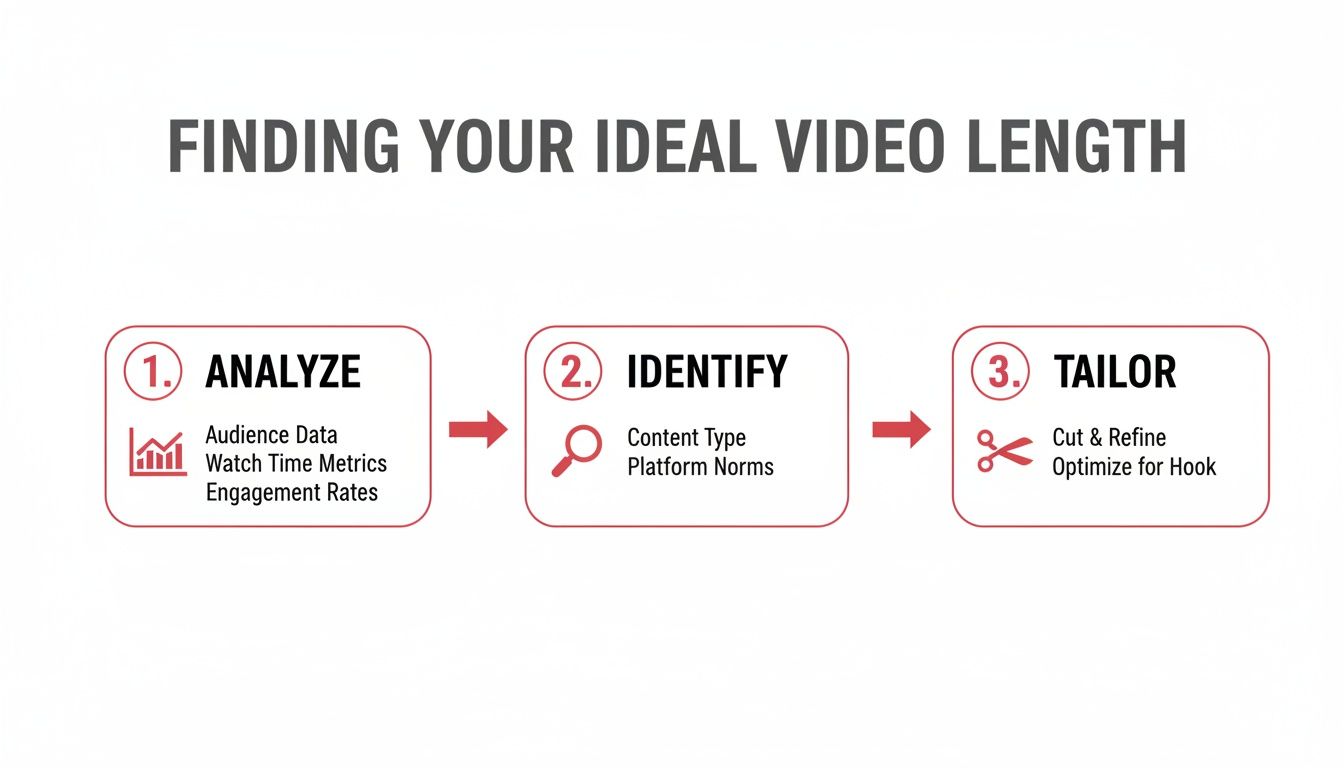
This chart really drives home how these pieces fit together. When you deliver value, you get retention, which builds watch time, which makes the algorithm happy.

It’s a simple feedback loop: good content holds attention, and holding attention is what YouTube is all about.
The Deep Dive Long-Form: 1-3+ Hours
It might sound crazy, but going really, really long can be a massive win for watch time and authority. This territory is reserved for content that delivers huge, continuous value. We're talking about:
- Full-length podcast episodes or interviews
- Replays of live streams
- Complete educational courses or webinars
- Documentary-style videos
Sure, this content attracts a smaller, more niche audience, but the payoff is enormous. When someone watches a two-hour podcast, they're handing you an incredible amount of watch time. It tells YouTube that your channel can literally own a viewer's entire session, which is one of the strongest signals you can possibly send.
Success here depends on having an audience that's already bought in. You wouldn't launch a brand-new channel with a three-hour deep dive. But for established creators, these marathon videos can become evergreen assets that drive views and ad revenue for years. The trick is making them digestible with timestamps and chapters, so viewers can jump straight to the parts they care about most.
How Longer Videos Unlock More Revenue
It’s a common misconception that shorter, punchier videos are always better. While they have their place, some of the most profitable content on YouTube is surprisingly long. Stretching your video's runtime isn't just about cramming in more details; it’s a deliberate strategy for boosting your channel's bottom line. The real financial magic starts when you cross one specific threshold.
That magic number is eight minutes. As soon as your video is longer than eight minutes, YouTube gives you the keys to mid-roll ads—commercial breaks you can place at different points in your content. This is a massive leap from being stuck with just one ad at the very beginning.
With mid-roll ads, you can multiply the number of ad impressions a single viewer sees, which can seriously pump up your AdSense earnings. For any creator serious about turning their channel into a career, learning how to structure content to naturally and ethically pass this eight-minute mark is a core monetization skill. To really dig into this, you can learn how to monetise your YouTube channel effectively.
The Surprising Power of Ultra-Long Videos
Getting past eight minutes is a great start, but the financial rewards can scale exponentially with even longer videos. It sounds a bit backward, I know, but ultra-long videos—the kind that run for hours—can become absolute revenue machines, even if they aren't pulling in the most views on your channel.
Fascinating analysis from Little Dot Studios showed that the earnings aren't linear at all. While so many creators are chasing brevity, videos over 3 hours are quietly crushing it in revenue and watch time. In their data, a 120-minute video earned, on average, a staggering 100 times more revenue than a standard 20-minute one.
These marathon videos didn't just rack up more minutes watched; they often got more views and hit a higher RPM (revenue per thousand views). It's proof that audiences willing to commit to deep-dive content are incredibly valuable.
Maximizing Session Watch Time
What makes these long videos so powerful? They tap directly into a key algorithmic signal: session watch time. This isn't just about how long someone watches your video; it's about the total time a viewer stays on YouTube after starting with your content.
Think about it. Someone clicks on your two-hour podcast episode and watches the whole thing. You've just kept that person glued to the YouTube platform for two solid hours. That’s a massive win for YouTube, and it sends an incredibly strong signal to the algorithm.
YouTube’s goal is to keep people on its site for as long as possible. When your video delivers a long viewing session, the algorithm sees your content as a valuable partner in achieving its main business goal.
As a reward, YouTube is far more likely to recommend that video and your other content to new audiences. This is how a single, well-made long-form video can become an engine for both revenue and channel growth. For a deeper look at these metrics, check out our guide that explains what CPM means on YouTube and how it connects to your earnings.
Making Long Videos Accessible
Of course, no one will watch your three-hour masterpiece if it feels like a chore. A long runtime can be intimidating, which is why smart formatting is non-negotiable.
- YouTube Chapters: Break up your video into logical, titled sections. This gives viewers a roadmap, letting them see the structure at a glance and jump straight to the parts they care about most. It turns a monolith into a user-friendly resource.
- Timestamps in the Description: Always include a clickable table of contents in your video description. It serves a similar function to chapters and is a huge help for people scanning for specific information before they commit.
Using these simple tools transforms a daunting runtime into an accessible, value-packed experience. It shows you respect your viewer's time while still letting you cash in on all the benefits that long-form content has to offer.
Tactics to Maximize Viewer Retention

Knowing the ideal length for your video is one thing, but earning every second of that runtime is the real challenge. A video's success isn't just about how long it is, but how well it captures and holds attention from the moment someone clicks play.
You get a razor-thin window to make a good impression—about 15 seconds. That's it. A slow, rambling start is the fastest way to get someone to click away. This is where your hook comes in. You have to immediately show the viewer that they're in the right place and that sticking around will be worth their time.
Crafting a Powerful Hook
A great hook isn't just a gimmick; it's a promise to the viewer. It sets the expectation for everything that follows and reassures them they've made the right choice. Here are a few battle-tested techniques to get it right:
- The Cold Open: Drop your audience right into the action. Start with the most exciting, surprising, or climactic moment from later in the video before your title card even shows up. It sparks instant curiosity.
- The Direct Promise: Be upfront and tell people exactly what they're going to get. For example, "In the next 10 minutes, I'm going to show you the three biggest mistakes new YouTubers make and how you can avoid them."
- The Provocative Question: Pose a question that stops viewers in their tracks and makes them think. Something like, "What if everything you thought you knew about video editing was holding you back?"
Once you've hooked them, the next job is to keep that momentum going. The secret is what I call value density—making sure every single minute of your video delivers on the promise you made at the start.
Maintaining Momentum and Visual Interest
A long video can feel short if it’s packed with great information and dynamic visuals. On the flip side, a short video can feel like an eternity if it's full of fluff. The goal is to cut out all the dead air and keep the viewer’s brain engaged.
This is where pattern interrupts become your best friend. These are simply small, deliberate changes in your video’s visuals or sound that jolt the viewer's attention and prevent them from zoning out.
Key Insight: Our brains are hardwired to notice change. By strategically changing what's happening on screen every few seconds, you create a far more engaging experience that keeps people watching. This is absolutely critical for holding attention, no matter how long your video is.
Here are some common pattern interrupts you can use right away:
- B-Roll Footage: Don't just stay on a talking head shot. Cut away to relevant clips, screen recordings, or other footage that illustrates your point.
- On-Screen Text and Graphics: Use text callouts, images, and simple animations to highlight key ideas.
- Zooming and Panning: Even on a static shot, you can add subtle digital zooms and pans to create a sense of movement.
When you combine these techniques with helpful tools like YouTube Chapters, which let viewers easily navigate longer content, you transform a simple recording into a genuinely compelling story.
Using Analytics to Pinpoint Retention Problems
The best teacher you have is your own data. Dive into your YouTube Analytics and look for the audience retention graph for each video. This graph shows you, second by second, exactly when people are losing interest and clicking away. It’s a roadmap for improvement.
The dips and drop-offs on that graph are gold. They're clues pointing you to the exact moments where your video went wrong.
When you see a sharp drop, go to that timestamp in your video and be brutally honest with yourself. Was the pacing dragging? Was an explanation confusing? Did you go off on a tangent that had nothing to do with the video's title? Finding these weak spots is how you learn.
Make it a habit to analyze your retention data. It's the single most effective way to sharpen your editing, refine your storytelling, and make sure your next video is exactly as long as it needs to be—and not a second longer.
Answering Your Lingering Questions About Video Length
Even with a solid plan, a few nagging questions always seem to pop up when you're staring at your content calendar. Let's tackle some of the most common ones I hear from creators so you can move forward with confidence.
Do Shorter Videos Actually Get More Views?
This is a classic myth, and the short answer is no, not really. It feels like they should, right? Quick, easy to watch, super shareable. But the YouTube algorithm is playing a different game.
Its main job is to keep people on YouTube for as long as possible. Because of that, it's obsessed with total watch time. Think about it: a 15-minute deep dive that keeps someone glued to their screen for 8 minutes sends a much stronger signal to the algorithm than a 2-minute clip people abandon after 30 seconds. That longer, high-retention video proves the viewer was satisfied, making YouTube much more likely to show it to more people.
Should I Make One Long Video or a Bunch of Shorter Ones?
The right call here comes down to the story you're trying to tell. You never want to chop up a topic that really needs to be explained in one go.
Go long when: You're covering something that needs a complete, A-to-Z explanation. A full walkthrough of a new software or a detailed documentary on a historical event are perfect examples. A single, comprehensive video establishes you as an authority and racks up serious watch time from viewers who are truly invested.
Break it up when: Your topic naturally falls into distinct, bite-sized pieces. Imagine a series on "Beginner Photography." You could easily create separate videos on lighting, composition, and camera settings. This approach gives people a reason to come back for the next lesson.
How Long Does My Video Need to Be for Mid-Roll Ads?
For any creator serious about turning their channel into a business, this is a huge deal. The magic number is 8 minutes. Once your video crosses that threshold, YouTube allows you to place mid-roll ads—the ones that show up in the middle of your video.
This is precisely why you see so many creators pushing their videos to that 8- to 10-minute mark. Hitting that length unlocks a massive revenue opportunity by letting you insert multiple ad breaks, which can seriously boost your earnings from a single video.
The Bottom Line: Your ideal video length is a constant balancing act. You need to provide real, in-depth value without letting your audience's attention drift. There's no magic number, but these principles will help you make a smarter call every single time you hit record.
What's the Average Video Length on YouTube Anyway?
It’s always good to have a sense of the landscape, even if your own strategy is what matters most. Across the entire platform, the average YouTube video length is about 11.7 minutes.
Keep in mind, that's a massive average. Music videos pull it down, while things like educational tutorials, video essays, and in-depth reviews can easily run for 30 minutes or more. For a deeper look at how different genres perform, you can check out these insights on video length and engagement.
At the end of the day, the only way to know for sure is to experiment. Post videos of different lengths, dive into your audience retention graphs, and see what your community responds to. Your analytics will always tell you the truth.
Ready to stop guessing and start growing? ViewsMax is an AI-powered toolkit that gives you the data-driven insights you need to optimize your videos for maximum reach and retention. From crafting the perfect title to analyzing your performance, we help you make smarter content decisions so you can focus on what you do best: creating. Discover how ViewsMax can help you grow your channel faster.