Let's cut right to it: YouTube watch hours are simply the total amount of time people have collectively spent watching your videos. Think of it as the ultimate measure of how captivating your content really is.
To get into the YouTube Partner Program (YPP) and start making money, you need to hit 4,000 public watch hours within the last 12 months, plus have 1,000 subscribers. This isn't just an arbitrary number—it's YouTube's way of verifying that you're creating content people genuinely want to watch.
Why Watch Hours Are The Most Important YouTube Metric
It’s easy to get caught up chasing views and subscriber counts, but watch time is the real currency on YouTube. A view just means someone clicked play. Watch time tells you if they stuck around.
Think about it. A video with a million views but an average watch time of 10 seconds is a red flag for the algorithm. It screams "clickbait" or signals that the content didn't live up to the title's promise. On the flip side, high watch hours prove your content is valuable and holds people's attention, which is exactly what YouTube's business model is built on.
The YouTube algorithm's primary job is to keep people on the platform. When your videos rack up serious watch time, you're basically sending a direct signal to the algorithm: "Hey, people love this stuff. You should show it to more of them."
This kicks off a powerful growth cycle. More watch time leads to more algorithmic recommendations, which brings in more views, which then leads to more subscribers and even more watch time. It all feeds itself.
The Two Pillars Of Watch Time Success
For every creator, mastering watch time is the key to unlocking two huge milestones:
- Monetization Eligibility: That magic number of 4,000 hours of valid public watch time in a 12-month window is your ticket to applying for the YPP and turning your passion into a revenue stream.
- Algorithmic Discoverability: The algorithm is designed to reward channels that keep viewers engaged. The more watch hours you accumulate, the more your videos will pop up on the homepage, in "Up Next" suggestions, and at the top of search results.
This is why a laser focus on youtube watch hours is so much more effective than just chasing a one-hit viral video. It builds a healthy, sustainable channel that the algorithm wants to promote.
To give you an idea of the scale, here's a quick summary of how watch hours impact your channel's growth.
The Impact of Watch Hours on Your Channel
| Area of Impact | Why Watch Hours Are Critical |
|---|---|
| Monetization | The 4,000-hour requirement is the main gatekeeper for the YouTube Partner Program. |
| Algorithm | High watch time is the strongest signal to the algorithm that your content is high-quality. |
| Discoverability | The algorithm promotes high-retention videos across the platform (homepage, suggestions, search). |
| Audience Growth | Keeping viewers watching longer builds a loyal community and naturally leads to more subscribers. |
| Channel Authority | Consistent high watch time establishes your channel as a trusted source in your niche. |
Ultimately, every aspect of your channel's success is tied back to your ability to hold a viewer's attention.
The Scale Of YouTube Engagement
The battle for eyeballs is intense. Every single day, people watch over 1 billion hours of video on YouTube. It's a staggering figure that shows just how central the platform is to our daily lives.
And here's a crucial detail: a whopping 70% of all YouTube watch time now happens on mobile devices. This means your titles and thumbnails have to grab attention on a small screen, or you'll get scrolled right past. Getting even a tiny slice of this massive viewership pie requires a smart strategy built around quality and retention. You can dive deeper into these kinds of revealing YouTube statistics to understand just how big the opportunity is.
How To Track Your Watch Time Progress In YouTube Studio
Before you can even think about growing your YouTube watch hours, you need to know where you stand. Think of your YouTube Studio as your channel's command center; it has all the vital stats you need to hit your monetization goal. Flying blind is not a strategy.
The first step is simply knowing where to look. Your analytics dashboard is packed with data, from viewer demographics to traffic sources, but we're zeroing in on one key number for now.
Finding Your Core Watch Time Metric
Let's get straight to the big picture—how close are you to that 4,000-hour finish line?
- Log into your YouTube Studio.
- Look for the Analytics tab on the left-hand menu and click it.
- Right there on the main overview page, you'll see a card for Watch time (hours).
By default, this number shows you the last 28 days. That’s helpful for checking recent trends, but it's not the number that matters for the YouTube Partner Program.
To see your true monetization progress, you have to adjust the time frame. Click the date range in the top right corner and change it to “Last 365 days.” This is the number YouTube looks at—your total public watch hours over the past year.
This is your main progress bar. Keep an eye on it. Watching this number climb tells you if your strategy is actually working and turns that big, intimidating goal into something you can track and influence week by week.
Analyzing Individual Video Performance
Knowing your total is one thing, but the real magic happens when you figure out which videos are doing the heavy lifting. Diving into the stats for each video helps you spot your winners so you can make more of what your audience loves.
By heading over to the "Content" tab inside Analytics, you can sort all your videos by "Watch time (hours)." This immediately shows you your watch time champions—the videos that are truly captivating your viewers.
On the flip side, you can also spot videos with tons of views but disappointing watch time. That’s a classic sign of a misleading thumbnail or title. This isn't just about looking at charts; it's about turning data into a playbook for creating better, more engaging content.
Mastering Audience Retention to Keep Viewers Hooked
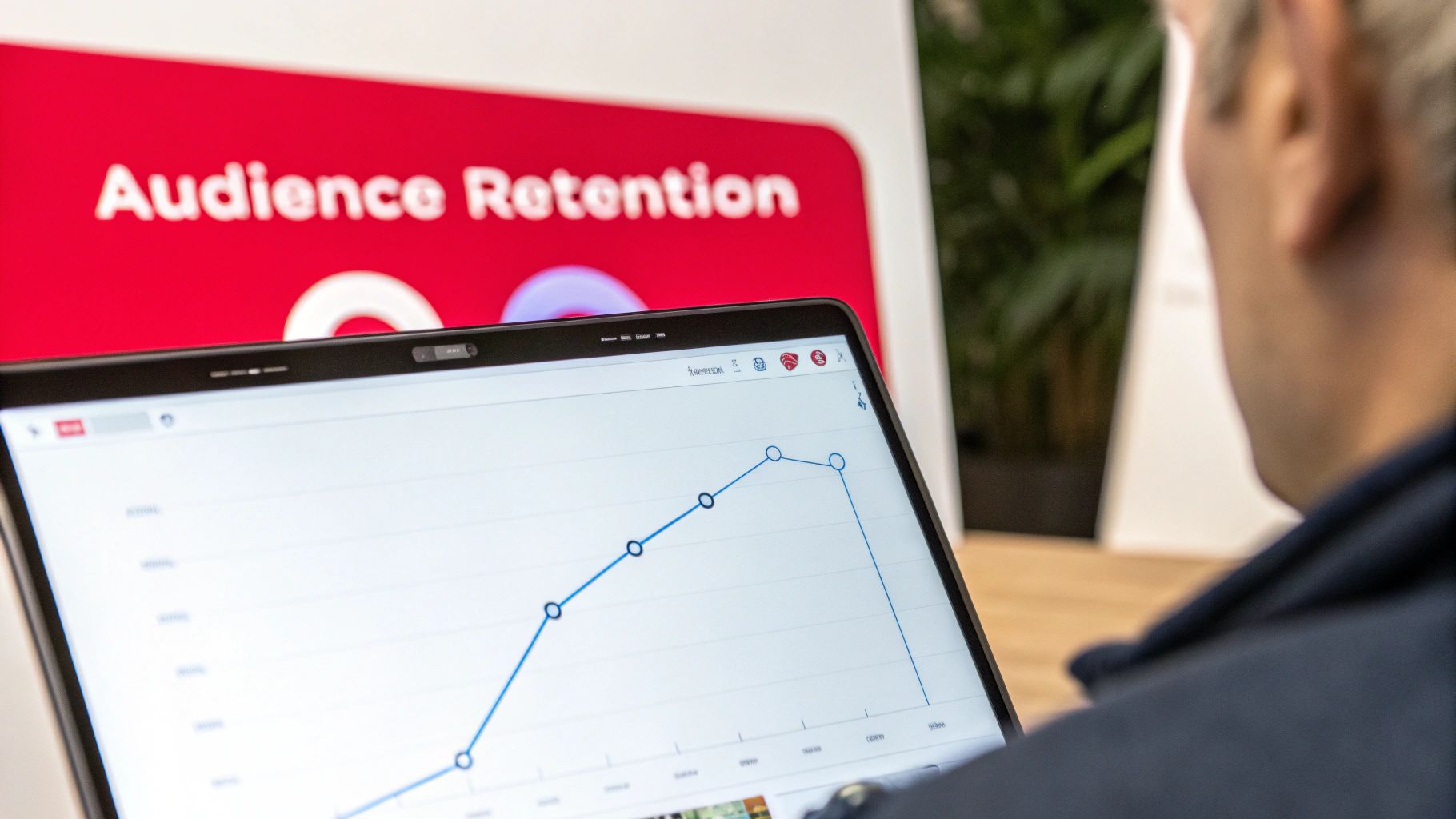
Getting someone to click on your video is just the first hurdle. The real challenge—and where the magic happens—is convincing them to stick around. The secret to racking up massive YouTube watch hours isn't about getting more clicks; it's about mastering audience retention.
Think of audience retention as the average percentage of your video that people actually watch. A high retention rate sends a powerful signal to the YouTube algorithm that your content is valuable and engaging, which in turn leads to more recommendations.
Your video is like a rollercoaster. The first few seconds are the initial climb, and they need to build immediate anticipation. If that climb is slow and boring, your viewers will hop off before the ride even gets good. This is precisely why your introduction, or "hook," is the single most important part of your video.
Crafting an Unskippable Hook
You’ve got about 15 seconds. That’s it. That's your window to prove your video is worth watching. If you fumble the intro, you'll see a massive, steep drop-off in your retention graph right at the beginning. A killer hook doesn't just grab attention; it clearly sets the stage for what's to come.
The good news is you don't have to reinvent the wheel. There are several tried-and-true formulas for creating a powerful hook that you can adapt to your own style.
- Ask a Compelling Question: Jump right in with a question that your ideal viewer is dying to have answered. Something like, "Are you sick of your videos getting stuck at 100 views?"
- Preview the "Aha!" Moment: Show a quick, tantalizing clip from later in the video that reveals the final result or the most valuable nugget of information. This creates an "information gap" that makes viewers want to stick around to see how you got there.
- Start with a Bold Statement: Kick things off with a surprising or even controversial claim related to your topic. It immediately piques curiosity and makes people want to see if you can back it up.
The mission here is simple: stop the scroll. Give the viewer a rock-solid reason to invest their time in your video over the millions of others.
Keeping Viewers Engaged With Storytelling
Okay, so you've hooked them. Now what? You have to keep that momentum going. This is where strategic storytelling and dynamic editing become your best friends. A long, monotonous talking head is a one-way ticket to low watch time. You have to constantly jolt the viewer's attention.
A fantastic technique for this is using pattern interrupts. These are small, unexpected changes that break the flow and re-engage a viewer's brain.
A pattern interrupt can be as simple as changing the camera angle, popping up some on-screen text, adding B-roll footage, or using a quick sound effect. These little shifts prevent viewer fatigue and keep your video feeling fresh and dynamic.
Another great storytelling tool is the open loop. This is where you introduce an idea or a story near the beginning but deliberately hold off on the conclusion until the very end. By leaving that loop open, you create a subtle tension that keeps people watching just to get the payoff.
Delivering on Your Promise
Every single time you pair a title with a thumbnail, you're making a promise. If your title is "How to Bake the Perfect Sourdough," your video had better deliver a clear, easy-to-follow guide on baking sourdough.
Failing to deliver on that promise is the quickest way to demolish trust and your watch time. When viewers feel like they've been tricked, they don't just click away—they remember. They become less likely to click on any of your future videos. This is why clickbait is a terrible long-term strategy for any channel that wants to grow.
To truly maximize your YouTube watch hours, your content has to deliver clear, undeniable value from the first second to the last. To dive deeper into how video length impacts what viewers expect, check out our guide on how long a YouTube video should be.
At the end of the day, incredible retention boils down to a strong start, an engaging middle, and a satisfying ending that fulfills the promise you made upfront. When you master this flow, you stop just making videos and start crafting experiences that turn casual viewers into loyal fans.
How to Optimize Your Videos for Maximum Watch Time
Getting someone to watch one video all the way through is a great start. But the secret to racking up serious YouTube watch hours is getting them to watch the next video, and then the one after that. This is where your video’s packaging comes in—everything from the title to the end screen is a chance to turn a single view into a full-blown watching session.
It all begins with a killer combination: a magnetic title and a thumbnail they can't resist clicking. These two work together to earn that all-important first click. Without that initial pull, even the most incredible video will just sit there, and all that potential watch time will go to waste.
Building the Perfect Binge-Watching Trap
So you've earned the click and kept them watching. Fantastic. Now, the last 20 seconds of your video are pure gold. This is when the End Screen pops up, giving you a prime opportunity to tell your audience exactly where to go next. Instead of letting them wander off, you can guide them deeper into your world.
A common mistake is just linking to your most recent upload. A much smarter move is to point them toward a hand-picked playlist.
By linking to a playlist, you’re not just suggesting one more video; you're inviting them into a seamless, lean-back viewing experience. The next video starts automatically, removing the friction of choice and significantly increasing the chances of them watching multiple videos in a row.
This one simple change can multiply the YouTube watch hours you get from a single viewer. You're no longer just thinking about one video's retention; you're optimizing for an entire viewing session.
Designing Playlists for Seamless Viewing
A good playlist isn't just a random assortment of videos. It needs to feel like a mini-series, where each video flows logically into the next. Think about arranging your videos to build on each other, creating a storyline or a learning path that keeps people hooked and ready for what's next.
Here’s how to make playlists that really work:
- Group by Theme: Bundle together videos that tackle different angles of the same big topic. For example, a "Beginner's Guide to Photography" playlist could have separate videos on camera settings, composition, and lighting.
- Create a Series: If you make content that comes in episodes, a dedicated series playlist is essential. It lets viewers catch up and watch everything in the right order, just like a Netflix show.
- Order Strategically: Put your videos with the highest audience retention right at the beginning of the playlist. This gets viewers hooked early on and makes it more likely they’ll stick around for the whole thing.
Treat each playlist like a carefully planned journey. The smoother and more engaging you make that journey, the more you encourage the kind of binge-watching that the YouTube algorithm absolutely loves.
Using Cards to Keep the Momentum Going
While End Screens are your closers, Cards are your secret weapon for re-engaging people in the middle of a video. They are those small, clickable notifications you can pop up at specific moments in your timeline. If you happen to mention a related topic or a past video, you can drop in a card that links right to it.
This is a great way to prevent viewers from dropping off. If someone’s interest is sparked by a side topic, a Card gives them a direct path to explore it on your channel, rather than leaving to search for it somewhere else. Using them well helps squeeze every last second of watch time out of every view. For more tips on this, learn how you can add chapters to your YouTube video to give your audience even more ways to navigate your content.
Beyond what’s on your video page, timing is huge. Knowing the best time to upload YouTube videos can give you that initial burst of engagement that’s so important for watch time.
And believe me, the audience is out there. Globally, YouTube mobile app users watched for an average of over 27 hours per month. Viewers in South Korea are leading the charge, spending a staggering 43 hours and 26 minutes monthly on the app, with US users not far behind at around 24.43 hours. These numbers show just how much watch time is available if you can grab and hold people's attention. You can see more on these global viewing habits on Statista.
Using Different Content Formats To Accelerate Growth
When you're trying to hit that 4,000-hour milestone, you quickly learn that not all videos are created equal. You need to be strategic about the types of content you create, mixing different styles to capture and hold your audience’s attention.
Relying only on short, snappy videos can feel like trying to fill a swimming pool with a teaspoon. To really speed things up, you have to embrace formats that are built for longer watch times.
The Power Of Long-Form Content
Think about the kind of videos that naturally keep people watching. I'm talking about deep-dive tutorials, comprehensive product reviews, feature-length documentaries, and even video podcasts. These are your watch time goldmines.
Why? Because a single person watching your 45-minute guide can give you more watch hours than a dozen people watching a three-minute clip. Viewers who click on this kind of in-depth content are already planning to stick around, which means your average view duration shoots up, giving your channel's total watch time a serious boost.
Capitalizing On The Live Stream Advantage
If you want the single fastest way to rack up public watch hours, look no further than live streaming. Let’s do some quick math: a single two-hour live event with just 50 people watching at any given time instantly generates 100 hours of watch time. You’d need thousands of views on your regular videos to get anywhere near that.
Live streams work so well because they’re interactive. The real-time chat, live Q&As, and sense of community keep people glued to their screens far longer than they would for a pre-recorded video. It's a powerful tool for any creator trying to hit their monetization goals faster.
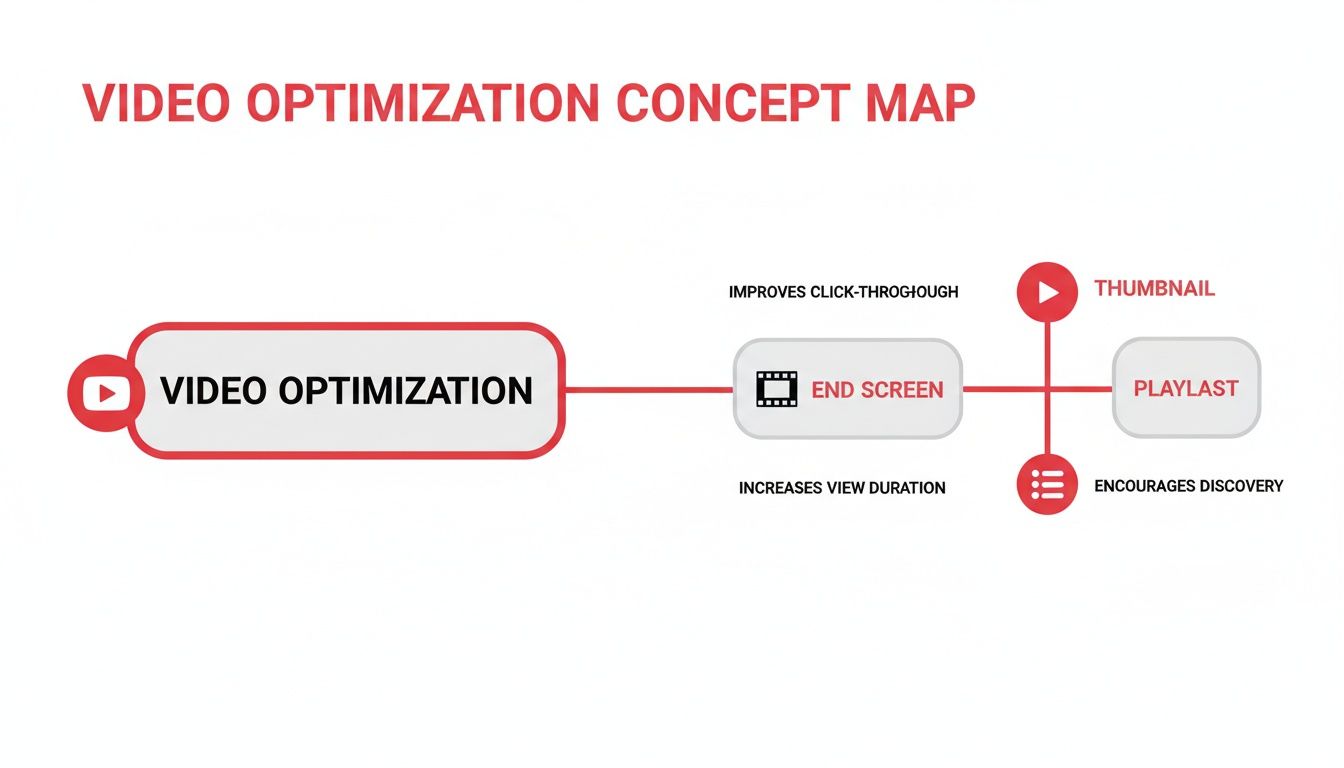
This image really breaks down how everything works together. A great thumbnail gets the click, but it's the playlists and end screens that keep people in your ecosystem, multiplying your watch time.
Using YouTube Shorts As A Discovery Engine
This is a huge point of confusion for many creators, so let’s get it straight: watch time from your videos viewed in the Shorts feed does not count toward your 4,000-hour requirement. So, why even make them? Simple. They are one of the best discovery tools YouTube has ever given us.
Think of your Shorts as commercials for your main channel. Their bite-sized, shareable nature is perfect for getting your content in front of a massive new audience that has never even heard of you.
The goal with Shorts isn't to rack up watch hours directly. It's to be a magnet at the top of your funnel, pulling in new viewers who then dive into your longer, monetizable videos.
Here’s how you build that bridge from a Short to your main content:
- Create Teasers: Clip the most exciting, valuable, or intriguing moments from your longer videos. Give viewers a taste that makes them hungry for the full story.
- Use The "Related Video" Feature: Don't leave them hanging! Pin a comment or use YouTube's built-in feature to link from your Short directly to the full-length video it came from.
- End with a Clear Call to Action: Literally tell people where to go next. A simple, "For the full breakdown, check out the video on my channel!" can work wonders.
This strategy turns a view that doesn't count for monetization into a potential long-term fan who contributes to your YouTube watch hours. On top of creating new content, you can also think about safely downloading your YouTube videos to repurpose them for other platforms, which can extend their reach even further. By combining long-form videos, live streams, and a smart Shorts strategy, you create a powerful system for earning watch time way faster.
Common Questions About YouTube Watch Hours Answered
Navigating the rules around YouTube watch hours can feel like trying to solve a puzzle. With so many different content formats and specific guidelines, it’s easy to get confused about what counts, what doesn’t, and which strategies actually move the needle.
Let's cut through the noise. Here are direct, clear answers to the most common questions creators have about racking up watch time, so you can focus your energy on what truly matters for growing your channel.
Do YouTube Shorts Count Towards The 4000 Watch Hours?
This is easily one of the most frequent questions out there, and the answer is a straightforward no. Watch hours gained from viewers swiping through the Shorts feed do not count toward the 4,000 public watch hours you need for the YouTube Partner Program (YPP).
But don't write them off just yet. Think of Shorts as the billboard or the movie trailer for your channel. They are an incredible tool for discovery and often reach audiences who have never seen your content before.
The real magic happens when someone finds your channel through a Short and then clicks over to watch your regular, long-form videos. Every minute they spend on those longer videos absolutely counts. This makes Shorts a powerful way to pull in new subscribers who will then contribute to your monetizable watch time.
What Exactly Are Public Watch Hours?
The key word here is "public." To be eligible for monetization, you need 4,000 public watch hours, which are the valid hours your viewers spend watching videos you have set to "Public."
This means that any time spent on certain types of content won't be included in your official YPP tally.
- Private Videos: Watch time from videos set to "Private" doesn't count.
- Unlisted Videos: Hours from "Unlisted" videos are also excluded.
- Deleted Videos: If you delete a video, any watch hours it earned are wiped from your total.
- Ad Campaigns: Watch time you get from promotional campaigns, like Google Ads, is not counted.
This distinction is critical. YouTube wants to see that you can earn your hours organically from a real audience that is actively choosing to watch your public content. It's a system built to reward genuine engagement, not manufactured views. For a deeper dive, check out our guide on what public watch hours are on YouTube.
How Long Does It Take To Get 4000 Watch Hours?
Honestly, there's no single answer. The timeline can be wildly different from one channel to another. It really comes down to your niche, how good your videos are, how often you upload, and your ability to hook people and keep them watching.
Let's break down the math to make the goal feel a bit more real. Say you upload a 15-minute video that gets 1,000 views with a solid average watch time of 6 minutes (that's 40% retention). That one video just earned you 100 hours of watch time.
To hit your 4,000-hour goal, you would need 40 videos performing at that same level. For some creators, a single viral hit could get them there in a few weeks. For others, a steady grind of publishing great content might take several months or even a year.
The focus shouldn't be on speed but on building something sustainable. The real goal is to create a library of valuable videos that consistently earns watch time day in and day out, creating a solid foundation for your channel.
Should I Buy YouTube Watch Hours?
The answer to this is a firm, absolute no. Buying watch hours is a serious violation of YouTube's Fake Engagement policy, and it can have catastrophic consequences for your channel's future.
These services use bots or click farms to generate views, which provide zero real engagement. YouTube's algorithm is incredibly sophisticated and can easily spot this artificial activity, sending powerful negative signals about your channel.
The risks are severe and just not worth it.
- Channel Termination: YouTube can and will shut down channels that violate its policies.
- Permanent YPP Ban: You could be banned from ever applying to the YouTube Partner Program.
- Credibility Destruction: Any real audience you have will lose trust in you, and your reputation will be toast.
True, lasting growth only comes from earning authentic watch time from real people who value your content. Investing your time and effort into making better videos is the only legitimate path to building a successful channel.
Ready to stop guessing and start growing your YouTube watch hours with a data-driven strategy? ViewsMax is the AI-powered toolkit that helps you create smarter, optimize faster, and monetize with confidence. From intelligent title recommendations to in-depth analytics, we give you the insights you need to turn your passion into a thriving channel. Start making videos that viewers click and watch by visiting us at https://blog.viewsmax.com.