A great script for a YouTube video is more than just words on a page; it's the architectural blueprint for content that works. It's what separates a video that gets clicks, keeps people watching, and ultimately gets them to act, from one that just sort of… exists.
Think of it as the difference between a rambling, unfocused chat and a story that pulls you in and won't let go.
Laying the Groundwork for a Winning Script
Before a single word of your script is written, the most successful creators do the prep work. They don't just open a blank document and hope for the best. This pre-writing phase is all about defining the "why" behind your video, making sure every line you eventually write has a clear and specific job.
Trying to write a script without this foundation is like trying to build a house without a blueprint. It's a recipe for disaster.
Watch this on how to write better scripts
Define Your Video’s Core Mission
Every video needs one primary job. What are you trying to accomplish? Are you teaching someone a new skill, trying to make them laugh, or convincing them that your new product is worth their money? This single decision shapes the entire tone, structure, and feel of your script.
Most videos fall into one of three buckets:
-
Educate: Your mission here is to transfer knowledge. Think tutorials, how-to guides, or deep dives into a complex subject. Your script needs to be logical, follow a clear sequence, and be dead simple to understand.
-
Entertain: This is all about emotion. You're aiming for laughter, excitement, or pure curiosity. Vlogs, skits, and commentary videos live here. The script should focus heavily on great storytelling, dynamic pacing, and letting your personality shine through.
-
Persuade: Your goal is to guide the viewer toward taking a specific action. Product reviews, case studies, or sales videos are prime examples. For these, your script must build trust, hammer home the benefits, and finish with a strong, clear call to action.
Of course, these aren't mutually exclusive. You can have a funny tutorial or an educational product review. But one mission has to be in the driver's seat, guiding all your other choices.
Build a Specific Viewer Persona
Here's a hard truth: you are not making a video for "everyone." The moment you try, you make a video for no one. A vague idea of your audience results in a generic script that connects with nobody. The key is to create a detailed persona of your one, single, ideal viewer.
I always write as if I'm talking to one specific person. It makes the script feel like a direct, personal conversation. When you try to speak to a crowd, your message gets diluted. When you speak to an individual, you create a real connection.
Get granular. Ask yourself some tough questions about this person:
-
What's the main problem or question they have that this video will answer?
-
How much do they already know about this topic? Are they a total newbie or a seasoned pro?
-
What kind of language do they use? Is it casual slang or more formal, technical jargon?
-
What's the one thing that would make them click away in the first 10 seconds?
A script for a "beginner's guide to photo editing" aimed at a 20-year-old student using their phone will sound completely different from one targeting a 50-year-old professional photographer. The first might reference TikTok trends and free apps, while the second will dive into Lightroom presets and color theory.
Choose Your Video Format Wisely
The format is the vehicle for your message. The one you pick directly impacts how you'll structure your script and sets expectations for the viewer the second they read your title.
Some popular and proven formats include:
-
Tutorial/How-To: These are linear and step-by-step. Clarity is king here, so the script has to be precise.
-
Listicle ("Top 5…"): This format is a gift for scripting. You can write each point as its own mini-segment, which is great for keeping viewers engaged.
-
Product Review: Typically follows a predictable and effective flow: unboxing, features, pros and cons, and the final verdict.
-
Vlog: This is all about narrative and personal connection. Your "script" might be more of a loose outline of key story beats rather than a word-for-word document.
-
Explainer: The goal is to make something complicated seem simple. The script needs to lean heavily on simple analogies and be written with visuals in mind.
Once you’ve locked in your goal, your audience, and your format, you're ready to actually start writing. You're no longer just staring at a blank page; you're building a piece of content that's been engineered for success from the ground up.
Nail the First 15 Seconds to Keep Viewers Watching
You have a tiny window—maybe five to ten seconds—to convince someone your video is worth their time. That's it. In a sea of endless content, your hook isn't just a part of the script; it's a brutal, all-or-nothing audition.
A weak opening is a guaranteed click away, which tells the YouTube algorithm your content isn't keeping people around. But a powerful one? That can lock a viewer in for the entire ride. This is why professionals use tactics to increase watch time and boost viewer retention that all start with a killer opening.
Field-Tested Hook Formulas That Actually Work
Forget starting with a bland "Hey guys, what's up." You need to lead with a formula designed for impact. These structures aren't just random; they're built on basic human psychology—curiosity, problem-solving, and the promise of a quick win.
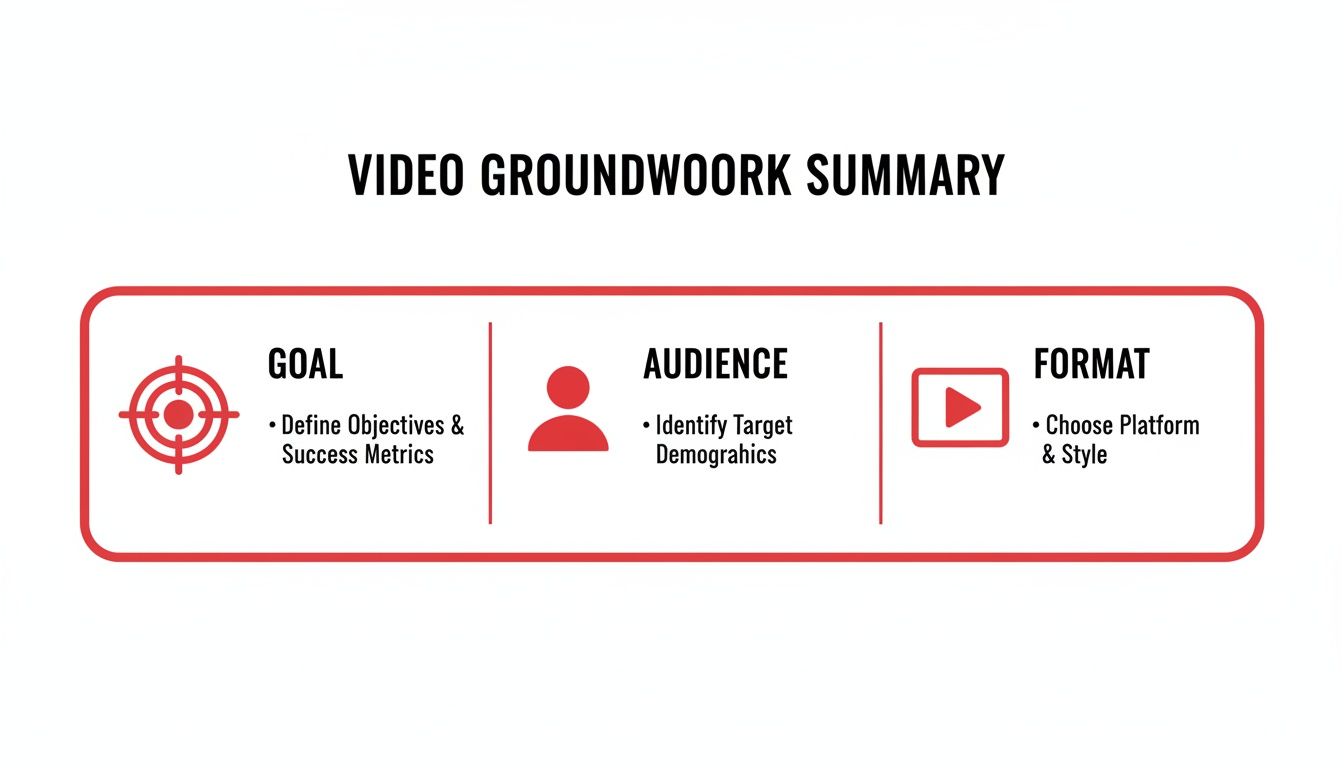
Before you even write a hook, you need a solid foundation. As this graphic shows, you have to know your goal, your audience, and your format. Once that’s clear, you can pick the right tool for the job.
Here are a few hook formulas I've seen work time and time again.
High-Impact Hook Formulas for YouTube Videos
Proven hook formulas with examples to help you start your script with maximum impact.
| Hook Formula | Description | Example Usage |
|---|---|---|
| Problem-Agitator | State a common pain point your viewer has. Then, twist the knife by describing why it's so frustrating before promising your solution. | "Are you tired of your houseplants dying? You've tried watering more, watering less, and nothing works. I'll show you the three mistakes you're making and how to fix them for good." |
| Results-First | Show off the amazing final result right away. If it's a DIY project, show the finished masterpiece. If it's a tutorial, reveal the impressive outcome. | A baking video opens with a slow-motion shot of a perfect cake slice. Voiceover: "This is the fluffiest chocolate cake you'll ever make, and I'm about to show you how." |
| Bold Statement | Open with a controversial or surprising statement that makes the viewer stop and think. It challenges a commonly held belief. | "Everything you've been told about productivity is wrong. The 'hustle' culture is actually making you less effective, and today I'm going to prove it." |
Experiment with these. See which one feels most natural for your topic and your audience. The right hook makes the rest of the script flow so much better.
Moving From Hook to Intro
Okay, you've grabbed their attention. Now what? Your intro needs to immediately set expectations and deliver a clear reason to stick around. The hook bought you a few seconds; the intro is where you close the deal.
Your introduction should quickly answer three questions for the viewer:
-
What is this video about? Be direct and state the topic.
-
What's in it for me? Explain the benefit or skill they will gain.
-
Why should I trust you? Briefly establish your credibility.
Pro Tip: Keep your entire introduction under 20-30 seconds. I’ve seen so many analytics charts where viewers drop off because the creator rambled for a minute straight. Get to the point fast to maintain the momentum your hook created.
This quick, punchy approach is absolutely essential for shorter videos. When you're figuring out https://blog.viewsmax.com/how-to-get-more-views-on-youtube-shorts/, you'll realize the entire video is basically a hook. There’s zero room for fluff.
Structuring Your Video's Main Body to Keep People Watching

Alright, you've landed a solid hook and made a promise to your audience. The next few minutes are where the real work begins—and where most creators lose their viewers. This is the part where you have to deliver.
The main body of your video is a make-or-break moment. A jumbled, confusing middle is the fastest way to get someone to click away, tanking your audience retention. Think of your script not as one long monologue, but as a series of connected mini-chapters. Each one should flow logically into the next, making your content incredibly easy for viewers to follow.
Finding the Right Narrative Structure for Your Content
There’s no single, magic formula for how to structure your video. The best approach depends entirely on what kind of video you're making. The goal is to match your script's flow to the viewer's expectations for that specific format.
Here are a few battle-tested structures I’ve seen work time and time again:
-
For Tutorials (The Step-by-Step Method): This one is beautifully simple. Your script should break down the entire process into a numbered or sequential list. State the end goal upfront, then walk them through each step in a logical order. I always recommend adding on-screen numbers for each step; it helps people follow along and makes it easy to rewind if they miss something.
-
For Vlogs (The Story Arc): A great vlog is more than just a random collection of clips from your day—it's a story. You need a beginning, middle, and end. Script out the key beats: an "inciting incident" (what kicks things off), some rising action (challenges or interesting moments), a climax (the main event), and a resolution. This gives your vlog momentum and keeps it from feeling like a boring diary entry.
-
For Reviews (The Criteria-Based Breakdown): When people watch a review, they want objective, well-organized information. Script your review around specific criteria like design, features, performance, and price. Dedicate a segment to each, covering the pros and cons for that point before you deliver a final verdict. This approach makes your review feel comprehensive and trustworthy.
A solid structure gives your viewer a roadmap. It shows them you know where you're going, which makes them want to stick around for the whole ride.
Keeping Your Audience Glued with Pacing and Pattern Interrupts
Structure is the skeleton, but pacing is what brings your video to life. Even a perfectly organized script can be a total snooze-fest if the pacing is flat. The trick is to constantly vary the rhythm and energy.
Good pacing means mixing things up. You might have a quick montage with upbeat music and fast cuts, then immediately slow down for a more personal, direct-to-camera explanation of a tricky concept. This variety keeps the viewer’s brain from zoning out.
This is where pattern interrupts come in. They're a scriptwriter's best friend. A pattern interrupt is anything that breaks the viewer’s train of thought. In your script, this could look like:
-
A sudden change in camera angle.
-
An unexpected sound effect or on-screen graphic.
-
A quick, self-aware joke or a personal story.
-
Asking the audience a direct question.
I’ve found that scripting in small interruptions every 60-90 seconds is a game-changer. You’re essentially hitting a reset button on your viewer's attention span, which is a powerful way to fight that mid-video slump where retention graphs usually nosedive.
For example, in the middle of a dry explanation, your script could note: [CUT TO: Extreme close-up] "Look, I know this sounds like a lot of jargon, but let me put it this way..." That simple visual shift is often enough to pull a viewer back in.
Scripting Smooth and Seamless Transitions
Transitions are the glue holding your video's "chapters" together. A clunky transition can feel jarring and pull the viewer right out of the experience. Your script needs to account for these moments.
Don't just stop one section and abruptly start the next. Use transitional phrases in your dialogue to signal what’s coming up.
Think along these lines:
-
"So now that we've nailed down the keyword research, let's look at how to actually use it in your video titles."
-
"While the build quality feels amazing, that’s useless if the performance isn’t there. So, let’s fire this thing up and put it to the test."
These phrases act as a natural bridge, making the jump between topics feel smooth. Remember to plan for visual transitions as well. Make notes in your script about where you’ll use a specific B-roll shot, a graphic, or a unique cut to guide the viewer from one idea to the next. By thoughtfully structuring your main body, mastering pacing, and scripting clear transitions, you create a video that’s not just informative, but genuinely engaging from start to finish.
Writing Calls to Action That Actually Work
A great script doesn't just fade to black. It tells the viewer exactly what to do next. Your Call to Action (CTA) is what turns someone who just watched your video into an actual member of your community.
Think of it this way: you did all the hard work to script, shoot, and edit an amazing video. Without a clear CTA, all that energy and goodwill you built up just evaporates. A good CTA channels that energy into something that helps you and the viewer.
Beyond “Like and Subscribe”
We've all heard "like, comment, and subscribe" a million times. It's a YouTube staple, sure, but it's far from the only play you should be running. The best CTAs are specific, valuable, and feel like the logical next step after watching your video.
So, what makes sense for your video?
-
Just finished a tutorial? Offer a free downloadable checklist or template that makes it even easier for them to apply what you taught.
-
Reviewing a product? The most natural CTA is to provide your affiliate link so they can check the current price or see more details.
-
Posted a deep-dive video essay? Guide them to another one of your videos that explores a related topic you only touched on briefly.
The whole idea is to match your request to their mindset. They just got value from you, so give them an easy way to get even more.
Smart CTA Placement
Most creators cram their CTAs into the last 10 seconds, but look at your audience retention graphs. You'll often see a massive viewer drop-off right at the end as people click away to whatever YouTube suggests next. We need to be smarter about this.
The perfect time to ask for something is right after you've delivered a huge "aha!" moment. Drop a CTA mid-video, immediately after a game-changing tip, and you'll catch viewers when their appreciation for your content is sky-high.
For example, after you explain a really clever editing trick, you could jump in with: "If you found that useful, I break down five more just like it in my advanced editing guide. The link is right there in the description." It feels less like an ad and more like genuine help.
Crafting the Perfect Outro
Your outro has two main jobs: wrap things up nicely and deliver your final, most important CTA. A solid conclusion makes the viewer feel like their time was well spent and reinforces the value you just gave them.
Here's a simple structure for a great outro script:
-
A Quick Recap: Briefly remind them of the core takeaway. "So, that's the three-step process for repotting an orchid without killing it." This makes them feel accomplished.
-
The Main CTA: Now, be direct and confident. Instead of a vague "check out my website," be specific: "Head over to my website to grab the full list of my recommended potting soils." Tell them exactly what to do and what they'll get.
-
Build Your Community: This is the ideal spot for the classic "like and subscribe." Frame it as a community thing: "If this helped, drop a comment and let me know which tip you're going to try first."
This simple formula provides closure while giving your viewers a clear path forward. Without this final piece, your script for a YouTube video isn't really complete. It's how you turn a single view into a real connection.
Adapting Your Script for Different YouTube Formats
Think about it: a script for a 20-minute deep-dive tutorial would be an absolute train wreck as a 60-second YouTube Short. The format you choose sets the rules, and your script is how you play the game. Treating every video the same is a surefire way to kill your audience retention and bring channel growth to a halt.
Adapting your writing style isn't just a good idea; it's mandatory. Each format connects with a completely different viewer mindset. Someone grabbing a coffee and settling in for a long-form product review is in a totally different headspace than someone swiping through Shorts on their lunch break. Your script for a YouTube video has to respect that.
Scripting for Clarity in Tutorials
When you're scripting a tutorial, your North Star is clarity. People are there to solve a problem, and if they get confused, they're gone. Your script needs to be meticulously structured and ruthlessly efficient.
Here's a battle-tested approach I always use:
-
Promise the Outcome Immediately: Your hook needs to instantly confirm what the viewer will achieve. For instance, "In the next ten minutes, you'll have a fully functional contact form on your website, even if you've never touched a line of code."
-
Break It Into Obvious Steps: Structure the core of your video with clear, numbered steps. I always script verbal signposts like, "Alright, moving on to step three, we're going to…" It keeps viewers grounded and focused.
-
Answer Questions Before They're Asked: A great tutorial script feels like you're reading the viewer's mind. Weave in lines like, "A common mistake here is forgetting to save. Make sure you hit that save button before you do anything else." This builds incredible trust.
Scripting for Trust in Product Reviews
With product reviews, the only currency that matters is trust. Your audience has to believe you're giving them the real story, not a sales pitch. The script has to be built from the ground up to establish that credibility.
I find that a balanced review script almost always works best:
-
Set the Scene: Briefly explain why you're reviewing this product and who it's actually for.
-
Walk Through the Features: Cover the key specs and selling points logically.
-
Show, Don't Just Tell: This is where the magic happens. Detail your real-world experience using the product, covering both the good and the bad.
-
Summarize the Pros and Cons: A dedicated summary section is a fantastic way to reinforce your objectivity.
-
Deliver the Verdict: End with a clear recommendation on who should—and just as importantly, who shouldn't—buy it.
Your script must balance the shiny positives with genuine criticisms. A review that’s 100% positive just feels like a sponsored ad, and that instantly kills viewer trust. Scripting in specific, honest drawbacks shows you’ve actually put in the work.
Scripting for Impact in YouTube Shorts
YouTube Shorts is a different universe with its own laws of physics. You don't have minutes to build a connection; you have seconds to make an impact. Forget the intro—your entire script is the hook.
The shift to this format has been massive. Shorts now rack up over 70 billion daily views, and most active channels are now focused on this short-form content. To stay relevant, you have to master scripting for lightning-fast hooks and repeatable formats.
To get the most out of your Shorts, you need to understand how the YouTube Shorts algorithm works and write your scripts to feed it exactly what it wants. For some practical starting points, check out our guide on YouTube Shorts ideas you can start scripting today.
Here's the scripting formula that works for Shorts:
-
No Wind-Up: Start directly with the most exciting, surprising, or valuable part of the video.
-
One Idea, One Video: A Short should have a single, crystal-clear message. Trying to cram in too much is the fastest way to lose the viewer.
-
Pace, Pace, Pace: Think fast cuts, dynamic on-screen text, and high-energy delivery. Your script should be all punchlines and no setup—every single word has to earn its place.
-
Craft a Perfect Loop: End the video in a way that flows seamlessly back to the beginning. Getting viewers to re-watch is a powerful signal to the algorithm that you've got something good.
When you start thoughtfully adapting your script to the specific demands of each format, you stop just making videos and start strategically engineering content that's built to perform.
Using Analytics to Refine and Improve Your Scripts

So you’ve hit publish. The work isn't over—in fact, the most valuable part is just beginning. Think of your finished script not as a final product, but as a hypothesis. Once your video is out in the wild, YouTube Analytics gives you all the data you need to see if that hypothesis was right.
This is how you stop guessing what your audience wants and start knowing. Their viewing habits become your roadmap, showing you exactly what to do more of and what to cut out of your next script for a YouTube video.
Decoding Your Audience Retention Graph
The most powerful scriptwriting tool you have is already in your YouTube Studio: the Audience Retention graph. This chart is your video's EKG, showing you the exact moment-by-moment percentage of viewers who are still tuned in. It's a raw, unfiltered look at how well your script held their attention.
When you see a steep drop-off, that’s not just a random dip. It's a bright red flag. It’s a group of people deciding, "Nope, I'm out."
Think of your Audience Retention graph as a 24/7 focus group. Every dip is a piece of feedback. It’s a viewer telling you, "This part dragged on," "I got confused here," or "You took way too long to get to the good stuff." Learning to read these signals is a game-changer.
Here's what you do: pull up the video and scrub to the exact timestamp where the graph takes a nosedive. More often than not, you'll find it lines up perfectly with one of these common script killers:
-
A long-winded explanation that could have been said in half the time.
-
An awkward or clunky transition between two different ideas.
-
A mismatch where what you're saying doesn't quite fit the visuals on screen.
-
An intro that promised something amazing but then took forever to deliver.
Once you spot these patterns, you can make a conscious effort to avoid them next time. For instance, if you notice viewers consistently bail during your outros, it's a clear sign they need to be shorter and punchier. Small, data-backed adjustments like these are what lead to huge improvements in watch time.
Weaving in Keywords and Search Insights
Analytics isn't just about retention; it's also about discovery. You can use tools like TubeBuddy or VidIQ—or even just poke around YouTube's search bar—to see the exact words and phrases your ideal viewer is typing.
Don't just cram these keywords into your title and description. You need to actually say them in your video. When you speak the terms people are searching for, YouTube’s transcription system hears it, which can help signal your video's relevance to the algorithm.
Let's say your research shows a popular search is "how to fix grainy video footage." A generic script might say, "Let's clean up your clips." A data-informed script, however, would say something like, "Now, let's talk about how to fix grainy video footage so it looks crisp and professional." It's a subtle change that makes a world of difference.
This creates a powerful feedback loop. The data from one video helps you write a better script. That better script gets better engagement, which gives you even more precise data for the next one. For anyone creating Shorts, understanding how this viewer data feeds the shorts algorithm is absolutely essential for breaking through. This cycle is what turns good scripts into undeniable, view-grabbing videos.
Got Questions About Scripting? We've Got Answers.
Even when you have a solid plan, getting into the nitty-gritty of scriptwriting always brings up new questions. It's one thing to know the theory, but it's another to stare at a blank page. Let's tackle some of the most common hurdles creators face.
These are the little things that can get you stuck, but once you know the answers, they're easy to push past.
How Long Should My Script Be?
There's no single magic number, but a great rule of thumb is that 150 to 160 words will translate to about one minute of on-screen talking time. So, if you're aiming for a 10-minute video, you'll want a script that’s roughly 1,500 to 1,600 words long.
But remember, that's just a starting point. Your real goal should be to cover the topic completely without fluff. Don't stretch a 7-minute idea into a 10-minute video just to hit a number.
The best judge of your video's length is your audience retention graph. If you consistently see a huge viewer drop-off at the 8-minute mark on your 12-minute videos, that’s a clear signal to tighten things up.
Use the word count to guide you, but let your content—and your data—have the final say.
Should I Script Everything Word-for-Word?
When you're just starting out, absolutely. A full, word-for-word script is your best friend. It acts as a safety net, making sure you hit every single point you want to make. It also gives you total control over the video's pacing and helps you kill those dreaded "ums" and "ahs."
As you get more comfortable in front of the camera, you might find you don't need every word written out. Many seasoned creators eventually switch to a detailed bullet-point outline. This approach gives you the best of both worlds:
-
Structure: It keeps you on topic and ensures your video flows logically from one point to the next.
-
Flexibility: It leaves room for a more natural, off-the-cuff delivery that feels less stiff and more conversational.
Ultimately, the right method comes down to you and the type of video you're making. A complex tutorial probably needs a precise script, while a casual vlog is going to feel much more authentic with a looser, bulleted format.
What’s the Best Software for Writing Scripts?
You really don't need fancy or expensive software for this. The best tool is usually the one you're already comfortable with and that doesn't get in your way.
By far the most common choice is Google Docs. It’s free, it’s in the cloud so you can access it anywhere, and sharing it with a collaborator is a breeze. Other creators swear by tools like Notion because they can keep their scripts, content calendars, and research all in one place. Honestly, even a simple text editor works if you want zero distractions.
The key is to find something that works for you and stick with it. Consistency is what matters.
Ready to turn these insights into measurable growth? ViewsMax provides AI-powered tools and data-informed recommendations to help you craft better scripts, optimize your videos, and grow your channel faster. Start making smarter content decisions today by visiting https://blog.viewsmax.com.
Leave a Reply