So, what exactly are "public watch hours" on YouTube? Think of it as the total time, in minutes and hours, that people have spent actively watching your public videos. This isn't just a vanity metric; it's one of the most critical factors for growing your channel and, more importantly, unlocking the ability to earn money.
Unlocking YouTube Monetization With Watch Hours
Ever wonder why some channels are plastered with ads while others aren't? The answer almost always comes back to public watch hours. This metric is more than just a number; it's a direct measure of how engaging your content truly is.
While views can be fleeting and subscribers can go dormant, watch time is solid proof that your videos are compelling enough to hold someone's attention. YouTube sees this as a sign of quality, and it's how they decide if your channel is a good place for advertisers to spend their money.
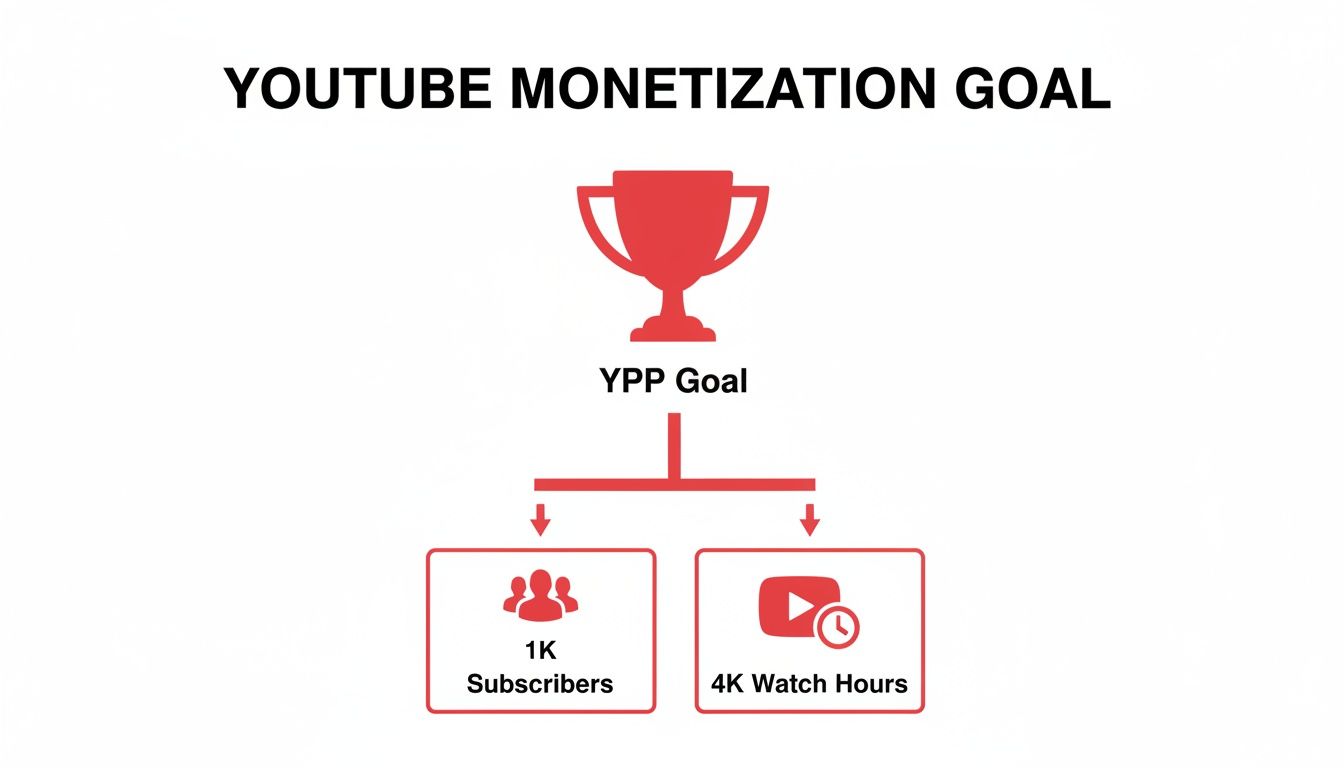
That’s why there's a specific goalpost for getting into the YouTube Partner Program (YPP). To start monetizing your channel, you need to hit 4,000 valid public watch hours within the last 12 months, along with reaching 1,000 subscribers. You can discover more insights about YouTube's massive viewing statistics on Senalnews.com.
Why Watch Hours Matter More Than Views
Many new creators fall into the trap of chasing views, hoping for that one viral hit. But YouTube's algorithm is much smarter than that; it prioritizes sustained engagement over quick, shallow views.
Think about it: a video with 10,000 views where everyone clicks away after 30 seconds isn't very valuable. A different video with only 2,000 views, but where the average viewer watches for a full 10 minutes, is a goldmine. The second video accumulates far more watch time, sending a powerful signal to YouTube that the content is genuinely good.
In essence, watch time is YouTube's currency for content quality. A high watch time tells the algorithm that your videos are satisfying viewers, which encourages it to promote your content to a wider audience.
We can break down why watch hours are the superior metric with a quick comparison.
Why Watch Hours Outweigh Other Metrics
| Metric | What It Really Measures | Its Role in Monetization |
|---|---|---|
| Watch Hours | True Engagement: How long you can hold a viewer's attention and deliver value. | Direct Requirement: A core pillar for YPP eligibility (4,000 hours). Signals a high-quality, ad-friendly channel. |
| Views | Initial Interest: How many times a video was clicked on. Can be misleading due to clickbait or short watch times. | Indirect Role: High views are great, but without watch time, they mean little for monetization. |
| Subscribers | Audience Potential: The number of people who want to see more of your content in the future. | Direct Requirement: A key YPP metric (1,000 subs), but doesn't guarantee your content is being watched. |
At the end of the day, a healthy subscriber count and a steady stream of views are fantastic, but they don't paint the full picture. It's the watch hours that truly demonstrate your channel's ability to engage and retain an audience, which is precisely what YouTube wants to see before it lets you monetize.
Understanding what is monetization on YouTube really begins here. It's a reward for creating content people stick around for. Building up those 4,000 hours is your first major milestone in turning a creative hobby into a real, sustainable venture. You're proving your value not just to your viewers, but to YouTube itself.
What Actually Counts Toward Your 4000 Hours
Getting to the 4,000-hour mark can feel like a marathon, and the last thing you want is to realize some of your hard-earned watch time doesn't even count. It’s a common tripwire for new creators. Not all watch time is created equal in YouTube's eyes, especially when it comes to qualifying for the YouTube Partner Program (YPP).
Think of it this way: YouTube wants to see that you can build a real, engaged audience that genuinely wants to watch your content. So, the rules are set up to measure just that. The main source of "valid" public watch hours comes from your standard, long-form public videos. Every second someone spends watching a video you’ve set to "Public" gets added to your running total. It's that simple.
Beyond your regular uploads, YouTube Premieres are another solid source. The watch time accumulated during the live premiere event and all the views it gets afterward as a regular public video both count. The same goes for public livestreams. Every minute viewers watch you live, plus all the time people spend watching the replay, gets tallied up for your YPP goal.
What YouTube Doesn't Count for YPP
Now for the tricky part. It's just as critical to know what doesn't count so you don't pour your energy into the wrong buckets. Many creators get a nasty surprise when they check their monetization progress, only to find the number is lower than they expected.
This is the core challenge: reaching 1,000 subscribers and hitting 4,000 watch hours are the two pillars you have to build before you can even apply to monetize.
To make sure you're focused on the right things, let’s get specific. Here's a breakdown of the video types and view sources that YouTube excludes from the 4,000-hour calculation.
Valid vs Invalid Watch Hour Sources
Understanding this distinction is the key to a smart content strategy. This table breaks down exactly what helps you and what doesn't on your path to monetization.
| Content Type | Does It Count for YPP? | Key Takeaway for Creators |
|---|---|---|
| Public Videos | Yes | This is your bread and butter. Focus on creating engaging long-form content. |
| Public Livestreams | Yes | Both the live viewing and the archived replay contribute. A great way to rack up hours. |
| YouTube Premieres | Yes | The initial event and all subsequent views count. Build hype and watch time simultaneously. |
| Private Videos | No | If the public can't see it, the watch time is invisible to the YPP counter. |
| Unlisted Videos | No | Similar to private videos, unlisted content doesn't contribute to your public total. |
| Deleted Videos | No | Any watch hours a video earned are permanently erased from your YPP total if you delete it. |
| YouTube Shorts | No | Shorts are amazing for discovery, but their watch time does not apply to the 4,000-hour goal. |
| Ad Campaign Views | No | Views from Google Ads are paid, not organic, so they don't count toward YPP eligibility. |
At the end of the day, the rules are designed to reward creators who build a genuine community around their long-form content. By focusing your efforts on public videos, premieres, and livestreams, you can be sure that every minute of your audience's attention is pushing you closer to your monetization goal.
How to Track Your Watch Time in YouTube Studio
Alright, you know the rules of the game. Now, how do you check the score? This is where YouTube Studio comes in. It's your mission control for turning the abstract goal of "getting more watch hours" into a concrete, data-driven strategy.
Your first stop should always be the Earn tab. Think of this as your official report card for the YouTube Partner Program (YPP). It cuts through the noise and shows you exactly where you stand with your public watch hours and subscriber count. No fluff, just the facts.
Finding Your Monetization Progress
Getting to this dashboard is a piece of cake. Seriously, it's just a few clicks.
- Log into your account and open up YouTube Studio.
- Look at the menu on the left and click the Earn tab (it has a little dollar sign icon).
- Scroll down a bit to the "How to join" section. You'll see two progress bars: one for subscribers and one for public watch hours.
This is the screen you'll be checking obsessively, showing your climb toward those magic numbers.

This simple view clearly lays out how close you are to hitting the 4,000-hour and 1,000-subscriber milestones.
Digging Deeper with Analytics
The Earn tab tells you what your progress is, but the Analytics tab tells you why. This is where the real detective work begins. Here, you can pinpoint your powerhouse videos and figure out which ones are falling flat.
Just head to Analytics > Content, and you can sort all of your videos by watch time. This immediately reveals your top performers.
The real secret isn't just watching the total watch hours tick up; it's figuring out which specific videos are doing the heavy lifting. I’ve seen channels where one or two breakout videos account for the vast majority of their total watch time.
Once you identify these "watch time heroes," you can start looking for patterns. Are they all long-form tutorials? Maybe they're part of a specific series that really resonates with your audience? Finding these common threads gives you a blueprint for what to create next.
If you want to get your content seen by more people in the first place, our guide on YouTube SEO for beginners is a great starting point.
Beyond YouTube's own platform, it's also helpful to understand how other general analytics tools work to get a wider view of content performance. Within YouTube Analytics itself, pay close attention to the audience retention graphs. They show you the exact second viewers are clicking away, giving you invaluable feedback to tighten up your intros and keep people hooked longer.
Proven Strategies to Increase Your Public Watch Hours
Knowing what watch hours are is one thing, but actually making them climb is the real challenge. There's no secret "hack" here. It all comes down to building a solid content strategy that genuinely keeps people watching.
The core idea is simple: create videos so valuable that viewers can't help but stick around. This not only racks up your watch time but also sends fantastic signals to the YouTube algorithm, telling it to show your content to more people.
Create Longer, Value-Packed Videos
One of the most straightforward ways to get more watch time is to simply make longer videos. It’s just math—a 15-minute video has more potential to earn watch hours than a 5-minute one, but only if you can hold the viewer's attention.
The goal isn't to add fluff just to increase the runtime. Instead, think about creating deep-dive tutorials, comprehensive product reviews, or detailed "how-to" guides that justify the length. Audiences are more than willing to invest their time in quality content, and the algorithm often rewards videos that contribute to longer viewing sessions.
Leverage the Power of Playlists
Playlists are your secret weapon for boosting watch hours, and honestly, they're criminally underused. When you group your videos into a logical sequence, you create an effortless binge-watching experience for your viewers.
Once one video ends, the next one in the playlist automatically cues up. It's a brilliant way to guide people through your content library without them having to lift a finger.
Try a few of these playlist ideas:
- A Multi-Part Series: Think "Learn Guitar – Part 1," "Part 2," and so on.
- Themed Collections: Group videos around a central topic, like "Beginner Woodworking Projects" or "Advanced SEO Techniques."
- Problem-to-Solution Guides: Structure a playlist that walks a viewer from a common problem to the ultimate solution over several videos.
This simple trick can turn a single view into an entire viewing session, multiplying your watch hours on the spot.
By strategically curating playlists, you're not just organizing content; you're designing a user journey. You're telling the viewer, "If you liked this, you're going to love what's next," which is a powerful way to increase public watch hours on YouTube.
Master Your Video Structure and Pacing
You have to earn a viewer's attention second by second. A strong hook in the first 15-30 seconds is non-negotiable—it's your chance to stop the scroll. Tell them exactly what the video is about and why they should stick around.
From there, keep things dynamic. Use "pattern interrupts" like switching up your camera angle, adding on-screen text or graphics, or cutting to B-roll footage. These small changes reset the viewer's attention and keep them locked in.
A well-planned script for your YouTube videos is the backbone of good pacing. It prevents you from rambling and ensures your points land clearly and logically. To make sure people find your amazing videos in the first place, check out these YouTube SEO tips. Combining a great script with smart SEO gets people to click and gives them a reason to watch all the way to the end.
Using Live Streams for Rapid Watch Hour Growth
If getting watch time from regular videos is a marathon, then live streaming is the sprint. It’s probably the single most powerful tool you have for racking up a huge number of public watch hours in a short amount of time.
Let's do some simple math. A standard video is a one-to-one deal: one viewer watches for a specific duration. A live stream, on the other hand, acts like a multiplier. If you go live for two hours and manage to keep an average of 50 concurrent viewers, you’ve just banked 100 public watch hours in a single session. It's the event-like atmosphere and real-time interaction that keeps people watching for way longer than they would on a pre-recorded video.
The Double Benefit of Live Content
The real beauty of live streaming is how it boosts your watch time in two distinct phases. First, you get that massive initial surge of hours while the stream is actually happening. People tune in, hang out in the chat, and become part of a live community, all of which adds directly to your total.
But it doesn't stop when you hit the "End Stream" button. The replay of your stream becomes a regular public video on your channel, where it can continue to collect watch hours from new viewers. This turns a one-time event into a long-term asset that keeps working for you. For brands, marketers, and especially gaming channels using growth tools like ViewsMax, this makes live streaming a clear and direct path to monetization. The scale here is hard to ignore; YouTube Live generated over 5 billion watch hours in two out of three months in early 2025. You can dig deeper into YouTube Live's impressive stats over on ElectroIQ.com.
Best Practices for a Successful Stream
Of course, just hitting the "Go Live" button isn't a guarantee for success. You need a game plan to keep your audience engaged and tuned in. A great stream is all about solid preparation and active interaction.
Live streaming transforms passive viewing into active participation. When a viewer feels seen and heard in the chat, their reason for staying shifts from just consuming content to being part of a shared experience. That connection is what drives marathon watch sessions.
Before you even think about starting, plan your stream around a topic that your audience is genuinely excited about. Don't forget to promote it on your other social media channels for a few days beforehand to build some buzz.
Once you're live, make interaction your absolute priority:
- Acknowledge Viewers: Welcome people by name when they pop into the stream. A simple shout-out goes a long way.
- Answer Questions: Keep one eye on the chat at all times and respond to questions as they come in.
- Run Polls: Use YouTube's built-in poll feature. It's a fantastic way to get instant feedback and make your audience feel like they're part of the show.
This community-first approach does more than just boost what are public watch hours on youtube; it builds a stronger bond with your most loyal fans, ensuring they’ll be back for the next video or stream.
Common Watch Hour Myths That Hurt Your Channel
When you're chasing that 4,000-hour goal, it feels like everyone has a "secret trick" or a shortcut. Unfortunately, a lot of that advice is just plain wrong and can do more harm than good. Let's cut through the noise and bust some of the most common myths that trip creators up.
Myth 1: Buying Watch Hours is a Smart Shortcut
This is probably the most dangerous myth out there. You'll see services online promising to deliver thousands of watch hours overnight. It sounds tempting, but it's a trap.
These services use bots and click farms, and YouTube's detection system is incredibly good at spotting this kind of fake engagement. Getting caught violates their policies, and the consequences are severe. At best, YouTube will just remove the fake hours. At worst? You could get a channel strike or even have your entire channel terminated. It's just not worth the risk.
Myth 2: You Need a Viral Video to Succeed
So many creators think they need that one-in-a-million viral hit to get monetized. While a video exploding to millions of views would definitely get you there fast, banking on it is like trying to win the lottery. It's not a strategy.
A much more reliable—and frankly, better—approach is to focus on consistency. When you consistently publish quality content that serves a specific audience, you build a loyal community. People subscribe and come back for more, video after video.
Think about it: ten solid videos that each pull in 400 hours of watch time from a dedicated community get you to the same place as one viral video with 4,000 hours from a fleeting audience. Consistency builds a real channel; virality is just a lucky break.
Myth 3: YouTube Shorts Will Get You to 4,000 Hours
Finally, let's talk about Shorts. They're an amazing tool for getting your channel discovered and gaining subscribers quickly. But when it comes to the 4,000-hour requirement for the YouTube Partner Program, they're a completely different ballgame.
It's crucial to understand the two separate paths to monetization:
- Long-Form Videos: The watch time from these videos counts directly toward the 4,000 public watch hours goal.
- YouTube Shorts: Their views count toward a separate goal: 10 million views in the last 90 days.
The bottom line? Use Shorts to attract a new audience and get people interested in your channel. But to hit that magic 4,000-hour number, you need to focus on creating compelling long-form content that keeps people watching. Steer clear of these myths, and you'll be able to focus your effort on what actually works.
Got Questions? We've Got Answers
Let's tackle some of the most common questions that pop up for creators grinding toward that 4,000-hour mark. Chances are, if you're wondering about it, so are thousands of other YouTubers.
How Often Does YouTube Update Watch Hours?
You might notice that your watch hours in the YouTube Studio Earn tab don't update instantly. That's totally normal. There's usually a processing delay, so you can expect to see your numbers refresh every 24-48 hours.
So, if one of your videos suddenly takes off, don't sweat it if the stats don't reflect it right away. Just give the system a day or two to catch up.
Do Public Watch Hours Expire?
Yes, they do, but it's more of a "rolling window" than a hard expiration date. The YouTube Partner Program requires 4,000 hours within the last 365 days.
Think of it like this: every new day that starts, the watch hours from 366 days ago fall off your total. Your job is to keep that number above the threshold within the most recent 12-month period, not just accumulate hours indefinitely.
This rolling 365-day window is YouTube's way of checking if a channel is still relevant. It ensures monetized channels are actively keeping an audience engaged, not just living off the glory of a single viral video from years ago.
Can I Get Kicked Out of the YPP if My Hours Drop?
Good news here. Once you're in the YouTube Partner Program (YPP), you won't be automatically booted out if your watch hours dip below 4,000 for a little while. Phew.
However, there is a catch. YouTube wants to see that you're still an active creator. If your channel goes completely inactive for six months and you fall below the YPP thresholds, you run the risk of being removed from the program. The key is to stay active.
Ready to turn those analytics into a real growth strategy? ViewsMax gives you the AI-powered tools to create smarter content, increase your watch time, and reach your monetization goals faster. Learn more and start growing today.
Leave a Reply